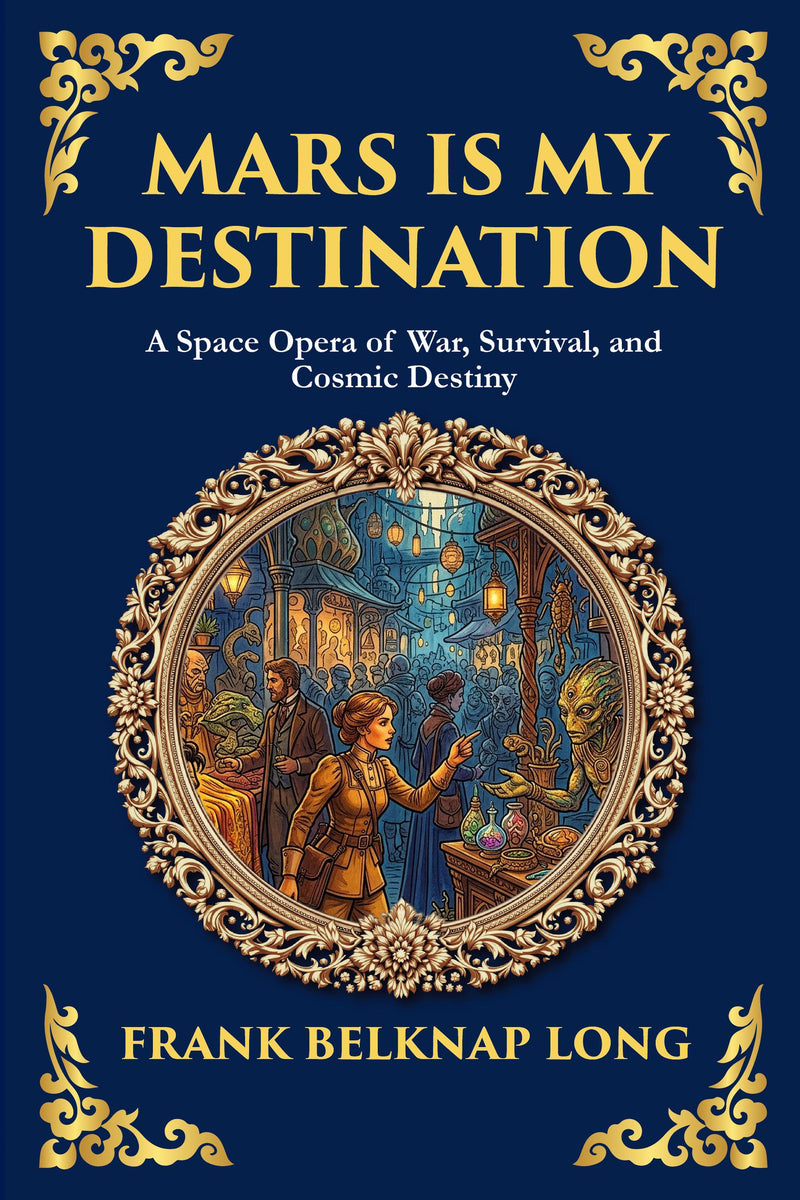
Mars is My Destination — Large Print
A red planet ruled by desolation, torn by conflict, and haunted by the ghosts of human ambition. In Mars is My Destination, legendary science fiction writer Frank Belknap Long launches readers into a high-octane space opera set against the backdrop of interplanetary war and political betrayal.
or free app
10,000+ hrs library
30-day guarantee
The complete Mars is My Destination appears in modern English through Library of Alexandria Press, available online with audiobook narration included for members.
Have you ever wondered why Mars has always drawn humanity toward conquest, wonder —and ruin? Mars is My Destination is a pulse-pounding science fiction epic by Frank Belknap Long, a master of the speculative and strange. Set in a future where Earth’s reach has extended to Mars —but peace has not—this novel explores war, survival, and cosmic fate with relentless energy and philosophical depth.
Colonial greed, military conflict, and a civilization on the brink provide the backdrop for a story that’s equal parts space opera, survival tale, and psychological drama. When American pilot Jed Hargraves is shot down over Martian sands, he must traverse a brutal terrain filled with environmental threats, alien mysteries, and human enemies. But beneath the surface lies something even more dangerous—a buried secret that could trigger interplanetary collapse or salvation.
More than just an action-packed story, Mars is My Destination wrestles with big ideas: What does it mean to colonize? Who gets to decide a planet’s destiny? And can a lone man shift the course of history?
What you’ll discover in this modern edition
- A Gritty Tale of War and Survival Join Jed Hargraves as he navigates betrayal, political manipulation, and physical desolation on the red planet.
| Formats | eBook (EPUB + PDF) · Audiobook · Paperback · Hardcover · Large Print |
| Language | English |
| Trim size (print) | 6 × 9 in |
| Binding | Paperback — perfect-bound · Hardcover — casewrap |
| Large Print edition | Same text in a larger, easy-read type — a larger font, not a larger trim |
| Print pricing | Every physical book at our true cost — at-cost, no profit (members) |
| Library | 873 restored titles, always growing |
| Length | 61,848 words · ~4 hr 7 min reading |
| Reading level | Grade 8 · an easy, flowing read (this modern-English edition) |
| Edition | Modern English translation · 2026 |
Member reviews for this edition are collected as readers finish it — be the first. Across the library: 12,000+ books shipped, every plan covered by a 365-day print guarantee.
About this edition
A faithful, unabridged modern-English edition by The Library of Alexandria — carefully rendered for today's reader and verified paragraph-by-paragraph against the public-domain source. Available as eBook, audiobook, paperback, hardcover, and large print.
- Complete & unabridgedVerified paragraph by paragraph against the source — never a scan, never abridged.
- Modern English, faithfulReadable today, with the author’s meaning kept intact. Readable — not simplified.
- Every format, one membershipRead in your browser or the free app, or listen to the full audiobook.
Included free with your membership
Cancel anytime, one click · 30-day money-back guarantee
Edition last updated July 2026
What’s inside
Mars is My Destination — Large Print — complete and unabridged: all 22 sections included with membership, plus the full audiobook.
Begin reading Mars is My Destination — Large Print
In clear modern English — the complete text is included with membership.
Introduction
There are certain writers whose names become synonymous with the very idea of imaginative fiction, whose careers span so many decades and touch so many movements that they seem less like individual authors and more like living bridges between the eras of literature itself. Frank Belknap Long is one of these rare figures. To open one of his books is to step into a current that has been flowing since the earliest days of the pulp magazines, through the golden age of science fiction, and onward into the modern world that those early visionaries could only dream of. The work you now hold in your hands represents a particular kind of treasure: a story written by a craftsman who learned his trade in the most demanding school imaginable, and one that has been carefully prepared so that today’s reader can experience it with the immediacy and clarity it deserves.
This edition is a modern translation, adapted for the contemporary reader. That phrase deserves a moment of explanation, because it speaks to the philosophy behind this entire undertaking. The fiction of the mid-twentieth century, particularly the science fiction and space opera of that period, was written in a style and idiom that reflected its own time. Sentences were sometimes constructed differently than we construct them today; certain expressions carried meanings that have shifted or faded; references that were instantly understood by readers of an earlier generation can now require a footnote or a moment of puzzled reflection. The purpose of this adaptation is not to rewrite or to diminish the original vision, but rather to clear away the small obstacles that time inevitably places between a reader and a text. The goal has been to preserve the spirit, the energy, and the essential character of the work while smoothing the path so that nothing stands between you and the pure pleasure of the story. Think of it as the careful cleaning of an old painting, removing the yellowed varnish so that the original colors can shine through once more, vivid and alive.
To appreciate what awaits you in these pages, it helps to understand something about the man who created it. Frank Belknap Long was born in 1901 in New York City, and he would go on to live and write through nearly the entire span of the twentieth century, passing away in 1994. This is an almost staggering range when you consider it. He began publishing in the early 1920s, in the legendary pages of magazines that defined an entire genre, and he was still producing work into his final decades. Few authors can claim to have witnessed and participated in so complete an arc of literary history. He was there at the birth of weird fiction, at the rise of pulp science fiction, and he lived to see those once-disreputable genres become the dominant cultural forms of an entire civilization.
Long is perhaps best remembered as a central figure in the circle of writers that gathered around H. P. Lovecraft, with whom he maintained a close and lifelong friendship. He was a poet, an essayist, a writer of horror and the macabre, and a novelist of science fiction and fantasy. This breadth is one of the keys to understanding the particular flavor of his work. A writer who has steeped himself in poetry brings a sensitivity to language and rhythm that purely commercial authors often lack. A writer who has explored the deepest reaches of cosmic horror brings an awareness of the vastness and indifference of the universe that gives even an adventure story a certain weight, a certain shadow of the sublime. When Long turned his attention to the planets and the stars, he did not see them merely as a backdrop for ray-gun battles and heroic escapes. He saw them as expressions of something larger, something that touched on the great questions of human destiny and human survival in a cosmos that does not exist for our convenience.
The title before us announces its ambitions clearly. This is a space opera, a term that has come to mean grand, sweeping adventure set against the canvas of the cosmos itself. But the subtitle deepens the promise: war, survival, and cosmic destiny. These are not idle words. They point toward the three great pillars upon which this kind of storytelling is built, and they signal that what you are about to read aspires to more than mere thrills. War, in the best science fiction, is never simply spectacle; it is a crucible in which character is tested and revealed, in which the values of individuals and entire societies are placed under unbearable pressure. Survival is the most primal of all narrative engines, the question that has driven stories since human beings first gathered around fires to tell them. And cosmic destiny — that grand, almost mythic notion that humanity has a place and a purpose in the larger scheme of the universe — is the special province of science fiction, the genre uniquely equipped to ask what we might become, and where we might be going, as a species cast out among the stars.
The World of Pulp Visionaries and the Red Planet's Spell
To read this book with the fullest possible appreciation, it is worth pausing to consider the extraordinary cultural moment from which the space opera tradition emerged, and the particular fascination that Mars has held over the imagination of writers and readers alike. For more than a century, the red planet has occupied a special place in the human dream of the cosmos. Long before any spacecraft had photographed its surface or any rover had crawled across its rusty dust, Mars was a screen onto which we projected our deepest hopes and fears about life beyond Earth.
The astronomers of the late nineteenth century, peering through their telescopes, believed they saw lines crossing the Martian surface — the famous canals that suggested, to some excited observers, the engineering works of an ancient and dying civilization. This idea seized the popular imagination with tremendous force. If Mars was inhabited, what manner of beings dwelt there? Were they wiser than us, or more terrible? Were they our future, a glimpse of what Earth might become as it aged and its oceans dried, or were they a threat, a hostile intelligence eyeing our green and watery world with envious eyes? Out of this ferment came some of the foundational works of science fiction — tales of invasion, of exploration, of romance and warfare beneath the twin moons of an alien sky.
By the time Frank Belknap Long came to write his own contribution to this rich tradition, Mars had become a kind of shared mythological territory, a place that every reader of imaginative fiction carried in their mind already furnished with possibility. To set a story there was to tap into a vast reservoir of association and expectation. And yet the best writers never simply borrowed these associations; they reshaped them, challenged them, and made them new. The fascination with Mars was never really about Mars at all, of course. It was about us. It was about the eternal human questions: Are we alone? What lies beyond the horizon? What will we have to become, and what will we have to sacrifice, in order to leave our cradle and make our home among the stars?
This is the territory into which the present work invites you. It belongs to a grand lineage, but it also stands on its own, the product of a specific imagination working at a specific moment in the long conversation that is science fiction. The space opera as a form reached its full flowering in the middle decades of the twentieth century, a period of extraordinary creativity and optimism in the genre. The pulp magazines that had nurtured writers like Long had given way to a more ambitious and sophisticated readership. The audience was growing up, demanding more from their stories — better characters, more plausible science, deeper themes — even as they retained their hunger for adventure, for wonder, for the sheer exhilaration of being carried away to places no human foot had ever trod.
The writers of this era worked under conditions that we would find almost unimaginable today. They wrote quickly, often for very little money, racing to meet the demands of a market that consumed stories at a prodigious rate. And yet, out of these pressures, something remarkable emerged. The discipline of the pulp tradition taught these authors lessons that more leisurely literary cultures often failed to instill. They learned that a story must move. They learned that a reader’s attention is a precious and fragile thing that must be earned with every paragraph. They learned to open in the midst of action, to plant questions in the reader’s mind that demand answers, to build toward climaxes that satisfy the appetites they have aroused. These are not lesser skills. They are, in many ways, the most fundamental skills of all, the very bedrock of the storyteller’s art, and they have been too often neglected by writers who mistake difficulty for depth and obscurity for profundity.
Frank Long mastered these skills over a career of remarkable length and productivity. He understood the architecture of suspense and the music of a well-turned phrase. He knew how to make a reader feel the cold of space and the heat of battle, the loneliness of the frontier and the strange comfort of comradeship under fire. And because he was, at heart, a poet and a philosopher as well as an entertainer, he infused his adventures with something that lingers after the last page is turned — a sense that the journey we have taken has meant something, that the questions raised have weight, that the destiny pursued by his characters is, in some sense, our own.
What you will find in this story, then, is the work of an author who never forgot that fiction exists first and foremost to be read, to be enjoyed, to grip and to move and to delight. But you will also find the deeper currents that flow beneath the surface of the best popular fiction — the meditations on courage and fear, on loyalty and betrayal, on what it means to be human in a universe that dwarfs all our ambitions and yet seems, somehow, to call us ever outward. The red planet beckons, as it has always beckoned, promising both peril and possibility in equal measure.
Reading Long Today: The Enduring Power of the Cosmic Adventure
It is natural to wonder, when approaching a work of science fiction written decades ago, whether it can still speak to us today. We live in an age that has, in some respects, caught up with the dreams of the old pulp writers and, in other respects, left them far behind. We have sent our machines across the solar system. We have photographed the surface of Mars in extraordinary detail and found it, alas, devoid of canals and dying civilizations — a cold, dry, beautiful desert world that nonetheless continues to fascinate us and to draw our ambitions toward it. We stand, perhaps, on the threshold of an age when human beings will actually walk upon its surface, when the dream of making a home on another world will pass from fiction into history.
In this light, the science of the older space operas can seem quaint, even charmingly naive. But to dismiss these works on that account would be a profound mistake, and it would deprive you of one of the greatest pleasures that literature has to offer. For the value of a story like this one was never primarily in the accuracy of its astronomical details or the plausibility of its technology. The value lies in the human truths it explores, in the emotions it evokes, and in the timeless questions it dares to ask. These do not age. The fear of death, the longing for home, the bonds that form between people who face danger together, the seductive and terrible pull of destiny — these are as fresh and as relevant today as they were when the ink was first dry on the page, and as they will be a thousand years from now.
Indeed, there is a special pleasure to be found in reading the science fiction of an earlier era precisely because it shows us not only the future as it might be, but the past as it dreamed of the future. To read this book is to enter into a kind of double vision, to see the cosmos through the eyes of an imagination shaped by a different world than our own, and in doing so, to understand both that world and our own a little better. The hopes and anxieties of the mid-twentieth century are woven into the fabric of these stories — the shadow of war, the dawn of the atomic age, the heady optimism of a civilization that had begun to believe it might truly reach the stars. There is something deeply moving about encountering these dreams in their original form, full of confidence and vigor, undimmed by the disappointments and complications that history would later bring.
Cancel anytime, one click · 30-day money-back guarantee
Founding annual rate available now — your price locks for life when you join.
Not ready? Get this free chapter by email — read it anytime.
✓ Sent — check your inbox for Mars is My Destination — Large Print.
Questions about Mars is My Destination — Large Print
What is Mars is My Destination about?
A red planet ruled by desolation, torn by conflict, and haunted by the ghosts of human ambition. In Mars is My Destination, legendary science fiction writer Frank Belknap Long launches readers into a high-octane space opera set against the backdrop of interplanetary war and political betrayal. When one man crash-lands on Mars with nothing but his training, will, and a secret that could shift the balance of galactic power, the fate of two worlds hangs in the balance.
Who wrote Mars is My Destination?
Mars is My Destination was written by Frank Belknap Long. This edition presents the complete work in clear modern English, faithfully rendered from the public-domain original by Library of Alexandria Press.
Is Mars is My Destination free to read?
The opening chapter is free to read on this page. Members read and listen to the complete work — and the entire library — free, and can order any physical book at our true print cost.
How long is Mars is My Destination?
22 chapters (~61,848 words) — about 4 hr 7 min of reading in this modern-English edition.
Is this an abridged version of Mars is My Destination?
No. This is the complete, unabridged Mars is My Destination, carefully rendered into clear modern English and verified paragraph-by-paragraph against the public-domain source — nothing is cut or summarised.
What formats does Mars is My Destination come in?
Mars is My Destination is available as eBook, paperback, hardcover and large print. eBook and audiobook are included with membership; printed editions ship at our true print cost.
Shipping & returns
Billing & membership
More from the library


Explore Adventure
- Tarzan of the Apes · Edgar Rice Burroughs
- The Wonderful Wizard of Oz · L. Frank Baum
- Peter Pan · J. M. Barrie
- Moby Dick; Or, The Whale · Herman Melville
- The Riddle of the Sands · Erskine Childers
- The Loss of the Swansea: A Story of the Florida Coast · W. L. Alden
- Sky Island · L. Frank Baum
- Vikram and the Vampire: Classic Hindu Tales of Adventure, Magic, and Romance · Unknown
- Tales of Unrest · Joseph Conrad
- The Tomb of Ts’in · Edgar Wallace
- Skinny McCord · Percy Keese Fitzhugh
- The Men of the Moss-Hags · S. R. Crockett
- The Hunniwell Boys and the Platinum Mystery · L. P. Wyman
- Allan Quatermain · H. Rider Haggard
- She · H. Rider Haggard
- Medical Life in the Navy · Gordon Stables
- The Thirty-Nine Steps · John Buchan
- The Story of Doctor Dolittle · Hugh Lofting
- The Princess and the Goblin · George MacDonald
- The Man Who Would Be King · Rudyard Kipling
- Lucian’s True History · Lucian of Samosata
- The Secret Adversary · Agatha Christie
- Lord Jim · Joseph Conrad
- The Marvelous Land of Oz · L. Frank Baum
- The Virginian: A Horseman of the Plains · Owen Wister
- Mars is My Destination · Frank Belknap Long
- Anabasis · Xenophon
- The Mississippi Saucer · Frank Belknap Long
- Sabotage in Space · Carey Rockwell
- Brood of the Dark Moon · Charles Willard Diffin
Mars is My Destination — Large Print
Mars is My Destination — Large Print
A Space Opera of War, Survival, and Cosmic Destiny
Frank Belknap Long
Contents
- Introduction
- Chapter 1
- Chapter 2
- Chapter 3
- Chapter 4
- Chapter 5
- Chapter 6
- Chapter 7
- Chapter 8
- Chapter 9
- Chapter 10
- Chapter 11
- Chapter 12
- Chapter 13
- Chapter 14
- Chapter 15
- Chapter 16
- Chapter 17
- Chapter 18
- Chapter 19
- Chapter 20
- Chapter 21
Introduction
There are certain writers whose names become synonymous with the very idea of imaginative fiction, whose careers span so many decades and touch so many movements that they seem less like individual authors and more like living bridges between the eras of literature itself. Frank Belknap Long is one of these rare figures. To open one of his books is to step into a current that has been flowing since the earliest days of the pulp magazines, through the golden age of science fiction, and onward into the modern world that those early visionaries could only dream of. The work you now hold in your hands represents a particular kind of treasure: a story written by a craftsman who learned his trade in the most demanding school imaginable, and one that has been carefully prepared so that today’s reader can experience it with the immediacy and clarity it deserves.
This edition is a modern translation, adapted for the contemporary reader. That phrase deserves a moment of explanation, because it speaks to the philosophy behind this entire undertaking. The fiction of the mid-twentieth century, particularly the science fiction and space opera of that period, was written in a style and idiom that reflected its own time. Sentences were sometimes constructed differently than we construct them today; certain expressions carried meanings that have shifted or faded; references that were instantly understood by readers of an earlier generation can now require a footnote or a moment of puzzled reflection. The purpose of this adaptation is not to rewrite or to diminish the original vision, but rather to clear away the small obstacles that time inevitably places between a reader and a text. The goal has been to preserve the spirit, the energy, and the essential character of the work while smoothing the path so that nothing stands between you and the pure pleasure of the story. Think of it as the careful cleaning of an old painting, removing the yellowed varnish so that the original colors can shine through once more, vivid and alive.
To appreciate what awaits you in these pages, it helps to understand something about the man who created it. Frank Belknap Long was born in 1901 in New York City, and he would go on to live and write through nearly the entire span of the twentieth century, passing away in 1994. This is an almost staggering range when you consider it. He began publishing in the early 1920s, in the legendary pages of magazines that defined an entire genre, and he was still producing work into his final decades. Few authors can claim to have witnessed and participated in so complete an arc of literary history. He was there at the birth of weird fiction, at the rise of pulp science fiction, and he lived to see those once-disreputable genres become the dominant cultural forms of an entire civilization.
Long is perhaps best remembered as a central figure in the circle of writers that gathered around H. P. Lovecraft, with whom he maintained a close and lifelong friendship. He was a poet, an essayist, a writer of horror and the macabre, and a novelist of science fiction and fantasy. This breadth is one of the keys to understanding the particular flavor of his work. A writer who has steeped himself in poetry brings a sensitivity to language and rhythm that purely commercial authors often lack. A writer who has explored the deepest reaches of cosmic horror brings an awareness of the vastness and indifference of the universe that gives even an adventure story a certain weight, a certain shadow of the sublime. When Long turned his attention to the planets and the stars, he did not see them merely as a backdrop for ray-gun battles and heroic escapes. He saw them as expressions of something larger, something that touched on the great questions of human destiny and human survival in a cosmos that does not exist for our convenience.
The title before us announces its ambitions clearly. This is a space opera, a term that has come to mean grand, sweeping adventure set against the canvas of the cosmos itself. But the subtitle deepens the promise: war, survival, and cosmic destiny. These are not idle words. They point toward the three great pillars upon which this kind of storytelling is built, and they signal that what you are about to read aspires to more than mere thrills. War, in the best science fiction, is never simply spectacle; it is a crucible in which character is tested and revealed, in which the values of individuals and entire societies are placed under unbearable pressure. Survival is the most primal of all narrative engines, the question that has driven stories since human beings first gathered around fires to tell them. And cosmic destiny — that grand, almost mythic notion that humanity has a place and a purpose in the larger scheme of the universe — is the special province of science fiction, the genre uniquely equipped to ask what we might become, and where we might be going, as a species cast out among the stars.
The World of Pulp Visionaries and the Red Planet's Spell
To read this book with the fullest possible appreciation, it is worth pausing to consider the extraordinary cultural moment from which the space opera tradition emerged, and the particular fascination that Mars has held over the imagination of writers and readers alike. For more than a century, the red planet has occupied a special place in the human dream of the cosmos. Long before any spacecraft had photographed its surface or any rover had crawled across its rusty dust, Mars was a screen onto which we projected our deepest hopes and fears about life beyond Earth.
The astronomers of the late nineteenth century, peering through their telescopes, believed they saw lines crossing the Martian surface — the famous canals that suggested, to some excited observers, the engineering works of an ancient and dying civilization. This idea seized the popular imagination with tremendous force. If Mars was inhabited, what manner of beings dwelt there? Were they wiser than us, or more terrible? Were they our future, a glimpse of what Earth might become as it aged and its oceans dried, or were they a threat, a hostile intelligence eyeing our green and watery world with envious eyes? Out of this ferment came some of the foundational works of science fiction — tales of invasion, of exploration, of romance and warfare beneath the twin moons of an alien sky.
By the time Frank Belknap Long came to write his own contribution to this rich tradition, Mars had become a kind of shared mythological territory, a place that every reader of imaginative fiction carried in their mind already furnished with possibility. To set a story there was to tap into a vast reservoir of association and expectation. And yet the best writers never simply borrowed these associations; they reshaped them, challenged them, and made them new. The fascination with Mars was never really about Mars at all, of course. It was about us. It was about the eternal human questions: Are we alone? What lies beyond the horizon? What will we have to become, and what will we have to sacrifice, in order to leave our cradle and make our home among the stars?
This is the territory into which the present work invites you. It belongs to a grand lineage, but it also stands on its own, the product of a specific imagination working at a specific moment in the long conversation that is science fiction. The space opera as a form reached its full flowering in the middle decades of the twentieth century, a period of extraordinary creativity and optimism in the genre. The pulp magazines that had nurtured writers like Long had given way to a more ambitious and sophisticated readership. The audience was growing up, demanding more from their stories — better characters, more plausible science, deeper themes — even as they retained their hunger for adventure, for wonder, for the sheer exhilaration of being carried away to places no human foot had ever trod.
The writers of this era worked under conditions that we would find almost unimaginable today. They wrote quickly, often for very little money, racing to meet the demands of a market that consumed stories at a prodigious rate. And yet, out of these pressures, something remarkable emerged. The discipline of the pulp tradition taught these authors lessons that more leisurely literary cultures often failed to instill. They learned that a story must move. They learned that a reader’s attention is a precious and fragile thing that must be earned with every paragraph. They learned to open in the midst of action, to plant questions in the reader’s mind that demand answers, to build toward climaxes that satisfy the appetites they have aroused. These are not lesser skills. They are, in many ways, the most fundamental skills of all, the very bedrock of the storyteller’s art, and they have been too often neglected by writers who mistake difficulty for depth and obscurity for profundity.
Frank Long mastered these skills over a career of remarkable length and productivity. He understood the architecture of suspense and the music of a well-turned phrase. He knew how to make a reader feel the cold of space and the heat of battle, the loneliness of the frontier and the strange comfort of comradeship under fire. And because he was, at heart, a poet and a philosopher as well as an entertainer, he infused his adventures with something that lingers after the last page is turned — a sense that the journey we have taken has meant something, that the questions raised have weight, that the destiny pursued by his characters is, in some sense, our own.
What you will find in this story, then, is the work of an author who never forgot that fiction exists first and foremost to be read, to be enjoyed, to grip and to move and to delight. But you will also find the deeper currents that flow beneath the surface of the best popular fiction — the meditations on courage and fear, on loyalty and betrayal, on what it means to be human in a universe that dwarfs all our ambitions and yet seems, somehow, to call us ever outward. The red planet beckons, as it has always beckoned, promising both peril and possibility in equal measure.
Reading Long Today: The Enduring Power of the Cosmic Adventure
It is natural to wonder, when approaching a work of science fiction written decades ago, whether it can still speak to us today. We live in an age that has, in some respects, caught up with the dreams of the old pulp writers and, in other respects, left them far behind. We have sent our machines across the solar system. We have photographed the surface of Mars in extraordinary detail and found it, alas, devoid of canals and dying civilizations — a cold, dry, beautiful desert world that nonetheless continues to fascinate us and to draw our ambitions toward it. We stand, perhaps, on the threshold of an age when human beings will actually walk upon its surface, when the dream of making a home on another world will pass from fiction into history.
In this light, the science of the older space operas can seem quaint, even charmingly naive. But to dismiss these works on that account would be a profound mistake, and it would deprive you of one of the greatest pleasures that literature has to offer. For the value of a story like this one was never primarily in the accuracy of its astronomical details or the plausibility of its technology. The value lies in the human truths it explores, in the emotions it evokes, and in the timeless questions it dares to ask. These do not age. The fear of death, the longing for home, the bonds that form between people who face danger together, the seductive and terrible pull of destiny — these are as fresh and as relevant today as they were when the ink was first dry on the page, and as they will be a thousand years from now.
Indeed, there is a special pleasure to be found in reading the science fiction of an earlier era precisely because it shows us not only the future as it might be, but the past as it dreamed of the future. To read this book is to enter into a kind of double vision, to see the cosmos through the eyes of an imagination shaped by a different world than our own, and in doing so, to understand both that world and our own a little better. The hopes and anxieties of the mid-twentieth century are woven into the fabric of these stories — the shadow of war, the dawn of the atomic age, the heady optimism of a civilization that had begun to believe it might truly reach the stars. There is something deeply moving about encountering these dreams in their original form, full of confidence and vigor, undimmed by the disappointments and complications that history would later bring.
For ten minutes, I had a feeling that something awful was about to occur. It felt inevitable, like a countdown leading toward a disaster.
The bar at the spaceport smelled fresh and scrubbed, as if the winds of deep space had swept through the room. There was also a crisp autumn scent in the air because the building was open at both ends. Outside lay New Chicago, with its parks, skyscrapers, and the vast inland waters of Lake Michigan.
Everything felt fine, as long as I focused on the world around me. Men and women walked with straight shoulders and a new sense of optimism, knowing that Earth was no longer a closed system. Children in the parks played at being astronauts, wrapped in insulated jackets and having the time of their lives. A blue jay sat on a branch, surrounded by leaves turning red and yellow. A nurse in a crisp white uniform pushed a baby carriage, her reddish-gold hair blowing in the wind and a dreamy expression in her eyes.
Nothing could ruin that scene. It was a permanent reality, and I took a few deep breaths, trying to forget that in the chaotic, 24-hour environment of the spaceports, Death was a frequent visitor.
Then I remembered, because I had to. You can’t ignore the ugliness of the world for long unless you have the mind of an ostrich and are willing to throw away your integrity.
I didn’t know the time, and I didn’t really care. All I knew was that Death had arrived late in the afternoon and was waiting in stony silence at the far end of the bar.
He was definitely there, even if he was as transparent as the air and you could see right through him. That sixth sense people feel sometimes—call it a premonition if you like—had started ringing an alarm bell in my head.
End of the free sample
Keep reading, free
Members read and listen to the complete book — and the entire library. Cancel anytime, one click · 30-day money-back guarantee.