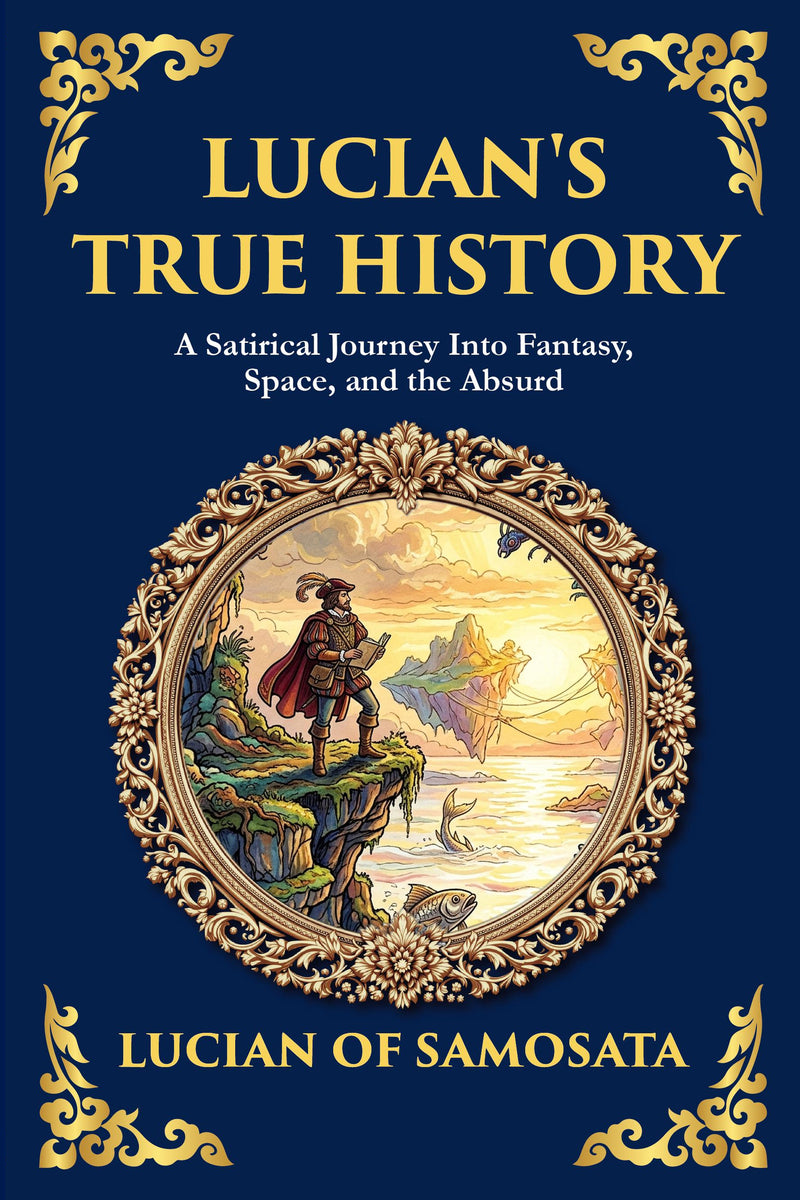
Lucian’s True History — Large Print
Before Jules Verne. Before H.G. Wells. There was Lucian. In True History, Lucian of Samosata launches readers into one of the earliest known works of science fiction—an outrageous parody that satirizes everything from ancient myths to pompous historians.
or free app
10,000+ hrs library
30-day guarantee
The complete Lucian's True History appears in modern English through Library of Alexandria Press, available online with audiobook narration included for members.
Have you ever wondered why the earliest science fiction story was written by a liar? Step aboard a whirlwind voyage across seas, skies, and stars in Lucian’s True History—the second-century masterpiece that dares to blend satire, fantasy, and proto-science fiction in an unforgettable literary concoction. Written by the wry and witty Lucian of Samosata, this work is anything but what its title suggests.
“True” it is not—in fact, Lucian openly mocks the pretensions of truth-telling by ancient historians, claiming upfront that everything he writes is fabricated. What follows is a wildly imaginative expedition that includes: A journey beyond the known world — from the belly of a whale to a war between lunar and solar civilizations Encounters with impossible beings — like vine-women, cloud-centaurs, and talking acorns A sharp satire on storytelling itself — Lucian skewers writers who claim to reveal the “truth” about myths and gods A proto-sci-fi adventure — featuring flying ships, interplanetary politics, and cosmic absurdities A literary time capsule — that reveals the humor and intellectual daring of the Greco- Roman world This modern, accessible translation brings Lucian’s groundbreaking vision to life for 21st- century readers. Whether you’re a fan of absurdist humor, classical literature, or speculative fiction, True History invites you to laugh, marvel, and think deeply about the stories we tell—and the lies we believe.
| Formats | eBook (EPUB + PDF) · Audiobook · Paperback · Hardcover · Large Print |
| Language | English |
| Trim size (print) | 6 × 9 in |
| Binding | Paperback — perfect-bound · Hardcover — casewrap |
| Large Print edition | Same text in a larger, easy-read type — a larger font, not a larger trim |
| Print pricing | Every physical book at our true cost — at-cost, no profit (members) |
| Library | 873 restored titles, always growing |
| Length | 17,905 words · ~1 hr 12 min reading |
| Reading level | Grade 5 · an easy, flowing read (this modern-English edition) |
| Edition | Modern English translation · 2026 |
Member reviews for this edition are collected as readers finish it — be the first. Across the library: 12,000+ books shipped, every plan covered by a 365-day print guarantee.
About this edition
A faithful, unabridged modern-English edition by The Library of Alexandria — carefully rendered for today's reader and verified paragraph-by-paragraph against the public-domain source. Available as eBook, audiobook, paperback, hardcover, and large print.
- Complete & unabridgedVerified paragraph by paragraph against the source — never a scan, never abridged.
- Modern English, faithfulReadable today, with the author’s meaning kept intact. Readable — not simplified.
- Every format, one membershipRead in your browser or the free app, or listen to the full audiobook.
Included free with your membership
Cancel anytime, one click · 30-day money-back guarantee
Edition last updated July 2026
What’s inside
Lucian’s True History — Large Print — complete and unabridged: all 3 sections included with membership, plus the full audiobook.
Begin reading Lucian’s True History — Large Print
In clear modern English — the complete text is included with membership.
Introduction
There is a particular kind of delight that comes from discovering that something you assumed was modern is, in fact, astonishingly ancient. We tend to think of science fiction as the child of the industrial age, a genre born from telescopes and rocketry, from the anxieties and ambitions of a mechanized world. We imagine voyages to the moon as the invention of authors writing by gaslight or under electric bulbs, dreaming forward into a future their readers could scarcely conceive. And yet, nearly two thousand years ago, in the sun-baked provinces of the Roman Empire, a sharp-tongued Greek writer sat down and composed a tale of intrepid sailors blown off course by a cosmic whirlwind, carried up beyond the clouds, and deposited upon the lunar surface in the middle of an interplanetary war. He wrote of voyagers swallowed whole by a sea creature so vast that an entire civilization lived within its belly. He wrote of islands made of cheese, of rivers running with wine, of lamps that walked and talked, and of an afterlife where the great heroes and philosophers of antiquity bickered, drank, and made fools of themselves like everyone else.
The author was Lucian of Samosata, and the work you are about to read has carried many names across the centuries: A True Story, The True History, Verae Historiae. The title itself is the first joke, and a magnificent one, because Lucian announces with perfect deadpan sincerity that everything he is about to tell you is an outrageous lie. This is a book that opens by promising to deceive you and then proceeds to keep that promise with such inventive abandon that you cannot help but love it for its honesty. To read it today is to feel the centuries collapse, to recognize in this distant voice a sensibility so playful, so irreverent, and so gleefully absurd that it might have been written yesterday. It is, by many reasonable measures, the oldest surviving work of fantastical fiction in the Western tradition, the great-great-grandfather of every starship and every impossible voyage that has followed. But to reduce it to a museum piece, a historical curiosity to be admired and shelved, would be to miss the point entirely. This is a book meant to be enjoyed, and it remains, after all this time, enormously enjoyable.
A Writer Who Refused to Take Anyone Seriously
To understand the spirit of this remarkable little book, it helps to understand something of the man who wrote it, though Lucian himself would probably have laughed at the idea of being treated with scholarly reverence. He was born around the year 125 of the common era in Samosata, a city on the banks of the Euphrates in the province of Syria, at the eastern fringe of the vast and sprawling Roman world. He was not, by birth, a member of the Greek cultural elite whose language and traditions dominated the intellectual life of the eastern Empire. His first language may not even have been Greek. He came, by his own account, from a family of modest means, and was at one point apprenticed to an uncle who was a sculptor, a career he abandoned almost immediately. And yet this provincial outsider, this self-made man from the edge of the map, taught himself to write Greek with such elegance, wit, and command that he became one of the most celebrated prose stylists of his entire age, and his reputation has endured where countless aristocratic authors have crumbled into dust.
Lucian made his living, at least for a time, as a traveling lecturer and rhetorician, one of the polished performers who roamed the cities of the Empire delivering speeches, declamations, and clever set pieces for paying audiences. This was the great age of what scholars call the Second Sophistic, a period in which rhetorical skill was prized above almost all else, when a man who could speak beautifully could win fame, fortune, and the admiration of crowds. Lucian mastered this art completely, and then, characteristically, he turned around and mocked it. For at his core, Lucian was a satirist, perhaps the finest satirist the ancient world produced. He looked at the pretensions of philosophers, the credulity of the religious, the pomposity of historians, the greed of charlatans, and the gullibility of the public, and he found all of it irresistibly ridiculous. His enormous body of surviving work, dozens of dialogues, essays, and stories, is held together by a single unifying thread: a refusal to take anyone’s self-importance at face value. He punctures the inflated, deflates the grand, and exposes the gap between what people claim to be and what they actually are.
What makes Lucian so appealing, and so unusual, is that his satire is rarely bitter. There is anger in him, certainly, and a genuine contempt for fraud and hypocrisy, but the dominant note is one of mischievous glee. He seems to delight in human folly even as he skewers it. He is the kind of writer who would rather make you laugh than make you furious, who understands that ridicule is often a more effective weapon than rage, and who knows that the most devastating thing you can do to a pompous fool is to take his ideas to their logical, absurd conclusion. In the work before you, this comic genius reaches one of its purest expressions, because here Lucian sets aside the specific targets of his other satires and aims at something larger and more universal: the very act of telling tall tales, of dressing up lies as truth, of asking an audience to believe the unbelievable.
The specific objects of his mockery were the travel writers and historians of his day, the authors who filled their accounts of distant lands with marvels and monsters and impossible wonders, all the while insisting solemnly upon their own accuracy. Lucian had read these writers, and he had no patience for them. He had read the epic poets too, the Homers and the Hesiods whose heroes performed feats no mortal could accomplish. He had read the philosophers who built elaborate systems of the cosmos out of pure speculation and then proclaimed them as established fact. And so he conceived a perfect revenge, a piece of literary jujitsu so clever that it has never been surpassed. Rather than argue against the liars, he would out-lie them. He would write a travel narrative so extravagantly, so deliriously, so transparently false that no one could possibly mistake it for truth, and in doing so he would expose the dishonesty of all those who lied while pretending to be truthful. His one act of perfect honesty, he tells us, is to admit openly that he is lying. Every other word in the book is a fabrication, and he wants you to know it.
This is the crucial frame through which to read what follows. Lucian is not trying to fool you. He is inviting you into a game, a knowing collaboration between author and reader, in which you both understand from the very first page that none of this happened, that none of it could have happened, and that the impossibility is precisely the point. He builds his absurdities with a straight face, narrating the most preposterous events in the calm, measured tone of a man reporting a slightly unusual fishing trip. That tonal contrast, the gulf between the cosmic strangeness of the events and the unflappable composure of the narrator describing them, is the engine of the book’s comedy. It is a technique that humorists have used ever since, the deadpan delivery of the outrageous, and Lucian wielded it with a confidence that few have matched in the eighteen centuries since.
It is worth pausing to appreciate how genuinely radical this enterprise was. The ancient world had its myths, its epics, its fables, and its legends, but the idea of fiction as we understand it, of a story openly acknowledged to be invented and offered purely for the pleasure and stimulation it provides, was not a settled or familiar concept. Stories were generally expected to carry the authority of tradition, the weight of religious truth, or the moral instruction of allegory. Lucian, by announcing at the outset that his tale is a deliberate and complete fabrication, was doing something close to inventing the modern relationship between a fiction writer and an audience. He was saying, in effect: here is a story I made up, I know I made it up, you know I made it up, and we shall both enjoy it all the more for that shared understanding. There is something thrillingly forward-looking in this, a literary self-awareness that would not become commonplace for many centuries. When later writers like Rabelais, Swift, Cyrano de Bergerac, and even the creators of modern science fiction reached for the tools of fantastical satire, they were, whether they knew it or not, following a path that Lucian had blazed.
A Voyage Beyond the Edges of the Possible
The structure of the book is, fittingly, the structure of a voyage. Lucian casts himself as the narrator, a traveler who, along with a band of adventurous companions, sets sail in search of what lies beyond the known boundaries of the world. From this simple and ancient premise, the premise of the Odyssey and of every sea-faring legend that followed, he launches a series of episodes that grow steadily more extraordinary, each one outdoing the last in sheer imaginative audacity. The journey carries the reader across strange seas, onto stranger shores, and eventually into realms that no earthly geography could contain. It is an episodic adventure, a string of marvels and encounters, and part of its charm is that you never know what lunatic wonder will appear over the next horizon.
I will not describe the specific destinations and discoveries that await you, because so much of the pleasure of this book lies in the surprise of it, in turning a page and being confronted with some new impossibility delivered with that magnificent straight face. But I can say that Lucian’s imagination ranges across the heavens and the depths, across the worlds of the living and the dead, across realms of pure fantasy and pointed parody. He takes the conventions of heroic literature and turns them inside out. He takes the religious and philosophical beliefs of his age and renders them gloriously ridiculous. He invents creatures, customs, and civilizations with a fertility of invention that would be the envy of any modern fantasist. And throughout, he maintains his comic discipline, never winking too obviously, never breaking character, allowing the absurdity to bloom and unfold with a kind of dreadful logic all its own.
One of the great pleasures awaiting the attentive reader is the recognition of just how many later literary inventions have their seeds here. The notion of an interplanetary war, of voyaging to other worlds, of encountering alien races with their own bizarre biologies and political conflicts, of being consumed by a monster and surviving within it, of visiting the realms of the famous dead and finding them all too human, of utopian and dystopian islands, of the fantastical voyage that satirizes the society it leaves behind. These ideas, which feel so thoroughly the property of later centuries, are all present here in embryonic form. To read Lucian is to watch a thousand later books being conceived in a single, dizzying burst of creative energy. Yet the experience is never dry or academic, never a matter of dutifully cataloguing influences. It is, first and foremost, a romp, a riot of invention propelled forward by the author’s evident joy in making it all up.
There is, beneath the comedy, a serious intelligence at work, and the modern reader who wishes to dig will find rich rewards. Lucian is not merely being silly. Every absurdity is a comment, every impossibility a critique. When he parodies the travel writers, he is making a real argument about truth and falsehood, about the responsibilities of those who claim to inform us, and about the credulity of audiences who want so badly to believe in wonders that they will swallow any nonsense dressed up in confident prose. When he sends his heroes among the famous dead and shows the great names of history and literature behaving badly, he is gently deflating the reverence with which his culture treated its ancestors, reminding his readers that the legendary figures of the past were, in the end, only people, with all the pettiness and absurdity that being a person entails. When he constructs his impossible societies, he is holding up a mirror to his own, inviting us to see the strangeness in what we take for granted by rendering it in unfamiliar form.
Cancel anytime, one click · 30-day money-back guarantee
Founding annual rate available now — your price locks for life when you join.
Not ready? Get this free chapter by email — read it anytime.
✓ Sent — check your inbox for Lucian’s True History — Large Print.
Questions about Lucian’s True History — Large Print
What is Lucian's True History about?
Before Jules Verne. Before H.G. Wells. There was Lucian.
Who wrote Lucian's True History?
Lucian's True History was written by Lucian of Samosata. This edition presents the complete work in clear modern English, faithfully rendered from the public-domain original by Library of Alexandria Press.
Is Lucian's True History free to read?
The opening chapter is free to read on this page. Members read and listen to the complete work — and the entire library — free, and can order any physical book at our true print cost.
How long is Lucian's True History?
3 chapters (~17,905 words) — about 1 hr 12 min of reading in this modern-English edition.
Is this an abridged version of Lucian's True History?
No. This is the complete, unabridged Lucian's True History, carefully rendered into clear modern English and verified paragraph-by-paragraph against the public-domain source — nothing is cut or summarised.
What formats does Lucian's True History come in?
Lucian's True History is available as eBook, paperback, hardcover and large print. eBook and audiobook are included with membership; printed editions ship at our true print cost.
Shipping & returns
Billing & membership
More from the library


Explore Adventure
- Tarzan of the Apes · Edgar Rice Burroughs
- The Wonderful Wizard of Oz · L. Frank Baum
- Peter Pan · J. M. Barrie
- Moby Dick; Or, The Whale · Herman Melville
- The Riddle of the Sands · Erskine Childers
- The Loss of the Swansea: A Story of the Florida Coast · W. L. Alden
- Sky Island · L. Frank Baum
- Vikram and the Vampire: Classic Hindu Tales of Adventure, Magic, and Romance · Unknown
- Tales of Unrest · Joseph Conrad
- The Tomb of Ts’in · Edgar Wallace
- Skinny McCord · Percy Keese Fitzhugh
- The Men of the Moss-Hags · S. R. Crockett
- The Hunniwell Boys and the Platinum Mystery · L. P. Wyman
- Allan Quatermain · H. Rider Haggard
- She · H. Rider Haggard
- Medical Life in the Navy · Gordon Stables
- The Thirty-Nine Steps · John Buchan
- The Story of Doctor Dolittle · Hugh Lofting
- The Princess and the Goblin · George MacDonald
- The Man Who Would Be King · Rudyard Kipling
- Lucian’s True History · Lucian of Samosata
- The Secret Adversary · Agatha Christie
- Lord Jim · Joseph Conrad
- The Marvelous Land of Oz · L. Frank Baum
- The Virginian: A Horseman of the Plains · Owen Wister
- Mars is My Destination · Frank Belknap Long
- Anabasis · Xenophon
- The Mississippi Saucer · Frank Belknap Long
- Sabotage in Space · Carey Rockwell
- Brood of the Dark Moon · Charles Willard Diffin
Lucian’s True History — Large Print
Lucian’s True History — Large Print
A Satirical Journey Through Fantasy, Space, and the Absurd
Lucian of Samosata
Contents
- Introduction
- Lucian: True History.
- Lucian. Book two. His true history.
Introduction
There is a particular kind of delight that comes from discovering that something you assumed was modern is, in fact, astonishingly ancient. We tend to think of science fiction as the child of the industrial age, a genre born from telescopes and rocketry, from the anxieties and ambitions of a mechanized world. We imagine voyages to the moon as the invention of authors writing by gaslight or under electric bulbs, dreaming forward into a future their readers could scarcely conceive. And yet, nearly two thousand years ago, in the sun-baked provinces of the Roman Empire, a sharp-tongued Greek writer sat down and composed a tale of intrepid sailors blown off course by a cosmic whirlwind, carried up beyond the clouds, and deposited upon the lunar surface in the middle of an interplanetary war. He wrote of voyagers swallowed whole by a sea creature so vast that an entire civilization lived within its belly. He wrote of islands made of cheese, of rivers running with wine, of lamps that walked and talked, and of an afterlife where the great heroes and philosophers of antiquity bickered, drank, and made fools of themselves like everyone else.
The author was Lucian of Samosata, and the work you are about to read has carried many names across the centuries: A True Story, The True History, Verae Historiae. The title itself is the first joke, and a magnificent one, because Lucian announces with perfect deadpan sincerity that everything he is about to tell you is an outrageous lie. This is a book that opens by promising to deceive you and then proceeds to keep that promise with such inventive abandon that you cannot help but love it for its honesty. To read it today is to feel the centuries collapse, to recognize in this distant voice a sensibility so playful, so irreverent, and so gleefully absurd that it might have been written yesterday. It is, by many reasonable measures, the oldest surviving work of fantastical fiction in the Western tradition, the great-great-grandfather of every starship and every impossible voyage that has followed. But to reduce it to a museum piece, a historical curiosity to be admired and shelved, would be to miss the point entirely. This is a book meant to be enjoyed, and it remains, after all this time, enormously enjoyable.
A Writer Who Refused to Take Anyone Seriously
To understand the spirit of this remarkable little book, it helps to understand something of the man who wrote it, though Lucian himself would probably have laughed at the idea of being treated with scholarly reverence. He was born around the year 125 of the common era in Samosata, a city on the banks of the Euphrates in the province of Syria, at the eastern fringe of the vast and sprawling Roman world. He was not, by birth, a member of the Greek cultural elite whose language and traditions dominated the intellectual life of the eastern Empire. His first language may not even have been Greek. He came, by his own account, from a family of modest means, and was at one point apprenticed to an uncle who was a sculptor, a career he abandoned almost immediately. And yet this provincial outsider, this self-made man from the edge of the map, taught himself to write Greek with such elegance, wit, and command that he became one of the most celebrated prose stylists of his entire age, and his reputation has endured where countless aristocratic authors have crumbled into dust.
Lucian made his living, at least for a time, as a traveling lecturer and rhetorician, one of the polished performers who roamed the cities of the Empire delivering speeches, declamations, and clever set pieces for paying audiences. This was the great age of what scholars call the Second Sophistic, a period in which rhetorical skill was prized above almost all else, when a man who could speak beautifully could win fame, fortune, and the admiration of crowds. Lucian mastered this art completely, and then, characteristically, he turned around and mocked it. For at his core, Lucian was a satirist, perhaps the finest satirist the ancient world produced. He looked at the pretensions of philosophers, the credulity of the religious, the pomposity of historians, the greed of charlatans, and the gullibility of the public, and he found all of it irresistibly ridiculous. His enormous body of surviving work, dozens of dialogues, essays, and stories, is held together by a single unifying thread: a refusal to take anyone’s self-importance at face value. He punctures the inflated, deflates the grand, and exposes the gap between what people claim to be and what they actually are.
What makes Lucian so appealing, and so unusual, is that his satire is rarely bitter. There is anger in him, certainly, and a genuine contempt for fraud and hypocrisy, but the dominant note is one of mischievous glee. He seems to delight in human folly even as he skewers it. He is the kind of writer who would rather make you laugh than make you furious, who understands that ridicule is often a more effective weapon than rage, and who knows that the most devastating thing you can do to a pompous fool is to take his ideas to their logical, absurd conclusion. In the work before you, this comic genius reaches one of its purest expressions, because here Lucian sets aside the specific targets of his other satires and aims at something larger and more universal: the very act of telling tall tales, of dressing up lies as truth, of asking an audience to believe the unbelievable.
The specific objects of his mockery were the travel writers and historians of his day, the authors who filled their accounts of distant lands with marvels and monsters and impossible wonders, all the while insisting solemnly upon their own accuracy. Lucian had read these writers, and he had no patience for them. He had read the epic poets too, the Homers and the Hesiods whose heroes performed feats no mortal could accomplish. He had read the philosophers who built elaborate systems of the cosmos out of pure speculation and then proclaimed them as established fact. And so he conceived a perfect revenge, a piece of literary jujitsu so clever that it has never been surpassed. Rather than argue against the liars, he would out-lie them. He would write a travel narrative so extravagantly, so deliriously, so transparently false that no one could possibly mistake it for truth, and in doing so he would expose the dishonesty of all those who lied while pretending to be truthful. His one act of perfect honesty, he tells us, is to admit openly that he is lying. Every other word in the book is a fabrication, and he wants you to know it.
This is the crucial frame through which to read what follows. Lucian is not trying to fool you. He is inviting you into a game, a knowing collaboration between author and reader, in which you both understand from the very first page that none of this happened, that none of it could have happened, and that the impossibility is precisely the point. He builds his absurdities with a straight face, narrating the most preposterous events in the calm, measured tone of a man reporting a slightly unusual fishing trip. That tonal contrast, the gulf between the cosmic strangeness of the events and the unflappable composure of the narrator describing them, is the engine of the book’s comedy. It is a technique that humorists have used ever since, the deadpan delivery of the outrageous, and Lucian wielded it with a confidence that few have matched in the eighteen centuries since.
It is worth pausing to appreciate how genuinely radical this enterprise was. The ancient world had its myths, its epics, its fables, and its legends, but the idea of fiction as we understand it, of a story openly acknowledged to be invented and offered purely for the pleasure and stimulation it provides, was not a settled or familiar concept. Stories were generally expected to carry the authority of tradition, the weight of religious truth, or the moral instruction of allegory. Lucian, by announcing at the outset that his tale is a deliberate and complete fabrication, was doing something close to inventing the modern relationship between a fiction writer and an audience. He was saying, in effect: here is a story I made up, I know I made it up, you know I made it up, and we shall both enjoy it all the more for that shared understanding. There is something thrillingly forward-looking in this, a literary self-awareness that would not become commonplace for many centuries. When later writers like Rabelais, Swift, Cyrano de Bergerac, and even the creators of modern science fiction reached for the tools of fantastical satire, they were, whether they knew it or not, following a path that Lucian had blazed.
A Voyage Beyond the Edges of the Possible
The structure of the book is, fittingly, the structure of a voyage. Lucian casts himself as the narrator, a traveler who, along with a band of adventurous companions, sets sail in search of what lies beyond the known boundaries of the world. From this simple and ancient premise, the premise of the Odyssey and of every sea-faring legend that followed, he launches a series of episodes that grow steadily more extraordinary, each one outdoing the last in sheer imaginative audacity. The journey carries the reader across strange seas, onto stranger shores, and eventually into realms that no earthly geography could contain. It is an episodic adventure, a string of marvels and encounters, and part of its charm is that you never know what lunatic wonder will appear over the next horizon.
I will not describe the specific destinations and discoveries that await you, because so much of the pleasure of this book lies in the surprise of it, in turning a page and being confronted with some new impossibility delivered with that magnificent straight face. But I can say that Lucian’s imagination ranges across the heavens and the depths, across the worlds of the living and the dead, across realms of pure fantasy and pointed parody. He takes the conventions of heroic literature and turns them inside out. He takes the religious and philosophical beliefs of his age and renders them gloriously ridiculous. He invents creatures, customs, and civilizations with a fertility of invention that would be the envy of any modern fantasist. And throughout, he maintains his comic discipline, never winking too obviously, never breaking character, allowing the absurdity to bloom and unfold with a kind of dreadful logic all its own.
One of the great pleasures awaiting the attentive reader is the recognition of just how many later literary inventions have their seeds here. The notion of an interplanetary war, of voyaging to other worlds, of encountering alien races with their own bizarre biologies and political conflicts, of being consumed by a monster and surviving within it, of visiting the realms of the famous dead and finding them all too human, of utopian and dystopian islands, of the fantastical voyage that satirizes the society it leaves behind. These ideas, which feel so thoroughly the property of later centuries, are all present here in embryonic form. To read Lucian is to watch a thousand later books being conceived in a single, dizzying burst of creative energy. Yet the experience is never dry or academic, never a matter of dutifully cataloguing influences. It is, first and foremost, a romp, a riot of invention propelled forward by the author’s evident joy in making it all up.
There is, beneath the comedy, a serious intelligence at work, and the modern reader who wishes to dig will find rich rewards. Lucian is not merely being silly. Every absurdity is a comment, every impossibility a critique. When he parodies the travel writers, he is making a real argument about truth and falsehood, about the responsibilities of those who claim to inform us, and about the credulity of audiences who want so badly to believe in wonders that they will swallow any nonsense dressed up in confident prose. When he sends his heroes among the famous dead and shows the great names of history and literature behaving badly, he is gently deflating the reverence with which his culture treated its ancestors, reminding his readers that the legendary figures of the past were, in the end, only people, with all the pettiness and absurdity that being a person entails. When he constructs his impossible societies, he is holding up a mirror to his own, inviting us to see the strangeness in what we take for granted by rendering it in unfamiliar form.
Just as athletes, wrestlers, and those who train for strength and agility don’t just focus on staying healthy and keeping up their regular exercise, but also take timely breaks to refresh themselves as a key part of their training, I believe scholars and students should do the same. After spending a long time immersed in serious authors, they need to relax their focus for a while so they can regain the strength and ability to continue their studies.
This kind of relaxation is even more rewarding and better suited to one’s goals if it is spent reading works that do more than just entertain with a pleasant style. Such books should also give the mind something intellectual to think about, which I believe I have achieved in my own writing. Readers might be amused not only by the unusual subject or the creativity of the plot, nor by hearing so many obvious lies told convincingly as if they were true, but because everything I have written here is a comical jab at various ancient poets, historians, and philosophers. These writers recorded many monstrous and unbelievable falsehoods in their works; I would have listed their names, but I know you will recognize them as you read.
Ctesias, the son of Ctesiochus from Cnidus, wrote about the lands of the Indians and the conditions of those countries, describing things he had never seen himself nor ever heard from anyone else. Iambulus also wrote about many strange miracles of the great ocean, which everyone knew were fake and made up, yet they were written in a way that remained enjoyable. Many others chose similar topics, with some publishing accounts of their own travels and journeys, describing giant animals and the violent nature of people with strange and primitive lifestyles. However, the original source of all this nonsense was Homer’s Ulysses. He told Alcinous a long story about the servitude of the winds, about one-eyed wild men who ate raw meat, about multi-headed beasts, and about his friends being transformed by magic potions—all of which he convinced the foolish Phaeacians were completely true.
End of the free sample
Keep reading, free
Members read and listen to the complete book — and the entire library. Cancel anytime, one click · 30-day money-back guarantee.