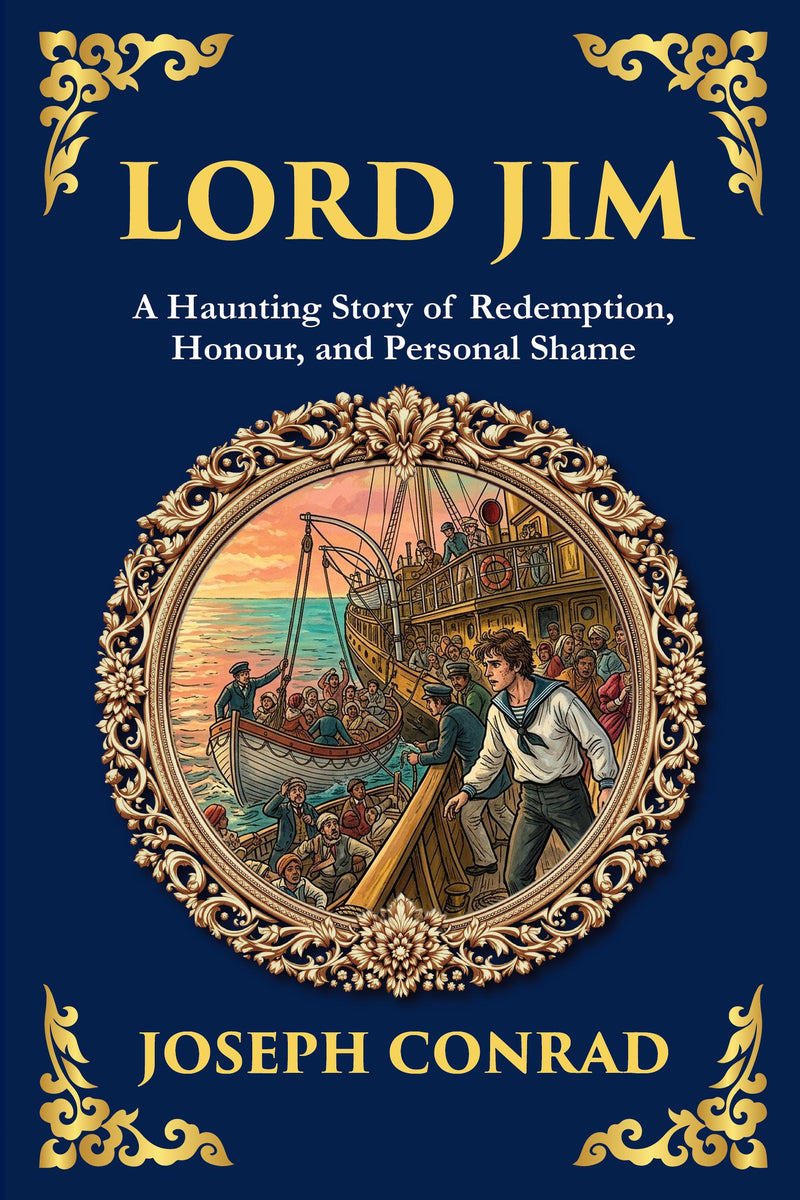
Lord Jim — Large Print
In the heart of the sea and the depths of the human soul lies the story of Lord Jim—a young seaman whose one act of cowardice shadows his every step.
or free app
10,000+ hrs library
30-day guarantee
The complete Lord Jim appears in modern English through Library of Alexandria Press, available online with audiobook narration included for members.
Have you ever wondered why a single moment can define a lifetime? Lord Jim by Joseph Conrad is a haunting and psychologically rich tale that captures the torment of a man who falters once—and spends the rest of his life chasing redemption. A promising young officer aboard the Patna, Jim abandons ship in a moment of panic, leaving hundreds of passengers to what he believes is certain death.
Though the ship is eventually rescued, Jim’s desertion is exposed, and he is publicly disgraced. Burdened with guilt and a longing to restore his honour, Jim journeys to the Malay Archipelago, where he is given a second chance to rebuild his reputation among a native community. But the past has a way of following even the most distant wanderer, and Jim’s path to redemption becomes a struggle between idealism, shame, and fate.
What you’ll discover in this modern edition
- A Deep Psychological Portrait Follow Jim’s inner turmoil as he battles with the consequences of one irreversible decision.
| Formats | eBook (EPUB + PDF) · Audiobook · Paperback · Hardcover · Large Print |
| Language | English |
| Trim size (print) | 6 × 9 in |
| Binding | Paperback — perfect-bound · Hardcover — casewrap |
| Large Print edition | Same text in a larger, easy-read type — a larger font, not a larger trim |
| Print pricing | Every physical book at our true cost — at-cost, no profit (members) |
| Library | 873 restored titles, always growing |
| Length | 127,949 words · ~8 hr 32 min reading |
| Reading level | Grade 7 · an easy, flowing read (this modern-English edition) |
| Edition | Modern English translation · 2026 |
Member reviews for this edition are collected as readers finish it — be the first. Across the library: 12,000+ books shipped, every plan covered by a 365-day print guarantee.
About this edition
A faithful, unabridged modern-English edition by The Library of Alexandria — carefully rendered for today's reader and verified paragraph-by-paragraph against the public-domain source. Available as eBook, audiobook, paperback, hardcover, and large print.
- Complete & unabridgedVerified paragraph by paragraph against the source — never a scan, never abridged.
- Modern English, faithfulReadable today, with the author’s meaning kept intact. Readable — not simplified.
- Every format, one membershipRead in your browser or the free app, or listen to the full audiobook.
Included free with your membership
Cancel anytime, one click · 30-day money-back guarantee
Edition last updated July 2026
What’s inside
Lord Jim — Large Print — complete and unabridged: all 47 sections included with membership, plus the full audiobook.
Begin reading Lord Jim — Large Print
In clear modern English — the complete text is included with membership.
Introduction
There are certain books that do not simply tell a story but instead place a question at the center of your chest and refuse to remove it. They ask you to consider what you might have done, what you secretly fear you would have done, and what kind of person you would become afterward if the worst version of yourself had been revealed in a single, irreversible instant. Joseph Conrad’s masterwork is one of these rare and unsettling books. It is the story of a young man who fails, who fails in a way that the world can see and measure, and who then spends the rest of his life attempting to outrun, outwork, and out-suffer that failure. It is a meditation on honor in an age that was beginning to lose its certainty about what honor even meant, and it remains, more than a century after its first publication, one of the most psychologically penetrating novels ever written.
This edition has been carefully adapted into modern language for the contemporary reader. Conrad’s original prose, magnificent as it is, can present real obstacles. He wrote in dense, looping sentences that fold back on themselves, layering qualification upon qualification, and his narration sometimes deliberately obscures the order of events so that the reader feels as disoriented as the characters. That difficulty was intentional and artful, but it has also kept generations of readers from discovering the extraordinary human drama beneath the surface. What this translation aims to do is clear away the thicket without burning down the forest. The intent, the atmosphere, the moral weight, and the haunting beauty of the original remain intact, while the path through them has been made walkable. You will not need a scholarly apparatus or a dictionary at your elbow. You will simply be able to follow the story and feel its full force, which is precisely what its author would have wanted for any reader sitting down with it for the first time.
Before you begin, it is worth understanding a little about the man who wrote this remarkable work and about the strange and compelling way in which he chose to tell it. Both of these things will deepen your reading immeasurably, and neither will spoil the experience of discovery that lies ahead.
A Sailor Who Became One of the Greatest Writers in the English Language
The author of this novel lived one of the most improbable literary lives imaginable. He was born in 1857 in a part of Eastern Europe that had been swallowed up by the Russian Empire, into a family of Polish patriots who paid dearly for their convictions. His father was a writer, a translator, and a political activist whose resistance to Russian rule led to his arrest and the family’s exile to a remote and punishing region of the empire. Both of the author’s parents died of illness and hardship before he reached adolescence, leaving him an orphan steeped in grief, in the memory of noble causes that ended in suffering, and in a deep and personal acquaintance with loss. These were not abstractions to him. They were the conditions of his childhood, and they left their mark on everything he would later write.
What is genuinely astonishing is what came next. As a teenager, this orphaned boy from a landlocked corner of Europe became obsessed with the sea, a place he had scarcely encountered, and he set out to make his life upon it. He went to France, then to the British merchant marine, and over the course of roughly two decades he sailed the world. He rounded the great capes, crossed the Indian Ocean, worked the routes of Southeast Asia, traveled up the Congo River into the heart of colonial Africa, and rose steadily through the ranks until he earned his certificate as a master mariner, qualified to command British ships. He saw the world not as a tourist but as a working seaman who depended on his fellow crew members for his life and who held others’ lives in his own hands. He understood storms, calms, fevers, mutinies, shipwrecks, and the strange intimacy of men confined together at the mercy of the ocean. He absorbed all of it.
And then, in an act of will that still seems barely believable, he became one of the supreme stylists of the English language. English was his third language. He did not learn it well until he was in his twenties, and he reportedly spoke it for the rest of his life with a heavy accent that strangers sometimes found difficult to understand. Yet he chose to write his novels in English rather than in Polish or French, and the prose he produced has a richness, a music, and a moral seriousness that few native speakers have ever equaled. He brought to the language the perspective of an outsider, someone who could see its possibilities freshly, and he brought to literature the hard-won knowledge of a man who had actually lived among the people and places he described. When he writes about ships, about the men who sail them, about the codes that bind them and the colonial outposts where European ambition met the wider world, he writes with an authority that cannot be faked.
This particular novel, published in 1900, occupies a central place in his achievement. It grew out of a real maritime scandal he had heard about during his years at sea, an incident in which a ship carrying hundreds of pilgrims was abandoned by its officers under circumstances that scandalized the seafaring world. From that seed he grew something far larger than a sea story. He took the bare facts of a notorious dereliction of duty and transformed them into a profound examination of the human capacity for cowardice and courage, for self-deception and self-knowledge, for the desperate need to be thought well of and the even more desperate need to think well of oneself. The novel he produced is sometimes called his first unquestioned masterpiece, the book in which all his powers came together at last. It is also the work in which he introduced one of the most important narrative innovations in the history of the modern novel.
That innovation deserves your attention, because it is the very thing that makes this book so unusual to read and so rewarding once you have surrendered to it.
How the Story Is Told, and Why It Matters
Most novels, especially most novels of adventure, are told straightforwardly. Something happens, then something else happens, and the narrator stands above it all, knowing everything, telling us what we need to know in the order it occurred. This book does almost the opposite, and understanding that in advance will spare you confusion and let you appreciate what the author was actually attempting.
The novel begins by describing its central figure from the outside, the way a stranger might observe him: a young man, physically impressive, working at a modest job, who seems to carry something heavy beneath his composed exterior. We are told a little of his background and his dreams, and we sense almost immediately that something has gone wrong in his life, something that follows him from place to place. But the full account of what happened does not come to us directly. Instead, for the great bulk of the book, the story is handed over to another character, an older sea captain who becomes fascinated by the young man and who tells his story aloud, years later, to a gathering of listeners after dinner.
This means that for much of the novel you are listening to one man talk about another man. The older captain pieces the story together from his own observations, from conversations with the young man, from the testimony of other witnesses, from rumors, from chance encounters in distant ports, and from his own attempts to understand a person who both attracts and disturbs him. He does not always tell things in order. He circles back. He pauses to reflect. He admits when he does not understand. He confesses his own biases and his own emotional involvement. He hears parts of the story from people he meets long after the central events, and he relays those accounts to us secondhand, sometimes thirdhand.
If this sounds complicated, it is, but it is complicated for a reason, and the reason is the whole point of the book. The author understood something that simpler storytellers ignore: that we never really know another human being completely, and that the truth about a person’s character, especially about a single decisive moment in that person’s life, is something we can only ever approach from the outside, gathering fragments, weighing testimony, and ultimately filling in the gaps with our own imagination and our own moral judgment. By telling the story this way, the author forces us into the same position as his narrator. We, too, must try to understand a man we can only see in glimpses. We, too, must decide what we think of him. We, too, must confront the unsettling possibility that the verdict we reach says as much about us as it does about him.
This translation has worked to make that structure as clear as possible without flattening it. Where the original sometimes leaves you genuinely lost as to who is speaking or when an event took place, this version provides gentle clarity, so that you always know whose voice you are hearing and roughly where you stand in time. But the essential method remains, because to remove it would be to remove the soul of the book. You are meant to feel that you are assembling a portrait piece by piece. You are meant to feel the gaps. You are meant to lean forward and try to understand, just as the narrator does, and just as the listeners gathered around him in the dark do.
There is a deep reward in this. When you read a story told the ordinary way, you are a passive recipient of information. When you read this story, you become an active participant in a kind of moral investigation. The central question of the book is not really “What happened?” The bare facts of what happened are established fairly early and are not especially complicated. The real question is “What does it mean, and how should we judge it, and could any of us be sure we would have done better?” That question cannot be answered by a narrator who simply tells you the truth. It can only be explored through exactly the kind of patient, circling, doubt-filled storytelling that the author chose. By the end, you will understand that the difficulty of the telling was never an obstacle to the meaning. It was the meaning.
It is also worth knowing that the older captain who narrates so much of this book appears in several of the author’s other works. He is a recurring presence, a kind of stand-in for thoughtful, experienced observation, a man who has seen a great deal and who tries, often with limited success, to make sense of it. You do not need to have read any of those other works to follow this one; the book stands entirely on its own. But you may find, as many readers do, that after finishing this novel you want to seek out the others, because the narrator’s voice becomes a companion you are reluctant to leave behind.
The Questions at the Heart of the Book, and What You Should Carry Into It
Without revealing the events that drive the plot, it is fair and helpful to describe the territory the novel explores, so that you can read with the right kind of attention.
At its core, this is a book about the gap between who we imagine ourselves to be and who we actually are when tested. The young man at the center of the story is a dreamer. From boyhood he has pictured himself as a hero, as the kind of person who runs toward danger, who saves others, who behaves nobly in a crisis. He has rehearsed these fantasies in his mind countless times, and he believes them. He is not a villain and not a fool. He is, in many ways, an admirable and likable young man, courageous in small things, decent in his instincts, full of high ideals. And that is precisely what makes his story so devastating. The book is not about a bad man getting what he deserves. It is about a good man, or at least a man who wanted to be good, discovering something about himself in a single unguarded moment that he can never afterward unknow.
Cancel anytime, one click · 30-day money-back guarantee
Founding annual rate available now — your price locks for life when you join.
Not ready? Get this free chapter by email — read it anytime.
✓ Sent — check your inbox for Lord Jim — Large Print.
Questions about Lord Jim — Large Print
What is Lord Jim about?
In the heart of the sea and the depths of the human soul lies the story of Lord Jim—a young seaman whose one act of cowardice shadows his every step. Haunted by a moment of failure, Jim flees from judgment and drifts from port to port, searching for redemption in a remote Eastern outpost. But can honour ever be reclaimed once it is lost?
Who wrote Lord Jim?
Lord Jim was written by Joseph Conrad. This edition presents the complete work in clear modern English, faithfully rendered from the public-domain original by Library of Alexandria Press.
Is Lord Jim free to read?
The opening chapter is free to read on this page. Members read and listen to the complete work — and the entire library — free, and can order any physical book at our true print cost.
How long is Lord Jim?
47 chapters (~127,949 words) — about 8 hr 32 min of reading in this modern-English edition.
Is this an abridged version of Lord Jim?
No. This is the complete, unabridged Lord Jim, carefully rendered into clear modern English and verified paragraph-by-paragraph against the public-domain source — nothing is cut or summarised.
What formats does Lord Jim come in?
Lord Jim is available as eBook, paperback, hardcover and large print. eBook and audiobook are included with membership; printed editions ship at our true print cost.
Shipping & returns
Billing & membership
More from the library


Explore Adventure
- Tarzan of the Apes · Edgar Rice Burroughs
- The Wonderful Wizard of Oz · L. Frank Baum
- Peter Pan · J. M. Barrie
- Moby Dick; Or, The Whale · Herman Melville
- The Riddle of the Sands · Erskine Childers
- The Loss of the Swansea: A Story of the Florida Coast · W. L. Alden
- Sky Island · L. Frank Baum
- Vikram and the Vampire: Classic Hindu Tales of Adventure, Magic, and Romance · Unknown
- Tales of Unrest · Joseph Conrad
- The Tomb of Ts’in · Edgar Wallace
- Skinny McCord · Percy Keese Fitzhugh
- The Men of the Moss-Hags · S. R. Crockett
- The Hunniwell Boys and the Platinum Mystery · L. P. Wyman
- Allan Quatermain · H. Rider Haggard
- She · H. Rider Haggard
- Medical Life in the Navy · Gordon Stables
- The Thirty-Nine Steps · John Buchan
- The Story of Doctor Dolittle · Hugh Lofting
- The Princess and the Goblin · George MacDonald
- The Man Who Would Be King · Rudyard Kipling
- Lucian’s True History · Lucian of Samosata
- The Secret Adversary · Agatha Christie
- Lord Jim · Joseph Conrad
- The Marvelous Land of Oz · L. Frank Baum
- The Virginian: A Horseman of the Plains · Owen Wister
- Mars is My Destination · Frank Belknap Long
- Anabasis · Xenophon
- The Mississippi Saucer · Frank Belknap Long
- Sabotage in Space · Carey Rockwell
- Brood of the Dark Moon · Charles Willard Diffin
Lord Jim — Large Print
Lord Jim — Large Print
A Haunting Story of Redemption, Honor, and Personal Shame
Joseph Conrad
Contents
- Introduction
- Preface by the Author
- Chapter 1
- Chapter 2
- Chapter 3
- Chapter 4
- Chapter 5
- Chapter 6
- Chapter 7
- Chapter 8
- Chapter 9
- Chapter 10
- Chapter 11
- Chapter 12
- Chapter 13
- Chapter 14
- Chapter 15
- Chapter 16
- Chapter 17
- Chapter 18
- Chapter 19
- Chapter 20
- Chapter 21
- Chapter 22
- Chapter 23
- Chapter 24
- Chapter 25
- Chapter 26
- Chapter 27
- Chapter 28
- Chapter 29
- Chapter 30
- Chapter 31
- Chapter 32
- Chapter 33
- Chapter 34
- Chapter 35
- Chapter 36
- Chapter 37
- Chapter 38
- … and 7 more chapters
Introduction
There are certain books that do not simply tell a story but instead place a question at the center of your chest and refuse to remove it. They ask you to consider what you might have done, what you secretly fear you would have done, and what kind of person you would become afterward if the worst version of yourself had been revealed in a single, irreversible instant. Joseph Conrad’s masterwork is one of these rare and unsettling books. It is the story of a young man who fails, who fails in a way that the world can see and measure, and who then spends the rest of his life attempting to outrun, outwork, and out-suffer that failure. It is a meditation on honor in an age that was beginning to lose its certainty about what honor even meant, and it remains, more than a century after its first publication, one of the most psychologically penetrating novels ever written.
This edition has been carefully adapted into modern language for the contemporary reader. Conrad’s original prose, magnificent as it is, can present real obstacles. He wrote in dense, looping sentences that fold back on themselves, layering qualification upon qualification, and his narration sometimes deliberately obscures the order of events so that the reader feels as disoriented as the characters. That difficulty was intentional and artful, but it has also kept generations of readers from discovering the extraordinary human drama beneath the surface. What this translation aims to do is clear away the thicket without burning down the forest. The intent, the atmosphere, the moral weight, and the haunting beauty of the original remain intact, while the path through them has been made walkable. You will not need a scholarly apparatus or a dictionary at your elbow. You will simply be able to follow the story and feel its full force, which is precisely what its author would have wanted for any reader sitting down with it for the first time.
Before you begin, it is worth understanding a little about the man who wrote this remarkable work and about the strange and compelling way in which he chose to tell it. Both of these things will deepen your reading immeasurably, and neither will spoil the experience of discovery that lies ahead.
A Sailor Who Became One of the Greatest Writers in the English Language
The author of this novel lived one of the most improbable literary lives imaginable. He was born in 1857 in a part of Eastern Europe that had been swallowed up by the Russian Empire, into a family of Polish patriots who paid dearly for their convictions. His father was a writer, a translator, and a political activist whose resistance to Russian rule led to his arrest and the family’s exile to a remote and punishing region of the empire. Both of the author’s parents died of illness and hardship before he reached adolescence, leaving him an orphan steeped in grief, in the memory of noble causes that ended in suffering, and in a deep and personal acquaintance with loss. These were not abstractions to him. They were the conditions of his childhood, and they left their mark on everything he would later write.
What is genuinely astonishing is what came next. As a teenager, this orphaned boy from a landlocked corner of Europe became obsessed with the sea, a place he had scarcely encountered, and he set out to make his life upon it. He went to France, then to the British merchant marine, and over the course of roughly two decades he sailed the world. He rounded the great capes, crossed the Indian Ocean, worked the routes of Southeast Asia, traveled up the Congo River into the heart of colonial Africa, and rose steadily through the ranks until he earned his certificate as a master mariner, qualified to command British ships. He saw the world not as a tourist but as a working seaman who depended on his fellow crew members for his life and who held others’ lives in his own hands. He understood storms, calms, fevers, mutinies, shipwrecks, and the strange intimacy of men confined together at the mercy of the ocean. He absorbed all of it.
And then, in an act of will that still seems barely believable, he became one of the supreme stylists of the English language. English was his third language. He did not learn it well until he was in his twenties, and he reportedly spoke it for the rest of his life with a heavy accent that strangers sometimes found difficult to understand. Yet he chose to write his novels in English rather than in Polish or French, and the prose he produced has a richness, a music, and a moral seriousness that few native speakers have ever equaled. He brought to the language the perspective of an outsider, someone who could see its possibilities freshly, and he brought to literature the hard-won knowledge of a man who had actually lived among the people and places he described. When he writes about ships, about the men who sail them, about the codes that bind them and the colonial outposts where European ambition met the wider world, he writes with an authority that cannot be faked.
This particular novel, published in 1900, occupies a central place in his achievement. It grew out of a real maritime scandal he had heard about during his years at sea, an incident in which a ship carrying hundreds of pilgrims was abandoned by its officers under circumstances that scandalized the seafaring world. From that seed he grew something far larger than a sea story. He took the bare facts of a notorious dereliction of duty and transformed them into a profound examination of the human capacity for cowardice and courage, for self-deception and self-knowledge, for the desperate need to be thought well of and the even more desperate need to think well of oneself. The novel he produced is sometimes called his first unquestioned masterpiece, the book in which all his powers came together at last. It is also the work in which he introduced one of the most important narrative innovations in the history of the modern novel.
That innovation deserves your attention, because it is the very thing that makes this book so unusual to read and so rewarding once you have surrendered to it.
How the Story Is Told, and Why It Matters
Most novels, especially most novels of adventure, are told straightforwardly. Something happens, then something else happens, and the narrator stands above it all, knowing everything, telling us what we need to know in the order it occurred. This book does almost the opposite, and understanding that in advance will spare you confusion and let you appreciate what the author was actually attempting.
The novel begins by describing its central figure from the outside, the way a stranger might observe him: a young man, physically impressive, working at a modest job, who seems to carry something heavy beneath his composed exterior. We are told a little of his background and his dreams, and we sense almost immediately that something has gone wrong in his life, something that follows him from place to place. But the full account of what happened does not come to us directly. Instead, for the great bulk of the book, the story is handed over to another character, an older sea captain who becomes fascinated by the young man and who tells his story aloud, years later, to a gathering of listeners after dinner.
This means that for much of the novel you are listening to one man talk about another man. The older captain pieces the story together from his own observations, from conversations with the young man, from the testimony of other witnesses, from rumors, from chance encounters in distant ports, and from his own attempts to understand a person who both attracts and disturbs him. He does not always tell things in order. He circles back. He pauses to reflect. He admits when he does not understand. He confesses his own biases and his own emotional involvement. He hears parts of the story from people he meets long after the central events, and he relays those accounts to us secondhand, sometimes thirdhand.
If this sounds complicated, it is, but it is complicated for a reason, and the reason is the whole point of the book. The author understood something that simpler storytellers ignore: that we never really know another human being completely, and that the truth about a person’s character, especially about a single decisive moment in that person’s life, is something we can only ever approach from the outside, gathering fragments, weighing testimony, and ultimately filling in the gaps with our own imagination and our own moral judgment. By telling the story this way, the author forces us into the same position as his narrator. We, too, must try to understand a man we can only see in glimpses. We, too, must decide what we think of him. We, too, must confront the unsettling possibility that the verdict we reach says as much about us as it does about him.
This translation has worked to make that structure as clear as possible without flattening it. Where the original sometimes leaves you genuinely lost as to who is speaking or when an event took place, this version provides gentle clarity, so that you always know whose voice you are hearing and roughly where you stand in time. But the essential method remains, because to remove it would be to remove the soul of the book. You are meant to feel that you are assembling a portrait piece by piece. You are meant to feel the gaps. You are meant to lean forward and try to understand, just as the narrator does, and just as the listeners gathered around him in the dark do.
There is a deep reward in this. When you read a story told the ordinary way, you are a passive recipient of information. When you read this story, you become an active participant in a kind of moral investigation. The central question of the book is not really “What happened?” The bare facts of what happened are established fairly early and are not especially complicated. The real question is “What does it mean, and how should we judge it, and could any of us be sure we would have done better?” That question cannot be answered by a narrator who simply tells you the truth. It can only be explored through exactly the kind of patient, circling, doubt-filled storytelling that the author chose. By the end, you will understand that the difficulty of the telling was never an obstacle to the meaning. It was the meaning.
It is also worth knowing that the older captain who narrates so much of this book appears in several of the author’s other works. He is a recurring presence, a kind of stand-in for thoughtful, experienced observation, a man who has seen a great deal and who tries, often with limited success, to make sense of it. You do not need to have read any of those other works to follow this one; the book stands entirely on its own. But you may find, as many readers do, that after finishing this novel you want to seek out the others, because the narrator’s voice becomes a companion you are reluctant to leave behind.
The Questions at the Heart of the Book, and What You Should Carry Into It
Without revealing the events that drive the plot, it is fair and helpful to describe the territory the novel explores, so that you can read with the right kind of attention.
At its core, this is a book about the gap between who we imagine ourselves to be and who we actually are when tested. The young man at the center of the story is a dreamer. From boyhood he has pictured himself as a hero, as the kind of person who runs toward danger, who saves others, who behaves nobly in a crisis. He has rehearsed these fantasies in his mind countless times, and he believes them. He is not a villain and not a fool. He is, in many ways, an admirable and likable young man, courageous in small things, decent in his instincts, full of high ideals. And that is precisely what makes his story so devastating. The book is not about a bad man getting what he deserves. It is about a good man, or at least a man who wanted to be good, discovering something about himself in a single unguarded moment that he can never afterward unknow.
He was perhaps an inch or two under six feet tall and powerfully built. He walked straight toward you with a slight slouch in his shoulders, head leaning forward, and a steady, low stare that reminded you of a charging bull. His voice was deep and loud, and his manner showed a kind of stubborn self-confidence that wasn’t aggressive. It seemed like a necessity, and it appeared to be directed as much at himself as at anyone else. He was spotlessly neat, dressed in pristine white from his shoes to his hat, and he was very popular in the various Eastern ports where he worked as a ship-chandler’s water-clerk.
A water-clerk doesn’t need to pass any specific exams, but he must possess a general kind of competence and be able to prove it through his actions. His job involves racing toward any ship about to anchor—whether it’s sailing, steaming, or rowing—to beat other clerks to the prize. He greets the captain cheerfully and pushes a business card for a ship-chandler into his hand. On the captain’s first trip ashore, the clerk guides him confidently, but without showing off, to a massive, cave-like store filled with everything people eat and drink on a ship. In this shop, you can find everything needed to make a vessel seaworthy and beautiful, from chain-hooks for the cables to gold leaf for the carvings on the stern. There, the captain is welcomed like a brother by a shopkeeper he has never met. The shop offers a cool parlor, comfortable chairs, drinks, cigars, writing supplies, and a copy of the harbor rules, all combined with a warmth of welcome that washes away the hardships of a three-month voyage from a sailor’s heart. This relationship, once started, is maintained by the water-clerk’s daily visits for as long as the ship stays in port. To the captain, he is as loyal as a friend and as attentive as a son, possessing the patience of Job, the selfless devotion of a woman, and the cheerfulness of a best friend. Later, the bill arrives. It is a beautiful and humane profession. That is why good water-clerks are rare. When a clerk who has this natural competence also has the advantage of being raised near the sea, he is worth a lot of money to his employer and requires a bit of special treatment. Jim always earned good wages and received enough indulgence to buy the loyalty of a demon. Nevertheless, with shocking ingratitude, he would suddenly quit and leave. The reasons he gave his employers were clearly not enough. As soon as he turned his back, they would call him a “confounded fool!” This was their only critique of his delicate sensitivity.
End of the free sample
Keep reading, free
Members read and listen to the complete book — and the entire library. Cancel anytime, one click · 30-day money-back guarantee.