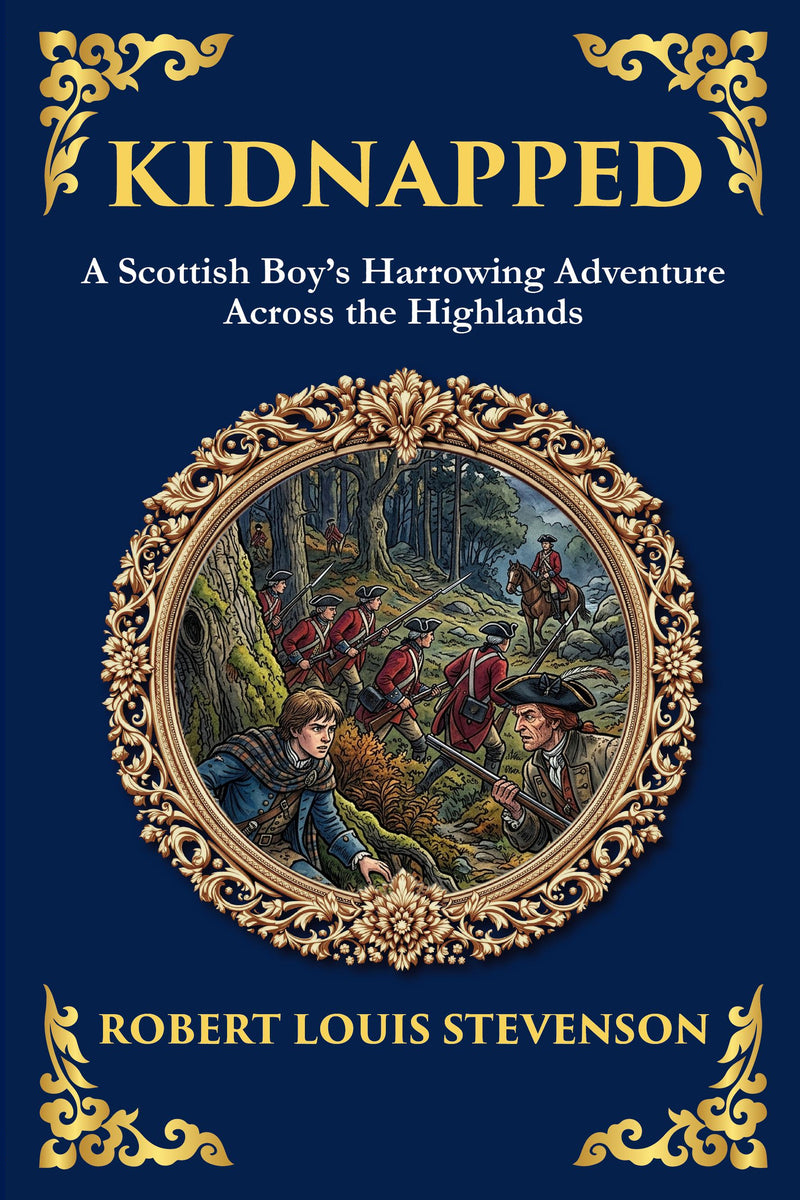
Kidnapped
In a world of betrayal, shipwreck, and swordfights, a young boy is thrown headfirst into a life he never imagined. When David Balfour sets out to claim his inheritance, he is instead kidnapped and sold into servitude.
or free app
10,000+ hrs library
30-day guarantee
The complete Kidnapped appears in modern English through Library of Alexandria Press, available online with audiobook narration included for members.
Have you ever wondered why the most dangerous paths often lead to the greatest discoveries? Set against the rugged beauty and political turmoil of 18th-century Scotland, Kidnapped: A Scottish Boy’s Harrowing Adventure Across the Highlands is Robert Louis Stevenson’s thrilling tale of survival, identity, and bravery. Young David Balfour, recently orphaned, journeys to find his family’s estate—only to be betrayed, abducted, and swept into a treacherous world of Highland clans, Redcoat patrols, and Jacobite intrigue.
Rescued by the fiery rebel Alan Breck Stewart, David must navigate shifting allegiances, hostile terrain, and his own moral compass to reclaim his rightful place. This modern edition delivers Stevenson’s gripping narrative in a fresh, accessible format, preserving the spirit and tension of the original while inviting new readers into its epic scope.
What you’ll discover in this modern edition
- A Swashbuckling Tale of Loyalty and Betrayal Follow David’s epic transformation from naïve youth to determined survivor in a landscape torn by history and violence.
- An Unforgettable Friendship Witness the dynamic bond between David and the enigmatic Alan Breck Stewart—one of literature’s most iconic duos.
- Rich Scottish Setting and Historical Context Experience the raw beauty of the Highlands and the tension of post-Culloden Scotland through Stevenson’s vivid prose.
- Timeless Themes of Justice, Freedom, and Identity Explore how personal integrity is forged through hardship, loyalty, and the search for truth.
- One of the Great Adventure Novels of All Time Discover why Kidnapped remains a cornerstone of the action-adventure genre and a favorite across generations.
| Formats | eBook (EPUB + PDF) · Audiobook · Paperback · Hardcover · Large Print |
| Language | English |
| Trim size (print) | 6 × 9 in |
| Binding | Paperback — perfect-bound · Hardcover — casewrap |
| Large Print edition | Same text in a larger, easy-read type — a larger font, not a larger trim |
| Print pricing | Every physical book at our true cost — at-cost, no profit (members) |
| Library | 873 restored titles, always growing |
| Length | 77,783 words · ~5 hr 11 min reading |
| Reading level | Grade 7 · an easy, flowing read (this modern-English edition) |
| Edition | Modern English translation · 2026 |
Member reviews for this edition are collected as readers finish it — be the first. Across the library: 12,000+ books shipped, every plan covered by a 365-day print guarantee.
About this edition
A faithful, unabridged modern-English edition by The Library of Alexandria — carefully rendered for today's reader and verified paragraph-by-paragraph against the public-domain source. Available as eBook, audiobook, paperback, hardcover, and large print.
- Complete & unabridgedVerified paragraph by paragraph against the source — never a scan, never abridged.
- Modern English, faithfulReadable today, with the author’s meaning kept intact. Readable — not simplified.
- Every format, one membershipRead in your browser or the free app, or listen to the full audiobook.
Included free with your membership
Cancel anytime, one click · 30-day money-back guarantee
Edition last updated July 2026
What’s inside
Kidnapped — complete and unabridged: all 31 sections included with membership, plus the full audiobook.
Begin reading Kidnapped
In clear modern English — the complete text is included with membership.
Introduction
There are certain books that announce themselves with a single word, and Kidnapped is one of them. The very title carries a charge of danger and momentum, a promise of treachery and flight, of a young life suddenly seized and flung into the wide and uncertain world. Robert Louis Stevenson chose his words with the precision of a man who understood, perhaps better than any writer of his century, exactly how to set a reader’s pulse racing from the first line. This is a story that begins quietly, almost gently, in the green ordinariness of a Scottish parish, and then opens like a trapdoor beneath the feet of its hero. What follows is one of the most thrilling and beautifully written adventures in the English language, a tale that has carried generations of readers across moors and mountains, onto storm-tossed ships and into the heart of a country torn between loyalty and survival.
This edition presents Stevenson’s masterpiece in a modern translation, carefully adapted for the contemporary reader. That phrase deserves a moment of explanation, because it speaks to the very heart of why this book continues to matter and why it deserves to be read freshly today. Stevenson wrote in the late nineteenth century, and his original prose, magnificent as it is, often reaches into the dialects and idioms of eighteenth-century Scotland. His Highland and Lowland characters speak in tongues that can feel, to the modern ear, like a foreign language braided into English. The legal customs, the political tensions, the social codes, and even the geography of the period were second nature to his first audience but can baffle a reader picking up the book for the first time today. This adaptation smooths those obstacles without sacrificing the spirit, the wit, the suspense, or the moral seriousness that make the story endure. The aim has been to keep every drop of Stevenson’s adventure while clearing away the underbrush of unfamiliar usage, so that the reader can run with the hero rather than stop every few sentences to puzzle out a word. What you hold is an invitation, not a barrier: a doorway into one of the great stories, opened wide.
A Writer Forged by Restlessness and Romance
To understand Kidnapped, it helps to understand the extraordinary man who wrote it, for few authors have ever poured so much of their own longing and temperament onto the page. Robert Louis Stevenson was born in Edinburgh in 1850 into a distinguished family of engineers, the kind of dynasty that built lighthouses to stand against the wild Scottish seas. It was expected that he would follow in that sturdy, practical tradition, and for a time he tried, studying engineering and then law at the university. But the boy was sickly from his earliest years, plagued by a weak chest and respiratory troubles that would dog him for the whole of his short life. Confined often to bed, he became a creature of imagination long before he became a creature of action, devouring stories and inventing his own, peopling the long hours of illness with pirates and soldiers, fugitives and kings.
This combination of physical fragility and ferocious imaginative energy shaped everything Stevenson wrote. He was a man who could not always go adventuring himself, at least not without enormous risk, and so he adventured on the page with a vividness that men of perfect health rarely achieve. There is a hunger in his writing, a yearning for open air and danger and the freedom of the road, that springs directly from the constraints of his own body. When his characters tramp across the heather, scramble up rocks, or stand on the deck of a ship feeling the salt spray on their faces, you can sense the author living through them, drinking in the wide world he so often had to experience secondhand.
Stevenson defied the expectations of his family and his class to become a writer, and he did so with a stubbornness that would mark his whole career. He traveled widely in search of health and inspiration, journeying through France, across the Atlantic to America, and eventually all the way to the South Pacific, where he spent his final years in Samoa and where he died, far too young, in 1894. Along the way he produced an astonishing range of work: essays of grace and insight, poetry both whimsical and profound, and of course the novels that made his name immortal. Treasure Island gave the world its enduring template of buried gold and one-legged buccaneers. The Strange Case of Dr Jekyll and Mr Hyde probed the darkness lurking within the respectable human soul and gave us a phrase that has entered the language forever. And Kidnapped, written in 1886, stands among the finest of them all, a book in which Stevenson’s love of his native Scotland and his genius for adventure fuse into something close to perfection.
What sets Stevenson apart from many of his contemporaries is the seriousness with which he took the craft of storytelling itself. He believed, deeply and unfashionably, that a story ought to be exciting, that the pleasures of plot and incident were not beneath the dignity of serious literature but among its highest achievements. He had a horror of the dull and the preachy. At the same time, he was no mere entertainer churning out cheap thrills. His adventures are shot through with moral complexity, with characters who are neither purely good nor purely wicked, and with questions about loyalty, friendship, justice, and identity that linger long after the last page is turned. He proved, once and for all, that a book could keep you up half the night turning pages and still leave you thinking for years afterward. Kidnapped is the supreme demonstration of that principle.
It is worth knowing, too, that Stevenson grounded this particular tale in real history. The Scotland of Kidnapped is not an invented fantasy land but a recognizable place at a specific and tense moment in time, the aftermath of a great rebellion that had divided the country and crushed an entire way of life. The Highlands had risen in support of a claimant to the throne, had been defeated in battle, and were in the process of being systematically dismantled by a victorious government determined that such a rising should never happen again. The old clans, with their fierce loyalties and ancient codes, were being broken up; their chiefs were exiled or executed; their tartans and weapons were outlawed; their language and customs were suppressed. Into this charged landscape Stevenson dropped his young hero, and one of the great pleasures of the novel is the way it brings a vanished world roaring back to life. Stevenson even wove in a real and notorious crime, a murder that genuinely shook Scotland and whose echoes you will encounter in these pages. He took history seriously, but he never let it weigh down the story; instead, he used it to give his adventure a weight and reality that pure invention could never supply.
The Heart of the Adventure: A Journey, a Friendship, a Country
Without revealing the turns of the plot, which deserve to unfold for you as freshly as they did for Stevenson’s first readers, it is worth saying something about the shape and texture of the experience that awaits. At its core, Kidnapped is the story of a young man named David Balfour, who stands at the threshold of adulthood with little in the world but his own two feet, his honesty, and a letter that will change his life. He is a Lowland boy, raised in a quiet and ordinary way, with conventional ideas about right and wrong and a faith in the basic decency of the world. The novel takes that faith and tests it, hammers it, very nearly breaks it, and in the process forges David into someone far more interesting than the boy he was at the start.
This is, in the deepest sense, a coming-of-age story dressed in the clothes of an adventure. David is thrown into circumstances utterly beyond his experience, forced to rely on strangers, to judge whom he can trust and whom he cannot, to confront violence and betrayal and physical hardship of a kind he has never imagined. Through it all, he must figure out who he is and what he is made of. The genius of Stevenson’s portrait is that David is not a flawless hero. He is brave but also stubborn, principled but sometimes priggish, capable of great loyalty but also of small jealousies and miscalculations. He is, in short, recognizably human, and watching him stumble and grow and ultimately stand tall is one of the abiding joys of the book.
But David does not travel alone, and here we come to one of the most memorable creations in all of adventure fiction. Across his path comes a man as different from him as fire is from water, a dashing, dangerous, proud, and utterly charismatic figure whose loyalties lie with the defeated Highland cause and whose past is a tangle of danger and devotion. The relationship between these two, the cautious Lowland youth and the swaggering Highland man, forms the beating heart of the novel. They quarrel and reconcile, save each other’s lives and exasperate each other almost to violence, and across the miles of hard country they cross together, they forge a friendship that is by turns comic, touching, and genuinely moving. It is one of the great male friendships in literature, built not on easy agreement but on the deep respect that grows between two very different men who come to recognize each other’s worth. Stevenson understood that the most enduring bonds are often the most unlikely, and the dance of affection and irritation between these two companions gives the book a warmth that pure action could never supply.
The journey itself is the third great character of the novel, and Stevenson renders the Scottish landscape with a love so palpable you can almost feel the wind and rain on your own skin. He knew this country intimately, had walked its hills and sailed its coasts, and his descriptions of the wild Highlands, the lonely moors, the dangerous waters, and the hidden glens have a poetry and immediacy that few writers have matched. The land is not mere backdrop; it is an active force, beautiful and deadly by turns, a place where a man can lose himself, hide himself, or find himself. There are passages in this book, particularly one long and harrowing flight across open country, that rank among the finest evocations of physical endurance and natural splendor in the language. Reading them, you understand that for Stevenson the Scottish landscape was almost a sacred thing, the soil of his own identity, and that Kidnapped was in part a love letter to the homeland he so often had to view from a distance, exiled by his fragile health to warmer and gentler climes.
It is also a book about a country at a crossroads, divided not only by geography but by politics, religion, and history. David, the Lowlander, embodies one Scotland, modern, commercial, loyal to the established order. His Highland companion embodies another, older, fierce, romantic, on the losing side of history and fighting a doomed rearguard action against the forces of change. The tension between these two Scotlands runs all through the book, and it gives the adventure a depth and resonance that lift it far above the level of simple excitement. Stevenson, who loved both Scotlands, refuses to take an easy side. He shows the cruelty and the nobility of each, the way the victors can be petty and vindictive while the vanquished can be both heroic and self-destructive. In the friendship between David and his companion, he dramatizes the possibility, fragile but real, that these divided halves of his nation might yet learn to understand and even love one another. There is a political and emotional generosity in this that makes the book feel surprisingly relevant to our own age of division, when so many countries find themselves split between competing visions of who they are and what they value.
For all its seriousness, though, never forget that this is first and foremost a tremendous entertainment, a book that races. There is a shipwreck and a desperate murder, a flight across the heather with soldiers in pursuit, a tense and unforgettable game of cards, a swordfight in the dark belly of a ship, a confrontation in a ruined tower, and a final reckoning that satisfies every expectation the story has built. Stevenson was a master of pace, of the cliffhanger, of the sudden reversal that leaves you gasping. He knew exactly when to let the action explode and when to slow down and let the characters breathe. The result is a reading experience that grips and never lets go, the kind of book that you mean to read a chapter of before bed and then look up, startled, to find that hours have passed and the candle, metaphorically speaking, has burned down to its stub.
Cancel anytime, one click · 30-day money-back guarantee
Founding annual rate available now — your price locks for life when you join.
Not ready? Get this free chapter by email — read it anytime.
✓ Sent — check your inbox for Kidnapped.
Questions about Kidnapped
What is Kidnapped about?
In a world of betrayal, shipwreck, and swordfights, a young boy is thrown headfirst into a life he never imagined. When David Balfour sets out to claim his inheritance, he is instead kidnapped and sold into servitude. Thrust into a perilous journey across the wild Scottish Highlands, he must rely on courage, wit, and a fugitive Jacobite rebel to survive.
Who wrote Kidnapped?
Kidnapped was written by Robert Louis Stevenson. This edition presents the complete work in clear modern English, faithfully rendered from the public-domain original by Library of Alexandria Press.
Is Kidnapped free to read?
The opening chapter is free to read on this page. Members read and listen to the complete work — and the entire library — free, and can order any physical book at our true print cost.
How long is Kidnapped?
31 chapters (~77,783 words) — about 5 hr 11 min of reading in this modern-English edition.
Is this an abridged version of Kidnapped?
No. This is the complete, unabridged Kidnapped, carefully rendered into clear modern English and verified paragraph-by-paragraph against the public-domain source — nothing is cut or summarised.
What formats does Kidnapped come in?
Kidnapped is available as eBook, paperback, hardcover and large print. eBook and audiobook are included with membership; printed editions ship at our true print cost.
Shipping & returns
Billing & membership
More from the library


Explore Adventure
- Tarzan of the Apes · Edgar Rice Burroughs
- The Wonderful Wizard of Oz · L. Frank Baum
- Peter Pan · J. M. Barrie
- Moby Dick; Or, The Whale · Herman Melville
- The Riddle of the Sands · Erskine Childers
- The Loss of the Swansea: A Story of the Florida Coast · W. L. Alden
- Sky Island · L. Frank Baum
- Vikram and the Vampire: Classic Hindu Tales of Adventure, Magic, and Romance · Unknown
- Tales of Unrest · Joseph Conrad
- The Tomb of Ts’in · Edgar Wallace
- Skinny McCord · Percy Keese Fitzhugh
- The Men of the Moss-Hags · S. R. Crockett
- The Hunniwell Boys and the Platinum Mystery · L. P. Wyman
- Allan Quatermain · H. Rider Haggard
- She · H. Rider Haggard
- Medical Life in the Navy · Gordon Stables
- The Thirty-Nine Steps · John Buchan
- The Story of Doctor Dolittle · Hugh Lofting
- The Princess and the Goblin · George MacDonald
- The Man Who Would Be King · Rudyard Kipling
- Lucian’s True History · Lucian of Samosata
- The Secret Adversary · Agatha Christie
- Lord Jim · Joseph Conrad
- The Marvelous Land of Oz · L. Frank Baum
- The Virginian: A Horseman of the Plains · Owen Wister
- Mars is My Destination · Frank Belknap Long
- Anabasis · Xenophon
- The Mississippi Saucer · Frank Belknap Long
- Sabotage in Space · Carey Rockwell
- Brood of the Dark Moon · Charles Willard Diffin
Kidnapped
Kidnapped
A Scottish Boy’s Harrowing Adventure Across the Highlands
Robert Louis Stevenson
Contents
- Introduction
- Chapter 1
- Chapter 2
- Chapter 3
- Chapter 4
- Chapter 5
- Chapter 6
- Chapter 7
- Chapter 8
- Chapter 9
- Chapter 10
- Chapter 11
- Chapter 12
- Chapter 13
- Chapter 14
- Chapter 15
- Chapter 16
- Chapter 17
- Chapter 18
- Chapter 19
- Chapter 20
- Chapter 21
- Chapter 22
- Chapter 23
- Chapter 24
- Chapter 25
- Chapter 26
- Chapter 27
- Chapter 28
- Chapter 29
- Chapter 30
Introduction
There are certain books that announce themselves with a single word, and Kidnapped is one of them. The very title carries a charge of danger and momentum, a promise of treachery and flight, of a young life suddenly seized and flung into the wide and uncertain world. Robert Louis Stevenson chose his words with the precision of a man who understood, perhaps better than any writer of his century, exactly how to set a reader’s pulse racing from the first line. This is a story that begins quietly, almost gently, in the green ordinariness of a Scottish parish, and then opens like a trapdoor beneath the feet of its hero. What follows is one of the most thrilling and beautifully written adventures in the English language, a tale that has carried generations of readers across moors and mountains, onto storm-tossed ships and into the heart of a country torn between loyalty and survival.
This edition presents Stevenson’s masterpiece in a modern translation, carefully adapted for the contemporary reader. That phrase deserves a moment of explanation, because it speaks to the very heart of why this book continues to matter and why it deserves to be read freshly today. Stevenson wrote in the late nineteenth century, and his original prose, magnificent as it is, often reaches into the dialects and idioms of eighteenth-century Scotland. His Highland and Lowland characters speak in tongues that can feel, to the modern ear, like a foreign language braided into English. The legal customs, the political tensions, the social codes, and even the geography of the period were second nature to his first audience but can baffle a reader picking up the book for the first time today. This adaptation smooths those obstacles without sacrificing the spirit, the wit, the suspense, or the moral seriousness that make the story endure. The aim has been to keep every drop of Stevenson’s adventure while clearing away the underbrush of unfamiliar usage, so that the reader can run with the hero rather than stop every few sentences to puzzle out a word. What you hold is an invitation, not a barrier: a doorway into one of the great stories, opened wide.
A Writer Forged by Restlessness and Romance
To understand Kidnapped, it helps to understand the extraordinary man who wrote it, for few authors have ever poured so much of their own longing and temperament onto the page. Robert Louis Stevenson was born in Edinburgh in 1850 into a distinguished family of engineers, the kind of dynasty that built lighthouses to stand against the wild Scottish seas. It was expected that he would follow in that sturdy, practical tradition, and for a time he tried, studying engineering and then law at the university. But the boy was sickly from his earliest years, plagued by a weak chest and respiratory troubles that would dog him for the whole of his short life. Confined often to bed, he became a creature of imagination long before he became a creature of action, devouring stories and inventing his own, peopling the long hours of illness with pirates and soldiers, fugitives and kings.
This combination of physical fragility and ferocious imaginative energy shaped everything Stevenson wrote. He was a man who could not always go adventuring himself, at least not without enormous risk, and so he adventured on the page with a vividness that men of perfect health rarely achieve. There is a hunger in his writing, a yearning for open air and danger and the freedom of the road, that springs directly from the constraints of his own body. When his characters tramp across the heather, scramble up rocks, or stand on the deck of a ship feeling the salt spray on their faces, you can sense the author living through them, drinking in the wide world he so often had to experience secondhand.
Stevenson defied the expectations of his family and his class to become a writer, and he did so with a stubbornness that would mark his whole career. He traveled widely in search of health and inspiration, journeying through France, across the Atlantic to America, and eventually all the way to the South Pacific, where he spent his final years in Samoa and where he died, far too young, in 1894. Along the way he produced an astonishing range of work: essays of grace and insight, poetry both whimsical and profound, and of course the novels that made his name immortal. Treasure Island gave the world its enduring template of buried gold and one-legged buccaneers. The Strange Case of Dr Jekyll and Mr Hyde probed the darkness lurking within the respectable human soul and gave us a phrase that has entered the language forever. And Kidnapped, written in 1886, stands among the finest of them all, a book in which Stevenson’s love of his native Scotland and his genius for adventure fuse into something close to perfection.
What sets Stevenson apart from many of his contemporaries is the seriousness with which he took the craft of storytelling itself. He believed, deeply and unfashionably, that a story ought to be exciting, that the pleasures of plot and incident were not beneath the dignity of serious literature but among its highest achievements. He had a horror of the dull and the preachy. At the same time, he was no mere entertainer churning out cheap thrills. His adventures are shot through with moral complexity, with characters who are neither purely good nor purely wicked, and with questions about loyalty, friendship, justice, and identity that linger long after the last page is turned. He proved, once and for all, that a book could keep you up half the night turning pages and still leave you thinking for years afterward. Kidnapped is the supreme demonstration of that principle.
It is worth knowing, too, that Stevenson grounded this particular tale in real history. The Scotland of Kidnapped is not an invented fantasy land but a recognizable place at a specific and tense moment in time, the aftermath of a great rebellion that had divided the country and crushed an entire way of life. The Highlands had risen in support of a claimant to the throne, had been defeated in battle, and were in the process of being systematically dismantled by a victorious government determined that such a rising should never happen again. The old clans, with their fierce loyalties and ancient codes, were being broken up; their chiefs were exiled or executed; their tartans and weapons were outlawed; their language and customs were suppressed. Into this charged landscape Stevenson dropped his young hero, and one of the great pleasures of the novel is the way it brings a vanished world roaring back to life. Stevenson even wove in a real and notorious crime, a murder that genuinely shook Scotland and whose echoes you will encounter in these pages. He took history seriously, but he never let it weigh down the story; instead, he used it to give his adventure a weight and reality that pure invention could never supply.
The Heart of the Adventure: A Journey, a Friendship, a Country
Without revealing the turns of the plot, which deserve to unfold for you as freshly as they did for Stevenson’s first readers, it is worth saying something about the shape and texture of the experience that awaits. At its core, Kidnapped is the story of a young man named David Balfour, who stands at the threshold of adulthood with little in the world but his own two feet, his honesty, and a letter that will change his life. He is a Lowland boy, raised in a quiet and ordinary way, with conventional ideas about right and wrong and a faith in the basic decency of the world. The novel takes that faith and tests it, hammers it, very nearly breaks it, and in the process forges David into someone far more interesting than the boy he was at the start.
This is, in the deepest sense, a coming-of-age story dressed in the clothes of an adventure. David is thrown into circumstances utterly beyond his experience, forced to rely on strangers, to judge whom he can trust and whom he cannot, to confront violence and betrayal and physical hardship of a kind he has never imagined. Through it all, he must figure out who he is and what he is made of. The genius of Stevenson’s portrait is that David is not a flawless hero. He is brave but also stubborn, principled but sometimes priggish, capable of great loyalty but also of small jealousies and miscalculations. He is, in short, recognizably human, and watching him stumble and grow and ultimately stand tall is one of the abiding joys of the book.
But David does not travel alone, and here we come to one of the most memorable creations in all of adventure fiction. Across his path comes a man as different from him as fire is from water, a dashing, dangerous, proud, and utterly charismatic figure whose loyalties lie with the defeated Highland cause and whose past is a tangle of danger and devotion. The relationship between these two, the cautious Lowland youth and the swaggering Highland man, forms the beating heart of the novel. They quarrel and reconcile, save each other’s lives and exasperate each other almost to violence, and across the miles of hard country they cross together, they forge a friendship that is by turns comic, touching, and genuinely moving. It is one of the great male friendships in literature, built not on easy agreement but on the deep respect that grows between two very different men who come to recognize each other’s worth. Stevenson understood that the most enduring bonds are often the most unlikely, and the dance of affection and irritation between these two companions gives the book a warmth that pure action could never supply.
The journey itself is the third great character of the novel, and Stevenson renders the Scottish landscape with a love so palpable you can almost feel the wind and rain on your own skin. He knew this country intimately, had walked its hills and sailed its coasts, and his descriptions of the wild Highlands, the lonely moors, the dangerous waters, and the hidden glens have a poetry and immediacy that few writers have matched. The land is not mere backdrop; it is an active force, beautiful and deadly by turns, a place where a man can lose himself, hide himself, or find himself. There are passages in this book, particularly one long and harrowing flight across open country, that rank among the finest evocations of physical endurance and natural splendor in the language. Reading them, you understand that for Stevenson the Scottish landscape was almost a sacred thing, the soil of his own identity, and that Kidnapped was in part a love letter to the homeland he so often had to view from a distance, exiled by his fragile health to warmer and gentler climes.
It is also a book about a country at a crossroads, divided not only by geography but by politics, religion, and history. David, the Lowlander, embodies one Scotland, modern, commercial, loyal to the established order. His Highland companion embodies another, older, fierce, romantic, on the losing side of history and fighting a doomed rearguard action against the forces of change. The tension between these two Scotlands runs all through the book, and it gives the adventure a depth and resonance that lift it far above the level of simple excitement. Stevenson, who loved both Scotlands, refuses to take an easy side. He shows the cruelty and the nobility of each, the way the victors can be petty and vindictive while the vanquished can be both heroic and self-destructive. In the friendship between David and his companion, he dramatizes the possibility, fragile but real, that these divided halves of his nation might yet learn to understand and even love one another. There is a political and emotional generosity in this that makes the book feel surprisingly relevant to our own age of division, when so many countries find themselves split between competing visions of who they are and what they value.
For all its seriousness, though, never forget that this is first and foremost a tremendous entertainment, a book that races. There is a shipwreck and a desperate murder, a flight across the heather with soldiers in pursuit, a tense and unforgettable game of cards, a swordfight in the dark belly of a ship, a confrontation in a ruined tower, and a final reckoning that satisfies every expectation the story has built. Stevenson was a master of pace, of the cliffhanger, of the sudden reversal that leaves you gasping. He knew exactly when to let the action explode and when to slow down and let the characters breathe. The result is a reading experience that grips and never lets go, the kind of book that you mean to read a chapter of before bed and then look up, startled, to find that hours have passed and the candle, metaphorically speaking, has burned down to its stub.
I will begin the story of my adventures on a certain morning in early June 1751, the day I took the key out of my father’s house for the last time. The sun was beginning to shine on the hilltops as I headed down the road. By the time I reached the manse, blackbirds were whistling in the garden lilacs, and the dawn mist hanging over the valley was starting to lift and disappear.
Mr. Campbell, the minister of Essendean, was waiting for me by the garden gate—what a good man he was! He asked if I had eaten breakfast, and when I told him I had everything I needed, he took my hand in both of his and kindly tucked it under his arm.
“Well, Davie, my boy,” he said, “I’ll walk with you as far as the ford to get you started on your way.” And we began to walk forward in silence.
“Are you sorry to leave Essendean?” he asked after a while.
“Well, sir,” I replied, “if I knew where I was going or what was likely to happen to me, I would tell you honestly. Essendean is indeed a good place, and I’ve been very happy here; but then, I’ve never been anywhere else. Since my father and mother are both dead, I’m no closer to them in Essendean than I would be in the Kingdom of Hungary. To tell you the truth, if I thought I had a chance to improve my life where I’m going, I’d go gladly.”
“Is that so?” Mr. Campbell said. “Very well, Davie. Then it’s my duty to tell your fortune—or as much of it as I can. After your mother passed, and your father—a worthy, Christian man—began to fall ill toward the end, he entrusted me with a letter, which he said was your inheritance. ‘As soon,’ he told me, ‘as I am gone, the house is cleaned out, and the belongings are sold’ (all of which, Davie, has been done), ‘give this letter to my boy and send him to the house of Shaws, not far from Cramond. That is where I came from,’ he said, ‘and it is where my boy should return. He is a steady lad and a careful traveler; I have no doubt he will arrive safely and be well liked where he goes.’”
End of the free sample
Keep reading, free
Members read and listen to the complete book — and the entire library. Cancel anytime, one click · 30-day money-back guarantee.