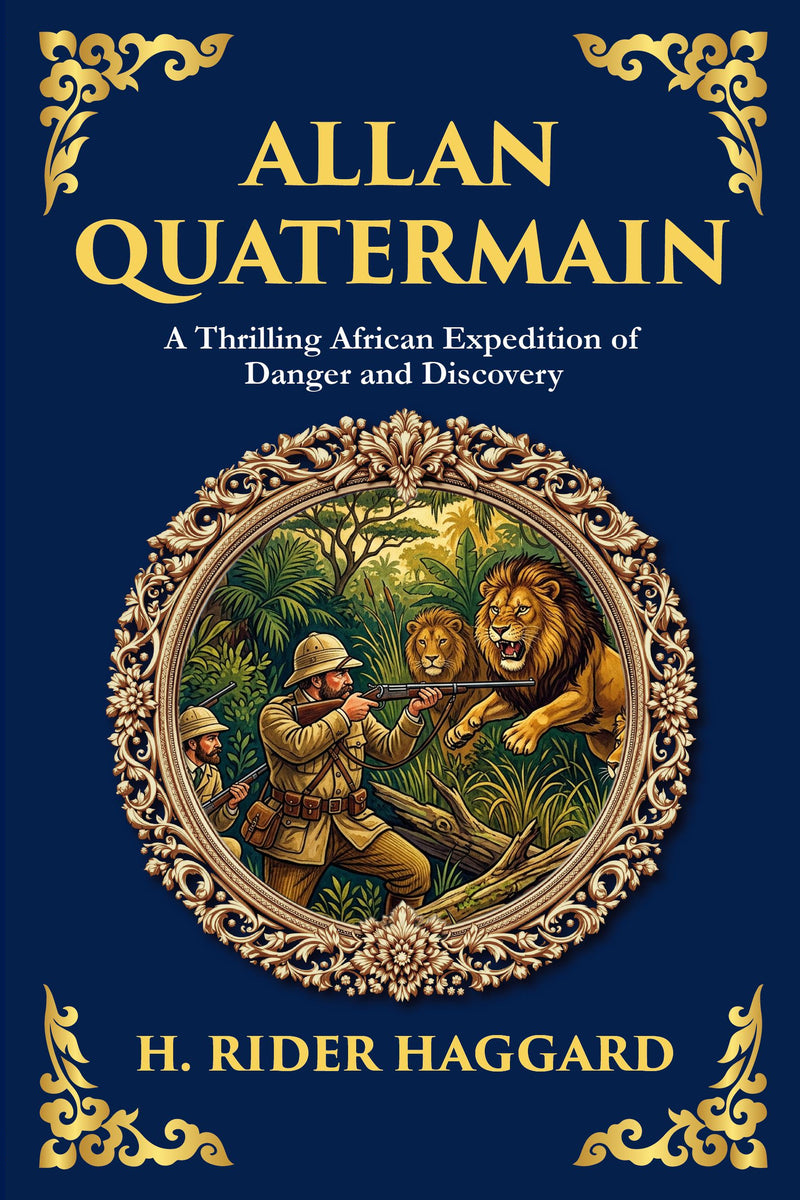
Allan Quatermain — Large Print
In the heart of uncharted Africa, where ancient kingdoms hide beneath dense jungle and danger lurks in every shadow, one man’s quest becomes legend.
or free app
10,000+ hrs library
30-day guarantee
The complete Allan Quatermain appears in modern English through Library of Alexandria Press, available online with audiobook narration included for members.
Have you ever wondered why some men risk everything for something they cannot see? Allan Quatermain is the thrilling continuation of H. Rider Haggard’s legendary African adventure series, and it brings the renowned explorer face to face with the vast unknown—both in the wild and within himself. Driven by grief after the death of his son and disillusioned with civilization, Allan assembles a group of companions for one final mission: to find a hidden, unspoiled kingdom beyond the known world.
This expedition takes them across unmarked lands, into towering mountains, past mystical temples, and through the inner corridors of ancient wisdom and spiritual reflection. Along the way, they face fierce warriors, natural wonders, and a battle for peace that will challenge every man’s soul. Blending action, philosophical reflection, and rich descriptions of an imagined Africa, Allan Quatermain is more than just an adventure story—it is a meditation on mortality, legacy, and the search for something greater than oneself.
What you’ll discover in this modern edition
- An Epic Quest Beyond the Frontier – Follow Quatermain and his allies on a dangerous mission deep into unexplored territory.
- A Lost Kingdom Revealed – Uncover a secret African civilization untouched by the modern world.
- Exploration of Honor and Brotherhood – Witness the bonds of friendship formed through danger and moral testing.
- Mysticism Meets Survival – Experience an adventure that weaves together mythology, philosophy, and raw wilderness.
- A Timeless Hero’s Farewell – See how Quatermain's final journey becomes a reflection on life, death, and meaning.
| Formats | eBook (EPUB + PDF) · Audiobook · Paperback · Hardcover · Large Print |
| Language | English |
| Trim size (print) | 6 × 9 in |
| Binding | Paperback — perfect-bound · Hardcover — casewrap |
| Large Print edition | Same text in a larger, easy-read type — a larger font, not a larger trim |
| Print pricing | Every physical book at our true cost — at-cost, no profit (members) |
| Library | 873 restored titles, always growing |
| Length | 100,799 words · ~6 hr 43 min reading |
| Reading level | Grade 8 · an easy, flowing read (this modern-English edition) |
| Edition | Modern English translation · 2026 |
Member reviews for this edition are collected as readers finish it — be the first. Across the library: 12,000+ books shipped, every plan covered by a 365-day print guarantee.
About this edition
A faithful, unabridged modern-English edition by The Library of Alexandria — carefully rendered for today's reader and verified paragraph-by-paragraph against the public-domain source. Available as eBook, audiobook, paperback, hardcover, and large print.
- Complete & unabridgedVerified paragraph by paragraph against the source — never a scan, never abridged.
- Modern English, faithfulReadable today, with the author’s meaning kept intact. Readable — not simplified.
- Every format, one membershipRead in your browser or the free app, or listen to the full audiobook.
Included free with your membership
Cancel anytime, one click · 30-day money-back guarantee
Edition last updated July 2026
What’s inside
Allan Quatermain — Large Print — complete and unabridged: all 26 sections included with membership, plus the full audiobook.
Begin reading Allan Quatermain — Large Print
In clear modern English — the complete text is included with membership.
Introduction
When H. Rider Haggard published Allan Quatermain in 1887, he was already a literary sensation. Two years earlier, his novel King Solomon’s Mines had electrified Victorian readers, introducing them to a world of unexplored landscapes, ancient secrets, and a uniquely compelling narrator whose weathered, modest voice felt utterly unlike the polished heroes of conventional adventure fiction. That earlier book had been written, by the author’s own account, partly on a dare—a bet that he could produce something as gripping as Robert Louis Stevenson’s Treasure Island. He won the bet handsomely, and in doing so practically invented a genre. This sequel, which returns us to the company of the aging hunter and his companions, represents Haggard at the height of his storytelling powers, deepening the character who had captured the public imagination and sending him on what would become his final, most personal quest.
The man at the center of these pages, Allan Quatermain, occupies a special place in the history of popular literature. He is the prototype of the rugged explorer-adventurer, a figure who would echo down through more than a century of fiction and film. Readers who have encountered the dusty, capable, self-deprecating heroes of countless later adventures—from the pulp explorers of the early twentieth century to the matinee idols of the cinema—are meeting one of their earliest and most fully realized ancestors here. Yet Quatermain is no superman. He is small, wiry, prone to melancholy, and entirely aware of his own mortality. He insists, again and again, that he is an ordinary man who has simply lived an extraordinary life. It is precisely this humility, this refusal to glorify himself, that makes him so trustworthy a guide and so endearing a companion. We follow him not because he is invincible but because he is human, and because his eyes have seen things that ours never will.
This particular tale finds Quatermain at a crossroads of the spirit. The opening chapters are among the most quietly affecting in all of Haggard’s work, for they reveal a man who has come home from a lifetime of wandering only to discover that home no longer fits him. He has grown restless amid the comforts of so-called civilization. Something pulls at him—a longing for the open spaces, for the clean danger of the wild, for one last great undertaking before the end. Without giving away the particulars of what sets him in motion, it is fair to say that the journey he embarks upon is driven by grief, by curiosity, and by a deep philosophical questioning of what it means to live fully. Haggard frames the entire narrative around a meditation on the nature of human existence—on whether the trappings of progress have made us better or merely tamer—and these reflections give the book a resonance that lifts it well above mere thrill-seeking.
A Story of Companionship and the Call of the Unknown
What gives this adventure its particular warmth is the fellowship at its heart. Quatermain does not journey alone. He is joined once more by two companions who will be instantly familiar to those who have read of his earlier exploits, though newcomers need no prior acquaintance to fall under their spell. There is Sir Henry Curtis, a giant of a man with golden hair and a Viking’s bearing, whose nobility of character matches his physical magnificence; and Captain John Good, a retired naval officer whose fussy attention to his appearance, his eyeglass, and his immaculate clothing provides a steady current of humor throughout even the most perilous episodes. Together with Quatermain, these three form one of the most beloved trios in adventure literature—each man distinct, each indispensable, and each bound to the others by a loyalty that has been tested in fire.
Yet for many readers, the most unforgettable member of the party is not one of the Englishmen at all. He is Umslopogaas, a magnificent Zulu warrior whose presence dominates every scene in which he appears. Carrying an axe he calls Inkosi-kaas and bearing the scars and the dignity of a lifetime of battle, Umslopogaas is one of Haggard’s supreme creations—a man of fierce pride, grim humor, and absolute courage. He represents a vision of nobility that Haggard, despite the limitations of his era, clearly admired without reservation. The relationship between this aging Zulu and the aging white hunter is one of mutual respect forged across the boundaries of culture and language, and it forms an emotional spine that runs the length of the book. When Umslopogaas speaks, the prose takes on the cadence of saga and legend, and the reader senses that they are in the presence of something ancient and elemental.
The structure of the narrative carries this band of comrades from the relatively known world into territories that grow steadily stranger and more wondrous. Haggard was a master of pacing, and he understood that the pleasure of a quest lies as much in the approach as in the arrival. The early stages of the expedition unfold across recognizable African landscapes, rendered with the vivid authenticity that came from the author’s own years spent in southern Africa during the 1870s. Haggard had served as a young man on the staff of the colonial administration in Natal and the Transvaal, had witnessed the dramatic events of that turbulent period firsthand, and had absorbed the languages, the customs, and above all the sheer physical grandeur of the land. This direct experience suffuses every page. When he describes the sweep of the veld, the menace of a lion in the darkness, the rituals of a tribal court, or the terror of a river in flood, he writes with the conviction of a man who has been there. The result is a texture of reality that anchors even the most fantastical developments.
And the developments do become fantastical, for Haggard belonged to a tradition of “lost world” romance that delighted in the possibility that somewhere beyond the edges of the map there might exist hidden kingdoms, forgotten civilizations, and peoples untouched by the modern age. This was the great age of exploration, when vast portions of the African interior remained genuinely unknown to European cartographers, and the public imagination ran wild with speculation about what those blank spaces might conceal. Haggard fed that hunger brilliantly. Without revealing the destinations toward which his characters travel, it is enough to say that the latter portions of this book contain some of the most imaginative world-building of the entire Victorian period—visions of strange societies, dazzling cities, and dramatic confrontations that would influence generations of fantasy and adventure writers to come. The famous author of Tarzan, the creators of countless lost-civilization tales, and even the architects of modern fantasy owe a debt to the dreaming pen of H. Rider Haggard.
It is worth pausing to appreciate how cinematic Haggard’s imagination truly was, decades before cinema existed. He constructs his set-pieces with an instinct for spectacle and tension that feels remarkably modern. A battle, a chase, a desperate stand against overwhelming odds, a moment of breathtaking discovery—these are staged with an eye for movement and a sense of mounting suspense that pulls the reader irresistibly forward. There is a sequence late in the book, involving a defense against impossible numbers, that ranks among the most thrilling action set-pieces in nineteenth-century fiction, and which has been imitated countless times since. Yet the violence is never gratuitous; it carries weight and consequence, and Haggard does not flinch from showing the cost of courage. Loss shadows triumph throughout these pages, and this willingness to let his heroes suffer and sacrifice gives the story an emotional gravity that mere swashbuckling could never achieve.
Beneath the surface excitement runs a deeper current of reflection that distinguishes this novel from lesser entertainments. Through Quatermain’s narration, Haggard probes questions that troubled many thoughtful Victorians and that remain just as urgent today. Is civilization a genuine advance, or merely a thin veneer over the same primal nature that drives the so-called savage? Are the men of the drawing room truly superior to the warriors of the wilderness, or have they simply lost touch with the elemental virtues of courage, loyalty, and honesty? Quatermain repeatedly turns these questions over, and his answers are far more complex and generous than the easy assumptions of his age might suggest. He often finds more to admire in the people he encounters on his travels than in the polished society he has left behind. This was a genuinely subversive stance for its time, and it gives the book a humane warmth that helps it transcend the prejudices of its era.
Reading Haggard in the Twenty-First Century
No honest introduction to a Victorian adventure novel can ignore the question of how such a work speaks to a modern reader. Allan Quatermain is a product of its time, written at the height of the British Empire by a man who had served that empire and largely believed in its mission. The novel reflects attitudes toward race, conquest, and the relationship between European and African peoples that belong unmistakably to the late nineteenth century. A reader approaching the book today will encounter assumptions and turns of phrase that no contemporary author would employ, and it would be dishonest to pretend otherwise.
Yet it would be equally dishonest, and a great deal poorer, to dismiss the book for these reasons alone. Haggard was, by the standards of his day, unusually sympathetic in his portrayal of African peoples. He had lived among the Zulu, learned to respect their culture deeply, and created in characters such as Umslopogaas figures of genuine heroism and dignity who command the reader’s admiration and affection. He frequently presents the indigenous peoples of his stories as morally and physically superior to the Europeans, possessed of virtues the white characters envy and emulate. This complexity sets him apart from many of his contemporaries and rewards a thoughtful reading. The best way to approach the book, then, is with an awareness of its historical context—understanding that we are entering the imaginative world of 1887, with all its glories and its blind spots, and that this very tension is part of what makes the encounter with such a text so illuminating. We read older books not only for pleasure but to understand the minds of those who came before us, to see how far we have traveled and to measure ourselves against their hopes and failings.
This edition presents the work as a modern translation, adapted for the contemporary reader. The purpose of such an adaptation is to clear away the obstacles that can stand between a present-day audience and the timeless pleasures of the story. Victorian prose, for all its richness, can sometimes feel dense and circuitous to readers accustomed to the brisker rhythms of modern writing. Sentences run long; vocabulary has shifted; references that were obvious to a reader in 1887 may now require explanation or feel obscure. A careful adaptation smooths these difficulties while preserving the essential character of Haggard’s voice—the wry humor, the vivid description, the philosophical asides, and above all the headlong momentum of the storytelling. The aim is never to replace Haggard but to make him newly accessible, to ensure that the wit and wonder that captivated readers more than a century ago can captivate readers once again, without the friction of outdated idiom or archaic construction standing in the way.
For those encountering Haggard for the first time through this volume, a few words of guidance may enhance the experience. Allow yourself to settle into the rhythm of the narration, which is leisurely at the outset and then gathers speed. Quatermain is a discursive storyteller; he likes to muse, to reminisce, to share his hard-won wisdom about hunting, about human nature, about the proper conduct of a brave man. These passages are not delays but pleasures in their own right, and they are essential to understanding who this man is and why his judgments carry such weight. Do not be impatient for the action to begin; trust the storyteller, and you will find that when the action does come, it strikes all the harder for the patience that preceded it.
Cancel anytime, one click · 30-day money-back guarantee
Founding annual rate available now — your price locks for life when you join.
Not ready? Get this free chapter by email — read it anytime.
✓ Sent — check your inbox for Allan Quatermain — Large Print.
Questions about Allan Quatermain — Large Print
What is Allan Quatermain about?
In the heart of uncharted Africa, where ancient kingdoms hide beneath dense jungle and danger lurks in every shadow, one man’s quest becomes legend. Allan Quatermain, the fearless adventurer, returns to the wild for one final journey—a perilous expedition in search of a lost civilization and deeper meaning beyond worldly conquest. Filled with suspense, honor, and unexpected friendship, H. Rider Haggard’s gripping sequel to King Solomon’s Mines takes readers deeper into the mysticism and peril of the African interio
Who wrote Allan Quatermain?
Allan Quatermain was written by H. Rider Haggard. This edition presents the complete work in clear modern English, faithfully rendered from the public-domain original by Library of Alexandria Press.
Is Allan Quatermain free to read?
The opening chapter is free to read on this page. Members read and listen to the complete work — and the entire library — free, and can order any physical book at our true print cost.
How long is Allan Quatermain?
26 chapters (~100,799 words) — about 6 hr 43 min of reading in this modern-English edition.
Is this an abridged version of Allan Quatermain?
No. This is the complete, unabridged Allan Quatermain, carefully rendered into clear modern English and verified paragraph-by-paragraph against the public-domain source — nothing is cut or summarised.
What formats does Allan Quatermain come in?
Allan Quatermain is available as eBook, paperback, hardcover and large print. eBook and audiobook are included with membership; printed editions ship at our true print cost.
Shipping & returns
Billing & membership
More from the library


Explore Adventure
- Tarzan of the Apes · Edgar Rice Burroughs
- The Wonderful Wizard of Oz · L. Frank Baum
- Peter Pan · J. M. Barrie
- Moby Dick; Or, The Whale · Herman Melville
- The Riddle of the Sands · Erskine Childers
- The Loss of the Swansea: A Story of the Florida Coast · W. L. Alden
- Sky Island · L. Frank Baum
- Vikram and the Vampire: Classic Hindu Tales of Adventure, Magic, and Romance · Unknown
- Tales of Unrest · Joseph Conrad
- The Tomb of Ts’in · Edgar Wallace
- Skinny McCord · Percy Keese Fitzhugh
- The Men of the Moss-Hags · S. R. Crockett
- The Hunniwell Boys and the Platinum Mystery · L. P. Wyman
- Allan Quatermain · H. Rider Haggard
- She · H. Rider Haggard
- Medical Life in the Navy · Gordon Stables
- The Thirty-Nine Steps · John Buchan
- The Story of Doctor Dolittle · Hugh Lofting
- The Princess and the Goblin · George MacDonald
- The Man Who Would Be King · Rudyard Kipling
- Lucian’s True History · Lucian of Samosata
- The Secret Adversary · Agatha Christie
- Lord Jim · Joseph Conrad
- The Marvelous Land of Oz · L. Frank Baum
- The Virginian: A Horseman of the Plains · Owen Wister
- Mars is My Destination · Frank Belknap Long
- Anabasis · Xenophon
- The Mississippi Saucer · Frank Belknap Long
- Sabotage in Space · Carey Rockwell
- Brood of the Dark Moon · Charles Willard Diffin
Allan Quatermain — Large Print
Allan Quatermain — Large Print
A Thrilling African Journey of Danger and Discovery
H. Rider Haggard
Contents
- Introduction
- Preface by the Author
- Chapter 1
- Chapter 2
- Chapter 3
- Chapter 4
- Chapter 5
- Chapter 6
- Chapter 7
- Chapter 8
- Chapter 9
- Chapter 10
- Chapter 11
- Chapter 12
- Chapter 13
- Chapter 14
- Chapter 15
- Chapter 16
- Chapter 17
- Chapter 18
- Chapter 19
- Chapter 20
- Chapter 21
- Chapter 22
- Chapter 23
- Chapter 24
Introduction
When H. Rider Haggard published Allan Quatermain in 1887, he was already a literary sensation. Two years earlier, his novel King Solomon’s Mines had electrified Victorian readers, introducing them to a world of unexplored landscapes, ancient secrets, and a uniquely compelling narrator whose weathered, modest voice felt utterly unlike the polished heroes of conventional adventure fiction. That earlier book had been written, by the author’s own account, partly on a dare—a bet that he could produce something as gripping as Robert Louis Stevenson’s Treasure Island. He won the bet handsomely, and in doing so practically invented a genre. This sequel, which returns us to the company of the aging hunter and his companions, represents Haggard at the height of his storytelling powers, deepening the character who had captured the public imagination and sending him on what would become his final, most personal quest.
The man at the center of these pages, Allan Quatermain, occupies a special place in the history of popular literature. He is the prototype of the rugged explorer-adventurer, a figure who would echo down through more than a century of fiction and film. Readers who have encountered the dusty, capable, self-deprecating heroes of countless later adventures—from the pulp explorers of the early twentieth century to the matinee idols of the cinema—are meeting one of their earliest and most fully realized ancestors here. Yet Quatermain is no superman. He is small, wiry, prone to melancholy, and entirely aware of his own mortality. He insists, again and again, that he is an ordinary man who has simply lived an extraordinary life. It is precisely this humility, this refusal to glorify himself, that makes him so trustworthy a guide and so endearing a companion. We follow him not because he is invincible but because he is human, and because his eyes have seen things that ours never will.
This particular tale finds Quatermain at a crossroads of the spirit. The opening chapters are among the most quietly affecting in all of Haggard’s work, for they reveal a man who has come home from a lifetime of wandering only to discover that home no longer fits him. He has grown restless amid the comforts of so-called civilization. Something pulls at him—a longing for the open spaces, for the clean danger of the wild, for one last great undertaking before the end. Without giving away the particulars of what sets him in motion, it is fair to say that the journey he embarks upon is driven by grief, by curiosity, and by a deep philosophical questioning of what it means to live fully. Haggard frames the entire narrative around a meditation on the nature of human existence—on whether the trappings of progress have made us better or merely tamer—and these reflections give the book a resonance that lifts it well above mere thrill-seeking.
A Story of Companionship and the Call of the Unknown
What gives this adventure its particular warmth is the fellowship at its heart. Quatermain does not journey alone. He is joined once more by two companions who will be instantly familiar to those who have read of his earlier exploits, though newcomers need no prior acquaintance to fall under their spell. There is Sir Henry Curtis, a giant of a man with golden hair and a Viking’s bearing, whose nobility of character matches his physical magnificence; and Captain John Good, a retired naval officer whose fussy attention to his appearance, his eyeglass, and his immaculate clothing provides a steady current of humor throughout even the most perilous episodes. Together with Quatermain, these three form one of the most beloved trios in adventure literature—each man distinct, each indispensable, and each bound to the others by a loyalty that has been tested in fire.
Yet for many readers, the most unforgettable member of the party is not one of the Englishmen at all. He is Umslopogaas, a magnificent Zulu warrior whose presence dominates every scene in which he appears. Carrying an axe he calls Inkosi-kaas and bearing the scars and the dignity of a lifetime of battle, Umslopogaas is one of Haggard’s supreme creations—a man of fierce pride, grim humor, and absolute courage. He represents a vision of nobility that Haggard, despite the limitations of his era, clearly admired without reservation. The relationship between this aging Zulu and the aging white hunter is one of mutual respect forged across the boundaries of culture and language, and it forms an emotional spine that runs the length of the book. When Umslopogaas speaks, the prose takes on the cadence of saga and legend, and the reader senses that they are in the presence of something ancient and elemental.
The structure of the narrative carries this band of comrades from the relatively known world into territories that grow steadily stranger and more wondrous. Haggard was a master of pacing, and he understood that the pleasure of a quest lies as much in the approach as in the arrival. The early stages of the expedition unfold across recognizable African landscapes, rendered with the vivid authenticity that came from the author’s own years spent in southern Africa during the 1870s. Haggard had served as a young man on the staff of the colonial administration in Natal and the Transvaal, had witnessed the dramatic events of that turbulent period firsthand, and had absorbed the languages, the customs, and above all the sheer physical grandeur of the land. This direct experience suffuses every page. When he describes the sweep of the veld, the menace of a lion in the darkness, the rituals of a tribal court, or the terror of a river in flood, he writes with the conviction of a man who has been there. The result is a texture of reality that anchors even the most fantastical developments.
And the developments do become fantastical, for Haggard belonged to a tradition of “lost world” romance that delighted in the possibility that somewhere beyond the edges of the map there might exist hidden kingdoms, forgotten civilizations, and peoples untouched by the modern age. This was the great age of exploration, when vast portions of the African interior remained genuinely unknown to European cartographers, and the public imagination ran wild with speculation about what those blank spaces might conceal. Haggard fed that hunger brilliantly. Without revealing the destinations toward which his characters travel, it is enough to say that the latter portions of this book contain some of the most imaginative world-building of the entire Victorian period—visions of strange societies, dazzling cities, and dramatic confrontations that would influence generations of fantasy and adventure writers to come. The famous author of Tarzan, the creators of countless lost-civilization tales, and even the architects of modern fantasy owe a debt to the dreaming pen of H. Rider Haggard.
It is worth pausing to appreciate how cinematic Haggard’s imagination truly was, decades before cinema existed. He constructs his set-pieces with an instinct for spectacle and tension that feels remarkably modern. A battle, a chase, a desperate stand against overwhelming odds, a moment of breathtaking discovery—these are staged with an eye for movement and a sense of mounting suspense that pulls the reader irresistibly forward. There is a sequence late in the book, involving a defense against impossible numbers, that ranks among the most thrilling action set-pieces in nineteenth-century fiction, and which has been imitated countless times since. Yet the violence is never gratuitous; it carries weight and consequence, and Haggard does not flinch from showing the cost of courage. Loss shadows triumph throughout these pages, and this willingness to let his heroes suffer and sacrifice gives the story an emotional gravity that mere swashbuckling could never achieve.
Beneath the surface excitement runs a deeper current of reflection that distinguishes this novel from lesser entertainments. Through Quatermain’s narration, Haggard probes questions that troubled many thoughtful Victorians and that remain just as urgent today. Is civilization a genuine advance, or merely a thin veneer over the same primal nature that drives the so-called savage? Are the men of the drawing room truly superior to the warriors of the wilderness, or have they simply lost touch with the elemental virtues of courage, loyalty, and honesty? Quatermain repeatedly turns these questions over, and his answers are far more complex and generous than the easy assumptions of his age might suggest. He often finds more to admire in the people he encounters on his travels than in the polished society he has left behind. This was a genuinely subversive stance for its time, and it gives the book a humane warmth that helps it transcend the prejudices of its era.
Reading Haggard in the Twenty-First Century
No honest introduction to a Victorian adventure novel can ignore the question of how such a work speaks to a modern reader. Allan Quatermain is a product of its time, written at the height of the British Empire by a man who had served that empire and largely believed in its mission. The novel reflects attitudes toward race, conquest, and the relationship between European and African peoples that belong unmistakably to the late nineteenth century. A reader approaching the book today will encounter assumptions and turns of phrase that no contemporary author would employ, and it would be dishonest to pretend otherwise.
Yet it would be equally dishonest, and a great deal poorer, to dismiss the book for these reasons alone. Haggard was, by the standards of his day, unusually sympathetic in his portrayal of African peoples. He had lived among the Zulu, learned to respect their culture deeply, and created in characters such as Umslopogaas figures of genuine heroism and dignity who command the reader’s admiration and affection. He frequently presents the indigenous peoples of his stories as morally and physically superior to the Europeans, possessed of virtues the white characters envy and emulate. This complexity sets him apart from many of his contemporaries and rewards a thoughtful reading. The best way to approach the book, then, is with an awareness of its historical context—understanding that we are entering the imaginative world of 1887, with all its glories and its blind spots, and that this very tension is part of what makes the encounter with such a text so illuminating. We read older books not only for pleasure but to understand the minds of those who came before us, to see how far we have traveled and to measure ourselves against their hopes and failings.
This edition presents the work as a modern translation, adapted for the contemporary reader. The purpose of such an adaptation is to clear away the obstacles that can stand between a present-day audience and the timeless pleasures of the story. Victorian prose, for all its richness, can sometimes feel dense and circuitous to readers accustomed to the brisker rhythms of modern writing. Sentences run long; vocabulary has shifted; references that were obvious to a reader in 1887 may now require explanation or feel obscure. A careful adaptation smooths these difficulties while preserving the essential character of Haggard’s voice—the wry humor, the vivid description, the philosophical asides, and above all the headlong momentum of the storytelling. The aim is never to replace Haggard but to make him newly accessible, to ensure that the wit and wonder that captivated readers more than a century ago can captivate readers once again, without the friction of outdated idiom or archaic construction standing in the way.
For those encountering Haggard for the first time through this volume, a few words of guidance may enhance the experience. Allow yourself to settle into the rhythm of the narration, which is leisurely at the outset and then gathers speed. Quatermain is a discursive storyteller; he likes to muse, to reminisce, to share his hard-won wisdom about hunting, about human nature, about the proper conduct of a brave man. These passages are not delays but pleasures in their own right, and they are essential to understanding who this man is and why his judgments carry such weight. Do not be impatient for the action to begin; trust the storyteller, and you will find that when the action does come, it strikes all the harder for the patience that preceded it.
A week had gone by since the funeral of my poor son, Harry. One evening, I was pacing back and forth in my room, lost in thought, when the doorbell rang. I went downstairs and opened the door myself to find my old friends, Sir Henry Curtis and Captain John Good of the Royal Navy. They stepped into the entryway and sat down in front of the large fireplace, where I recall a wonderful log fire was burning.
“It is very kind of you to visit,” I said, just to break the silence. “Walking through the snow must have been difficult.”
They didn’t say a word, but Sir Henry slowly packed his pipe and lit it using a glowing ember. As he leaned forward, the fire hit a resinous piece of pine and flared up, illuminating everything clearly. I thought to myself, “What an impressive man he is!” He had a calm, strong face with sharp features, large grey eyes, and blonde hair and a beard—truly a magnificent example of a superior human being. His body matched his face perfectly. I had never seen anyone with broader shoulders or a deeper chest. In fact, Sir Henry was so wide that, despite being six feet two inches tall, he didn’t actually seem that tall. Looking at him, I couldn’t help but notice the strange contrast between his grand presence and my own small, shriveled self. Picture a withered, yellow-faced sixty-three-year-old man with thin hands, large brown eyes, and short, greyish hair that stood up like an old scrubbing brush—weighing only 132 pounds in my clothes—and you will have a good idea of Allan Quatermain. I am commonly known as Hunter Quatermain, or called “Macumazahn” by the locals, which means “he who keeps a bright lookout at night,” or more simply, a sharp man who cannot be fooled.
End of the free sample
Keep reading, free
Members read and listen to the complete book — and the entire library. Cancel anytime, one click · 30-day money-back guarantee.