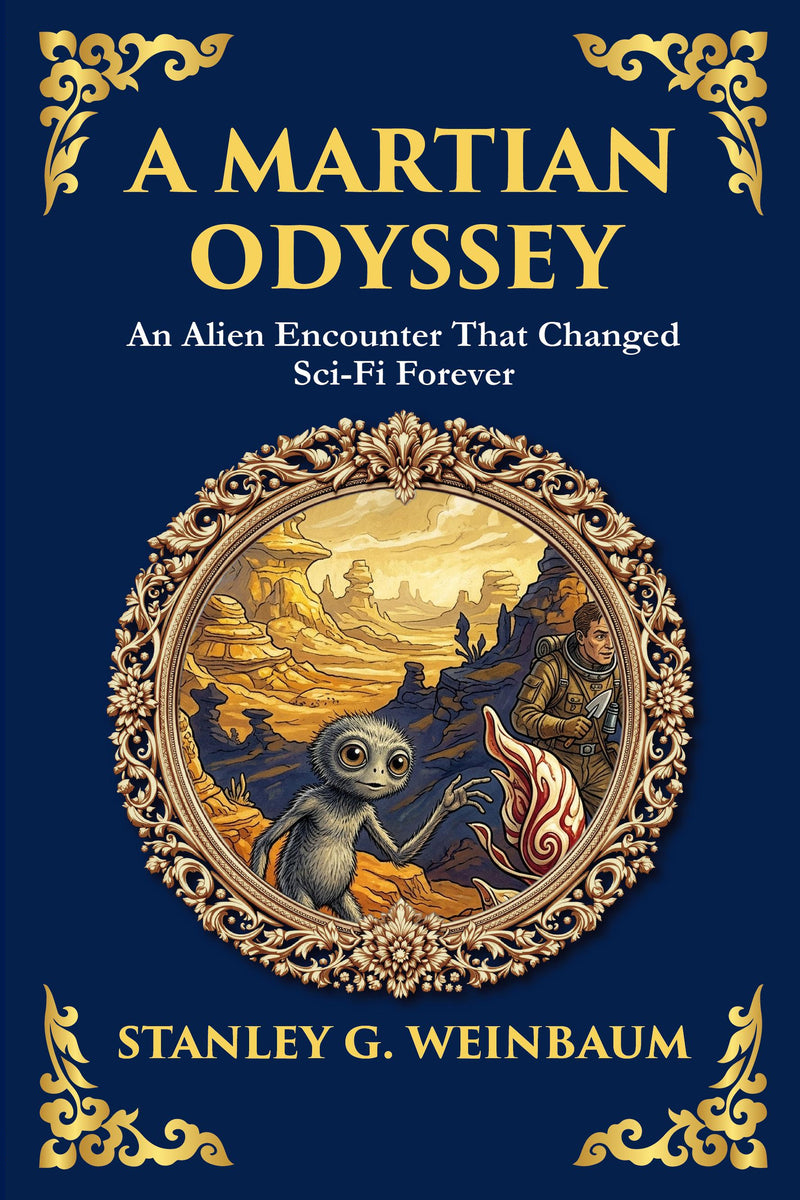
A Martian Odyssey
Before Star Trek and The Martian, there was A Martian Odyssey—a groundbreaking tale that redefined what science fiction could be.
or free app
10,000+ hrs library
30-day guarantee
The complete A Martian Odyssey appears in modern English through Library of Alexandria Press, available online with audiobook narration included for members.
Have you ever wondered why this one short story changed the course of science fiction history? A Martian Odyssey is not just a tale of space exploration—it’s a turning point in literary science fiction. When Stanley G. Weinbaum introduced the alien character Tweel in 1934, he shattered the mold of mindless monsters and made first contact with truly alien intelligence.
This story follows astronaut Dick Jarvis, who becomes stranded on Mars and meets the eccentric and puzzling Tweel. Together, they embark on a surreal and treacherous odyssey through the Martian landscape—encountering unimaginable lifeforms, strange civilizations, and profound questions about intelligence, language, and connection. Far ahead of its time, A Martian Odyssey blends scientific vision with emotional depth, delivering a story that is both thrilling and deeply philosophical.
It’s not just about space—it’s about empathy, understanding, and the unknown.
What you’ll discover in this modern edition
- The Original Sci-Fi Masterpiece of Alien Contact – Discover the story that forever changed how extraterrestrials were portrayed in fiction.
| Formats | eBook (EPUB + PDF) · Audiobook · Paperback · Hardcover · Large Print |
| Language | English |
| Trim size (print) | 6 × 9 in |
| Binding | Paperback — perfect-bound · Hardcover — casewrap |
| Large Print edition | Same text in a larger, easy-read type — a larger font, not a larger trim |
| Print pricing | Every physical book at our true cost — at-cost, no profit (members) |
| Library | 873 restored titles, always growing |
| Length | 14,019 words · ~56 min reading |
| Reading level | Grade 3 · an easy, flowing read (this modern-English edition) |
| Edition | Modern English translation · 2026 |
Member reviews for this edition are collected as readers finish it — be the first. Across the library: 12,000+ books shipped, every plan covered by a 365-day print guarantee.
About this edition
A faithful, unabridged modern-English edition by The Library of Alexandria — carefully rendered for today's reader and verified paragraph-by-paragraph against the public-domain source. Available as eBook, audiobook, paperback, hardcover, and large print.
- Complete & unabridgedVerified paragraph by paragraph against the source — never a scan, never abridged.
- Modern English, faithfulReadable today, with the author’s meaning kept intact. Readable — not simplified.
- Every format, one membershipRead in your browser or the free app, or listen to the full audiobook.
Included free with your membership
Cancel anytime, one click · 30-day money-back guarantee
Edition last updated July 2026
What’s inside
A Martian Odyssey — complete and unabridged, included in full with membership, plus the full audiobook.
Begin reading A Martian Odyssey
In clear modern English — the complete text is included with membership.
Introduction
When this story first appeared in the July 1934 issue of Wonder Stories, it landed with the quiet force of a paradigm shift. Readers who picked up that pulp magazine, drawn by lurid cover art and the promise of interplanetary adventure, encountered something they had never quite seen before. Within a few thousand words, a young schoolteacher and chemist from Milwaukee named Stanley G. Weinbaum had rewritten the rules of what an alien could be, what a journey to another world might mean, and how science fiction itself could feel. The effect on the genre’s most influential figures was immediate and lasting. Decades later, when the Science Fiction Writers of America assembled their landmark anthology of the finest stories published before the founding of the Nebula Awards, this tale was placed first in the volume, an honor reflecting its near-universal recognition as a foundational text. To read it now is to encounter the precise moment when an entire literary tradition grew up.
To understand why this slim narrative carried such weight, it helps to imagine the landscape into which it arrived. The early 1930s were the high noon of pulp science fiction, an era of breathless space operas and ray-gun heroics. The Martians, Venusians, and assorted extraterrestrials who populated these stories tended to fall into two tidy categories. They were either menacing monsters bent on the destruction of humanity, slavering creatures whose only function was to threaten the square-jawed Earthman, or they were thinly veiled humans in costume, beings who thought, spoke, and behaved exactly as a twentieth-century American might, differing only in the color of their skin or the number of their limbs. The alien, in other words, was either an enemy to be conquered or a mirror reflecting ourselves back at us. What almost no writer had attempted was the far more difficult and far more interesting proposition: an alien that was genuinely, fundamentally other, a creature whose mind operated according to a logic neither hostile nor familiar, a being one might encounter and simply fail to comprehend, not because it wished us harm but because its very nature lay outside the boundaries of human thought.
This is the achievement that made Weinbaum’s contribution revolutionary, and it is the experience that awaits you in these pages. Without revealing the particulars of the journey, it is enough to say that the protagonist, a member of an expedition to Mars, finds himself stranded and alone in an unfamiliar landscape, and there makes contact with a native inhabitant. What unfolds between them is not a battle and not a tidy friendship, but something stranger and far more rewarding: an attempt at understanding across a gulf so vast that communication itself becomes the central drama. The creature that the explorer meets is one of the most beloved inventions in the history of the genre, a being so vividly realized, so charming and inscrutable in equal measure, that it has lingered in the imaginations of readers and writers for the better part of a century. You will know it when you meet it, and you will not soon forget it.
The story of Stanley Grauman Weinbaum is one of the most poignant in all of science fiction, a career that burned with extraordinary brilliance for a tragically brief span. Born in Louisville, Kentucky, in 1902, Weinbaum grew up in a cultured household and went on to study at the University of Wisconsin, where he pursued chemical engineering before transferring to English. This dual grounding, in the hard precision of science and the supple craft of language, would prove essential to the distinctive voice he brought to the field. He worked variously as a movie theater manager and in other occupations through the lean years of the Great Depression, and he had already tried his hand at fiction, publishing a romance novel under a pseudonym, before he turned his attention to the speculative tale that would make his name.
What is remarkable, and what lends his story its particular emotional resonance for those who love the genre, is how little time he had. The work you are about to read was his very first published science fiction story. From that debut in the summer of 1934 to his death from lung cancer in December of 1935, Weinbaum’s entire career as a science fiction author spanned roughly eighteen months. In that compressed window he produced a body of work, a sequel to this very tale among them, along with a handful of other stories and novels, that would influence the development of the entire field out of all proportion to its size. He was thirty-three years old when he died. One can only speculate about what he might have accomplished had he been granted the decades that lesser talents enjoyed.
The reaction to his death within the small, passionate community of science fiction readers and writers speaks volumes about the impact he had made in so short a time. The grief was genuine and widespread. Isaac Asimov, who would go on to become one of the towering figures of the genre, later wrote with characteristic candor about the influence Weinbaum had exerted on him as a young aspiring writer. Asimov recalled the powerful, almost vertiginous feeling of encountering this story for the first time, the sudden recognition that science fiction could do things he had not previously imagined possible. He spoke of how Weinbaum had shown an entire generation of writers that aliens need not be either villains or men in masks, and that the genre could aspire to a kind of imaginative sophistication it had rarely reached before. Other luminaries echoed the sentiment. The sense among Weinbaum’s contemporaries was that they had lost not merely a talented colleague but a writer who was actively expanding the possibilities of their art, and who might have led the field into entirely new territory had he lived.
It is worth pausing on what, precisely, Weinbaum did differently, because understanding his innovation will deepen your appreciation of the reading experience ahead. The breakthrough was not simply that he invented a strange-looking creature; pulp magazines had been full of strange-looking creatures for years. The breakthrough was that he imagined an alien psychology. His Martians do not behave the way humans behave because they are not human, and Weinbaum had the discipline and the imagination to follow that premise to its logical and bewildering conclusions. The result is a portrait of contact between species that feels at once comic and profound, frustrating and exhilarating. The human characters cannot always understand what they are seeing, and Weinbaum trusts his readers to share in that productive confusion rather than spelling everything out. This was a radical act of authorial restraint and respect, and it pointed the way toward the more mature, more genuinely speculative science fiction that would flourish in the decades to follow.
There is also a tone to Weinbaum’s writing that sets it apart from much of the somber, portentous fiction that surrounded it. His prose has a lightness, a wit, an easy camaraderie among its characters that makes the reading a pleasure even apart from its conceptual innovations. The members of the expedition banter and tease one another; the narrator approaches the wonders of Mars with a blend of awe and good humor that feels thoroughly modern. There is no pretension here, no straining after significance. Weinbaum simply tells a wonderful adventure story populated by likable people and an unforgettable alien, and in doing so he changed everything. That combination of accessibility and depth, of entertainment and intellectual substance, is exactly what the best science fiction has aspired to ever since, and it began, in large measure, here.
This edition has been prepared as a modern translation, adapted for the contemporary reader, and a word about what that means will help you settle into the experience with the right expectations. A work written and published in 1934 inevitably carries with it the linguistic textures of its era. Slang that was current then may puzzle a reader today; scientific assumptions that seemed reasonable to Weinbaum and his audience have since been overtaken by discovery; sentence rhythms and turns of phrase that felt natural to a Depression-era pulp reader can occasionally create small barriers for someone coming to the text nearly a century later. The purpose of this adaptation is to gently smooth those barriers, to ensure that the brilliance of the storytelling reaches you unobstructed, while preserving everything that makes the original a treasure.
It is important to be honest about a particular dimension of reading vintage science fiction, and to do so without condescension toward either the author or yourself. The Mars of this story is, scientifically speaking, a Mars that never existed. When Weinbaum was writing, the red planet was still a realm of romantic speculation. The notion that Mars might harbor life of some kind, even intelligent life, was not the fringe fantasy it would later become; it occupied a genuine place in the scientific and popular imagination, fed by the famous and ultimately mistaken observations of “canals” crisscrossing the planet’s surface. Weinbaum gives his Mars an atmosphere a person can breathe, at least for a time, along with vegetation, varied life forms, and landscapes that an explorer might traverse on foot. None of this corresponds to the frigid, nearly airless, radiation-scoured world that spacecraft have since revealed to us.
To read the story today, then, is to engage in a small but delightful act of imaginative generosity. You are invited not to fact-check Weinbaum against the latest planetary science, an exercise that would miss the point entirely, but to enter into the Mars of 1934, a place of dreams and possibilities, and to take it on its own terms. This is no different from the pleasure we take in reading any work of period fiction. We do not fault the great voyage narratives of earlier centuries for their geographical errors, nor do we dismiss the sea monsters of ancient maps because we now know what lies beyond the horizon. We recognize instead that these visions tell us something true about the human imagination and its hunger to populate the unknown. The Mars of this story belongs to that grand tradition of imagined worlds, and it has a charm and a coherence all its own. Once you accept its premises, the world Weinbaum builds is internally consistent, richly detailed, and wonderfully strange.
This translation, accordingly, has made no attempt to “correct” the science. To do so would be to vandalize the work, to impose our knowledge upon a vision that was complete and beautiful in itself. What the adaptation does instead is ensure that the language carrying that vision is clear and inviting, that the dialogue reads naturally, and that the pacing serves the modern reader’s experience without sacrificing the period flavor that is part of the story’s considerable appeal. The goal throughout has been fidelity to Weinbaum’s spirit, to his wit, his sense of wonder, his humane and curious view of the universe, while removing the small frictions that the passage of nearly a century inevitably introduces. You will find here the story as Weinbaum meant it to be received: fresh, lively, and irresistibly readable.
A reader new to fiction of this vintage should also be prepared for, and indeed should savor, the particular texture of the early pulp adventure. The narrative does not waste time. There is an economy and a momentum to it that reflects its origins in a competitive marketplace of magazines where stories had to grab the reader at once and never let go. The characters are drawn quickly but vividly, sketched with a few deft strokes that nonetheless leave a lasting impression. The exposition, the necessary business of explaining the situation, is handled through a framing device that feels conversational and unforced, so that information arrives naturally rather than being dumped upon the reader in heavy paragraphs. This is craftsmanship of a high order disguised as simplicity, and it rewards attention. Notice, as you read, how efficiently Weinbaum establishes his world, how naturally his characters speak, and how he manages to convey genuine wonder without ever stooping to purple prose.
Cancel anytime, one click · 30-day money-back guarantee
Founding annual rate available now — your price locks for life when you join.
Not ready? Get this free chapter by email — read it anytime.
✓ Sent — check your inbox for A Martian Odyssey.
Questions about A Martian Odyssey
What is A Martian Odyssey about?
Before Star Trek and The Martian, there was A Martian Odyssey—a groundbreaking tale that redefined what science fiction could be. Stanley G. Weinbaum’s visionary short story stunned readers in 1934 with its complex alien lifeforms, scientifically grounded setting, and truly non- human intelligence. When astronaut Jarvis crash-lands on Mars, he encounters the bizarre yet intelligent creature Tweel.
Who wrote A Martian Odyssey?
A Martian Odyssey was written by Stanley G. Weinbaum. This edition presents the complete work in clear modern English, faithfully rendered from the public-domain original by Library of Alexandria Press.
Is A Martian Odyssey free to read?
The opening chapter is free to read on this page. Members read and listen to the complete work — and the entire library — free, and can order any physical book at our true print cost.
How long is A Martian Odyssey?
2 chapters (~14,019 words) — about 56 min of reading in this modern-English edition.
Is this an abridged version of A Martian Odyssey?
No. This is the complete, unabridged A Martian Odyssey, carefully rendered into clear modern English and verified paragraph-by-paragraph against the public-domain source — nothing is cut or summarised.
What formats does A Martian Odyssey come in?
A Martian Odyssey is available as eBook, paperback, hardcover and large print. eBook and audiobook are included with membership; printed editions ship at our true print cost.
Shipping & returns
Billing & membership
More from the library


Explore Adventure
- Tarzan of the Apes · Edgar Rice Burroughs
- The Wonderful Wizard of Oz · L. Frank Baum
- Peter Pan · J. M. Barrie
- Moby Dick; Or, The Whale · Herman Melville
- The Riddle of the Sands · Erskine Childers
- The Loss of the Swansea: A Story of the Florida Coast · W. L. Alden
- Sky Island · L. Frank Baum
- Vikram and the Vampire: Classic Hindu Tales of Adventure, Magic, and Romance · Unknown
- Tales of Unrest · Joseph Conrad
- The Tomb of Ts’in · Edgar Wallace
- Skinny McCord · Percy Keese Fitzhugh
- The Men of the Moss-Hags · S. R. Crockett
- The Hunniwell Boys and the Platinum Mystery · L. P. Wyman
- Allan Quatermain · H. Rider Haggard
- She · H. Rider Haggard
- Medical Life in the Navy · Gordon Stables
- The Thirty-Nine Steps · John Buchan
- The Story of Doctor Dolittle · Hugh Lofting
- The Princess and the Goblin · George MacDonald
- The Man Who Would Be King · Rudyard Kipling
- Lucian’s True History · Lucian of Samosata
- The Secret Adversary · Agatha Christie
- Lord Jim · Joseph Conrad
- The Marvelous Land of Oz · L. Frank Baum
- The Virginian: A Horseman of the Plains · Owen Wister
- Mars is My Destination · Frank Belknap Long
- Anabasis · Xenophon
- The Mississippi Saucer · Frank Belknap Long
- Sabotage in Space · Carey Rockwell
- Brood of the Dark Moon · Charles Willard Diffin
A Martian Odyssey
A Martian Odyssey
An Alien Encounter That Changed Sci-Fi Forever
Stanley G. Weinbaum
Contents
- Introduction
- A Martian Odyssey
Introduction
When this story first appeared in the July 1934 issue of Wonder Stories, it landed with the quiet force of a paradigm shift. Readers who picked up that pulp magazine, drawn by lurid cover art and the promise of interplanetary adventure, encountered something they had never quite seen before. Within a few thousand words, a young schoolteacher and chemist from Milwaukee named Stanley G. Weinbaum had rewritten the rules of what an alien could be, what a journey to another world might mean, and how science fiction itself could feel. The effect on the genre’s most influential figures was immediate and lasting. Decades later, when the Science Fiction Writers of America assembled their landmark anthology of the finest stories published before the founding of the Nebula Awards, this tale was placed first in the volume, an honor reflecting its near-universal recognition as a foundational text. To read it now is to encounter the precise moment when an entire literary tradition grew up.
To understand why this slim narrative carried such weight, it helps to imagine the landscape into which it arrived. The early 1930s were the high noon of pulp science fiction, an era of breathless space operas and ray-gun heroics. The Martians, Venusians, and assorted extraterrestrials who populated these stories tended to fall into two tidy categories. They were either menacing monsters bent on the destruction of humanity, slavering creatures whose only function was to threaten the square-jawed Earthman, or they were thinly veiled humans in costume, beings who thought, spoke, and behaved exactly as a twentieth-century American might, differing only in the color of their skin or the number of their limbs. The alien, in other words, was either an enemy to be conquered or a mirror reflecting ourselves back at us. What almost no writer had attempted was the far more difficult and far more interesting proposition: an alien that was genuinely, fundamentally other, a creature whose mind operated according to a logic neither hostile nor familiar, a being one might encounter and simply fail to comprehend, not because it wished us harm but because its very nature lay outside the boundaries of human thought.
This is the achievement that made Weinbaum’s contribution revolutionary, and it is the experience that awaits you in these pages. Without revealing the particulars of the journey, it is enough to say that the protagonist, a member of an expedition to Mars, finds himself stranded and alone in an unfamiliar landscape, and there makes contact with a native inhabitant. What unfolds between them is not a battle and not a tidy friendship, but something stranger and far more rewarding: an attempt at understanding across a gulf so vast that communication itself becomes the central drama. The creature that the explorer meets is one of the most beloved inventions in the history of the genre, a being so vividly realized, so charming and inscrutable in equal measure, that it has lingered in the imaginations of readers and writers for the better part of a century. You will know it when you meet it, and you will not soon forget it.
The story of Stanley Grauman Weinbaum is one of the most poignant in all of science fiction, a career that burned with extraordinary brilliance for a tragically brief span. Born in Louisville, Kentucky, in 1902, Weinbaum grew up in a cultured household and went on to study at the University of Wisconsin, where he pursued chemical engineering before transferring to English. This dual grounding, in the hard precision of science and the supple craft of language, would prove essential to the distinctive voice he brought to the field. He worked variously as a movie theater manager and in other occupations through the lean years of the Great Depression, and he had already tried his hand at fiction, publishing a romance novel under a pseudonym, before he turned his attention to the speculative tale that would make his name.
What is remarkable, and what lends his story its particular emotional resonance for those who love the genre, is how little time he had. The work you are about to read was his very first published science fiction story. From that debut in the summer of 1934 to his death from lung cancer in December of 1935, Weinbaum’s entire career as a science fiction author spanned roughly eighteen months. In that compressed window he produced a body of work, a sequel to this very tale among them, along with a handful of other stories and novels, that would influence the development of the entire field out of all proportion to its size. He was thirty-three years old when he died. One can only speculate about what he might have accomplished had he been granted the decades that lesser talents enjoyed.
The reaction to his death within the small, passionate community of science fiction readers and writers speaks volumes about the impact he had made in so short a time. The grief was genuine and widespread. Isaac Asimov, who would go on to become one of the towering figures of the genre, later wrote with characteristic candor about the influence Weinbaum had exerted on him as a young aspiring writer. Asimov recalled the powerful, almost vertiginous feeling of encountering this story for the first time, the sudden recognition that science fiction could do things he had not previously imagined possible. He spoke of how Weinbaum had shown an entire generation of writers that aliens need not be either villains or men in masks, and that the genre could aspire to a kind of imaginative sophistication it had rarely reached before. Other luminaries echoed the sentiment. The sense among Weinbaum’s contemporaries was that they had lost not merely a talented colleague but a writer who was actively expanding the possibilities of their art, and who might have led the field into entirely new territory had he lived.
It is worth pausing on what, precisely, Weinbaum did differently, because understanding his innovation will deepen your appreciation of the reading experience ahead. The breakthrough was not simply that he invented a strange-looking creature; pulp magazines had been full of strange-looking creatures for years. The breakthrough was that he imagined an alien psychology. His Martians do not behave the way humans behave because they are not human, and Weinbaum had the discipline and the imagination to follow that premise to its logical and bewildering conclusions. The result is a portrait of contact between species that feels at once comic and profound, frustrating and exhilarating. The human characters cannot always understand what they are seeing, and Weinbaum trusts his readers to share in that productive confusion rather than spelling everything out. This was a radical act of authorial restraint and respect, and it pointed the way toward the more mature, more genuinely speculative science fiction that would flourish in the decades to follow.
There is also a tone to Weinbaum’s writing that sets it apart from much of the somber, portentous fiction that surrounded it. His prose has a lightness, a wit, an easy camaraderie among its characters that makes the reading a pleasure even apart from its conceptual innovations. The members of the expedition banter and tease one another; the narrator approaches the wonders of Mars with a blend of awe and good humor that feels thoroughly modern. There is no pretension here, no straining after significance. Weinbaum simply tells a wonderful adventure story populated by likable people and an unforgettable alien, and in doing so he changed everything. That combination of accessibility and depth, of entertainment and intellectual substance, is exactly what the best science fiction has aspired to ever since, and it began, in large measure, here.
This edition has been prepared as a modern translation, adapted for the contemporary reader, and a word about what that means will help you settle into the experience with the right expectations. A work written and published in 1934 inevitably carries with it the linguistic textures of its era. Slang that was current then may puzzle a reader today; scientific assumptions that seemed reasonable to Weinbaum and his audience have since been overtaken by discovery; sentence rhythms and turns of phrase that felt natural to a Depression-era pulp reader can occasionally create small barriers for someone coming to the text nearly a century later. The purpose of this adaptation is to gently smooth those barriers, to ensure that the brilliance of the storytelling reaches you unobstructed, while preserving everything that makes the original a treasure.
It is important to be honest about a particular dimension of reading vintage science fiction, and to do so without condescension toward either the author or yourself. The Mars of this story is, scientifically speaking, a Mars that never existed. When Weinbaum was writing, the red planet was still a realm of romantic speculation. The notion that Mars might harbor life of some kind, even intelligent life, was not the fringe fantasy it would later become; it occupied a genuine place in the scientific and popular imagination, fed by the famous and ultimately mistaken observations of “canals” crisscrossing the planet’s surface. Weinbaum gives his Mars an atmosphere a person can breathe, at least for a time, along with vegetation, varied life forms, and landscapes that an explorer might traverse on foot. None of this corresponds to the frigid, nearly airless, radiation-scoured world that spacecraft have since revealed to us.
To read the story today, then, is to engage in a small but delightful act of imaginative generosity. You are invited not to fact-check Weinbaum against the latest planetary science, an exercise that would miss the point entirely, but to enter into the Mars of 1934, a place of dreams and possibilities, and to take it on its own terms. This is no different from the pleasure we take in reading any work of period fiction. We do not fault the great voyage narratives of earlier centuries for their geographical errors, nor do we dismiss the sea monsters of ancient maps because we now know what lies beyond the horizon. We recognize instead that these visions tell us something true about the human imagination and its hunger to populate the unknown. The Mars of this story belongs to that grand tradition of imagined worlds, and it has a charm and a coherence all its own. Once you accept its premises, the world Weinbaum builds is internally consistent, richly detailed, and wonderfully strange.
This translation, accordingly, has made no attempt to “correct” the science. To do so would be to vandalize the work, to impose our knowledge upon a vision that was complete and beautiful in itself. What the adaptation does instead is ensure that the language carrying that vision is clear and inviting, that the dialogue reads naturally, and that the pacing serves the modern reader’s experience without sacrificing the period flavor that is part of the story’s considerable appeal. The goal throughout has been fidelity to Weinbaum’s spirit, to his wit, his sense of wonder, his humane and curious view of the universe, while removing the small frictions that the passage of nearly a century inevitably introduces. You will find here the story as Weinbaum meant it to be received: fresh, lively, and irresistibly readable.
A reader new to fiction of this vintage should also be prepared for, and indeed should savor, the particular texture of the early pulp adventure. The narrative does not waste time. There is an economy and a momentum to it that reflects its origins in a competitive marketplace of magazines where stories had to grab the reader at once and never let go. The characters are drawn quickly but vividly, sketched with a few deft strokes that nonetheless leave a lasting impression. The exposition, the necessary business of explaining the situation, is handled through a framing device that feels conversational and unforced, so that information arrives naturally rather than being dumped upon the reader in heavy paragraphs. This is craftsmanship of a high order disguised as simplicity, and it rewards attention. Notice, as you read, how efficiently Weinbaum establishes his world, how naturally his characters speak, and how he manages to convey genuine wonder without ever stooping to purple prose.
Jarvis stretched his body as much as he could in the tight living quarters of the Ares.
“Air you can actually breathe!” he exclaimed. “Compared to the thin stuff outside, this feels as thick as soup!” He nodded toward the Martian landscape, which looked flat and empty in the light of the closer moon, visible through the window of the port.
The other three looked at him with sympathy: Putz the engineer, Leroy the biologist, and Harrison, the astronomer and captain of the mission. Dick Jarvis was the chemist for this famous crew, the Ares expedition—the first humans to step foot on Earth’s mysterious neighbor, the planet Mars. This happened in the old days, less than twenty years after the eccentric American Doheny died perfecting the atomic blast, and only ten years after the equally wild Cardoza used that technology to travel to the moon. These four members of the Ares were true pioneers. Aside from a few moon missions and the disastrous de Lancey flight toward the tempting planet Venus, they were the first people to experience gravity other than Earth’s, and certainly the first successful crew to leave the Earth-moon system. They earned that success given the hardships they faced—spending months in acclimation chambers on Earth learning to breathe air as thin as Mars’, braving the void in a tiny rocket powered by the temperamental engines of the twenty-first century, and, above all, facing a completely unknown world.
Jarvis stretched and touched the raw, peeling tip of his frostbitten nose. He let out another satisfied sigh.
“Alright,” Harrison suddenly burst out, “are we going to hear what happened? You left in a small auxiliary rocket, we didn’t hear a word from you for ten days, and finally Putz finds you in a crazy ant-hill with a weird ostrich for a buddy! Start talking!”
End of the free sample
Keep reading, free
Members read and listen to the complete book — and the entire library. Cancel anytime, one click · 30-day money-back guarantee.