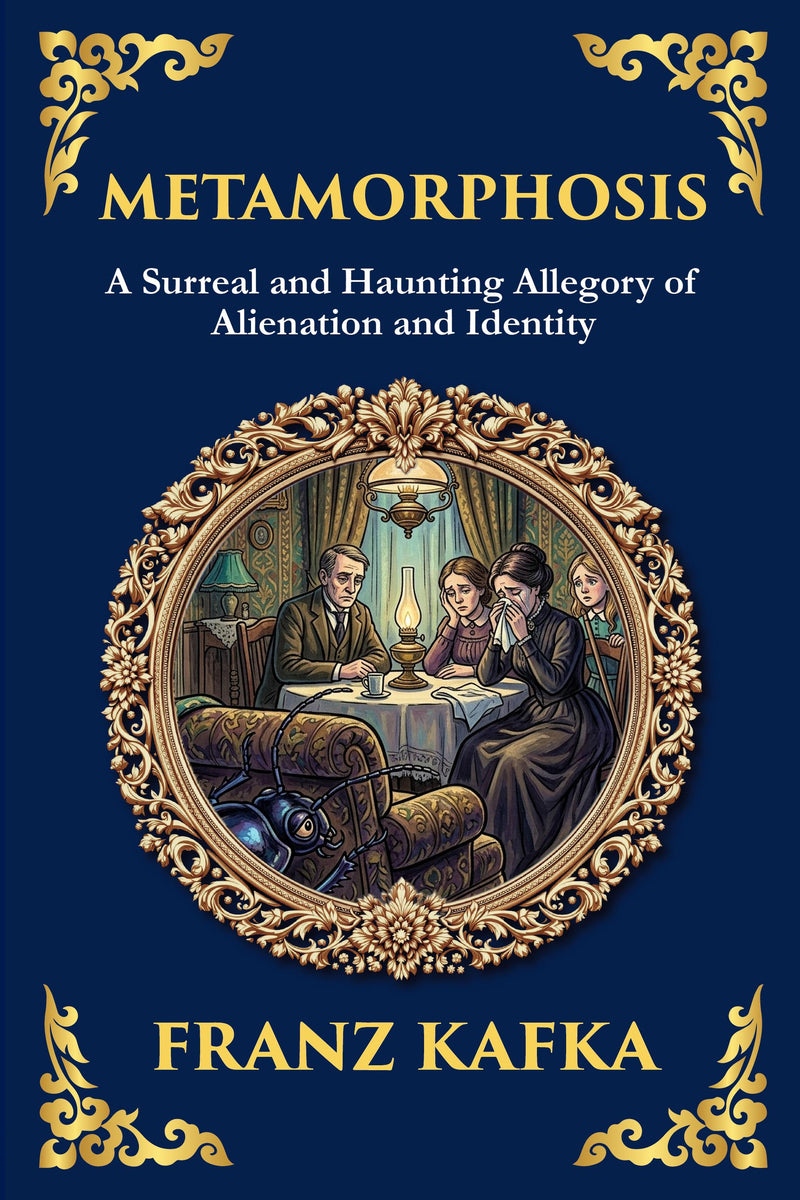
Metamorphosis — Large Print
One morning, Gregor Samsa awakens not as a man, but as a monstrous insect. Trapped in a grotesque body, he watches helplessly as his world unravels—his family recoils, his work is lost, and his humanity slowly slips away.
or free app
10,000+ hrs library
30-day guarantee
The complete Metamorphosis appears in modern English through Library of Alexandria Press, available online with audiobook narration included for members.
Have you ever wondered why one man’s monstrous transformation still terrifies and captivates the world? Metamorphosis is Franz Kafka’s surreal, disturbing, and deeply moving exploration of the human condition. When Gregor Samsa, a dutiful traveling salesman, awakens to find himself transformed into a giant insect, he becomes an outcast within his own home.
Once the provider and pride of his family, Gregor is now a source of shame and burden—trapped not only in a hideous form but in the crushing weight of isolation and rejection. Kafka’s novella transcends its bizarre premise to confront profound truths about identity, responsibility, guilt, and the cold mechanisms of modern life. Written in spare, haunting prose, this enduring classic is as relevant today as it was upon publication—a mirror held up to the soul of society.
What you’ll discover in this modern edition
- A Profound Allegory of Transformation and Loss Experience Gregor’s physical and emotional metamorphosis as a symbol for societal rejection, mental illness, or existential crisis.
- A Masterwork of 20th Century Literature Kafka’s minimalist style and penetrating insight continue to define literary modernism.
- Themes That Resonate Universally Explore timeless reflections on alienation, identity, family obligation, and the human struggle for meaning.
- A Journey Into Psychological Horror Witness the slow unraveling of a man’s sense of self as he’s cast out by those who once depended on him.
- A Story That Asks Uncomfortable Questions Who are we when we can no longer perform our roles? What is the true nature of love, duty, and empathy?
| Formats | eBook (EPUB + PDF) · Audiobook · Paperback · Hardcover · Large Print |
| Language | English |
| Trim size (print) | 6 × 9 in |
| Binding | Paperback — perfect-bound · Hardcover — casewrap |
| Large Print edition | Same text in a larger, easy-read type — a larger font, not a larger trim |
| Print pricing | Every physical book at our true cost — at-cost, no profit (members) |
| Library | 873 restored titles, always growing |
| Length | 21,781 words · ~1 hr 27 min reading |
| Reading level | Grade 4 · an easy, flowing read (this modern-English edition) |
| Edition | Modern English translation · 2026 |
Member reviews for this edition are collected as readers finish it — be the first. Across the library: 12,000+ books shipped, every plan covered by a 365-day print guarantee.
About this edition
A faithful, unabridged modern-English edition by The Library of Alexandria — carefully rendered for today's reader and verified paragraph-by-paragraph against the public-domain source. Available as eBook, audiobook, paperback, hardcover, and large print.
- Complete & unabridgedVerified paragraph by paragraph against the source — never a scan, never abridged.
- Modern English, faithfulReadable today, with the author’s meaning kept intact. Readable — not simplified.
- Every format, one membershipRead in your browser or the free app, or listen to the full audiobook.
Included free with your membership
Cancel anytime, one click · 30-day money-back guarantee
Edition last updated July 2026
What’s inside
Metamorphosis — Large Print — complete and unabridged: all 4 sections included with membership, plus the full audiobook.
Begin reading Metamorphosis — Large Print
In clear modern English — the complete text is included with membership.
Introduction
There are certain stories that, once read, never quite release their hold on the imagination. They lodge themselves somewhere beneath conscious thought, surfacing in odd moments—when we wake disoriented from a dream, when we feel suddenly estranged from our own reflection, when we sense, however briefly, that we have become strangers in the very life we have built for ourselves. Among all the works of modern literature, few accomplish this with such quiet, devastating precision as the brief, unsettling tale you are about to read. It opens with one of the most famous sentences ever committed to paper, and from that single declarative moment, it draws the reader into a world that is at once utterly impossible and disturbingly familiar.
Franz Kafka wrote this novella in the autumn of 1912, completing it over the course of a few feverish weeks in November and December of that year. He was working at the time as a clerk in an insurance institute in Prague, a position that consumed his days and left him only the exhausted hours of the night for the writing that mattered to him. This dual existence—the obedient functionary by daylight, the tormented artist by candlelight—would prove inseparable from the themes that animate his fiction. He understood, perhaps better than any writer before or since, what it means to feel divided against oneself, to perform a role that fits like an ill-made coat, to suspect that the person others see is not the person who lives behind the eyes. That sense of internal exile pervades every page of this work, and it is one of the reasons the story has lost none of its force in more than a century of readers.
The premise is deceptively simple. A young man, a traveling salesman who supports his family through wearying, unglamorous labor, awakens one morning to find himself transformed. What follows is not an adventure, nor a horror story in any conventional sense, nor a fable with a tidy moral waiting at its conclusion. It is something stranger and more profound: an unflinching examination of what happens to a human being—and to the people around him—when the comfortable arrangements of ordinary life are abruptly and irreversibly broken. The genius of the tale lies not in the transformation itself, which Kafka presents with an almost clinical matter-of-factness, but in everything that comes after it. The fantastical event is merely the door through which we enter; the real territory of the story is the heart, the household, and the brutal economics of love and obligation.
This edition presents the story in a modern translation, adapted with the contemporary reader firmly in mind. There is a reason such care has been taken with the language, and it is worth pausing to understand it. Kafka wrote in German, and his prose has a peculiar quality that has long challenged translators. On the surface it is plain, even bureaucratic—he was, after all, a man who spent his working life drafting reports and assessing risk. His sentences can be long and labyrinthine, winding through subordinate clauses in a manner natural to German but treacherous in English. Beneath that surface plainness, however, runs an undercurrent of dark comedy, of pathos, of a horror so understated it can be missed entirely if the rhythm of the prose is wrong. To render Kafka faithfully is to walk a tightrope: too literal, and the English becomes stilted and airless; too free, and the unsettling precision that makes the work so powerful dissolves into mere oddity.
The aim of this adaptation is to give you the experience that German-speaking readers have always had: a story whose language is clear, immediate, and accessible, allowing the strangeness of the events to land with full impact rather than being obscured by archaic phrasing or grammatical knots. You will not have to fight your way through the prose to reach the meaning. Instead, the meaning will come to you directly, with the cool, almost matter-of-fact tone that is so essential to the story’s effect. For this is a tale that derives much of its power from restraint. Kafka never shouts. He never tells you how to feel. He simply observes, with terrible patience, and lets the implications accumulate until they become almost unbearable.
It is important to approach this work without the expectation that it will explain itself. Readers accustomed to fiction that resolves its mysteries, that offers reasons and reassurances, may find the experience initially disorienting. Why does the transformation happen? The story does not say. It never says. And this refusal is not a flaw or an omission—it is the entire point. The transformation is presented as a given, an irreversible fact of the world the moment the story begins, and the absence of any cause invites us to read it not as a puzzle to be solved but as a condition to be inhabited. In this sense, the tale operates more like a dream than a conventional narrative. Things happen because they happen. The logic is emotional rather than mechanical. And like a dream, it speaks most directly to the parts of us that lie beneath rational thought—our fears of becoming useless, of being abandoned, of losing the love we depend upon, of discovering that our worth in the eyes of others was always conditional, always tied to what we could provide rather than to who we are.
The word that has come to define this entire mode of storytelling is, fittingly, the author’s own name turned into an adjective. To describe a situation as “Kafkaesque” is to evoke a particular flavor of modern dread: the experience of confronting an indifferent, incomprehensible system; of being trapped in circumstances that obey their own merciless logic; of trying, with mounting desperation, to communicate across an unbridgeable gap. This story is perhaps the purest distillation of that sensibility ever written. The protagonist’s plight is, on its surface, a fantasy, but the feelings it produces—the helplessness, the shame, the longing to be understood, the slow erosion of identity under the pressure of others’ expectations—are profoundly, painfully real. We may never wake to find ourselves transformed in the literal sense, but who among us has not felt, at some low moment, that we have become something monstrous in the eyes of those we love, or that the self we present to the world bears little resemblance to the creature that lives within?
This is the secret of the story’s endurance. It is, at its core, an allegory of alienation, and alienation is not a problem unique to any single era. If anything, the conditions that produce it have only intensified in the century since Kafka set down his pen. We live now in a world of relentless productivity, where human beings are measured by their output, where the fear of becoming a burden haunts the aging, the ill, and the unemployed alike. We live amid technologies that promise connection yet so often deliver isolation, in households and workplaces where roles are rigidly defined and where stepping outside those roles can cost us everything. The salesman at the heart of this story, who exists almost entirely to serve the needs of others and who is valued chiefly for his earnings, will feel uncannily contemporary to many readers. His situation, stripped of its fantastical element, is the situation of anyone who has ever wondered whether they would still be loved if they could no longer be useful.
What makes the novella so much richer than a simple parable, however, is its acute attention to the dynamics of family. For while the transformation happens to one individual, the story is in many ways about the household around him—about how a family responds when one of its members can no longer fulfill the function assigned to him. Kafka, who had a notoriously fraught relationship with his own father, understood the domestic sphere as a place of both refuge and oppression, of tenderness tangled inseparably with control. The family in this story is not a backdrop; it is the crucible in which the real drama unfolds. We watch the parents and the sister react to the catastrophe in their midst, and in their reactions—their pity, their revulsion, their attempts at kindness, their slow drift toward resentment and exhaustion—we recognize something true and uncomfortable about human nature itself.
There is a particular relationship at the center of the family that readers tend to find especially moving: the bond between the protagonist and his younger sister. In the early days following the transformation, it is she who shows the most compassion, who takes on the difficult, distasteful work of caring for him, who tries to imagine what he might need and to provide it. Through her, the story offers a flicker of hope, a suggestion that love might be capable of surviving even the most grotesque of transformations. But Kafka is too honest a writer to let that hope remain uncomplicated. The story traces, with heartbreaking subtlety, how even the most devoted care can curdle over time under the weight of burden and disappointment. It asks us to consider how long compassion can endure when it is met with no recovery, no improvement, no reciprocity—when the object of our care offers nothing back but the silent fact of his continued, inconvenient existence.
These are uncomfortable questions, and the story does not flinch from them. Yet it would be a mistake to think of this as a bleak or cynical work. There is, throughout, a deep current of compassion for the protagonist himself, whose inner life Kafka renders with extraordinary tenderness. Even in his altered state, he continues to worry about his family’s finances, to feel ashamed of the trouble he causes, to long for the warmth and acceptance he has lost. His thoughts remain those of a loving son and brother, a dutiful provider, a man who wants nothing more than to be a part of the life going on around him. The tragedy of the story is precisely this persistence of humanity in circumstances that render it invisible to everyone else. He remains himself, in all the ways that matter most, but no one can see it. And in that gap between the inner reality and the outer appearance lies the whole aching heart of the book.
Readers approaching the story for the first time should know that it rewards a slow, attentive reading. This is not a work to be rushed through. Its power accumulates gradually, through accretion of small details, through the careful tracking of shifts in mood and circumstance that might easily be missed by an impatient eye. Notice how the descriptions of physical space evolve—the protagonist’s room, the door that separates him from his family, the window through which he glimpses the outside world. Notice the changes in how he is fed, in what is brought to him and how it is offered. Notice the gradual transformation of the household around him, the way the family’s circumstances and attitudes shift in response to their altered situation. Kafka was a master of meaningful detail, and almost nothing in the story is accidental. The novella is short, but it is dense, and the reader who lingers will be richly rewarded.
It is also worth noting the strange streak of humor that runs through the work—a quality that surprises many first-time readers. Kafka himself is said to have laughed aloud while reading portions of his stories to friends. There is something absurd, almost comic, in the bureaucratic responses of the characters to the impossible situation they confront: the concern over employment, the anxiety about appearances, the petty domestic squabbles that continue even in the shadow of the extraordinary. This dark comedy is not a contradiction of the story’s seriousness; it is part of how the seriousness is delivered. The juxtaposition of the cosmic and the mundane, of the fantastical and the petty, produces an effect that is uniquely Kafkaesque—a kind of laughter that catches in the throat, that turns, almost without our noticing, into something closer to grief. Do not be surprised, then, if you find yourself smiling at moments that you know, somewhere deeper, are profoundly sad. That double response is exactly what the author intended.
Cancel anytime, one click · 30-day money-back guarantee
Founding annual rate available now — your price locks for life when you join.
Not ready? Get this free chapter by email — read it anytime.
✓ Sent — check your inbox for Metamorphosis — Large Print.
Questions about Metamorphosis — Large Print
What is Metamorphosis about?
One morning, Gregor Samsa awakens not as a man, but as a monstrous insect. Trapped in a grotesque body, he watches helplessly as his world unravels—his family recoils, his work is lost, and his humanity slowly slips away. In Metamorphosis, Franz Kafka delivers one of the most striking and unforgettable explorations of alienation, identity, and the fragility of human connection.
Who wrote Metamorphosis?
Metamorphosis was written by Franz Kafka. This edition presents the complete work in clear modern English, faithfully rendered from the public-domain original by Library of Alexandria Press.
Is Metamorphosis free to read?
The opening chapter is free to read on this page. Members read and listen to the complete work — and the entire library — free, and can order any physical book at our true print cost.
How long is Metamorphosis?
4 chapters (~21,781 words) — about 1 hr 27 min of reading in this modern-English edition.
Is this an abridged version of Metamorphosis?
No. This is the complete, unabridged Metamorphosis, carefully rendered into clear modern English and verified paragraph-by-paragraph against the public-domain source — nothing is cut or summarised.
What formats does Metamorphosis come in?
Metamorphosis is available as eBook, paperback, hardcover and large print. eBook and audiobook are included with membership; printed editions ship at our true print cost.
Shipping & returns
Billing & membership
More from the library


Explore Horror & Gothic
- The Strange Case of Dr. Jekyll and Mr. Hyde · Robert Louis Stevenson
- The Cask of Amontillado · Edgar Allan Poe
- Ghost Stories of an Antiquary · M. R. James
- The Monk: A Romance · M. G. Lewis
- The House of the Seven Gables · Nathaniel Hawthorne
- The Willows · Algernon Blackwood
- The Monkey’s Paw · W. W. Jacobs
- The Call of Cthulhu · H. P. Lovecraft
- The Life-Eater · Harold Ward
- The Black Kiss
- The Legend of Sleepy Hollow · Washington Irving
- Brood of the Dark Moon · Charles Willard Diffin
- The Night Land · William Hope Hodgson
- The Castle of Otranto · Horace Walpole
- Dracula · Bram Stoker
- Carmilla · Joseph Sheridan Le Fanu
- The King in Yellow · Robert W. Chambers
- Wuthering Heights · Emily Brontë
- The Vampyre: A Tale · John William Polidori
- A Christmas Carol · Charles Dickens
- Northanger Abbey · Jane Austen
- The Turn of the Screw · Henry James
- Metamorphosis · Franz Kafka
- The Yellow Wallpaper · Charlotte Perkins Gilman
- The Adventures of Ferdinand Count Fathom — Complete · T. Smollett
- The Picture of Dorian Gray · Oscar Wilde
- Frankenstein; Or, The Modern Prometheus · Mary Wollstonecraft Shelley
Metamorphosis — Large Print
Metamorphosis — Large Print
A Surreal and Haunting Allegory of Alienation and Identity
Franz Kafka
Contents
- Introduction
- Chapter 1
- Chapter 2
- Chapter 3
Introduction
There are certain stories that, once read, never quite release their hold on the imagination. They lodge themselves somewhere beneath conscious thought, surfacing in odd moments—when we wake disoriented from a dream, when we feel suddenly estranged from our own reflection, when we sense, however briefly, that we have become strangers in the very life we have built for ourselves. Among all the works of modern literature, few accomplish this with such quiet, devastating precision as the brief, unsettling tale you are about to read. It opens with one of the most famous sentences ever committed to paper, and from that single declarative moment, it draws the reader into a world that is at once utterly impossible and disturbingly familiar.
Franz Kafka wrote this novella in the autumn of 1912, completing it over the course of a few feverish weeks in November and December of that year. He was working at the time as a clerk in an insurance institute in Prague, a position that consumed his days and left him only the exhausted hours of the night for the writing that mattered to him. This dual existence—the obedient functionary by daylight, the tormented artist by candlelight—would prove inseparable from the themes that animate his fiction. He understood, perhaps better than any writer before or since, what it means to feel divided against oneself, to perform a role that fits like an ill-made coat, to suspect that the person others see is not the person who lives behind the eyes. That sense of internal exile pervades every page of this work, and it is one of the reasons the story has lost none of its force in more than a century of readers.
The premise is deceptively simple. A young man, a traveling salesman who supports his family through wearying, unglamorous labor, awakens one morning to find himself transformed. What follows is not an adventure, nor a horror story in any conventional sense, nor a fable with a tidy moral waiting at its conclusion. It is something stranger and more profound: an unflinching examination of what happens to a human being—and to the people around him—when the comfortable arrangements of ordinary life are abruptly and irreversibly broken. The genius of the tale lies not in the transformation itself, which Kafka presents with an almost clinical matter-of-factness, but in everything that comes after it. The fantastical event is merely the door through which we enter; the real territory of the story is the heart, the household, and the brutal economics of love and obligation.
This edition presents the story in a modern translation, adapted with the contemporary reader firmly in mind. There is a reason such care has been taken with the language, and it is worth pausing to understand it. Kafka wrote in German, and his prose has a peculiar quality that has long challenged translators. On the surface it is plain, even bureaucratic—he was, after all, a man who spent his working life drafting reports and assessing risk. His sentences can be long and labyrinthine, winding through subordinate clauses in a manner natural to German but treacherous in English. Beneath that surface plainness, however, runs an undercurrent of dark comedy, of pathos, of a horror so understated it can be missed entirely if the rhythm of the prose is wrong. To render Kafka faithfully is to walk a tightrope: too literal, and the English becomes stilted and airless; too free, and the unsettling precision that makes the work so powerful dissolves into mere oddity.
The aim of this adaptation is to give you the experience that German-speaking readers have always had: a story whose language is clear, immediate, and accessible, allowing the strangeness of the events to land with full impact rather than being obscured by archaic phrasing or grammatical knots. You will not have to fight your way through the prose to reach the meaning. Instead, the meaning will come to you directly, with the cool, almost matter-of-fact tone that is so essential to the story’s effect. For this is a tale that derives much of its power from restraint. Kafka never shouts. He never tells you how to feel. He simply observes, with terrible patience, and lets the implications accumulate until they become almost unbearable.
It is important to approach this work without the expectation that it will explain itself. Readers accustomed to fiction that resolves its mysteries, that offers reasons and reassurances, may find the experience initially disorienting. Why does the transformation happen? The story does not say. It never says. And this refusal is not a flaw or an omission—it is the entire point. The transformation is presented as a given, an irreversible fact of the world the moment the story begins, and the absence of any cause invites us to read it not as a puzzle to be solved but as a condition to be inhabited. In this sense, the tale operates more like a dream than a conventional narrative. Things happen because they happen. The logic is emotional rather than mechanical. And like a dream, it speaks most directly to the parts of us that lie beneath rational thought—our fears of becoming useless, of being abandoned, of losing the love we depend upon, of discovering that our worth in the eyes of others was always conditional, always tied to what we could provide rather than to who we are.
The word that has come to define this entire mode of storytelling is, fittingly, the author’s own name turned into an adjective. To describe a situation as “Kafkaesque” is to evoke a particular flavor of modern dread: the experience of confronting an indifferent, incomprehensible system; of being trapped in circumstances that obey their own merciless logic; of trying, with mounting desperation, to communicate across an unbridgeable gap. This story is perhaps the purest distillation of that sensibility ever written. The protagonist’s plight is, on its surface, a fantasy, but the feelings it produces—the helplessness, the shame, the longing to be understood, the slow erosion of identity under the pressure of others’ expectations—are profoundly, painfully real. We may never wake to find ourselves transformed in the literal sense, but who among us has not felt, at some low moment, that we have become something monstrous in the eyes of those we love, or that the self we present to the world bears little resemblance to the creature that lives within?
This is the secret of the story’s endurance. It is, at its core, an allegory of alienation, and alienation is not a problem unique to any single era. If anything, the conditions that produce it have only intensified in the century since Kafka set down his pen. We live now in a world of relentless productivity, where human beings are measured by their output, where the fear of becoming a burden haunts the aging, the ill, and the unemployed alike. We live amid technologies that promise connection yet so often deliver isolation, in households and workplaces where roles are rigidly defined and where stepping outside those roles can cost us everything. The salesman at the heart of this story, who exists almost entirely to serve the needs of others and who is valued chiefly for his earnings, will feel uncannily contemporary to many readers. His situation, stripped of its fantastical element, is the situation of anyone who has ever wondered whether they would still be loved if they could no longer be useful.
What makes the novella so much richer than a simple parable, however, is its acute attention to the dynamics of family. For while the transformation happens to one individual, the story is in many ways about the household around him—about how a family responds when one of its members can no longer fulfill the function assigned to him. Kafka, who had a notoriously fraught relationship with his own father, understood the domestic sphere as a place of both refuge and oppression, of tenderness tangled inseparably with control. The family in this story is not a backdrop; it is the crucible in which the real drama unfolds. We watch the parents and the sister react to the catastrophe in their midst, and in their reactions—their pity, their revulsion, their attempts at kindness, their slow drift toward resentment and exhaustion—we recognize something true and uncomfortable about human nature itself.
There is a particular relationship at the center of the family that readers tend to find especially moving: the bond between the protagonist and his younger sister. In the early days following the transformation, it is she who shows the most compassion, who takes on the difficult, distasteful work of caring for him, who tries to imagine what he might need and to provide it. Through her, the story offers a flicker of hope, a suggestion that love might be capable of surviving even the most grotesque of transformations. But Kafka is too honest a writer to let that hope remain uncomplicated. The story traces, with heartbreaking subtlety, how even the most devoted care can curdle over time under the weight of burden and disappointment. It asks us to consider how long compassion can endure when it is met with no recovery, no improvement, no reciprocity—when the object of our care offers nothing back but the silent fact of his continued, inconvenient existence.
These are uncomfortable questions, and the story does not flinch from them. Yet it would be a mistake to think of this as a bleak or cynical work. There is, throughout, a deep current of compassion for the protagonist himself, whose inner life Kafka renders with extraordinary tenderness. Even in his altered state, he continues to worry about his family’s finances, to feel ashamed of the trouble he causes, to long for the warmth and acceptance he has lost. His thoughts remain those of a loving son and brother, a dutiful provider, a man who wants nothing more than to be a part of the life going on around him. The tragedy of the story is precisely this persistence of humanity in circumstances that render it invisible to everyone else. He remains himself, in all the ways that matter most, but no one can see it. And in that gap between the inner reality and the outer appearance lies the whole aching heart of the book.
Readers approaching the story for the first time should know that it rewards a slow, attentive reading. This is not a work to be rushed through. Its power accumulates gradually, through accretion of small details, through the careful tracking of shifts in mood and circumstance that might easily be missed by an impatient eye. Notice how the descriptions of physical space evolve—the protagonist’s room, the door that separates him from his family, the window through which he glimpses the outside world. Notice the changes in how he is fed, in what is brought to him and how it is offered. Notice the gradual transformation of the household around him, the way the family’s circumstances and attitudes shift in response to their altered situation. Kafka was a master of meaningful detail, and almost nothing in the story is accidental. The novella is short, but it is dense, and the reader who lingers will be richly rewarded.
It is also worth noting the strange streak of humor that runs through the work—a quality that surprises many first-time readers. Kafka himself is said to have laughed aloud while reading portions of his stories to friends. There is something absurd, almost comic, in the bureaucratic responses of the characters to the impossible situation they confront: the concern over employment, the anxiety about appearances, the petty domestic squabbles that continue even in the shadow of the extraordinary. This dark comedy is not a contradiction of the story’s seriousness; it is part of how the seriousness is delivered. The juxtaposition of the cosmic and the mundane, of the fantastical and the petty, produces an effect that is uniquely Kafkaesque—a kind of laughter that catches in the throat, that turns, almost without our noticing, into something closer to grief. Do not be surprised, then, if you find yourself smiling at moments that you know, somewhere deeper, are profoundly sad. That double response is exactly what the author intended.
One morning, after waking from a series of disturbing dreams, Gregor Samsa found himself transformed in his bed into a giant insect. He was lying on his hard, shell-like back, and when he lifted his head slightly, he could see his brown belly, slightly domed and divided into stiff sections. The covers barely managed to stay on his body and looked like they would slide off at any moment. His many legs, pathetic and thin compared to the rest of his bulk, waved helplessly in the air as he watched.
“What happened to me?” he wondered. This wasn’t a dream. His room was a normal human bedroom, though a bit small, and it felt peaceful within its four familiar walls. A collection of fabric samples was spread across the table—Gregor was a traveling salesman—and above them hung a picture he had recently clipped from a magazine and placed in an elegant gold frame. It showed a woman wearing a fur hat and a fur stole, sitting upright and holding a heavy fur muff that covered her entire lower arm toward the viewer.
Gregor turned to look out the window at the gloomy weather. The sound of rain hitting the glass made him feel deeply depressed. “Maybe if I sleep a little longer, I can forget all this nonsense,” he thought. But he couldn’t, because he was used to sleeping on his right side, and in his current state, he couldn’t get into that position. No matter how hard he tried to throw himself to the right, he always rolled back. He must have tried a hundred times, closing his eyes so he wouldn’t have to see his flailing legs, and only stopped when he felt a dull, mild pain he had never experienced before.
End of the free sample
Keep reading, free
Members read and listen to the complete book — and the entire library. Cancel anytime, one click · 30-day money-back guarantee.