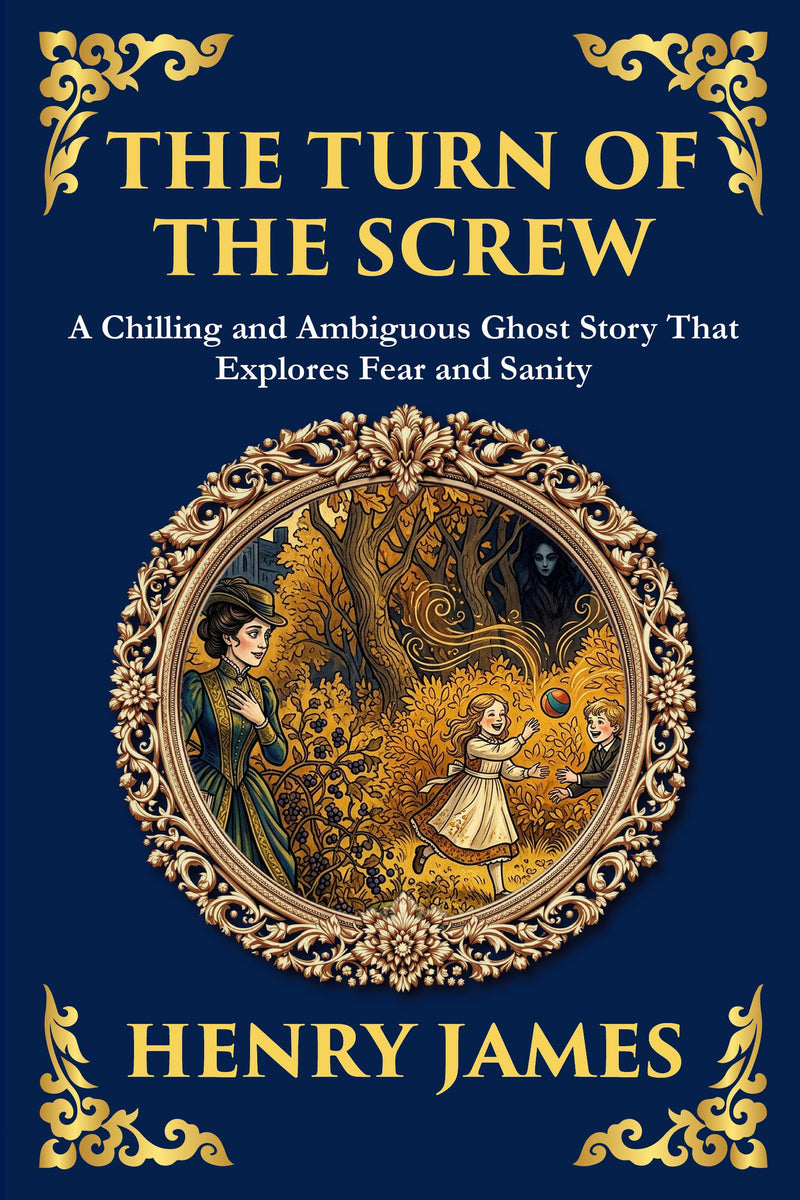
The Turn of the Screw
In an isolated country estate shrouded by silence and secrets, a young governess is tasked with caring for two eerily perfect children.
or free app
10,000+ hrs library
30-day guarantee
The complete The Turn of the Screw appears in modern English through Library of Alexandria Press, available online with audiobook narration included for members.
Have you ever wondered why we fear what we cannot explain? The Turn of the Screw by Henry James is a haunting novella that defies conventional ghost stories. Set in a grand but lonely English manor, this classic work of gothic fiction tells the story of a governess who believes her young charges, Flora and Miles, are being haunted by malevolent spirits.
But as the tale unfolds through her increasingly frantic narration, questions arise: Are the ghosts real? Or is the terror rooted in the governess’s own mind? Told with eerie restraint and mounting dread, this psychological thriller explores the terrifying power of isolation, repression, and unspoken trauma.
More than a ghost story, it’s a chilling meditation on innocence, corruption, and the fragility of the human psyche.
What you’ll discover in this modern edition
- A Spine-Tingling Narrative – Dive into a story where every shadow hides meaning and every silence holds suspense.
- A Psychological Puzzle – Decide for yourself whether the danger is paranormal—or psychological.
- A Masterclass in Literary Ambiguity – James crafts a tale that’s open to endless interpretation and scholarly debate.
- A Claustrophobic Atmosphere – Experience the creeping dread of Bly Manor through the eyes of an increasingly unreliable narrator.
- Enduring Themes of Fear and Madness – Examine how uncertainty, isolation, and the burden of responsibility can fracture the mind. The Turn of the Screw remains one of the most analyzed and talked-about ghost stories of all time.
| Formats | eBook (EPUB + PDF) · Audiobook · Paperback · Hardcover · Large Print |
| Language | English |
| Trim size (print) | 6 × 9 in |
| Binding | Paperback — perfect-bound · Hardcover — casewrap |
| Large Print edition | Same text in a larger, easy-read type — a larger font, not a larger trim |
| Print pricing | Every physical book at our true cost — at-cost, no profit (members) |
| Library | 873 restored titles, always growing |
| Length | 41,112 words · ~2 hr 44 min reading |
| Reading level | Grade 7 · an easy, flowing read (this modern-English edition) |
| Edition | Modern English translation · 2026 |
Member reviews for this edition are collected as readers finish it — be the first. Across the library: 12,000+ books shipped, every plan covered by a 365-day print guarantee.
About this edition
A faithful, unabridged modern-English edition by The Library of Alexandria — carefully rendered for today's reader and verified paragraph-by-paragraph against the public-domain source. Available as eBook, audiobook, paperback, hardcover, and large print.
- Complete & unabridgedVerified paragraph by paragraph against the source — never a scan, never abridged.
- Modern English, faithfulReadable today, with the author’s meaning kept intact. Readable — not simplified.
- Every format, one membershipRead in your browser or the free app, or listen to the full audiobook.
Included free with your membership
Cancel anytime, one click · 30-day money-back guarantee
Edition last updated July 2026
What’s inside
The Turn of the Screw — complete and unabridged: all 26 sections included with membership, plus the full audiobook.
Begin reading The Turn of the Screw
In clear modern English — the complete text is included with membership.
Introduction
There are stories that frighten you in the moment and are forgotten by morning, and then there are stories that lodge themselves somewhere beneath the surface of your thinking, surfacing weeks or even years later in the half-light of an unfamiliar room. The Turn of the Screw belongs unmistakably to the second category. Since its first appearance in 1898, Henry James’s slender, deceptively quiet tale has refused to settle into a single, comfortable meaning. It has been read as one of the most accomplished ghost stories in the English language and, with equal conviction, as a penetrating study of psychological collapse that contains no ghosts at all. The remarkable thing is that both readings can be defended with the same sentences, the same scenes, the same haunted silences. This is not a flaw in the narrative. It is the entire point.
What you hold in your hands is a modern adaptation of that classic text, carefully reshaped for the contemporary reader. The original, written at the height of James’s late period, is famous not only for its atmosphere but for its prose—long, winding, syntactically intricate sentences that fold back on themselves, qualifying and reconsidering with every clause. For many readers across more than a century, that style has been both the glory and the obstacle of the book. It rewards patience extravagantly, but it can also exhaust a reader before the genuine terror has had a chance to take hold. The aim of this edition is to preserve everything that makes the tale unforgettable—its mounting dread, its moral ambiguity, its psychological precision—while easing the path through James’s denser thickets of language. The shadows remain exactly where he placed them. Only the underbrush has been cleared so that you can move through them more freely.
Before you begin, it is worth understanding a little about the strange, slippery thing you are about to read, and about the man who made it. For this is a book that gains immeasurably from being approached with the right expectations—not expectations of what will happen, which it would be a crime to spoil, but expectations of how to read, of what kind of attention the story demands and rewards.
Henry James was born in New York City in 1843 into a family of remarkable intellectual restlessness. His father, Henry James Sr., was a theologian and philosopher of independent means and idiosyncratic views; his brother William James would become one of the most influential psychologists and philosophers in American history, the father of pragmatism and a pioneering investigator of consciousness, religious experience, and the mind’s capacity to deceive itself. It is no small thing that the author of this haunting tale of perception and possible delusion grew up in such close intellectual company with a man who devoted his life to studying how the human mind works—how it constructs reality, how it can be misled, how the line between belief and knowledge can blur. The fingerprints of that family conversation are all over this book, even if they are never named.
James spent much of his youth shuttling between the United States and Europe, absorbing languages, cities, museums, and manners. This transatlantic upbringing made him a permanent observer, a man perpetually slightly outside the worlds he moved through, watching with an almost painful acuity the small gestures and unspoken implications by which people reveal—and conceal—themselves. Eventually he settled in England, becoming one of the defining figures of the literary world on both sides of the Atlantic. His great novels—The Portrait of a Lady, The Wings of the Dove, The Ambassadors, The Golden Bowl—are monuments of psychological realism, dense with interior life, attentive above all to consciousness itself: to the way a person thinks and feels and rationalizes in the privacy of their own head.
This is the crucial thing to understand about James as you enter this particular story. He was not, by temperament or training, a writer of cheap shocks or supernatural spectacle. His abiding subject across his entire career was the inner life—the gap between what people say and what they mean, between what they see and what is actually there, between the stories they tell themselves and the truth they cannot quite face. When such a writer turns his attention to a ghost story, the result is not a tale about whether the dead can return. It is a tale about the human mind under pressure, about the terrifying instability of our own perceptions, about how desire and fear and loneliness can populate the empty rooms of a great house with figures that may or may not be real.
James himself was characteristically coy about what he had created. He called the story a “trap for the unwary,” a deliberate ambiguity, a piece of machinery designed to make the reader’s own imagination do the work of horror. In his preface to a later edition, he described his intention to make the reader supply the evil themselves, to give just enough suggestion that the mind would rush in to fill the void with its own worst imaginings. “Make him think the evil,” James wrote, “make him think it for himself, and you are released from weak specifications.” This is the secret engine of the book’s enduring power. It does not tell you what to be afraid of. It opens a door into darkness and lets you decide what is standing on the other side.
The tale emerged during a difficult and transitional period in James’s life. In the years just before he wrote it, he had suffered a humiliating public failure in the theater—his play Guy Domville was booed at its London premiere in 1895, an experience that wounded him deeply. He retreated from the stage and returned to fiction with renewed concentration, entering the dense, experimental phase of his late work. The Turn of the Screw sits at a hinge point in this development. It was dictated, in part, to a typist—James had begun composing aloud, pacing his study and speaking his sentences into being—and something of that spoken quality, that sense of a voice telling a tale, animates the whole. It was published serially in Collier’s Weekly before appearing in book form, and it became one of his most widely read and discussed works almost immediately, precisely because it could be enjoyed as a popular thrill and dissected as a serious literary puzzle in the same breath.
The Frame, the Voice, and the Art of Doubt
One of the first things you will notice about this story is that it does not begin where you expect it to. James constructs the tale within a frame—a gathering of people exchanging ghost stories on a winter evening, where the central manuscript is introduced and read aloud. This is not mere decoration. The frame establishes a chain of transmission, a series of hands through which the story has passed before it reaches you, and in doing so it quietly raises a question that will haunt the entire reading: Can we trust this account? By the time the central narrative begins, we have already been made aware that we are receiving a story at several removes, a document of unverifiable reliability, a confession or a record whose author is no longer present to be questioned.
This matters enormously, because the heart of the book is a single consciousness—an intelligent, sensitive, intensely feeling narrator whose perceptions are the only window we have onto the events. We see everything through this one pair of eyes, hear everything filtered through one interpreting mind. And here is where James’s genius detonates with quiet force: at no point can we be entirely certain that what this narrator sees is real. Every apparition, every sinister implication, every mounting conviction of danger reaches us already shaped by a particular sensibility—one that is lonely, romantic, hungry for significance, and placed in a situation of considerable isolation and responsibility. Is the narrator a reliable witness to genuine supernatural horror? Or are we watching a mind unravel, projecting its own fears and desires onto an innocent world, constructing a nightmare out of shadows and longing?
James gives us no neutral ground from which to judge. There is no second perspective, no omniscient narrator to step in and tell us what is “really” happening. We are locked inside one head, and that head may be perfectly sound or may be coming apart at the seams—and the awful brilliance of the construction is that the same evidence supports both conclusions. A figure appears at a window. Is it a ghost, or a trick of the light interpreted by a primed and frightened imagination? A child behaves strangely. Is it the influence of malevolent forces, or the ordinary unfathomableness of children seen through the lens of an adult’s growing paranoia? Every scene is a Rorschach blot. What you see in it will say as much about you as about the text.
This is why generations of readers and critics have divided into rival camps, sometimes with surprising heat. The “apparitionist” reading takes the ghosts as real, a genuine supernatural threat that the narrator perceives correctly and battles courageously. The “non-apparitionist” or psychological reading takes the ghosts as hallucinations, symptoms of the narrator’s repressed desires and mounting hysteria, with the real horror being the damage an unstable adult might inflict on the children in her care. Both readings have been argued with tremendous sophistication. Both are textually defensible. And—this is the essential thing to carry with you—James designed the book so that neither could ever finally win. He built the ambiguity into the foundation. To resolve it is to destroy it.
For this reason, I want to offer a small piece of advice as you begin: resist the urge to decide too quickly. The temptation, especially for modern readers trained by films and novels that always eventually explain themselves, is to keep asking “But what’s really happening?” and to feel frustrated when the answer never arrives. Try, instead, to hold both possibilities open at once, to let the story exist in its productive uncertainty. The dread of The Turn of the Screw lives precisely in that suspended state, in the vertigo of not knowing whether you are reading about a haunted house or a haunted mind. The moment you commit firmly to one interpretation, much of the terror drains away, because terror requires uncertainty. We are not most afraid of the monster we can see clearly. We are most afraid of the thing we cannot quite make out, the shape at the edge of the room, the possibility we cannot confirm or dispel.
This is also why the story has retained its grip across so many decades and so many shifts in literary fashion. It anticipated, in 1898, concerns that would come to dominate the twentieth century and beyond: the unreliability of the narrator, the instability of perception, the unconscious mind and its hidden drives, the question of whether we can ever truly know another person—or even ourselves. Long before psychology had a popular vocabulary for repression, projection, and hysteria, James had dramatized them with uncanny precision. And long before postmodern fiction made the unreliable narrator a commonplace, he had constructed a story whose entire meaning hinges on our inability to trust the voice telling it. The book feels astonishingly modern because it was, in the truest sense, ahead of its time.
Setting plays its own quiet role in this machinery of doubt. The action unfolds largely at a remote country estate, a great isolated house surrounded by grounds, lake, and the kind of silence that amplifies every small sound and every uneasy thought. James understood that isolation is the natural habitat of the haunted imagination. Cut off from the corrective presence of the wider world, removed from the ordinary social checks that keep our interpretations grounded, a sensitive mind left alone with its responsibilities and its fears can build whole architectures of meaning out of very little. The house is a pressure chamber. Within its walls, ambiguity festers and grows. Whether what grows is supernatural or psychological is, once again, precisely the question the book refuses to answer.
Cancel anytime, one click · 30-day money-back guarantee
Founding annual rate available now — your price locks for life when you join.
Not ready? Get this free chapter by email — read it anytime.
✓ Sent — check your inbox for The Turn of the Screw.
Questions about The Turn of the Screw
What is The Turn of the Screw about?
In an isolated country estate shrouded by silence and secrets, a young governess is tasked with caring for two eerily perfect children. But when ghostly apparitions begin to appear and the children’s behavior turns mysteriously disturbing, she finds herself spiraling into a chilling battle between perception and reality. Is she protecting them from evil—or is the danger a figment of her unraveling mind?
Who wrote The Turn of the Screw?
The Turn of the Screw was written by Henry James. This edition presents the complete work in clear modern English, faithfully rendered from the public-domain original by Library of Alexandria Press.
Is The Turn of the Screw free to read?
The opening chapter is free to read on this page. Members read and listen to the complete work — and the entire library — free, and can order any physical book at our true print cost.
How long is The Turn of the Screw?
26 chapters (~41,112 words) — about 2 hr 44 min of reading in this modern-English edition.
Is this an abridged version of The Turn of the Screw?
No. This is the complete, unabridged The Turn of the Screw, carefully rendered into clear modern English and verified paragraph-by-paragraph against the public-domain source — nothing is cut or summarised.
What formats does The Turn of the Screw come in?
The Turn of the Screw is available as eBook, paperback, hardcover and large print. eBook and audiobook are included with membership; printed editions ship at our true print cost.
Shipping & returns
Billing & membership
More from the library


Explore Children's Classics
- Jack and Jill · Louisa May Alcott
- The Wonderful Wizard of Oz · L. Frank Baum
- Peter Pan · J. M. Barrie
- The Prince and the Pauper · Mark Twain
- The Red Fairy Book · Andrew Lang
- Old Christmas: from the Sketch Book of Washington Irving · Washington Irving
- A Houseful of Girls · Sarah Tytler
- In the hollow of His hand · Hesba Stretton
- Miss Primrose · Agnes Giberne
- Five Little Peppers and How They Grew · Margaret Sidney
- The Loss of the Swansea: A Story of the Florida Coast · W. L. Alden
- Sky Island · L. Frank Baum
- The Book of Dragons · E. Nesbit
- Wild Animals I Have Known · Ernest Thompson Seton
- Skinny McCord · Percy Keese Fitzhugh
- The Hunniwell Boys and the Platinum Mystery · L. P. Wyman
- Rainbow Valley · L. M. Montgomery
- "Us and Our Donkey" · Amy Le Feuvre
- Dorothy and the Wizard in Oz · L. Frank Baum
- The Home Book of Verse — Volume 4 · Burton Egbert Stevenson
- The Story of Doctor Dolittle · Hugh Lofting
- The Tale of Benjamin Bunny · Beatrix Potter
- Fifty Famous Stories Retold · James Baldwin
- Rilla of Ingleside · L. M. Montgomery
- The House at Pooh Corner · A. A. Milne
- Rich and Humble: A Story for Young People · Oliver Optic
- The Three Bears · A. E. Kennedy
- Peter and Wendy · J. M. Barrie
- The Marvelous Land of Oz · L. Frank Baum
- Andersen’s Fairy Tales · H. C. Andersen
The Turn of the Screw
The Turn of the Screw
A Chilling and Ambiguous Ghost Story That Explores Fear and Sanity
Henry James
Contents
- Introduction
- The Turn of the Screw
- Chapter 1
- Chapter 2
- Chapter 3
- Chapter 4
- Chapter 5
- Chapter 6
- Chapter 7
- Chapter 8
- Chapter 9
- Chapter 10
- Chapter 11
- Chapter 12
- Chapter 13
- Chapter 14
- Chapter 15
- Chapter 16
- Chapter 17
- Chapter 18
- Chapter 19
- Chapter 20
- Chapter 21
- Chapter 22
- Chapter 23
- Chapter 24
Introduction
There are stories that frighten you in the moment and are forgotten by morning, and then there are stories that lodge themselves somewhere beneath the surface of your thinking, surfacing weeks or even years later in the half-light of an unfamiliar room. The Turn of the Screw belongs unmistakably to the second category. Since its first appearance in 1898, Henry James’s slender, deceptively quiet tale has refused to settle into a single, comfortable meaning. It has been read as one of the most accomplished ghost stories in the English language and, with equal conviction, as a penetrating study of psychological collapse that contains no ghosts at all. The remarkable thing is that both readings can be defended with the same sentences, the same scenes, the same haunted silences. This is not a flaw in the narrative. It is the entire point.
What you hold in your hands is a modern adaptation of that classic text, carefully reshaped for the contemporary reader. The original, written at the height of James’s late period, is famous not only for its atmosphere but for its prose—long, winding, syntactically intricate sentences that fold back on themselves, qualifying and reconsidering with every clause. For many readers across more than a century, that style has been both the glory and the obstacle of the book. It rewards patience extravagantly, but it can also exhaust a reader before the genuine terror has had a chance to take hold. The aim of this edition is to preserve everything that makes the tale unforgettable—its mounting dread, its moral ambiguity, its psychological precision—while easing the path through James’s denser thickets of language. The shadows remain exactly where he placed them. Only the underbrush has been cleared so that you can move through them more freely.
Before you begin, it is worth understanding a little about the strange, slippery thing you are about to read, and about the man who made it. For this is a book that gains immeasurably from being approached with the right expectations—not expectations of what will happen, which it would be a crime to spoil, but expectations of how to read, of what kind of attention the story demands and rewards.
Henry James was born in New York City in 1843 into a family of remarkable intellectual restlessness. His father, Henry James Sr., was a theologian and philosopher of independent means and idiosyncratic views; his brother William James would become one of the most influential psychologists and philosophers in American history, the father of pragmatism and a pioneering investigator of consciousness, religious experience, and the mind’s capacity to deceive itself. It is no small thing that the author of this haunting tale of perception and possible delusion grew up in such close intellectual company with a man who devoted his life to studying how the human mind works—how it constructs reality, how it can be misled, how the line between belief and knowledge can blur. The fingerprints of that family conversation are all over this book, even if they are never named.
James spent much of his youth shuttling between the United States and Europe, absorbing languages, cities, museums, and manners. This transatlantic upbringing made him a permanent observer, a man perpetually slightly outside the worlds he moved through, watching with an almost painful acuity the small gestures and unspoken implications by which people reveal—and conceal—themselves. Eventually he settled in England, becoming one of the defining figures of the literary world on both sides of the Atlantic. His great novels—The Portrait of a Lady, The Wings of the Dove, The Ambassadors, The Golden Bowl—are monuments of psychological realism, dense with interior life, attentive above all to consciousness itself: to the way a person thinks and feels and rationalizes in the privacy of their own head.
This is the crucial thing to understand about James as you enter this particular story. He was not, by temperament or training, a writer of cheap shocks or supernatural spectacle. His abiding subject across his entire career was the inner life—the gap between what people say and what they mean, between what they see and what is actually there, between the stories they tell themselves and the truth they cannot quite face. When such a writer turns his attention to a ghost story, the result is not a tale about whether the dead can return. It is a tale about the human mind under pressure, about the terrifying instability of our own perceptions, about how desire and fear and loneliness can populate the empty rooms of a great house with figures that may or may not be real.
James himself was characteristically coy about what he had created. He called the story a “trap for the unwary,” a deliberate ambiguity, a piece of machinery designed to make the reader’s own imagination do the work of horror. In his preface to a later edition, he described his intention to make the reader supply the evil themselves, to give just enough suggestion that the mind would rush in to fill the void with its own worst imaginings. “Make him think the evil,” James wrote, “make him think it for himself, and you are released from weak specifications.” This is the secret engine of the book’s enduring power. It does not tell you what to be afraid of. It opens a door into darkness and lets you decide what is standing on the other side.
The tale emerged during a difficult and transitional period in James’s life. In the years just before he wrote it, he had suffered a humiliating public failure in the theater—his play Guy Domville was booed at its London premiere in 1895, an experience that wounded him deeply. He retreated from the stage and returned to fiction with renewed concentration, entering the dense, experimental phase of his late work. The Turn of the Screw sits at a hinge point in this development. It was dictated, in part, to a typist—James had begun composing aloud, pacing his study and speaking his sentences into being—and something of that spoken quality, that sense of a voice telling a tale, animates the whole. It was published serially in Collier’s Weekly before appearing in book form, and it became one of his most widely read and discussed works almost immediately, precisely because it could be enjoyed as a popular thrill and dissected as a serious literary puzzle in the same breath.
The Frame, the Voice, and the Art of Doubt
One of the first things you will notice about this story is that it does not begin where you expect it to. James constructs the tale within a frame—a gathering of people exchanging ghost stories on a winter evening, where the central manuscript is introduced and read aloud. This is not mere decoration. The frame establishes a chain of transmission, a series of hands through which the story has passed before it reaches you, and in doing so it quietly raises a question that will haunt the entire reading: Can we trust this account? By the time the central narrative begins, we have already been made aware that we are receiving a story at several removes, a document of unverifiable reliability, a confession or a record whose author is no longer present to be questioned.
This matters enormously, because the heart of the book is a single consciousness—an intelligent, sensitive, intensely feeling narrator whose perceptions are the only window we have onto the events. We see everything through this one pair of eyes, hear everything filtered through one interpreting mind. And here is where James’s genius detonates with quiet force: at no point can we be entirely certain that what this narrator sees is real. Every apparition, every sinister implication, every mounting conviction of danger reaches us already shaped by a particular sensibility—one that is lonely, romantic, hungry for significance, and placed in a situation of considerable isolation and responsibility. Is the narrator a reliable witness to genuine supernatural horror? Or are we watching a mind unravel, projecting its own fears and desires onto an innocent world, constructing a nightmare out of shadows and longing?
James gives us no neutral ground from which to judge. There is no second perspective, no omniscient narrator to step in and tell us what is “really” happening. We are locked inside one head, and that head may be perfectly sound or may be coming apart at the seams—and the awful brilliance of the construction is that the same evidence supports both conclusions. A figure appears at a window. Is it a ghost, or a trick of the light interpreted by a primed and frightened imagination? A child behaves strangely. Is it the influence of malevolent forces, or the ordinary unfathomableness of children seen through the lens of an adult’s growing paranoia? Every scene is a Rorschach blot. What you see in it will say as much about you as about the text.
This is why generations of readers and critics have divided into rival camps, sometimes with surprising heat. The “apparitionist” reading takes the ghosts as real, a genuine supernatural threat that the narrator perceives correctly and battles courageously. The “non-apparitionist” or psychological reading takes the ghosts as hallucinations, symptoms of the narrator’s repressed desires and mounting hysteria, with the real horror being the damage an unstable adult might inflict on the children in her care. Both readings have been argued with tremendous sophistication. Both are textually defensible. And—this is the essential thing to carry with you—James designed the book so that neither could ever finally win. He built the ambiguity into the foundation. To resolve it is to destroy it.
For this reason, I want to offer a small piece of advice as you begin: resist the urge to decide too quickly. The temptation, especially for modern readers trained by films and novels that always eventually explain themselves, is to keep asking “But what’s really happening?” and to feel frustrated when the answer never arrives. Try, instead, to hold both possibilities open at once, to let the story exist in its productive uncertainty. The dread of The Turn of the Screw lives precisely in that suspended state, in the vertigo of not knowing whether you are reading about a haunted house or a haunted mind. The moment you commit firmly to one interpretation, much of the terror drains away, because terror requires uncertainty. We are not most afraid of the monster we can see clearly. We are most afraid of the thing we cannot quite make out, the shape at the edge of the room, the possibility we cannot confirm or dispel.
This is also why the story has retained its grip across so many decades and so many shifts in literary fashion. It anticipated, in 1898, concerns that would come to dominate the twentieth century and beyond: the unreliability of the narrator, the instability of perception, the unconscious mind and its hidden drives, the question of whether we can ever truly know another person—or even ourselves. Long before psychology had a popular vocabulary for repression, projection, and hysteria, James had dramatized them with uncanny precision. And long before postmodern fiction made the unreliable narrator a commonplace, he had constructed a story whose entire meaning hinges on our inability to trust the voice telling it. The book feels astonishingly modern because it was, in the truest sense, ahead of its time.
Setting plays its own quiet role in this machinery of doubt. The action unfolds largely at a remote country estate, a great isolated house surrounded by grounds, lake, and the kind of silence that amplifies every small sound and every uneasy thought. James understood that isolation is the natural habitat of the haunted imagination. Cut off from the corrective presence of the wider world, removed from the ordinary social checks that keep our interpretations grounded, a sensitive mind left alone with its responsibilities and its fears can build whole architectures of meaning out of very little. The house is a pressure chamber. Within its walls, ambiguity festers and grows. Whether what grows is supernatural or psychological is, once again, precisely the question the book refuses to answer.
We sat around the fire, completely captivated by the story. Aside from the obvious comment that it was gruesome—which is exactly how a strange tale should be on Christmas Eve in an old house—I don’t remember anyone saying anything until someone mentioned that it was the only case they’d heard of where a ghost had appeared to a child. The story involved an apparition in an old house much like the one we were in. A terrifying figure had appeared to a little boy while he was sleeping in his mother’s room. He woke her up in a panic, but before she could calm him down and put him back to sleep, she saw the same horrifying sight that had shaken him.
Later that evening, this comment prompted a response from Douglas that led to an interesting turn of events. Someone else told a story that wasn’t particularly gripping, and I noticed Douglas wasn’t paying attention. I took this as a sign that he had a story of his own to tell and that we just had to wait. We didn’t actually hear it until two nights later, but that evening, before we left, he let us know what was on his mind.
“I agree that in Griffin’s case—or whatever that ghost was—the fact that it appeared first to such a young child adds a special touch. But that’s not the only story of its kind involving a child that I know. If one child adds a ‘turn of the screw’ to the effect, what do you say to two children?”
“We’d say they give it two turns, of course!” someone exclaimed. “And we definitely want to hear about them.”
I can still see Douglas standing by the fire with his back to us, hands in his pockets, looking down at the person who spoke. “No one but me has ever heard this until now. It’s far too horrible.” Naturally, several people chimed in to say that only made the story more valuable. With a quiet, calculated move, Douglas built up the suspense by glancing at the rest of us and adding, “It’s beyond anything. Nothing I’ve ever heard even comes close.”
End of the free sample
Keep reading, free
Members read and listen to the complete book — and the entire library. Cancel anytime, one click · 30-day money-back guarantee.