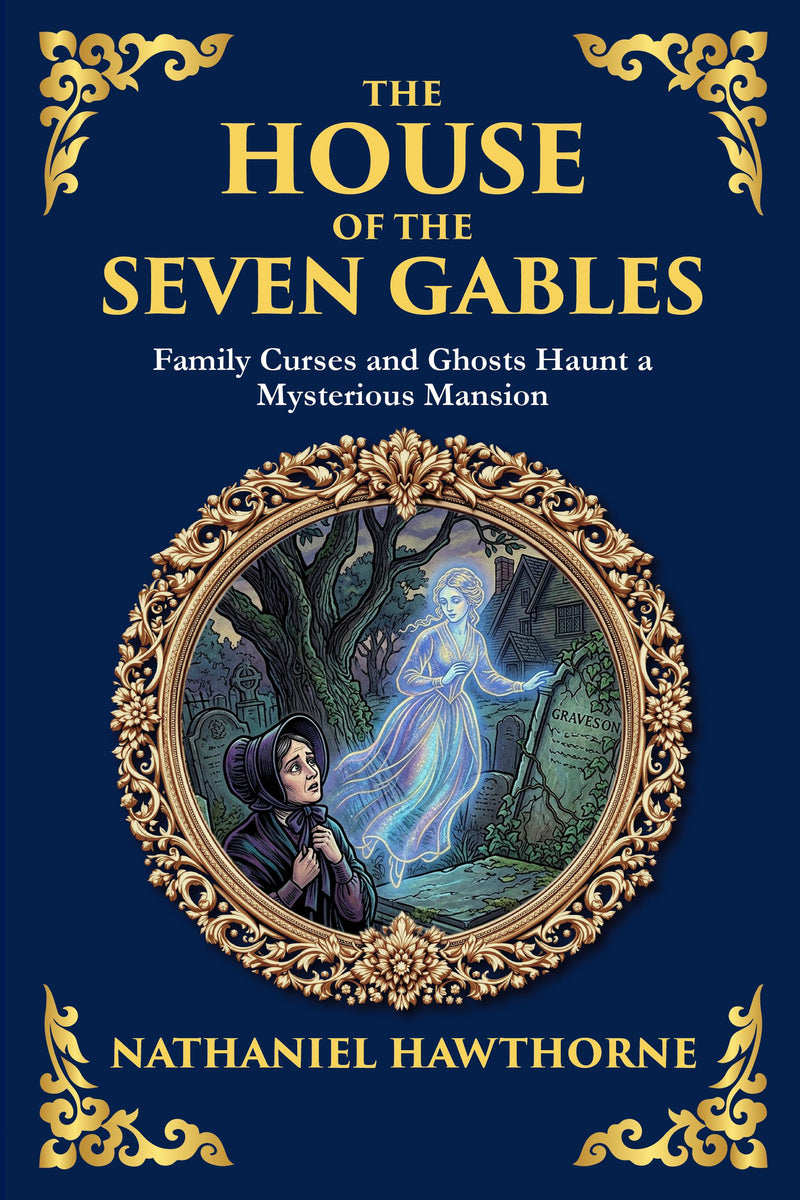
The House of the Seven Gables
In a brooding mansion scarred by a centuries-old curse, the weight of ancestral guilt and hidden sins seeps through every creaking floorboard.
or free app
10,000+ hrs library
30-day guarantee
The complete The House of the Seven Gables appears in modern English through Library of Alexandria Press, available online with audiobook narration included for members.
Have you ever wondered why some houses seem to remember every secret ever whispered inside their walls? The House of the Seven Gables: Family Curses and Ghosts Haunt a Mysterious Mansion is Nathaniel Hawthorne’s haunting exploration of generational guilt, greed, and the possibility of redemption. Set in a crumbling New England mansion marked by tragedy and superstition, the story follows the decaying fortunes of the Pyncheon family—heirs to a legacy tainted by bloodshed and betrayal.
As old secrets surface, and spectral presences seem to stir within the walls, a cast of vividly drawn characters must confront the sins of their forefathers. From the proud and reclusive Hepzibah to the mysterious Judge Pyncheon, from the radiant Phoebe to the brooding Holgrave, each figure plays a role in the unfolding drama of fate, free will, and justice. Combining gothic suspense with psychological insight, Hawthorne’s novel is not merely a ghost story—it’s a profound meditation on time, morality, and the redemptive power of love and truth.
What you’ll discover in this modern edition
- A Gothic Tale of Legacy and Retribution – Explore a haunted house where every room echoes with the sins of the past.
- A Family Cursed by Injustice – Witness the slow unraveling of a dynasty built on a grave injustice and one man’s lust for power.
- Rich Symbolism and Deep Moral Questions – Hawthorne’s allegory challenges readers to examine guilt, fate, and renewal.
- Memorable Characters in a Decaying Setting – From bitter recluses to youthful hope, the inhabitants of the mansion bring the story to life.
- Atmosphere of Mystery and Dread – Perfect for lovers of eerie mansions, ghostly whispers, and secrets hiding behind locked doors.
| Formats | eBook (EPUB + PDF) · Audiobook · Paperback · Hardcover · Large Print |
| Language | English |
| Trim size (print) | 6 × 9 in |
| Binding | Paperback — perfect-bound · Hardcover — casewrap |
| Large Print edition | Same text in a larger, easy-read type — a larger font, not a larger trim |
| Print pricing | Every physical book at our true cost — at-cost, no profit (members) |
| Library | 873 restored titles, always growing |
| Length | 99,304 words · ~6 hr 37 min reading |
| Reading level | Grade 7 · an easy, flowing read (this modern-English edition) |
| Edition | Modern English translation · 2026 |
Member reviews for this edition are collected as readers finish it — be the first. Across the library: 12,000+ books shipped, every plan covered by a 365-day print guarantee.
About this edition
A faithful, unabridged modern-English edition by The Library of Alexandria — carefully rendered for today's reader and verified paragraph-by-paragraph against the public-domain source. Available as eBook, audiobook, paperback, hardcover, and large print.
- Complete & unabridgedVerified paragraph by paragraph against the source — never a scan, never abridged.
- Modern English, faithfulReadable today, with the author’s meaning kept intact. Readable — not simplified.
- Every format, one membershipRead in your browser or the free app, or listen to the full audiobook.
Included free with your membership
Cancel anytime, one click · 30-day money-back guarantee
Edition last updated July 2026
What’s inside
The House of the Seven Gables — complete and unabridged: all 22 sections included with membership, plus the full audiobook.
Begin reading The House of the Seven Gables
In clear modern English — the complete text is included with membership.
Introduction
There are houses that seem to breathe. You can feel it the moment you cross the threshold—a sense that the walls have absorbed something over the years, that the floorboards remember footsteps long after the feet that made them have turned to dust. We tell ourselves these are merely tricks of imagination, the creak of old timber settling, the play of shadow across a darkened stairwell. And yet the feeling persists, stubborn and irrational, that certain dwellings hold the weight of everything that has happened inside them. Nathaniel Hawthorne understood this feeling perhaps better than any American writer who ever lived, and in the novel you are about to read, he built a house out of words so vivid and so haunted that it has stood for more than a century and a half, drawing readers up its gabled facade and through its dim rooms again and again.
This story concerns a mansion—an old, weathered structure with seven sharp gables jutting against the New England sky—and the family whose fortunes have risen and fallen within its rooms across generations. But to call it simply a story about a house would be to miss the deeper architecture of what Hawthorne accomplished. This is a book about inheritance in the fullest sense: the inheritance of money and property, yes, but also the inheritance of guilt, of secrets, of pride and shame and the slow accumulation of consequence. It asks a question that has not lost an ounce of its urgency in the years since it was written: how much of our lives do we truly control, and how much is determined for us before we are even born, by the choices of those who came before? Are we free, or are we simply playing out a script written by our ancestors, repeating their errors and paying their debts whether we wish to or not?
You are holding a modern translation of this classic, an edition adapted thoughtfully for the contemporary reader. Before we go any further, it is worth pausing on what that means and why it matters, because the choice to read this particular version will shape your experience in important ways.
Why a Modern Translation, and What You Can Expect from It
Nathaniel Hawthorne wrote in the middle of the nineteenth century, in an English that was elaborate, ornate, and dense even by the standards of his own time. He loved long sentences that wound through clause after clause like a river finding its way to the sea. He delighted in vocabulary that has since faded from common use, in sentence structures that ask a reader to hold several ideas in suspension at once before delivering the final, illuminating word. For the readers of his day, this was the music of serious literature, and they read it with pleasure and understanding. But language is a living thing, and it changes. Words shift their meanings, fall out of fashion, or vanish entirely. Rhythms that once felt natural now feel formal and remote. A reader coming to Hawthorne’s original prose today, without preparation, can find the experience like trying to walk through deep water—the effort required to parse each sentence can leave little energy for the actual pleasure and emotion of the story.
That is precisely the problem this edition seeks to solve. A modern translation does not change the story. It does not alter the characters, the setting, the events, or the meaning. What it does is take Hawthorne’s intricate nineteenth-century sentences and render them in language that a present-day reader can absorb naturally and immediately. The goal is to remove the barrier of antique style while preserving everything that made the work worth reading in the first place—the atmosphere, the suspense, the psychological depth, the moral seriousness, the moments of unexpected tenderness and humor. Think of it as cleaning the varnish from an old painting. The image underneath was always beautiful; sometimes it simply needs to be brought back into clear view so that we can see what the artist intended.
Some readers feel a flicker of hesitation about adapted classics, as though reading a modernized version were somehow a lesser act, a shortcut. I want to gently set that worry aside. The purpose of literature is to be read, to be felt, to enter into the mind and stay there. A great story locked behind a wall of difficult language serves no one. If a modern translation allows this remarkable book to reach you—to genuinely reach you, so that you feel the chill of its haunted rooms and the warmth of its surprising friendships—then it has done exactly what it should. There will always be a place for the original text, and if this version stirs in you a hunger to seek out Hawthorne’s exact words later, so much the better. But the experience that matters most is the one you are about to have: a clear, vivid, immersive journey into a story that has captivated readers for generations.
What you can expect, then, is a reading experience that moves. The atmosphere remains thick and brooding, the suspense remains taut, but the prose carries you forward rather than holding you back. You will be able to lose yourself in the dim parlor of the old mansion, to feel the dust and the silence, to sense the presence of the past pressing in from every corner—all without having to stop and decode the sentence you just read. The emotion arrives directly. The fear arrives directly. The hope, when it comes, arrives directly too. That is the gift this edition offers.
It is also worth saying a word about pacing, because this is a story that rewards patience even in its modernized form. Hawthorne was not a writer of breathless action. He builds slowly, deliberately, layering atmosphere and observation until the weight of it becomes almost unbearable, and then—just when you think nothing will ever break the spell—something shifts. The careful reader who allows themselves to sink into the rhythm of the early chapters, to inhabit the house and its inhabitants fully, will be richly repaid as the story tightens toward its conclusion. This is a book to be savored rather than rushed, a book that asks you to slow down to the pace of an old life lived in an old house, where days unfold quietly and the smallest events take on tremendous significance. Give yourself over to that pace, and you will find it strangely soothing, even hypnotic.
The Man Who Built the House and the World He Built It in
To understand why this story carries the particular charge it does, it helps to know something about the man who wrote it and the soil from which it grew. Nathaniel Hawthorne was born in Salem, Massachusetts, in 1804, into a region thick with history and heavy with memory. New England in his time was a place that had not yet shaken off its Puritan past—the stern, severe, deeply religious culture of the early settlers who had crossed the ocean two centuries before. The values of that culture, with its sharp sense of sin and judgment, its conviction that human beings were fallen creatures perpetually at risk of damnation, still shaped the moral imagination of the people, even those who no longer fully believed.
Hawthorne carried this inheritance in his very blood, and it troubled him deeply. His own ancestors had been figures of some prominence in colonial Massachusetts, and one of them, a judge, had played a direct and shameful role in one of the darkest episodes in American history. During the notorious witch trials, when ordinary men and women were accused of consorting with the devil and were imprisoned, tortured, and executed on the basis of hysteria and superstition, this ancestor sat in judgment and condemned the accused. The memory of that cruelty haunted Hawthorne. He felt the stain of it personally, as though the guilt of his forebear had been passed down to him across the generations—as though he, who had committed no crime, nonetheless bore some portion of the responsibility. He even added a letter to the spelling of his family name, a small act of distancing, of trying to separate himself from the weight of his lineage.
You may already begin to see how directly this personal history feeds into the novel you are about to read. The question of inherited guilt—of whether the sins of one generation cling to the next, whether a curse pronounced long ago can reach forward through time to poison the lives of the innocent descendants—was not an abstract philosophical puzzle for Hawthorne. It was the central anxiety of his life. He poured it into this book, transforming his private torment into a work of art that speaks to anyone who has ever wondered whether they are truly free, or whether they are quietly paying for choices they never made.
Hawthorne was, by temperament, a solitary and watchful man. After his years of study he retreated for a long period into near-total seclusion, reading voraciously and teaching himself to write in a small room in his mother’s house. He emerged from that isolation with a vision of fiction unlike anything his contemporaries were producing. He was less interested in the surface of ordinary life than in what lay beneath it—the hidden movements of conscience, the secret operations of guilt and pride, the way the past lingers in the present like a smell that cannot be aired out. He called his longer works “romances” rather than “novels,” and he meant something specific by the term. A novel, in his understanding, aimed at faithful realism, at depicting life exactly as it is. A romance claimed a greater freedom—the right to heighten reality, to let atmosphere bleed into something close to the supernatural, to write about the world not quite as it is but as it feels when we are most alive to its mysteries.
This distinction is worth keeping in mind as you read. The story occupies a deliberately ambiguous territory between the natural and the supernatural. Strange things seem to happen, and you will often find yourself unsure whether you are witnessing genuine occurrences of the uncanny or simply the workings of guilty, frightened, imaginative minds. Hawthorne does this on purpose, and he does not resolve the ambiguity for you. He leaves the door ajar, neither confirming nor denying the presence of ghosts and curses, trusting you to sit with the uncertainty. This is one of the great pleasures of the book—the way it keeps you suspended between belief and doubt, never letting you fully settle. Is the family truly cursed, or do they merely believe themselves to be, and does the belief itself become a kind of curse? The book never tells you outright, and that refusal is part of its genius.
It is also helpful to know that Hawthorne wrote this book at a particular moment in his life, shortly after the success of an earlier and even more famous work that had established his reputation. He was, for the first time, a celebrated author, and he turned his attention to this new project with the confidence of a writer at the height of his powers. He set the story in a town very much like his own Salem, in a house drawn partly from real dwellings he had known, with their steep roofs and shadowed windows. The result feels deeply rooted in a specific place and a specific history, and yet it transcends both. You do not need to know anything about colonial New England to feel the truth of what the book explores. The themes are universal. Every family has its secrets. Every house has its history. Every person carries within them some inheritance they did not choose.
There is one more element of Hawthorne’s vision that deserves mention, because it may surprise you. For all the darkness of his subject matter—the curses, the guilt, the sense of doom hanging over the old mansion—this is ultimately not a hopeless book. Hawthorne believed, in his complicated way, in the possibility of renewal. He believed that even the heaviest inheritance might one day be set down, that the dead hand of the past could be loosened, that light could finally enter rooms that had been dark for generations. As you make your way through the gathering gloom of the early chapters, hold onto that knowledge. The story is building toward something, and that something is not what you might expect from a tale so steeped in shadow. There is warmth in this book, and humor, and a kind of fragile, hard-won grace. The characters who seem most trapped may yet find a path forward. Watch for the small signs of life that persist even in the most decayed corners of the old house—a flower growing in an unexpected place, a bird singing at a window, the laughter of someone young. These are not accidents. They are Hawthorne’s quiet promise that the past, however heavy, does not have to be the end of the story.
Cancel anytime, one click · 30-day money-back guarantee
Founding annual rate available now — your price locks for life when you join.
Not ready? Get this free chapter by email — read it anytime.
✓ Sent — check your inbox for The House of the Seven Gables.
Questions about The House of the Seven Gables
What is The House of the Seven Gables about?
In a brooding mansion scarred by a centuries-old curse, the weight of ancestral guilt and hidden sins seeps through every creaking floorboard. The Pyncheon family—once proud and powerful —now teeters on the brink of ruin, haunted by mysterious deaths, family secrets, and the shadow of a wrongful accusation. The House of the Seven Gables is a timeless gothic tale of decaying aristocracy, retribution, and redemption.
Who wrote The House of the Seven Gables?
The House of the Seven Gables was written by Nathaniel Hawthorne. This edition presents the complete work in clear modern English, faithfully rendered from the public-domain original by Library of Alexandria Press.
Is The House of the Seven Gables free to read?
The opening chapter is free to read on this page. Members read and listen to the complete work — and the entire library — free, and can order any physical book at our true print cost.
How long is The House of the Seven Gables?
22 chapters (~99,304 words) — about 6 hr 37 min of reading in this modern-English edition.
Is this an abridged version of The House of the Seven Gables?
No. This is the complete, unabridged The House of the Seven Gables, carefully rendered into clear modern English and verified paragraph-by-paragraph against the public-domain source — nothing is cut or summarised.
What formats does The House of the Seven Gables come in?
The House of the Seven Gables is available as eBook, paperback, hardcover and large print. eBook and audiobook are included with membership; printed editions ship at our true print cost.
Shipping & returns
Billing & membership
More from the library


Explore Horror & Gothic
- The Strange Case of Dr. Jekyll and Mr. Hyde · Robert Louis Stevenson
- The Cask of Amontillado · Edgar Allan Poe
- Ghost Stories of an Antiquary · M. R. James
- The Monk: A Romance · M. G. Lewis
- The Willows · Algernon Blackwood
- The Monkey’s Paw · W. W. Jacobs
- The Call of Cthulhu · H. P. Lovecraft
- The Life-Eater · Harold Ward
- The Black Kiss
- The Legend of Sleepy Hollow · Washington Irving
- Brood of the Dark Moon · Charles Willard Diffin
- The Night Land · William Hope Hodgson
- The Castle of Otranto · Horace Walpole
- Dracula · Bram Stoker
- Carmilla · Joseph Sheridan Le Fanu
- The King in Yellow · Robert W. Chambers
- Wuthering Heights · Emily Brontë
- The Vampyre: A Tale · John William Polidori
- A Christmas Carol · Charles Dickens
- Northanger Abbey · Jane Austen
- The Turn of the Screw · Henry James
- Metamorphosis · Franz Kafka
- The Yellow Wallpaper · Charlotte Perkins Gilman
- The Adventures of Ferdinand Count Fathom — Complete · T. Smollett
- The Picture of Dorian Gray · Oscar Wilde
- Frankenstein; Or, The Modern Prometheus · Mary Wollstonecraft Shelley
The House of the Seven Gables
The House of the Seven Gables
Family Curses and Ghosts Haunt a Mysterious Mansion
Nathaniel Hawthorne
Contents
- Introduction
- Chapter 1
- Chapter 2
- Chapter 3
- Chapter 4
- Chapter 5
- Chapter 6
- Chapter 7
- Chapter 8
- Chapter 9
- Chapter 10
- Chapter 11
- Chapter 12
- Chapter 13
- Chapter 14
- Chapter 15
- Chapter 16
- Chapter 17
- Chapter 18
- Chapter 19
- Chapter 20
- Chapter 21
Introduction
There are houses that seem to breathe. You can feel it the moment you cross the threshold—a sense that the walls have absorbed something over the years, that the floorboards remember footsteps long after the feet that made them have turned to dust. We tell ourselves these are merely tricks of imagination, the creak of old timber settling, the play of shadow across a darkened stairwell. And yet the feeling persists, stubborn and irrational, that certain dwellings hold the weight of everything that has happened inside them. Nathaniel Hawthorne understood this feeling perhaps better than any American writer who ever lived, and in the novel you are about to read, he built a house out of words so vivid and so haunted that it has stood for more than a century and a half, drawing readers up its gabled facade and through its dim rooms again and again.
This story concerns a mansion—an old, weathered structure with seven sharp gables jutting against the New England sky—and the family whose fortunes have risen and fallen within its rooms across generations. But to call it simply a story about a house would be to miss the deeper architecture of what Hawthorne accomplished. This is a book about inheritance in the fullest sense: the inheritance of money and property, yes, but also the inheritance of guilt, of secrets, of pride and shame and the slow accumulation of consequence. It asks a question that has not lost an ounce of its urgency in the years since it was written: how much of our lives do we truly control, and how much is determined for us before we are even born, by the choices of those who came before? Are we free, or are we simply playing out a script written by our ancestors, repeating their errors and paying their debts whether we wish to or not?
You are holding a modern translation of this classic, an edition adapted thoughtfully for the contemporary reader. Before we go any further, it is worth pausing on what that means and why it matters, because the choice to read this particular version will shape your experience in important ways.
Why a Modern Translation, and What You Can Expect from It
Nathaniel Hawthorne wrote in the middle of the nineteenth century, in an English that was elaborate, ornate, and dense even by the standards of his own time. He loved long sentences that wound through clause after clause like a river finding its way to the sea. He delighted in vocabulary that has since faded from common use, in sentence structures that ask a reader to hold several ideas in suspension at once before delivering the final, illuminating word. For the readers of his day, this was the music of serious literature, and they read it with pleasure and understanding. But language is a living thing, and it changes. Words shift their meanings, fall out of fashion, or vanish entirely. Rhythms that once felt natural now feel formal and remote. A reader coming to Hawthorne’s original prose today, without preparation, can find the experience like trying to walk through deep water—the effort required to parse each sentence can leave little energy for the actual pleasure and emotion of the story.
That is precisely the problem this edition seeks to solve. A modern translation does not change the story. It does not alter the characters, the setting, the events, or the meaning. What it does is take Hawthorne’s intricate nineteenth-century sentences and render them in language that a present-day reader can absorb naturally and immediately. The goal is to remove the barrier of antique style while preserving everything that made the work worth reading in the first place—the atmosphere, the suspense, the psychological depth, the moral seriousness, the moments of unexpected tenderness and humor. Think of it as cleaning the varnish from an old painting. The image underneath was always beautiful; sometimes it simply needs to be brought back into clear view so that we can see what the artist intended.
Some readers feel a flicker of hesitation about adapted classics, as though reading a modernized version were somehow a lesser act, a shortcut. I want to gently set that worry aside. The purpose of literature is to be read, to be felt, to enter into the mind and stay there. A great story locked behind a wall of difficult language serves no one. If a modern translation allows this remarkable book to reach you—to genuinely reach you, so that you feel the chill of its haunted rooms and the warmth of its surprising friendships—then it has done exactly what it should. There will always be a place for the original text, and if this version stirs in you a hunger to seek out Hawthorne’s exact words later, so much the better. But the experience that matters most is the one you are about to have: a clear, vivid, immersive journey into a story that has captivated readers for generations.
What you can expect, then, is a reading experience that moves. The atmosphere remains thick and brooding, the suspense remains taut, but the prose carries you forward rather than holding you back. You will be able to lose yourself in the dim parlor of the old mansion, to feel the dust and the silence, to sense the presence of the past pressing in from every corner—all without having to stop and decode the sentence you just read. The emotion arrives directly. The fear arrives directly. The hope, when it comes, arrives directly too. That is the gift this edition offers.
It is also worth saying a word about pacing, because this is a story that rewards patience even in its modernized form. Hawthorne was not a writer of breathless action. He builds slowly, deliberately, layering atmosphere and observation until the weight of it becomes almost unbearable, and then—just when you think nothing will ever break the spell—something shifts. The careful reader who allows themselves to sink into the rhythm of the early chapters, to inhabit the house and its inhabitants fully, will be richly repaid as the story tightens toward its conclusion. This is a book to be savored rather than rushed, a book that asks you to slow down to the pace of an old life lived in an old house, where days unfold quietly and the smallest events take on tremendous significance. Give yourself over to that pace, and you will find it strangely soothing, even hypnotic.
The Man Who Built the House and the World He Built It in
To understand why this story carries the particular charge it does, it helps to know something about the man who wrote it and the soil from which it grew. Nathaniel Hawthorne was born in Salem, Massachusetts, in 1804, into a region thick with history and heavy with memory. New England in his time was a place that had not yet shaken off its Puritan past—the stern, severe, deeply religious culture of the early settlers who had crossed the ocean two centuries before. The values of that culture, with its sharp sense of sin and judgment, its conviction that human beings were fallen creatures perpetually at risk of damnation, still shaped the moral imagination of the people, even those who no longer fully believed.
Hawthorne carried this inheritance in his very blood, and it troubled him deeply. His own ancestors had been figures of some prominence in colonial Massachusetts, and one of them, a judge, had played a direct and shameful role in one of the darkest episodes in American history. During the notorious witch trials, when ordinary men and women were accused of consorting with the devil and were imprisoned, tortured, and executed on the basis of hysteria and superstition, this ancestor sat in judgment and condemned the accused. The memory of that cruelty haunted Hawthorne. He felt the stain of it personally, as though the guilt of his forebear had been passed down to him across the generations—as though he, who had committed no crime, nonetheless bore some portion of the responsibility. He even added a letter to the spelling of his family name, a small act of distancing, of trying to separate himself from the weight of his lineage.
You may already begin to see how directly this personal history feeds into the novel you are about to read. The question of inherited guilt—of whether the sins of one generation cling to the next, whether a curse pronounced long ago can reach forward through time to poison the lives of the innocent descendants—was not an abstract philosophical puzzle for Hawthorne. It was the central anxiety of his life. He poured it into this book, transforming his private torment into a work of art that speaks to anyone who has ever wondered whether they are truly free, or whether they are quietly paying for choices they never made.
Hawthorne was, by temperament, a solitary and watchful man. After his years of study he retreated for a long period into near-total seclusion, reading voraciously and teaching himself to write in a small room in his mother’s house. He emerged from that isolation with a vision of fiction unlike anything his contemporaries were producing. He was less interested in the surface of ordinary life than in what lay beneath it—the hidden movements of conscience, the secret operations of guilt and pride, the way the past lingers in the present like a smell that cannot be aired out. He called his longer works “romances” rather than “novels,” and he meant something specific by the term. A novel, in his understanding, aimed at faithful realism, at depicting life exactly as it is. A romance claimed a greater freedom—the right to heighten reality, to let atmosphere bleed into something close to the supernatural, to write about the world not quite as it is but as it feels when we are most alive to its mysteries.
This distinction is worth keeping in mind as you read. The story occupies a deliberately ambiguous territory between the natural and the supernatural. Strange things seem to happen, and you will often find yourself unsure whether you are witnessing genuine occurrences of the uncanny or simply the workings of guilty, frightened, imaginative minds. Hawthorne does this on purpose, and he does not resolve the ambiguity for you. He leaves the door ajar, neither confirming nor denying the presence of ghosts and curses, trusting you to sit with the uncertainty. This is one of the great pleasures of the book—the way it keeps you suspended between belief and doubt, never letting you fully settle. Is the family truly cursed, or do they merely believe themselves to be, and does the belief itself become a kind of curse? The book never tells you outright, and that refusal is part of its genius.
It is also helpful to know that Hawthorne wrote this book at a particular moment in his life, shortly after the success of an earlier and even more famous work that had established his reputation. He was, for the first time, a celebrated author, and he turned his attention to this new project with the confidence of a writer at the height of his powers. He set the story in a town very much like his own Salem, in a house drawn partly from real dwellings he had known, with their steep roofs and shadowed windows. The result feels deeply rooted in a specific place and a specific history, and yet it transcends both. You do not need to know anything about colonial New England to feel the truth of what the book explores. The themes are universal. Every family has its secrets. Every house has its history. Every person carries within them some inheritance they did not choose.
There is one more element of Hawthorne’s vision that deserves mention, because it may surprise you. For all the darkness of his subject matter—the curses, the guilt, the sense of doom hanging over the old mansion—this is ultimately not a hopeless book. Hawthorne believed, in his complicated way, in the possibility of renewal. He believed that even the heaviest inheritance might one day be set down, that the dead hand of the past could be loosened, that light could finally enter rooms that had been dark for generations. As you make your way through the gathering gloom of the early chapters, hold onto that knowledge. The story is building toward something, and that something is not what you might expect from a tale so steeped in shadow. There is warmth in this book, and humor, and a kind of fragile, hard-won grace. The characters who seem most trapped may yet find a path forward. Watch for the small signs of life that persist even in the most decayed corners of the old house—a flower growing in an unexpected place, a bird singing at a window, the laughter of someone young. These are not accidents. They are Hawthorne’s quiet promise that the past, however heavy, does not have to be the end of the story.
Halfway down a side street in one of our New England towns stands a rusty wooden house. It has seven sharp, peaked gables facing different directions and a massive, clustered chimney in the center. The street is called Pyncheon Street, and the building is the old Pyncheon House. In front of the door stands a wide elm tree, known to every child born in the town as the Pyncheon Elm. Whenever I visited this town, I almost always turned down Pyncheon Street just to walk through the shadows of these two ancient landmarks: the great elm tree and the weather-worn house.
The look of the ancient mansion has always reminded me of a human face. It doesn’t just show the effects of wind and sun, but also reflects the long passage of human life and the various ups and downs that happened inside. If these stories were told properly, they would make a fascinating and educational narrative. In fact, they have a striking sense of unity that almost feels like it was carefully planned. However, the story would cover a chain of events spanning most of two centuries. If written in detail, it would fill a massive book or a long series of volumes—more space than one could reasonably dedicate to the entire history of New England over the same period. Therefore, I must move quickly through most of the legends surrounding the old Pyncheon House, also known as the House of the Seven Gables. After a brief description of how the house was built and a quick look at its strange exterior—which turns black in the common east wind, with patches of bright green moss on the roof and walls—we will begin the main action of our story in a time not far from the present. Still, there will be links to the distant past: references to forgotten people and events, and to customs, feelings, and beliefs that are now mostly obsolete. If I can explain these clearly, they will show how much of the past shapes the newest parts of human life. From this, we can learn a serious lesson from a truth often ignored: the actions of one generation are the seeds that will eventually produce either good or bad results in the distant future. Along with the short-term goals people call “practicality,” they inevitably plant the seeds of a more permanent growth that may cast a dark shadow over their descendants.
End of the free sample
Keep reading, free
Members read and listen to the complete book — and the entire library. Cancel anytime, one click · 30-day money-back guarantee.