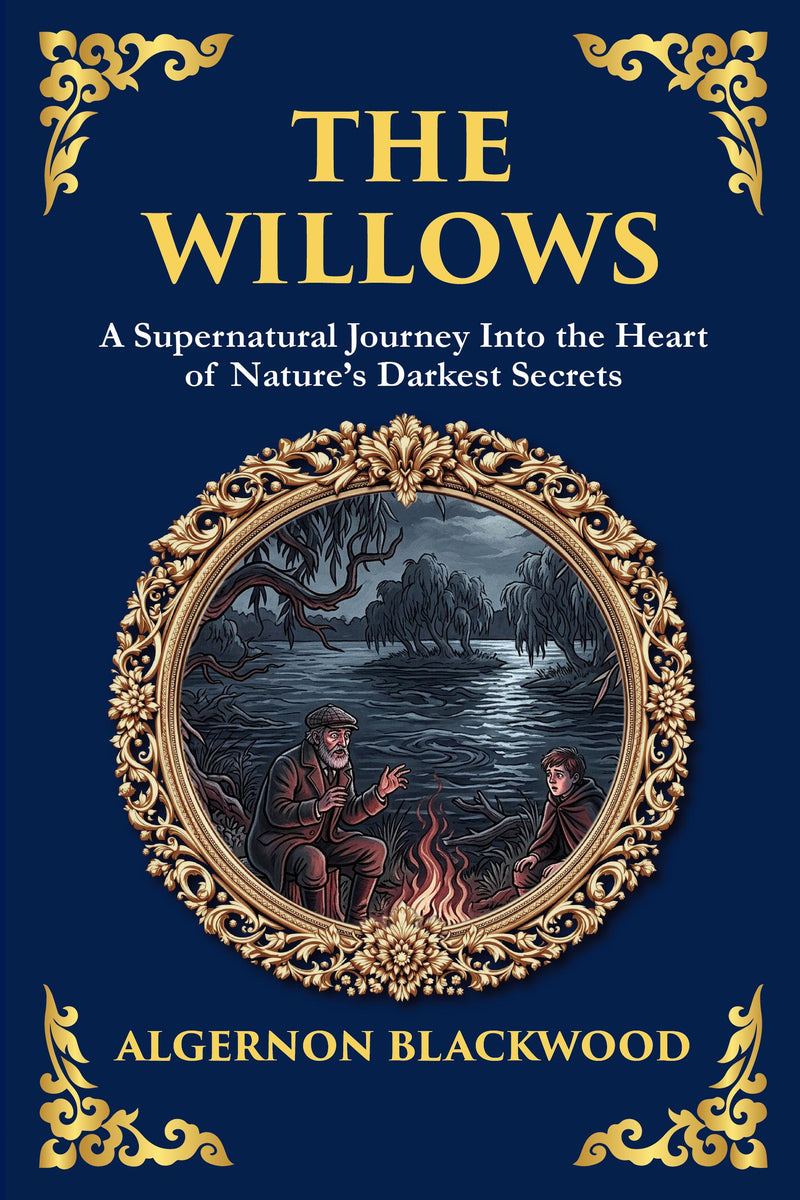
The Willows
Two friends journey by canoe down the Danube River, seeking solitude and serenity in nature’s untouched wilderness. But when they camp on a remote river island surrounded by swaying willows, their peaceful expedition descends into a waking nightmare.
or free app
10,000+ hrs library
30-day guarantee
The complete The Willows appears in modern English through Library of Alexandria Press, available online with audiobook narration included for members.
Have you ever wondered why some places make your soul tremble, even when nothing moves? In The Willows, Algernon Blackwood crafts one of the most unsettling and psychologically profound tales in supernatural literature. Set in the desolate floodplains of the Danube, the novella follows two travelers on a canoeing expedition who stumble upon a secluded island covered in endless, whispering willows.
As night falls, they realize they are not alone—and that the willows are far more than mere trees. This isn’t a ghost story. It’s an exploration of unseen forces, alien to human understanding, that dwell beneath the veil of nature.
A landmark of weird fiction, The Willows is a masterclass in atmosphere, dread, and spiritual terror that profoundly influenced authors like H.P. Lovecraft, who called it “the finest supernatural tale in English literature.” This modern edition preserves Blackwood’s poetic prose while enhancing its accessibility for contemporary readers, making it a perfect entry point for lovers of eerie, thought-provoking horror.
What you’ll discover in this modern edition
- An Atmosphere of Existential Dread – Enter a setting where the natural world pulses with a strange, incomprehensible intelligence.
- A Story of Isolation and Cosmic Terror – Witness the psychological unraveling of two men as they confront forces far beyond their grasp.
- A Masterpiece of Literary Horror – Ranked among the most influential tales in supernatural fiction, and revered by literary icons from Lovecraft to Borges.
- A Modern, Reader-Friendly Format – Faithful to the original, yet formatted to suit today’s literary tastes without losing Blackwood’s lyrical style.
| Formats | eBook (EPUB + PDF) · Audiobook · Paperback · Hardcover · Large Print |
| Language | English |
| Trim size (print) | 6 × 9 in |
| Binding | Paperback — perfect-bound · Hardcover — casewrap |
| Large Print edition | Same text in a larger, easy-read type — a larger font, not a larger trim |
| Print pricing | Every physical book at our true cost — at-cost, no profit (members) |
| Library | 873 restored titles, always growing |
| Length | 22,483 words · ~1 hr 30 min reading |
| Reading level | Grade 4 · an easy, flowing read (this modern-English edition) |
| Edition | Modern English translation · 2026 |
Member reviews for this edition are collected as readers finish it — be the first. Across the library: 12,000+ books shipped, every plan covered by a 365-day print guarantee.
About this edition
A faithful, unabridged modern-English edition by The Library of Alexandria — carefully rendered for today's reader and verified paragraph-by-paragraph against the public-domain source. Available as eBook, audiobook, paperback, hardcover, and large print.
- Complete & unabridgedVerified paragraph by paragraph against the source — never a scan, never abridged.
- Modern English, faithfulReadable today, with the author’s meaning kept intact. Readable — not simplified.
- Every format, one membershipRead in your browser or the free app, or listen to the full audiobook.
Included free with your membership
Cancel anytime, one click · 30-day money-back guarantee
Edition last updated July 2026
What’s inside
The Willows — complete and unabridged: all 6 sections included with membership, plus the full audiobook.
Begin reading The Willows
In clear modern English — the complete text is included with membership.
Introduction
There are stories that frighten us with monsters, and there are stories that frighten us with something far more unsettling: the suspicion that the world is not what we believe it to be, that beneath the familiar surface of rivers and trees and open sky there moves a vast intelligence wholly indifferent to human life. The tale you are about to read belongs firmly to the second category. It is widely regarded as one of the finest pieces of supernatural literature ever written in the English language, and it earned that reputation not through gore, not through shock, but through a slow, creeping, almost unbearable sense of dread that builds until the reader feels the very air around them grow thin and strange.
This is a story without villains in the conventional sense. There is no ghost rattling chains, no demon with a recognizable face, no creature that can be named, fought, or banished. Instead, there is a place — a wild, marshy, half-drowned stretch of landscape where two travelers find themselves stranded — and the growing, terrible understanding that this place is alive in a way they had never imagined, and that they have wandered, quite by accident, across a boundary that human beings were never meant to cross. What follows is a confrontation not with a thing, but with a presence; not with the unnatural, but with something so deeply, profoundly natural that human consciousness can barely withstand the contact.
To read this work is to undergo an experience that lingers long after the final page. It does not release its grip easily. Many readers report that they cannot look at a stand of trees swaying in the wind, or hear water lapping at a riverbank, in quite the same way ever again. That transformation of the ordinary into the menacing — that ability to make the wind itself seem like a voice, and the rustle of leaves seem like an argument among unseen powers — is the signature achievement of Algernon Blackwood, and it is on full and magnificent display here.
This particular edition has been prepared as a modern translation, carefully adapted for the contemporary reader. It is worth pausing on what that means and why it matters, because the choice to present a classic in updated language is never made lightly. Blackwood wrote in the opening years of the twentieth century, in a prose style that was elegant, dense, and richly textured — but also, by the standards of today, occasionally winding and elaborate in ways that can slow a modern reader down. Sentences sometimes stretched across half a page; vocabulary that was everyday currency in 1907 has since faded into obscurity; rhythms of speech and patterns of thought belonged to a world that no longer exists. For some readers, these features are part of the charm. For others, they form a barrier between the reader and the raw emotional power of the story.
The aim of this adaptation is to dissolve that barrier without sacrificing the soul of the work. The goal has been to preserve everything that makes the tale extraordinary — its atmosphere, its escalating tension, its philosophical depth, its unforgettable imagery — while rendering it in language that flows naturally for a reader of the present day. The hope is that you will fall under the spell of the story exactly as its first readers did, with nothing standing between you and the experience the author intended to create. Think of it not as a replacement for the original, which remains a treasure worth seeking out, but as a doorway — a way in, accessible and immediate, that delivers the full force of one of literature’s great masterpieces of unease.
The Man Who Heard the Voices in the Woods
To understand why this story carries such authority, such conviction, such an almost frightening sense of authenticity, it helps to understand the remarkable man who wrote it. Algernon Blackwood was born in England in 1869 into a family of considerable privilege and intense religious conviction. His father was a devout evangelical, and the young Blackwood was raised in an atmosphere of strict piety that he would later describe with a mixture of affection and rebellion. But from his earliest years, something in him resisted the rigid framework of his upbringing. He was drawn instead to the mystical, the unexplained, the vast and the wild. While other children might have been content with the lessons of the catechism, Blackwood found himself reaching toward something older and stranger — a sense that the natural world was not merely a backdrop to human affairs but a living thing, charged with meaning and power.
This was no idle fancy. Blackwood’s biography reads like the résumé of a man deliberately seeking out the raw edges of existence. As a young man, he traveled to Canada, where he tried his hand at farming and at running a dairy, both of which ended in financial ruin. He went to New York, where he lived in genuine poverty, working as a journalist and at one point sleeping in the open, surviving on next to nothing in a city that showed him no mercy. He battled illness, betrayal, and the kind of grinding hardship that breaks many people entirely. Yet through all of it, he was watching, absorbing, feeling the texture of a world that most people pass through without ever truly seeing.
What sets Blackwood apart from nearly every other writer of supernatural fiction is that he was, by all accounts, a genuine mystic — not in any vague or fashionable sense, but as a serious and lifelong practitioner of esoteric study and spiritual exploration. He immersed himself in mysticism, in the occult traditions of his era, in Eastern philosophy, in the study of consciousness and the question of whether the human mind might be capable of perceiving realities that ordinarily lie hidden. He spent extended periods alone in remote wilderness, canoeing through the vast forests of Canada, camping in places where the human footprint was faint or absent altogether. These were not casual vacations. They were, for him, something closer to pilgrimages — opportunities to push past the edge of civilization and to listen for whatever might be speaking in the silence.
The story you hold draws directly on one of these journeys. Blackwood and a companion undertook a canoe expedition down the Danube River, traveling through a wild and desolate region where the great river spreads out into a maze of channels, islands, and flooded lowlands. There, surrounded by an endless sea of willow bushes, Blackwood experienced something — a feeling, an atmosphere, an apprehension — that he could never quite shake. He felt himself to be a trespasser in a region that did not belong to humanity, where the ordinary rules of the world seemed suspended, and where the willows themselves appeared to possess a kind of awareness, a watchfulness, that filled him with awe and terror in equal measure. Out of that experience came this tale, and the power of the writing flows in large part from the fact that the author was not inventing his fear out of nothing. He had felt it, in his own body, on a real river under a real and indifferent sky.
This authenticity is the secret ingredient that elevates the story above mere entertainment. When Blackwood describes the way the wind behaves, the way the river rises and shifts, the way the willows seem to crowd in and press closer in the failing light, he is not reaching for effects. He is reporting, as faithfully as language allows, on a quality of dread that he believed was real — a sense that nature, far from being the gentle, picturesque thing of popular imagination, conceals depths and powers that human beings cannot comprehend and would be wise to fear.
Blackwood went on to become one of the most respected and prolific authors of weird and supernatural fiction of his generation. He wrote a vast number of stories and several novels, and his influence on the genre is enormous. The American master of cosmic horror, H. P. Lovecraft, considered this particular tale to be the single finest supernatural story in the English language, and praised Blackwood as one of the supreme architects of the literature of fear. That admiration was not casual flattery. Lovecraft recognized in Blackwood a kindred spirit who understood that the deepest horror is not the horror of being harmed, but the horror of insignificance — the dawning realization that we are tiny, fragile creatures clinging to the surface of a reality that is far larger, far stranger, and far more terrible than we can bear to acknowledge.
In his later years, Blackwood became something of a public figure in Britain, beloved for his appearances on radio and television, where he would tell ghost stories in a voice that listeners found mesmerizing. He had a face like weathered stone and eyes that seemed to look through the world rather than at it, and audiences adored him. He had become, in effect, the kindly old teller of tales by the fireside — but beneath that warm public persona lay a man who had stared into something vast and dark in the wilderness, and who never forgot what he had seen. He died in 1951, leaving behind a body of work that continues to unsettle and enthrall readers, and of which the story before you is universally acknowledged as the crown jewel.
Now a few words about how best to approach the reading experience itself, so that you may draw from it everything it has to offer. The most important thing to understand is that this is a story of atmosphere above all else. If you come to it expecting the rapid pace and frequent jolts of modern horror, you may at first feel impatient. Resist that impatience. The genius of this work lies precisely in its slowness, in its patience, in the way it tightens around you almost imperceptibly, so that by the time you realize how deeply you have been drawn into its world, it is far too late to look away. Blackwood was a master of the gradual accumulation of dread. He understood that fear, like water, finds its way in through the smallest cracks, and that the most terrifying moment is not the one in which something happens, but the long, agonizing stretch in which you sense that something is about to happen and cannot tell what it will be.
Read it, if you can, in a quiet place, with few distractions, ideally at a time when you can give yourself over to it fully. This is not a story to be consumed in fragments between other tasks. It rewards immersion. It wants your attention, your imagination, your willingness to enter into the perceptions of the two travelers and to feel what they feel as the world around them slowly reveals itself to be something other than what they had assumed. Pay attention to the descriptions of the landscape — they are not filler, not scene-setting in the ordinary sense, but the very heart of the matter. The willows themselves are, in a real way, the central presence of the tale, and the way they are rendered — restless, multitudinous, swaying and whispering and seeming always to be on the verge of some terrible purpose — is among the most extraordinary achievements of mood in all of literature.
Notice, too, the relationship between the two men at the center of the story, and the way their differing temperaments shape their responses to the mounting strangeness around them. There is a profound psychological truth in the way the narrator and his companion react — one inclined to rationalize and explain, the other more open to the possibility that they have stumbled into something beyond explanation. This dynamic gives the supernatural elements a grounding in recognizable human nature, and it is part of what makes the dread feel so real. We see ourselves in these men. We recognize the desperate impulse to find ordinary explanations for extraordinary phenomena, the way the mind reaches for any straw of normalcy when confronted with the unthinkable. And we recognize, too, the moment when those explanations begin to fail, when the comfortable scaffolding of reason starts to buckle under the weight of an experience it was never built to contain.
Cancel anytime, one click · 30-day money-back guarantee
Founding annual rate available now — your price locks for life when you join.
Not ready? Get this free chapter by email — read it anytime.
✓ Sent — check your inbox for The Willows.
Questions about The Willows
What is The Willows about?
Two friends journey by canoe down the Danube River, seeking solitude and serenity in nature’s untouched wilderness. But when they camp on a remote river island surrounded by swaying willows, their peaceful expedition descends into a waking nightmare. Something ancient and otherworldly stirs among the trees—something watching, waiting, and silently encroaching.
Who wrote The Willows?
The Willows was written by Algernon Blackwood. This edition presents the complete work in clear modern English, faithfully rendered from the public-domain original by Library of Alexandria Press.
Is The Willows free to read?
The opening chapter is free to read on this page. Members read and listen to the complete work — and the entire library — free, and can order any physical book at our true print cost.
How long is The Willows?
6 chapters (~22,483 words) — about 1 hr 30 min of reading in this modern-English edition.
Is this an abridged version of The Willows?
No. This is the complete, unabridged The Willows, carefully rendered into clear modern English and verified paragraph-by-paragraph against the public-domain source — nothing is cut or summarised.
What formats does The Willows come in?
The Willows is available as eBook, paperback, hardcover and large print. eBook and audiobook are included with membership; printed editions ship at our true print cost.
Shipping & returns
Billing & membership
More from the library


Explore Horror & Gothic
- The Strange Case of Dr. Jekyll and Mr. Hyde · Robert Louis Stevenson
- The Cask of Amontillado · Edgar Allan Poe
- Ghost Stories of an Antiquary · M. R. James
- The Monk: A Romance · M. G. Lewis
- The House of the Seven Gables · Nathaniel Hawthorne
- The Monkey’s Paw · W. W. Jacobs
- The Call of Cthulhu · H. P. Lovecraft
- The Life-Eater · Harold Ward
- The Black Kiss
- The Legend of Sleepy Hollow · Washington Irving
- Brood of the Dark Moon · Charles Willard Diffin
- The Night Land · William Hope Hodgson
- The Castle of Otranto · Horace Walpole
- Dracula · Bram Stoker
- Carmilla · Joseph Sheridan Le Fanu
- The King in Yellow · Robert W. Chambers
- Wuthering Heights · Emily Brontë
- The Vampyre: A Tale · John William Polidori
- A Christmas Carol · Charles Dickens
- Northanger Abbey · Jane Austen
- The Turn of the Screw · Henry James
- Metamorphosis · Franz Kafka
- The Yellow Wallpaper · Charlotte Perkins Gilman
- The Adventures of Ferdinand Count Fathom — Complete · T. Smollett
- The Picture of Dorian Gray · Oscar Wilde
- Frankenstein; Or, The Modern Prometheus · Mary Wollstonecraft Shelley
The Willows
The Willows
A Supernatural Journey Into the Heart of Nature’s Darkest Secrets
Algernon Blackwood
Contents
- Introduction
- Chapter 1
- Chapter 2
- Chapter 3
- Chapter 4
- Chapter 5
Introduction
There are stories that frighten us with monsters, and there are stories that frighten us with something far more unsettling: the suspicion that the world is not what we believe it to be, that beneath the familiar surface of rivers and trees and open sky there moves a vast intelligence wholly indifferent to human life. The tale you are about to read belongs firmly to the second category. It is widely regarded as one of the finest pieces of supernatural literature ever written in the English language, and it earned that reputation not through gore, not through shock, but through a slow, creeping, almost unbearable sense of dread that builds until the reader feels the very air around them grow thin and strange.
This is a story without villains in the conventional sense. There is no ghost rattling chains, no demon with a recognizable face, no creature that can be named, fought, or banished. Instead, there is a place — a wild, marshy, half-drowned stretch of landscape where two travelers find themselves stranded — and the growing, terrible understanding that this place is alive in a way they had never imagined, and that they have wandered, quite by accident, across a boundary that human beings were never meant to cross. What follows is a confrontation not with a thing, but with a presence; not with the unnatural, but with something so deeply, profoundly natural that human consciousness can barely withstand the contact.
To read this work is to undergo an experience that lingers long after the final page. It does not release its grip easily. Many readers report that they cannot look at a stand of trees swaying in the wind, or hear water lapping at a riverbank, in quite the same way ever again. That transformation of the ordinary into the menacing — that ability to make the wind itself seem like a voice, and the rustle of leaves seem like an argument among unseen powers — is the signature achievement of Algernon Blackwood, and it is on full and magnificent display here.
This particular edition has been prepared as a modern translation, carefully adapted for the contemporary reader. It is worth pausing on what that means and why it matters, because the choice to present a classic in updated language is never made lightly. Blackwood wrote in the opening years of the twentieth century, in a prose style that was elegant, dense, and richly textured — but also, by the standards of today, occasionally winding and elaborate in ways that can slow a modern reader down. Sentences sometimes stretched across half a page; vocabulary that was everyday currency in 1907 has since faded into obscurity; rhythms of speech and patterns of thought belonged to a world that no longer exists. For some readers, these features are part of the charm. For others, they form a barrier between the reader and the raw emotional power of the story.
The aim of this adaptation is to dissolve that barrier without sacrificing the soul of the work. The goal has been to preserve everything that makes the tale extraordinary — its atmosphere, its escalating tension, its philosophical depth, its unforgettable imagery — while rendering it in language that flows naturally for a reader of the present day. The hope is that you will fall under the spell of the story exactly as its first readers did, with nothing standing between you and the experience the author intended to create. Think of it not as a replacement for the original, which remains a treasure worth seeking out, but as a doorway — a way in, accessible and immediate, that delivers the full force of one of literature’s great masterpieces of unease.
The Man Who Heard the Voices in the Woods
To understand why this story carries such authority, such conviction, such an almost frightening sense of authenticity, it helps to understand the remarkable man who wrote it. Algernon Blackwood was born in England in 1869 into a family of considerable privilege and intense religious conviction. His father was a devout evangelical, and the young Blackwood was raised in an atmosphere of strict piety that he would later describe with a mixture of affection and rebellion. But from his earliest years, something in him resisted the rigid framework of his upbringing. He was drawn instead to the mystical, the unexplained, the vast and the wild. While other children might have been content with the lessons of the catechism, Blackwood found himself reaching toward something older and stranger — a sense that the natural world was not merely a backdrop to human affairs but a living thing, charged with meaning and power.
This was no idle fancy. Blackwood’s biography reads like the résumé of a man deliberately seeking out the raw edges of existence. As a young man, he traveled to Canada, where he tried his hand at farming and at running a dairy, both of which ended in financial ruin. He went to New York, where he lived in genuine poverty, working as a journalist and at one point sleeping in the open, surviving on next to nothing in a city that showed him no mercy. He battled illness, betrayal, and the kind of grinding hardship that breaks many people entirely. Yet through all of it, he was watching, absorbing, feeling the texture of a world that most people pass through without ever truly seeing.
What sets Blackwood apart from nearly every other writer of supernatural fiction is that he was, by all accounts, a genuine mystic — not in any vague or fashionable sense, but as a serious and lifelong practitioner of esoteric study and spiritual exploration. He immersed himself in mysticism, in the occult traditions of his era, in Eastern philosophy, in the study of consciousness and the question of whether the human mind might be capable of perceiving realities that ordinarily lie hidden. He spent extended periods alone in remote wilderness, canoeing through the vast forests of Canada, camping in places where the human footprint was faint or absent altogether. These were not casual vacations. They were, for him, something closer to pilgrimages — opportunities to push past the edge of civilization and to listen for whatever might be speaking in the silence.
The story you hold draws directly on one of these journeys. Blackwood and a companion undertook a canoe expedition down the Danube River, traveling through a wild and desolate region where the great river spreads out into a maze of channels, islands, and flooded lowlands. There, surrounded by an endless sea of willow bushes, Blackwood experienced something — a feeling, an atmosphere, an apprehension — that he could never quite shake. He felt himself to be a trespasser in a region that did not belong to humanity, where the ordinary rules of the world seemed suspended, and where the willows themselves appeared to possess a kind of awareness, a watchfulness, that filled him with awe and terror in equal measure. Out of that experience came this tale, and the power of the writing flows in large part from the fact that the author was not inventing his fear out of nothing. He had felt it, in his own body, on a real river under a real and indifferent sky.
This authenticity is the secret ingredient that elevates the story above mere entertainment. When Blackwood describes the way the wind behaves, the way the river rises and shifts, the way the willows seem to crowd in and press closer in the failing light, he is not reaching for effects. He is reporting, as faithfully as language allows, on a quality of dread that he believed was real — a sense that nature, far from being the gentle, picturesque thing of popular imagination, conceals depths and powers that human beings cannot comprehend and would be wise to fear.
Blackwood went on to become one of the most respected and prolific authors of weird and supernatural fiction of his generation. He wrote a vast number of stories and several novels, and his influence on the genre is enormous. The American master of cosmic horror, H. P. Lovecraft, considered this particular tale to be the single finest supernatural story in the English language, and praised Blackwood as one of the supreme architects of the literature of fear. That admiration was not casual flattery. Lovecraft recognized in Blackwood a kindred spirit who understood that the deepest horror is not the horror of being harmed, but the horror of insignificance — the dawning realization that we are tiny, fragile creatures clinging to the surface of a reality that is far larger, far stranger, and far more terrible than we can bear to acknowledge.
In his later years, Blackwood became something of a public figure in Britain, beloved for his appearances on radio and television, where he would tell ghost stories in a voice that listeners found mesmerizing. He had a face like weathered stone and eyes that seemed to look through the world rather than at it, and audiences adored him. He had become, in effect, the kindly old teller of tales by the fireside — but beneath that warm public persona lay a man who had stared into something vast and dark in the wilderness, and who never forgot what he had seen. He died in 1951, leaving behind a body of work that continues to unsettle and enthrall readers, and of which the story before you is universally acknowledged as the crown jewel.
Now a few words about how best to approach the reading experience itself, so that you may draw from it everything it has to offer. The most important thing to understand is that this is a story of atmosphere above all else. If you come to it expecting the rapid pace and frequent jolts of modern horror, you may at first feel impatient. Resist that impatience. The genius of this work lies precisely in its slowness, in its patience, in the way it tightens around you almost imperceptibly, so that by the time you realize how deeply you have been drawn into its world, it is far too late to look away. Blackwood was a master of the gradual accumulation of dread. He understood that fear, like water, finds its way in through the smallest cracks, and that the most terrifying moment is not the one in which something happens, but the long, agonizing stretch in which you sense that something is about to happen and cannot tell what it will be.
Read it, if you can, in a quiet place, with few distractions, ideally at a time when you can give yourself over to it fully. This is not a story to be consumed in fragments between other tasks. It rewards immersion. It wants your attention, your imagination, your willingness to enter into the perceptions of the two travelers and to feel what they feel as the world around them slowly reveals itself to be something other than what they had assumed. Pay attention to the descriptions of the landscape — they are not filler, not scene-setting in the ordinary sense, but the very heart of the matter. The willows themselves are, in a real way, the central presence of the tale, and the way they are rendered — restless, multitudinous, swaying and whispering and seeming always to be on the verge of some terrible purpose — is among the most extraordinary achievements of mood in all of literature.
Notice, too, the relationship between the two men at the center of the story, and the way their differing temperaments shape their responses to the mounting strangeness around them. There is a profound psychological truth in the way the narrator and his companion react — one inclined to rationalize and explain, the other more open to the possibility that they have stumbled into something beyond explanation. This dynamic gives the supernatural elements a grounding in recognizable human nature, and it is part of what makes the dread feel so real. We see ourselves in these men. We recognize the desperate impulse to find ordinary explanations for extraordinary phenomena, the way the mind reaches for any straw of normalcy when confronted with the unthinkable. And we recognize, too, the moment when those explanations begin to fail, when the comfortable scaffolding of reason starts to buckle under the weight of an experience it was never built to contain.
After you leave Vienna, well before reaching Budapest, the Danube flows into a strangely lonely and desolate region. Here, the water spreads out in every direction without a main channel, turning the landscape into a swamp for miles, covered by a massive sea of low willow bushes. On large maps, this empty area is colored a soft blue that fades as it moves away from the riverbanks, and the word “Sümpfe,” meaning marshes, is written across it in large, sprawling letters.
During high floods, this vast expanse of sand, gravel beds, and willow-covered islands is almost completely submerged. However, in normal seasons, the bushes bend and rustle in the open wind, showing their silver leaves to the sun in a constantly shifting plain of stunning beauty. These willows never grow into full trees; they lack sturdy trunks and remain small bushes with rounded tops and soft edges. They sway on thin stems that react to the slightest breeze, as flexible as grass. Because they shift so constantly, it feels as though the entire plain is moving and alive. The wind creates waves that rise and fall across the surface—waves of leaves rather than water. They look like green swells of the ocean until the branches flip upward, revealing their silvery-white undersides to the sun.
Glad to be free from the strict constraints of its banks, the Danube wanders wherever it pleases here. It winds through a complex web of channels that cut across the islands, creating wide paths where the water rushes forward with a roaring sound. This current creates whirlpools, swirling eddies, and foaming rapids that eat away at the sandy shores, washing away chunks of land and clusters of willow trees. In the process, it forms countless new islands that change size and shape every day; these islands are temporary by nature, as the flood seasons eventually wipe them out completely.
End of the free sample
Keep reading, free
Members read and listen to the complete book — and the entire library. Cancel anytime, one click · 30-day money-back guarantee.