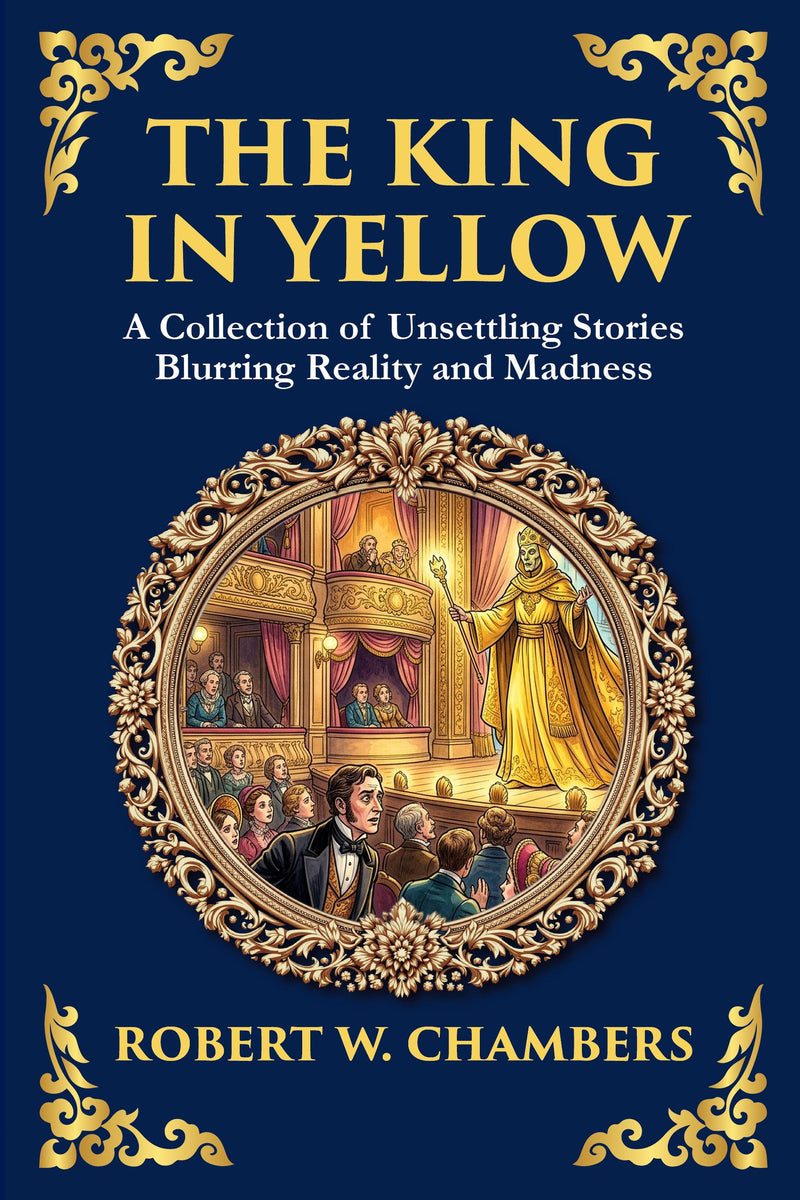
The King in Yellow
Within these haunting pages lies The King in Yellow, a collection of tales that walk the delicate line between reality and insanity.
or free app
10,000+ hrs library
30-day guarantee
The complete The King in Yellow appears in modern English through Library of Alexandria Press, available online with audiobook narration included for members.
Have you ever wondered why forbidden knowledge can drive the human mind to the edge of madness? In The King in Yellow, Robert W. Chambers delivers a chilling collection of interconnected stories centered around a forbidden play so powerful that those who read it descend into madness. These tales of psychological horror and supernatural dread blur the lines between reality and nightmare, pulling readers into a web of paranoia, fear, and cosmic mystery.
First published in 1895, this collection became a foundational work of weird fiction, deeply influencing later masters of horror like H.P. Lovecraft and Stephen King. Within these pages, you’ll encounter haunted artists, deranged seekers of truth, and cursed lovers—all bound by the shadow of The King in Yellow, a sinister figure whose presence is felt but never fully seen.
What you’ll discover in this modern edition
- The Mystery of the Forbidden Play – A terrifying manuscript that drives its readers to madness, weaving through multiple stories.
- Tales of Psychological Horror – Explore characters descending into obsession, paranoia, and despair as they face forces beyond comprehension.
- A Groundbreaking Work of Weird Fiction – Discover why this collection became a cornerstone of supernatural horror literature.
- The Birth of the Mythos – A precursor to Lovecraft’s Cthulhu Mythos, filled with dark symbols, cosmic terror, and unknowable truths.
- A Timeless Reflection on Madness and Power – Themes of forbidden knowledge, destructive ambition, and human fragility that resonate even today.
| Formats | eBook (EPUB + PDF) · Audiobook · Paperback · Hardcover · Large Print |
| Language | English |
| Trim size (print) | 6 × 9 in |
| Binding | Paperback — perfect-bound · Hardcover — casewrap |
| Large Print edition | Same text in a larger, easy-read type — a larger font, not a larger trim |
| Print pricing | Every physical book at our true cost — at-cost, no profit (members) |
| Library | 873 restored titles, always growing |
| Length | 71,477 words · ~4 hr 46 min reading |
| Reading level | Grade 3 · an easy, flowing read (this modern-English edition) |
| Edition | Modern English translation · 2026 |
Member reviews for this edition are collected as readers finish it — be the first. Across the library: 12,000+ books shipped, every plan covered by a 365-day print guarantee.
About this edition
A faithful, unabridged modern-English edition by The Library of Alexandria — carefully rendered for today's reader and verified paragraph-by-paragraph against the public-domain source. Available as eBook, audiobook, paperback, hardcover, and large print.
- Complete & unabridgedVerified paragraph by paragraph against the source — never a scan, never abridged.
- Modern English, faithfulReadable today, with the author’s meaning kept intact. Readable — not simplified.
- Every format, one membershipRead in your browser or the free app, or listen to the full audiobook.
Included free with your membership
Cancel anytime, one click · 30-day money-back guarantee
Edition last updated July 2026
What’s inside
The King in Yellow — complete and unabridged: all 11 sections included with membership, plus the full audiobook.
Begin reading The King in Yellow
In clear modern English — the complete text is included with membership.
Introduction
There are certain books that refuse to behave themselves. They will not sit quietly on the shelf, waiting their turn. They seep. They creep into the corners of the mind and take up residence there, surfacing unbidden in the small hours when sleep proves elusive and the house has gone silent. The King in Yellow is one of those books. Published in 1895 by a young American writer named Robert W. Chambers, it has spent well over a century proving that the most enduring kind of fear is not the kind that makes you scream, but the kind that makes you doubt — doubt your senses, your memories, your sanity, and the solidity of the very ground beneath your feet.
To open this volume is to step into a peculiar and beautiful trap. On the surface, you will find stories of artists in their Parisian garrets, of soldiers and lovers, of dreamers and the women who haunt them. The prose is often delicate, even romantic, painting scenes of cobblestone streets and Latin Quarter studios with the affectionate eye of a man who knew them intimately. And yet, threaded through these tales like a single black wire running beneath polished floorboards, there is something terribly wrong. A title keeps recurring — a play, a forbidden drama also called The King in Yellow, a work of such poisonous artistry that to read its second act is to invite madness. A strange symbol appears, the Yellow Sign, glimpsed in passing and then never forgotten. Names drift through the pages like fog: Carcosa, Hastur, Aldebaran, the Lake of Hali, the Pallid Mask. These references arrive without explanation and depart without resolution, and the cumulative effect is one of profound and exhilarating unease.
What makes this collection so remarkable, and what has secured its place in the canon of weird fiction, is precisely this restraint. Chambers does not hand you the monster. He never lets you read the cursed play yourself; he only shows you the wreckage it leaves in the lives of those unlucky enough to encounter it. The horror lives in the gaps, in what is implied rather than stated, in the maddening suspicion that some terrible truth lies just beyond the edge of comprehension. This is a book that trusts its reader to do the most frightening work — the imagining — and in doing so it achieves an intimacy of dread that more explicit works can never match.
This modern edition has been carefully adapted for the contemporary reader. The aim throughout has been to preserve the strange, intoxicating atmosphere that Chambers created while gently clearing away the obstacles that more than a century of linguistic drift can place between a reader and a text. Antiquated turns of phrase, references that have faded into obscurity, and the occasional density of late-Victorian prose have been smoothed where smoothing serves clarity — but never at the cost of the book’s essential mood, its music, or its mystery. The goal has been to let you experience what readers in 1895 must have experienced: the slow-dawning horror, the seductive beauty, the sense of having brushed against something forbidden. You are meant to be unsettled. You are meant to wonder. That, after all, is the point.
To understand the curious magic of this book, it helps to know a little about the man who wrote it — and to appreciate just how unlikely a creator he was for such a deeply disquieting work. Robert William Chambers was born in Brooklyn, New York, in 1865, into a comfortable and accomplished family. His father was a prominent lawyer, and young Robert showed early gifts not in writing but in art. He trained as a painter, first at the Art Students League in New York — where he studied alongside the future illustrator Charles Dana Gibson, creator of the famous “Gibson Girl” — and then in Paris, at the legendary Académie Julian and the École des Beaux-Arts. He spent the better part of seven years in the French capital during the late 1880s and early 1890s, absorbing the bohemian life of the art student, exhibiting his work at the Paris Salon, and steeping himself in a world of studios, cafés, models, and dreamers.
This biographical detail is no mere footnote. The Paris of The King in Yellow is not invented; it is remembered. When Chambers writes of the Latin Quarter, of the gardens of the Luxembourg, of the camaraderie and rivalry and tender melancholy of young artists trying to make their way, he writes from the inside. The settings glow with authenticity, and this lived-in quality is one of the great pleasures of the collection. It also makes the intrusion of the uncanny all the more effective. When horror erupts from a world rendered with such loving, naturalistic precision, the contrast is devastating. We believe the streets, and so we are forced, against our will, to believe the nightmare.
Chambers returned to America in the early 1890s and turned, somewhat reluctantly at first, from painting to writing. His first novel appeared in 1894, and The King in Yellow followed in 1895, when he was just thirty years old. It is, in many ways, a young man’s book — ambitious, uneven, brimming with ideas, alternating between the lyrical and the grotesque. It was not the book that made him rich. In fact, the strange and unsettling stories that have made his name immortal among lovers of weird fiction were, during his own lifetime, something of an anomaly in his career. Chambers went on to become one of the most commercially successful authors in America, producing a torrent of popular romances, historical novels, and adventure stories that earned him a fortune and a fashionable lifestyle. The vast majority of those bestsellers are now forgotten, gathering dust in the obscurity of literary history.
There is a profound irony here, and one worth sitting with. The work Chambers is remembered for — the work that influenced generations of writers and continues to send shivers down spines today — is not the work he was celebrated for in his time. He wrote his masterpiece early, almost as if by accident, and then spent decades writing books that paid the bills and pleased the crowds. It is as though he stumbled upon a doorway into something dark and extraordinary, glanced through it, recorded what he saw, and then prudently closed it and walked away toward safer, sunnier pastures. We are fortunate that he opened it at all.
The other thing worth knowing is where Chambers found his raw materials. The eerie nomenclature that gives the collection its haunted texture — Carcosa, Hastur, the Hyades, Aldebaran — was not invented from whole cloth. Chambers borrowed several of these names from the short stories of Ambrose Bierce, the acerbic American writer and Civil War veteran whose tales “An Inhabitant of Carcosa” and “Haïta the Shepherd” supplied evocative place-names and a hint of cosmic strangeness. Chambers took these scattered seeds and planted them in his own peculiar soil, and what grew was something entirely new: a mythology of madness, a constellation of dread that would outlive its origins and take on a life of its own.
For that mythology did not die with Chambers. Some twenty years after the publication of this book, a young writer in Providence, Rhode Island, named Howard Phillips Lovecraft, discovered it and was deeply impressed. Lovecraft praised Chambers’s weird tales and absorbed their lessons — the power of suggestion, the horror of forbidden texts, the dread of cosmic forces indifferent to human life. He folded the names Hastur and the Yellow Sign into the sprawling shared universe that would become known as the Cthulhu Mythos, and through that vast and ongoing collaborative tradition, Chambers’s inventions have spread to countless other writers, to games, to films, and to television. When a modern audience encounters a reference to “the King in Yellow” or “Carcosa” in contemporary popular culture, they are encountering, often without knowing it, the long shadow of this slim Victorian volume. Few books published in 1895 can claim such persistent, mutating influence. Fewer still deserve it.
The Cursed Play and the Architecture of Dread
At the dark heart of this collection lies an idea so simple and so brilliant that it seems astonishing no one had fully exploited it before: the cursed book. Within the world Chambers creates, there exists a play, a drama in two acts, also titled The King in Yellow. Its first act is said to be innocent enough — even beautiful. But the second act is something else entirely. To read it is to be undone. It does not kill the reader outright; it does something far worse. It opens the mind to truths the mind was never meant to hold, and once those truths are glimpsed, there is no closing the door. Madness follows. Despair follows. The reader is marked, set apart, drawn inexorably toward a fate that hangs always just out of view.
The genius of this conceit is that the play itself is never reproduced. We get fragments — a stage direction here, a snatch of dialogue there, a line of verse that hints at unspeakable wonders and terrors. We learn that the play has been banned and suppressed, that copies are sought and destroyed, and yet that it spreads, that it finds its way into the hands of the curious and the doomed. We are told of its effects, but we are never permitted to read the cursed second act ourselves — and this is mercy and torment in equal measure. By withholding the text, Chambers makes the reader complicit in the very horror he describes. We become, like his characters, people who have heard of the forbidden thing, who circle it, who are tempted by it. Each fragment we are given is a thread pulled from a tapestry we cannot see, and the imagination races to fill in the rest, conjuring something far more terrible than any words on a page could ever be.
This is the most important thing to understand before you begin reading, and the thing that will most reward your patience: The King in Yellow is a book built on suggestion, atmosphere, and accumulation. It does not operate the way modern horror often does. There are no jump scares, no relentless escalation toward a climactic revelation, no neat explanation tying everything together at the end. Instead, there is a slow seeping of unease, a steady drip of strangeness that pools and rises until you find yourself standing in it without quite knowing when the water reached your knees.
The collection’s structure reinforces this effect in a way that first-time readers should be prepared for. The book is, in truth, a book of two halves. The opening stories — the most famous and the most influential — are tales of the supernatural and the uncanny, saturated with references to the cursed play, the Yellow Sign, and the haunting names of that distant, doomed realm. These are the stories that gave the collection its reputation, the ones that Lovecraft admired and that have echoed through weird fiction ever since. They are eerie, ambiguous, and genuinely disturbing, and they reward slow, attentive reading.
But as you move deeper into the volume, the character of the stories shifts. The supernatural elements recede, and the tales become more grounded — stories of love and loss, of artists and their muses, of life in Paris and the tender, often heartbreaking dramas of young people far from home. To a reader who came expecting an unbroken stream of horror, this shift can feel disorienting, even like a betrayal. But it is worth approaching the second half with an open mind and a recalibrated set of expectations. These are not failures or filler; they are evidence of Chambers’s range, his deep affection for the bohemian world he had lived in, and his gifts as a writer of romantic and atmospheric fiction. Read on their own terms, the later stories possess a wistful beauty, and they cast the earlier horror tales in an interesting light. The same hand that conjured cosmic dread could also render a quiet love affair with delicacy and grace. There is a wholeness to the collection’s strange contradictions, a sense that Chambers was showing us both the nightmare and the dream, the abyss and the garden, often within a few pages of each other.
Cancel anytime, one click · 30-day money-back guarantee
Founding annual rate available now — your price locks for life when you join.
Not ready? Get this free chapter by email — read it anytime.
✓ Sent — check your inbox for The King in Yellow.
Questions about The King in Yellow
What is The King in Yellow about?
Within these haunting pages lies The King in Yellow, a collection of tales that walk the delicate line between reality and insanity. At its heart is a mysterious and forbidden play that drives its readers into madness and despair. As strange events unfold and dark secrets are revealed, each story pulls you deeper into a world of cosmic horror, where obsession and fear merge into something unspeakable.
Who wrote The King in Yellow?
The King in Yellow was written by Robert W. Chambers. This edition presents the complete work in clear modern English, faithfully rendered from the public-domain original by Library of Alexandria Press.
Is The King in Yellow free to read?
The opening chapter is free to read on this page. Members read and listen to the complete work — and the entire library — free, and can order any physical book at our true print cost.
How long is The King in Yellow?
11 chapters (~71,477 words) — about 4 hr 46 min of reading in this modern-English edition.
Is this an abridged version of The King in Yellow?
No. This is the complete, unabridged The King in Yellow, carefully rendered into clear modern English and verified paragraph-by-paragraph against the public-domain source — nothing is cut or summarised.
What formats does The King in Yellow come in?
The King in Yellow is available as eBook, paperback, hardcover and large print. eBook and audiobook are included with membership; printed editions ship at our true print cost.
Shipping & returns
Billing & membership
More from the library


Explore Horror & Gothic
- The Strange Case of Dr. Jekyll and Mr. Hyde · Robert Louis Stevenson
- The Cask of Amontillado · Edgar Allan Poe
- Ghost Stories of an Antiquary · M. R. James
- The Monk: A Romance · M. G. Lewis
- The House of the Seven Gables · Nathaniel Hawthorne
- The Willows · Algernon Blackwood
- The Monkey’s Paw · W. W. Jacobs
- The Call of Cthulhu · H. P. Lovecraft
- The Life-Eater · Harold Ward
- The Black Kiss
- The Legend of Sleepy Hollow · Washington Irving
- Brood of the Dark Moon · Charles Willard Diffin
- The Night Land · William Hope Hodgson
- The Castle of Otranto · Horace Walpole
- Dracula · Bram Stoker
- Carmilla · Joseph Sheridan Le Fanu
- Wuthering Heights · Emily Brontë
- The Vampyre: A Tale · John William Polidori
- A Christmas Carol · Charles Dickens
- Northanger Abbey · Jane Austen
- The Turn of the Screw · Henry James
- Metamorphosis · Franz Kafka
- The Yellow Wallpaper · Charlotte Perkins Gilman
- The Adventures of Ferdinand Count Fathom — Complete · T. Smollett
- The Picture of Dorian Gray · Oscar Wilde
- Frankenstein; Or, The Modern Prometheus · Mary Wollstonecraft Shelley
The King in Yellow
The King in Yellow
A Collection of Unsettling Stories Blurring Reality and Madness
Robert W. Chambers
Contents
- Introduction
- Chapter 1
- Chapter 2
- Chapter 3
- Chapter 4
- Chapter 5
- Chapter 6
- Chapter 7
- Chapter 8
- Chapter 9
- Chapter 10
Introduction
There are certain books that refuse to behave themselves. They will not sit quietly on the shelf, waiting their turn. They seep. They creep into the corners of the mind and take up residence there, surfacing unbidden in the small hours when sleep proves elusive and the house has gone silent. The King in Yellow is one of those books. Published in 1895 by a young American writer named Robert W. Chambers, it has spent well over a century proving that the most enduring kind of fear is not the kind that makes you scream, but the kind that makes you doubt — doubt your senses, your memories, your sanity, and the solidity of the very ground beneath your feet.
To open this volume is to step into a peculiar and beautiful trap. On the surface, you will find stories of artists in their Parisian garrets, of soldiers and lovers, of dreamers and the women who haunt them. The prose is often delicate, even romantic, painting scenes of cobblestone streets and Latin Quarter studios with the affectionate eye of a man who knew them intimately. And yet, threaded through these tales like a single black wire running beneath polished floorboards, there is something terribly wrong. A title keeps recurring — a play, a forbidden drama also called The King in Yellow, a work of such poisonous artistry that to read its second act is to invite madness. A strange symbol appears, the Yellow Sign, glimpsed in passing and then never forgotten. Names drift through the pages like fog: Carcosa, Hastur, Aldebaran, the Lake of Hali, the Pallid Mask. These references arrive without explanation and depart without resolution, and the cumulative effect is one of profound and exhilarating unease.
What makes this collection so remarkable, and what has secured its place in the canon of weird fiction, is precisely this restraint. Chambers does not hand you the monster. He never lets you read the cursed play yourself; he only shows you the wreckage it leaves in the lives of those unlucky enough to encounter it. The horror lives in the gaps, in what is implied rather than stated, in the maddening suspicion that some terrible truth lies just beyond the edge of comprehension. This is a book that trusts its reader to do the most frightening work — the imagining — and in doing so it achieves an intimacy of dread that more explicit works can never match.
This modern edition has been carefully adapted for the contemporary reader. The aim throughout has been to preserve the strange, intoxicating atmosphere that Chambers created while gently clearing away the obstacles that more than a century of linguistic drift can place between a reader and a text. Antiquated turns of phrase, references that have faded into obscurity, and the occasional density of late-Victorian prose have been smoothed where smoothing serves clarity — but never at the cost of the book’s essential mood, its music, or its mystery. The goal has been to let you experience what readers in 1895 must have experienced: the slow-dawning horror, the seductive beauty, the sense of having brushed against something forbidden. You are meant to be unsettled. You are meant to wonder. That, after all, is the point.
To understand the curious magic of this book, it helps to know a little about the man who wrote it — and to appreciate just how unlikely a creator he was for such a deeply disquieting work. Robert William Chambers was born in Brooklyn, New York, in 1865, into a comfortable and accomplished family. His father was a prominent lawyer, and young Robert showed early gifts not in writing but in art. He trained as a painter, first at the Art Students League in New York — where he studied alongside the future illustrator Charles Dana Gibson, creator of the famous “Gibson Girl” — and then in Paris, at the legendary Académie Julian and the École des Beaux-Arts. He spent the better part of seven years in the French capital during the late 1880s and early 1890s, absorbing the bohemian life of the art student, exhibiting his work at the Paris Salon, and steeping himself in a world of studios, cafés, models, and dreamers.
This biographical detail is no mere footnote. The Paris of The King in Yellow is not invented; it is remembered. When Chambers writes of the Latin Quarter, of the gardens of the Luxembourg, of the camaraderie and rivalry and tender melancholy of young artists trying to make their way, he writes from the inside. The settings glow with authenticity, and this lived-in quality is one of the great pleasures of the collection. It also makes the intrusion of the uncanny all the more effective. When horror erupts from a world rendered with such loving, naturalistic precision, the contrast is devastating. We believe the streets, and so we are forced, against our will, to believe the nightmare.
Chambers returned to America in the early 1890s and turned, somewhat reluctantly at first, from painting to writing. His first novel appeared in 1894, and The King in Yellow followed in 1895, when he was just thirty years old. It is, in many ways, a young man’s book — ambitious, uneven, brimming with ideas, alternating between the lyrical and the grotesque. It was not the book that made him rich. In fact, the strange and unsettling stories that have made his name immortal among lovers of weird fiction were, during his own lifetime, something of an anomaly in his career. Chambers went on to become one of the most commercially successful authors in America, producing a torrent of popular romances, historical novels, and adventure stories that earned him a fortune and a fashionable lifestyle. The vast majority of those bestsellers are now forgotten, gathering dust in the obscurity of literary history.
There is a profound irony here, and one worth sitting with. The work Chambers is remembered for — the work that influenced generations of writers and continues to send shivers down spines today — is not the work he was celebrated for in his time. He wrote his masterpiece early, almost as if by accident, and then spent decades writing books that paid the bills and pleased the crowds. It is as though he stumbled upon a doorway into something dark and extraordinary, glanced through it, recorded what he saw, and then prudently closed it and walked away toward safer, sunnier pastures. We are fortunate that he opened it at all.
The other thing worth knowing is where Chambers found his raw materials. The eerie nomenclature that gives the collection its haunted texture — Carcosa, Hastur, the Hyades, Aldebaran — was not invented from whole cloth. Chambers borrowed several of these names from the short stories of Ambrose Bierce, the acerbic American writer and Civil War veteran whose tales “An Inhabitant of Carcosa” and “Haïta the Shepherd” supplied evocative place-names and a hint of cosmic strangeness. Chambers took these scattered seeds and planted them in his own peculiar soil, and what grew was something entirely new: a mythology of madness, a constellation of dread that would outlive its origins and take on a life of its own.
For that mythology did not die with Chambers. Some twenty years after the publication of this book, a young writer in Providence, Rhode Island, named Howard Phillips Lovecraft, discovered it and was deeply impressed. Lovecraft praised Chambers’s weird tales and absorbed their lessons — the power of suggestion, the horror of forbidden texts, the dread of cosmic forces indifferent to human life. He folded the names Hastur and the Yellow Sign into the sprawling shared universe that would become known as the Cthulhu Mythos, and through that vast and ongoing collaborative tradition, Chambers’s inventions have spread to countless other writers, to games, to films, and to television. When a modern audience encounters a reference to “the King in Yellow” or “Carcosa” in contemporary popular culture, they are encountering, often without knowing it, the long shadow of this slim Victorian volume. Few books published in 1895 can claim such persistent, mutating influence. Fewer still deserve it.
The Cursed Play and the Architecture of Dread
At the dark heart of this collection lies an idea so simple and so brilliant that it seems astonishing no one had fully exploited it before: the cursed book. Within the world Chambers creates, there exists a play, a drama in two acts, also titled The King in Yellow. Its first act is said to be innocent enough — even beautiful. But the second act is something else entirely. To read it is to be undone. It does not kill the reader outright; it does something far worse. It opens the mind to truths the mind was never meant to hold, and once those truths are glimpsed, there is no closing the door. Madness follows. Despair follows. The reader is marked, set apart, drawn inexorably toward a fate that hangs always just out of view.
The genius of this conceit is that the play itself is never reproduced. We get fragments — a stage direction here, a snatch of dialogue there, a line of verse that hints at unspeakable wonders and terrors. We learn that the play has been banned and suppressed, that copies are sought and destroyed, and yet that it spreads, that it finds its way into the hands of the curious and the doomed. We are told of its effects, but we are never permitted to read the cursed second act ourselves — and this is mercy and torment in equal measure. By withholding the text, Chambers makes the reader complicit in the very horror he describes. We become, like his characters, people who have heard of the forbidden thing, who circle it, who are tempted by it. Each fragment we are given is a thread pulled from a tapestry we cannot see, and the imagination races to fill in the rest, conjuring something far more terrible than any words on a page could ever be.
This is the most important thing to understand before you begin reading, and the thing that will most reward your patience: The King in Yellow is a book built on suggestion, atmosphere, and accumulation. It does not operate the way modern horror often does. There are no jump scares, no relentless escalation toward a climactic revelation, no neat explanation tying everything together at the end. Instead, there is a slow seeping of unease, a steady drip of strangeness that pools and rises until you find yourself standing in it without quite knowing when the water reached your knees.
The collection’s structure reinforces this effect in a way that first-time readers should be prepared for. The book is, in truth, a book of two halves. The opening stories — the most famous and the most influential — are tales of the supernatural and the uncanny, saturated with references to the cursed play, the Yellow Sign, and the haunting names of that distant, doomed realm. These are the stories that gave the collection its reputation, the ones that Lovecraft admired and that have echoed through weird fiction ever since. They are eerie, ambiguous, and genuinely disturbing, and they reward slow, attentive reading.
But as you move deeper into the volume, the character of the stories shifts. The supernatural elements recede, and the tales become more grounded — stories of love and loss, of artists and their muses, of life in Paris and the tender, often heartbreaking dramas of young people far from home. To a reader who came expecting an unbroken stream of horror, this shift can feel disorienting, even like a betrayal. But it is worth approaching the second half with an open mind and a recalibrated set of expectations. These are not failures or filler; they are evidence of Chambers’s range, his deep affection for the bohemian world he had lived in, and his gifts as a writer of romantic and atmospheric fiction. Read on their own terms, the later stories possess a wistful beauty, and they cast the earlier horror tales in an interesting light. The same hand that conjured cosmic dread could also render a quiet love affair with delicacy and grace. There is a wholeness to the collection’s strange contradictions, a sense that Chambers was showing us both the nightmare and the dream, the abyss and the garden, often within a few pages of each other.
“Let us not mock the mad; their madness lasts longer than ours.... That is the only difference.”
By the end of 1920, the United States government had nearly finished the program started during the final months of President Winthrop’s term. The country seemed peaceful. Everyone remembers how the issues regarding tariffs and labor were resolved. The war with Germany, triggered by that country’s seizure of the Samoan Islands, had left no lasting scars on the republic. The brief occupation of Norfolk by the invading army was quickly forgotten, overshadowed by the joy of repeated naval victories and the embarrassing defeat of General Von Gartenlaube’s forces in New Jersey. Investments in Cuba and Hawaii had paid off completely, and the Samoan territory proved to be a valuable coaling station.
The nation’s defenses were in top shape. Every coastal city was well-fortified. Under the strict guidance of a General Staff organized on the Prussian model, the army had grown to 300,000 men, supported by a reserve of one million. Six impressive squadrons of cruisers and battleships patrolled the major navigable seas, while a steam reserve remained ready to protect home waters. Politicians from the West finally admitted that a college for training diplomats was just as necessary as law schools are for training lawyers; as a result, the U.S. was no longer represented abroad by incompetent patriots.
The nation was thriving. Chicago, briefly paralyzed by a second great fire, had risen from the ashes—white, grand, and even more beautiful than the “White City” built for the 1893 fair. Good architecture was replacing the old eyesores everywhere. Even in New York, a sudden desire for decency had cleared away many of the city’s horrors. Streets were widened, properly paved, and lit; trees were planted, squares were created, and elevated trains were torn down and replaced by underground roads. The new government buildings and barracks were architectural gems, and the long system of stone quays surrounding the island had been turned into parks that were a blessing to the people.
End of the free sample
Keep reading, free
Members read and listen to the complete book — and the entire library. Cancel anytime, one click · 30-day money-back guarantee.