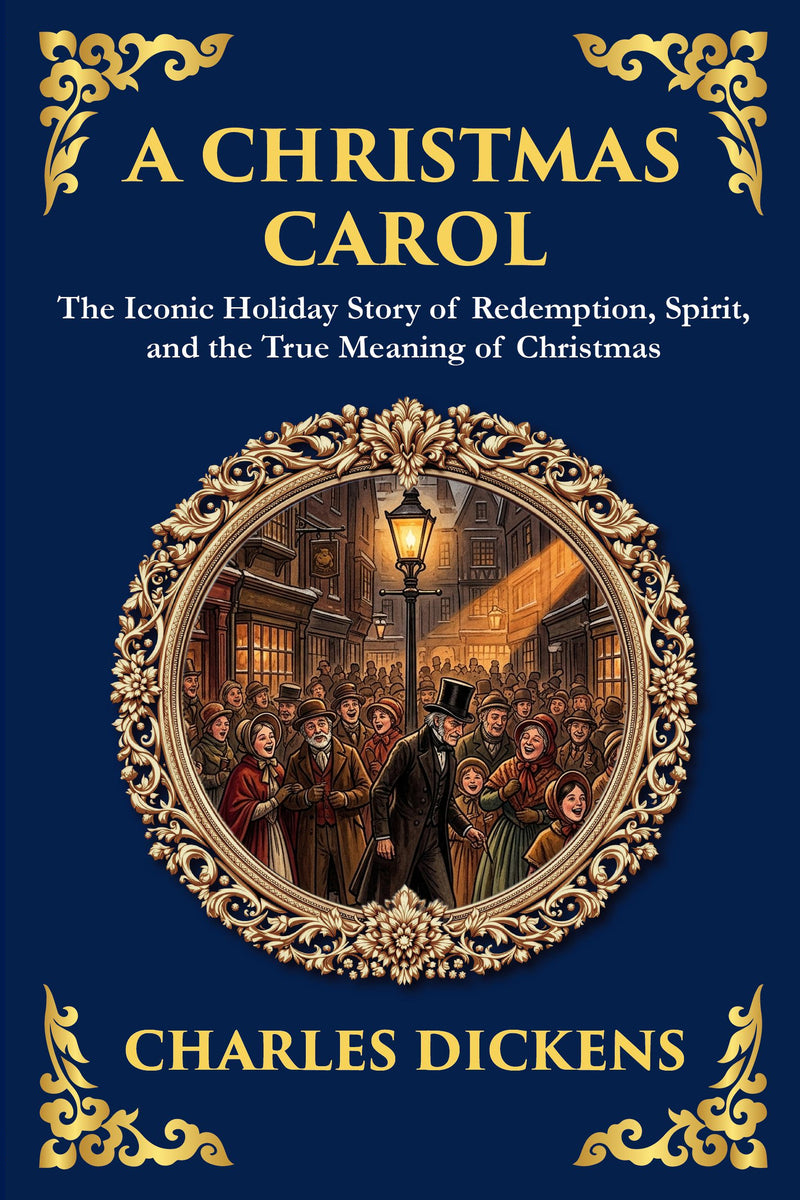
A Christmas Carol
In a world darkened by greed and indifference, one bitter old miser is about to face the ghosts of his past, present, and future.
or free app
10,000+ hrs library
30-day guarantee
The complete A Christmas Carol appears in modern English through Library of Alexandria Press, available online with audiobook narration included for members.
Have you ever wondered why the spirit of Christmas can soften even the hardest hearts? Charles Dickens' A Christmas Carol is one of the most beloved and enduring stories in literary history. First published in 1843, this unforgettable novella has become synonymous with the holiday season—and for good reason.
At its heart is the powerful transformation of Ebenezer Scrooge, a man who values money above all else, until a visit from three ghosts changes everything. In this classic tale of regret and renewal, Dickens crafts more than just a seasonal story. He delivers a profound exploration of human nature, redemption, and the capacity for change.
With vividly drawn characters, haunting visions, and a message of hope, A Christmas Carol continues to inspire generations.
What you’ll discover in this modern edition
- A Tale of Moral Transformation – Follow the unforgettable journey of Ebenezer Scrooge, from heartless miser to joyful benefactor
- Richly Imagined Ghostly Encounters – The Ghosts of Christmas Past, Present, and Yet to Come offer more than scares—they bring truth
- A Universal Message of Redemption – A story that speaks to all ages, reminding us it’s never too late to change
- Dickensian London in Full Charm and Chill – Experience the spirit and setting of 19th-century England, alive with carols and cobblestones
- A Story That Defines the Season – The literary embodiment of compassion, joy, and goodwill to all
| Formats | eBook (EPUB + PDF) · Audiobook · Paperback · Hardcover · Large Print |
| Language | English |
| Trim size (print) | 6 × 9 in |
| Binding | Paperback — perfect-bound · Hardcover — casewrap |
| Large Print edition | Same text in a larger, easy-read type — a larger font, not a larger trim |
| Print pricing | Every physical book at our true cost — at-cost, no profit (members) |
| Library | 873 restored titles, always growing |
| Length | 29,615 words · ~1 hr 58 min reading |
| Reading level | Grade 3 · an easy, flowing read (this modern-English edition) |
| Edition | Modern English translation · 2026 |
Member reviews for this edition are collected as readers finish it — be the first. Across the library: 12,000+ books shipped, every plan covered by a 365-day print guarantee.
About this edition
A faithful, unabridged modern-English edition by The Library of Alexandria — carefully rendered for today's reader and verified paragraph-by-paragraph against the public-domain source. Available as eBook, audiobook, paperback, hardcover, and large print.
- Complete & unabridgedVerified paragraph by paragraph against the source — never a scan, never abridged.
- Modern English, faithfulReadable today, with the author’s meaning kept intact. Readable — not simplified.
- Every format, one membershipRead in your browser or the free app, or listen to the full audiobook.
Included free with your membership
Cancel anytime, one click · 30-day money-back guarantee
Edition last updated July 2026
What’s inside
A Christmas Carol — complete and unabridged: all 6 sections included with membership, plus the full audiobook.
Begin reading A Christmas Carol
In clear modern English — the complete text is included with membership.
Introduction
There are stories that entertain, and then there are stories that change the very fabric of how a culture imagines itself. The slim volume you are about to read belongs unmistakably to the second category. First published on the nineteenth of December in 1843, just in time to be tucked beneath the boughs of Victorian Christmas trees, this little book did something almost no work of fiction has ever managed to do: it took hold of an entire civilization’s understanding of a season and refused to let go. Nearly two centuries later, its phrases echo in our everyday speech, its characters populate our holiday traditions, and its central message—that no human heart is beyond the reach of redemption—continues to move readers of every age, faith, and background. To open these pages is to step into a tradition that spans generations, and to encounter a tale whose warmth has not cooled in the slightest with the passage of time.
This particular edition has been thoughtfully adapted for the contemporary reader, smoothing certain passages of nineteenth-century phrasing that might otherwise slow a modern eye while preserving with great care the spirit, the imagery, and the unmistakable voice that have made the original so beloved. The aim is not to replace the experience of Dickens’s prose but to invite you fully into it—to let the ghosts walk and the bells ring without the friction of unfamiliar idiom standing between you and the story’s beating heart. What you hold is a doorway, and beyond it lies one of the most perfectly constructed narratives in the English language, a story so tightly wound and so emotionally true that it can be read in a single sitting and yet returned to year after year without ever feeling exhausted.
Before you cross that threshold, it is worth pausing to consider just what makes this book so extraordinary, and why it has endured when so many other works of its era have faded into the dusty shelves of academic interest. For this is not merely a Christmas story. It is a story about what it means to be alive, to be connected to one another, to carry the weight of our choices and to discover, sometimes when we least expect it, that the chance to begin again is never quite as lost as we feared.
A Story Born of Its Time, Yet Belonging to All Time
To understand the force with which this tale struck its first readers, it helps to picture the world into which it was born. The England of the 1840s was a nation in the midst of staggering transformation. The Industrial Revolution had filled the cities with smoke and machinery, drawing vast populations from the countryside into crowded, often desperate urban centers. Wealth accumulated at the top with dizzying speed, while at the bottom, men, women, and children labored in conditions we would now find scarcely believable. Childhood as we understand it barely existed for the poor; small boys and girls worked long hours in factories and mines, and the gap between those who had and those who had not seemed to widen by the day.
The author had walked this world himself. As a boy of twelve, when his father was imprisoned for debt, he had been sent to work in a grimy factory pasting labels onto pots of boot-blacking. The humiliation and terror of those months never left him, and they gave him something that few writers of comfortable circumstance ever possess: a bone-deep, unsentimental knowledge of what poverty actually feels like, of the cold and the hunger and the gnawing fear of being forgotten. When he wrote about want—when he gave it a face and a name—he was not theorizing. He was remembering.
In the autumn of 1843, he had recently visited a school for impoverished children and had been profoundly shaken by the conditions he witnessed. He had also read government reports detailing the plight of child laborers, and his initial impulse was to write a fierce political pamphlet, a direct cry of outrage. But something wiser and more enduring stayed his hand. He realized that an argument, however righteous, would be read by few and forgotten by most. A story, on the other hand—a story with ghosts and laughter and a transformed soul at its center—might slip past the defenses of the comfortable and lodge itself permanently in the imagination. He chose, in other words, to make his argument through the heart rather than the head, and in doing so he created something far more powerful than any tract could ever have been.
He wrote the book in a fever of inspiration, completing it in roughly six weeks during the late autumn. Witnesses recalled that he walked the black streets of London at night, fifteen and twenty miles at a stretch, while the story took shape in his mind. He wept over it and laughed over it as he composed, so fully had he given himself to the world he was creating. When at last it appeared, bound in cloth with gilt edges and hand-colored illustrations, it sold out its first printing of six thousand copies within days. The public did not merely read it; they embraced it, passed it from hand to hand, read it aloud by the fire, and absorbed its lessons into the very rituals of the season.
What is remarkable is how little of its power depends on the specific circumstances of its origin. Yes, this is a Victorian story, full of gas-lamps and counting-houses and Christmas puddings flaming with brandy. But strip away the period details and you find something timeless and universal: a meditation on isolation and connection, on the way a life can curdle into bitterness, and on the possibility—always present, never extinguished—of choosing differently while there is still time. The social conditions that troubled the author have changed in their particulars, but the human tendencies he diagnosed are as alive today as they were then. We still build walls around ourselves. We still measure our worth in the wrong currencies. We still, too often, look at the suffering of strangers and tell ourselves that it is not our concern. And we still possess, every one of us, the astonishing capacity to wake one morning and decide to become someone better. That is why the story has never dated, and why it never will.
It is worth noting, too, the sheer craftsmanship at work in these pages. The author was at the height of his powers, and he structured the narrative with the precision of a master architect. The tale unfolds in a series of movements, each one building upon the last, each one tightening the emotional screws while never losing the thread of hope. The opening is famously stark—an image so memorable that it has entered the language—and from that beginning, the story moves with the inevitability of a great piece of music toward its triumphant resolution. There is not a wasted word, not a scene that does not earn its place. For a work composed in such haste, it possesses an almost miraculous unity of effect.
The Ghosts, the Heart, and the Meaning Beneath the Magic
It would be a disservice to you, the reader, to lay out the events of the story in detail, for much of its enduring delight lies in experiencing its turns as they come, whether for the first time or the fiftieth. But it is no spoiler to speak of the architecture of the thing, for its broad shape has long since passed into common cultural knowledge. This is, at its surface, a ghost story—and a genuinely eerie one at that. The author understood that fear and wonder are close cousins, and he was not shy about reaching for the supernatural to achieve his effects. There are knockers that transform into faces, chains that rattle in the dark, and apparitions that appear from nowhere to lead a frightened soul on journeys through time and space. The atmosphere of these passages is genuinely unsettling; read them late at night, with the wind at the windows, and you may find yourself glancing nervously into the shadows of your own room.
Yet the ghosts are never mere decoration. Each of the spirits who appears in the course of the night carries a precise and beautiful purpose, and together they form one of the most elegant moral mechanisms ever devised in fiction. They come not to punish but to instruct, not to condemn but to awaken. Through them, the story asks us to consider the relationship between who we were, who we are, and who we may yet become—the three tenses of a human life laid bare and held up for examination. There is profound psychological wisdom in this structure. We are, after all, the sum of our pasts, the inhabitants of our present, and the architects of our future, and the genius of the narrative is to dramatize this truth so vividly that we feel it rather than merely understand it.
At the center of everything stands one of literature’s most unforgettable characters—a figure whose very name has become a shorthand for a certain kind of cold, miserly, joyless existence. And yet to reduce him to a caricature of greed is to miss what makes him so compelling and, ultimately, so moving. For he is not simply wicked. He is wounded. The story takes great care to show us how a person becomes hardened, how disappointment and fear and the slow erosion of hope can wall a heart off from the world. By the time we meet him, he has spent decades constructing his isolation, brick by careful brick, until he can scarcely remember the warmth he has shut out. He is, in his way, a deeply human figure, and his journey resonates precisely because we recognize fragments of him in ourselves—the small refusals, the petty calculations, the moments when we have chosen self-protection over generosity.
What the story understands, and what it conveys with such grace, is that redemption is not a matter of erasing the past but of seeing it clearly. The transformation at the heart of this narrative does not come about through magic, not really, though magic is its instrument. It comes about through vision—through being made to truly see one’s own life, the consequences of one’s choices, the faces of those one has neglected, and the future toward which one is heedlessly rushing. To see clearly, the story suggests, is already to begin to change. And once the change begins, it cascades outward, touching everyone within its reach, transforming not just one life but a whole web of lives connected to it.
This is where the book reveals its deepest and most radical idea, the one that gives it its enduring moral weight. The author insists, again and again, that we belong to one another. The suffering of the poor is not separate from the comfort of the rich; the loneliness of one soul is bound up with the warmth of another; we are all, every one of us, threads in a single fabric, and what we do to the least of those around us we do, in some real sense, to ourselves. This vision of human interconnection—of mutual obligation, of shared responsibility, of the simple, world-changing truth that mankind is our business—is the philosophical heart of the work. It is delivered without preaching, dramatized rather than declared, and it lands with a force that a thousand sermons could not match.
There is also, woven through all the moral seriousness, an abundance of sheer joy. This is not a grim or heavy book. It overflows with humor, with feasting, with games and dancing and song. The author clearly loved Christmas—loved its food and its laughter, its families gathered close against the winter dark, its impulse toward generosity and forgiveness—and that love radiates from every page. There are scenes of such warmth and conviviality that reading them feels like being welcomed into a circle of friends. The descriptions of holiday abundance are almost intoxicating in their richness: the steaming puddings, the glowing fires, the streets bustling with cheerful preparation. This sensual delight in the pleasures of the season is no accident. It is the author’s way of showing us what the cold heart has shut itself away from, and of reminding us how much there is to be gained by opening the door.
Indeed, it is no exaggeration to say that this single book did much to shape the modern celebration of Christmas itself. Many of the customs and feelings we now associate with the season—the emphasis on family togetherness, on charity toward the less fortunate, on goodwill and generosity and the setting aside of grievances—were powerfully reinforced, if not invented, by this story’s enormous popularity. It helped revive traditions that had faded and infused the holiday with a moral and emotional dimension that persists to this day. When we speak of the “spirit of Christmas,” we are, whether we know it or not, speaking in large part of the spirit conjured by these pages. Few works of literature can claim to have so directly altered the way a culture lives and feels.
Cancel anytime, one click · 30-day money-back guarantee
Founding annual rate available now — your price locks for life when you join.
Not ready? Get this free chapter by email — read it anytime.
✓ Sent — check your inbox for A Christmas Carol.
Questions about A Christmas Carol
What is A Christmas Carol about?
In a world darkened by greed and indifference, one bitter old miser is about to face the ghosts of his past, present, and future. A Christmas Carol, Charles Dickens' timeless holiday tale, follows Ebenezer Scrooge as he is given a chance to transform his cold heart and rediscover the joy, warmth, and compassion he long abandoned. Set against the snowy backdrop of Victorian London, this heartwarming story of redemption reminds us that no soul is beyond saving, and that the spirit of Christmas lives in kindness, gene
Who wrote A Christmas Carol?
A Christmas Carol was written by Charles Dickens. This edition presents the complete work in clear modern English, faithfully rendered from the public-domain original by Library of Alexandria Press.
Is A Christmas Carol free to read?
The opening chapter is free to read on this page. Members read and listen to the complete work — and the entire library — free, and can order any physical book at our true print cost.
How long is A Christmas Carol?
6 chapters (~29,615 words) — about 1 hr 58 min of reading in this modern-English edition.
Is this an abridged version of A Christmas Carol?
No. This is the complete, unabridged A Christmas Carol, carefully rendered into clear modern English and verified paragraph-by-paragraph against the public-domain source — nothing is cut or summarised.
What formats does A Christmas Carol come in?
A Christmas Carol is available as eBook, paperback, hardcover and large print. eBook and audiobook are included with membership; printed editions ship at our true print cost.
Shipping & returns
Billing & membership
More from the library


Explore Children's Classics
- Jack and Jill · Louisa May Alcott
- The Wonderful Wizard of Oz · L. Frank Baum
- Peter Pan · J. M. Barrie
- The Prince and the Pauper · Mark Twain
- The Red Fairy Book · Andrew Lang
- Old Christmas: from the Sketch Book of Washington Irving · Washington Irving
- A Houseful of Girls · Sarah Tytler
- In the hollow of His hand · Hesba Stretton
- Miss Primrose · Agnes Giberne
- Five Little Peppers and How They Grew · Margaret Sidney
- The Loss of the Swansea: A Story of the Florida Coast · W. L. Alden
- Sky Island · L. Frank Baum
- The Book of Dragons · E. Nesbit
- Wild Animals I Have Known · Ernest Thompson Seton
- Skinny McCord · Percy Keese Fitzhugh
- The Hunniwell Boys and the Platinum Mystery · L. P. Wyman
- Rainbow Valley · L. M. Montgomery
- "Us and Our Donkey" · Amy Le Feuvre
- Dorothy and the Wizard in Oz · L. Frank Baum
- The Home Book of Verse — Volume 4 · Burton Egbert Stevenson
- The Story of Doctor Dolittle · Hugh Lofting
- The Tale of Benjamin Bunny · Beatrix Potter
- Fifty Famous Stories Retold · James Baldwin
- Rilla of Ingleside · L. M. Montgomery
- The House at Pooh Corner · A. A. Milne
- Rich and Humble: A Story for Young People · Oliver Optic
- The Three Bears · A. E. Kennedy
- Peter and Wendy · J. M. Barrie
- The Marvelous Land of Oz · L. Frank Baum
- Andersen’s Fairy Tales · H. C. Andersen
A Christmas Carol
A Christmas Carol
The Iconic Holiday Story of Redemption, Spirit, and the True Meaning of Christmas
Charles Dickens
Contents
- Introduction
- Chapter 1
- Chapter 2
- Chapter 3
- Chapter 4
- Chapter 5
Introduction
There are stories that entertain, and then there are stories that change the very fabric of how a culture imagines itself. The slim volume you are about to read belongs unmistakably to the second category. First published on the nineteenth of December in 1843, just in time to be tucked beneath the boughs of Victorian Christmas trees, this little book did something almost no work of fiction has ever managed to do: it took hold of an entire civilization’s understanding of a season and refused to let go. Nearly two centuries later, its phrases echo in our everyday speech, its characters populate our holiday traditions, and its central message—that no human heart is beyond the reach of redemption—continues to move readers of every age, faith, and background. To open these pages is to step into a tradition that spans generations, and to encounter a tale whose warmth has not cooled in the slightest with the passage of time.
This particular edition has been thoughtfully adapted for the contemporary reader, smoothing certain passages of nineteenth-century phrasing that might otherwise slow a modern eye while preserving with great care the spirit, the imagery, and the unmistakable voice that have made the original so beloved. The aim is not to replace the experience of Dickens’s prose but to invite you fully into it—to let the ghosts walk and the bells ring without the friction of unfamiliar idiom standing between you and the story’s beating heart. What you hold is a doorway, and beyond it lies one of the most perfectly constructed narratives in the English language, a story so tightly wound and so emotionally true that it can be read in a single sitting and yet returned to year after year without ever feeling exhausted.
Before you cross that threshold, it is worth pausing to consider just what makes this book so extraordinary, and why it has endured when so many other works of its era have faded into the dusty shelves of academic interest. For this is not merely a Christmas story. It is a story about what it means to be alive, to be connected to one another, to carry the weight of our choices and to discover, sometimes when we least expect it, that the chance to begin again is never quite as lost as we feared.
A Story Born of Its Time, Yet Belonging to All Time
To understand the force with which this tale struck its first readers, it helps to picture the world into which it was born. The England of the 1840s was a nation in the midst of staggering transformation. The Industrial Revolution had filled the cities with smoke and machinery, drawing vast populations from the countryside into crowded, often desperate urban centers. Wealth accumulated at the top with dizzying speed, while at the bottom, men, women, and children labored in conditions we would now find scarcely believable. Childhood as we understand it barely existed for the poor; small boys and girls worked long hours in factories and mines, and the gap between those who had and those who had not seemed to widen by the day.
The author had walked this world himself. As a boy of twelve, when his father was imprisoned for debt, he had been sent to work in a grimy factory pasting labels onto pots of boot-blacking. The humiliation and terror of those months never left him, and they gave him something that few writers of comfortable circumstance ever possess: a bone-deep, unsentimental knowledge of what poverty actually feels like, of the cold and the hunger and the gnawing fear of being forgotten. When he wrote about want—when he gave it a face and a name—he was not theorizing. He was remembering.
In the autumn of 1843, he had recently visited a school for impoverished children and had been profoundly shaken by the conditions he witnessed. He had also read government reports detailing the plight of child laborers, and his initial impulse was to write a fierce political pamphlet, a direct cry of outrage. But something wiser and more enduring stayed his hand. He realized that an argument, however righteous, would be read by few and forgotten by most. A story, on the other hand—a story with ghosts and laughter and a transformed soul at its center—might slip past the defenses of the comfortable and lodge itself permanently in the imagination. He chose, in other words, to make his argument through the heart rather than the head, and in doing so he created something far more powerful than any tract could ever have been.
He wrote the book in a fever of inspiration, completing it in roughly six weeks during the late autumn. Witnesses recalled that he walked the black streets of London at night, fifteen and twenty miles at a stretch, while the story took shape in his mind. He wept over it and laughed over it as he composed, so fully had he given himself to the world he was creating. When at last it appeared, bound in cloth with gilt edges and hand-colored illustrations, it sold out its first printing of six thousand copies within days. The public did not merely read it; they embraced it, passed it from hand to hand, read it aloud by the fire, and absorbed its lessons into the very rituals of the season.
What is remarkable is how little of its power depends on the specific circumstances of its origin. Yes, this is a Victorian story, full of gas-lamps and counting-houses and Christmas puddings flaming with brandy. But strip away the period details and you find something timeless and universal: a meditation on isolation and connection, on the way a life can curdle into bitterness, and on the possibility—always present, never extinguished—of choosing differently while there is still time. The social conditions that troubled the author have changed in their particulars, but the human tendencies he diagnosed are as alive today as they were then. We still build walls around ourselves. We still measure our worth in the wrong currencies. We still, too often, look at the suffering of strangers and tell ourselves that it is not our concern. And we still possess, every one of us, the astonishing capacity to wake one morning and decide to become someone better. That is why the story has never dated, and why it never will.
It is worth noting, too, the sheer craftsmanship at work in these pages. The author was at the height of his powers, and he structured the narrative with the precision of a master architect. The tale unfolds in a series of movements, each one building upon the last, each one tightening the emotional screws while never losing the thread of hope. The opening is famously stark—an image so memorable that it has entered the language—and from that beginning, the story moves with the inevitability of a great piece of music toward its triumphant resolution. There is not a wasted word, not a scene that does not earn its place. For a work composed in such haste, it possesses an almost miraculous unity of effect.
The Ghosts, the Heart, and the Meaning Beneath the Magic
It would be a disservice to you, the reader, to lay out the events of the story in detail, for much of its enduring delight lies in experiencing its turns as they come, whether for the first time or the fiftieth. But it is no spoiler to speak of the architecture of the thing, for its broad shape has long since passed into common cultural knowledge. This is, at its surface, a ghost story—and a genuinely eerie one at that. The author understood that fear and wonder are close cousins, and he was not shy about reaching for the supernatural to achieve his effects. There are knockers that transform into faces, chains that rattle in the dark, and apparitions that appear from nowhere to lead a frightened soul on journeys through time and space. The atmosphere of these passages is genuinely unsettling; read them late at night, with the wind at the windows, and you may find yourself glancing nervously into the shadows of your own room.
Yet the ghosts are never mere decoration. Each of the spirits who appears in the course of the night carries a precise and beautiful purpose, and together they form one of the most elegant moral mechanisms ever devised in fiction. They come not to punish but to instruct, not to condemn but to awaken. Through them, the story asks us to consider the relationship between who we were, who we are, and who we may yet become—the three tenses of a human life laid bare and held up for examination. There is profound psychological wisdom in this structure. We are, after all, the sum of our pasts, the inhabitants of our present, and the architects of our future, and the genius of the narrative is to dramatize this truth so vividly that we feel it rather than merely understand it.
At the center of everything stands one of literature’s most unforgettable characters—a figure whose very name has become a shorthand for a certain kind of cold, miserly, joyless existence. And yet to reduce him to a caricature of greed is to miss what makes him so compelling and, ultimately, so moving. For he is not simply wicked. He is wounded. The story takes great care to show us how a person becomes hardened, how disappointment and fear and the slow erosion of hope can wall a heart off from the world. By the time we meet him, he has spent decades constructing his isolation, brick by careful brick, until he can scarcely remember the warmth he has shut out. He is, in his way, a deeply human figure, and his journey resonates precisely because we recognize fragments of him in ourselves—the small refusals, the petty calculations, the moments when we have chosen self-protection over generosity.
What the story understands, and what it conveys with such grace, is that redemption is not a matter of erasing the past but of seeing it clearly. The transformation at the heart of this narrative does not come about through magic, not really, though magic is its instrument. It comes about through vision—through being made to truly see one’s own life, the consequences of one’s choices, the faces of those one has neglected, and the future toward which one is heedlessly rushing. To see clearly, the story suggests, is already to begin to change. And once the change begins, it cascades outward, touching everyone within its reach, transforming not just one life but a whole web of lives connected to it.
This is where the book reveals its deepest and most radical idea, the one that gives it its enduring moral weight. The author insists, again and again, that we belong to one another. The suffering of the poor is not separate from the comfort of the rich; the loneliness of one soul is bound up with the warmth of another; we are all, every one of us, threads in a single fabric, and what we do to the least of those around us we do, in some real sense, to ourselves. This vision of human interconnection—of mutual obligation, of shared responsibility, of the simple, world-changing truth that mankind is our business—is the philosophical heart of the work. It is delivered without preaching, dramatized rather than declared, and it lands with a force that a thousand sermons could not match.
There is also, woven through all the moral seriousness, an abundance of sheer joy. This is not a grim or heavy book. It overflows with humor, with feasting, with games and dancing and song. The author clearly loved Christmas—loved its food and its laughter, its families gathered close against the winter dark, its impulse toward generosity and forgiveness—and that love radiates from every page. There are scenes of such warmth and conviviality that reading them feels like being welcomed into a circle of friends. The descriptions of holiday abundance are almost intoxicating in their richness: the steaming puddings, the glowing fires, the streets bustling with cheerful preparation. This sensual delight in the pleasures of the season is no accident. It is the author’s way of showing us what the cold heart has shut itself away from, and of reminding us how much there is to be gained by opening the door.
Indeed, it is no exaggeration to say that this single book did much to shape the modern celebration of Christmas itself. Many of the customs and feelings we now associate with the season—the emphasis on family togetherness, on charity toward the less fortunate, on goodwill and generosity and the setting aside of grievances—were powerfully reinforced, if not invented, by this story’s enormous popularity. It helped revive traditions that had faded and infused the holiday with a moral and emotional dimension that persists to this day. When we speak of the “spirit of Christmas,” we are, whether we know it or not, speaking in large part of the spirit conjured by these pages. Few works of literature can claim to have so directly altered the way a culture lives and feels.
To start with, Marley was dead. There’s no doubt about that. The burial register was signed by the priest, the clerk, the undertaker, and the chief mourner. Scrooge signed it. And Scrooge’s signature was trusted everywhere in the business district for whatever he chose to authorize. Old Marley was as dead as a doornail.
Now, I don’t actually know what makes a doornail particularly “dead.” Personally, I’ve always thought a coffin nail would be the deadest piece of hardware in the business. But there’s wisdom in the old saying, and I won’t be the one to mess with it, or the country will be ruined. So, let me repeat emphatically: Marley was as dead as a doornail.
Did Scrooge know he was dead? Of course he did. How could he not? He and Marley had been partners for years. Scrooge was his only executor, administrator, assign, heir, friend, and mourner. Even so, Scrooge wasn’t so devastated by the death that he couldn’t be a great businessman on the day of the funeral; in fact, he marked the occasion by closing a guaranteed bargain.
Mentioning Marley’s funeral brings me back to my starting point. There is no doubt that Marley was dead. This must be clearly understood, otherwise the story I’m about to tell won’t be surprising at all. If we weren’t completely sure that Hamlet’s father died before the play began, there would be nothing strange about him taking a midnight stroll in an east wind on his own castle walls. It would be no different than any other middle-aged man recklessly heading out into a breezy night—say, in St. Paul’s Churchyard—just to shock his son’s fragile mind.
Scrooge never painted over Old Marley’s name. Years later, it still sat above the warehouse door: Scrooge and Marley. The company was known as Scrooge and Marley. Sometimes people new to the business called Scrooge “Scrooge,” and sometimes they called him “Marley,” but he answered to both. It didn’t matter to him.
End of the free sample
Keep reading, free
Members read and listen to the complete book — and the entire library. Cancel anytime, one click · 30-day money-back guarantee.