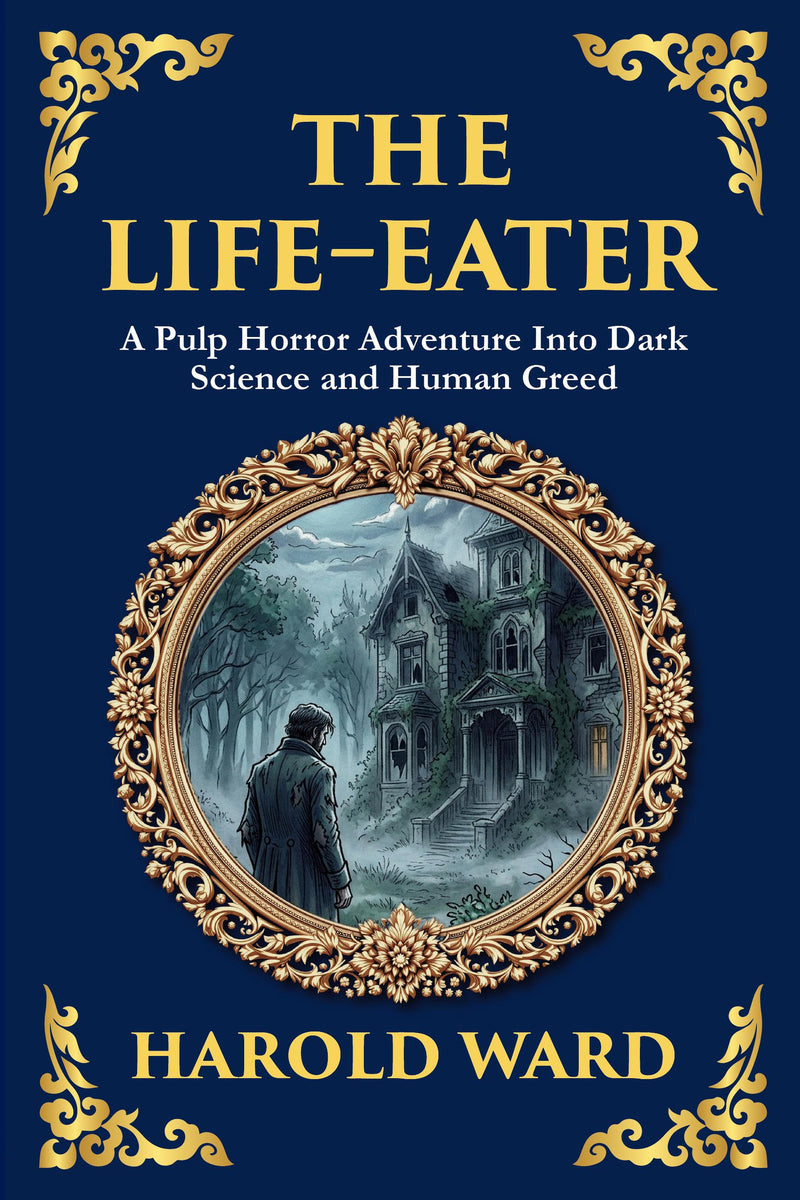
The Life-Eater
A brilliant but deranged scientist unlocks the secret to eternal youth—by draining the very life force from others. Driven by obsession and unchecked ambition, he descends into a spiral of horror, deception, and moral collapse.
or free app
10,000+ hrs library
30-day guarantee
The complete The Life-Eater appears in modern English through Library of Alexandria Press, available online with audiobook narration included for members.
Have you ever wondered why the pursuit of immortality often leads to humanity’s darkest experiments? In The Life-Eater, Harold Ward crafts a pulse-pounding tale of science gone horribly wrong. A once-noble medical genius becomes consumed by his discovery: a process that can prolong life indefinitely—by harvesting it from others.
This dark revelation sets the stage for a gripping descent into madness, secrecy, and soul-devouring ambition. Set against the moody backdrop of a world teetering between the scientific age and gothic superstition, this rediscovered pulp horror classic delivers all the eerie thrills of early 20th- century weird fiction. With elements of mystery, moral decay, and vintage science horror, it poses unsettling questions about how far one might go to avoid death—and what kind of monster might emerge on the other side.
What you’ll discover in this modern edition
- A Chilling Tale of Mad Science – Follow a genius doctor as he pursues eternal youth at a horrifying cost.
- Classic Pulp Horror Atmosphere – Dive into a noir-tinted world of shadows, old mansions, and whispered secrets.
| Formats | eBook (EPUB + PDF) · Audiobook · Paperback · Hardcover · Large Print |
| Language | English |
| Trim size (print) | 6 × 9 in |
| Binding | Paperback — perfect-bound · Hardcover — casewrap |
| Large Print edition | Same text in a larger, easy-read type — a larger font, not a larger trim |
| Print pricing | Every physical book at our true cost — at-cost, no profit (members) |
| Library | 873 restored titles, always growing |
| Length | 10,516 words · ~42 min reading |
| Reading level | Grade 9 · a comfortable read (this modern-English edition) |
| Edition | Modern English translation · 2026 |
Member reviews for this edition are collected as readers finish it — be the first. Across the library: 12,000+ books shipped, every plan covered by a 365-day print guarantee.
About this edition
A faithful, unabridged modern-English edition by The Library of Alexandria — carefully rendered for today's reader and verified paragraph-by-paragraph against the public-domain source. Available as eBook, audiobook, paperback, hardcover, and large print.
- Complete & unabridgedVerified paragraph by paragraph against the source — never a scan, never abridged.
- Modern English, faithfulReadable today, with the author’s meaning kept intact. Readable — not simplified.
- Every format, one membershipRead in your browser or the free app, or listen to the full audiobook.
Included free with your membership
Cancel anytime, one click · 30-day money-back guarantee
Edition last updated July 2026
What’s inside
The Life-Eater — complete and unabridged: all 5 sections included with membership, plus the full audiobook.
Begin reading The Life-Eater
In clear modern English — the complete text is included with membership.
Introduction
There is a particular kind of pleasure that comes from opening a story written in an age when the boundaries between science and superstition had grown deliciously thin. The early decades of the twentieth century produced a flood of fiction that thrived in exactly that uncertain space — tales where the laboratory and the crypt seemed to share a wall, where the rational mind and the primal terror sat side by side, and where a reader could be both thrilled and unsettled by the question of what human beings might do if given power they were never meant to wield. The Life-Eater belongs proudly to that tradition, and it carries the unmistakable fingerprints of an era when storytelling was unashamed of its own intensity.
Harold Ward wrote for an audience that wanted to be gripped, frightened, and entertained, and he understood the machinery of that desire as well as anyone working in the pulp magazines of his day. The very title promises something monstrous — a thing that consumes life itself — and the subtitle frames the menace not merely as a creature of the night but as a product of “dark science and human greed.” That phrase is worth pausing on, because it tells you a great deal about what makes this story tick. The horror here is not simply supernatural. It is the horror of ambition pushed past its proper limits, of intelligence corrupted by want, of the human capacity to rationalize terrible things in the pursuit of personal gain. The most chilling monsters in fiction have always been the ones we recognize, and Ward knew that the deepest fear is not of the unknown but of the all-too-familiar darkness in ourselves.
This edition has been prepared as a modern translation and adaptation for the contemporary reader, and a few words about what that means — and what it does not mean — will help you settle into the experience with the right expectations. The aim of this presentation is to preserve everything that made the original a compelling piece of pulp horror while gently easing the friction that nearly a century can place between a story and the people reading it. Language drifts. Idioms fall out of use, certain turns of phrase that once landed cleanly now require a mental footnote, and the rhythms of sentences constructed for readers of the 1920s and 1930s can occasionally slow down a modern eye accustomed to a brisker pace. The work of adaptation is to smooth those rough patches without sanding away the texture, to keep the voice intact while making sure the voice can still be heard. You are meant to feel the age of this tale — its flavor, its atmosphere, its wonderful melodramatic confidence — but you are not meant to struggle against it.
To understand why a book like this rewards the attention of a modern reader, it helps to understand the world that produced it. The pulp magazines took their name from the cheap, wood-pulp paper they were printed on, a deliberately inexpensive format that allowed publishers to put fiction into the hands of ordinary working people at prices anyone could afford. These were not refined literary journals aimed at the cultured few. They were mass entertainment, sold at newsstands and drugstores, devoured on trains and in parlors and by lamplight at the end of long working days. And because they had to compete fiercely for the attention of readers who had many choices and little money to waste, they demanded a particular kind of writing — fiction that grabbed you on the first page and refused to let go.
Authors who succeeded in this market learned to be ruthless about pacing and generous with sensation. They could not afford to bore. They could not waste a reader’s patience with lengthy preliminaries or self-indulgent digressions. Every chapter had to earn its place, every scene had to push the story forward, and the cliffhanger became not a cheap trick but a fundamental tool of the trade. Writers like Harold Ward developed an instinct for momentum that many “respectable” novelists of the period never bothered to cultivate, and that instinct is one of the great gifts these stories offer to readers today. There is nothing dusty or sluggish about the best pulp fiction. It moves. It crackles. It understands that the reader’s time is precious and that the storyteller’s first duty is to be interesting.
Ward worked within a thriving ecosystem of horror, mystery, and weird fiction, contributing to the same general landscape that produced so many enduring images of dread. The horror pulps in particular occupied a fascinating cultural position. They drew on the gothic traditions of the previous century — the haunted houses, the mad doctors, the secret laboratories, the experiments that should never have been attempted — but they injected those old anxieties with a distinctly modern energy. The early twentieth century was a time of dizzying scientific advancement, when electricity was still close enough to magic to inspire genuine wonder and unease, when discoveries in medicine and physics seemed to be reshaping the boundaries of the possible week by week. This created a perfect breeding ground for stories that asked the uncomfortable question lurking beneath all that progress: just because we can do a thing, does that mean we should?
That question is the dark engine at the heart of The Life-Eater. The “dark science” of the subtitle is not incidental decoration. It is the moral and dramatic core of the tale, the place where wonder curdles into horror, where the pursuit of knowledge collides with the limits of conscience. Ward, like the best writers in his field, understood that the most effective horror does not come from senseless monstrosity but from monstrousness with a logic to it — a chain of decisions that, step by step, leads an intelligent person into something unspeakable. There is a perverse plausibility to the worst things in fiction like this, a sense that the path to ruin is paved with reasoning we can almost follow, and that recognition is what makes the hair stand up on the back of your neck.
It is also worth appreciating the sheer craftsmanship involved in producing fiction of this kind on the schedule the pulp markets demanded. Writers were paid by the word and had to be enormously productive to make a living, which meant they could not afford to wait for inspiration or fuss endlessly over a single perfect sentence. They had to deliver, again and again, and the discipline this imposed produced a certain muscular efficiency in their prose. The pleasures of pulp writing are not the pleasures of ornate, carefully polished literary fiction. They are the pleasures of forward motion, of vivid imagery deployed quickly and effectively, of dialogue that does its work and gets out of the way, of plotting that keeps you turning pages well past the hour you intended to stop. Reading a story like this one, you are in the hands of a professional entertainer who knew exactly what he was doing and who took genuine pride in his ability to hold an audience captive.
The Pleasures and Peculiarities of Reading Vintage Horror
Approaching a vintage horror tale with the right frame of mind makes an enormous difference to the experience, and a little perspective here will serve you well. The conventions of horror fiction have shifted dramatically over the past hundred years, and what frightens a contemporary audience raised on a century of accumulated scares is not always the same as what chilled readers in Ward’s day. This is not a deficiency in the older work — quite the opposite. Part of the joy of reading fiction from another era is the chance to experience storytelling on its own terms, to feel the particular textures and obsessions of a different moment in our cultural history, and to recognize how the fears of one generation echo and transform into the fears of the next.
The horror of this period tended toward the operatic. It was bold, unabashed, willing to commit fully to its effects without the layer of irony or self-consciousness that so often coats modern genre work. When a pulp horror writer wanted you to feel dread, he did not hedge or undercut himself. He reached straight for the strongest possible image and delivered it with total conviction. This sincerity can feel almost startling to a contemporary reader accustomed to stories that wink at their own conventions, and once you tune yourself to its frequency, it becomes one of the most refreshing qualities of the entire experience. There is something liberating about a story that simply believes in its own menace, that asks you to be afraid and trusts that you will rise to the occasion.
You will also notice that the prose carries the rhythms and flourishes of its time. Even in adapted form, where the most obstructive archaisms have been smoothed away, a certain stately cadence remains — a fondness for atmosphere, for the slow tightening of tension, for the careful construction of mood before the eruption of incident. Modern thrillers often sprint from shock to shock, but earlier horror frequently took the time to build a sense of place and unease, to let dread accumulate like a chill in an unheated room. This patience is a feature, not a flaw, and readers willing to settle into its rhythm will find that the payoffs land all the harder for the buildup that precedes them. The slow burn was an art form, and writers of this era practiced it with skill.
There is, too, the question of how stories from a century ago reflect the attitudes and assumptions of their time, and honesty about this serves the reader better than pretending otherwise. Fiction is always a product of the world that produced it, and the early twentieth century held views — about science, about society, about human nature, about all manner of things — that differ in countless ways from our own. Part of the pleasure and the value of reading older work lies precisely in encountering these differences, in seeing the world through eyes shaped by a different set of circumstances and beliefs. A thoughtful modern reader can appreciate the craft and the entertainment of a vintage tale while also recognizing it as a historical artifact, a window into how people once imagined their fears and their possibilities. This adaptation aims to make the story accessible and engaging without erasing the fact that it comes to us from another age, and the best way to read it is with both curiosity and a generous spirit.
The “human greed” promised in the subtitle deserves a moment of reflection here, because it points to something that makes the best horror of this period far more durable than its detractors might assume. The monsters and the dark science are the spectacle, but the greed is the truth. Stories that locate their horror in human failing — in avarice, in arrogance, in the willingness to sacrifice others for personal advantage — tap into anxieties that never go out of date. The specific technologies and superstitions of the 1920s and 1930s may seem quaint to us now, but the human appetites they dramatize are perfectly contemporary. We still know people who would do almost anything for power, for wealth, for the chance to rise above their fellows. We still recognize the seductive logic by which a person convinces himself that the ends justify whatever monstrous means he chooses. In this sense, the horror of The Life-Eater is not really about the past at all. It wears the costume of its era, but it speaks to something timeless in the human heart, and that is precisely why it still has the power to disturb.
It is worth saying a word, too, about the experience of reading horror as a form of pleasure rather than pain — a paradox that has fascinated thinkers for centuries. Why do we voluntarily seek out stories designed to frighten and unsettle us? Part of the answer surely lies in the safety of the encounter: we can confront the worst imaginable things from the comfort of our chairs, experiencing the thrill of fear without any of its real consequences. But there is more to it than mere safe thrills. Horror fiction allows us to rehearse our deepest anxieties, to give shape and form to dreads that might otherwise remain formless and oppressive. By naming the monster, by following the dark experiment to its terrible conclusion, we exercise a kind of control over fears that, in the unstructured chaos of real life, we cannot control at all. The pulp horror writers understood this intuitively. They gave their readers monsters they could face, terrors with rules and shapes and endings, and in doing so they provided a strange sort of comfort even as they raised the gooseflesh on a reader’s arms. There is catharsis in being frightened by a story, and the masters of this genre were masters of catharsis.
Cancel anytime, one click · 30-day money-back guarantee
Founding annual rate available now — your price locks for life when you join.
Not ready? Get this free chapter by email — read it anytime.
✓ Sent — check your inbox for The Life-Eater.
Questions about The Life-Eater
What is The Life-Eater about?
A brilliant but deranged scientist unlocks the secret to eternal youth—by draining the very life force from others. Driven by obsession and unchecked ambition, he descends into a spiral of horror, deception, and moral collapse. The Life-Eater is a chilling pulp-era masterpiece of mad science and ethical ruin, where the lines between progress and monstrosity blur beyond recognition.
Who wrote The Life-Eater?
The Life-Eater was written by Harold Ward. This edition presents the complete work in clear modern English, faithfully rendered from the public-domain original by Library of Alexandria Press.
Is The Life-Eater free to read?
The opening chapter is free to read on this page. Members read and listen to the complete work — and the entire library — free, and can order any physical book at our true print cost.
How long is The Life-Eater?
5 chapters (~10,516 words) — about 42 min of reading in this modern-English edition.
Is this an abridged version of The Life-Eater?
No. This is the complete, unabridged The Life-Eater, carefully rendered into clear modern English and verified paragraph-by-paragraph against the public-domain source — nothing is cut or summarised.
What formats does The Life-Eater come in?
The Life-Eater is available as eBook, paperback, hardcover and large print. eBook and audiobook are included with membership; printed editions ship at our true print cost.
Shipping & returns
Billing & membership
More from the library


Explore Horror & Gothic
- The Strange Case of Dr. Jekyll and Mr. Hyde · Robert Louis Stevenson
- The Cask of Amontillado · Edgar Allan Poe
- Ghost Stories of an Antiquary · M. R. James
- The Monk: A Romance · M. G. Lewis
- The House of the Seven Gables · Nathaniel Hawthorne
- The Willows · Algernon Blackwood
- The Monkey’s Paw · W. W. Jacobs
- The Call of Cthulhu · H. P. Lovecraft
- The Black Kiss
- The Legend of Sleepy Hollow · Washington Irving
- Brood of the Dark Moon · Charles Willard Diffin
- The Night Land · William Hope Hodgson
- The Castle of Otranto · Horace Walpole
- Dracula · Bram Stoker
- Carmilla · Joseph Sheridan Le Fanu
- The King in Yellow · Robert W. Chambers
- Wuthering Heights · Emily Brontë
- The Vampyre: A Tale · John William Polidori
- A Christmas Carol · Charles Dickens
- Northanger Abbey · Jane Austen
- The Turn of the Screw · Henry James
- Metamorphosis · Franz Kafka
- The Yellow Wallpaper · Charlotte Perkins Gilman
- The Adventures of Ferdinand Count Fathom — Complete · T. Smollett
- The Picture of Dorian Gray · Oscar Wilde
- Frankenstein; Or, The Modern Prometheus · Mary Wollstonecraft Shelley
The Life-Eater
The Life-Eater
A Pulp Horror Adventure of Dark Science and Human Greed
Harold Ward
Contents
- Introduction
- The Life-Eater
- Chapter 1
- Chapter 2
- Chapter 3
Introduction
There is a particular kind of pleasure that comes from opening a story written in an age when the boundaries between science and superstition had grown deliciously thin. The early decades of the twentieth century produced a flood of fiction that thrived in exactly that uncertain space — tales where the laboratory and the crypt seemed to share a wall, where the rational mind and the primal terror sat side by side, and where a reader could be both thrilled and unsettled by the question of what human beings might do if given power they were never meant to wield. The Life-Eater belongs proudly to that tradition, and it carries the unmistakable fingerprints of an era when storytelling was unashamed of its own intensity.
Harold Ward wrote for an audience that wanted to be gripped, frightened, and entertained, and he understood the machinery of that desire as well as anyone working in the pulp magazines of his day. The very title promises something monstrous — a thing that consumes life itself — and the subtitle frames the menace not merely as a creature of the night but as a product of “dark science and human greed.” That phrase is worth pausing on, because it tells you a great deal about what makes this story tick. The horror here is not simply supernatural. It is the horror of ambition pushed past its proper limits, of intelligence corrupted by want, of the human capacity to rationalize terrible things in the pursuit of personal gain. The most chilling monsters in fiction have always been the ones we recognize, and Ward knew that the deepest fear is not of the unknown but of the all-too-familiar darkness in ourselves.
This edition has been prepared as a modern translation and adaptation for the contemporary reader, and a few words about what that means — and what it does not mean — will help you settle into the experience with the right expectations. The aim of this presentation is to preserve everything that made the original a compelling piece of pulp horror while gently easing the friction that nearly a century can place between a story and the people reading it. Language drifts. Idioms fall out of use, certain turns of phrase that once landed cleanly now require a mental footnote, and the rhythms of sentences constructed for readers of the 1920s and 1930s can occasionally slow down a modern eye accustomed to a brisker pace. The work of adaptation is to smooth those rough patches without sanding away the texture, to keep the voice intact while making sure the voice can still be heard. You are meant to feel the age of this tale — its flavor, its atmosphere, its wonderful melodramatic confidence — but you are not meant to struggle against it.
To understand why a book like this rewards the attention of a modern reader, it helps to understand the world that produced it. The pulp magazines took their name from the cheap, wood-pulp paper they were printed on, a deliberately inexpensive format that allowed publishers to put fiction into the hands of ordinary working people at prices anyone could afford. These were not refined literary journals aimed at the cultured few. They were mass entertainment, sold at newsstands and drugstores, devoured on trains and in parlors and by lamplight at the end of long working days. And because they had to compete fiercely for the attention of readers who had many choices and little money to waste, they demanded a particular kind of writing — fiction that grabbed you on the first page and refused to let go.
Authors who succeeded in this market learned to be ruthless about pacing and generous with sensation. They could not afford to bore. They could not waste a reader’s patience with lengthy preliminaries or self-indulgent digressions. Every chapter had to earn its place, every scene had to push the story forward, and the cliffhanger became not a cheap trick but a fundamental tool of the trade. Writers like Harold Ward developed an instinct for momentum that many “respectable” novelists of the period never bothered to cultivate, and that instinct is one of the great gifts these stories offer to readers today. There is nothing dusty or sluggish about the best pulp fiction. It moves. It crackles. It understands that the reader’s time is precious and that the storyteller’s first duty is to be interesting.
Ward worked within a thriving ecosystem of horror, mystery, and weird fiction, contributing to the same general landscape that produced so many enduring images of dread. The horror pulps in particular occupied a fascinating cultural position. They drew on the gothic traditions of the previous century — the haunted houses, the mad doctors, the secret laboratories, the experiments that should never have been attempted — but they injected those old anxieties with a distinctly modern energy. The early twentieth century was a time of dizzying scientific advancement, when electricity was still close enough to magic to inspire genuine wonder and unease, when discoveries in medicine and physics seemed to be reshaping the boundaries of the possible week by week. This created a perfect breeding ground for stories that asked the uncomfortable question lurking beneath all that progress: just because we can do a thing, does that mean we should?
That question is the dark engine at the heart of The Life-Eater. The “dark science” of the subtitle is not incidental decoration. It is the moral and dramatic core of the tale, the place where wonder curdles into horror, where the pursuit of knowledge collides with the limits of conscience. Ward, like the best writers in his field, understood that the most effective horror does not come from senseless monstrosity but from monstrousness with a logic to it — a chain of decisions that, step by step, leads an intelligent person into something unspeakable. There is a perverse plausibility to the worst things in fiction like this, a sense that the path to ruin is paved with reasoning we can almost follow, and that recognition is what makes the hair stand up on the back of your neck.
It is also worth appreciating the sheer craftsmanship involved in producing fiction of this kind on the schedule the pulp markets demanded. Writers were paid by the word and had to be enormously productive to make a living, which meant they could not afford to wait for inspiration or fuss endlessly over a single perfect sentence. They had to deliver, again and again, and the discipline this imposed produced a certain muscular efficiency in their prose. The pleasures of pulp writing are not the pleasures of ornate, carefully polished literary fiction. They are the pleasures of forward motion, of vivid imagery deployed quickly and effectively, of dialogue that does its work and gets out of the way, of plotting that keeps you turning pages well past the hour you intended to stop. Reading a story like this one, you are in the hands of a professional entertainer who knew exactly what he was doing and who took genuine pride in his ability to hold an audience captive.
The Pleasures and Peculiarities of Reading Vintage Horror
Approaching a vintage horror tale with the right frame of mind makes an enormous difference to the experience, and a little perspective here will serve you well. The conventions of horror fiction have shifted dramatically over the past hundred years, and what frightens a contemporary audience raised on a century of accumulated scares is not always the same as what chilled readers in Ward’s day. This is not a deficiency in the older work — quite the opposite. Part of the joy of reading fiction from another era is the chance to experience storytelling on its own terms, to feel the particular textures and obsessions of a different moment in our cultural history, and to recognize how the fears of one generation echo and transform into the fears of the next.
The horror of this period tended toward the operatic. It was bold, unabashed, willing to commit fully to its effects without the layer of irony or self-consciousness that so often coats modern genre work. When a pulp horror writer wanted you to feel dread, he did not hedge or undercut himself. He reached straight for the strongest possible image and delivered it with total conviction. This sincerity can feel almost startling to a contemporary reader accustomed to stories that wink at their own conventions, and once you tune yourself to its frequency, it becomes one of the most refreshing qualities of the entire experience. There is something liberating about a story that simply believes in its own menace, that asks you to be afraid and trusts that you will rise to the occasion.
You will also notice that the prose carries the rhythms and flourishes of its time. Even in adapted form, where the most obstructive archaisms have been smoothed away, a certain stately cadence remains — a fondness for atmosphere, for the slow tightening of tension, for the careful construction of mood before the eruption of incident. Modern thrillers often sprint from shock to shock, but earlier horror frequently took the time to build a sense of place and unease, to let dread accumulate like a chill in an unheated room. This patience is a feature, not a flaw, and readers willing to settle into its rhythm will find that the payoffs land all the harder for the buildup that precedes them. The slow burn was an art form, and writers of this era practiced it with skill.
There is, too, the question of how stories from a century ago reflect the attitudes and assumptions of their time, and honesty about this serves the reader better than pretending otherwise. Fiction is always a product of the world that produced it, and the early twentieth century held views — about science, about society, about human nature, about all manner of things — that differ in countless ways from our own. Part of the pleasure and the value of reading older work lies precisely in encountering these differences, in seeing the world through eyes shaped by a different set of circumstances and beliefs. A thoughtful modern reader can appreciate the craft and the entertainment of a vintage tale while also recognizing it as a historical artifact, a window into how people once imagined their fears and their possibilities. This adaptation aims to make the story accessible and engaging without erasing the fact that it comes to us from another age, and the best way to read it is with both curiosity and a generous spirit.
The “human greed” promised in the subtitle deserves a moment of reflection here, because it points to something that makes the best horror of this period far more durable than its detractors might assume. The monsters and the dark science are the spectacle, but the greed is the truth. Stories that locate their horror in human failing — in avarice, in arrogance, in the willingness to sacrifice others for personal advantage — tap into anxieties that never go out of date. The specific technologies and superstitions of the 1920s and 1930s may seem quaint to us now, but the human appetites they dramatize are perfectly contemporary. We still know people who would do almost anything for power, for wealth, for the chance to rise above their fellows. We still recognize the seductive logic by which a person convinces himself that the ends justify whatever monstrous means he chooses. In this sense, the horror of The Life-Eater is not really about the past at all. It wears the costume of its era, but it speaks to something timeless in the human heart, and that is precisely why it still has the power to disturb.
It is worth saying a word, too, about the experience of reading horror as a form of pleasure rather than pain — a paradox that has fascinated thinkers for centuries. Why do we voluntarily seek out stories designed to frighten and unsettle us? Part of the answer surely lies in the safety of the encounter: we can confront the worst imaginable things from the comfort of our chairs, experiencing the thrill of fear without any of its real consequences. But there is more to it than mere safe thrills. Horror fiction allows us to rehearse our deepest anxieties, to give shape and form to dreads that might otherwise remain formless and oppressive. By naming the monster, by following the dark experiment to its terrible conclusion, we exercise a kind of control over fears that, in the unstructured chaos of real life, we cannot control at all. The pulp horror writers understood this intuitively. They gave their readers monsters they could face, terrors with rules and shapes and endings, and in doing so they provided a strange sort of comfort even as they raised the gooseflesh on a reader’s arms. There is catharsis in being frightened by a story, and the masters of this genre were masters of catharsis.
Death haunted the small village of La Foubelle, located on the edge of a vast swamp. It struck repeatedly, filling the tiny graveyard draped in cypress trees until almost every home was in mourning.
This was no ordinary disaster, but a true horror. Men spoke of it in hushed, fearful whispers. Women, looking gaunt and exhausted from worry, held their children close while they went about their chores. When night fell, the streets became empty, and the terrified townspeople huddled behind locked doors.
They called it “La maladie sans maladie”—the sickness without a sickness. This dark, shapeless, and indescribable terror always arrived at night, killing both the young and the old. It left behind bodies that looked shriveled and deflated, with skin wrinkled into a thousand folds. The simple people of La Foubelle had watched their loved ones die, seeing them twist and writhe in terrible pain at the very end. Sometimes, if the victim was particularly strong, the creature would torture them for several days.
Jules Delatour claimed he saw the horror hovering over his dying mother. He babbled about a black, transparent thing that looked like shapeless smoke, with a beastly face full of evil cruelty. However, Jules was the village drunk and had been intoxicated the night his mother died, so nobody believed his story.
Doctor Lamontaine was sipping rum from a dented tin cup and studying a book by Cagliostro when he noticed a shadow fall across the pages as a man entered his small office.
“Drink?” he grunted without looking up, sliding a second cup across the desk. “Rum. Good Jamaican rum. Help yourself.”
End of the free sample
Keep reading, free
Members read and listen to the complete book — and the entire library. Cancel anytime, one click · 30-day money-back guarantee.