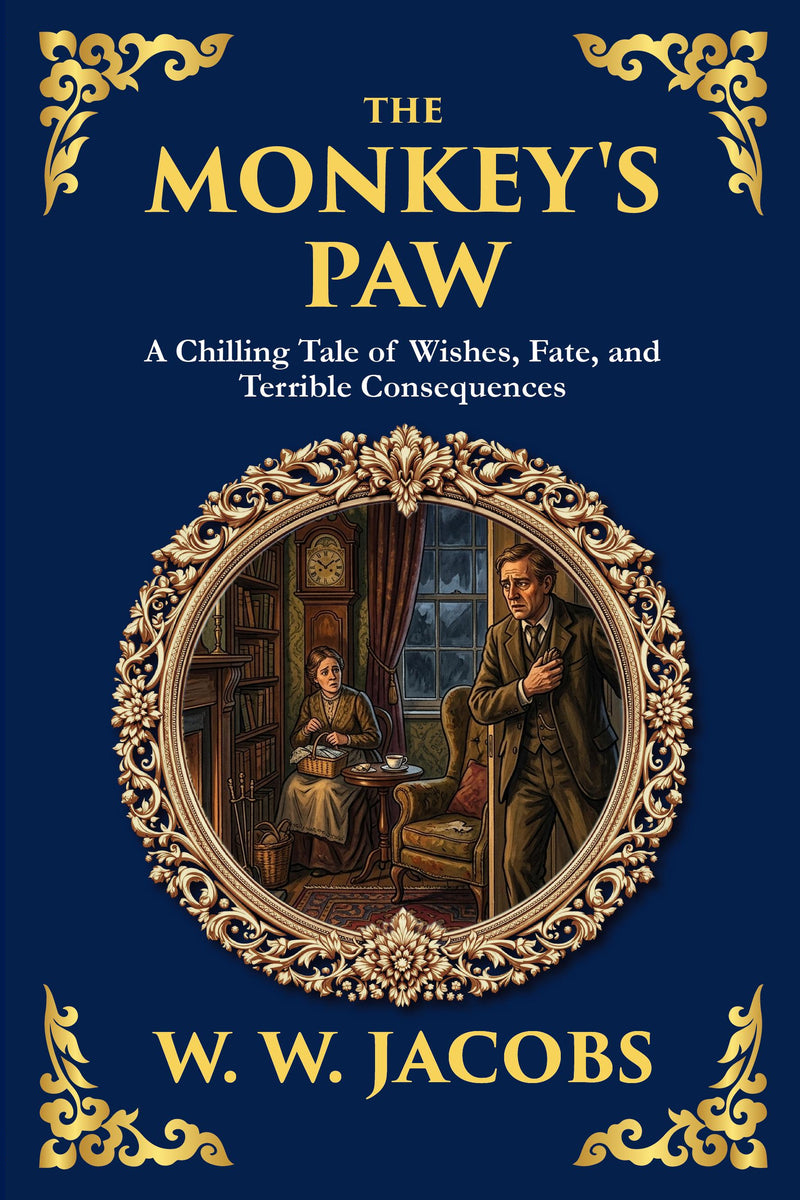
The Monkey’s Paw
A mysterious talisman grants three wishes—but at a dreadful cost. In this haunting and unforgettable story, the White family comes into possession of a monkey’s paw said to contain ancient, mystical power.
or free app
10,000+ hrs library
30-day guarantee
The complete The Monkey's Paw appears in modern English through Library of Alexandria Press, available online with audiobook narration included for members.
Have you ever wondered why some wishes should never be granted? In The Monkey’s Paw, W. W. Jacobs crafts a short story that has terrified, fascinated, and warned generations of readers. A family living in quiet rural England receives an ominous gift: a mummified monkey’s paw that allegedly grants three wishes.
At first dismissed as harmless folklore, the relic soon unleashes a series of terrifying events that none could have foreseen. This chilling tale is more than a gothic classic—it is a parable about greed, grief, and the irreversible consequences of meddling with forces beyond comprehension. With its eerie atmosphere, tight storytelling, and heart-stopping conclusion, this timeless work continues to resonate as a cautionary tale about the dangers of unchecked desire.
What you’ll discover in this modern edition
- A Spellbinding Horror Classic Experience the suspenseful tale of the White family and their descent into despair after invoking the paw’s cursed powers.
- A Gripping Moral Allegory Delve into the ethical implications of wishing for more—and what one must lose to gain it.
- A Psychological and Supernatural Thriller Witness the psychological unraveling of a family as they confront fate and mourn the cost of their choices.
- Timeless Themes of Loss and Regret Reflect on themes of love, death, and the devastating price of trying to undo the past.
- An Accessible, Modern Presentation This edition retains the eerie charm of the original while offering clear formatting for today’s readers.
| Formats | eBook (EPUB + PDF) · Audiobook · Paperback · Hardcover · Large Print |
| Language | English |
| Trim size (print) | 6 × 9 in |
| Binding | Paperback — perfect-bound · Hardcover — casewrap |
| Large Print edition | Same text in a larger, easy-read type — a larger font, not a larger trim |
| Print pricing | Every physical book at our true cost — at-cost, no profit (members) |
| Library | 873 restored titles, always growing |
| Length | 7,572 words · ~30 min reading |
| Reading level | Grade 8 · an easy, flowing read (this modern-English edition) |
| Edition | Modern English translation · 2026 |
Member reviews for this edition are collected as readers finish it — be the first. Across the library: 12,000+ books shipped, every plan covered by a 365-day print guarantee.
About this edition
A faithful, unabridged modern-English edition by The Library of Alexandria — carefully rendered for today's reader and verified paragraph-by-paragraph against the public-domain source. Available as eBook, audiobook, paperback, hardcover, and large print.
- Complete & unabridgedVerified paragraph by paragraph against the source — never a scan, never abridged.
- Modern English, faithfulReadable today, with the author’s meaning kept intact. Readable — not simplified.
- Every format, one membershipRead in your browser or the free app, or listen to the full audiobook.
Included free with your membership
Cancel anytime, one click · 30-day money-back guarantee
Edition last updated July 2026
What’s inside
The Monkey’s Paw — complete and unabridged: all 4 sections included with membership, plus the full audiobook.
Begin reading The Monkey’s Paw
In clear modern English — the complete text is included with membership.
Introduction
There are stories that entertain us for an evening and are forgotten by morning, and then there are stories that lodge themselves somewhere deep in the mind, waiting quietly to resurface at the most inconvenient hours—when the house creaks at night, when a knock comes unexpectedly at the door, when we catch ourselves wishing aloud for something we want very badly. The tale you are about to read belongs firmly to the second category. First published in 1902, it has haunted readers for well over a century, and it has done so not through gore or spectacle, but through something far more unsettling: the suggestion that our deepest desires might be the most dangerous things we possess.
This modern translation has been carefully adapted for the contemporary reader, smoothing the more archaic turns of phrase and clarifying expressions that have drifted out of common use since the Edwardian era, while preserving the eerie restraint and the slow-building tension that make the original so unforgettable. The aim has been to remove the barriers that sometimes stand between a modern audience and an older masterpiece, without sanding away the texture, atmosphere, and quiet menace that give the work its power. What remains is a story that reads as freshly and as chillingly today as it did when it first appeared in the pages of a magazine more than a hundred years ago.
Before you turn to the first page, it is worth taking a few moments to understand what makes this small, deceptively simple story such an enduring fixture of the horror tradition—and why, of all the thousands of supernatural tales written in its era, this one continues to be reprinted, adapted, parodied, referenced, and feared. To appreciate it fully is not to spoil it. Quite the opposite. A little context can deepen the dread, sharpen the suspense, and help you notice the careful craftsmanship working beneath the surface of what seems, at first, like nothing more than a quiet evening in an ordinary home.
The author, William Wymark Jacobs, is a figure who might surprise readers expecting the creator of one of the most chilling stories in the English language to be a brooding gothic recluse. In fact, Jacobs was something close to the opposite. Born in London in 1863, the son of a wharf manager who oversaw the bustling docks along the Thames, he grew up surrounded by the smells, sounds, and rough humor of riverside life. That world of barges, sailors, watermen, and warehouse clerks would shape the bulk of his literary output, which leaned heavily toward gentle comedy. For most of his career, Jacobs was celebrated not as a writer of terror but as a humorist—a popular and prolific author of light, affectionate tales about seafaring men, nagging wives, scheming clerks, and the small absurdities of working-class English life.
This is one of the great ironies of literary history. A man who spent the majority of his energies making people chuckle is remembered today, above all, for making them shudder. His comic works, once beloved, have largely faded from public memory, while this one short, dark experiment has refused to die. There is a lesson in that, and perhaps even a small irony fitting to the tale itself: sometimes what we are most known for is not what we set out to create, and the things that endure are not always the things we expect.
Yet the comic background is not irrelevant to the horror. Quite the contrary—it is one of the secret keys to why this story works so well. Jacobs was a master of ordinary domestic life. He knew how families spoke to one another, how spouses bickered affectionately, how a son teased his parents, how an evening at home unfolded with all its small rhythms and routines. He understood the cozy, the mundane, the familiar. And it is precisely this gift for capturing the everyday that makes the intrusion of the uncanny so devastating. The horror here does not erupt in some distant castle or fog-shrouded moor. It comes into a warm, lamplit sitting room where a fire burns and a family plays a game and the kettle is on. It enters a home that feels, in its details, almost exactly like our own.
This is the difference between cheap fright and genuine dread. A monster in an alien landscape is frightening, but it is also distant; we can tell ourselves it could never happen to us. But when terror seeps into the most secure and intimate space we know—the family home, the place of safety, the hearth—it becomes something we cannot so easily dismiss. Jacobs the humorist, the chronicler of domestic comedy, was uniquely equipped to build that warm and believable world. And having built it, he was uniquely equipped to violate it.
Jacobs lived a long life, dying in 1943, and continued writing for decades. But he never again struck the same nerve as he did with this brief tale. Readers and critics have long debated why this particular story succeeded where so many of his others have faded. The answer, as we shall see, lies in its extraordinary economy and in the timeless, almost mythic simplicity of the idea at its center.
The era in which Jacobs wrote also matters. The late Victorian and Edwardian periods were a golden age for the supernatural short story. This was a time of séances and spiritualism, of public fascination with ghosts and the afterlife, of widespread interest in the occult and in tales of the British Empire’s far-flung and “exotic” colonies, which the Western imagination filled with mystery, danger, and forbidden knowledge. Magazines hungry for short fiction provided a ready market for tales of the eerie and the strange, and writers of considerable talent—many of them, like Jacobs, not primarily known as horror authors—turned their hands to the form. It was a period when the ghost story and the weird tale achieved a kind of literary respectability, crafted with care and read by audiences who appreciated subtlety and atmosphere over crude shock. This story emerged from that rich tradition and stands today as one of its finest and most perfectly executed examples.
What distinguishes this tale is not its premise alone—though the premise is brilliant—but the masterful precision with which it is constructed. To read it is to witness a small machine of suspense built with the care of a watchmaker. Every element is placed with purpose. Nothing is wasted. The story is remarkably short, and yet it manages to deliver an emotional and psychological impact that lingers far longer than works ten times its length. This is a testament to the principle that in storytelling, restraint is often more powerful than excess.
Consider the structure. The story unfolds in three distinct movements, each tightening the screws a little further. The first establishes the warm, ordinary world and introduces the strange object that will set everything in motion, along with the dark warnings that surround it. The second presents the central act and its immediate, terrible consequences. The third—the one that has caused generations of readers to sit frozen, scarcely breathing—delivers the climax, a sequence of mounting tension built almost entirely on sound, anticipation, and the unbearable space between desire and dread. This three-part architecture is so clean and so effective that it has become a model studied by writers and analyzed by critics ever since.
One of the most striking aspects of Jacobs’s technique is his use of suggestion over depiction. The most frightening moments in this story are not shown to us directly. They happen offstage, in the dark, beyond the reach of the lamplight and beyond the reach of our sight. Jacobs understood something that the finest practitioners of horror have always known: that the human imagination is a far more terrifying instrument than any description could ever be. When we are forced to fill in the blanks ourselves, when we are made to imagine what waits in the darkness or on the other side of a door, our own minds conjure horrors far worse than any the author could have spelled out. The story trusts the reader to do this work, and in doing so, it makes the reader complicit in its terror.
Pay attention, as you read, to the role of sound. There is a long, agonizing sequence in this story that depends almost entirely on the reader’s imagination of what is happening based on what is heard—knocks, footsteps, the rasp of a bolt, the desperate fumbling of hands in the dark. It is one of the most effective uses of auditory dread in all of literature, and it works because Jacobs withholds the visual confirmation we crave. We are kept in suspense not because we cannot see the threat, but precisely because we cannot, and the not-seeing becomes its own form of agony.
Notice, too, the weather and the atmosphere. The story opens on a wet, wild night, with the wind howling outside and the rain beating against the windows. This is not mere scene-setting. The storm establishes the contrast between the warmth and safety within and the cold, hostile world without—a boundary that the story will eventually threaten to breach. The cozy interior, with its fire and its lamp and its family games, is a fragile bubble of comfort, and we sense, even before anything has gone wrong, that this comfort is precarious, that something is pressing in from outside.
The dialogue, too, repays close attention. Jacobs’s gift for the rhythms of natural conversation, honed across all those comic stories, serves him beautifully here. The early exchanges between family members feel genuine and lived-in—the gentle teasing, the small disagreements, the easy intimacy of people who have known one another all their lives. This authenticity is crucial. Because we believe in these people as real human beings, we care about what happens to them. And because we care, the horror that follows strikes us not as an abstract scary story but as a genuine tragedy befalling people we have come to know.
There is a profound moral and philosophical dimension to the story as well, one that elevates it above mere entertainment. At its heart lies one of humanity’s oldest and most universal anxieties: the fear that getting what we want might be the worst thing that could ever happen to us. This is an idea that recurs throughout world mythology, folklore, and literature. From the legend of King Midas, whose golden touch became a curse, to the countless fairy tales in which wishes are granted with cruel and unforeseen consequences, the warning is always the same. Be careful what you wish for. The universe, these stories suggest, has a terrible sense of irony, and the gap between what we ask for and what we actually want is wider and more perilous than we imagine.
This story takes that ancient theme and gives it a fresh, modern, deeply human form. It asks uncomfortable questions about fate and free will, about whether we are wise enough to be trusted with the power to alter our own destinies, and about the cost of meddling with forces we do not understand. It explores grief, and the desperate, irrational things that grief can drive us to do. It examines the limits of love and the dangers of desire. And it does all of this without ever lecturing, without ever pausing to moralize, allowing the events themselves to carry the full weight of their implications. The reader is left to draw the conclusions, and those conclusions tend to be all the more powerful for being self-discovered.
There is also a sense in which the story functions as a meditation on consequence itself—on the way that actions, once taken, cannot be untaken, and that the chain of events we set in motion may carry us to places we never intended and could never have foreseen. The characters in this tale are not wicked people. They are ordinary, decent, loving individuals who make understandable choices for understandable reasons. And it is precisely their ordinariness, their decency, that makes their fate so affecting. The story seems to whisper that this could happen to anyone, that the door between safety and catastrophe is thinner than we think, and that we are all, in our deepest desires, only ever a single wish away from disaster.
Cancel anytime, one click · 30-day money-back guarantee
Founding annual rate available now — your price locks for life when you join.
Not ready? Get this free chapter by email — read it anytime.
✓ Sent — check your inbox for The Monkey’s Paw.
Questions about The Monkey’s Paw
What is The Monkey's Paw about?
A mysterious talisman grants three wishes—but at a dreadful cost. In this haunting and unforgettable story, the White family comes into possession of a monkey’s paw said to contain ancient, mystical power. But when their desires are granted with cruel twists of fate, they discover too late that tampering with destiny brings consequences no one can control.
Who wrote The Monkey's Paw?
The Monkey's Paw was written by W. W. Jacobs. This edition presents the complete work in clear modern English, faithfully rendered from the public-domain original by Library of Alexandria Press.
Is The Monkey's Paw free to read?
The opening chapter is free to read on this page. Members read and listen to the complete work — and the entire library — free, and can order any physical book at our true print cost.
How long is The Monkey's Paw?
4 chapters (~7,572 words) — about 30 min of reading in this modern-English edition.
Is this an abridged version of The Monkey's Paw?
No. This is the complete, unabridged The Monkey's Paw, carefully rendered into clear modern English and verified paragraph-by-paragraph against the public-domain source — nothing is cut or summarised.
What formats does The Monkey's Paw come in?
The Monkey's Paw is available as eBook, paperback, hardcover and large print. eBook and audiobook are included with membership; printed editions ship at our true print cost.
Shipping & returns
Billing & membership
More from the library


Explore Horror & Gothic
- The Strange Case of Dr. Jekyll and Mr. Hyde · Robert Louis Stevenson
- The Cask of Amontillado · Edgar Allan Poe
- Ghost Stories of an Antiquary · M. R. James
- The Monk: A Romance · M. G. Lewis
- The House of the Seven Gables · Nathaniel Hawthorne
- The Willows · Algernon Blackwood
- The Call of Cthulhu · H. P. Lovecraft
- The Life-Eater · Harold Ward
- The Black Kiss
- The Legend of Sleepy Hollow · Washington Irving
- Brood of the Dark Moon · Charles Willard Diffin
- The Night Land · William Hope Hodgson
- The Castle of Otranto · Horace Walpole
- Dracula · Bram Stoker
- Carmilla · Joseph Sheridan Le Fanu
- The King in Yellow · Robert W. Chambers
- Wuthering Heights · Emily Brontë
- The Vampyre: A Tale · John William Polidori
- A Christmas Carol · Charles Dickens
- Northanger Abbey · Jane Austen
- The Turn of the Screw · Henry James
- Metamorphosis · Franz Kafka
- The Yellow Wallpaper · Charlotte Perkins Gilman
- The Adventures of Ferdinand Count Fathom — Complete · T. Smollett
- The Picture of Dorian Gray · Oscar Wilde
- Frankenstein; Or, The Modern Prometheus · Mary Wollstonecraft Shelley
The Monkey’s Paw
The Monkey’s Paw
A Scary Story About Wishes, Destiny, and Horrible Results
W. W. Jacobs
Contents
- Introduction
- Chapter 1
- Chapter 2
- Chapter 3
Introduction
There are stories that entertain us for an evening and are forgotten by morning, and then there are stories that lodge themselves somewhere deep in the mind, waiting quietly to resurface at the most inconvenient hours—when the house creaks at night, when a knock comes unexpectedly at the door, when we catch ourselves wishing aloud for something we want very badly. The tale you are about to read belongs firmly to the second category. First published in 1902, it has haunted readers for well over a century, and it has done so not through gore or spectacle, but through something far more unsettling: the suggestion that our deepest desires might be the most dangerous things we possess.
This modern translation has been carefully adapted for the contemporary reader, smoothing the more archaic turns of phrase and clarifying expressions that have drifted out of common use since the Edwardian era, while preserving the eerie restraint and the slow-building tension that make the original so unforgettable. The aim has been to remove the barriers that sometimes stand between a modern audience and an older masterpiece, without sanding away the texture, atmosphere, and quiet menace that give the work its power. What remains is a story that reads as freshly and as chillingly today as it did when it first appeared in the pages of a magazine more than a hundred years ago.
Before you turn to the first page, it is worth taking a few moments to understand what makes this small, deceptively simple story such an enduring fixture of the horror tradition—and why, of all the thousands of supernatural tales written in its era, this one continues to be reprinted, adapted, parodied, referenced, and feared. To appreciate it fully is not to spoil it. Quite the opposite. A little context can deepen the dread, sharpen the suspense, and help you notice the careful craftsmanship working beneath the surface of what seems, at first, like nothing more than a quiet evening in an ordinary home.
The author, William Wymark Jacobs, is a figure who might surprise readers expecting the creator of one of the most chilling stories in the English language to be a brooding gothic recluse. In fact, Jacobs was something close to the opposite. Born in London in 1863, the son of a wharf manager who oversaw the bustling docks along the Thames, he grew up surrounded by the smells, sounds, and rough humor of riverside life. That world of barges, sailors, watermen, and warehouse clerks would shape the bulk of his literary output, which leaned heavily toward gentle comedy. For most of his career, Jacobs was celebrated not as a writer of terror but as a humorist—a popular and prolific author of light, affectionate tales about seafaring men, nagging wives, scheming clerks, and the small absurdities of working-class English life.
This is one of the great ironies of literary history. A man who spent the majority of his energies making people chuckle is remembered today, above all, for making them shudder. His comic works, once beloved, have largely faded from public memory, while this one short, dark experiment has refused to die. There is a lesson in that, and perhaps even a small irony fitting to the tale itself: sometimes what we are most known for is not what we set out to create, and the things that endure are not always the things we expect.
Yet the comic background is not irrelevant to the horror. Quite the contrary—it is one of the secret keys to why this story works so well. Jacobs was a master of ordinary domestic life. He knew how families spoke to one another, how spouses bickered affectionately, how a son teased his parents, how an evening at home unfolded with all its small rhythms and routines. He understood the cozy, the mundane, the familiar. And it is precisely this gift for capturing the everyday that makes the intrusion of the uncanny so devastating. The horror here does not erupt in some distant castle or fog-shrouded moor. It comes into a warm, lamplit sitting room where a fire burns and a family plays a game and the kettle is on. It enters a home that feels, in its details, almost exactly like our own.
This is the difference between cheap fright and genuine dread. A monster in an alien landscape is frightening, but it is also distant; we can tell ourselves it could never happen to us. But when terror seeps into the most secure and intimate space we know—the family home, the place of safety, the hearth—it becomes something we cannot so easily dismiss. Jacobs the humorist, the chronicler of domestic comedy, was uniquely equipped to build that warm and believable world. And having built it, he was uniquely equipped to violate it.
Jacobs lived a long life, dying in 1943, and continued writing for decades. But he never again struck the same nerve as he did with this brief tale. Readers and critics have long debated why this particular story succeeded where so many of his others have faded. The answer, as we shall see, lies in its extraordinary economy and in the timeless, almost mythic simplicity of the idea at its center.
The era in which Jacobs wrote also matters. The late Victorian and Edwardian periods were a golden age for the supernatural short story. This was a time of séances and spiritualism, of public fascination with ghosts and the afterlife, of widespread interest in the occult and in tales of the British Empire’s far-flung and “exotic” colonies, which the Western imagination filled with mystery, danger, and forbidden knowledge. Magazines hungry for short fiction provided a ready market for tales of the eerie and the strange, and writers of considerable talent—many of them, like Jacobs, not primarily known as horror authors—turned their hands to the form. It was a period when the ghost story and the weird tale achieved a kind of literary respectability, crafted with care and read by audiences who appreciated subtlety and atmosphere over crude shock. This story emerged from that rich tradition and stands today as one of its finest and most perfectly executed examples.
What distinguishes this tale is not its premise alone—though the premise is brilliant—but the masterful precision with which it is constructed. To read it is to witness a small machine of suspense built with the care of a watchmaker. Every element is placed with purpose. Nothing is wasted. The story is remarkably short, and yet it manages to deliver an emotional and psychological impact that lingers far longer than works ten times its length. This is a testament to the principle that in storytelling, restraint is often more powerful than excess.
Consider the structure. The story unfolds in three distinct movements, each tightening the screws a little further. The first establishes the warm, ordinary world and introduces the strange object that will set everything in motion, along with the dark warnings that surround it. The second presents the central act and its immediate, terrible consequences. The third—the one that has caused generations of readers to sit frozen, scarcely breathing—delivers the climax, a sequence of mounting tension built almost entirely on sound, anticipation, and the unbearable space between desire and dread. This three-part architecture is so clean and so effective that it has become a model studied by writers and analyzed by critics ever since.
One of the most striking aspects of Jacobs’s technique is his use of suggestion over depiction. The most frightening moments in this story are not shown to us directly. They happen offstage, in the dark, beyond the reach of the lamplight and beyond the reach of our sight. Jacobs understood something that the finest practitioners of horror have always known: that the human imagination is a far more terrifying instrument than any description could ever be. When we are forced to fill in the blanks ourselves, when we are made to imagine what waits in the darkness or on the other side of a door, our own minds conjure horrors far worse than any the author could have spelled out. The story trusts the reader to do this work, and in doing so, it makes the reader complicit in its terror.
Pay attention, as you read, to the role of sound. There is a long, agonizing sequence in this story that depends almost entirely on the reader’s imagination of what is happening based on what is heard—knocks, footsteps, the rasp of a bolt, the desperate fumbling of hands in the dark. It is one of the most effective uses of auditory dread in all of literature, and it works because Jacobs withholds the visual confirmation we crave. We are kept in suspense not because we cannot see the threat, but precisely because we cannot, and the not-seeing becomes its own form of agony.
Notice, too, the weather and the atmosphere. The story opens on a wet, wild night, with the wind howling outside and the rain beating against the windows. This is not mere scene-setting. The storm establishes the contrast between the warmth and safety within and the cold, hostile world without—a boundary that the story will eventually threaten to breach. The cozy interior, with its fire and its lamp and its family games, is a fragile bubble of comfort, and we sense, even before anything has gone wrong, that this comfort is precarious, that something is pressing in from outside.
The dialogue, too, repays close attention. Jacobs’s gift for the rhythms of natural conversation, honed across all those comic stories, serves him beautifully here. The early exchanges between family members feel genuine and lived-in—the gentle teasing, the small disagreements, the easy intimacy of people who have known one another all their lives. This authenticity is crucial. Because we believe in these people as real human beings, we care about what happens to them. And because we care, the horror that follows strikes us not as an abstract scary story but as a genuine tragedy befalling people we have come to know.
There is a profound moral and philosophical dimension to the story as well, one that elevates it above mere entertainment. At its heart lies one of humanity’s oldest and most universal anxieties: the fear that getting what we want might be the worst thing that could ever happen to us. This is an idea that recurs throughout world mythology, folklore, and literature. From the legend of King Midas, whose golden touch became a curse, to the countless fairy tales in which wishes are granted with cruel and unforeseen consequences, the warning is always the same. Be careful what you wish for. The universe, these stories suggest, has a terrible sense of irony, and the gap between what we ask for and what we actually want is wider and more perilous than we imagine.
This story takes that ancient theme and gives it a fresh, modern, deeply human form. It asks uncomfortable questions about fate and free will, about whether we are wise enough to be trusted with the power to alter our own destinies, and about the cost of meddling with forces we do not understand. It explores grief, and the desperate, irrational things that grief can drive us to do. It examines the limits of love and the dangers of desire. And it does all of this without ever lecturing, without ever pausing to moralize, allowing the events themselves to carry the full weight of their implications. The reader is left to draw the conclusions, and those conclusions tend to be all the more powerful for being self-discovered.
There is also a sense in which the story functions as a meditation on consequence itself—on the way that actions, once taken, cannot be untaken, and that the chain of events we set in motion may carry us to places we never intended and could never have foreseen. The characters in this tale are not wicked people. They are ordinary, decent, loving individuals who make understandable choices for understandable reasons. And it is precisely their ordinariness, their decency, that makes their fate so affecting. The story seems to whisper that this could happen to anyone, that the door between safety and catastrophe is thinner than we think, and that we are all, in our deepest desires, only ever a single wish away from disaster.
Outside, the night was chilly and rainy, but inside the small living room of Laburnam Villa, the blinds were closed and a fire crackled warmly. A father and son were playing chess. The father, who had some unconventional ideas about the game, put his king in such dangerous and pointless positions that it even caught the attention of the white-haired old lady, who was calmly knitting by the fire.
“Listen to that wind,” said Mr. White. He had just realized he made a fatal mistake, but it was too late, and he was now trying to distract his son so the young man wouldn’t notice it.
“I’m listening,” the son replied, staring grimly at the board as he moved his piece. “Check.”
“I doubt he’ll actually show up tonight,” his father said, his hand hovering over the board.
“This is the problem with living so far out!” Mr. White shouted with sudden, unexpected anger. “Of all the miserable, muddy, remote places to live, this is the absolute worst. The path is a swamp and the road is a river. I don’t know what people are thinking. I guess since only two houses on this road are rented, they think it doesn’t matter.”
“It’s okay, dear,” his wife said comfortingly. “Maybe you’ll win the next one.”
Mr. White looked up quickly, catching a knowing look shared between his wife and son. He stopped speaking and hid a guilty smile behind his thin grey beard.
“Here he comes,” Herbert White said, as the gate slammed loudly and heavy footsteps approached the door.
The old man stood up quickly to welcome his guest. As he opened the door, he could be heard offering sympathy to the newcomer. The visitor expressed similar sympathy for himself, prompting Mrs. White to say, “Tut, tut!” She coughed softly as her husband walked back into the room, followed by a tall, muscular man with small, sharp eyes and a red face.
End of the free sample
Keep reading, free
Members read and listen to the complete book — and the entire library. Cancel anytime, one click · 30-day money-back guarantee.