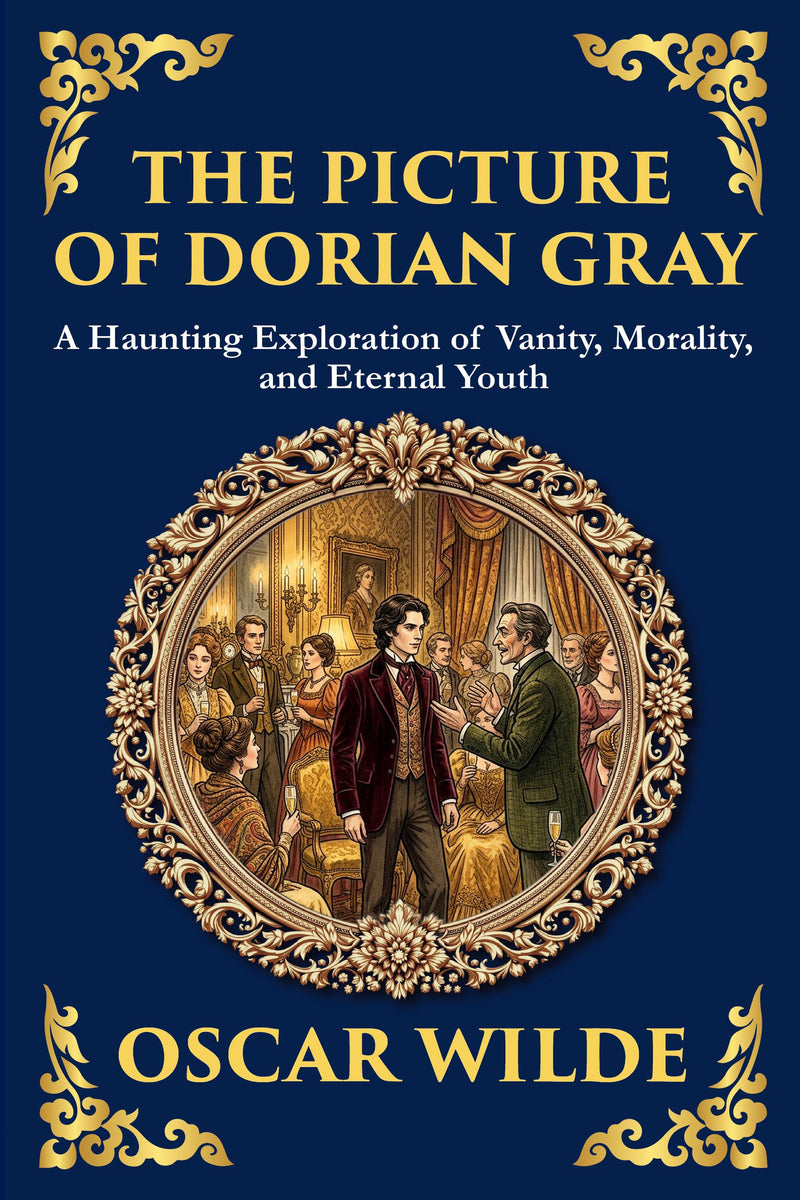
The Picture of Dorian Gray
What if you could remain young and beautiful forever—while your soul bears the cost? In The Picture of Dorian Gray, Oscar Wilde unveils a chilling portrait of aesthetic obsession, moral corruption, and the devastating price of unchecked desire.
or free app
10,000+ hrs library
30-day guarantee
The complete The Picture of Dorian Gray appears in modern English through Library of Alexandria Press, available online with audiobook narration included for members.
Have you ever wondered why beauty can be a curse—and the soul, a silent witness to every secret sin? Oscar Wilde’s The Picture of Dorian Gray is more than a gothic masterpiece. It is a deeply unsettling exploration of vanity, art, and the corruptible nature of the human spirit.
With razor- sharp wit and lyrical prose, Wilde creates a character who embodies both the seductive charm and moral decay of a society obsessed with appearances. Dorian Gray, young and mesmerizingly beautiful, sits for a portrait painted by the adoring artist Basil Hallward. Influenced by the hedonistic Lord Henry Wotton, Dorian wishes that he might stay forever young—and his wish is granted.
While Dorian remains untouched by time, his portrait absorbs the scars of his sins. As he spirals deeper into a life of indulgence, cruelty, and secrecy, the hidden painting becomes a grotesque reflection of his soul. More than a cautionary tale, this novel is an intellectual thriller—a dance between surface and substance, appearance and truth, life and death.
Wilde’s philosophical insights and biting social commentary make The Picture of Dorian Gray as powerful today as it was scandalous upon release.
What you’ll discover in this modern edition
- A Gothic Tale of Eternal Youth and Decay – Witness a man’s soul unravel behind a mask of perfection.
- Oscar Wilde’s Only Novel—Bold, Provocative, and Enduring – His genius distilled into a single unforgettable narrative.
- A Deep Dive into Morality and Identity – Explore how influence, ego, and beauty can shape—and shatter—a person.
- A Masterclass in Psychological Fiction – Written with exquisite irony, poetic darkness, and philosophical weight.
- A Story That Still Haunts Modern Culture – The idea of hiding corruption behind beauty has never been more relevant.
| Formats | eBook (EPUB + PDF) · Audiobook · Paperback · Hardcover · Large Print |
| Language | English |
| Trim size (print) | 6 × 9 in |
| Binding | Paperback — perfect-bound · Hardcover — casewrap |
| Large Print edition | Same text in a larger, easy-read type — a larger font, not a larger trim |
| Print pricing | Every physical book at our true cost — at-cost, no profit (members) |
| Library | 873 restored titles, always growing |
| Length | 75,396 words · ~5 hr 2 min reading |
| Reading level | Grade 5 · an easy, flowing read (this modern-English edition) |
| Edition | Modern English translation · 2026 |
Member reviews for this edition are collected as readers finish it — be the first. Across the library: 12,000+ books shipped, every plan covered by a 365-day print guarantee.
About this edition
A faithful, unabridged modern-English edition by The Library of Alexandria — carefully rendered for today's reader and verified paragraph-by-paragraph against the public-domain source. Available as eBook, audiobook, paperback, hardcover, and large print.
- Complete & unabridgedVerified paragraph by paragraph against the source — never a scan, never abridged.
- Modern English, faithfulReadable today, with the author’s meaning kept intact. Readable — not simplified.
- Every format, one membershipRead in your browser or the free app, or listen to the full audiobook.
Included free with your membership
Cancel anytime, one click · 30-day money-back guarantee
Edition last updated July 2026
What’s inside
The Picture of Dorian Gray — complete and unabridged: all 22 sections included with membership, plus the full audiobook.
Begin reading The Picture of Dorian Gray
In clear modern English — the complete text is included with membership.
Introduction
There are certain books that do not simply tell a story but cast a spell over everyone who comes near them. They unsettle and enchant in equal measure, lingering in the imagination long after the final page is turned. Oscar Wilde’s only novel belongs to this rare company. First published in 1890, it scandalized Victorian society, provoked outrage among critics, and very nearly destroyed its author’s reputation—yet it has endured, generation after generation, precisely because it dares to ask questions that most of us spend our lives avoiding. What price would you pay to remain forever young? What happens to the soul when beauty becomes the only thing we worship? And how long can a person hide the truth of who they really are before that truth begins to demand its reckoning?
This modern translation has been carefully prepared for the contemporary reader, smoothing the more archaic turns of phrase and unfamiliar references that can sometimes form a barrier between a present-day audience and a text written more than a century ago. The goal has not been to flatten Wilde’s voice—heaven forbid, for his voice is one of the glories of English literature—but to ensure that nothing stands between you and the dazzling intelligence, the wit, the menace, and the moral seriousness that pulse beneath the surface of this extraordinary work. What awaits you is a tale of seduction and corruption, of art and conscience, told by a man who understood human vanity more intimately than almost any writer who has ever lived. You are about to enter a world of glittering drawing rooms and shadowy secrets, of conversations sharp enough to draw blood, and of a single, terrible bargain whose consequences unfold with the inevitability of a nightmare.
To understand the strange power of this novel, it helps to understand something of the man who wrote it and the world that both adored and ultimately punished him. Oscar Fingal O’Flahertie Wills Wilde was born in Dublin in 1854, the son of a celebrated surgeon and a poet and Irish nationalist who wrote under the pen name “Speranza.” From an early age he was steeped in literature, language, and the conviction that life itself should be lived as a work of art. He distinguished himself brilliantly at Trinity College Dublin and then at Oxford, where he came under the influence of thinkers like Walter Pater and John Ruskin, and where he began to formulate the philosophy that would define his career: the doctrine of Aestheticism, the belief in “art for art’s sake,” the idea that beauty possesses a value entirely independent of moral instruction or practical use.
By the 1880s Wilde had become one of the most famous personalities in the English-speaking world—not yet for his writing, but for his persona. He dressed flamboyantly, spoke in epigrams, and turned conversation into a kind of performance art. He toured America delivering lectures on aesthetics, and when a customs officer asked if he had anything to declare, he is said to have replied, “Nothing but my genius.” He was a celebrity in the most modern sense, a man who understood instinctively that the way one presents oneself to the world is itself a form of creation. But beneath the dazzling surface lay a serious thinker and a writer of genuine depth, and when he finally turned his attention to the novel, the result was something far more troubling and profound than his public reputation as a wit and dandy might have suggested.
The London of the late nineteenth century in which this story unfolds was a society obsessed with appearances and rigidly governed by codes of respectability. It was an age that prized self-control, moral earnestness, and the careful maintenance of a spotless public face—while behind closed doors, a vast and largely unspoken world of desire, hypocrisy, and forbidden pleasure flourished in the shadows. The tension between the visible and the hidden, between what is shown and what is concealed, ran through Victorian life like a fault line. Wilde, who lived much of his own existence in the gap between his public persona and his private self, understood this tension better than anyone. And it is precisely this theme—the chasm between the face we present and the soul we hide—that forms the dark heart of the story you are about to read.
When the novel first appeared in 1890, the reaction was immediate and ferocious. Critics condemned it as immoral, decadent, and corrupting. Reviewers called it poisonous, accused it of glorifying vice, and suggested it should be suppressed entirely. Wilde, never one to retreat from a fight, defended his work with characteristic brilliance, and when the novel was published in book form the following year he added a now-famous preface—a series of provocative aphorisms about art, morality, and the artist’s relationship to both. “There is no such thing as a moral or an immoral book,” he declared. “Books are well written, or badly written. That is all.” It was a deliberate provocation, a challenge thrown down before a society he found suffocating in its self-righteousness. Yet, as you will discover, the novel itself tells a more complicated story than that defiant preface might suggest—for whatever Wilde claimed about art’s independence from morality, the tale he wrote is among the most morally serious in the English language.
Five years after the novel’s publication, Wilde’s own life would collapse with a tragic completeness that no novelist would dare invent. Accused and convicted under the harsh laws of the time, he was sentenced to two years of hard labor, an ordeal that shattered his health and his spirit. He emerged from prison broken, impoverished, and exiled, and died in Paris in 1900 at the age of forty-six. There is a haunting symmetry between the fate of the author and the warnings embedded in his great novel—a sense that Wilde, in writing this story, was somehow prophesying the destruction that awaited a man who lived too dangerously in the space between his public mask and his private truth. To read the book today, knowing what became of its creator, is to feel the chill of something more than fiction.
The Story, the Spell, and Why It Still Holds Us
At the center of this novel stand three remarkable figures, and the relationships among them generate nearly all of the story’s electric tension. There is a young man of extraordinary beauty, whose loveliness is so striking that it seems almost otherworldly—a perfection that inspires devotion, obsession, and ruin in those who fall under its influence. There is an artist, sensitive and devoted, who sees in this young man a kind of ideal, an inspiration that transforms his work and perhaps, dangerously, his life. And there is a third figure, a cynical and brilliant aristocrat whose conversation drips with seductive wit and dangerous philosophy, a man who delights in challenging every convention and who takes a peculiar pleasure in the corruption of innocence. The interplay among these three—admiration, influence, envy, longing, and the slow poisoning of a soul—forms the engine of the narrative.
I will not reveal the central event around which the entire story turns, for the discovery of it is one of the great pleasures the novel offers, and to read it for the first time without knowing precisely what is coming is to experience its full uncanny force. But I can tell you this much: the story concerns a bargain, a wish made half in jest and yet uttered with a desperate sincerity, and the supernatural fulfillment of that wish in a manner both wondrous and horrifying. What begins as a meditation on beauty and youth becomes, over the course of the book, a profound and terrifying examination of the relationship between the self we show the world and the self we cannot bear to look upon. It is a story about the consequences of choosing pleasure over conscience, sensation over meaning, and surface over substance. And it builds, with the relentless momentum of a tragedy, toward a conclusion that has lost none of its power to shock and disturb in the more than a century since it was first written.
What makes the novel so much more than a mere ghost story or moral fable is the intelligence and beauty of Wilde’s prose. The conversations in this book are among the most quotable in all of literature. The cynical aristocrat in particular speaks in a steady stream of paradoxes and epigrams so brilliant, so seductive, that the reader—like the young man at the story’s center—may find themselves half-charmed and half-appalled. “I can resist everything except temptation.” “The only way to get rid of a temptation is to yield to it.” “Nowadays people know the price of everything and the value of nothing.” These glittering aphorisms are not mere ornament; they are the very instruments of seduction within the story, the velvet glove over the iron hand of corruption. Wilde understood that the most dangerous ideas are often the most beautifully expressed, and he gives his tempter a tongue of gold precisely so that we, the readers, may feel the pull of temptation for ourselves and understand how a young and impressionable soul might be led astray.
Yet for all its wit and sparkle, the novel is shot through with darkness. There are descriptions of squalor and degradation, of opium dens and midnight encounters, of cruelty and despair, that stand in deliberate contrast to the glittering world of high society in which much of the action takes place. Wilde was determined to show both faces of the coin—the beautiful surface and the rotting underside—and this doubleness gives the book its peculiar and unforgettable atmosphere. As you read, you will feel the tension between these worlds, the way the elegant drawing rooms seem always to be casting shadows, the way pleasure seems forever shadowed by dread. It is a book that understands, with terrible clarity, that the pursuit of beauty and sensation without conscience leads not to fulfillment but to a kind of living death.
The questions the novel raises feel, if anything, more urgent today than they did in 1890. We live in an age more obsessed with image, youth, and surface than perhaps any in human history. We curate our public selves with a care and anxiety that Wilde could scarcely have imagined, presenting flawless faces to a watching world while concealing whatever we deem unworthy of display. We are surrounded by promises of eternal youth, by the endless pursuit of beauty, by the temptation to value how we appear over who we actually are. The central conceit of this novel—the idea of a self that remains forever young and beautiful on the surface while something hidden bears the true weight of every choice, every sin, every act of selfishness and cruelty—speaks directly to the condition of modern life. Wilde, writing more than a century ago, somehow anticipated the moral peril of a culture that worships the image above all else, and his novel reads today not as a quaint period piece but as a prophecy.
There is also, woven throughout the book, a deep and genuine inquiry into the nature of influence—the way one person can shape, mold, and ultimately corrupt another. The story asks how much responsibility we bear for the souls we touch, whether a teacher or mentor or friend can be held accountable for what they awaken in others, and where the line falls between liberation and destruction. The cynical aristocrat at the heart of the tale liberates the young man from the moral constraints of his upbringing—but is this liberation a gift or a poison? Does he free his protégé to become his truest self, or does he merely unleash an appetite that will consume everything, including the one who possessed it? These are not questions the novel answers easily or comfortably, and that refusal to provide simple moral resolution is part of what gives the book its enduring richness. You will find yourself arguing with it, wrestling with it, perhaps even resisting its conclusions—and that is exactly as Wilde intended.
It is worth saying a word, too, about how to approach the experience of reading this novel, particularly if you are coming to it for the first time. Allow yourself to be seduced. Let the language wash over you. Do not rush to judge the characters or to extract a tidy lesson; instead, surrender to the atmosphere Wilde so carefully constructs, the way he draws you deeper and deeper into a world of beauty and menace. Notice how the early chapters seem almost intoxicated with the pleasures of art and conversation and youth, and how gradually, almost imperceptibly, a chill begins to creep into the prose. Pay attention to the recurring images—the play of light and shadow, the obsession with surfaces and mirrors, the contrast between the fresh and the decayed. Wilde was a meticulous craftsman, and nearly every detail in this book is placed with intention. The novel rewards careful reading, but it also delivers, on the simplest level, the pure pleasure of a gripping and unsettling story. You can read it as a thriller, as a fable, as a philosophical meditation, or as all three at once.
Cancel anytime, one click · 30-day money-back guarantee
Founding annual rate available now — your price locks for life when you join.
Not ready? Get this free chapter by email — read it anytime.
✓ Sent — check your inbox for The Picture of Dorian Gray.
Questions about The Picture of Dorian Gray
What is The Picture of Dorian Gray about?
What if you could remain young and beautiful forever—while your soul bears the cost? In The Picture of Dorian Gray, Oscar Wilde unveils a chilling portrait of aesthetic obsession, moral corruption, and the devastating price of unchecked desire. When the handsome Dorian Gray makes a Faustian wish, his portrait begins to age and rot in his place—reflecting every sin, every indulgence, every dark deed.
Who wrote The Picture of Dorian Gray?
The Picture of Dorian Gray was written by Oscar Wilde. This edition presents the complete work in clear modern English, faithfully rendered from the public-domain original by Library of Alexandria Press.
Is The Picture of Dorian Gray free to read?
The opening chapter is free to read on this page. Members read and listen to the complete work — and the entire library — free, and can order any physical book at our true print cost.
How long is The Picture of Dorian Gray?
22 chapters (~75,396 words) — about 5 hr 2 min of reading in this modern-English edition.
Is this an abridged version of The Picture of Dorian Gray?
No. This is the complete, unabridged The Picture of Dorian Gray, carefully rendered into clear modern English and verified paragraph-by-paragraph against the public-domain source — nothing is cut or summarised.
What formats does The Picture of Dorian Gray come in?
The Picture of Dorian Gray is available as eBook, paperback, hardcover and large print. eBook and audiobook are included with membership; printed editions ship at our true print cost.
Shipping & returns
Billing & membership
More from the library


Explore Horror & Gothic
- The Strange Case of Dr. Jekyll and Mr. Hyde · Robert Louis Stevenson
- The Cask of Amontillado · Edgar Allan Poe
- Ghost Stories of an Antiquary · M. R. James
- The Monk: A Romance · M. G. Lewis
- The House of the Seven Gables · Nathaniel Hawthorne
- The Willows · Algernon Blackwood
- The Monkey’s Paw · W. W. Jacobs
- The Call of Cthulhu · H. P. Lovecraft
- The Life-Eater · Harold Ward
- The Black Kiss
- The Legend of Sleepy Hollow · Washington Irving
- Brood of the Dark Moon · Charles Willard Diffin
- The Night Land · William Hope Hodgson
- The Castle of Otranto · Horace Walpole
- Dracula · Bram Stoker
- Carmilla · Joseph Sheridan Le Fanu
- The King in Yellow · Robert W. Chambers
- Wuthering Heights · Emily Brontë
- The Vampyre: A Tale · John William Polidori
- A Christmas Carol · Charles Dickens
- Northanger Abbey · Jane Austen
- The Turn of the Screw · Henry James
- Metamorphosis · Franz Kafka
- The Yellow Wallpaper · Charlotte Perkins Gilman
- The Adventures of Ferdinand Count Fathom — Complete · T. Smollett
- Frankenstein; Or, The Modern Prometheus · Mary Wollstonecraft Shelley
The Picture of Dorian Gray
The Picture of Dorian Gray
A Haunting Exploration of Vanity, Morality, and Eternal Youth
Oscar Wilde
Contents
- Introduction
- Preface by the Author
- Chapter 1
- Chapter 2
- Chapter 3
- Chapter 4
- Chapter 5
- Chapter 6
- Chapter 7
- Chapter 8
- Chapter 9
- Chapter 10
- Chapter 11
- Chapter 12
- Chapter 13
- Chapter 14
- Chapter 15
- Chapter 16
- Chapter 17
- Chapter 18
- Chapter 19
- Chapter 20
Introduction
There are certain books that do not simply tell a story but cast a spell over everyone who comes near them. They unsettle and enchant in equal measure, lingering in the imagination long after the final page is turned. Oscar Wilde’s only novel belongs to this rare company. First published in 1890, it scandalized Victorian society, provoked outrage among critics, and very nearly destroyed its author’s reputation—yet it has endured, generation after generation, precisely because it dares to ask questions that most of us spend our lives avoiding. What price would you pay to remain forever young? What happens to the soul when beauty becomes the only thing we worship? And how long can a person hide the truth of who they really are before that truth begins to demand its reckoning?
This modern translation has been carefully prepared for the contemporary reader, smoothing the more archaic turns of phrase and unfamiliar references that can sometimes form a barrier between a present-day audience and a text written more than a century ago. The goal has not been to flatten Wilde’s voice—heaven forbid, for his voice is one of the glories of English literature—but to ensure that nothing stands between you and the dazzling intelligence, the wit, the menace, and the moral seriousness that pulse beneath the surface of this extraordinary work. What awaits you is a tale of seduction and corruption, of art and conscience, told by a man who understood human vanity more intimately than almost any writer who has ever lived. You are about to enter a world of glittering drawing rooms and shadowy secrets, of conversations sharp enough to draw blood, and of a single, terrible bargain whose consequences unfold with the inevitability of a nightmare.
To understand the strange power of this novel, it helps to understand something of the man who wrote it and the world that both adored and ultimately punished him. Oscar Fingal O’Flahertie Wills Wilde was born in Dublin in 1854, the son of a celebrated surgeon and a poet and Irish nationalist who wrote under the pen name “Speranza.” From an early age he was steeped in literature, language, and the conviction that life itself should be lived as a work of art. He distinguished himself brilliantly at Trinity College Dublin and then at Oxford, where he came under the influence of thinkers like Walter Pater and John Ruskin, and where he began to formulate the philosophy that would define his career: the doctrine of Aestheticism, the belief in “art for art’s sake,” the idea that beauty possesses a value entirely independent of moral instruction or practical use.
By the 1880s Wilde had become one of the most famous personalities in the English-speaking world—not yet for his writing, but for his persona. He dressed flamboyantly, spoke in epigrams, and turned conversation into a kind of performance art. He toured America delivering lectures on aesthetics, and when a customs officer asked if he had anything to declare, he is said to have replied, “Nothing but my genius.” He was a celebrity in the most modern sense, a man who understood instinctively that the way one presents oneself to the world is itself a form of creation. But beneath the dazzling surface lay a serious thinker and a writer of genuine depth, and when he finally turned his attention to the novel, the result was something far more troubling and profound than his public reputation as a wit and dandy might have suggested.
The London of the late nineteenth century in which this story unfolds was a society obsessed with appearances and rigidly governed by codes of respectability. It was an age that prized self-control, moral earnestness, and the careful maintenance of a spotless public face—while behind closed doors, a vast and largely unspoken world of desire, hypocrisy, and forbidden pleasure flourished in the shadows. The tension between the visible and the hidden, between what is shown and what is concealed, ran through Victorian life like a fault line. Wilde, who lived much of his own existence in the gap between his public persona and his private self, understood this tension better than anyone. And it is precisely this theme—the chasm between the face we present and the soul we hide—that forms the dark heart of the story you are about to read.
When the novel first appeared in 1890, the reaction was immediate and ferocious. Critics condemned it as immoral, decadent, and corrupting. Reviewers called it poisonous, accused it of glorifying vice, and suggested it should be suppressed entirely. Wilde, never one to retreat from a fight, defended his work with characteristic brilliance, and when the novel was published in book form the following year he added a now-famous preface—a series of provocative aphorisms about art, morality, and the artist’s relationship to both. “There is no such thing as a moral or an immoral book,” he declared. “Books are well written, or badly written. That is all.” It was a deliberate provocation, a challenge thrown down before a society he found suffocating in its self-righteousness. Yet, as you will discover, the novel itself tells a more complicated story than that defiant preface might suggest—for whatever Wilde claimed about art’s independence from morality, the tale he wrote is among the most morally serious in the English language.
Five years after the novel’s publication, Wilde’s own life would collapse with a tragic completeness that no novelist would dare invent. Accused and convicted under the harsh laws of the time, he was sentenced to two years of hard labor, an ordeal that shattered his health and his spirit. He emerged from prison broken, impoverished, and exiled, and died in Paris in 1900 at the age of forty-six. There is a haunting symmetry between the fate of the author and the warnings embedded in his great novel—a sense that Wilde, in writing this story, was somehow prophesying the destruction that awaited a man who lived too dangerously in the space between his public mask and his private truth. To read the book today, knowing what became of its creator, is to feel the chill of something more than fiction.
The Story, the Spell, and Why It Still Holds Us
At the center of this novel stand three remarkable figures, and the relationships among them generate nearly all of the story’s electric tension. There is a young man of extraordinary beauty, whose loveliness is so striking that it seems almost otherworldly—a perfection that inspires devotion, obsession, and ruin in those who fall under its influence. There is an artist, sensitive and devoted, who sees in this young man a kind of ideal, an inspiration that transforms his work and perhaps, dangerously, his life. And there is a third figure, a cynical and brilliant aristocrat whose conversation drips with seductive wit and dangerous philosophy, a man who delights in challenging every convention and who takes a peculiar pleasure in the corruption of innocence. The interplay among these three—admiration, influence, envy, longing, and the slow poisoning of a soul—forms the engine of the narrative.
I will not reveal the central event around which the entire story turns, for the discovery of it is one of the great pleasures the novel offers, and to read it for the first time without knowing precisely what is coming is to experience its full uncanny force. But I can tell you this much: the story concerns a bargain, a wish made half in jest and yet uttered with a desperate sincerity, and the supernatural fulfillment of that wish in a manner both wondrous and horrifying. What begins as a meditation on beauty and youth becomes, over the course of the book, a profound and terrifying examination of the relationship between the self we show the world and the self we cannot bear to look upon. It is a story about the consequences of choosing pleasure over conscience, sensation over meaning, and surface over substance. And it builds, with the relentless momentum of a tragedy, toward a conclusion that has lost none of its power to shock and disturb in the more than a century since it was first written.
What makes the novel so much more than a mere ghost story or moral fable is the intelligence and beauty of Wilde’s prose. The conversations in this book are among the most quotable in all of literature. The cynical aristocrat in particular speaks in a steady stream of paradoxes and epigrams so brilliant, so seductive, that the reader—like the young man at the story’s center—may find themselves half-charmed and half-appalled. “I can resist everything except temptation.” “The only way to get rid of a temptation is to yield to it.” “Nowadays people know the price of everything and the value of nothing.” These glittering aphorisms are not mere ornament; they are the very instruments of seduction within the story, the velvet glove over the iron hand of corruption. Wilde understood that the most dangerous ideas are often the most beautifully expressed, and he gives his tempter a tongue of gold precisely so that we, the readers, may feel the pull of temptation for ourselves and understand how a young and impressionable soul might be led astray.
Yet for all its wit and sparkle, the novel is shot through with darkness. There are descriptions of squalor and degradation, of opium dens and midnight encounters, of cruelty and despair, that stand in deliberate contrast to the glittering world of high society in which much of the action takes place. Wilde was determined to show both faces of the coin—the beautiful surface and the rotting underside—and this doubleness gives the book its peculiar and unforgettable atmosphere. As you read, you will feel the tension between these worlds, the way the elegant drawing rooms seem always to be casting shadows, the way pleasure seems forever shadowed by dread. It is a book that understands, with terrible clarity, that the pursuit of beauty and sensation without conscience leads not to fulfillment but to a kind of living death.
The questions the novel raises feel, if anything, more urgent today than they did in 1890. We live in an age more obsessed with image, youth, and surface than perhaps any in human history. We curate our public selves with a care and anxiety that Wilde could scarcely have imagined, presenting flawless faces to a watching world while concealing whatever we deem unworthy of display. We are surrounded by promises of eternal youth, by the endless pursuit of beauty, by the temptation to value how we appear over who we actually are. The central conceit of this novel—the idea of a self that remains forever young and beautiful on the surface while something hidden bears the true weight of every choice, every sin, every act of selfishness and cruelty—speaks directly to the condition of modern life. Wilde, writing more than a century ago, somehow anticipated the moral peril of a culture that worships the image above all else, and his novel reads today not as a quaint period piece but as a prophecy.
There is also, woven throughout the book, a deep and genuine inquiry into the nature of influence—the way one person can shape, mold, and ultimately corrupt another. The story asks how much responsibility we bear for the souls we touch, whether a teacher or mentor or friend can be held accountable for what they awaken in others, and where the line falls between liberation and destruction. The cynical aristocrat at the heart of the tale liberates the young man from the moral constraints of his upbringing—but is this liberation a gift or a poison? Does he free his protégé to become his truest self, or does he merely unleash an appetite that will consume everything, including the one who possessed it? These are not questions the novel answers easily or comfortably, and that refusal to provide simple moral resolution is part of what gives the book its enduring richness. You will find yourself arguing with it, wrestling with it, perhaps even resisting its conclusions—and that is exactly as Wilde intended.
It is worth saying a word, too, about how to approach the experience of reading this novel, particularly if you are coming to it for the first time. Allow yourself to be seduced. Let the language wash over you. Do not rush to judge the characters or to extract a tidy lesson; instead, surrender to the atmosphere Wilde so carefully constructs, the way he draws you deeper and deeper into a world of beauty and menace. Notice how the early chapters seem almost intoxicated with the pleasures of art and conversation and youth, and how gradually, almost imperceptibly, a chill begins to creep into the prose. Pay attention to the recurring images—the play of light and shadow, the obsession with surfaces and mirrors, the contrast between the fresh and the decayed. Wilde was a meticulous craftsman, and nearly every detail in this book is placed with intention. The novel rewards careful reading, but it also delivers, on the simplest level, the pure pleasure of a gripping and unsettling story. You can read it as a thriller, as a fable, as a philosophical meditation, or as all three at once.
The studio was filled with the rich scent of roses. When the light summer breeze stirred the trees in the garden, the heavy fragrance of lilac or the delicate perfume of pink flowering thorn drifted through the open door.
Lord Henry Wotton lay on a divan covered in Persian saddle-bags, smoking his usual endless stream of cigarettes. From where he lay, he could just see the honey-colored blossoms of a laburnum tree, its shaking branches seeming barely able to hold such flame-like beauty. Every so often, the silhouettes of flying birds flickered across the long silk curtains in front of the huge window. It created a momentary Japanese effect, reminding him of those pale, jade-faced painters in Tokyo who use a static art form to try and capture the feeling of speed and motion. The dull hum of bees pushing through the long, unmown grass, or circling insistently around the dusty gold horns of the wild vines, seemed to make the silence feel even heavier. The distant roar of London sounded like the low drone of a far-off organ.
In the center of the room, clamped to an easel, was a full-length portrait of a young man of extraordinary beauty. Sitting a short distance away was the artist himself, Basil Hallward—the man whose sudden disappearance years ago had caused such a public stir and led to so many strange theories.
As the painter looked at the graceful, handsome figure he had so skillfully captured, a satisfied smile crossed his face and seemed to linger. But he suddenly jumped up and closed his eyes, pressing his fingers against his lids as if trying to trap a strange dream in his mind before he woke up.
End of the free sample
Keep reading, free
Members read and listen to the complete book — and the entire library. Cancel anytime, one click · 30-day money-back guarantee.