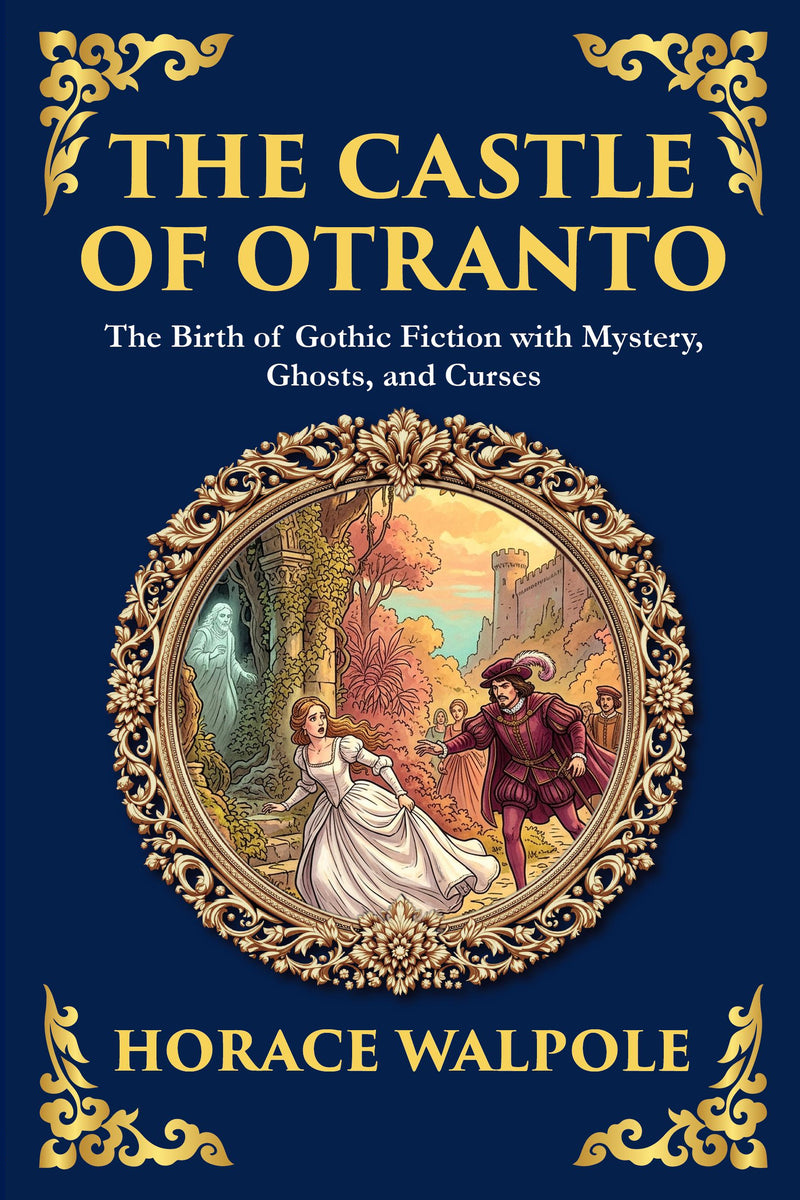
The Castle of Otranto
A mysterious death. A haunted castle. A prophecy that cannot be escaped. The Castle of Otranto is the legendary tale that birthed the Gothic fiction genre—a dark and dramatic narrative woven with secrets, supernatural forces, and ancient curses.
or free app
10,000+ hrs library
30-day guarantee
The complete The Castle of Otranto appears in modern English through Library of Alexandria Press, available online with audiobook narration included for members.
Have you ever wondered why Gothic fiction began with a castle—and a curse? In The Castle of Otranto: The Birth of Gothic Fiction with Mystery, Ghosts, and Curses, Horace Walpole crafts a tale unlike anything that had come before—a mesmerizing blend of supernatural drama, medieval history, and psychological torment. Originally published in 1764 and disguised as a translation of a lost Italian manuscript, this haunting novel follows the downfall of the House of Otranto, a noble family cursed by a prophecy that dooms them to ruin.
When a mysterious and fatal event shatters an arranged marriage, Lord Manfred attempts to defy fate by marrying the young bride himself. But the more he pushes against destiny, the more reality bends—until apparitions, ancestral guilt, and divine justice erupt within the castle walls. Walpole's groundbreaking work introduced many of the hallmarks that still define Gothic literature: dark secrets, decaying aristocracy, supernatural portents, and a brooding atmosphere that turns stone and shadow into characters of their own.
What you’ll discover in this modern edition
- The Original Gothic Horror The very first novel to define the genre—mixing tragedy, terror, and romance with supernatural dread.
- A Tale of Tyranny, Fate, and Redemption Watch Lord Manfred’s descent into desperation as he tries to outwit a curse that stretches across generations.
- Specters, Visions, and Omens Ghostly apparitions, prophetic statues, and unexplained phenomena foreshadow the doom to come.
- A Towering Setting that Comes Alive The castle itself becomes a living presence—filled with creaking halls, secret passages, and ancient horrors.
- A Blend of Medieval Romance and Modern Fear Walpole masterfully blends old-world chivalry with modern psychological suspense.
| Formats | eBook (EPUB + PDF) · Audiobook · Paperback · Hardcover · Large Print |
| Language | English |
| Trim size (print) | 6 × 9 in |
| Binding | Paperback — perfect-bound · Hardcover — casewrap |
| Large Print edition | Same text in a larger, easy-read type — a larger font, not a larger trim |
| Print pricing | Every physical book at our true cost — at-cost, no profit (members) |
| Library | 873 restored titles, always growing |
| Length | 36,795 words · ~2 hr 27 min reading |
| Reading level | Grade 3 · an easy, flowing read (this modern-English edition) |
| Edition | Modern English translation · 2026 |
Member reviews for this edition are collected as readers finish it — be the first. Across the library: 12,000+ books shipped, every plan covered by a 365-day print guarantee.
About this edition
A faithful, unabridged modern-English edition by The Library of Alexandria — carefully rendered for today's reader and verified paragraph-by-paragraph against the public-domain source. Available as eBook, audiobook, paperback, hardcover, and large print.
- Complete & unabridgedVerified paragraph by paragraph against the source — never a scan, never abridged.
- Modern English, faithfulReadable today, with the author’s meaning kept intact. Readable — not simplified.
- Every format, one membershipRead in your browser or the free app, or listen to the full audiobook.
Included free with your membership
Cancel anytime, one click · 30-day money-back guarantee
Edition last updated July 2026
What’s inside
The Castle of Otranto — complete and unabridged: all 6 sections included with membership, plus the full audiobook.
Begin reading The Castle of Otranto
In clear modern English — the complete text is included with membership.
Introduction
When Horace Walpole sat down to write the strange little book that would become The Castle of Otranto, he could not have imagined that he was opening a doorway through which generations of writers and readers would eagerly pass. He thought he was indulging a private fancy, a curious experiment born of a dream. What he actually accomplished was the invention of an entire literary tradition—one that would give us haunted houses and crumbling abbeys, family curses and forbidden chambers, brooding villains and imperiled heroines, and that delicious shiver of dread that we now call the Gothic. Nearly every ghost story, every horror novel, every tale of supernatural menace that has captivated audiences in the centuries since owes something to this short, peculiar, and oddly magnificent work first published in the winter of 1764.
To open this book is to stand at a beginning. It is to witness the precise moment when literature decided that terror could be beautiful, that the past could reach out and seize the present, that old stones could hold secrets, and that the human heart, when pushed to its extremities by fear and desire and guilt, becomes a subject worthy of the most dramatic treatment imaginable. This modern translation has been prepared with one essential goal in mind: to allow you, the contemporary reader, to experience the full force of Walpole’s imagination without the barriers of antiquated phrasing, tangled syntax, or the obscure idioms of the eighteenth century. What remains is the pure essence of the story—its momentum, its atmosphere, its astonishing audacity—rendered in language that flows naturally for the modern eye and ear while preserving every ounce of the original’s gothic grandeur.
To appreciate what you are about to read, it helps to know a little about the remarkable person who brought it into being. Horace Walpole was born in 1717, the youngest son of Sir Robert Walpole, who is generally regarded as Britain’s first Prime Minister. This was a man born into the very center of power, privilege, and culture, and he spent his long life as a kind of brilliant dilettante—a connoisseur, a collector, a wit, a letter-writer of genius, and one of the great tastemakers of his age. He was educated at Eton and Cambridge, traveled extensively through France and Italy on the customary Grand Tour, and returned to England with a head full of European art, history, and architecture.
Walpole’s true masterpiece, in his own mind, was not a book at all but a house. In the 1740s he acquired a modest property near the Thames at Twickenham and proceeded, over the following decades, to transform it into Strawberry Hill—a fantastical confection of towers, battlements, pointed arches, and stained glass that he himself called “a little Gothic castle.” This was a revolutionary act. In an age that worshipped the clean, balanced, rational lines of classical and neoclassical design, Walpole deliberately reached backward toward the medieval, toward the shadowy and the romantic, toward the very aesthetic that the cultivated taste of his time had dismissed as barbaric. Strawberry Hill became one of the most famous and influential buildings of its era and helped to launch the great Gothic Revival in architecture.
It is no accident that the man who built a make-believe medieval castle should also have written the first Gothic novel. The two creations are sisters, born of the same imagination, the same nostalgic longing for a more vivid and mysterious past. And indeed, Walpole tells us that the very idea for the book arrived in a dream. He had fallen asleep, he later explained in a letter, with his head full of the romantic gloom of his own house, and he dreamed that on the uppermost banister of a great staircase he saw an enormous hand encased in armor. He woke, sat down at his desk, and began to write with such feverish intensity that, by his own account, he completed the entire manuscript in a matter of weeks, scarcely knowing where the story was leading him. There is something wonderfully appropriate in this origin—that a book about the irruption of the uncanny into ordinary life should itself have come uninvited out of the depths of sleep.
When the book first appeared, Walpole did not put his own name on it. Instead, he presented it through an elaborate disguise. The first edition claimed to be a translation of an ancient Italian manuscript, supposedly printed in Naples in the sixteenth century and only recently discovered in the library of an old Catholic family in the north of England. Walpole, hiding behind the persona of a translator named “William Marshal,” even provided a learned preface speculating about the manuscript’s origins and the intentions of its imagined medieval author. This was a literary game, a kind of playful forgery, and it served a practical purpose. Walpole was a man of considerable social standing and reputation, and he was nervous about how a tale of ghosts, prophecies, and supernatural horrors would be received by the sophisticated, skeptical readers of his Enlightenment age. By pretending it was a genuine relic of a more credulous past, he gave himself cover.
The deception worked beautifully—perhaps too well. The book was an immediate success, and readers were captivated by what they believed to be a thrilling artifact of the medieval imagination. But when a second edition was called for, Walpole came clean. He revealed himself as the true author and added a new preface explaining his actual aims. This second preface is one of the most important documents in literary history, because in it Walpole lays out, for the first time, the artistic philosophy behind what we now call Gothic fiction.
In that famous second preface, Walpole explained that he had set out to attempt something genuinely new: to blend two kinds of storytelling that had, until then, been kept apart. On one side stood the old romances—the medieval and Renaissance tales of knights and giants and enchantments, full of marvels and improbabilities, where anything could happen but where the characters often felt like cardboard figures going through their paces. On the other side stood the modern novel, which in Walpole’s day was busy perfecting its craft of realistic, true-to-life storytelling, full of recognizable human beings behaving in believable ways, but which had banished all the wonder and magic of the older tales.
Walpole’s bold idea was to fuse them: to take the supernatural machinery and high drama of the ancient romance and graft it onto the psychological realism of the modern novel. He wanted his characters to react to impossible events the way real people actually would—with terror, confusion, denial, and dread—even as the impossible events themselves piled up around them. The ghosts and prophecies and miraculous occurrences would be fantastic, but the human responses to them would be utterly believable. This combination is the very DNA of the entire genre that followed, and it is precisely what makes the story you are about to read feel so alive even today. The supernatural is frightening not because of what it is in the abstract, but because of how it affects the flesh-and-blood people caught in its grip.
The plot, which I will not spoil here, unfolds within the walls of a great Italian castle and concerns a noble family whose fate is bound up with an ancient prophecy. From the very first pages, an event of shocking and inexplicable violence sets the story hurtling forward, and from that moment on the pace rarely slackens. Walpole packs an extraordinary amount of incident into a small space: secret passages and hidden identities, midnight flights and desperate pursuits, confrontations between the powerful and the helpless, and the steady, mounting pressure of supernatural forces that seem to be working toward some grim and inevitable conclusion. The whole thing has the breathless quality of a fever dream—which, given its origins, is entirely fitting.
What strikes many first-time readers is how cinematic the book feels, centuries before cinema existed. Walpole had a gift for the vivid, arresting image: a giant helmet, a portrait that stirs in its frame, a statue that bleeds, suits of armor that move of their own accord, doors that slam and lights that gutter at the worst possible moments. These are the very furnishings of every haunted-house story you have ever encountered, and here they are, fresh and startling, being deployed for the very first time. To read The Castle of Otranto is to discover the original source of countless images and devices that have since become beloved staples of horror and suspense.
At the dark heart of the story stands one of literature’s first great villains, a man whose tyranny, ambition, and ruthlessness drive much of the action. He is a character of real complexity—not a cartoonish monster, but a man undone by his own desires, his pride, and his refusal to accept the limits that fate and morality place upon him. Around him move figures of suffering virtue and quiet courage, including young women whose endurance and dignity in the face of terror anticipate the brave heroines who would populate Gothic fiction for the next two centuries. There is also a strain of genuine pathos running through the book, moments of tenderness and grief that give weight to all the spectacle. Walpole understood that terror is most effective when we care about the people experiencing it, and he made sure we would.
It would be wrong, however, to leave the impression that the book is grim from beginning to end. Walpole was, above all, a man of wit, and there is a vein of dark humor and even occasional comedy running through the tale, particularly in his handling of certain servants whose chattering, fearful, roundabout way of delivering bad news provides moments of welcome levity amid the gathering doom. Walpole was quite deliberate about this; he defended these comic touches in his preface by pointing to Shakespeare, whose plays famously mingle high tragedy with low comedy, kings with gravediggers, the sublime with the ridiculous. Walpole admired Shakespeare enormously and modeled much of his own approach on the Bard’s example, including the heightened, theatrical dialogue and the willingness to let the cosmic and the domestic share the same stage. Readers who keep this in mind will find their enjoyment of the book enriched, recognizing the deliberate artistry behind its shifts in tone.
Why This Story Still Matters—and How to Read It
It is worth pausing to consider just how enormous the influence of this slim volume turned out to be. Within a few decades of its publication, the Gothic novel had exploded into one of the most popular literary forms in Europe. Ann Radcliffe took Walpole’s template and refined it into the suspenseful, atmospheric romances that thrilled readers across the continent. Matthew Lewis pushed it toward shocking extremes of horror and transgression. The form gave us the dark, brooding landscapes of the Brontë sisters, whose Wuthering Heights and Jane Eyre are unthinkable without the Gothic tradition Walpole founded. It gave us Mary Shelley’s Frankenstein and Bram Stoker’s Dracula, Edgar Allan Poe’s tales of terror and Henry James’s ghostly ambiguities. Trace the lineage forward and you arrive at every modern horror novel, every gothic romance, every haunted-house film, every story in which the past refuses to stay buried and old sins demand a reckoning. All of it flows, in some sense, from that armored hand Walpole glimpsed in a dream and the book it inspired him to write.
This is the historical importance of the work, and it is reason enough to read it. But I would urge you not to approach the book merely as a museum piece, a literary curiosity to be admired from a respectful distance. Read instead for the sheer pleasure of the thing—for the headlong rush of the storytelling, the gorgeous gloom of its atmosphere, the genuine surprises of its plot, and the strange power of its central images. Despite being more than two and a half centuries old, the story retains an extraordinary capacity to grip and entertain. It is, after all, a tale of family secrets, hidden inheritances, doomed love, and supernatural vengeance—themes that have lost none of their fascination and never will.
Cancel anytime, one click · 30-day money-back guarantee
Founding annual rate available now — your price locks for life when you join.
Not ready? Get this free chapter by email — read it anytime.
✓ Sent — check your inbox for The Castle of Otranto.
Questions about The Castle of Otranto
What is The Castle of Otranto about?
A mysterious death. A haunted castle. A prophecy that cannot be escaped.
Who wrote The Castle of Otranto?
The Castle of Otranto was written by Horace Walpole. This edition presents the complete work in clear modern English, faithfully rendered from the public-domain original by Library of Alexandria Press.
Is The Castle of Otranto free to read?
The opening chapter is free to read on this page. Members read and listen to the complete work — and the entire library — free, and can order any physical book at our true print cost.
How long is The Castle of Otranto?
6 chapters (~36,795 words) — about 2 hr 27 min of reading in this modern-English edition.
Is this an abridged version of The Castle of Otranto?
No. This is the complete, unabridged The Castle of Otranto, carefully rendered into clear modern English and verified paragraph-by-paragraph against the public-domain source — nothing is cut or summarised.
What formats does The Castle of Otranto come in?
The Castle of Otranto is available as eBook, paperback, hardcover and large print. eBook and audiobook are included with membership; printed editions ship at our true print cost.
Shipping & returns
Billing & membership
More from the library


Explore Horror & Gothic
- The Strange Case of Dr. Jekyll and Mr. Hyde · Robert Louis Stevenson
- The Cask of Amontillado · Edgar Allan Poe
- Ghost Stories of an Antiquary · M. R. James
- The Monk: A Romance · M. G. Lewis
- The House of the Seven Gables · Nathaniel Hawthorne
- The Willows · Algernon Blackwood
- The Monkey’s Paw · W. W. Jacobs
- The Call of Cthulhu · H. P. Lovecraft
- The Life-Eater · Harold Ward
- The Black Kiss
- The Legend of Sleepy Hollow · Washington Irving
- Brood of the Dark Moon · Charles Willard Diffin
- The Night Land · William Hope Hodgson
- Dracula · Bram Stoker
- Carmilla · Joseph Sheridan Le Fanu
- The King in Yellow · Robert W. Chambers
- Wuthering Heights · Emily Brontë
- The Vampyre: A Tale · John William Polidori
- A Christmas Carol · Charles Dickens
- Northanger Abbey · Jane Austen
- The Turn of the Screw · Henry James
- Metamorphosis · Franz Kafka
- The Yellow Wallpaper · Charlotte Perkins Gilman
- The Adventures of Ferdinand Count Fathom — Complete · T. Smollett
- The Picture of Dorian Gray · Oscar Wilde
- Frankenstein; Or, The Modern Prometheus · Mary Wollstonecraft Shelley
The Castle of Otranto
The Castle of Otranto
The Birth of Gothic Fiction with Mystery, Ghosts, and Curses
Horace Walpole
Contents
- Introduction
- Chapter 1
- Chapter 2
- Chapter 3
- Chapter 4
- Chapter 5
Introduction
When Horace Walpole sat down to write the strange little book that would become The Castle of Otranto, he could not have imagined that he was opening a doorway through which generations of writers and readers would eagerly pass. He thought he was indulging a private fancy, a curious experiment born of a dream. What he actually accomplished was the invention of an entire literary tradition—one that would give us haunted houses and crumbling abbeys, family curses and forbidden chambers, brooding villains and imperiled heroines, and that delicious shiver of dread that we now call the Gothic. Nearly every ghost story, every horror novel, every tale of supernatural menace that has captivated audiences in the centuries since owes something to this short, peculiar, and oddly magnificent work first published in the winter of 1764.
To open this book is to stand at a beginning. It is to witness the precise moment when literature decided that terror could be beautiful, that the past could reach out and seize the present, that old stones could hold secrets, and that the human heart, when pushed to its extremities by fear and desire and guilt, becomes a subject worthy of the most dramatic treatment imaginable. This modern translation has been prepared with one essential goal in mind: to allow you, the contemporary reader, to experience the full force of Walpole’s imagination without the barriers of antiquated phrasing, tangled syntax, or the obscure idioms of the eighteenth century. What remains is the pure essence of the story—its momentum, its atmosphere, its astonishing audacity—rendered in language that flows naturally for the modern eye and ear while preserving every ounce of the original’s gothic grandeur.
To appreciate what you are about to read, it helps to know a little about the remarkable person who brought it into being. Horace Walpole was born in 1717, the youngest son of Sir Robert Walpole, who is generally regarded as Britain’s first Prime Minister. This was a man born into the very center of power, privilege, and culture, and he spent his long life as a kind of brilliant dilettante—a connoisseur, a collector, a wit, a letter-writer of genius, and one of the great tastemakers of his age. He was educated at Eton and Cambridge, traveled extensively through France and Italy on the customary Grand Tour, and returned to England with a head full of European art, history, and architecture.
Walpole’s true masterpiece, in his own mind, was not a book at all but a house. In the 1740s he acquired a modest property near the Thames at Twickenham and proceeded, over the following decades, to transform it into Strawberry Hill—a fantastical confection of towers, battlements, pointed arches, and stained glass that he himself called “a little Gothic castle.” This was a revolutionary act. In an age that worshipped the clean, balanced, rational lines of classical and neoclassical design, Walpole deliberately reached backward toward the medieval, toward the shadowy and the romantic, toward the very aesthetic that the cultivated taste of his time had dismissed as barbaric. Strawberry Hill became one of the most famous and influential buildings of its era and helped to launch the great Gothic Revival in architecture.
It is no accident that the man who built a make-believe medieval castle should also have written the first Gothic novel. The two creations are sisters, born of the same imagination, the same nostalgic longing for a more vivid and mysterious past. And indeed, Walpole tells us that the very idea for the book arrived in a dream. He had fallen asleep, he later explained in a letter, with his head full of the romantic gloom of his own house, and he dreamed that on the uppermost banister of a great staircase he saw an enormous hand encased in armor. He woke, sat down at his desk, and began to write with such feverish intensity that, by his own account, he completed the entire manuscript in a matter of weeks, scarcely knowing where the story was leading him. There is something wonderfully appropriate in this origin—that a book about the irruption of the uncanny into ordinary life should itself have come uninvited out of the depths of sleep.
When the book first appeared, Walpole did not put his own name on it. Instead, he presented it through an elaborate disguise. The first edition claimed to be a translation of an ancient Italian manuscript, supposedly printed in Naples in the sixteenth century and only recently discovered in the library of an old Catholic family in the north of England. Walpole, hiding behind the persona of a translator named “William Marshal,” even provided a learned preface speculating about the manuscript’s origins and the intentions of its imagined medieval author. This was a literary game, a kind of playful forgery, and it served a practical purpose. Walpole was a man of considerable social standing and reputation, and he was nervous about how a tale of ghosts, prophecies, and supernatural horrors would be received by the sophisticated, skeptical readers of his Enlightenment age. By pretending it was a genuine relic of a more credulous past, he gave himself cover.
The deception worked beautifully—perhaps too well. The book was an immediate success, and readers were captivated by what they believed to be a thrilling artifact of the medieval imagination. But when a second edition was called for, Walpole came clean. He revealed himself as the true author and added a new preface explaining his actual aims. This second preface is one of the most important documents in literary history, because in it Walpole lays out, for the first time, the artistic philosophy behind what we now call Gothic fiction.
In that famous second preface, Walpole explained that he had set out to attempt something genuinely new: to blend two kinds of storytelling that had, until then, been kept apart. On one side stood the old romances—the medieval and Renaissance tales of knights and giants and enchantments, full of marvels and improbabilities, where anything could happen but where the characters often felt like cardboard figures going through their paces. On the other side stood the modern novel, which in Walpole’s day was busy perfecting its craft of realistic, true-to-life storytelling, full of recognizable human beings behaving in believable ways, but which had banished all the wonder and magic of the older tales.
Walpole’s bold idea was to fuse them: to take the supernatural machinery and high drama of the ancient romance and graft it onto the psychological realism of the modern novel. He wanted his characters to react to impossible events the way real people actually would—with terror, confusion, denial, and dread—even as the impossible events themselves piled up around them. The ghosts and prophecies and miraculous occurrences would be fantastic, but the human responses to them would be utterly believable. This combination is the very DNA of the entire genre that followed, and it is precisely what makes the story you are about to read feel so alive even today. The supernatural is frightening not because of what it is in the abstract, but because of how it affects the flesh-and-blood people caught in its grip.
The plot, which I will not spoil here, unfolds within the walls of a great Italian castle and concerns a noble family whose fate is bound up with an ancient prophecy. From the very first pages, an event of shocking and inexplicable violence sets the story hurtling forward, and from that moment on the pace rarely slackens. Walpole packs an extraordinary amount of incident into a small space: secret passages and hidden identities, midnight flights and desperate pursuits, confrontations between the powerful and the helpless, and the steady, mounting pressure of supernatural forces that seem to be working toward some grim and inevitable conclusion. The whole thing has the breathless quality of a fever dream—which, given its origins, is entirely fitting.
What strikes many first-time readers is how cinematic the book feels, centuries before cinema existed. Walpole had a gift for the vivid, arresting image: a giant helmet, a portrait that stirs in its frame, a statue that bleeds, suits of armor that move of their own accord, doors that slam and lights that gutter at the worst possible moments. These are the very furnishings of every haunted-house story you have ever encountered, and here they are, fresh and startling, being deployed for the very first time. To read The Castle of Otranto is to discover the original source of countless images and devices that have since become beloved staples of horror and suspense.
At the dark heart of the story stands one of literature’s first great villains, a man whose tyranny, ambition, and ruthlessness drive much of the action. He is a character of real complexity—not a cartoonish monster, but a man undone by his own desires, his pride, and his refusal to accept the limits that fate and morality place upon him. Around him move figures of suffering virtue and quiet courage, including young women whose endurance and dignity in the face of terror anticipate the brave heroines who would populate Gothic fiction for the next two centuries. There is also a strain of genuine pathos running through the book, moments of tenderness and grief that give weight to all the spectacle. Walpole understood that terror is most effective when we care about the people experiencing it, and he made sure we would.
It would be wrong, however, to leave the impression that the book is grim from beginning to end. Walpole was, above all, a man of wit, and there is a vein of dark humor and even occasional comedy running through the tale, particularly in his handling of certain servants whose chattering, fearful, roundabout way of delivering bad news provides moments of welcome levity amid the gathering doom. Walpole was quite deliberate about this; he defended these comic touches in his preface by pointing to Shakespeare, whose plays famously mingle high tragedy with low comedy, kings with gravediggers, the sublime with the ridiculous. Walpole admired Shakespeare enormously and modeled much of his own approach on the Bard’s example, including the heightened, theatrical dialogue and the willingness to let the cosmic and the domestic share the same stage. Readers who keep this in mind will find their enjoyment of the book enriched, recognizing the deliberate artistry behind its shifts in tone.
Why This Story Still Matters—and How to Read It
It is worth pausing to consider just how enormous the influence of this slim volume turned out to be. Within a few decades of its publication, the Gothic novel had exploded into one of the most popular literary forms in Europe. Ann Radcliffe took Walpole’s template and refined it into the suspenseful, atmospheric romances that thrilled readers across the continent. Matthew Lewis pushed it toward shocking extremes of horror and transgression. The form gave us the dark, brooding landscapes of the Brontë sisters, whose Wuthering Heights and Jane Eyre are unthinkable without the Gothic tradition Walpole founded. It gave us Mary Shelley’s Frankenstein and Bram Stoker’s Dracula, Edgar Allan Poe’s tales of terror and Henry James’s ghostly ambiguities. Trace the lineage forward and you arrive at every modern horror novel, every gothic romance, every haunted-house film, every story in which the past refuses to stay buried and old sins demand a reckoning. All of it flows, in some sense, from that armored hand Walpole glimpsed in a dream and the book it inspired him to write.
This is the historical importance of the work, and it is reason enough to read it. But I would urge you not to approach the book merely as a museum piece, a literary curiosity to be admired from a respectful distance. Read instead for the sheer pleasure of the thing—for the headlong rush of the storytelling, the gorgeous gloom of its atmosphere, the genuine surprises of its plot, and the strange power of its central images. Despite being more than two and a half centuries old, the story retains an extraordinary capacity to grip and entertain. It is, after all, a tale of family secrets, hidden inheritances, doomed love, and supernatural vengeance—themes that have lost none of their fascination and never will.
Manfred, the Prince of Otranto, had a son and a daughter. His daughter, Matilda, was eighteen and incredibly beautiful. His son, Conrad, was three years younger; he was plain, sickly, and had a disappointing personality. Despite this, he was his father’s favorite, while Manfred never showed any affection for Matilda. Manfred had arranged a marriage for his son with Isabella, the daughter of the Marquis of Vicenza. Her guardians had already handed her over to Manfred so that the wedding could take place as soon as Conrad’s poor health allowed.
Manfred’s eagerness to rush the wedding was noticed by both his family and his neighbors. His family, fearing the Prince’s volatile temper, didn’t dare voice their suspicions about why he was hurrying. His wife, the kind-hearted Hippolita, occasionally tried to warn him that marrying their only son so young was dangerous, given the boy’s age and fragile health. However, the only response she ever got was a reminder that she had been unable to provide him with any other heir. His tenants and subjects were less cautious. They believed the rushed wedding was because the Prince feared an old prophecy. According to the legend, the castle and lordship of Otranto would leave the current family whenever the true owner grew too large to fit inside it. It was hard to make sense of this prophecy, and even harder to see how it related to the marriage. Still, these contradictions didn’t stop the common people from believing it.
Young Conrad’s birthday was chosen for the wedding. The guests had gathered in the castle chapel, and everything was ready for the religious service, but Conrad was missing. Manfred, who couldn’t stand the slightest delay and hadn’t noticed his son leave, sent an attendant to summon the young Prince. The servant hadn’t even made it across the courtyard to Conrad’s room before he came running back. He was breathless and frantic, his eyes wide and foam at his mouth. He didn’t say a word; he simply pointed toward the courtyard.
End of the free sample
Keep reading, free
Members read and listen to the complete book — and the entire library. Cancel anytime, one click · 30-day money-back guarantee.