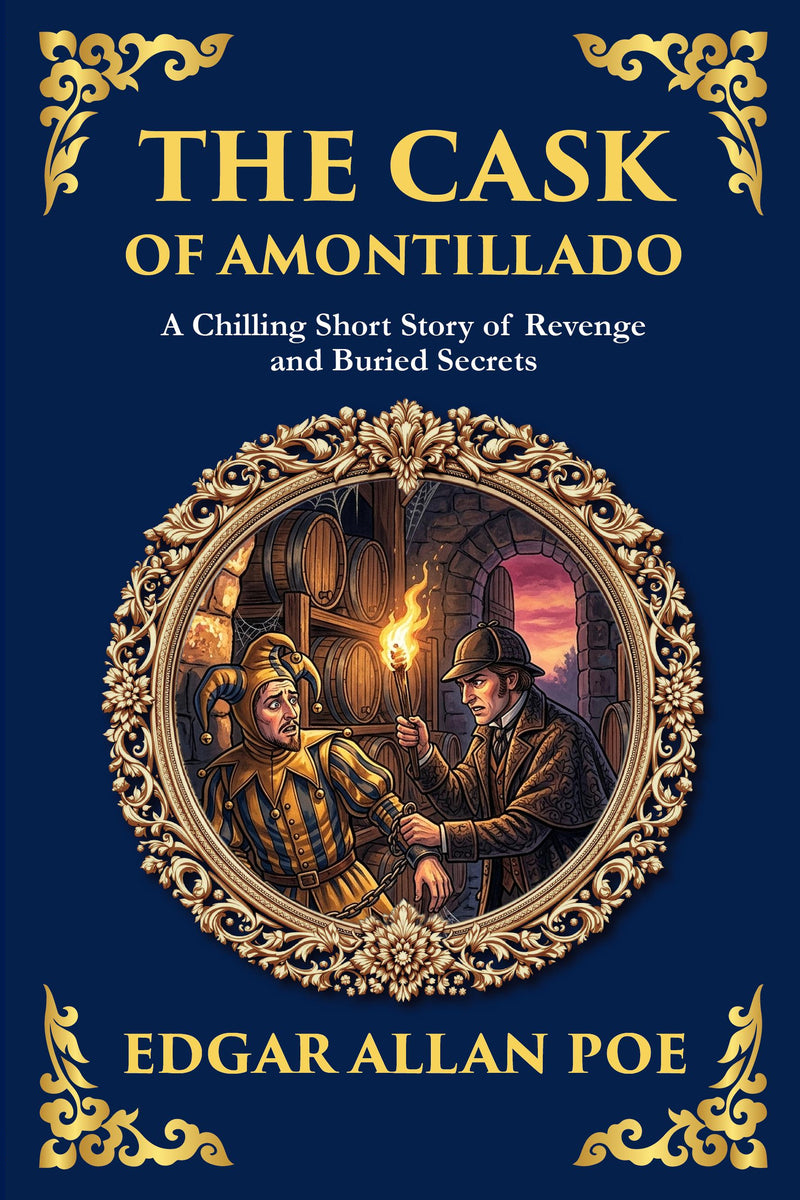
The Cask of Amontillado
When a man feels he has been wronged, how far will he go to exact revenge? In The Cask of Amontillado, Edgar Allan Poe delivers one of the most haunting short stories in literary history.
or free app
10,000+ hrs library
30-day guarantee
The complete The Cask of Amontillado appears in modern English through Library of Alexandria Press, available online with audiobook narration included for members.
Have you ever wondered why the most dangerous emotions are the ones we bury deep inside? Step into the shadowy world of Edgar Allan Poe with The Cask of Amontillado, a short story that has gripped readers for generations with its cold, calculated depiction of revenge. Written with Poe’s trademark mastery of atmosphere and psychological intensity, this is not just a tale—it is a slow, macabre descent into human darkness.
Montresor, the narrator, believes he has been gravely insulted by his acquaintance Fortunato. During a night of wild carnival celebration, Montresor leads the unsuspecting Fortunato through winding catacombs beneath his estate with the promise of tasting a rare vintage of Amontillado wine. But as the torches flicker and the passage narrows, it becomes clear that this is no ordinary wine tasting—it is a carefully orchestrated act of vengeance.
What you’ll discover in this modern edition
- A Masterclass in Psychological Horror – Witness the inner workings of a mind obsessed with vengeance and control.
- One of Poe’s Most Iconic Short Stories – Perfectly crafted with foreshadowing, irony, and dread.
- Themes of Betrayal, Pride, and Madness – Explore the terrifying consequences of wounded ego and unchecked obsession.
- A Chilling Setting Beneath the Surface – Enter a labyrinth of wine vaults and silence, where secrets are entombed.
- Timelessly Relevant and Universally Resonant – A story that still provokes fear and reflection long after the final line.
- A Gateway into Poe’s Dark Genius – Ideal for both long-time fans and readers discovering Poe for the first time. The Cask of Amontillado is more than a revenge tale—it is a claustrophobic, literary trap sprung with exacting cruelty.
| Formats | eBook (EPUB + PDF) · Audiobook · Paperback · Hardcover · Large Print |
| Language | English |
| Trim size (print) | 6 × 9 in |
| Binding | Paperback — perfect-bound · Hardcover — casewrap |
| Large Print edition | Same text in a larger, easy-read type — a larger font, not a larger trim |
| Print pricing | Every physical book at our true cost — at-cost, no profit (members) |
| Library | 873 restored titles, always growing |
| Length | 5,567 words · ~22 min reading |
| Reading level | Grade 9 · a comfortable read (this modern-English edition) |
| Edition | Modern English translation · 2026 |
Member reviews for this edition are collected as readers finish it — be the first. Across the library: 12,000+ books shipped, every plan covered by a 365-day print guarantee.
About this edition
A faithful, unabridged modern-English edition by The Library of Alexandria — carefully rendered for today's reader and verified paragraph-by-paragraph against the public-domain source. Available as eBook, audiobook, paperback, hardcover, and large print.
- Complete & unabridgedVerified paragraph by paragraph against the source — never a scan, never abridged.
- Modern English, faithfulReadable today, with the author’s meaning kept intact. Readable — not simplified.
- Every format, one membershipRead in your browser or the free app, or listen to the full audiobook.
Included free with your membership
Cancel anytime, one click · 30-day money-back guarantee
Edition last updated July 2026
What’s inside
The Cask of Amontillado — complete and unabridged, included in full with membership, plus the full audiobook.
Begin reading The Cask of Amontillado
In clear modern English — the complete text is included with membership.
Introduction
There are stories that entertain, and there are stories that haunt. Edgar Allan Poe’s tale of a man who lures another into the depths of his family vaults belongs unmistakably to the second category. From its very first sentence—delivered with chilling intimacy by a narrator who has already decided your fate before you understand what is happening—it grips the reader by the collar and refuses to let go until the final, suffocating words. It is a work of fewer than two and a half thousand words, yet it has cast a shadow across nearly two centuries of literature, inspiring filmmakers, novelists, songwriters, and countless uneasy readers who finish it and then immediately turn back to the beginning, certain they must have missed some clue, some warning, some moment when everything could have turned out differently.
The version you hold in your hands has been carefully adapted for the contemporary reader. Poe wrote in the polished, ornate English of the 1840s, a style dense with antique constructions, classical allusions, and rhythms that can occasionally trip a modern eye. This modern translation preserves every essential element of his genius—the suspense, the irony, the creeping horror, the meticulous architecture of dread—while smoothing the path so that nothing stands between you and the experience itself. The goal is not to simplify Poe but to liberate him, to allow his extraordinary command of mood and menace to reach you as directly and powerfully as it reached readers when the story first appeared. What follows in these pages is a faithful descent into one of the darkest and most perfectly constructed tales ever written, rendered in language that feels alive and immediate today.
Before you begin that descent, it is worth pausing to consider what makes this small story so monumental, and how to read it in a way that yields its greatest rewards. Poe was a master of effect, a writer who believed that every word in a short story should bend toward a single, unified impression. Understanding what he was attempting—and how he achieved it—will deepen your appreciation without spoiling a single one of the surprises that await. This introduction is designed to prepare you, not to rob you of discovery. The plot itself, with all its turns and revelations, remains untouched here, waiting for you in the chapters ahead.
Edgar Allan Poe occupies a peculiar and permanent place in the imagination of readers everywhere. He is the writer we associate most intimately with terror, with the macabre, with the velvet-dark corridors of the human mind where reason gives way to obsession. Yet he was far more than a purveyor of frights. He was a poet of haunting musicality, the author of “The Raven” and “Annabel Lee.” He was an editor and critic of fierce intelligence and famously sharp opinions. And, perhaps most consequentially, he was the inventor of the modern detective story, the man who gave the world the analytical sleuth long before Sherlock Holmes ever lit his pipe. To read Poe is to encounter a mind that was endlessly fascinated by the mechanics of thought, by how we reason, how we deceive, and how we are deceived.
Born in 1809 in Boston, Poe lived a life marked by hardship, loss, and instability that seems almost too tragic to be true. Orphaned young, raised by a foster family with whom he had a fraught and ultimately broken relationship, he struggled throughout his life with poverty, with the deaths of those he loved, and with the indifference of a literary establishment that did not always recognize his brilliance. He died in 1849 under circumstances that remain mysterious to this day, found delirious on the streets of Baltimore, never able to fully explain what had happened to him. He was only forty years old. The shadow of that strange, sorrowful biography has always clung to his work, encouraging readers to see in his tales of guilt, burial, and obsession the projections of a tormented soul.
But it would be a mistake to read this story merely as autobiography in disguise. Poe was, above all, a craftsman—a deliberate, calculating artist who thought harder about the technique of fiction than almost any writer of his era. He laid out his theory in essays and reviews, arguing that the ideal tale should be short enough to be read in a single sitting, so that the reader’s attention is never broken, and that every element—every sentence, every image, every detail of setting and tone—should contribute to one overwhelming emotional effect. He called this the “unity of effect,” and no story in his entire body of work demonstrates it more flawlessly than the one you are about to read.
This tale is, in a sense, the purest distillation of everything Poe believed fiction could do. There is not a wasted word in it. There is no subplot, no digression, no scene that does not advance the slow, inexorable movement toward its conclusion. From the opening lines, Poe establishes a tone of cold control, and he never once releases it. The result is a reading experience that is almost unbearably tense—a tension achieved not through action or violence in the conventional sense, but through atmosphere, through implication, and through the dreadful, dawning awareness of what is actually taking place. When you finish, you will understand why writers and critics have studied this story for generations as a model of how much can be accomplished in how little space.
What also sets Poe apart is his refusal to moralize. He does not lecture. He does not pause to condemn the actions of his characters or to reassure us that justice will be served. Instead, he places us inside a consciousness and forces us to remain there, complicit, listening, unable to look away. This is one of the great unsettling pleasures of his work—and one of the reasons it has endured. He understood that true horror does not come from monsters or supernatural forces, but from the human capacity for cruelty, for self-deception, and for the calm, methodical pursuit of a terrible aim. He understood, in other words, that the most frightening thing in the world is a person who has made up their mind.
One of the most striking features of this particular tale is its narrator. Poe was a pioneer of the unreliable, first-person voice—the storyteller whose account we cannot entirely trust, whose perceptions are warped by emotion, obsession, or guilt. Several of his most famous stories are narrated by men who insist upon their own sanity even as they reveal, through the very act of telling, just how unhinged they have become. The voice that guides you through this story is one of his most chilling creations precisely because it does not rave or rant. It speaks with composure. It speaks with intelligence and even, at times, with something resembling charm. And it speaks across a great distance of time, recounting events that took place long ago, with the serenity of someone who has had decades to reflect upon what was done.
This is essential to the experience the story offers, and it is worth being attentive to as you read. The narrator is not confessing in the heat of the moment. He is reminiscing. He is sharing a secret he has carried for a very long time, and he shares it with a strange, intimate directness, as though he has chosen you specifically as the recipient of his confidence. From the first sentence, he assumes that you already understand certain things about him, about his grievances, about what drives him. He does not stop to justify himself in the way an innocent man might. There is a smoothness, a self-assurance, to his account that becomes more disquieting the more you consider it. Here is a person entirely at peace with himself.
Pay attention, as you read, to the gap between what the narrator says and what is actually happening. Poe is a master of dramatic irony—the technique by which the reader understands more than the characters do, or grasps the true meaning of words and actions that one character intends quite differently. This story is built almost entirely upon irony. Lines that seem innocent on their surface carry a second, darker meaning that the speaker fully intends but his listener does not catch. Gestures of friendship conceal something else entirely. Expressions of concern become, on reflection, almost unbearably cruel. The pleasure of the story—if pleasure is the right word for something so menacing—lies in your gradual realization of what you are truly witnessing, and in the way Poe trusts you to perceive it without ever spelling it out.
This is why the modern adaptation you are reading takes such care to preserve the precise texture of the narrator’s voice. The temptation, when updating older prose, is to flatten its subtleties in the name of clarity. But the whole power of this tale depends on subtlety—on the deadly double meanings, the controlled politeness, the chilling courtesy with which the narrator conducts himself. Every effort has been made here to keep those effects fully intact, so that the irony lands as sharply as Poe intended, and so that the slow tightening of suspense unfolds without interruption. Where the original language might have obscured rather than illuminated for a present-day reader, it has been gently clarified; but the essential coldness, the dark wit, the dreadful intimacy of the telling—all of that remains exactly where Poe left it.
Consider, too, the setting. Without revealing anything of the plot, it is fair to say that Poe was a genius at using physical space to generate emotion. He understood that architecture itself could be terrifying—that a descent, a narrowing, an enclosure, a deepening darkness could work upon the reader’s nerves more powerfully than any explicit description of dread. As the story progresses, you will become aware of how the environment closes in, how the air seems to change, how the light grows dim and the spaces grow tight. Poe orchestrates all of this with extraordinary precision. He does not need to tell you to feel uneasy; he simply guides you, step by step, into a place where unease becomes inevitable. This is sensory storytelling of the highest order, the kind that bypasses the intellect and speaks directly to the body’s instinct for self-preservation.
The story is also notable for what it withholds. Poe gives us tantalizingly little background. We are told that the narrator has been wronged, but the precise nature of the offense is never fully explained. We are left to fill in the blanks, and this absence is one of the story’s most brilliant strokes. By refusing to specify what was done to provoke such an extreme response, Poe forces us to confront an uncomfortable question: does the punishment fit the crime? Is the narrator’s grievance even real, or is it the invention of a disordered mind that has nursed a small slight into a monstrous justification? The story offers no easy answer. It simply lets the ambiguity hang in the air, like the damp chill of a buried place, and trusts the reader to sit with the discomfort. This refusal to explain, to reassure, to resolve, is a large part of why the tale lingers in the mind long after the last page is turned.
How to Read This Tale, and Why It Endures
If you are coming to this story for the first time, I would offer a few gentle suggestions for getting the most out of it. The first is to read it slowly, and ideally in one sitting. This is exactly how Poe intended his stories to be experienced. He believed that the power of short fiction depended on an unbroken spell, a continuous immersion that allowed the mood to build without interruption. Set aside twenty or thirty undistracted minutes. Find a quiet place, perhaps in the evening, perhaps when the house is still. Let the narrator’s voice draw you in, and resist the urge to rush toward the ending. The story rewards patience. Its horror is cumulative, built layer upon layer, and to hurry through it is to miss the slow, masterful construction of dread that is its greatest achievement.
Cancel anytime, one click · 30-day money-back guarantee
Founding annual rate available now — your price locks for life when you join.
Not ready? Get this free chapter by email — read it anytime.
✓ Sent — check your inbox for The Cask of Amontillado.
Questions about The Cask of Amontillado
What is The Cask of Amontillado about?
When a man feels he has been wronged, how far will he go to exact revenge? In The Cask of Amontillado, Edgar Allan Poe delivers one of the most haunting short stories in literary history. Set during a Venetian carnival, this dark and twisted tale of deception and retribution unfolds with terrifying precision.
Who wrote The Cask of Amontillado?
The Cask of Amontillado was written by Edgar Allan Poe. This edition presents the complete work in clear modern English, faithfully rendered from the public-domain original by Library of Alexandria Press.
Is The Cask of Amontillado free to read?
The opening chapter is free to read on this page. Members read and listen to the complete work — and the entire library — free, and can order any physical book at our true print cost.
How long is The Cask of Amontillado?
2 chapters (~5,567 words) — about 22 min of reading in this modern-English edition.
Is this an abridged version of The Cask of Amontillado?
No. This is the complete, unabridged The Cask of Amontillado, carefully rendered into clear modern English and verified paragraph-by-paragraph against the public-domain source — nothing is cut or summarised.
What formats does The Cask of Amontillado come in?
The Cask of Amontillado is available as eBook, paperback, hardcover and large print. eBook and audiobook are included with membership; printed editions ship at our true print cost.
Shipping & returns
Billing & membership
More from the library


Explore Horror & Gothic
- The Strange Case of Dr. Jekyll and Mr. Hyde · Robert Louis Stevenson
- Ghost Stories of an Antiquary · M. R. James
- The Monk: A Romance · M. G. Lewis
- The House of the Seven Gables · Nathaniel Hawthorne
- The Willows · Algernon Blackwood
- The Monkey’s Paw · W. W. Jacobs
- The Call of Cthulhu · H. P. Lovecraft
- The Life-Eater · Harold Ward
- The Black Kiss
- The Legend of Sleepy Hollow · Washington Irving
- Brood of the Dark Moon · Charles Willard Diffin
- The Night Land · William Hope Hodgson
- The Castle of Otranto · Horace Walpole
- Dracula · Bram Stoker
- Carmilla · Joseph Sheridan Le Fanu
- The King in Yellow · Robert W. Chambers
- Wuthering Heights · Emily Brontë
- The Vampyre: A Tale · John William Polidori
- A Christmas Carol · Charles Dickens
- Northanger Abbey · Jane Austen
- The Turn of the Screw · Henry James
- Metamorphosis · Franz Kafka
- The Yellow Wallpaper · Charlotte Perkins Gilman
- The Adventures of Ferdinand Count Fathom — Complete · T. Smollett
- The Picture of Dorian Gray · Oscar Wilde
- Frankenstein; Or, The Modern Prometheus · Mary Wollstonecraft Shelley
The Cask of Amontillado
The Cask of Amontillado
A chilling short story about revenge and buried secrets
Edgar Allan Poe
Contents
- Introduction
- The Cask of Amontillado
Introduction
There are stories that entertain, and there are stories that haunt. Edgar Allan Poe’s tale of a man who lures another into the depths of his family vaults belongs unmistakably to the second category. From its very first sentence—delivered with chilling intimacy by a narrator who has already decided your fate before you understand what is happening—it grips the reader by the collar and refuses to let go until the final, suffocating words. It is a work of fewer than two and a half thousand words, yet it has cast a shadow across nearly two centuries of literature, inspiring filmmakers, novelists, songwriters, and countless uneasy readers who finish it and then immediately turn back to the beginning, certain they must have missed some clue, some warning, some moment when everything could have turned out differently.
The version you hold in your hands has been carefully adapted for the contemporary reader. Poe wrote in the polished, ornate English of the 1840s, a style dense with antique constructions, classical allusions, and rhythms that can occasionally trip a modern eye. This modern translation preserves every essential element of his genius—the suspense, the irony, the creeping horror, the meticulous architecture of dread—while smoothing the path so that nothing stands between you and the experience itself. The goal is not to simplify Poe but to liberate him, to allow his extraordinary command of mood and menace to reach you as directly and powerfully as it reached readers when the story first appeared. What follows in these pages is a faithful descent into one of the darkest and most perfectly constructed tales ever written, rendered in language that feels alive and immediate today.
Before you begin that descent, it is worth pausing to consider what makes this small story so monumental, and how to read it in a way that yields its greatest rewards. Poe was a master of effect, a writer who believed that every word in a short story should bend toward a single, unified impression. Understanding what he was attempting—and how he achieved it—will deepen your appreciation without spoiling a single one of the surprises that await. This introduction is designed to prepare you, not to rob you of discovery. The plot itself, with all its turns and revelations, remains untouched here, waiting for you in the chapters ahead.
Edgar Allan Poe occupies a peculiar and permanent place in the imagination of readers everywhere. He is the writer we associate most intimately with terror, with the macabre, with the velvet-dark corridors of the human mind where reason gives way to obsession. Yet he was far more than a purveyor of frights. He was a poet of haunting musicality, the author of “The Raven” and “Annabel Lee.” He was an editor and critic of fierce intelligence and famously sharp opinions. And, perhaps most consequentially, he was the inventor of the modern detective story, the man who gave the world the analytical sleuth long before Sherlock Holmes ever lit his pipe. To read Poe is to encounter a mind that was endlessly fascinated by the mechanics of thought, by how we reason, how we deceive, and how we are deceived.
Born in 1809 in Boston, Poe lived a life marked by hardship, loss, and instability that seems almost too tragic to be true. Orphaned young, raised by a foster family with whom he had a fraught and ultimately broken relationship, he struggled throughout his life with poverty, with the deaths of those he loved, and with the indifference of a literary establishment that did not always recognize his brilliance. He died in 1849 under circumstances that remain mysterious to this day, found delirious on the streets of Baltimore, never able to fully explain what had happened to him. He was only forty years old. The shadow of that strange, sorrowful biography has always clung to his work, encouraging readers to see in his tales of guilt, burial, and obsession the projections of a tormented soul.
But it would be a mistake to read this story merely as autobiography in disguise. Poe was, above all, a craftsman—a deliberate, calculating artist who thought harder about the technique of fiction than almost any writer of his era. He laid out his theory in essays and reviews, arguing that the ideal tale should be short enough to be read in a single sitting, so that the reader’s attention is never broken, and that every element—every sentence, every image, every detail of setting and tone—should contribute to one overwhelming emotional effect. He called this the “unity of effect,” and no story in his entire body of work demonstrates it more flawlessly than the one you are about to read.
This tale is, in a sense, the purest distillation of everything Poe believed fiction could do. There is not a wasted word in it. There is no subplot, no digression, no scene that does not advance the slow, inexorable movement toward its conclusion. From the opening lines, Poe establishes a tone of cold control, and he never once releases it. The result is a reading experience that is almost unbearably tense—a tension achieved not through action or violence in the conventional sense, but through atmosphere, through implication, and through the dreadful, dawning awareness of what is actually taking place. When you finish, you will understand why writers and critics have studied this story for generations as a model of how much can be accomplished in how little space.
What also sets Poe apart is his refusal to moralize. He does not lecture. He does not pause to condemn the actions of his characters or to reassure us that justice will be served. Instead, he places us inside a consciousness and forces us to remain there, complicit, listening, unable to look away. This is one of the great unsettling pleasures of his work—and one of the reasons it has endured. He understood that true horror does not come from monsters or supernatural forces, but from the human capacity for cruelty, for self-deception, and for the calm, methodical pursuit of a terrible aim. He understood, in other words, that the most frightening thing in the world is a person who has made up their mind.
One of the most striking features of this particular tale is its narrator. Poe was a pioneer of the unreliable, first-person voice—the storyteller whose account we cannot entirely trust, whose perceptions are warped by emotion, obsession, or guilt. Several of his most famous stories are narrated by men who insist upon their own sanity even as they reveal, through the very act of telling, just how unhinged they have become. The voice that guides you through this story is one of his most chilling creations precisely because it does not rave or rant. It speaks with composure. It speaks with intelligence and even, at times, with something resembling charm. And it speaks across a great distance of time, recounting events that took place long ago, with the serenity of someone who has had decades to reflect upon what was done.
This is essential to the experience the story offers, and it is worth being attentive to as you read. The narrator is not confessing in the heat of the moment. He is reminiscing. He is sharing a secret he has carried for a very long time, and he shares it with a strange, intimate directness, as though he has chosen you specifically as the recipient of his confidence. From the first sentence, he assumes that you already understand certain things about him, about his grievances, about what drives him. He does not stop to justify himself in the way an innocent man might. There is a smoothness, a self-assurance, to his account that becomes more disquieting the more you consider it. Here is a person entirely at peace with himself.
Pay attention, as you read, to the gap between what the narrator says and what is actually happening. Poe is a master of dramatic irony—the technique by which the reader understands more than the characters do, or grasps the true meaning of words and actions that one character intends quite differently. This story is built almost entirely upon irony. Lines that seem innocent on their surface carry a second, darker meaning that the speaker fully intends but his listener does not catch. Gestures of friendship conceal something else entirely. Expressions of concern become, on reflection, almost unbearably cruel. The pleasure of the story—if pleasure is the right word for something so menacing—lies in your gradual realization of what you are truly witnessing, and in the way Poe trusts you to perceive it without ever spelling it out.
This is why the modern adaptation you are reading takes such care to preserve the precise texture of the narrator’s voice. The temptation, when updating older prose, is to flatten its subtleties in the name of clarity. But the whole power of this tale depends on subtlety—on the deadly double meanings, the controlled politeness, the chilling courtesy with which the narrator conducts himself. Every effort has been made here to keep those effects fully intact, so that the irony lands as sharply as Poe intended, and so that the slow tightening of suspense unfolds without interruption. Where the original language might have obscured rather than illuminated for a present-day reader, it has been gently clarified; but the essential coldness, the dark wit, the dreadful intimacy of the telling—all of that remains exactly where Poe left it.
Consider, too, the setting. Without revealing anything of the plot, it is fair to say that Poe was a genius at using physical space to generate emotion. He understood that architecture itself could be terrifying—that a descent, a narrowing, an enclosure, a deepening darkness could work upon the reader’s nerves more powerfully than any explicit description of dread. As the story progresses, you will become aware of how the environment closes in, how the air seems to change, how the light grows dim and the spaces grow tight. Poe orchestrates all of this with extraordinary precision. He does not need to tell you to feel uneasy; he simply guides you, step by step, into a place where unease becomes inevitable. This is sensory storytelling of the highest order, the kind that bypasses the intellect and speaks directly to the body’s instinct for self-preservation.
The story is also notable for what it withholds. Poe gives us tantalizingly little background. We are told that the narrator has been wronged, but the precise nature of the offense is never fully explained. We are left to fill in the blanks, and this absence is one of the story’s most brilliant strokes. By refusing to specify what was done to provoke such an extreme response, Poe forces us to confront an uncomfortable question: does the punishment fit the crime? Is the narrator’s grievance even real, or is it the invention of a disordered mind that has nursed a small slight into a monstrous justification? The story offers no easy answer. It simply lets the ambiguity hang in the air, like the damp chill of a buried place, and trusts the reader to sit with the discomfort. This refusal to explain, to reassure, to resolve, is a large part of why the tale lingers in the mind long after the last page is turned.
How to Read This Tale, and Why It Endures
If you are coming to this story for the first time, I would offer a few gentle suggestions for getting the most out of it. The first is to read it slowly, and ideally in one sitting. This is exactly how Poe intended his stories to be experienced. He believed that the power of short fiction depended on an unbroken spell, a continuous immersion that allowed the mood to build without interruption. Set aside twenty or thirty undistracted minutes. Find a quiet place, perhaps in the evening, perhaps when the house is still. Let the narrator’s voice draw you in, and resist the urge to rush toward the ending. The story rewards patience. Its horror is cumulative, built layer upon layer, and to hurry through it is to miss the slow, masterful construction of dread that is its greatest achievement.
I put up with countless insults from Fortunato for as long as I could, but when he finally crossed the line and insulted me, I swore to get revenge. You, who understand my character so well, will realize that I never actually threatened him. I decided that I would eventually have my revenge; that part was certain. However, because I was so determined, I couldn’t take any risks. I didn’t just need to punish him; I had to do it without getting caught. A wrong isn’t truly righted if the person seeking revenge is punished themselves. Likewise, the wrong isn’t fixed if the victim fails to make the offender realize who is responsible for the payback.
It should be clear that I never said or did anything to make Fortunato doubt that I liked him. I kept smiling at him, as I always had, and he didn’t realize that I was now smiling because I was thinking about his death.
Fortunato had one weakness, even though in every other way he was a man to be respected or even feared. He took great pride in being an expert on wine. Very few Italians are true experts. Most of them just pretend to be passionate about it when it’s convenient, usually to trick wealthy British and Austrian millionaires. When it came to paintings and jewelry, Fortunato was a fraud just like most of his countrymen, but he was honest about old wines. In that regard, I was much like him; I was also an expert in Italian wines and bought as much as I could.
I ran into my acquaintance one evening around sunset, during the peak madness of the carnival season. He greeted me with overwhelming enthusiasm because he had been drinking heavily. The man was dressed as a jester, wearing a tight, multi-colored striped outfit and a pointed cap topped with bells. I was so happy to see him that I felt I could have shaken his hand forever.
End of the free sample
Keep reading, free
Members read and listen to the complete book — and the entire library. Cancel anytime, one click · 30-day money-back guarantee.