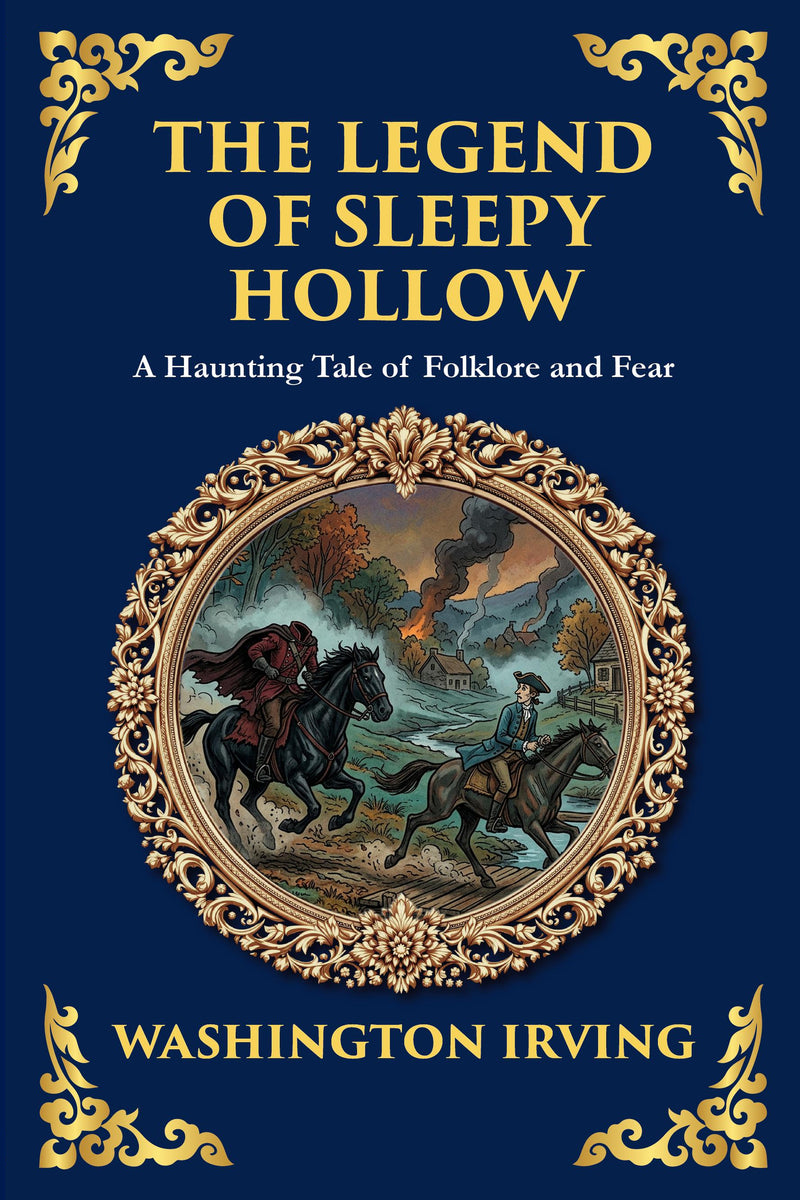
The Legend of Sleepy Hollow
Set in the misty, mysterious hamlet of Sleepy Hollow, this timeless tale follows the superstitious schoolmaster Ichabod Crane and his fateful encounter with the terrifying Headless Horseman.
or free app
10,000+ hrs library
30-day guarantee
The complete The Legend of Sleepy Hollow appears in modern English through Library of Alexandria Press, available online with audiobook narration included for members.
Have you ever wondered why the Headless Horseman still rides through our nightmares? The Legend of Sleepy Hollow is one of the most iconic ghost stories in Western literature—and for good reason. With poetic language, sharp wit, and Gothic atmosphere, Washington Irving crafts a spellbinding tale of fear, folklore, and the fine line between myth and madness.
When the lanky, awkward schoolteacher Ichabod Crane arrives in Sleepy Hollow, he’s captivated by its legends, enchanted by its beauty, and driven by his ambition to win the hand (and fortune) of the fair Katrina Van Tassel. But as Ichabod competes with the brawny Brom Bones and explores the shadowy lanes of the town, he finds himself haunted—literally—by the ghost of a Hessian soldier said to ride without a head. This modern edition preserves the lyrical prose of the original while sharpening its themes for a contemporary audience—making it the perfect entry point into American Gothic literature.
What you’ll discover in this modern edition
- in This Definitive Edition of The Legend of Sleepy Hollow:
- A Chilling Folk Tale That Transcends Time – Experience one of America’s earliest and most enduring ghost stories.
| Formats | eBook (EPUB + PDF) · Audiobook · Paperback · Hardcover · Large Print |
| Language | English |
| Trim size (print) | 6 × 9 in |
| Binding | Paperback — perfect-bound · Hardcover — casewrap |
| Large Print edition | Same text in a larger, easy-read type — a larger font, not a larger trim |
| Print pricing | Every physical book at our true cost — at-cost, no profit (members) |
| Library | 873 restored titles, always growing |
| Length | 14,865 words · ~59 min reading |
| Reading level | Grade 4 · an easy, flowing read (this modern-English edition) |
| Edition | Modern English translation · 2026 |
Member reviews for this edition are collected as readers finish it — be the first. Across the library: 12,000+ books shipped, every plan covered by a 365-day print guarantee.
About this edition
A faithful, unabridged modern-English edition by The Library of Alexandria — carefully rendered for today's reader and verified paragraph-by-paragraph against the public-domain source. Available as eBook, audiobook, paperback, hardcover, and large print.
- Complete & unabridgedVerified paragraph by paragraph against the source — never a scan, never abridged.
- Modern English, faithfulReadable today, with the author’s meaning kept intact. Readable — not simplified.
- Every format, one membershipRead in your browser or the free app, or listen to the full audiobook.
Included free with your membership
Cancel anytime, one click · 30-day money-back guarantee
Edition last updated July 2026
What’s inside
The Legend of Sleepy Hollow — complete and unabridged: all 3 sections included with membership, plus the full audiobook.
Begin reading The Legend of Sleepy Hollow
In clear modern English — the complete text is included with membership.
Introduction
There are stories that we feel we already know before we have ever read them—tales so deeply woven into the fabric of a culture that their images seem to have always existed, hovering at the edge of memory like the mist that rises off a quiet river at dusk. A headless rider thundering through the dark. A lonely schoolmaster hurrying along a moonlit road, glancing fearfully over his shoulder. A bridge, a covered hollow, the snap of a twig, and the cold certainty that something is following close behind. These pictures belong to all of us now, passed down through generations, retold around campfires and in classrooms, reimagined in films and cartoons and whispered ghost stories. And yet, remarkably, they all spring from a single, slender masterpiece written more than two centuries ago by a man who longed to give his young nation a mythology of its own.
What you hold in your hands is a fresh, modern rendering of that masterpiece—one carefully adapted so that the contemporary reader can step into its world without the friction of antiquated phrasing or unfamiliar idiom, while losing none of the wit, atmosphere, or sly humor that have made it immortal. This is a tale that has frightened and delighted readers since the early nineteenth century, and it rewards every kind of reading: the late-night thrill-seeker hunting for a good scare, the lover of beautiful language savoring the rhythm of a sentence, the student of folklore tracing the roots of an American legend, and the curious newcomer who simply wants to find out, at last, what really happened on that fateful autumn night. Before you begin your journey down the winding road into that drowsy, dreaming glen, it is worth pausing to consider the remarkable circumstances of the story’s creation, the strange and singular man who wrote it, and the qualities that have allowed it to endure where so many other tales have faded into silence.
To understand why this story matters—why it feels so different from a mere campfire scare—it helps to imagine the world into which it was born. In the early years of the nineteenth century, the United States was a young and self-conscious country, barely a generation removed from its founding. It had won its independence, established its government, and begun to expand westward, but in one crucial respect it felt impoverished compared to the great nations of Europe. It had no ancient castles crumbling on misty hilltops, no medieval cathedrals, no centuries-old legends of knights and kings and tragic queens. Europe was thick with the weight of history; its very stones seemed haunted by the accumulated stories of a thousand years. America, by contrast, struck many of its own writers and thinkers as a place too new, too raw, too practical to possess that rich and shadowy heritage from which literature and romance are so often drawn.
The author of this tale, Washington Irving, felt this lack keenly, and he set himself a quiet but ambitious task: to prove that the American landscape could be just as enchanted as any European countryside, that its rivers and valleys and small Dutch farming communities could harbor their own ghosts and legends, their own atmosphere of mystery and wonder. The setting he chose was not invented from whole cloth. The Hudson River Valley, with its sleepy villages settled by Dutch colonists, its rolling hills and shadowed glens, its old churchyards and covered bridges, was a real and beloved landscape that Irving had known intimately since childhood. He understood instinctively that the secret to creating an enduring legend was not to import exotic foreign trappings but to find the magic already latent in familiar ground.
And so he took a real region, populated it with characters drawn from the kind of people who genuinely lived there, and layered over it a delicious atmosphere of superstition and the supernatural. The result was something entirely new in American letters: a homegrown legend that felt as old and as deeply rooted as anything from the Old World, even though it had only just been written. Irving was, in effect, inventing a tradition—creating overnight the sense that this little corner of New York had always been a place where strange and frightening things happened, where the boundary between the living and the dead grew thin on certain nights, where a traveler might encounter something that defied all rational explanation. He succeeded so completely that the very name of the place he wrote about has become synonymous with the eerie and the uncanny. To this day, visitors travel to that part of the Hudson Valley specifically to walk in the footsteps of his characters, to stand on the bridge, to feel the chill of the story for themselves.
This achievement is all the more striking when we remember that Irving was working largely alone, without the support of an established national literature to draw upon. He could not simply build on the work of earlier American storytellers, because there were so few of them, and fewer still who had achieved real artistry. He looked instead to European models—to the German folk tales then enjoying a vogue, to the gothic romances of England, to the elegant essayists of the eighteenth century—and he fused these influences with his own deep knowledge of American places and American people. What emerged was a voice that was at once cultivated and earthy, sophisticated and warmly accessible, capable of describing a magnificent autumn sunset and a steaming country feast with equal relish, and of slipping from gentle comedy into genuine dread without ever losing its footing. It is this voice, this perfectly controlled blend of charm and menace, that has kept readers spellbound for two hundred years.
It is worth dwelling, too, on the broader collection from which this story comes. Irving published it as part of a larger work—a miscellany of essays, sketches, and tales presented as the writings of a fictional, gently eccentric narrator. This framing device was no accident. By presenting the legend as a story told by an old gentleman, a story he in turn had heard from someone else, who had perhaps embellished it along the way, Irving wrapped his tale in layers of pleasant uncertainty. We are never quite sure how much to believe, and that ambiguity is precisely the point. A good legend, after all, gains its power from the fact that it is always at one remove—something that happened to someone else, somewhere else, long ago, and that has grown in the telling. Irving understood this perfectly, and he built that quality of hearsay and rumor into the very structure of his work. The famous postscript and the playful framing that surround the central narrative are not mere decoration; they are essential to the experience, and as you read, you may find yourself smiling at how cleverly the author keeps you guessing.
This modern adaptation has been prepared with great care to preserve all of these subtle effects while making the language accessible to readers today. The original prose, for all its beauty, can sometimes feel dense to the modern ear, with its long, winding sentences and its vocabulary that has shifted in meaning over two centuries. Words that were perfectly clear to Irving’s first readers may now require a footnote or a moment’s puzzlement. The aim of this edition is to remove those small obstacles—to smooth the path without paving over the scenery, so to speak—so that you can experience the story’s humor, its tension, and its atmosphere as freshly and vividly as its earliest audiences did. Nothing essential has been lost; the descriptions remain lush, the comedy remains sharp, the dread remains palpable. What has changed is simply the ease with which you can now slip into that drowsy, dreaming world and let it carry you along.
One of the great pleasures of this tale—and one of the reasons it continues to be studied and admired by writers of horror and suspense—is the masterful way it builds its atmosphere. This is not a story that rushes toward its frightening climax. On the contrary, it takes its time, lingering lovingly over the details of its setting and its characters, lulling the reader into a sense of comfort and even drowsiness that perfectly mirrors the sleepy, somnolent quality of the place it describes. There is a deep wisdom in this approach. The most effective scares are not those that come at us suddenly, out of nowhere, but those that we have been quietly anticipating, those that emerge from an atmosphere so thick and so carefully established that we feel them coming long before they arrive.
Consider how Irving introduces his world. He describes a valley so peaceful, so removed from the bustle of the world, that a kind of dreamy enchantment seems to hang over the whole region. The very air, we are told, induces a tendency toward the marvelous and the supernatural. The people who live there are prone to seeing visions, hearing strange music, encountering apparitions. By the time the story’s central figure—a lanky, superstitious schoolmaster with an enormous appetite and an even more enormous imagination—begins his nightly walks home through the dark, we have already absorbed the sense that this is a place where anything might happen, where the rational rules of the ordinary world do not quite apply. We are primed for fear, and we feel it gathering with every page.
And then there are the descriptions of food, of festivity, of the warm domestic comforts that fill so much of the narrative. It might seem strange, in a ghost story, to spend so many delightful pages describing pumpkin pies and honey cakes, golden harvests and groaning tables laden with country delicacies. But these passages serve a crucial purpose. They make the world of the story feel real, solid, and inviting—a world worth being part of, a world full of sensual pleasures and human warmth. And because we have come to feel the coziness and the abundance of this world, the intrusion of something cold and supernatural becomes all the more shocking by contrast. Irving understood that terror is most effective when it threatens something we value, when it disrupts a peace we have learned to cherish. The lavish descriptions of plenty are not a digression from the horror; they are its necessary foundation.
The characters, too, are drawn with a precision and a humor that make them unforgettable. There is the schoolmaster, at once sympathetic and faintly ridiculous, a man whose head is so full of tales of witchcraft and ghosts that he frightens himself half to death on every lonely road. There is the local hero, a swaggering, good-natured roughneck who is everything the schoolmaster is not—strong where the other is weak, bold where the other is timid, beloved by the community where the other is merely tolerated. And there is the lovely young woman around whom much of the human drama revolves, a girl whose charms are matched only by the prosperity of her father’s farm. Irving is gently, affectionately satirical about all of them, and part of the great fun of the story is the way he winks at the reader, never letting us take any of his characters entirely seriously, even as he makes us care about what happens to them.
This blend of comedy and dread is perhaps the most distinctive quality of the tale, and it is something that many imitators have failed to capture. It would have been easy to write a straightforward ghost story, all shadows and shudders. It would have been equally easy to write a simple rural comedy, all bumpkins and banquets. What makes this story a masterpiece is the way it holds both registers in perfect balance, shifting between them so deftly that we are never quite sure whether we are meant to laugh or to tremble—and often we are doing both at once. The author keeps us off balance, keeps us guessing, and in doing so creates an experience far richer and more memorable than a story of pure horror or pure comedy could ever be.
As you read this modern adaptation, pay attention to the rhythm of the storytelling, to the way the pace gradually quickens as the tale approaches its famous climax. Notice how the long, leisurely descriptions of the early pages give way to shorter, more urgent passages as night falls and the road grows dark. This acceleration is deliberate and brilliant, a kind of literary heartbeat that quickens along with our own as the moment of terror approaches. By the time the schoolmaster finds himself alone in the darkness, with the wind sighing in the trees and the river murmuring below and something—or someone—appearing on the road ahead, we are so thoroughly drawn into his world and his fears that his terror becomes our own. This is the work of a true master, and it is a pleasure to watch it unfold, knowing how carefully every effect has been prepared.
Cancel anytime, one click · 30-day money-back guarantee
Founding annual rate available now — your price locks for life when you join.
Not ready? Get this free chapter by email — read it anytime.
✓ Sent — check your inbox for The Legend of Sleepy Hollow.
Questions about The Legend of Sleepy Hollow
What is The Legend of Sleepy Hollow about?
Set in the misty, mysterious hamlet of Sleepy Hollow, this timeless tale follows the superstitious schoolmaster Ichabod Crane and his fateful encounter with the terrifying Headless Horseman. Blending ghost story with social satire, The Legend of Sleepy Hollow captures the eerie stillness of rural America, where legends breathe just beneath the surface of reality. A masterpiece of early American fiction, Washington Irving’s haunting classic continues to enthrall readers with its chilling suspense, unforgettable char
Who wrote The Legend of Sleepy Hollow?
The Legend of Sleepy Hollow was written by Washington Irving. This edition presents the complete work in clear modern English, faithfully rendered from the public-domain original by Library of Alexandria Press.
Is The Legend of Sleepy Hollow free to read?
The opening chapter is free to read on this page. Members read and listen to the complete work — and the entire library — free, and can order any physical book at our true print cost.
How long is The Legend of Sleepy Hollow?
3 chapters (~14,865 words) — about 59 min of reading in this modern-English edition.
Is this an abridged version of The Legend of Sleepy Hollow?
No. This is the complete, unabridged The Legend of Sleepy Hollow, carefully rendered into clear modern English and verified paragraph-by-paragraph against the public-domain source — nothing is cut or summarised.
What formats does The Legend of Sleepy Hollow come in?
The Legend of Sleepy Hollow is available as eBook, paperback, hardcover and large print. eBook and audiobook are included with membership; printed editions ship at our true print cost.
Shipping & returns
Billing & membership
More from the library


Explore Children's Classics
- Jack and Jill · Louisa May Alcott
- The Wonderful Wizard of Oz · L. Frank Baum
- Peter Pan · J. M. Barrie
- The Prince and the Pauper · Mark Twain
- The Red Fairy Book · Andrew Lang
- Old Christmas: from the Sketch Book of Washington Irving · Washington Irving
- A Houseful of Girls · Sarah Tytler
- In the hollow of His hand · Hesba Stretton
- Miss Primrose · Agnes Giberne
- Five Little Peppers and How They Grew · Margaret Sidney
- The Loss of the Swansea: A Story of the Florida Coast · W. L. Alden
- Sky Island · L. Frank Baum
- The Book of Dragons · E. Nesbit
- Wild Animals I Have Known · Ernest Thompson Seton
- Skinny McCord · Percy Keese Fitzhugh
- The Hunniwell Boys and the Platinum Mystery · L. P. Wyman
- Rainbow Valley · L. M. Montgomery
- "Us and Our Donkey" · Amy Le Feuvre
- Dorothy and the Wizard in Oz · L. Frank Baum
- The Home Book of Verse — Volume 4 · Burton Egbert Stevenson
- The Story of Doctor Dolittle · Hugh Lofting
- The Tale of Benjamin Bunny · Beatrix Potter
- Fifty Famous Stories Retold · James Baldwin
- Rilla of Ingleside · L. M. Montgomery
- The House at Pooh Corner · A. A. Milne
- Rich and Humble: A Story for Young People · Oliver Optic
- The Three Bears · A. E. Kennedy
- Peter and Wendy · J. M. Barrie
- The Marvelous Land of Oz · L. Frank Baum
- Andersen’s Fairy Tales · H. C. Andersen
The Legend of Sleepy Hollow
The Legend of Sleepy Hollow
A Haunting Tale of Folklore and Fear
Washington Irving
Contents
- Introduction
- Found among the papers of the late diedrich knickerbocker.
- Postscript.
Introduction
There are stories that we feel we already know before we have ever read them—tales so deeply woven into the fabric of a culture that their images seem to have always existed, hovering at the edge of memory like the mist that rises off a quiet river at dusk. A headless rider thundering through the dark. A lonely schoolmaster hurrying along a moonlit road, glancing fearfully over his shoulder. A bridge, a covered hollow, the snap of a twig, and the cold certainty that something is following close behind. These pictures belong to all of us now, passed down through generations, retold around campfires and in classrooms, reimagined in films and cartoons and whispered ghost stories. And yet, remarkably, they all spring from a single, slender masterpiece written more than two centuries ago by a man who longed to give his young nation a mythology of its own.
What you hold in your hands is a fresh, modern rendering of that masterpiece—one carefully adapted so that the contemporary reader can step into its world without the friction of antiquated phrasing or unfamiliar idiom, while losing none of the wit, atmosphere, or sly humor that have made it immortal. This is a tale that has frightened and delighted readers since the early nineteenth century, and it rewards every kind of reading: the late-night thrill-seeker hunting for a good scare, the lover of beautiful language savoring the rhythm of a sentence, the student of folklore tracing the roots of an American legend, and the curious newcomer who simply wants to find out, at last, what really happened on that fateful autumn night. Before you begin your journey down the winding road into that drowsy, dreaming glen, it is worth pausing to consider the remarkable circumstances of the story’s creation, the strange and singular man who wrote it, and the qualities that have allowed it to endure where so many other tales have faded into silence.
To understand why this story matters—why it feels so different from a mere campfire scare—it helps to imagine the world into which it was born. In the early years of the nineteenth century, the United States was a young and self-conscious country, barely a generation removed from its founding. It had won its independence, established its government, and begun to expand westward, but in one crucial respect it felt impoverished compared to the great nations of Europe. It had no ancient castles crumbling on misty hilltops, no medieval cathedrals, no centuries-old legends of knights and kings and tragic queens. Europe was thick with the weight of history; its very stones seemed haunted by the accumulated stories of a thousand years. America, by contrast, struck many of its own writers and thinkers as a place too new, too raw, too practical to possess that rich and shadowy heritage from which literature and romance are so often drawn.
The author of this tale, Washington Irving, felt this lack keenly, and he set himself a quiet but ambitious task: to prove that the American landscape could be just as enchanted as any European countryside, that its rivers and valleys and small Dutch farming communities could harbor their own ghosts and legends, their own atmosphere of mystery and wonder. The setting he chose was not invented from whole cloth. The Hudson River Valley, with its sleepy villages settled by Dutch colonists, its rolling hills and shadowed glens, its old churchyards and covered bridges, was a real and beloved landscape that Irving had known intimately since childhood. He understood instinctively that the secret to creating an enduring legend was not to import exotic foreign trappings but to find the magic already latent in familiar ground.
And so he took a real region, populated it with characters drawn from the kind of people who genuinely lived there, and layered over it a delicious atmosphere of superstition and the supernatural. The result was something entirely new in American letters: a homegrown legend that felt as old and as deeply rooted as anything from the Old World, even though it had only just been written. Irving was, in effect, inventing a tradition—creating overnight the sense that this little corner of New York had always been a place where strange and frightening things happened, where the boundary between the living and the dead grew thin on certain nights, where a traveler might encounter something that defied all rational explanation. He succeeded so completely that the very name of the place he wrote about has become synonymous with the eerie and the uncanny. To this day, visitors travel to that part of the Hudson Valley specifically to walk in the footsteps of his characters, to stand on the bridge, to feel the chill of the story for themselves.
This achievement is all the more striking when we remember that Irving was working largely alone, without the support of an established national literature to draw upon. He could not simply build on the work of earlier American storytellers, because there were so few of them, and fewer still who had achieved real artistry. He looked instead to European models—to the German folk tales then enjoying a vogue, to the gothic romances of England, to the elegant essayists of the eighteenth century—and he fused these influences with his own deep knowledge of American places and American people. What emerged was a voice that was at once cultivated and earthy, sophisticated and warmly accessible, capable of describing a magnificent autumn sunset and a steaming country feast with equal relish, and of slipping from gentle comedy into genuine dread without ever losing its footing. It is this voice, this perfectly controlled blend of charm and menace, that has kept readers spellbound for two hundred years.
It is worth dwelling, too, on the broader collection from which this story comes. Irving published it as part of a larger work—a miscellany of essays, sketches, and tales presented as the writings of a fictional, gently eccentric narrator. This framing device was no accident. By presenting the legend as a story told by an old gentleman, a story he in turn had heard from someone else, who had perhaps embellished it along the way, Irving wrapped his tale in layers of pleasant uncertainty. We are never quite sure how much to believe, and that ambiguity is precisely the point. A good legend, after all, gains its power from the fact that it is always at one remove—something that happened to someone else, somewhere else, long ago, and that has grown in the telling. Irving understood this perfectly, and he built that quality of hearsay and rumor into the very structure of his work. The famous postscript and the playful framing that surround the central narrative are not mere decoration; they are essential to the experience, and as you read, you may find yourself smiling at how cleverly the author keeps you guessing.
This modern adaptation has been prepared with great care to preserve all of these subtle effects while making the language accessible to readers today. The original prose, for all its beauty, can sometimes feel dense to the modern ear, with its long, winding sentences and its vocabulary that has shifted in meaning over two centuries. Words that were perfectly clear to Irving’s first readers may now require a footnote or a moment’s puzzlement. The aim of this edition is to remove those small obstacles—to smooth the path without paving over the scenery, so to speak—so that you can experience the story’s humor, its tension, and its atmosphere as freshly and vividly as its earliest audiences did. Nothing essential has been lost; the descriptions remain lush, the comedy remains sharp, the dread remains palpable. What has changed is simply the ease with which you can now slip into that drowsy, dreaming world and let it carry you along.
One of the great pleasures of this tale—and one of the reasons it continues to be studied and admired by writers of horror and suspense—is the masterful way it builds its atmosphere. This is not a story that rushes toward its frightening climax. On the contrary, it takes its time, lingering lovingly over the details of its setting and its characters, lulling the reader into a sense of comfort and even drowsiness that perfectly mirrors the sleepy, somnolent quality of the place it describes. There is a deep wisdom in this approach. The most effective scares are not those that come at us suddenly, out of nowhere, but those that we have been quietly anticipating, those that emerge from an atmosphere so thick and so carefully established that we feel them coming long before they arrive.
Consider how Irving introduces his world. He describes a valley so peaceful, so removed from the bustle of the world, that a kind of dreamy enchantment seems to hang over the whole region. The very air, we are told, induces a tendency toward the marvelous and the supernatural. The people who live there are prone to seeing visions, hearing strange music, encountering apparitions. By the time the story’s central figure—a lanky, superstitious schoolmaster with an enormous appetite and an even more enormous imagination—begins his nightly walks home through the dark, we have already absorbed the sense that this is a place where anything might happen, where the rational rules of the ordinary world do not quite apply. We are primed for fear, and we feel it gathering with every page.
And then there are the descriptions of food, of festivity, of the warm domestic comforts that fill so much of the narrative. It might seem strange, in a ghost story, to spend so many delightful pages describing pumpkin pies and honey cakes, golden harvests and groaning tables laden with country delicacies. But these passages serve a crucial purpose. They make the world of the story feel real, solid, and inviting—a world worth being part of, a world full of sensual pleasures and human warmth. And because we have come to feel the coziness and the abundance of this world, the intrusion of something cold and supernatural becomes all the more shocking by contrast. Irving understood that terror is most effective when it threatens something we value, when it disrupts a peace we have learned to cherish. The lavish descriptions of plenty are not a digression from the horror; they are its necessary foundation.
The characters, too, are drawn with a precision and a humor that make them unforgettable. There is the schoolmaster, at once sympathetic and faintly ridiculous, a man whose head is so full of tales of witchcraft and ghosts that he frightens himself half to death on every lonely road. There is the local hero, a swaggering, good-natured roughneck who is everything the schoolmaster is not—strong where the other is weak, bold where the other is timid, beloved by the community where the other is merely tolerated. And there is the lovely young woman around whom much of the human drama revolves, a girl whose charms are matched only by the prosperity of her father’s farm. Irving is gently, affectionately satirical about all of them, and part of the great fun of the story is the way he winks at the reader, never letting us take any of his characters entirely seriously, even as he makes us care about what happens to them.
This blend of comedy and dread is perhaps the most distinctive quality of the tale, and it is something that many imitators have failed to capture. It would have been easy to write a straightforward ghost story, all shadows and shudders. It would have been equally easy to write a simple rural comedy, all bumpkins and banquets. What makes this story a masterpiece is the way it holds both registers in perfect balance, shifting between them so deftly that we are never quite sure whether we are meant to laugh or to tremble—and often we are doing both at once. The author keeps us off balance, keeps us guessing, and in doing so creates an experience far richer and more memorable than a story of pure horror or pure comedy could ever be.
As you read this modern adaptation, pay attention to the rhythm of the storytelling, to the way the pace gradually quickens as the tale approaches its famous climax. Notice how the long, leisurely descriptions of the early pages give way to shorter, more urgent passages as night falls and the road grows dark. This acceleration is deliberate and brilliant, a kind of literary heartbeat that quickens along with our own as the moment of terror approaches. By the time the schoolmaster finds himself alone in the darkness, with the wind sighing in the trees and the river murmuring below and something—or someone—appearing on the road ahead, we are so thoroughly drawn into his world and his fears that his terror becomes our own. This is the work of a true master, and it is a pleasure to watch it unfold, knowing how carefully every effect has been prepared.
It was a pleasant land of sleepy minds, where dreams float before half-closed eyes and colorful castles in the clouds drift by, forever glowing against a summer sky. CASTLE OF INDOLENCE.
Tucked away in one of the wide bays along the eastern shore of the Hudson River is a small market town or rural port. This area is located at a broad stretch of the river that old Dutch sailors called the Tappan Zee, where they always wisely lowered their sails and prayed to St. Nicholas for protection while crossing. Some people call this town Greensburgh, but it is more commonly and correctly known as Tarry Town. We are told that local housewives gave it this name long ago because their husbands had a stubborn habit of lingering at the village tavern on market days. Whether that is true or not, I cannot say for sure; I only mention it to be precise and thorough. Not far from the village, perhaps two miles away, there is a small valley—or rather a cozy lap of land—nestled among high hills. It is one of the quietest places in the world. A small stream flows through it, making just enough noise to lull a person to sleep, and the occasional whistle of a quail or the tapping of a woodpecker is nearly the only sound that ever breaks the constant peace.
I remember that as a young boy, my first attempt at hunting squirrels took place in a grove of tall walnut trees that shades one side of the valley. I had wandered in at noon, when nature is especially quiet, and I was startled by the roar of my own gun. The sound broke the Sunday silence and echoed loudly through the air. If I ever need a retreat where I can hide from the world and its distractions, and quietly dream away the rest of a troubled life, I know of no place more promising than this little valley.
End of the free sample
Keep reading, free
Members read and listen to the complete book — and the entire library. Cancel anytime, one click · 30-day money-back guarantee.