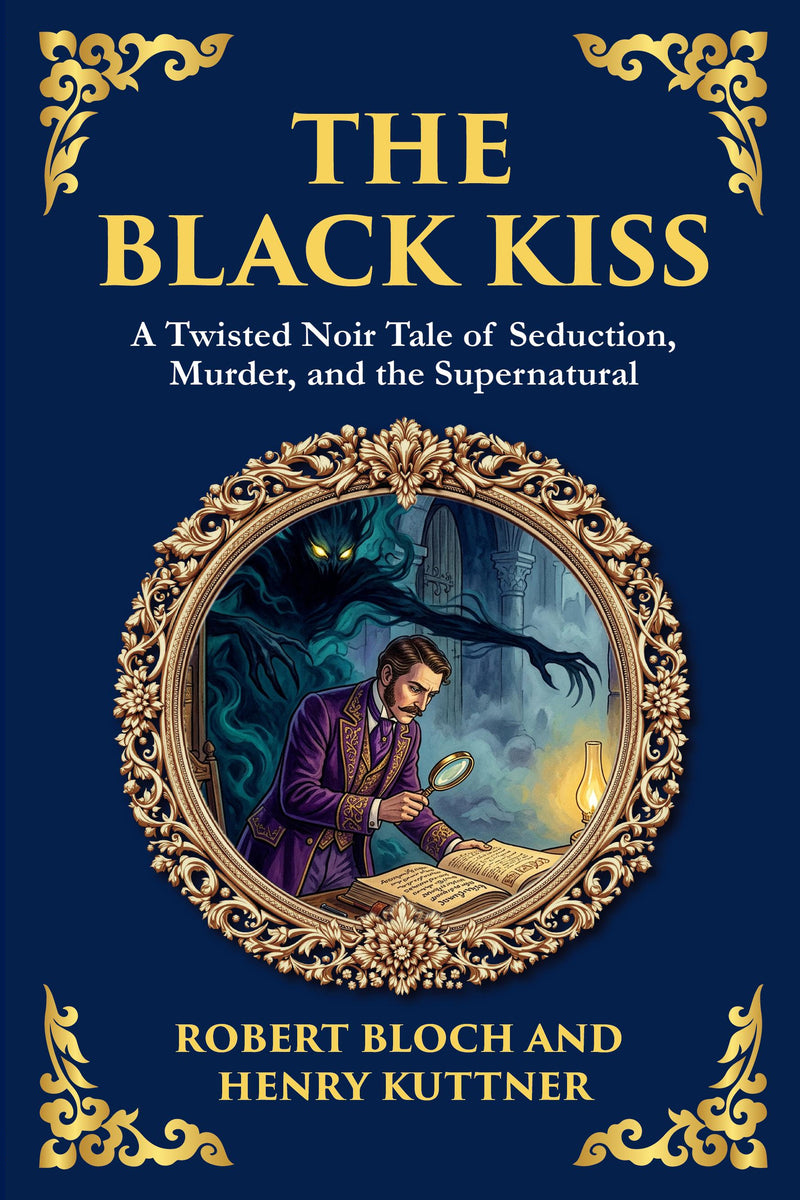
The Black Kiss
Robert Bloch In the shadowy underworld of postwar America, a beautiful woman hides deadly secrets, a haunted past, and a kiss that can kill.
or free app
10,000+ hrs library
30-day guarantee
The complete The Black Kiss appears in modern English through Library of Alexandria Press, available online with audiobook narration included for members.
Have you ever wondered why some kisses come with a curse? The Black Kiss: A Twisted Noir Tale of Seduction, Murder, and the Supernatural is a hard-hitting blend of classic detective fiction and supernatural horror, penned by two legends of pulp storytelling—Robert Bloch and Henry Kuttner. In this twisted noir, a cynical private eye is hired to find a missing person—but the trail leads him to something far darker than betrayal or greed.
It leads him to her: a seductive, dangerous woman with a kiss that haunts, scars, and possibly… kills. With each step deeper into the case, he’s pulled into an underworld of occult rituals, cursed relics, and a city that oozes corruption from every alley. As bodies pile up and sanity slips, the detective must uncover the truth behind The Black Kiss— before he becomes its next victim.
What you’ll discover in this modern edition
- A Razor-Edged Detective Story with a Supernatural Twist Hardboiled crime fiction meets haunting horror in a genre-bending narrative.
| Formats | eBook (EPUB + PDF) · Audiobook · Paperback · Hardcover · Large Print |
| Language | English |
| Trim size (print) | 6 × 9 in |
| Binding | Paperback — perfect-bound · Hardcover — casewrap |
| Large Print edition | Same text in a larger, easy-read type — a larger font, not a larger trim |
| Print pricing | Every physical book at our true cost — at-cost, no profit (members) |
| Library | 873 restored titles, always growing |
| Length | 10,713 words · ~43 min reading |
| Reading level | Grade 9 · a comfortable read (this modern-English edition) |
| Edition | Modern English translation · 2026 |
Member reviews for this edition are collected as readers finish it — be the first. Across the library: 12,000+ books shipped, every plan covered by a 365-day print guarantee.
About this edition
A faithful, unabridged modern-English edition by The Library of Alexandria — carefully rendered for today's reader and verified paragraph-by-paragraph against the public-domain source. Available as eBook, audiobook, paperback, hardcover, and large print.
- Complete & unabridgedVerified paragraph by paragraph against the source — never a scan, never abridged.
- Modern English, faithfulReadable today, with the author’s meaning kept intact. Readable — not simplified.
- Every format, one membershipRead in your browser or the free app, or listen to the full audiobook.
Included free with your membership
Cancel anytime, one click · 30-day money-back guarantee
Edition last updated July 2026
What’s inside
The Black Kiss — complete and unabridged: all 5 sections included with membership, plus the full audiobook.
Begin reading The Black Kiss
In clear modern English — the complete text is included with membership.
Introduction
There are stories that whisper, and there are stories that lure. The Black Kiss belongs firmly to the second category. It is a tale that does not so much invite the reader inside as beckon them with a crooked finger, drawing them step by step toward a threshold from which there is no comfortable return. Written by two of the most formidable imaginations ever to grace the pulp magazines of the early twentieth century—Robert Bloch and Henry Kuttner—this collaboration represents a remarkable meeting of minds, a fusion of two distinct creative temperaments into a single, shimmering, sinister whole. To open these pages is to surrender to a particular kind of dread, the slow-building unease that begins as a faint chill at the base of the spine and gradually tightens into something far more difficult to shake.
What follows is a story steeped in atmosphere, in the salt-tang of coastal air and the murk of shadowed rooms, in the seductive pull of beauty that conceals something ancient and wrong. It is a work that refuses easy categorization. Is it horror? Yes, undeniably. Is it noir, with its cynicism, its moral ambiguity, its sense of a protagonist sliding inexorably toward a fate he can sense but cannot prevent? Equally so. Is it supernatural fiction in the grand tradition of the weird tale? Without question. The genius of this collaboration lies precisely in how these threads are woven together until they become inseparable, until the reader can no longer tell where the seduction ends and the terror begins. That blurring is intentional. It is the very mechanism by which the story exerts its grip.
This modern translation and adaptation has been prepared with a singular goal in mind: to deliver the full, unadulterated power of the original to a contemporary readership without the friction of dated phrasing or obscure idiom standing between the reader and the experience. The intention is never to dilute or sanitize, never to strip away the texture that makes this such a memorable piece of fiction, but rather to clear the path so that the dread arrives unimpeded. The voice remains faithful to the spirit of its creators. The shadows remain just as deep. What has changed is the ease with which a reader of today can fall under the spell, and fall they shall.
To fully appreciate what you hold in your hands, it helps to understand a little of the men who made it. Robert Bloch and Henry Kuttner were not casual acquaintances who happened to share a byline. They were friends, correspondents, fellow travelers in a literary movement that flourished in the pages of magazines like Weird Tales, where the strange and the supernatural found a home during an era when mainstream publishing largely turned its nose up at such things. Both men were profoundly influenced by the orbit of H. P. Lovecraft, the reclusive New England author whose cosmic mythos cast a long shadow over an entire generation of writers. Lovecraft corresponded with young talents, encouraged them, and in some cases shaped the entire trajectory of their careers. Bloch and Kuttner were among those who benefited from this strange and generous mentorship.
Robert Bloch is a name that even casual readers may recognize, though often without realizing it. He is the man who gave the world Psycho, the novel that Alfred Hitchcock transformed into one of the most influential films ever made. That single work reshaped the landscape of suspense and horror, introducing the idea that the most terrifying monsters might wear ordinary human faces, that madness could hide behind a shy smile and a quiet manner. But Bloch was far more than the author of a single famous book. He was a prolific craftsman with a wicked sense of humor, a writer who understood that horror and dark comedy are close cousins, and that the most unsettling moments often arrive wrapped in a perversely entertaining package. His prose has a sly, conversational quality, an intimacy that makes the reader feel as though they are being let in on a terrible secret by someone who is, perhaps, enjoying the telling just a little too much.
Henry Kuttner occupies a slightly different place in the literary memory, though he was no less gifted. Often overshadowed in popular recollection by his contemporaries, Kuttner was nonetheless a writer of extraordinary range and inventiveness, equally at home in science fiction, fantasy, and horror. He frequently collaborated with his wife, the brilliant C. L. Moore, producing work under various pseudonyms that has only grown in reputation over the decades. Kuttner brought to his fiction a precision, a structural elegance, and an unsettling capacity to make the impossible feel inevitable. Where Bloch favored the human dimension of horror—the psychology, the corruption of the soul—Kuttner often leaned toward the cosmic and the otherworldly, the sense of vast and indifferent forces operating just beyond the veil of ordinary perception.
When these two sensibilities combined, the result was something neither could have produced alone. The Black Kiss carries the fingerprints of both authors. There is Bloch’s keen interest in the seductions and self-deceptions of the human heart, his understanding of how desire can lead a person willingly into the dark. And there is Kuttner’s mastery of atmosphere, his ability to summon the weight of ancient and inhuman menace, the suggestion of things that should not be and yet are. The collaboration produces a peculiar alchemy, a story in which the intimate and the cosmic exist side by side, in which a man’s private temptation becomes the doorway to horrors far larger than himself.
It is worth pausing to consider what collaboration meant in this context. Writing together is no simple matter; it requires a shared vision, a willingness to subsume one’s individual voice into a collective effort. That two writers of such distinct identities could produce a work this seamless speaks to the depth of their understanding and the genuine respect they held for one another’s craft. The pulp era, for all its commercial pressures and breakneck production schedules, fostered a kind of creative camaraderie that is increasingly rare. Writers swapped ideas, borrowed elements of one another’s invented worlds, and built upon a shared foundation of mythology and mood. The Black Kiss is a product of that fertile environment, a small but potent gem mined from a remarkable vein of imaginative collaboration.
The era that produced this tale deserves a moment of reflection as well. The pulps—so called for the cheap, wood-pulp paper on which they were printed—were the popular entertainment of their day, devoured by readers hungry for adventure, mystery, romance, and terror. They were disposable in the literal sense, printed on flimsy stock and often discarded after a single reading. Yet within those ephemeral pages, some of the most enduring and influential fiction of the century was born. The pulps gave us hardboiled detectives and interplanetary explorers, swashbuckling heroes and slinking villains, and above all, an entire vocabulary of dread that continues to shape horror and dark fantasy to this day. To read The Black Kiss is to step back into that vanished world, to experience the particular flavor of an age when storytelling was unashamed of spectacle, when atmosphere was prized above all, and when a tale’s first duty was to grip the reader and refuse to let go.
What is it about a story like this that continues to fascinate, decades after its first appearance? Why do readers return, again and again, to fiction that promises seduction and murder and the intrusion of the supernatural into ordinary life? The answer lies, perhaps, in something fundamental about the human relationship to fear and desire. We are drawn to the very things that frighten us, fascinated by the boundaries we know we should not cross. The dark tale, when crafted with skill, allows us to approach those boundaries safely, to feel the cold breath of the abyss without falling in.
The Black Kiss understands this attraction intimately. At its heart lies the most ancient of narrative engines: temptation. The lure of beauty, the pull of the forbidden, the seductive promise that one might possess something wondrous if only one is willing to ignore the warning signs. This is a story about wanting, and about the terrible price that wanting can exact. The noir tradition, from which this tale draws so much of its DNA, is built upon precisely this foundation. The classic noir protagonist is a man who knows better and proceeds anyway, who sees the trap and walks into it because some hunger within him cannot be denied. He is a creature of compromised judgment and fatal attraction, and we watch his descent with a mixture of horror and recognition, because we understand, on some level, that we might do the same.
What elevates this particular work above the standard fare is the way it grafts the supernatural onto this familiar framework. In conventional noir, the femme fatale is dangerous because of human treachery—greed, lust, the willingness to kill for advantage. But what if the danger were something older and stranger? What if the seduction were not merely a trap but a transformation, a pulling of the victim into a reality entirely apart from the one he thought he inhabited? This is where Kuttner’s cosmic sensibility merges with Bloch’s psychological acuity, and the result is a story that operates on multiple levels at once. There is the surface narrative of attraction and danger, taut and suspenseful in its own right. And beneath it, there is a deeper current, a suggestion of vast and incomprehensible forces, of horrors that predate humanity and care nothing for human notions of love or morality.
The setting plays no small part in this effect. Coastal locations have always held a peculiar power in weird fiction, and for good reason. The sea is the great unknown, the boundary between the familiar world of solid ground and the boundless, fathomless deep. It is a place of endless suggestion, where things may rise from below, where the tide deposits strange offerings on the shore, where the constant murmur of the waves seems to carry whispers from somewhere far away. Fog, salt air, the cry of seabirds, the slow erosion of rock and timber by relentless water—these are the raw materials of dread, and they are deployed here with consummate skill. The reader can almost taste the brine, feel the damp chill seeping into their bones, hear the distant boom of surf against the rocks. Atmosphere is not mere decoration in a story like this; it is the very medium through which the horror is transmitted.
There is also a profound psychological dimension to the tale that rewards careful attention. The protagonist’s journey is, in many ways, a journey into the self, an exploration of the appetites and weaknesses that lie buried within all of us. The supernatural elements function not only as external threats but as externalizations of internal states, manifestations of desire and dread made flesh. This is one of the great strengths of the weird tale as a form: it allows the abstract terrors of the inner life to take on monstrous, tangible shape. When we read of a man tempted by something beautiful and deadly, we are also reading, in a sense, about our own capacity for self-destruction, about the way longing can override reason, about the seductive whisper that tells us the rules do not apply to us.
For the modern reader, there is an additional layer of fascination in encountering a work that predates so much of what we now take for granted in the horror and thriller genres. So many of the tropes and techniques that contemporary fiction and film employ as a matter of course were, in this era, still being invented and refined. To read The Black Kiss is to witness the building blocks of modern dark fiction being assembled by master craftsmen. The slow burn of mounting suspense, the unreliable seduction of an alluring stranger, the gradual revelation that the world is not as it appears—these techniques feel familiar to us precisely because writers like Bloch and Kuttner helped to establish them. There is a particular pleasure in returning to the source, in experiencing these ideas in their original potency, before they were diluted by endless imitation.
Cancel anytime, one click · 30-day money-back guarantee
Founding annual rate available now — your price locks for life when you join.
Not ready? Get this free chapter by email — read it anytime.
✓ Sent — check your inbox for The Black Kiss.
Questions about The Black Kiss
What is The Black Kiss about?
Robert Bloch In the shadowy underworld of postwar America, a beautiful woman hides deadly secrets, a haunted past, and a kiss that can kill. When a private investigator takes on what seems to be a routine case, he’s drawn into a web of lust, madness, and occult horror. The Black Kiss blends the grit of hardboiled detective fiction with the dread of supernatural horror in a tale co-written by Robert Bloch, author of Psycho, and Henry Kuttner, a master of dark fantasy.
Is The Black Kiss free to read?
The opening chapter is free to read on this page. Members read and listen to the complete work — and the entire library — free, and can order any physical book at our true print cost.
How long is The Black Kiss?
5 chapters (~10,713 words) — about 43 min of reading in this modern-English edition.
Is this an abridged version of The Black Kiss?
No. This is the complete, unabridged The Black Kiss, carefully rendered into clear modern English and verified paragraph-by-paragraph against the public-domain source — nothing is cut or summarised.
What formats does The Black Kiss come in?
The Black Kiss is available as eBook, paperback, hardcover and large print. eBook and audiobook are included with membership; printed editions ship at our true print cost.
Shipping & returns
Billing & membership
More from the library


Explore Horror & Gothic
- The Strange Case of Dr. Jekyll and Mr. Hyde · Robert Louis Stevenson
- The Cask of Amontillado · Edgar Allan Poe
- Ghost Stories of an Antiquary · M. R. James
- The Monk: A Romance · M. G. Lewis
- The House of the Seven Gables · Nathaniel Hawthorne
- The Willows · Algernon Blackwood
- The Monkey’s Paw · W. W. Jacobs
- The Call of Cthulhu · H. P. Lovecraft
- The Life-Eater · Harold Ward
- The Legend of Sleepy Hollow · Washington Irving
- Brood of the Dark Moon · Charles Willard Diffin
- The Night Land · William Hope Hodgson
- The Castle of Otranto · Horace Walpole
- Dracula · Bram Stoker
- Carmilla · Joseph Sheridan Le Fanu
- The King in Yellow · Robert W. Chambers
- Wuthering Heights · Emily Brontë
- The Vampyre: A Tale · John William Polidori
- A Christmas Carol · Charles Dickens
- Northanger Abbey · Jane Austen
- The Turn of the Screw · Henry James
- Metamorphosis · Franz Kafka
- The Yellow Wallpaper · Charlotte Perkins Gilman
- The Adventures of Ferdinand Count Fathom — Complete · T. Smollett
- The Picture of Dorian Gray · Oscar Wilde
- Frankenstein; Or, The Modern Prometheus · Mary Wollstonecraft Shelley
The Black Kiss
The Black Kiss
A Twisted Noir Tale of Seduction, Murder, and the Supernatural
Anonymous
Contents
- Introduction
- The Black Kiss
- Chapter 1
- Chapter 2
- Chapter 3
Introduction
There are stories that whisper, and there are stories that lure. The Black Kiss belongs firmly to the second category. It is a tale that does not so much invite the reader inside as beckon them with a crooked finger, drawing them step by step toward a threshold from which there is no comfortable return. Written by two of the most formidable imaginations ever to grace the pulp magazines of the early twentieth century—Robert Bloch and Henry Kuttner—this collaboration represents a remarkable meeting of minds, a fusion of two distinct creative temperaments into a single, shimmering, sinister whole. To open these pages is to surrender to a particular kind of dread, the slow-building unease that begins as a faint chill at the base of the spine and gradually tightens into something far more difficult to shake.
What follows is a story steeped in atmosphere, in the salt-tang of coastal air and the murk of shadowed rooms, in the seductive pull of beauty that conceals something ancient and wrong. It is a work that refuses easy categorization. Is it horror? Yes, undeniably. Is it noir, with its cynicism, its moral ambiguity, its sense of a protagonist sliding inexorably toward a fate he can sense but cannot prevent? Equally so. Is it supernatural fiction in the grand tradition of the weird tale? Without question. The genius of this collaboration lies precisely in how these threads are woven together until they become inseparable, until the reader can no longer tell where the seduction ends and the terror begins. That blurring is intentional. It is the very mechanism by which the story exerts its grip.
This modern translation and adaptation has been prepared with a singular goal in mind: to deliver the full, unadulterated power of the original to a contemporary readership without the friction of dated phrasing or obscure idiom standing between the reader and the experience. The intention is never to dilute or sanitize, never to strip away the texture that makes this such a memorable piece of fiction, but rather to clear the path so that the dread arrives unimpeded. The voice remains faithful to the spirit of its creators. The shadows remain just as deep. What has changed is the ease with which a reader of today can fall under the spell, and fall they shall.
To fully appreciate what you hold in your hands, it helps to understand a little of the men who made it. Robert Bloch and Henry Kuttner were not casual acquaintances who happened to share a byline. They were friends, correspondents, fellow travelers in a literary movement that flourished in the pages of magazines like Weird Tales, where the strange and the supernatural found a home during an era when mainstream publishing largely turned its nose up at such things. Both men were profoundly influenced by the orbit of H. P. Lovecraft, the reclusive New England author whose cosmic mythos cast a long shadow over an entire generation of writers. Lovecraft corresponded with young talents, encouraged them, and in some cases shaped the entire trajectory of their careers. Bloch and Kuttner were among those who benefited from this strange and generous mentorship.
Robert Bloch is a name that even casual readers may recognize, though often without realizing it. He is the man who gave the world Psycho, the novel that Alfred Hitchcock transformed into one of the most influential films ever made. That single work reshaped the landscape of suspense and horror, introducing the idea that the most terrifying monsters might wear ordinary human faces, that madness could hide behind a shy smile and a quiet manner. But Bloch was far more than the author of a single famous book. He was a prolific craftsman with a wicked sense of humor, a writer who understood that horror and dark comedy are close cousins, and that the most unsettling moments often arrive wrapped in a perversely entertaining package. His prose has a sly, conversational quality, an intimacy that makes the reader feel as though they are being let in on a terrible secret by someone who is, perhaps, enjoying the telling just a little too much.
Henry Kuttner occupies a slightly different place in the literary memory, though he was no less gifted. Often overshadowed in popular recollection by his contemporaries, Kuttner was nonetheless a writer of extraordinary range and inventiveness, equally at home in science fiction, fantasy, and horror. He frequently collaborated with his wife, the brilliant C. L. Moore, producing work under various pseudonyms that has only grown in reputation over the decades. Kuttner brought to his fiction a precision, a structural elegance, and an unsettling capacity to make the impossible feel inevitable. Where Bloch favored the human dimension of horror—the psychology, the corruption of the soul—Kuttner often leaned toward the cosmic and the otherworldly, the sense of vast and indifferent forces operating just beyond the veil of ordinary perception.
When these two sensibilities combined, the result was something neither could have produced alone. The Black Kiss carries the fingerprints of both authors. There is Bloch’s keen interest in the seductions and self-deceptions of the human heart, his understanding of how desire can lead a person willingly into the dark. And there is Kuttner’s mastery of atmosphere, his ability to summon the weight of ancient and inhuman menace, the suggestion of things that should not be and yet are. The collaboration produces a peculiar alchemy, a story in which the intimate and the cosmic exist side by side, in which a man’s private temptation becomes the doorway to horrors far larger than himself.
It is worth pausing to consider what collaboration meant in this context. Writing together is no simple matter; it requires a shared vision, a willingness to subsume one’s individual voice into a collective effort. That two writers of such distinct identities could produce a work this seamless speaks to the depth of their understanding and the genuine respect they held for one another’s craft. The pulp era, for all its commercial pressures and breakneck production schedules, fostered a kind of creative camaraderie that is increasingly rare. Writers swapped ideas, borrowed elements of one another’s invented worlds, and built upon a shared foundation of mythology and mood. The Black Kiss is a product of that fertile environment, a small but potent gem mined from a remarkable vein of imaginative collaboration.
The era that produced this tale deserves a moment of reflection as well. The pulps—so called for the cheap, wood-pulp paper on which they were printed—were the popular entertainment of their day, devoured by readers hungry for adventure, mystery, romance, and terror. They were disposable in the literal sense, printed on flimsy stock and often discarded after a single reading. Yet within those ephemeral pages, some of the most enduring and influential fiction of the century was born. The pulps gave us hardboiled detectives and interplanetary explorers, swashbuckling heroes and slinking villains, and above all, an entire vocabulary of dread that continues to shape horror and dark fantasy to this day. To read The Black Kiss is to step back into that vanished world, to experience the particular flavor of an age when storytelling was unashamed of spectacle, when atmosphere was prized above all, and when a tale’s first duty was to grip the reader and refuse to let go.
What is it about a story like this that continues to fascinate, decades after its first appearance? Why do readers return, again and again, to fiction that promises seduction and murder and the intrusion of the supernatural into ordinary life? The answer lies, perhaps, in something fundamental about the human relationship to fear and desire. We are drawn to the very things that frighten us, fascinated by the boundaries we know we should not cross. The dark tale, when crafted with skill, allows us to approach those boundaries safely, to feel the cold breath of the abyss without falling in.
The Black Kiss understands this attraction intimately. At its heart lies the most ancient of narrative engines: temptation. The lure of beauty, the pull of the forbidden, the seductive promise that one might possess something wondrous if only one is willing to ignore the warning signs. This is a story about wanting, and about the terrible price that wanting can exact. The noir tradition, from which this tale draws so much of its DNA, is built upon precisely this foundation. The classic noir protagonist is a man who knows better and proceeds anyway, who sees the trap and walks into it because some hunger within him cannot be denied. He is a creature of compromised judgment and fatal attraction, and we watch his descent with a mixture of horror and recognition, because we understand, on some level, that we might do the same.
What elevates this particular work above the standard fare is the way it grafts the supernatural onto this familiar framework. In conventional noir, the femme fatale is dangerous because of human treachery—greed, lust, the willingness to kill for advantage. But what if the danger were something older and stranger? What if the seduction were not merely a trap but a transformation, a pulling of the victim into a reality entirely apart from the one he thought he inhabited? This is where Kuttner’s cosmic sensibility merges with Bloch’s psychological acuity, and the result is a story that operates on multiple levels at once. There is the surface narrative of attraction and danger, taut and suspenseful in its own right. And beneath it, there is a deeper current, a suggestion of vast and incomprehensible forces, of horrors that predate humanity and care nothing for human notions of love or morality.
The setting plays no small part in this effect. Coastal locations have always held a peculiar power in weird fiction, and for good reason. The sea is the great unknown, the boundary between the familiar world of solid ground and the boundless, fathomless deep. It is a place of endless suggestion, where things may rise from below, where the tide deposits strange offerings on the shore, where the constant murmur of the waves seems to carry whispers from somewhere far away. Fog, salt air, the cry of seabirds, the slow erosion of rock and timber by relentless water—these are the raw materials of dread, and they are deployed here with consummate skill. The reader can almost taste the brine, feel the damp chill seeping into their bones, hear the distant boom of surf against the rocks. Atmosphere is not mere decoration in a story like this; it is the very medium through which the horror is transmitted.
There is also a profound psychological dimension to the tale that rewards careful attention. The protagonist’s journey is, in many ways, a journey into the self, an exploration of the appetites and weaknesses that lie buried within all of us. The supernatural elements function not only as external threats but as externalizations of internal states, manifestations of desire and dread made flesh. This is one of the great strengths of the weird tale as a form: it allows the abstract terrors of the inner life to take on monstrous, tangible shape. When we read of a man tempted by something beautiful and deadly, we are also reading, in a sense, about our own capacity for self-destruction, about the way longing can override reason, about the seductive whisper that tells us the rules do not apply to us.
For the modern reader, there is an additional layer of fascination in encountering a work that predates so much of what we now take for granted in the horror and thriller genres. So many of the tropes and techniques that contemporary fiction and film employ as a matter of course were, in this era, still being invented and refined. To read The Black Kiss is to witness the building blocks of modern dark fiction being assembled by master craftsmen. The slow burn of mounting suspense, the unreliable seduction of an alluring stranger, the gradual revelation that the world is not as it appears—these techniques feel familiar to us precisely because writers like Bloch and Kuttner helped to establish them. There is a particular pleasure in returning to the source, in experiencing these ideas in their original potency, before they were diluted by endless imitation.
Graham Dean nervously stubbed out his cigarette and looked into Doctor Hedwig’s confused eyes.
“I’ve never felt this disturbed before,” he said. “These dreams won’t go away. They aren’t just random nightmares. They feel—I know it sounds crazy—they feel intentional.”
“Planned dreams? That’s ridiculous.” Doctor Hedwig looked skeptical. “Mr. Dean, you are an artist, which means you are naturally sensitive. This house in San Pedro is new to you, and you mentioned hearing strange stories. These dreams are just the result of your imagination and exhaustion.”
Dean looked out the window, a frown crossing his unusually pale face.
“I hope you’re right,” he replied quietly. “But dreams shouldn’t make me look like this, should they?”
He pointed to the deep blue circles under his eyes and the bloodless, ghostly paleness of his thin cheeks.
“Overworking has caused that, Mr. Dean. I understand your condition better than you do.”
The white-haired doctor picked up a page filled with his own barely readable notes and studied them carefully.
“You inherited that house in San Pedro a few months ago, right? And you moved in by yourself to get some work done.”
“Yes. The coastline there is absolutely stunning.” For a second, Dean looked young again as a spark of excitement lit up his pale face. Then he continued, frowning with worry. “But I haven’t been able to paint lately—at least not the ocean. It’s very strange. My sketches don’t feel right anymore. There is a certain quality to them that I’m not adding myself—“
“Yes. A sense of evil, if I can put it that way. I can’t quite describe it. There’s something behind the image that strips away all the beauty. And I haven’t been overworking myself these past few weeks, Doctor Hedwig.”
End of the free sample
Keep reading, free
Members read and listen to the complete book — and the entire library. Cancel anytime, one click · 30-day money-back guarantee.