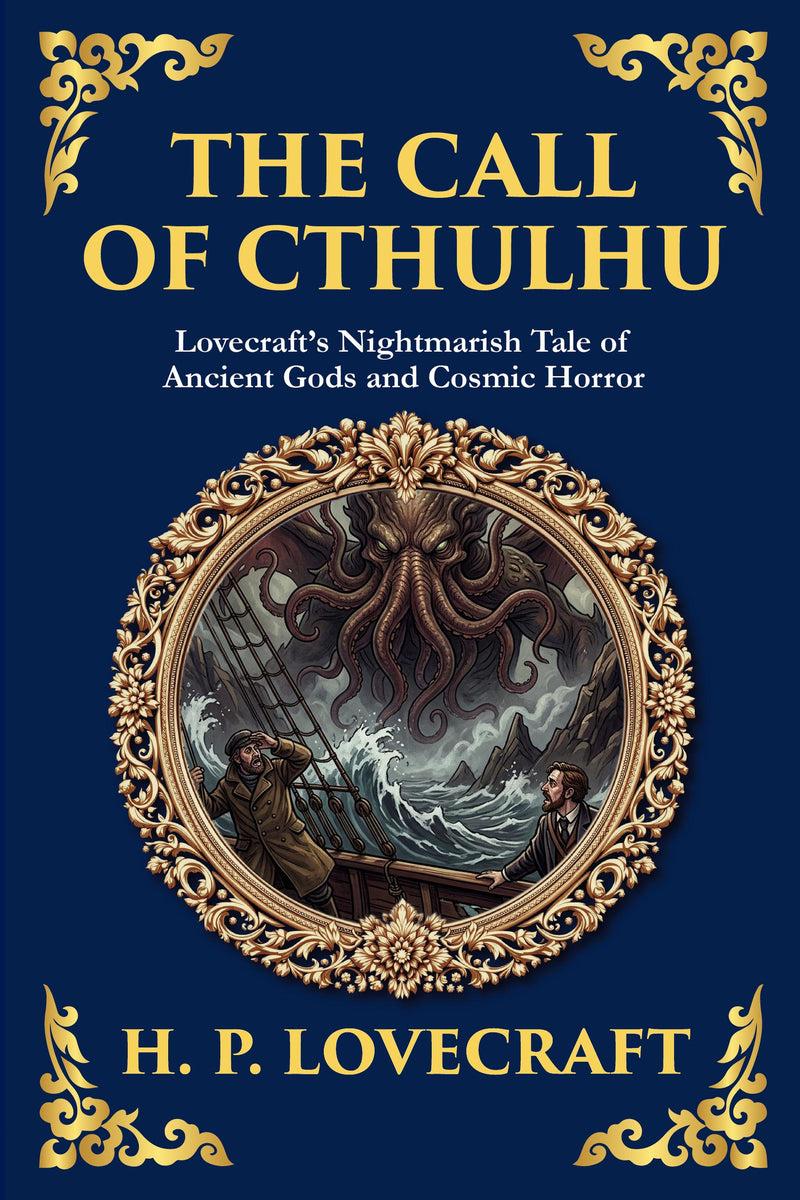
The Call of Cthulhu
Beneath the surface of the sea sleeps a god of unspeakable power—an ancient entity whose very existence threatens the sanity of mankind.
or free app
10,000+ hrs library
30-day guarantee
The complete The Call of Cthulhu appears in modern English through Library of Alexandria Press, available online with audiobook narration included for members.
Have you ever wondered why some horrors lie hidden, not out of fear—but mercy? The Call of Cthulhu is H. P. Lovecraft’s seminal masterpiece that defined the genre of cosmic horror and introduced readers to the terrifying mythos of ancient, godlike beings indifferent to mankind. Through scattered notes, cryptic testimonies, and unsettling dreams, an investigator uncovers a tale of a sunken city, an unearthly cult, and a monstrous creature whose very presence defies the limits of human understanding.
This modern edition presents Lovecraft’s nightmarish vision in a clean, accessible format while preserving the unnerving atmosphere that has haunted generations of readers. A must-read for lovers of horror, the occult, and speculative fiction that ventures into the abyss of the unknown.
What you’ll discover in this modern edition
- The Birth of the Cthulhu Mythos – Explore the origins of one of the most enduring icons in horror literature.
- Cosmic Horror at Its Finest – Enter a world where the true terror lies not in death, but in the insignificance of humanity.
- A Story Told Through Mystery and Fragmentation – Follow a gripping narrative pieced together from various sources, building toward a chilling conclusion.
- A Modern, Readable Format – Experience Lovecraft’s archaic intensity in an edition designed for today’s readers without compromising its eldritch atmosphere.
- The Foundation of a Genre – Understand how Lovecraft’s imagination shaped modern horror, science fiction, and fantasy.
| Formats | eBook (EPUB + PDF) · Audiobook · Paperback · Hardcover · Large Print |
| Language | English |
| Trim size (print) | 6 × 9 in |
| Binding | Paperback — perfect-bound · Hardcover — casewrap |
| Large Print edition | Same text in a larger, easy-read type — a larger font, not a larger trim |
| Print pricing | Every physical book at our true cost — at-cost, no profit (members) |
| Library | 873 restored titles, always growing |
| Length | 15,098 words · ~1 hr 0 min reading |
| Reading level | Grade 12 · a confident, adult read (this modern-English edition) |
| Edition | Modern English translation · 2026 |
Member reviews for this edition are collected as readers finish it — be the first. Across the library: 12,000+ books shipped, every plan covered by a 365-day print guarantee.
About this edition
A faithful, unabridged modern-English edition by The Library of Alexandria — carefully rendered for today's reader and verified paragraph-by-paragraph against the public-domain source. Available as eBook, audiobook, paperback, hardcover, and large print.
- Complete & unabridgedVerified paragraph by paragraph against the source — never a scan, never abridged.
- Modern English, faithfulReadable today, with the author’s meaning kept intact. Readable — not simplified.
- Every format, one membershipRead in your browser or the free app, or listen to the full audiobook.
Included free with your membership
Cancel anytime, one click · 30-day money-back guarantee
Edition last updated July 2026
What’s inside
The Call of Cthulhu — complete and unabridged: all 4 sections included with membership, plus the full audiobook.
Begin reading The Call of Cthulhu
In clear modern English — the complete text is included with membership.
Introduction
There are stories that frighten us by what they show, and there are stories that frighten us by what they suggest. The tale you are about to read belongs firmly to the second, rarer category. It does not rely on a monster lurking behind a door, nor on the sudden shock of a knife in the dark. Instead, it works on the imagination the way water works on stone—slowly, patiently, inevitably—until the foundations of everything you thought you knew about your place in the universe begin to crack and shift beneath you. First published in the pages of a pulp magazine in 1928, this short work has gone on to become one of the most influential pieces of imaginative fiction ever written, spawning an entire genre, a sprawling shared mythology, and a vocabulary of dread that countless writers, filmmakers, and artists continue to draw upon nearly a century later.
The premise is deceptively simple. A man inherits the papers of his deceased grand-uncle, a professor, and in sorting through them he stumbles upon a strange manuscript, a peculiar clay sculpture, and a collection of newspaper clippings and notes that, taken together, hint at something vast and terrible. As he investigates further, piecing together accounts from scattered corners of the globe—a nervous young artist’s feverish dreams, a police raid on a secret cult in a Louisiana swamp, the log of a doomed sea voyage—he begins to perceive a pattern. And it is precisely this act of perception, this gradual assembling of fragments into a coherent and horrifying whole, that forms the true engine of the story. The horror here is not something that happens to the characters so much as something they come to understand. And once understood, it cannot be unlearned.
This Modern Translation has been prepared with a single, guiding purpose: to make that experience of dawning comprehension available to you, the contemporary reader, in all its original power. To explain what that means, and why it matters, requires us to talk for a moment about the original prose, the man who wrote it, and the particular pleasures and challenges of approaching a text written for an audience that lived in a very different world.
A Story Built on Suggestion, and Why It Still Works
The author of this tale was a writer who believed, above all else, in the power of atmosphere. He once wrote that the oldest and strongest emotion of humankind is fear, and the oldest and strongest kind of fear is fear of the unknown. Everything in his fiction is built upon that conviction. He understood that the human imagination, left to its own devices, will always conjure something more terrifying than any explicit description a writer could provide. And so his method was one of restraint, of indirection, of the half-glimpsed and the barely-named. He gives you angles that seem wrong, geometry that doesn’t behave, colors that have no business existing, and the suggestion—never quite the confirmation—that the world is far older, far stranger, and far more indifferent to human existence than we could possibly bear to know.
This is what would later be called “cosmic horror,” and it represents a profound departure from the ghost stories and gothic tales that came before. In a traditional ghost story, the supernatural is personal. A spirit haunts a house because of some unresolved grievance, some wrong that must be put right. The dead have business with the living. The universe, however frightening, is fundamentally human in scale and concern. Cosmic horror throws all of that away. In this vision, the things that threaten us are not malevolent in any way we can comprehend. They are not interested in us at all. We are to them what insects are to a person walking across a field—beneath notice, beneath contempt, crushed underfoot without a second thought. The terror lies not in being hated by the cosmos but in being utterly irrelevant to it. There is no bargain to be struck, no salvation to be earned, no meaning to be found in our suffering. There is only the vast, cold, ancient dark, and our own small, flickering, doomed awareness within it.
It is worth pausing to appreciate how radical this idea was, and how radical it remains. We are creatures who crave meaning. We build religions, philosophies, and entire civilizations around the conviction that our lives matter, that the universe was made with us in mind, that there is a plan. This story takes that conviction and quietly, methodically dismantles it. The famous opening passage—which you will encounter shortly—argues that the merciful thing about the human mind is its inability to connect all its contents, and that someday the piecing together of dissociated knowledge will reveal such terrifying vistas of reality, and of our frightful position therein, that we shall either go mad from the revelation or flee into the safety of a new dark age. This is not a story about a creature. It is a story about a truth—a truth so corrosive that mere knowledge of it is itself the danger.
What makes the tale so durable, so endlessly imitated and adapted, is the way its structure perfectly serves its theme. Rather than presenting events in a straightforward chronological narrative, the author assembles his horror the way a detective assembles a case, or the way a scholar assembles a thesis. The reader is given documents, testimonies, accounts from different times and places, and is invited—indeed, compelled—to draw the connections. This means that you, the reader, become complicit in the act of discovery. You are not a passive witness to the protagonist’s terror; you are experiencing the same slow, sickening realization that he is. The story makes you do the work, and in doing that work, you internalize the horror far more deeply than any direct description could achieve. By the time the final pieces fall into place, the dread is not on the page. It is in your own mind, assembled there by your own hand.
This is also why the story has lent itself so well to a vast and ever-expanding body of work by other creators. The mythology it helped to establish—a pantheon of ancient, alien entities; forbidden books of unspeakable knowledge; remote and accursed places; the thin membrane separating our comfortable reality from the chaos beyond—has become a kind of shared creative inheritance. Generations of writers have added their own chapters, their own monsters, their own doomed investigators. Filmmakers have borrowed its imagery and its mood. Game designers have built entire worlds upon its principles. The single, sunpronounceable name at the center of this tale has entered the cultural lexicon so thoroughly that people who have never read a word of the original nonetheless recognize it. To read this story, then, is to go back to the source—to drink from the well from which so much modern horror has been drawn.
The Purpose and Promise of This Modern Translation
If this tale is so powerful and so important, you may reasonably ask, why does it need a modern translation at all? It was, after all, written in English. The answer lies in the considerable distance between the way English was written in the 1920s—particularly the way it was written by this specific author—and the way we read today.
The original prose is, to put it plainly, dense. The author favored long, elaborate sentences, heavily ornamented with adjectives, that wound their way through subordinate clauses before arriving, at last, at their point. He had a fondness for archaic vocabulary, for words that were already somewhat antique in his own time and that have since fallen almost entirely out of use. He employed a deliberately heightened, formal register, the kind of rolling, incantatory prose that aimed to overwhelm the reader with its sheer accumulation of detail and dread. For readers of his era, attuned to the literary conventions of the period, this style was potent and effective. The very strangeness and excess of the language contributed to the sense of unreality, the feeling of being drawn into a world subtly out of joint.
For many contemporary readers, however, this same style can become a barrier rather than a doorway. Sentences that stretch across half a page can lose their momentum. Vocabulary that requires constant interruption to look up can break the spell of immersion. The very ornateness that once heightened the atmosphere can, for a reader accustomed to the leaner rhythms of modern prose, instead create distance and fatigue. The tragedy is that the horror itself—the ideas, the atmosphere, the slow build of cosmic dread—remains as powerful as ever. It is only the delivery mechanism that has aged. And it would be a genuine loss if readers were turned away at the threshold, unable to reach the extraordinary experience waiting just beyond the difficult prose.
That is the gap this Modern Translation is designed to bridge. The aim has been to carry across—to translate, in the truest sense—everything that makes the story great, while removing the obstacles that stand between you and that greatness. Sentences have been clarified and, where necessary, restructured for natural readability, without sacrificing the rhythm and the building pressure that are so essential to the effect. Archaic and obscure words have been rendered in contemporary equivalents that preserve their meaning and their tone. The formal, atmospheric register has been retained—this is not a story that should sound casual or breezy, and no attempt has been made to strip it of its essential gravity—but it has been adjusted so that the formality serves the mood rather than impeding comprehension.
The goal throughout has been faithfulness to the experience rather than slavish reproduction of the words. A literal, word-for-word modernization would defeat the entire purpose; it would simply substitute one set of awkward constructions for another. Instead, the question guiding every choice has been: what was this passage meant to make the reader feel, and how can that feeling be most effectively delivered to a reader today? The chilling restraint, the mounting unease, the sense of a curtain being slowly drawn back to reveal something the human mind was never meant to see—all of this has been carefully preserved. What has changed is the ease with which you can receive it.
It is important to be clear about what this adaptation is and is not. It is not an abridgment. The story has not been shortened or simplified in its content; the full narrative, with all its layers and connections, remains intact. Nor is it a reimagining that relocates the events to a new setting or alters the characters and plot. This is the same story, with the same structure, the same revelations, the same devastating conclusion. What has been modernized is the language—the medium through which that story reaches you. Think of it as the difference between viewing a great painting through grimy, distorting glass and viewing it through glass that has been cleaned and clarified. The painting is unchanged. You are simply, finally, able to see it as it was meant to be seen.
For those readers who already know and love the original in its untranslated form, this edition offers a chance to revisit a familiar tale with fresh eyes, and perhaps to share it with friends or family who might otherwise have found the original prose forbidding. For those encountering the story for the very first time, this edition offers the best possible point of entry—a way to experience the full force of one of horror’s foundational texts without the friction that has, for too long, kept this masterpiece at arm’s length from the audience it deserves.
A few words about how to read this story, now that the path has been cleared. Resist the temptation to rush. This is not a tale that rewards hasty reading; it is a tale that rewards attention, patience, and a willingness to sit with discomfort. Let yourself notice the connections as they emerge. Pay attention to the way the narrator’s confidence gradually erodes, the way his rational, scholarly tone begins to fray at the edges as the implications of his discoveries sink in. Notice how often the most frightening things are the ones left undescribed, gestured at rather than depicted. The author trusts you to do the imaginative work, and the more you give yourself over to that collaboration, the more deeply the story will affect you.
Cancel anytime, one click · 30-day money-back guarantee
Founding annual rate available now — your price locks for life when you join.
Not ready? Get this free chapter by email — read it anytime.
✓ Sent — check your inbox for The Call of Cthulhu.
Questions about The Call of Cthulhu
What is The Call of Cthulhu about?
Beneath the surface of the sea sleeps a god of unspeakable power—an ancient entity whose very existence threatens the sanity of mankind. When scattered fragments of a forbidden story begin to surface, a scholar pieces together a terrifying truth: that a cult worships a monstrous being known as Cthulhu, and its awakening may herald the end of the world. In The Call of Cthulhu, H. P. Lovecraft introduces readers to a chilling mythology where humanity is but a fragile illusion in the face of incomprehensible cosmic fo
Who wrote The Call of Cthulhu?
The Call of Cthulhu was written by H. P. Lovecraft. This edition presents the complete work in clear modern English, faithfully rendered from the public-domain original by Library of Alexandria Press.
Is The Call of Cthulhu free to read?
The opening chapter is free to read on this page. Members read and listen to the complete work — and the entire library — free, and can order any physical book at our true print cost.
How long is The Call of Cthulhu?
4 chapters (~15,098 words) — about 1 hr 0 min of reading in this modern-English edition.
Is this an abridged version of The Call of Cthulhu?
No. This is the complete, unabridged The Call of Cthulhu, carefully rendered into clear modern English and verified paragraph-by-paragraph against the public-domain source — nothing is cut or summarised.
What formats does The Call of Cthulhu come in?
The Call of Cthulhu is available as eBook, paperback, hardcover and large print. eBook and audiobook are included with membership; printed editions ship at our true print cost.
Shipping & returns
Billing & membership
More from the library


Explore Horror & Gothic
- The Strange Case of Dr. Jekyll and Mr. Hyde · Robert Louis Stevenson
- The Cask of Amontillado · Edgar Allan Poe
- Ghost Stories of an Antiquary · M. R. James
- The Monk: A Romance · M. G. Lewis
- The House of the Seven Gables · Nathaniel Hawthorne
- The Willows · Algernon Blackwood
- The Monkey’s Paw · W. W. Jacobs
- The Life-Eater · Harold Ward
- The Black Kiss
- The Legend of Sleepy Hollow · Washington Irving
- Brood of the Dark Moon · Charles Willard Diffin
- The Night Land · William Hope Hodgson
- The Castle of Otranto · Horace Walpole
- Dracula · Bram Stoker
- Carmilla · Joseph Sheridan Le Fanu
- The King in Yellow · Robert W. Chambers
- Wuthering Heights · Emily Brontë
- The Vampyre: A Tale · John William Polidori
- A Christmas Carol · Charles Dickens
- Northanger Abbey · Jane Austen
- The Turn of the Screw · Henry James
- Metamorphosis · Franz Kafka
- The Yellow Wallpaper · Charlotte Perkins Gilman
- The Adventures of Ferdinand Count Fathom — Complete · T. Smollett
- The Picture of Dorian Gray · Oscar Wilde
- Frankenstein; Or, The Modern Prometheus · Mary Wollstonecraft Shelley
The Call of Cthulhu
The Call of Cthulhu
Lovecraft’s terrifying story of ancient deities and cosmic horror
H. P. Lovecraft
Contents
- Introduction
- Chapter 1
- Chapter 2
- Chapter 3
Introduction
There are stories that frighten us by what they show, and there are stories that frighten us by what they suggest. The tale you are about to read belongs firmly to the second, rarer category. It does not rely on a monster lurking behind a door, nor on the sudden shock of a knife in the dark. Instead, it works on the imagination the way water works on stone—slowly, patiently, inevitably—until the foundations of everything you thought you knew about your place in the universe begin to crack and shift beneath you. First published in the pages of a pulp magazine in 1928, this short work has gone on to become one of the most influential pieces of imaginative fiction ever written, spawning an entire genre, a sprawling shared mythology, and a vocabulary of dread that countless writers, filmmakers, and artists continue to draw upon nearly a century later.
The premise is deceptively simple. A man inherits the papers of his deceased grand-uncle, a professor, and in sorting through them he stumbles upon a strange manuscript, a peculiar clay sculpture, and a collection of newspaper clippings and notes that, taken together, hint at something vast and terrible. As he investigates further, piecing together accounts from scattered corners of the globe—a nervous young artist’s feverish dreams, a police raid on a secret cult in a Louisiana swamp, the log of a doomed sea voyage—he begins to perceive a pattern. And it is precisely this act of perception, this gradual assembling of fragments into a coherent and horrifying whole, that forms the true engine of the story. The horror here is not something that happens to the characters so much as something they come to understand. And once understood, it cannot be unlearned.
This Modern Translation has been prepared with a single, guiding purpose: to make that experience of dawning comprehension available to you, the contemporary reader, in all its original power. To explain what that means, and why it matters, requires us to talk for a moment about the original prose, the man who wrote it, and the particular pleasures and challenges of approaching a text written for an audience that lived in a very different world.
A Story Built on Suggestion, and Why It Still Works
The author of this tale was a writer who believed, above all else, in the power of atmosphere. He once wrote that the oldest and strongest emotion of humankind is fear, and the oldest and strongest kind of fear is fear of the unknown. Everything in his fiction is built upon that conviction. He understood that the human imagination, left to its own devices, will always conjure something more terrifying than any explicit description a writer could provide. And so his method was one of restraint, of indirection, of the half-glimpsed and the barely-named. He gives you angles that seem wrong, geometry that doesn’t behave, colors that have no business existing, and the suggestion—never quite the confirmation—that the world is far older, far stranger, and far more indifferent to human existence than we could possibly bear to know.
This is what would later be called “cosmic horror,” and it represents a profound departure from the ghost stories and gothic tales that came before. In a traditional ghost story, the supernatural is personal. A spirit haunts a house because of some unresolved grievance, some wrong that must be put right. The dead have business with the living. The universe, however frightening, is fundamentally human in scale and concern. Cosmic horror throws all of that away. In this vision, the things that threaten us are not malevolent in any way we can comprehend. They are not interested in us at all. We are to them what insects are to a person walking across a field—beneath notice, beneath contempt, crushed underfoot without a second thought. The terror lies not in being hated by the cosmos but in being utterly irrelevant to it. There is no bargain to be struck, no salvation to be earned, no meaning to be found in our suffering. There is only the vast, cold, ancient dark, and our own small, flickering, doomed awareness within it.
It is worth pausing to appreciate how radical this idea was, and how radical it remains. We are creatures who crave meaning. We build religions, philosophies, and entire civilizations around the conviction that our lives matter, that the universe was made with us in mind, that there is a plan. This story takes that conviction and quietly, methodically dismantles it. The famous opening passage—which you will encounter shortly—argues that the merciful thing about the human mind is its inability to connect all its contents, and that someday the piecing together of dissociated knowledge will reveal such terrifying vistas of reality, and of our frightful position therein, that we shall either go mad from the revelation or flee into the safety of a new dark age. This is not a story about a creature. It is a story about a truth—a truth so corrosive that mere knowledge of it is itself the danger.
What makes the tale so durable, so endlessly imitated and adapted, is the way its structure perfectly serves its theme. Rather than presenting events in a straightforward chronological narrative, the author assembles his horror the way a detective assembles a case, or the way a scholar assembles a thesis. The reader is given documents, testimonies, accounts from different times and places, and is invited—indeed, compelled—to draw the connections. This means that you, the reader, become complicit in the act of discovery. You are not a passive witness to the protagonist’s terror; you are experiencing the same slow, sickening realization that he is. The story makes you do the work, and in doing that work, you internalize the horror far more deeply than any direct description could achieve. By the time the final pieces fall into place, the dread is not on the page. It is in your own mind, assembled there by your own hand.
This is also why the story has lent itself so well to a vast and ever-expanding body of work by other creators. The mythology it helped to establish—a pantheon of ancient, alien entities; forbidden books of unspeakable knowledge; remote and accursed places; the thin membrane separating our comfortable reality from the chaos beyond—has become a kind of shared creative inheritance. Generations of writers have added their own chapters, their own monsters, their own doomed investigators. Filmmakers have borrowed its imagery and its mood. Game designers have built entire worlds upon its principles. The single, sunpronounceable name at the center of this tale has entered the cultural lexicon so thoroughly that people who have never read a word of the original nonetheless recognize it. To read this story, then, is to go back to the source—to drink from the well from which so much modern horror has been drawn.
The Purpose and Promise of This Modern Translation
If this tale is so powerful and so important, you may reasonably ask, why does it need a modern translation at all? It was, after all, written in English. The answer lies in the considerable distance between the way English was written in the 1920s—particularly the way it was written by this specific author—and the way we read today.
The original prose is, to put it plainly, dense. The author favored long, elaborate sentences, heavily ornamented with adjectives, that wound their way through subordinate clauses before arriving, at last, at their point. He had a fondness for archaic vocabulary, for words that were already somewhat antique in his own time and that have since fallen almost entirely out of use. He employed a deliberately heightened, formal register, the kind of rolling, incantatory prose that aimed to overwhelm the reader with its sheer accumulation of detail and dread. For readers of his era, attuned to the literary conventions of the period, this style was potent and effective. The very strangeness and excess of the language contributed to the sense of unreality, the feeling of being drawn into a world subtly out of joint.
For many contemporary readers, however, this same style can become a barrier rather than a doorway. Sentences that stretch across half a page can lose their momentum. Vocabulary that requires constant interruption to look up can break the spell of immersion. The very ornateness that once heightened the atmosphere can, for a reader accustomed to the leaner rhythms of modern prose, instead create distance and fatigue. The tragedy is that the horror itself—the ideas, the atmosphere, the slow build of cosmic dread—remains as powerful as ever. It is only the delivery mechanism that has aged. And it would be a genuine loss if readers were turned away at the threshold, unable to reach the extraordinary experience waiting just beyond the difficult prose.
That is the gap this Modern Translation is designed to bridge. The aim has been to carry across—to translate, in the truest sense—everything that makes the story great, while removing the obstacles that stand between you and that greatness. Sentences have been clarified and, where necessary, restructured for natural readability, without sacrificing the rhythm and the building pressure that are so essential to the effect. Archaic and obscure words have been rendered in contemporary equivalents that preserve their meaning and their tone. The formal, atmospheric register has been retained—this is not a story that should sound casual or breezy, and no attempt has been made to strip it of its essential gravity—but it has been adjusted so that the formality serves the mood rather than impeding comprehension.
The goal throughout has been faithfulness to the experience rather than slavish reproduction of the words. A literal, word-for-word modernization would defeat the entire purpose; it would simply substitute one set of awkward constructions for another. Instead, the question guiding every choice has been: what was this passage meant to make the reader feel, and how can that feeling be most effectively delivered to a reader today? The chilling restraint, the mounting unease, the sense of a curtain being slowly drawn back to reveal something the human mind was never meant to see—all of this has been carefully preserved. What has changed is the ease with which you can receive it.
It is important to be clear about what this adaptation is and is not. It is not an abridgment. The story has not been shortened or simplified in its content; the full narrative, with all its layers and connections, remains intact. Nor is it a reimagining that relocates the events to a new setting or alters the characters and plot. This is the same story, with the same structure, the same revelations, the same devastating conclusion. What has been modernized is the language—the medium through which that story reaches you. Think of it as the difference between viewing a great painting through grimy, distorting glass and viewing it through glass that has been cleaned and clarified. The painting is unchanged. You are simply, finally, able to see it as it was meant to be seen.
For those readers who already know and love the original in its untranslated form, this edition offers a chance to revisit a familiar tale with fresh eyes, and perhaps to share it with friends or family who might otherwise have found the original prose forbidding. For those encountering the story for the very first time, this edition offers the best possible point of entry—a way to experience the full force of one of horror’s foundational texts without the friction that has, for too long, kept this masterpiece at arm’s length from the audience it deserves.
A few words about how to read this story, now that the path has been cleared. Resist the temptation to rush. This is not a tale that rewards hasty reading; it is a tale that rewards attention, patience, and a willingness to sit with discomfort. Let yourself notice the connections as they emerge. Pay attention to the way the narrator’s confidence gradually erodes, the way his rational, scholarly tone begins to fray at the edges as the implications of his discoveries sink in. Notice how often the most frightening things are the ones left undescribed, gestured at rather than depicted. The author trusts you to do the imaginative work, and the more you give yourself over to that collaboration, the more deeply the story will affect you.
I believe the kindest thing in the world is that the human mind cannot connect everything it knows. We live on a calm island of ignorance surrounded by vast, black oceans of infinity, and we were never meant to travel very far. So far, the various sciences have not done us much harm because they each focus on their own separate goals. However, one day, when these disconnected pieces of knowledge are finally put together, they will reveal a reality so terrifying—and a position for humanity so horrific—that we will either lose our minds from the discovery or run away from the deadly light and hide in the safety of a new dark age.
Theosophists have tried to imagine the overwhelming scale of the cosmic cycle, where our world and the human race are nothing more than brief, passing moments. They have suggested the existence of strange survivors using language that would be blood-curdling if it weren’t hidden behind a mask of cheerful optimism. But they aren’t the ones who gave me that single glimpse of forbidden eras—the one that chills me when I think about it and drives me mad when I dream of it. That glimpse, like all terrifying realizations of truth, came from accidentally connecting separate pieces of information; in this instance, an old newspaper clipping and the notes of a deceased professor. I hope no one else ever puts these pieces together. If I survive, I will certainly never knowingly provide another link in such a hideous chain. I believe the professor also intended to stay silent about what he knew, and that he would have burned his notes if death hadn’t claimed him so suddenly.
End of the free sample
Keep reading, free
Members read and listen to the complete book — and the entire library. Cancel anytime, one click · 30-day money-back guarantee.