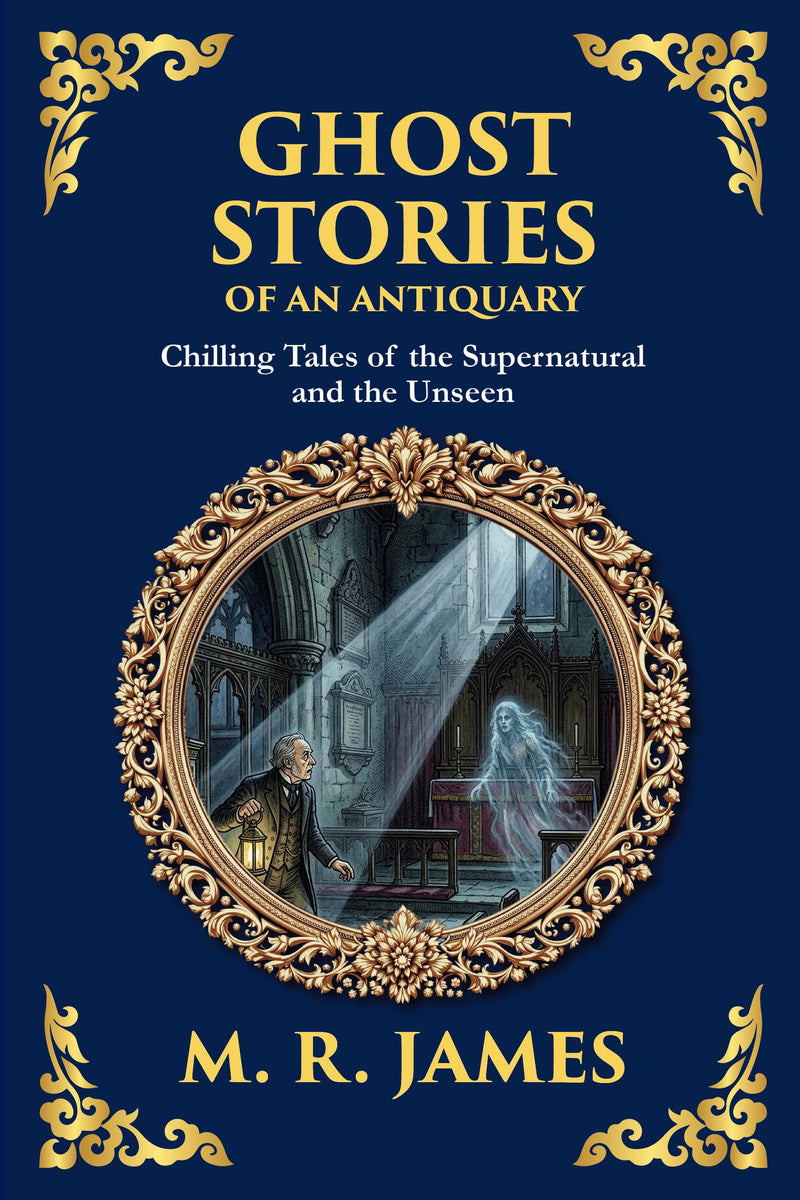
Ghost Stories of an Antiquary — Large Print
Prepare yourself for shivers that sneak up from behind and whispers that follow you down silent corridors. Ghost Stories of an Antiquary by M. R. James is the definitive collection of classic English ghost stories—elegant, eerie, and expertly crafted to disturb.
or free app
10,000+ hrs library
30-day guarantee
The complete Ghost Stories of an Antiquary appears in modern English through Library of Alexandria Press, available online with audiobook narration included for members.
Have you ever wondered why the most terrifying ghosts whisper instead of scream? Ghost Stories of an Antiquary: Chilling Tales of the Supernatural and the Unseen gathers eight of the most influential and unnerving ghost stories in the English language, penned by the master of subtle horror, M. R. James. Far from the grotesque or gory, James’s tales draw their power from atmosphere, implication, and the slow realization that something is terribly, terribly wrong.
As a Cambridge scholar and medievalist, M. R. James drew inspiration from dusty manuscripts, forgotten folklore, and ancient architecture. His protagonists—often fellow antiquarians— unearth more than they bargained for: cursed objects, forgotten crimes, and entities that wait in the shadows for the right moment to strike. Each story is a masterclass in restraint and terror, revealing how the suggestion of the supernatural—rather than the spectacle—is what truly haunts the reader’s imagination.
What you’ll discover in this modern edition
- Canon-Defining Ghost Stories Includes “Canon Alberic’s Scrap-Book,” “Oh, Whistle, and I’ll Come to You, My Lad,” “The Mezzotint,” and more
- Atmospheric English Horror Stories that haunt libraries, abbeys, seaside towns, and crumbling estates
- An Antiquarian’s Nightmare When history refuses to remain buried and the past claws back into the present
- Psychological Fear Over Flashy Terror Discover why less is more in the most sophisticated horror tales
- Timeless Lessons in Storytelling Learn how silence, subtlety, and suggestion create the most enduring scares
| Formats | eBook (EPUB + PDF) · Audiobook · Paperback · Hardcover · Large Print |
| Language | English |
| Trim size (print) | 6 × 9 in |
| Binding | Paperback — perfect-bound · Hardcover — casewrap |
| Large Print edition | Same text in a larger, easy-read type — a larger font, not a larger trim |
| Print pricing | Every physical book at our true cost — at-cost, no profit (members) |
| Library | 873 restored titles, always growing |
| Length | 45,409 words · ~3 hr 2 min reading |
| Reading level | Grade 5 · an easy, flowing read (this modern-English edition) |
| Edition | Modern English translation · 2026 |
Member reviews for this edition are collected as readers finish it — be the first. Across the library: 12,000+ books shipped, every plan covered by a 365-day print guarantee.
About this edition
A faithful, unabridged modern-English edition by The Library of Alexandria — carefully rendered for today's reader and verified paragraph-by-paragraph against the public-domain source. Available as eBook, audiobook, paperback, hardcover, and large print.
- Complete & unabridgedVerified paragraph by paragraph against the source — never a scan, never abridged.
- Modern English, faithfulReadable today, with the author’s meaning kept intact. Readable — not simplified.
- Every format, one membershipRead in your browser or the free app, or listen to the full audiobook.
Included free with your membership
Cancel anytime, one click · 30-day money-back guarantee
Edition last updated July 2026
What’s inside
Ghost Stories of an Antiquary — Large Print — complete and unabridged: all 9 sections included with membership, plus the full audiobook.
Begin reading Ghost Stories of an Antiquary — Large Print
In clear modern English — the complete text is included with membership.
Introduction
There is a particular kind of dread that does not announce itself with thunder or shrieking, but instead arrives quietly, almost politely, like a knock at the door of a study where a scholar sits late into the night surrounded by old manuscripts. It is the dread of realizing that the thing you have just uncovered—the inscription you decoded, the volume you pulled from a forgotten shelf, the curious object you pocketed without a second thought—was perhaps better left undisturbed. This is the territory of Montague Rhodes James, a man who in his daily life moved among the dusty treasures of England’s great libraries, and who, in his leisure hours, transformed that very world of learning into one of the most refined and unsettling bodies of supernatural fiction ever written.
The collection you are about to read first appeared at the close of the nineteenth century, the product of a tradition that had become something of a ritual. James was in the habit of writing these tales to be read aloud, by candlelight or firelight, to a gathered circle of friends and colleagues during the Christmas season. There is something delightfully paradoxical in that origin: stories of cold terror conceived as a warm seasonal entertainment, ghosts summoned into being in a room full of laughter and good company. Yet that context tells us a great deal about the experience James intended to create. These were never meant to be lonely confrontations with the page. They were performances—shared experiences in which a roomful of intelligent, skeptical adults could feel, for the duration of an evening, the delicious certainty that something was watching them from just beyond the reach of the firelight.
That this present edition has been carefully adapted for the contemporary reader is, I think, a service worth pausing over. James wrote in an English that was already somewhat formal and antiquarian even in his own day—deliberately so, for he loved the textures of old documents, scholarly Latin, ecclesiastical history, and the precise vocabulary of churches, libraries, and country houses. For modern readers, some of that original phrasing can become a thicket through which the genuine terror struggles to reach us. The aim of this adaptation is not to dilute James, nor to scrub away the period flavor that gives his work its distinctive character, but rather to clear the path so that the essential thing—the slow, creeping, masterfully engineered fear—lands with the full force its author intended. What remains is the architecture of his suspense, the cleverness of his plotting, and above all the sensation, unique to James, that the boundary between the comfortable everyday and the unspeakable is far thinner than we would like to believe.
To understand why these stories work as well as they do, it helps to understand the curious life of the man who wrote them. Montague Rhodes James was born in 1862, the son of a clergyman, and he grew up in the kind of rural English setting—old churches, country rectories, ancient landscapes layered with history—that would later furnish the backdrops for so much of his fiction. From an early age he displayed an almost uncanny aptitude for languages and for the study of old texts. He was the sort of boy who found genuine excitement in deciphering medieval manuscripts, and that excitement never left him.
His academic career was extraordinary by any measure. He became a celebrated scholar of medieval manuscripts, biblical apocrypha, and the history of art, and he rose to the highest positions in the institutions he served, eventually presiding over one of the most venerable colleges in England and later over the famous school where many of England’s leading figures had been educated. He was, in short, a consummate insider of the world of learning—a man who spent his days in libraries and chapels, cataloguing collections, examining the fabric of ancient buildings, and reading languages that few others could.
This is precisely what makes his ghost stories so distinctive. James did not write about haunted castles in some vague faraway land, nor about the operatic horrors that filled the pages of earlier Gothic fiction. He wrote about what he knew. His protagonists are scholars, collectors, clergymen, and curious antiquarians—men very much like himself—who pursue some innocent-seeming line of inquiry and find, to their cost, that the past does not always wish to be examined. The settings are libraries, cathedral towns, seaside inns, lonely country estates, and the dim corners of museums. The objects that trigger the horror are not magic swords or cursed amulets of obvious menace, but bibles, brass instruments, whistles, prints, dollhouses, mezzotints, and inscriptions—the very stuff of an educated man’s quiet hobbies.
There is a deep authenticity to all of this. When James describes the smell of old paper, the feel of a binding, the particular satisfaction of solving a textual puzzle, he is writing from genuine, lived passion. And it is exactly that authenticity that lends his terror its power. Because we believe so completely in the ordinary, scholarly world he constructs—because it is rendered with such loving and convincing detail—we are utterly unprepared when something monstrous intrudes upon it. The horror does not feel like a fantasy. It feels like a violation of a reality we have come to trust.
James was also, famously, a man of habit and reserve, deeply attached to the rhythms of academic life and the company of his friends. He never married, and he devoted his immense energies to scholarship and to the small, treasured social world of college and chapel. There is something poignant in the contrast between this orderly, gentle, intensely civilized existence and the unspeakable things that crawled out of his imagination on winter nights. Perhaps it is precisely because he so valued order, learning, and the comfortable certainties of his world that he understood so well the terror of seeing those certainties betrayed.
Readers coming to these stories for the first time should be prepared for a particular kind of horror—one that may run counter to the expectations shaped by more modern, more explicit entertainments. James was not interested in gore, in spectacle, or in shock for its own sake. His method was subtler, more patient, and ultimately, I would argue, far more durable. He understood that the most effective fear is not the fear of what we are shown, but the fear of what we are made to imagine.
Consider his typical structure. A story begins in a register of complete and reassuring normality. We are introduced to a learned, sensible man going about his business—researching a church, examining a collection, taking a holiday by the sea. The prose is unhurried, often genial, sometimes touched with dry humor. James takes his time establishing this world, layering in convincing detail about the protagonist’s work, his surroundings, his small comforts and curiosities. We settle in. We grow comfortable. And then, almost imperceptibly, something begins to go wrong.
It is rarely sudden at first. A detail seems slightly off. A figure is glimpsed where no figure should be. A sound is heard that does not quite fit. The protagonist notices, perhaps, but rationalizes—as we all would—and presses on. James is a master of this incremental accumulation of wrongness. He understood that genuine dread builds slowly, that the mind resists believing in the impossible until the evidence becomes overwhelming, and that this resistance is itself a source of terrible suspense. We, the readers, often see the danger coming before the characters do, and this discrepancy ratchets the tension to almost unbearable levels.
When the climax arrives—when the thing finally reveals itself—James shows admirable restraint. He gives us just enough. A glimpse, a touch, an impression of something that should not be. He famously knew that a creature fully described is a creature half-defused; the imagination, left to its own devices, will always conjure something worse than any author could spell out. His monsters are often suggested rather than seen: a sense of dampness, of hair, of something with too many limbs or the wrong kind of face, something glimpsed in poor light and immediately, mercifully, gone. The reader’s mind does the rest, and the mind is an exceptionally cruel collaborator.
One of the recurring sensations in James’s work is tactile horror—the horror of touch. Again and again, his characters reach for something in the dark, or feel something brush against them, or find a hand where a hand should not be. There is a primal quality to this. We can close our eyes against a sight, but touch invades us; it cannot be denied or unfelt. James exploited this brilliantly. Some of the most unforgettable moments in this collection involve nothing more than the wrong texture under a groping hand—a moment of contact that the reader feels in the prickling of their own skin.
It is worth saying, too, that James’s ghosts are not the mournful, drifting specters of romantic tradition. They are not sad lost souls seeking peace. They are malevolent, purposeful, and often physically dangerous. They want something—usually to punish the intruder who disturbed them—and they pursue that aim with a relentless, predatory intelligence. There is nothing comforting or redemptive about them. They are, in the truest sense, things that should not be, and their hostility is total. This gives the stories a hard, frightening edge beneath their genteel surface. The civilized world of the scholar may be polite, but the things that lie beneath it are anything but.
James also had firm ideas about the rules of the genre, which he occasionally articulated. He believed a good ghost story should be set in a familiar, ordinary world, so that the supernatural intrusion would feel all the more shocking by contrast. He believed the ghost should be malevolent rather than benign, because malevolence creates suspense and stakes. And he believed in withholding pseudo-scientific explanation—he had little patience for stories that tried to rationalize the supernatural with elaborate occult machinery. The terror, for James, lay precisely in the inexplicable, in the breach of natural law that could not be tidied away. Reading this collection, you will see these principles at work again and again, deployed with the confidence of a master craftsman who knew exactly what he was doing and precisely why it worked.
There is, beneath all of this, a kind of moral architecture as well, though James was far too subtle to moralize openly. His victims are very often guilty of a particular sin: intellectual arrogance, acquisitiveness, the presumption that nothing is beyond their right to examine, possess, or understand. They take what is not theirs. They pry into matters that warn them away. They dismiss the fears and superstitions of simpler folk as beneath their educated notice—and they pay dearly for that condescension. There is a current of warning running through these tales: a suggestion that knowledge has limits, that some doors are locked for good reason, and that the past holds dangers the rational mind dismisses at its peril. For a man who spent his life in the pursuit of knowledge, this is a remarkable and rather humble theme. James seems to acknowledge that the very curiosity that drove his own existence might, in another context, be a fatal flaw.
What strikes me most, returning to these tales after many years, is how astonishingly well they have aged. The genre of supernatural fiction is littered with works that once frightened readers and now seem merely quaint—their conventions exhausted, their devices over-familiar, their fears no longer ours. James has not suffered this fate. His stories remain genuinely frightening, and the reason, I think, is that he located the source of horror not in any particular cultural anxiety of his time, but in something permanent and universal: the fear of the unknown, the dread of the dark, the terror of being pursued by something that cannot be reasoned with or escaped.
Cancel anytime, one click · 30-day money-back guarantee
Founding annual rate available now — your price locks for life when you join.
Not ready? Get this free chapter by email — read it anytime.
✓ Sent — check your inbox for Ghost Stories of an Antiquary — Large Print.
Questions about Ghost Stories of an Antiquary — Large Print
What is Ghost Stories of an Antiquary about?
Prepare yourself for shivers that sneak up from behind and whispers that follow you down silent corridors. Ghost Stories of an Antiquary by M. R. James is the definitive collection of classic English ghost stories—elegant, eerie, and expertly crafted to disturb. Rooted in scholarly calm but steeped in creeping dread, these stories unfold in ancient libraries, country manors, and shadowy ruins—worlds where dusty manuscripts awaken vengeful spirits and seemingly innocuous relics harbor hidden horrors.
Who wrote Ghost Stories of an Antiquary?
Ghost Stories of an Antiquary was written by M. R. James. This edition presents the complete work in clear modern English, faithfully rendered from the public-domain original by Library of Alexandria Press.
Is Ghost Stories of an Antiquary free to read?
The opening chapter is free to read on this page. Members read and listen to the complete work — and the entire library — free, and can order any physical book at our true print cost.
How long is Ghost Stories of an Antiquary?
9 chapters (~45,409 words) — about 3 hr 2 min of reading in this modern-English edition.
Is this an abridged version of Ghost Stories of an Antiquary?
No. This is the complete, unabridged Ghost Stories of an Antiquary, carefully rendered into clear modern English and verified paragraph-by-paragraph against the public-domain source — nothing is cut or summarised.
What formats does Ghost Stories of an Antiquary come in?
Ghost Stories of an Antiquary is available as eBook, paperback, hardcover and large print. eBook and audiobook are included with membership; printed editions ship at our true print cost.
Shipping & returns
Billing & membership
More from the library


Explore Horror & Gothic
- The Strange Case of Dr. Jekyll and Mr. Hyde · Robert Louis Stevenson
- The Cask of Amontillado · Edgar Allan Poe
- Ghost Stories of an Antiquary · M. R. James
- The Monk: A Romance · M. G. Lewis
- The House of the Seven Gables · Nathaniel Hawthorne
- The Willows · Algernon Blackwood
- The Monkey’s Paw · W. W. Jacobs
- The Call of Cthulhu · H. P. Lovecraft
- The Life-Eater · Harold Ward
- The Black Kiss
- The Legend of Sleepy Hollow · Washington Irving
- Brood of the Dark Moon · Charles Willard Diffin
- The Night Land · William Hope Hodgson
- The Castle of Otranto · Horace Walpole
- Dracula · Bram Stoker
- Carmilla · Joseph Sheridan Le Fanu
- The King in Yellow · Robert W. Chambers
- Wuthering Heights · Emily Brontë
- The Vampyre: A Tale · John William Polidori
- A Christmas Carol · Charles Dickens
- Northanger Abbey · Jane Austen
- The Turn of the Screw · Henry James
- Metamorphosis · Franz Kafka
- The Yellow Wallpaper · Charlotte Perkins Gilman
- The Adventures of Ferdinand Count Fathom — Complete · T. Smollett
- The Picture of Dorian Gray · Oscar Wilde
- Frankenstein; Or, The Modern Prometheus · Mary Wollstonecraft Shelley
Ghost Stories of an Antiquary — Large Print
Ghost Stories of an Antiquary — Large Print
Scary Stories of the Supernatural and the Unseen
M. R. James
Contents
- Introduction
- Chapter 1
- Chapter 2
- Chapter 3
- Chapter 4
- Chapter 5
- Chapter 6
- Chapter 7
- Chapter 8
Introduction
There is a particular kind of dread that does not announce itself with thunder or shrieking, but instead arrives quietly, almost politely, like a knock at the door of a study where a scholar sits late into the night surrounded by old manuscripts. It is the dread of realizing that the thing you have just uncovered—the inscription you decoded, the volume you pulled from a forgotten shelf, the curious object you pocketed without a second thought—was perhaps better left undisturbed. This is the territory of Montague Rhodes James, a man who in his daily life moved among the dusty treasures of England’s great libraries, and who, in his leisure hours, transformed that very world of learning into one of the most refined and unsettling bodies of supernatural fiction ever written.
The collection you are about to read first appeared at the close of the nineteenth century, the product of a tradition that had become something of a ritual. James was in the habit of writing these tales to be read aloud, by candlelight or firelight, to a gathered circle of friends and colleagues during the Christmas season. There is something delightfully paradoxical in that origin: stories of cold terror conceived as a warm seasonal entertainment, ghosts summoned into being in a room full of laughter and good company. Yet that context tells us a great deal about the experience James intended to create. These were never meant to be lonely confrontations with the page. They were performances—shared experiences in which a roomful of intelligent, skeptical adults could feel, for the duration of an evening, the delicious certainty that something was watching them from just beyond the reach of the firelight.
That this present edition has been carefully adapted for the contemporary reader is, I think, a service worth pausing over. James wrote in an English that was already somewhat formal and antiquarian even in his own day—deliberately so, for he loved the textures of old documents, scholarly Latin, ecclesiastical history, and the precise vocabulary of churches, libraries, and country houses. For modern readers, some of that original phrasing can become a thicket through which the genuine terror struggles to reach us. The aim of this adaptation is not to dilute James, nor to scrub away the period flavor that gives his work its distinctive character, but rather to clear the path so that the essential thing—the slow, creeping, masterfully engineered fear—lands with the full force its author intended. What remains is the architecture of his suspense, the cleverness of his plotting, and above all the sensation, unique to James, that the boundary between the comfortable everyday and the unspeakable is far thinner than we would like to believe.
To understand why these stories work as well as they do, it helps to understand the curious life of the man who wrote them. Montague Rhodes James was born in 1862, the son of a clergyman, and he grew up in the kind of rural English setting—old churches, country rectories, ancient landscapes layered with history—that would later furnish the backdrops for so much of his fiction. From an early age he displayed an almost uncanny aptitude for languages and for the study of old texts. He was the sort of boy who found genuine excitement in deciphering medieval manuscripts, and that excitement never left him.
His academic career was extraordinary by any measure. He became a celebrated scholar of medieval manuscripts, biblical apocrypha, and the history of art, and he rose to the highest positions in the institutions he served, eventually presiding over one of the most venerable colleges in England and later over the famous school where many of England’s leading figures had been educated. He was, in short, a consummate insider of the world of learning—a man who spent his days in libraries and chapels, cataloguing collections, examining the fabric of ancient buildings, and reading languages that few others could.
This is precisely what makes his ghost stories so distinctive. James did not write about haunted castles in some vague faraway land, nor about the operatic horrors that filled the pages of earlier Gothic fiction. He wrote about what he knew. His protagonists are scholars, collectors, clergymen, and curious antiquarians—men very much like himself—who pursue some innocent-seeming line of inquiry and find, to their cost, that the past does not always wish to be examined. The settings are libraries, cathedral towns, seaside inns, lonely country estates, and the dim corners of museums. The objects that trigger the horror are not magic swords or cursed amulets of obvious menace, but bibles, brass instruments, whistles, prints, dollhouses, mezzotints, and inscriptions—the very stuff of an educated man’s quiet hobbies.
There is a deep authenticity to all of this. When James describes the smell of old paper, the feel of a binding, the particular satisfaction of solving a textual puzzle, he is writing from genuine, lived passion. And it is exactly that authenticity that lends his terror its power. Because we believe so completely in the ordinary, scholarly world he constructs—because it is rendered with such loving and convincing detail—we are utterly unprepared when something monstrous intrudes upon it. The horror does not feel like a fantasy. It feels like a violation of a reality we have come to trust.
James was also, famously, a man of habit and reserve, deeply attached to the rhythms of academic life and the company of his friends. He never married, and he devoted his immense energies to scholarship and to the small, treasured social world of college and chapel. There is something poignant in the contrast between this orderly, gentle, intensely civilized existence and the unspeakable things that crawled out of his imagination on winter nights. Perhaps it is precisely because he so valued order, learning, and the comfortable certainties of his world that he understood so well the terror of seeing those certainties betrayed.
Readers coming to these stories for the first time should be prepared for a particular kind of horror—one that may run counter to the expectations shaped by more modern, more explicit entertainments. James was not interested in gore, in spectacle, or in shock for its own sake. His method was subtler, more patient, and ultimately, I would argue, far more durable. He understood that the most effective fear is not the fear of what we are shown, but the fear of what we are made to imagine.
Consider his typical structure. A story begins in a register of complete and reassuring normality. We are introduced to a learned, sensible man going about his business—researching a church, examining a collection, taking a holiday by the sea. The prose is unhurried, often genial, sometimes touched with dry humor. James takes his time establishing this world, layering in convincing detail about the protagonist’s work, his surroundings, his small comforts and curiosities. We settle in. We grow comfortable. And then, almost imperceptibly, something begins to go wrong.
It is rarely sudden at first. A detail seems slightly off. A figure is glimpsed where no figure should be. A sound is heard that does not quite fit. The protagonist notices, perhaps, but rationalizes—as we all would—and presses on. James is a master of this incremental accumulation of wrongness. He understood that genuine dread builds slowly, that the mind resists believing in the impossible until the evidence becomes overwhelming, and that this resistance is itself a source of terrible suspense. We, the readers, often see the danger coming before the characters do, and this discrepancy ratchets the tension to almost unbearable levels.
When the climax arrives—when the thing finally reveals itself—James shows admirable restraint. He gives us just enough. A glimpse, a touch, an impression of something that should not be. He famously knew that a creature fully described is a creature half-defused; the imagination, left to its own devices, will always conjure something worse than any author could spell out. His monsters are often suggested rather than seen: a sense of dampness, of hair, of something with too many limbs or the wrong kind of face, something glimpsed in poor light and immediately, mercifully, gone. The reader’s mind does the rest, and the mind is an exceptionally cruel collaborator.
One of the recurring sensations in James’s work is tactile horror—the horror of touch. Again and again, his characters reach for something in the dark, or feel something brush against them, or find a hand where a hand should not be. There is a primal quality to this. We can close our eyes against a sight, but touch invades us; it cannot be denied or unfelt. James exploited this brilliantly. Some of the most unforgettable moments in this collection involve nothing more than the wrong texture under a groping hand—a moment of contact that the reader feels in the prickling of their own skin.
It is worth saying, too, that James’s ghosts are not the mournful, drifting specters of romantic tradition. They are not sad lost souls seeking peace. They are malevolent, purposeful, and often physically dangerous. They want something—usually to punish the intruder who disturbed them—and they pursue that aim with a relentless, predatory intelligence. There is nothing comforting or redemptive about them. They are, in the truest sense, things that should not be, and their hostility is total. This gives the stories a hard, frightening edge beneath their genteel surface. The civilized world of the scholar may be polite, but the things that lie beneath it are anything but.
James also had firm ideas about the rules of the genre, which he occasionally articulated. He believed a good ghost story should be set in a familiar, ordinary world, so that the supernatural intrusion would feel all the more shocking by contrast. He believed the ghost should be malevolent rather than benign, because malevolence creates suspense and stakes. And he believed in withholding pseudo-scientific explanation—he had little patience for stories that tried to rationalize the supernatural with elaborate occult machinery. The terror, for James, lay precisely in the inexplicable, in the breach of natural law that could not be tidied away. Reading this collection, you will see these principles at work again and again, deployed with the confidence of a master craftsman who knew exactly what he was doing and precisely why it worked.
There is, beneath all of this, a kind of moral architecture as well, though James was far too subtle to moralize openly. His victims are very often guilty of a particular sin: intellectual arrogance, acquisitiveness, the presumption that nothing is beyond their right to examine, possess, or understand. They take what is not theirs. They pry into matters that warn them away. They dismiss the fears and superstitions of simpler folk as beneath their educated notice—and they pay dearly for that condescension. There is a current of warning running through these tales: a suggestion that knowledge has limits, that some doors are locked for good reason, and that the past holds dangers the rational mind dismisses at its peril. For a man who spent his life in the pursuit of knowledge, this is a remarkable and rather humble theme. James seems to acknowledge that the very curiosity that drove his own existence might, in another context, be a fatal flaw.
What strikes me most, returning to these tales after many years, is how astonishingly well they have aged. The genre of supernatural fiction is littered with works that once frightened readers and now seem merely quaint—their conventions exhausted, their devices over-familiar, their fears no longer ours. James has not suffered this fate. His stories remain genuinely frightening, and the reason, I think, is that he located the source of horror not in any particular cultural anxiety of his time, but in something permanent and universal: the fear of the unknown, the dread of the dark, the terror of being pursued by something that cannot be reasoned with or escaped.
St Bertrand de Comminges is a fading town located on the foothills of the Pyrenees, not far from Toulouse and even closer to Bagnères-de-Luchon. It served as a bishopric until the Revolution and features a cathedral that attracts a fair number of tourists. In the spring of 1883, an Englishman arrived in this old-fashioned place—I can barely call it a city, since it has fewer than a thousand residents. He was a graduate of Cambridge who had traveled specifically from Toulouse to visit the church of St Bertrand. He left two friends, who weren’t as passionate about archaeology as he was, at their hotel in Toulouse, promising to meet them the next morning. A quick half-hour visit to the church would be enough for them, after which all three could continue their trip toward Auch. However, the Englishman had arrived early that day and intended to fill a notebook and use dozens of photographic plates to document every corner of the magnificent church that overlooks the small hill of Comminges. To do this properly, he needed the church verger’s undivided attention for the day. The verger, or sacristan (I prefer that term, even if it’s not technically accurate), was summoned by the somewhat blunt woman who runs the Chapeau Rouge inn. When the man arrived, the Englishman found him to be an unexpectedly fascinating subject. The interest wasn’t in the physical appearance of the small, thin, shriveled old man, as he looked exactly like any other church caretaker in France. Instead, it was his strange, secretive, and almost hunted demeanor. He was constantly glancing over his shoulder; the muscles in his back and shoulders seemed permanently tense, as if he expected to be grabbed by an enemy at any second. The Englishman couldn’t decide if the man was suffering from a delusion, burdened by a guilty conscience, or simply a husband who was miserably controlled by his wife. Based on the odds, the last option seemed most likely; nevertheless, he gave the impression of being chased by something far more terrifying than a loud, bossy spouse.
End of the free sample
Keep reading, free
Members read and listen to the complete book — and the entire library. Cancel anytime, one click · 30-day money-back guarantee.