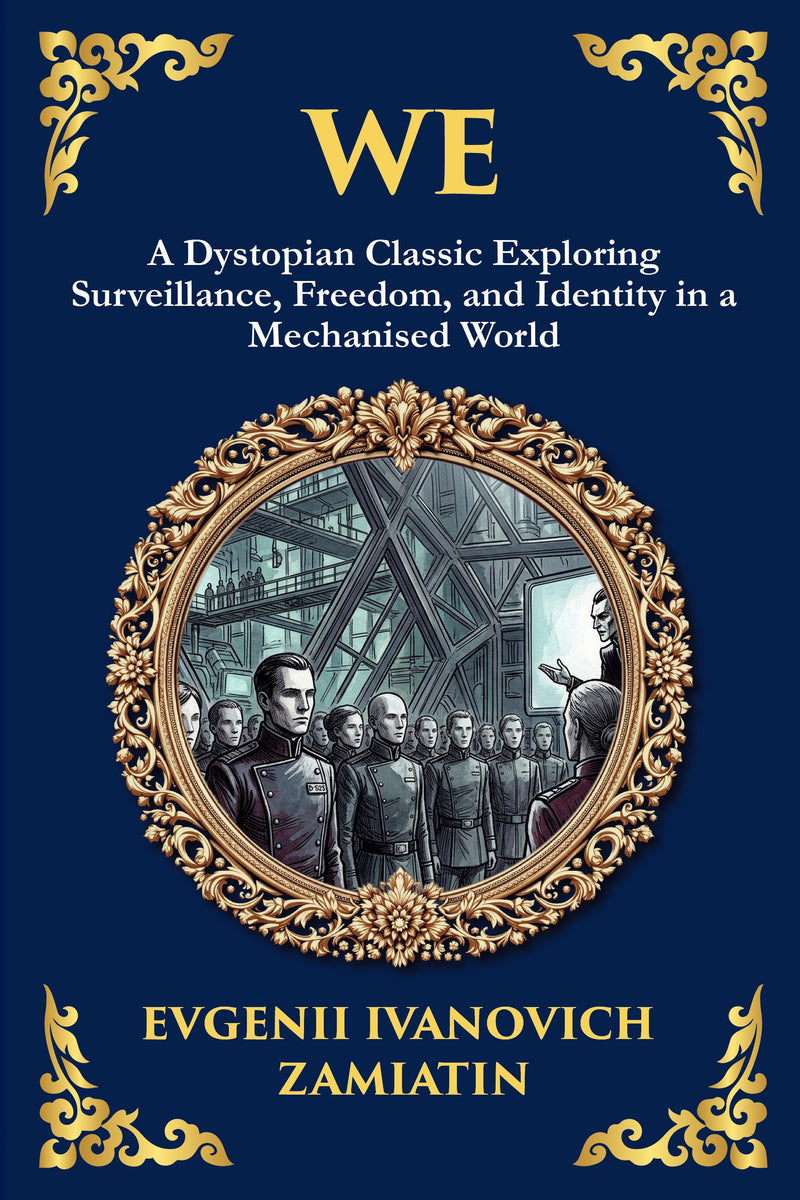
We
Evgenii Zamiatin Before 1984, before Brave New World, there was We—the haunting and prophetic novel that set the stage for all dystopian fiction to come.
or free app
10,000+ hrs library
30-day guarantee
The complete We appears in modern English through Library of Alexandria Press, available online with audiobook narration included for members.
Have you ever wondered why a world without freedom can feel so eerily familiar? We by Evgenii Zamiatin is the original dystopian masterpiece that inspired Orwell’s 1984, Huxley’s Brave New World, and countless others. Written in the aftermath of the Russian Revolution, this visionary novel imagines a future in which the world has become a glass-walled machine: perfect, efficient, and utterly dehumanized.
D-503, a mathematician and engineer of the One State, begins the book as a loyal servant of logic and order. But when he meets I-330, a bold and defiant woman who dares to imagine a life outside of state control, D-503 is thrust into a battle between conformity and consciousness. As he questions the values he once accepted, the cracks in this totalitarian utopia begin to grow.
What you’ll discover in this modern edition
- The Blueprint for Totalitarian Control – Surveillance, censorship, uniformity, and the erasure of personal identity
- A Chilling Glimpse Into the Future – A society where emotions are regulated, names are replaced by numbers, and imagination is a crime
- A Love Story in the Face of Oppression – The inner turmoil of D-503 as he is torn between logic and passion, loyalty and rebellion
- Philosophy Meets Sci-Fi – Rich metaphors, symbolic architecture, and provocative questions about the soul and state
- The Origin of the Modern Dystopia – A literary ancestor to 1984 and Fahrenheit 451, and a bold critique of technocratic tyranny A literary triumph, We stands as a warning and a challenge.
| Formats | eBook (EPUB + PDF) · Audiobook · Paperback · Hardcover · Large Print |
| Language | English |
| Trim size (print) | 6 × 9 in |
| Binding | Paperback — perfect-bound · Hardcover — casewrap |
| Large Print edition | Same text in a larger, easy-read type — a larger font, not a larger trim |
| Print pricing | Every physical book at our true cost — at-cost, no profit (members) |
| Library | 873 restored titles, always growing |
| Length | 61,834 words · ~4 hr 7 min reading |
| Reading level | Grade 7 · an easy, flowing read (this modern-English edition) |
| Edition | Modern English translation · 2026 |
Member reviews for this edition are collected as readers finish it — be the first. Across the library: 12,000+ books shipped, every plan covered by a 365-day print guarantee.
About this edition
A faithful, unabridged modern-English edition by The Library of Alexandria — carefully rendered for today's reader and verified paragraph-by-paragraph against the public-domain source. Available as eBook, audiobook, paperback, hardcover, and large print.
- Complete & unabridgedVerified paragraph by paragraph against the source — never a scan, never abridged.
- Modern English, faithfulReadable today, with the author’s meaning kept intact. Readable — not simplified.
- Every format, one membershipRead in your browser or the free app, or listen to the full audiobook.
Included free with your membership
Cancel anytime, one click · 30-day money-back guarantee
Edition last updated July 2026
What’s inside
We — complete and unabridged: all 41 sections included with membership, plus the full audiobook.
Begin reading We
In clear modern English — the complete text is included with membership.
Introduction
There are books that entertain, books that instruct, and books that change the way we see the world. And then there are the rare few that seem to anticipate it—that peer through the haze of their own era and glimpse, with unsettling clarity, the shape of a future not yet born. We belongs unmistakably to this final category. Written in the chaotic aftermath of the Russian Revolution, in a country only just beginning to imagine what a wholly engineered society might look like, this novel reaches across more than a century to speak directly to our age of data, screens, and constant observation. To open its pages today is to discover a mirror held up not only to the author’s anxieties but to our own.
The book you are holding is a modern translation, carefully adapted for the contemporary reader, and that fact matters more than it may at first appear. The original was composed in a Russian prose so dense, fractured, and deliberately strange that even native speakers have struggled with it. Its sentences fracture mid-thought; its imagery leaps from mathematics to music to physical sensation in the space of a breath. This was no accident—the disjointed style was the point, a formal echo of a mind coming apart and reassembling itself. Yet for the modern reader encountering the work for the first time, the antique density of earlier translations could form a wall rather than a window. This edition aims to dissolve that wall while preserving the strangeness that gives the book its electric charge. The goal is not to flatten the work into something easy, but to make its difficulty legible—to let you feel the disorientation the author intended without being defeated by mere archaism.
Before you begin, it is worth understanding something of where this remarkable text came from, why it was suppressed for so long, and what makes it the secret ancestor of nearly every dystopia you have ever read or watched.
The man who wrote this novel was an engineer by training and a revolutionary by temperament—a combination that would prove fateful for both his life and his art. Born in 1884 in a provincial Russian town, he grew up in the twilight of the old imperial order, the son of an Orthodox priest and a musician. He was drawn early to two things that would never fully reconcile within him: the cold precision of mathematics and machinery on one hand, and the wild, irrational pulse of human feeling on the other. That tension—between the calculable and the unmeasurable, between the line and the curve, between order and chaos—is the very engine of the book before you.
As a young man, he threw himself into radical politics, joining the Bolshevik faction and earning himself arrest, imprisonment, and exile for his trouble. He believed, as so many of his generation did, that the old world was rotten and deserved to be swept away. And yet he was never a comfortable revolutionary, never a man who could surrender his independent judgment to a party line. He distrusted final answers. He distrusted, above all, the seductive promise of perfection—the idea that human society could be solved like an equation, optimized like a machine, and frozen forever in a state of flawless contentment. This skepticism would eventually make him an enemy of the very revolution he had helped to bring about.
His engineering work took him abroad, most significantly to England during the First World War, where he supervised the construction of icebreakers in the shipyards of the north. The experience left deep marks on his imagination. He observed firsthand the relentless logic of industrial production, the way human beings could be subordinated to the rhythms of the factory, the strange beauty and the strange horror of a world built to specification. The gleaming, glass-and-steel city that dominates this novel owes something to those grey English industrial towns, with their regimented routines and their faith in the efficient ordering of human labor. He came to see that the machine was not merely a tool but a philosophy—a way of thinking that, if extended to its logical end, might one day consume the very people it was meant to serve.
When he returned to Russia, he found his country in the throes of transformation. The revolution had triumphed, the old order had fallen, and a new society was being constructed from the ground up. For a time, this was thrilling. But the engineer-revolutionary soon began to notice something troubling in the air—a hardening, a tendency toward orthodoxy, an intolerance of dissent and doubt. He saw the first stirrings of an apparatus that would demand not merely obedience but enthusiasm, not merely compliance but the surrender of the inner self. He saw, in short, the beginnings of the very nightmare his novel describes. He wrote it around 1920 and 1921, in the early years of the Soviet state, and what he produced was less a prophecy than a diagnosis: a clear-eyed examination of where certain ideas, pursued without restraint, would inevitably lead.
The consequences for him were severe. The book could not be published in his homeland. It was the first work ever to be banned by the Soviet censorship board, a distinction that says a great deal about its power to unsettle. It circulated first in translation abroad, appearing in English in the 1920s, and only much later, decades after his death, did it finally appear in his native language in the country that had produced it. The author himself, increasingly silenced and unable to work, eventually petitioned the Soviet leader directly for permission to leave. Remarkably, the request was granted, and he spent his final years in exile in Paris, where he died in relative poverty in 1937, his masterpiece still forbidden in the land it had been written to warn. It is one of the great ironies of literary history that a book so concerned with the suppression of the individual voice should have been suppressed so thoroughly, and for so long.
This biography is not incidental to the reading experience. The novel was written by a man who knew, from the inside, both the intoxication of revolutionary hope and the chill of its betrayal. He was not an outsider sniping at a system he had never understood; he was a believer who had watched belief curdle into something monstrous. This is why the book carries such conviction. It is not propaganda. It does not offer easy villains or comforting reassurances. Its central question is genuinely agonizing: What if happiness and freedom are incompatible? What if the price of perfect order is the death of the soul—and what if a great many people would gladly pay it?
To understand why this novel matters so enormously, you must understand the role it played in the history of literature. Put simply, it is the source from which an entire river of imaginative writing flows. The famous dystopias of the twentieth century—the totalitarian nightmare of perpetual surveillance and rewritten truth, the pleasure-drugged conformity of a genetically engineered world state—owe profound and acknowledged debts to this book. One of the most celebrated English dystopian novelists reviewed the work and clearly absorbed its lessons; the author of perhaps the most famous dystopia of all read it and praised it, and the parallels between his masterpiece and this one are too numerous to be coincidental. When you read about an all-seeing authority, a society in which citizens are known by numbers rather than names, a state that has abolished privacy in the name of collective happiness, a rebellion sparked by forbidden desire—you are reading variations on themes that were first orchestrated here.
This is not to diminish the works that followed. They are magnificent in their own right, and each adds something distinctive to the tradition. But there is a particular thrill in returning to the headwaters, in encountering the original articulation of ideas that have since become the common furniture of our cultural imagination. Reading this novel is like hearing a familiar piece of music played for the first time on the instrument for which it was composed. Everything is recognizable, and yet everything is fresh, because here the ideas are still raw, still dangerous, still being discovered in the act of writing.
What sets this book apart from its descendants is its extraordinary form. Most dystopian novels are written in clear, functional prose—deliberately so, since their authors want the horror of their imagined worlds to register without distraction. This novel takes the opposite approach. It is told through the diary entries of its narrator, a brilliant mathematician and engineer, a man utterly devoted to the rational order of his society, who begins writing as a celebration of that order and finds, to his growing terror, that the act of writing is awakening something in him he cannot control. The prose is fragmentary, feverish, shot through with mathematical metaphors and sudden bursts of poetic imagery. Words break off mid-sentence. Thoughts collide. The narrator reaches for the language of equations to describe his feelings and finds the equations dissolving in his hands.
This style can be challenging, and it would be dishonest to pretend otherwise. But it is challenging on purpose, and once you attune yourself to its rhythms, it becomes one of the great pleasures of the book. The fractured prose is not a flaw to be endured but the very substance of the novel’s meaning. We are watching, in real time, the disintegration of a mind that has been trained to think only in straight lines as it confronts the curves and irrationalities of genuine human experience. The form is the content. The breakdown of the sentences mirrors the breakdown of the narrator’s certainties. As his world becomes stranger and more dangerous, his language becomes stranger too, until the boundary between observer and observed, between sanity and its opposite, begins to blur.
The modern translation you are about to read has been crafted with great care to honor this stylistic ambition while making it accessible. Earlier English versions sometimes rendered the prose so literally that its strangeness tipped over into mere confusion, leaving readers lost rather than productively disoriented. This edition seeks the balance the author himself was striving for: difficulty that rewards rather than frustrates, strangeness that illuminates rather than obscures. The mathematical imagery has been rendered with attention to clarity, so that the reader without a scientific background can follow the narrator’s logic and feel its seductive appeal. The poetic passages retain their music. And the overall experience—of being inside a mind that is coming apart and reassembling itself in unexpected ways—has been preserved as the central achievement it is.
A word about the imagery is worth offering here, because it is one of the book’s most distinctive features and may be unfamiliar to readers steeped in the more naturalistic dystopias that followed. The author was deeply influenced by the artistic movements of his time—by the bold geometries of modernist painting, by the cult of the machine, by a fascination with color and number and abstract form. His descriptions are intensely visual and synaesthetic. Sounds have colors. Emotions have shapes. People are described in terms of geometric figures—curves and angles, X’s and triangles. The city itself is a marvel of glass and crystalline structure, transparent and dazzling, where nothing can be hidden because everything can be seen. There is a strange beauty to all of this, and it is essential to grasp that beauty if you are to understand the novel’s deepest provocation. The world it depicts is not crudely ugly or obviously evil. It is, in many ways, gorgeous. It is clean, bright, orderly, and rational. It has eliminated the chaos and suffering of ordinary human life. And that is precisely what makes it so terrifying—because it tempts us, just as it tempts the narrator, to wonder whether such a trade might not be worth making.
Cancel anytime, one click · 30-day money-back guarantee
Founding annual rate available now — your price locks for life when you join.
Not ready? Get this free chapter by email — read it anytime.
✓ Sent — check your inbox for We.
Questions about We
What is We about?
Evgenii Zamiatin Before 1984, before Brave New World, there was We—the haunting and prophetic novel that set the stage for all dystopian fiction to come. In a cold and ordered future, where the individual has been erased and only the collective We remains, D-503, a loyal citizen of the One State, begins to question everything when he falls under the spell of a mysterious woman and awakens to forbidden thoughts. Told through a series of intimate journal entries, We chronicles one man’s awakening in a world without p
Who wrote We?
We was written by Evgenii Ivanovich Zamiatin. This edition presents the complete work in clear modern English, faithfully rendered from the public-domain original by Library of Alexandria Press.
Is We free to read?
The opening chapter is free to read on this page. Members read and listen to the complete work — and the entire library — free, and can order any physical book at our true print cost.
How long is We?
41 chapters (~61,834 words) — about 4 hr 7 min of reading in this modern-English edition.
Is this an abridged version of We?
No. This is the complete, unabridged We, carefully rendered into clear modern English and verified paragraph-by-paragraph against the public-domain source — nothing is cut or summarised.
What formats does We come in?
We is available as eBook, paperback, hardcover and large print. eBook and audiobook are included with membership; printed editions ship at our true print cost.
Shipping & returns
Billing & membership
More from the library


Explore Science Fiction
- The Island of Doctor Moreau · H. G. Wells
- A Midsummer Night’s Dream · William Shakespeare
- The Invisible Man: A Grotesque Romance · H. G. Wells
- The War of the Worlds · H. G. Wells
- The Strange Case of Dr. Jekyll and Mr. Hyde · Robert Louis Stevenson
- Limanora: the island of progress · Godfrey Sweven
- The Book of Dragons · E. Nesbit
- She · H. Rider Haggard
- Dorothy and the Wizard in Oz · L. Frank Baum
- The Princess and the Goblin · George MacDonald
- Gawayne and the Green Knight: A Fairy Tale · Charlton M. Lewis
- Lucian’s True History · Lucian of Samosata
- The Willows · Algernon Blackwood
- The Call of Cthulhu · H. P. Lovecraft
- The Life-Eater · Harold Ward
- The Marvelous Land of Oz · L. Frank Baum
- Mars is My Destination · Frank Belknap Long
- The Black Kiss
- The Beasts in the Void · Paul W. Fairman
- John Jones’s Dollar · Harry Stephen Keeler
- Subversive · Mack Reynolds
- The Mississippi Saucer · Frank Belknap Long
- Man of Distinction · Michael Shaara
- Spawn of the Comet · H. Thompson Rich
- The Golden Judge · Nathaniel Gordon
- Final Weapon · Everett B. Cole
- The Big Fix · George O. Smith
- Last Enemy · H. Beam Piper
- Time and Time Again · H. Beam Piper
- Sabotage in Space · Carey Rockwell
We
We
A Dystopian Classic Exploring Surveillance, Freedom, and Identity in a Mechanized World
Evgenii Ivanovich Zamiatin
Contents
- Introduction
- Chapter 1
- Chapter 2
- Chapter 3
- Chapter 4
- Chapter 5
- Chapter 6
- Chapter 7
- Chapter 8
- Chapter 9
- Chapter 10
- Chapter 11
- Chapter 12
- Chapter 13
- Chapter 14
- Chapter 15
- Chapter 16
- Chapter 17
- Chapter 18
- Chapter 19
- Chapter 20
- Chapter 21
- Chapter 22
- Chapter 23
- Chapter 24
- Chapter 25
- Chapter 26
- Chapter 27
- Chapter 28
- Chapter 29
- Chapter 30
- Chapter 31
- Chapter 32
- Chapter 33
- Chapter 34
- Chapter 35
- Chapter 36
- Chapter 37
- Chapter 38
- Chapter 39
- … and 1 more chapters
Introduction
There are books that entertain, books that instruct, and books that change the way we see the world. And then there are the rare few that seem to anticipate it—that peer through the haze of their own era and glimpse, with unsettling clarity, the shape of a future not yet born. We belongs unmistakably to this final category. Written in the chaotic aftermath of the Russian Revolution, in a country only just beginning to imagine what a wholly engineered society might look like, this novel reaches across more than a century to speak directly to our age of data, screens, and constant observation. To open its pages today is to discover a mirror held up not only to the author’s anxieties but to our own.
The book you are holding is a modern translation, carefully adapted for the contemporary reader, and that fact matters more than it may at first appear. The original was composed in a Russian prose so dense, fractured, and deliberately strange that even native speakers have struggled with it. Its sentences fracture mid-thought; its imagery leaps from mathematics to music to physical sensation in the space of a breath. This was no accident—the disjointed style was the point, a formal echo of a mind coming apart and reassembling itself. Yet for the modern reader encountering the work for the first time, the antique density of earlier translations could form a wall rather than a window. This edition aims to dissolve that wall while preserving the strangeness that gives the book its electric charge. The goal is not to flatten the work into something easy, but to make its difficulty legible—to let you feel the disorientation the author intended without being defeated by mere archaism.
Before you begin, it is worth understanding something of where this remarkable text came from, why it was suppressed for so long, and what makes it the secret ancestor of nearly every dystopia you have ever read or watched.
The man who wrote this novel was an engineer by training and a revolutionary by temperament—a combination that would prove fateful for both his life and his art. Born in 1884 in a provincial Russian town, he grew up in the twilight of the old imperial order, the son of an Orthodox priest and a musician. He was drawn early to two things that would never fully reconcile within him: the cold precision of mathematics and machinery on one hand, and the wild, irrational pulse of human feeling on the other. That tension—between the calculable and the unmeasurable, between the line and the curve, between order and chaos—is the very engine of the book before you.
As a young man, he threw himself into radical politics, joining the Bolshevik faction and earning himself arrest, imprisonment, and exile for his trouble. He believed, as so many of his generation did, that the old world was rotten and deserved to be swept away. And yet he was never a comfortable revolutionary, never a man who could surrender his independent judgment to a party line. He distrusted final answers. He distrusted, above all, the seductive promise of perfection—the idea that human society could be solved like an equation, optimized like a machine, and frozen forever in a state of flawless contentment. This skepticism would eventually make him an enemy of the very revolution he had helped to bring about.
His engineering work took him abroad, most significantly to England during the First World War, where he supervised the construction of icebreakers in the shipyards of the north. The experience left deep marks on his imagination. He observed firsthand the relentless logic of industrial production, the way human beings could be subordinated to the rhythms of the factory, the strange beauty and the strange horror of a world built to specification. The gleaming, glass-and-steel city that dominates this novel owes something to those grey English industrial towns, with their regimented routines and their faith in the efficient ordering of human labor. He came to see that the machine was not merely a tool but a philosophy—a way of thinking that, if extended to its logical end, might one day consume the very people it was meant to serve.
When he returned to Russia, he found his country in the throes of transformation. The revolution had triumphed, the old order had fallen, and a new society was being constructed from the ground up. For a time, this was thrilling. But the engineer-revolutionary soon began to notice something troubling in the air—a hardening, a tendency toward orthodoxy, an intolerance of dissent and doubt. He saw the first stirrings of an apparatus that would demand not merely obedience but enthusiasm, not merely compliance but the surrender of the inner self. He saw, in short, the beginnings of the very nightmare his novel describes. He wrote it around 1920 and 1921, in the early years of the Soviet state, and what he produced was less a prophecy than a diagnosis: a clear-eyed examination of where certain ideas, pursued without restraint, would inevitably lead.
The consequences for him were severe. The book could not be published in his homeland. It was the first work ever to be banned by the Soviet censorship board, a distinction that says a great deal about its power to unsettle. It circulated first in translation abroad, appearing in English in the 1920s, and only much later, decades after his death, did it finally appear in his native language in the country that had produced it. The author himself, increasingly silenced and unable to work, eventually petitioned the Soviet leader directly for permission to leave. Remarkably, the request was granted, and he spent his final years in exile in Paris, where he died in relative poverty in 1937, his masterpiece still forbidden in the land it had been written to warn. It is one of the great ironies of literary history that a book so concerned with the suppression of the individual voice should have been suppressed so thoroughly, and for so long.
This biography is not incidental to the reading experience. The novel was written by a man who knew, from the inside, both the intoxication of revolutionary hope and the chill of its betrayal. He was not an outsider sniping at a system he had never understood; he was a believer who had watched belief curdle into something monstrous. This is why the book carries such conviction. It is not propaganda. It does not offer easy villains or comforting reassurances. Its central question is genuinely agonizing: What if happiness and freedom are incompatible? What if the price of perfect order is the death of the soul—and what if a great many people would gladly pay it?
To understand why this novel matters so enormously, you must understand the role it played in the history of literature. Put simply, it is the source from which an entire river of imaginative writing flows. The famous dystopias of the twentieth century—the totalitarian nightmare of perpetual surveillance and rewritten truth, the pleasure-drugged conformity of a genetically engineered world state—owe profound and acknowledged debts to this book. One of the most celebrated English dystopian novelists reviewed the work and clearly absorbed its lessons; the author of perhaps the most famous dystopia of all read it and praised it, and the parallels between his masterpiece and this one are too numerous to be coincidental. When you read about an all-seeing authority, a society in which citizens are known by numbers rather than names, a state that has abolished privacy in the name of collective happiness, a rebellion sparked by forbidden desire—you are reading variations on themes that were first orchestrated here.
This is not to diminish the works that followed. They are magnificent in their own right, and each adds something distinctive to the tradition. But there is a particular thrill in returning to the headwaters, in encountering the original articulation of ideas that have since become the common furniture of our cultural imagination. Reading this novel is like hearing a familiar piece of music played for the first time on the instrument for which it was composed. Everything is recognizable, and yet everything is fresh, because here the ideas are still raw, still dangerous, still being discovered in the act of writing.
What sets this book apart from its descendants is its extraordinary form. Most dystopian novels are written in clear, functional prose—deliberately so, since their authors want the horror of their imagined worlds to register without distraction. This novel takes the opposite approach. It is told through the diary entries of its narrator, a brilliant mathematician and engineer, a man utterly devoted to the rational order of his society, who begins writing as a celebration of that order and finds, to his growing terror, that the act of writing is awakening something in him he cannot control. The prose is fragmentary, feverish, shot through with mathematical metaphors and sudden bursts of poetic imagery. Words break off mid-sentence. Thoughts collide. The narrator reaches for the language of equations to describe his feelings and finds the equations dissolving in his hands.
This style can be challenging, and it would be dishonest to pretend otherwise. But it is challenging on purpose, and once you attune yourself to its rhythms, it becomes one of the great pleasures of the book. The fractured prose is not a flaw to be endured but the very substance of the novel’s meaning. We are watching, in real time, the disintegration of a mind that has been trained to think only in straight lines as it confronts the curves and irrationalities of genuine human experience. The form is the content. The breakdown of the sentences mirrors the breakdown of the narrator’s certainties. As his world becomes stranger and more dangerous, his language becomes stranger too, until the boundary between observer and observed, between sanity and its opposite, begins to blur.
The modern translation you are about to read has been crafted with great care to honor this stylistic ambition while making it accessible. Earlier English versions sometimes rendered the prose so literally that its strangeness tipped over into mere confusion, leaving readers lost rather than productively disoriented. This edition seeks the balance the author himself was striving for: difficulty that rewards rather than frustrates, strangeness that illuminates rather than obscures. The mathematical imagery has been rendered with attention to clarity, so that the reader without a scientific background can follow the narrator’s logic and feel its seductive appeal. The poetic passages retain their music. And the overall experience—of being inside a mind that is coming apart and reassembling itself in unexpected ways—has been preserved as the central achievement it is.
A word about the imagery is worth offering here, because it is one of the book’s most distinctive features and may be unfamiliar to readers steeped in the more naturalistic dystopias that followed. The author was deeply influenced by the artistic movements of his time—by the bold geometries of modernist painting, by the cult of the machine, by a fascination with color and number and abstract form. His descriptions are intensely visual and synaesthetic. Sounds have colors. Emotions have shapes. People are described in terms of geometric figures—curves and angles, X’s and triangles. The city itself is a marvel of glass and crystalline structure, transparent and dazzling, where nothing can be hidden because everything can be seen. There is a strange beauty to all of this, and it is essential to grasp that beauty if you are to understand the novel’s deepest provocation. The world it depicts is not crudely ugly or obviously evil. It is, in many ways, gorgeous. It is clean, bright, orderly, and rational. It has eliminated the chaos and suffering of ordinary human life. And that is precisely what makes it so terrifying—because it tempts us, just as it tempts the narrator, to wonder whether such a trade might not be worth making.
This is a word-for-word copy of what was published this morning in the State newspaper:
“The construction of the Integral will be finished in another 120 days. The great historic moment is near, when the first Integral will launch into the limitless space of the universe. A thousand years ago, your heroic ancestors brought the entire earth under the power of the United State. An even more glorious task now lies before you: to solve the infinite equation of the Cosmos using the glass, electric, fire-breathing Integral. Your mission is to bring the unknown beings of other planets—who may still be in a primitive state of freedom—under the grateful rule of reason. If they do not understand that we are bringing them a mathematically perfect happiness, it will be our duty to force them to be happy. But before we take up arms, we will try the power of words.
“In the name of The Well-Doer, the following is announced to all Numbers of the United State:
“Anyone who feels capable should consider it their duty to write essays, poems, manifestos, odes, and other works on the greatness and beauty of the United State.
“This will be the first cargo the Integral carries.
“Long live the United State! Long live the Numbers!! Long live the Well-Doer!!!”
I feel my cheeks burning as I write this. To solve the colossal, universal equation! To bend the wild curve and straighten it into a tangent—a straight line! For the United State is a straight line: a great, divine, precise, and wise line—the wisest of lines!
I, D-503, the builder of the Integral, am just one of the many mathematicians of the United State. My pen, used to figures, struggles to express the rhythm of harmony; therefore, I will try to record only what I see and what I think—or more accurately, what we think. Yes, we; that is exactly what I mean, and therefore, “We” shall be the title of my records. But this will only be a reflection of our life—of our mathematically perfect life in the United State. If that is the case, won’t this reflection be a poem in itself, despite my limitations? It will. I believe it; I know it.
End of the free sample
Keep reading, free
Members read and listen to the complete book — and the entire library. Cancel anytime, one click · 30-day money-back guarantee.