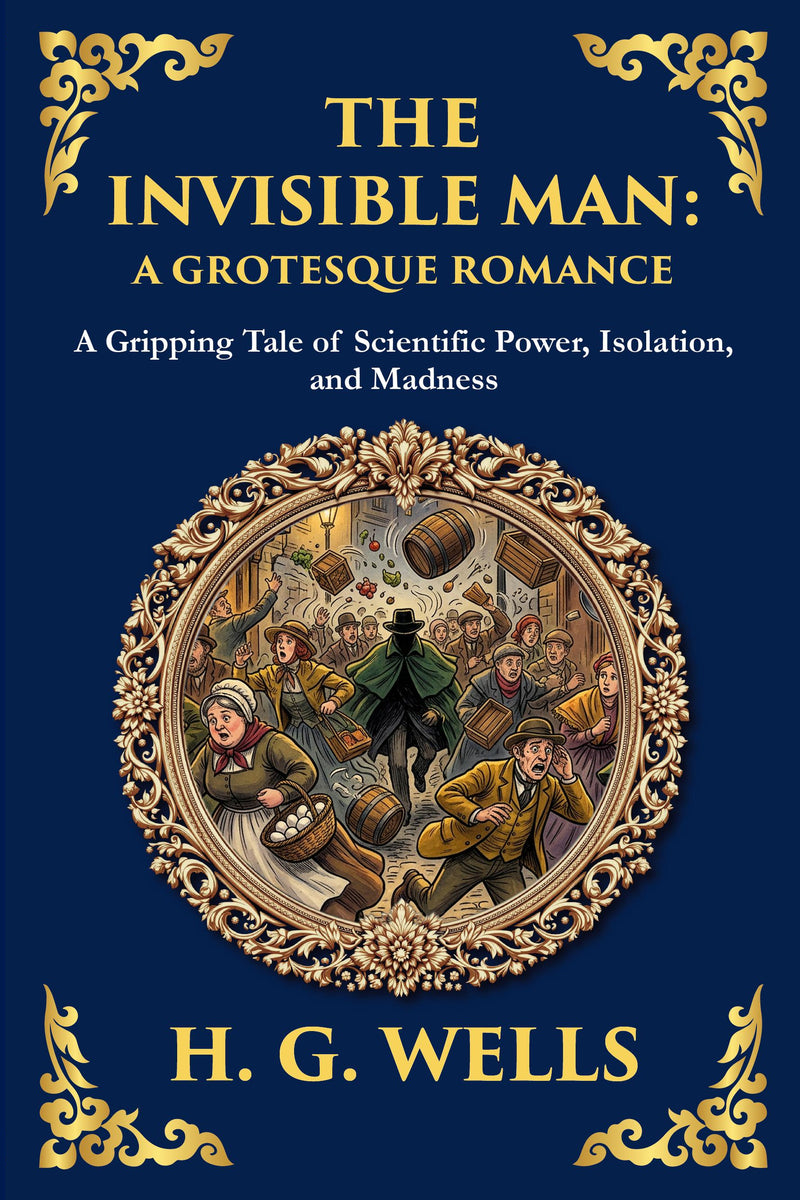
The Invisible Man: A Grotesque Romance
In a world where science pushes the boundaries of the possible, one man dares to vanish entirely. The Invisible Man is H. G. Wells’ haunting tale of Griffin, a brilliant but unhinged scientist who unlocks the secret of invisibility—only to descend into madness and terror.
or free app
10,000+ hrs library
30-day guarantee
The complete The Invisible Man: A Grotesque appears in modern English through Library of Alexandria Press, available online with audiobook narration included for members.
Have you ever wondered why some discoveries are best left unexplored? The Invisible Man: A Grotesque Romance by H. G. Wells is a searing exploration of ambition, alienation, and the destructive thirst for control. Far from a simple tale of science gone awry, this novel is a psychological descent into what happens when a man removes himself—literally and figuratively—from the moral boundaries of society.
Griffin, a gifted physicist driven by obsession, unlocks the ability to make himself invisible. But what begins as a triumph of intellect quickly transforms into a spiral of paranoia and cruelty. Lacking the ability to reverse his condition, he isolates himself from the world and becomes increasingly unhinged.
Without identity, without consequence, and without connection, he slips from scientist to specter… and finally, to menace. Set against the foggy backdrop of rural England and steeped in the anxieties of the modern world, The Invisible Man is both a gripping thriller and a profound meditation on isolation, power, and the moral limits of invention.
What you’ll discover in this modern edition
- The Tragic Journey of a Brilliant Mind – Witness the transformation of Griffin from genius to outcast, visionary to villain
- A Haunting Tale of Isolation and Power – Explore the psychological cost of becoming untouchable and unseen
- A Milestone in Science Fiction Literature – One of the earliest and most enduring works of speculative fiction
- Themes That Echo in Modern Times – Surveillance, identity, ego, and the ethics of innovation
- A Masterclass in Suspense and Dread – Wells builds tension with atmospheric settings, tight pacing, and chilling moral stakes The Invisible Man is more than a horror story—it’s a warning.
| Formats | eBook (EPUB + PDF) · Audiobook · Paperback · Hardcover · Large Print |
| Language | English |
| Trim size (print) | 6 × 9 in |
| Binding | Paperback — perfect-bound · Hardcover — casewrap |
| Large Print edition | Same text in a larger, easy-read type — a larger font, not a larger trim |
| Print pricing | Every physical book at our true cost — at-cost, no profit (members) |
| Library | 873 restored titles, always growing |
| Length | 49,858 words · ~3 hr 19 min reading |
| Reading level | Grade 7 · an easy, flowing read (this modern-English edition) |
| Edition | Modern English translation · 2026 |
Member reviews for this edition are collected as readers finish it — be the first. Across the library: 12,000+ books shipped, every plan covered by a 365-day print guarantee.
About this edition
A faithful, unabridged modern-English edition by The Library of Alexandria — carefully rendered for today's reader and verified paragraph-by-paragraph against the public-domain source. Available as eBook, audiobook, paperback, hardcover, and large print.
- Complete & unabridgedVerified paragraph by paragraph against the source — never a scan, never abridged.
- Modern English, faithfulReadable today, with the author’s meaning kept intact. Readable — not simplified.
- Every format, one membershipRead in your browser or the free app, or listen to the full audiobook.
Included free with your membership
Cancel anytime, one click · 30-day money-back guarantee
Edition last updated July 2026
What’s inside
The Invisible Man: A Grotesque Romance — complete and unabridged: all 30 sections included with membership, plus the full audiobook.
Begin reading The Invisible Man: A Grotesque Romance
In clear modern English — the complete text is included with membership.
Introduction
When H. G. Wells published The Invisible Man in 1897, he was a young writer at the height of an extraordinary creative surge, producing in just a few short years a body of work that would help define an entirely new kind of storytelling. Within the span of the late 1890s, Wells gave the world The Time Machine, The Island of Doctor Moreau, The War of the Worlds, and the strange, unsettling tale you are about to read. These were not simply adventure stories or fantasies. They were probing investigations into the nature of human ambition, the limits of science, and the fragile assumptions that hold civilization together. Of all of them, The Invisible Man may be the most intimate and the most psychologically penetrating, for it turns its gaze not upon distant planets or far-flung futures, but upon a single human mind and the terrible consequences of one man’s pursuit of a forbidden power.
The premise is deceptively simple. A stranger arrives in a quiet English village, swathed head to foot in bandages, his eyes hidden behind dark glasses, his manner brusque and secretive. He wants only to be left alone with his work, and he resents any intrusion into his privacy. The villagers, naturally, are curious. Their curiosity grows into suspicion, and their suspicion into fear, until the dreadful truth about the man among them is revealed. From this modest beginning, Wells constructs a narrative that accelerates with the relentless momentum of a fever dream, carrying the reader from comic misunderstanding into genuine horror, and from horror into something that feels uncomfortably like tragedy.
What makes this novel endure, more than a century and a quarter after its first appearance, is the way Wells refuses to let his fantastical conceit remain merely a spectacle. Invisibility, in lesser hands, might have been an excuse for a string of pranks and escapes, a clever party trick spun out to fill a book. Wells understood that the real story lay deeper. He asked himself a question that goes to the heart of human ethics: what would a person do, who could do anything, if no one could ever see him do it? Strip away the possibility of being observed, of being held accountable, of being caught, and what remains of a man’s morality? This is the question that pulses beneath every page, and it is a question that has lost none of its urgency in our own age of surveillance and anonymity, of digital masks and hidden identities. The man who cannot be seen is, in some profound sense, a man who has been released from the social contract, and Wells follows that release to its logical and devastating conclusion.
This edition presents Wells’s classic in a modern translation, carefully adapted for the contemporary reader. The aim of this adaptation is not to diminish or simplify the original, but to clear away the obstacles that can sometimes stand between a modern audience and a Victorian text. Wells wrote in the idiom of his time, with the rhythms, vocabulary, and assumptions of late nineteenth-century England woven through every sentence. For readers in the twenty-first century, some of those rhythms can feel distant, and some of the references obscure. What this edition offers is a reading experience in which the brilliance of the storytelling shines through unimpeded, in which the tension builds without the friction of archaic phrasing, and in which the full force of Wells’s imagination reaches you as directly as it reached his original audience. The essential character of the work remains intact: the wit, the menace, the steadily mounting dread, the flashes of dark humor, and above all the profound moral seriousness that lurks beneath the surface of what looks, at first glance, like a simple thriller.
To understand the impact of this novel, it helps to imagine the world into which it was born. The closing years of the nineteenth century were a period of dizzying scientific advance and equally dizzying anxiety about where that advance might lead. The achievements of the era were genuinely staggering. Electricity was transforming daily life. The germ theory of disease was revolutionizing medicine. New chemicals, new materials, new machines seemed to arrive almost daily, each one promising to remake some corner of human existence. To many observers, science appeared to be a kind of secular magic, a force capable of granting wishes that had been beyond the reach of all previous generations. There was a heady optimism in the air, a sense that the human race stood on the threshold of unprecedented mastery over nature.
But alongside this optimism ran a darker current of unease. If science could grant such power, who would wield it, and to what ends? The same chemistry that produced medicines could produce poisons. The same engineering that built bridges could build weapons. And the same intellect that unlocked the secrets of the universe might, in its arrogance, forget that it was still bound by human limitations and human responsibilities. Wells, who had himself trained as a scientist under the great biologist Thomas Henry Huxley, was acutely sensitive to this double-edged quality of scientific progress. He admired science deeply and believed in its capacity to improve human life, but he was also profoundly aware of its dangers, particularly when divorced from any ethical framework or any sense of the common good.
The central figure of this novel embodies that danger in its purest form. He is a man of genuine brilliance, a researcher whose intellectual gifts allow him to achieve something that no one before him has achieved. But his brilliance is unaccompanied by wisdom, his ambition unchecked by conscience, and his isolation from ordinary human bonds renders him incapable of using his discovery for anything but his own ends. Here Wells anticipates a theme that would dominate the science fiction of the following century and beyond: the figure of the scientist who, in reaching for godlike power, loses his own humanity in the process. We see echoes of this archetype everywhere in modern culture, from the tortured creators of countless films and novels to the very real ethical debates that surround the most powerful technologies of our own day. When Wells wrote his cautionary tale, he was not merely entertaining his readers. He was warning them, and the warning has only grown louder with time.
Yet it would be a mistake to read this book purely as a sermon or a thesis dressed up in fictional clothing. Wells was, first and foremost, a magnificent storyteller, and the pleasures of this novel are abundant and immediate. The opening chapters, set in the snowbound village of Iping, possess a wonderful comic energy. The stranger’s arrival at the local inn, the bafflement of the innkeeper and her husband, the gossip that circulates among the villagers, the petty rivalries and small-town suspicions—all of this is rendered with a sharp eye for human folly and a genuine affection for the ordinary people whose quiet lives are about to be turned upside down. There is something delicious in watching the mundane world of rural England, with its concerns about rent and respectability and the proper way to treat a paying guest, collide with the utterly impossible.
This contrast between the ordinary and the extraordinary is one of Wells’s great gifts as a writer. He understood that the fantastic becomes most vivid, most believable, and most frightening when it is set against a backdrop of unremarkable reality. A monster in a haunted castle is one thing; a monster in a familiar village inn, surrounded by familiar people doing familiar things, is something far more disturbing. By grounding his impossible premise in the texture of everyday life, Wells achieves a peculiar kind of plausibility. We find ourselves believing in the unbelievable precisely because everything around it is so recognizably real. This technique would become a hallmark of the best science fiction, and few writers have ever employed it with greater skill than Wells does here.
As the story progresses, the comic tone darkens by degrees. What begins as a tale of village curiosity becomes a tale of pursuit, of conflict, and finally of something approaching open warfare between one man and the whole of society. The transformation is masterfully handled. Wells never lurches abruptly from comedy to horror; instead he lets the shadows gather slowly, so that by the time we realize how grave the situation has become, we are already fully in its grip. This gradual tightening of tension is one of the novel’s greatest pleasures, and it rewards the patient reader who allows the atmosphere to accumulate rather than rushing toward the climax.
At the center of everything stands the figure of the invisible man himself, and it is here that Wells’s psychological insight reveals its full depth. It would have been easy to make this character a simple villain, a wicked man who uses his power for wicked ends. Wells does something far more interesting and far more troubling. He gives us a man who is, in many ways, sympathetic—a man of real ability who has suffered real frustrations, who has struggled against poverty and obscurity, who has poured years of his life into his great work. We can understand the hunger that drove him, the desire to achieve something remarkable, to escape the limitations that hemmed him in. There is a part of us, perhaps, that recognizes that hunger in ourselves.
And yet, as the story unfolds, we watch this man’s character disintegrate under the pressure of his own power. The invisibility that he sought as a triumph becomes, instead, a curse. It isolates him from human contact, makes ordinary life impossible, and gradually erodes whatever was decent in him. Freed from the gaze of others, he is also freed from the restraints that the gaze of others imposes. He becomes increasingly desperate, increasingly violent, increasingly detached from any recognition of other people as fellow human beings deserving of consideration. By the end, we are confronted with a question that Wells leaves deliberately, hauntingly open: was this man corrupted by his power, or did his power simply reveal what was always there, hidden beneath the conventions of civilized behavior?
This ambiguity is part of what gives the novel its lasting power. Wells does not hand us easy answers. He does not assure us that we ourselves, in similar circumstances, would behave any better. Instead he presents us with a kind of experiment, a thought-provoking scenario that forces us to examine our own assumptions about morality, accountability, and the sources of human decency. Are we good because we are good, or are we good because we are watched? Would the removal of consequences reveal us as saints or as monsters? These are uncomfortable questions, and Wells has the courage to pose them without flinching.
The psychological realism of the central character is matched by Wells’s keen understanding of crowd behavior and social dynamics. Throughout the novel, we see how ordinary people react to the presence of something they cannot understand—first with curiosity, then with suspicion, then with fear, and finally with a kind of collective fury. Wells was a sharp observer of human nature in groups, and his depiction of how a community responds to a threat in its midst is both convincing and unsettling. There is a mob mentality that takes hold, a willingness to abandon reason and decency in the face of the unknown, that feels as relevant today as it did in Wells’s own time. The novel is, among other things, a study of how societies respond to that which lies outside their experience, and the picture it paints is not always flattering.
One of the remarkable achievements of the book is the way it makes invisibility itself feel real and consequential. Wells thought through the implications of his premise with the rigor of a trained scientist. He considered the practical problems that an invisible man would face—how he would eat, how he would stay warm, how he would move through a world built for visible people, how the very advantage of invisibility might become, in unexpected ways, a terrible disadvantage. These details ground the fantasy and make it intellectually satisfying. We are not asked simply to accept a magical premise and move on; we are invited to think carefully about what such a condition would actually mean, with all its inconveniences and dangers as well as its powers. This commitment to working out the logic of an impossible idea is one of the things that distinguishes genuine science fiction from mere fantasy, and Wells was among the first and finest practitioners of the form.
Cancel anytime, one click · 30-day money-back guarantee
Founding annual rate available now — your price locks for life when you join.
Not ready? Get this free chapter by email — read it anytime.
✓ Sent — check your inbox for The Invisible Man: A Grotesque Romance.
Questions about The Invisible Man: A Grotesque Romance
What is The Invisible Man: A Grotesque about?
In a world where science pushes the boundaries of the possible, one man dares to vanish entirely. The Invisible Man is H. G. Wells’ haunting tale of Griffin, a brilliant but unhinged scientist who unlocks the secret of invisibility—only to descend into madness and terror. As Griffin struggles with his newfound condition, he becomes estranged from humanity, obsessed with power, and hunted by those who once welcomed him.
Who wrote The Invisible Man: A Grotesque?
The Invisible Man: A Grotesque was written by H. G. Wells. This edition presents the complete work in clear modern English, faithfully rendered from the public-domain original by Library of Alexandria Press.
Is The Invisible Man: A Grotesque free to read?
The opening chapter is free to read on this page. Members read and listen to the complete work — and the entire library — free, and can order any physical book at our true print cost.
How long is The Invisible Man: A Grotesque?
30 chapters (~49,858 words) — about 3 hr 19 min of reading in this modern-English edition.
Is this an abridged version of The Invisible Man: A Grotesque?
No. This is the complete, unabridged The Invisible Man: A Grotesque, carefully rendered into clear modern English and verified paragraph-by-paragraph against the public-domain source — nothing is cut or summarised.
What formats does The Invisible Man: A Grotesque come in?
The Invisible Man: A Grotesque is available as eBook, paperback, hardcover and large print. eBook and audiobook are included with membership; printed editions ship at our true print cost.
Shipping & returns
Billing & membership
More from the library


Explore Science Fiction
- The Island of Doctor Moreau · H. G. Wells
- A Midsummer Night’s Dream · William Shakespeare
- The War of the Worlds · H. G. Wells
- The Strange Case of Dr. Jekyll and Mr. Hyde · Robert Louis Stevenson
- Limanora: the island of progress · Godfrey Sweven
- The Book of Dragons · E. Nesbit
- She · H. Rider Haggard
- Dorothy and the Wizard in Oz · L. Frank Baum
- The Princess and the Goblin · George MacDonald
- Gawayne and the Green Knight: A Fairy Tale · Charlton M. Lewis
- Lucian’s True History · Lucian of Samosata
- The Willows · Algernon Blackwood
- The Call of Cthulhu · H. P. Lovecraft
- The Life-Eater · Harold Ward
- The Marvelous Land of Oz · L. Frank Baum
- Mars is My Destination · Frank Belknap Long
- The Black Kiss
- The Beasts in the Void · Paul W. Fairman
- John Jones’s Dollar · Harry Stephen Keeler
- Subversive · Mack Reynolds
- The Mississippi Saucer · Frank Belknap Long
- Man of Distinction · Michael Shaara
- Spawn of the Comet · H. Thompson Rich
- The Golden Judge · Nathaniel Gordon
- Final Weapon · Everett B. Cole
- The Big Fix · George O. Smith
- Last Enemy · H. Beam Piper
- Time and Time Again · H. Beam Piper
- Sabotage in Space · Carey Rockwell
- The Aliens · Murray Leinster
The Invisible Man: A Grotesque Romance
The Invisible Man: A Grotesque Romance
A Gripping Tale of Scientific Power, Isolation, and Madness
H. G. Wells
Contents
- Introduction
- Chapter 1
- Chapter 2
- Chapter 3
- Chapter 4
- Chapter 5
- Chapter 6
- Chapter 7
- Chapter 8
- Chapter 9
- Chapter 10
- Chapter 11
- Chapter 12
- Chapter 13
- Chapter 14
- Chapter 15
- Chapter 16
- Chapter 17
- Chapter 18
- Chapter 19
- Chapter 20
- Chapter 21
- Chapter 22
- Chapter 23
- Chapter 24
- Chapter 25
- Chapter 26
- Chapter 27
- Chapter 28
- Epilogue
Introduction
When H. G. Wells published The Invisible Man in 1897, he was a young writer at the height of an extraordinary creative surge, producing in just a few short years a body of work that would help define an entirely new kind of storytelling. Within the span of the late 1890s, Wells gave the world The Time Machine, The Island of Doctor Moreau, The War of the Worlds, and the strange, unsettling tale you are about to read. These were not simply adventure stories or fantasies. They were probing investigations into the nature of human ambition, the limits of science, and the fragile assumptions that hold civilization together. Of all of them, The Invisible Man may be the most intimate and the most psychologically penetrating, for it turns its gaze not upon distant planets or far-flung futures, but upon a single human mind and the terrible consequences of one man’s pursuit of a forbidden power.
The premise is deceptively simple. A stranger arrives in a quiet English village, swathed head to foot in bandages, his eyes hidden behind dark glasses, his manner brusque and secretive. He wants only to be left alone with his work, and he resents any intrusion into his privacy. The villagers, naturally, are curious. Their curiosity grows into suspicion, and their suspicion into fear, until the dreadful truth about the man among them is revealed. From this modest beginning, Wells constructs a narrative that accelerates with the relentless momentum of a fever dream, carrying the reader from comic misunderstanding into genuine horror, and from horror into something that feels uncomfortably like tragedy.
What makes this novel endure, more than a century and a quarter after its first appearance, is the way Wells refuses to let his fantastical conceit remain merely a spectacle. Invisibility, in lesser hands, might have been an excuse for a string of pranks and escapes, a clever party trick spun out to fill a book. Wells understood that the real story lay deeper. He asked himself a question that goes to the heart of human ethics: what would a person do, who could do anything, if no one could ever see him do it? Strip away the possibility of being observed, of being held accountable, of being caught, and what remains of a man’s morality? This is the question that pulses beneath every page, and it is a question that has lost none of its urgency in our own age of surveillance and anonymity, of digital masks and hidden identities. The man who cannot be seen is, in some profound sense, a man who has been released from the social contract, and Wells follows that release to its logical and devastating conclusion.
This edition presents Wells’s classic in a modern translation, carefully adapted for the contemporary reader. The aim of this adaptation is not to diminish or simplify the original, but to clear away the obstacles that can sometimes stand between a modern audience and a Victorian text. Wells wrote in the idiom of his time, with the rhythms, vocabulary, and assumptions of late nineteenth-century England woven through every sentence. For readers in the twenty-first century, some of those rhythms can feel distant, and some of the references obscure. What this edition offers is a reading experience in which the brilliance of the storytelling shines through unimpeded, in which the tension builds without the friction of archaic phrasing, and in which the full force of Wells’s imagination reaches you as directly as it reached his original audience. The essential character of the work remains intact: the wit, the menace, the steadily mounting dread, the flashes of dark humor, and above all the profound moral seriousness that lurks beneath the surface of what looks, at first glance, like a simple thriller.
To understand the impact of this novel, it helps to imagine the world into which it was born. The closing years of the nineteenth century were a period of dizzying scientific advance and equally dizzying anxiety about where that advance might lead. The achievements of the era were genuinely staggering. Electricity was transforming daily life. The germ theory of disease was revolutionizing medicine. New chemicals, new materials, new machines seemed to arrive almost daily, each one promising to remake some corner of human existence. To many observers, science appeared to be a kind of secular magic, a force capable of granting wishes that had been beyond the reach of all previous generations. There was a heady optimism in the air, a sense that the human race stood on the threshold of unprecedented mastery over nature.
But alongside this optimism ran a darker current of unease. If science could grant such power, who would wield it, and to what ends? The same chemistry that produced medicines could produce poisons. The same engineering that built bridges could build weapons. And the same intellect that unlocked the secrets of the universe might, in its arrogance, forget that it was still bound by human limitations and human responsibilities. Wells, who had himself trained as a scientist under the great biologist Thomas Henry Huxley, was acutely sensitive to this double-edged quality of scientific progress. He admired science deeply and believed in its capacity to improve human life, but he was also profoundly aware of its dangers, particularly when divorced from any ethical framework or any sense of the common good.
The central figure of this novel embodies that danger in its purest form. He is a man of genuine brilliance, a researcher whose intellectual gifts allow him to achieve something that no one before him has achieved. But his brilliance is unaccompanied by wisdom, his ambition unchecked by conscience, and his isolation from ordinary human bonds renders him incapable of using his discovery for anything but his own ends. Here Wells anticipates a theme that would dominate the science fiction of the following century and beyond: the figure of the scientist who, in reaching for godlike power, loses his own humanity in the process. We see echoes of this archetype everywhere in modern culture, from the tortured creators of countless films and novels to the very real ethical debates that surround the most powerful technologies of our own day. When Wells wrote his cautionary tale, he was not merely entertaining his readers. He was warning them, and the warning has only grown louder with time.
Yet it would be a mistake to read this book purely as a sermon or a thesis dressed up in fictional clothing. Wells was, first and foremost, a magnificent storyteller, and the pleasures of this novel are abundant and immediate. The opening chapters, set in the snowbound village of Iping, possess a wonderful comic energy. The stranger’s arrival at the local inn, the bafflement of the innkeeper and her husband, the gossip that circulates among the villagers, the petty rivalries and small-town suspicions—all of this is rendered with a sharp eye for human folly and a genuine affection for the ordinary people whose quiet lives are about to be turned upside down. There is something delicious in watching the mundane world of rural England, with its concerns about rent and respectability and the proper way to treat a paying guest, collide with the utterly impossible.
This contrast between the ordinary and the extraordinary is one of Wells’s great gifts as a writer. He understood that the fantastic becomes most vivid, most believable, and most frightening when it is set against a backdrop of unremarkable reality. A monster in a haunted castle is one thing; a monster in a familiar village inn, surrounded by familiar people doing familiar things, is something far more disturbing. By grounding his impossible premise in the texture of everyday life, Wells achieves a peculiar kind of plausibility. We find ourselves believing in the unbelievable precisely because everything around it is so recognizably real. This technique would become a hallmark of the best science fiction, and few writers have ever employed it with greater skill than Wells does here.
As the story progresses, the comic tone darkens by degrees. What begins as a tale of village curiosity becomes a tale of pursuit, of conflict, and finally of something approaching open warfare between one man and the whole of society. The transformation is masterfully handled. Wells never lurches abruptly from comedy to horror; instead he lets the shadows gather slowly, so that by the time we realize how grave the situation has become, we are already fully in its grip. This gradual tightening of tension is one of the novel’s greatest pleasures, and it rewards the patient reader who allows the atmosphere to accumulate rather than rushing toward the climax.
At the center of everything stands the figure of the invisible man himself, and it is here that Wells’s psychological insight reveals its full depth. It would have been easy to make this character a simple villain, a wicked man who uses his power for wicked ends. Wells does something far more interesting and far more troubling. He gives us a man who is, in many ways, sympathetic—a man of real ability who has suffered real frustrations, who has struggled against poverty and obscurity, who has poured years of his life into his great work. We can understand the hunger that drove him, the desire to achieve something remarkable, to escape the limitations that hemmed him in. There is a part of us, perhaps, that recognizes that hunger in ourselves.
And yet, as the story unfolds, we watch this man’s character disintegrate under the pressure of his own power. The invisibility that he sought as a triumph becomes, instead, a curse. It isolates him from human contact, makes ordinary life impossible, and gradually erodes whatever was decent in him. Freed from the gaze of others, he is also freed from the restraints that the gaze of others imposes. He becomes increasingly desperate, increasingly violent, increasingly detached from any recognition of other people as fellow human beings deserving of consideration. By the end, we are confronted with a question that Wells leaves deliberately, hauntingly open: was this man corrupted by his power, or did his power simply reveal what was always there, hidden beneath the conventions of civilized behavior?
This ambiguity is part of what gives the novel its lasting power. Wells does not hand us easy answers. He does not assure us that we ourselves, in similar circumstances, would behave any better. Instead he presents us with a kind of experiment, a thought-provoking scenario that forces us to examine our own assumptions about morality, accountability, and the sources of human decency. Are we good because we are good, or are we good because we are watched? Would the removal of consequences reveal us as saints or as monsters? These are uncomfortable questions, and Wells has the courage to pose them without flinching.
The psychological realism of the central character is matched by Wells’s keen understanding of crowd behavior and social dynamics. Throughout the novel, we see how ordinary people react to the presence of something they cannot understand—first with curiosity, then with suspicion, then with fear, and finally with a kind of collective fury. Wells was a sharp observer of human nature in groups, and his depiction of how a community responds to a threat in its midst is both convincing and unsettling. There is a mob mentality that takes hold, a willingness to abandon reason and decency in the face of the unknown, that feels as relevant today as it did in Wells’s own time. The novel is, among other things, a study of how societies respond to that which lies outside their experience, and the picture it paints is not always flattering.
One of the remarkable achievements of the book is the way it makes invisibility itself feel real and consequential. Wells thought through the implications of his premise with the rigor of a trained scientist. He considered the practical problems that an invisible man would face—how he would eat, how he would stay warm, how he would move through a world built for visible people, how the very advantage of invisibility might become, in unexpected ways, a terrible disadvantage. These details ground the fantasy and make it intellectually satisfying. We are not asked simply to accept a magical premise and move on; we are invited to think carefully about what such a condition would actually mean, with all its inconveniences and dangers as well as its powers. This commitment to working out the logic of an impossible idea is one of the things that distinguishes genuine science fiction from mere fantasy, and Wells was among the first and finest practitioners of the form.
The stranger arrived early in February on a freezing day. He walked from Bramblehurst station across the downs through a biting wind and driving snow—the last snowfall of the year—carrying a small black suitcase in his thickly gloved hand. He was bundled up from head to toe, and the brim of his soft felt hat hid everything but the shiny tip of his nose. Snow had piled up on his shoulders and chest, forming a white crest on the bag he carried. He staggered into the “Coach and Horses” looking half-dead and dropped his suitcase. “A fire!” he shouted. “For heaven’s sake, a room and a fire!” He stamped the snow off his boots in the bar and followed Mrs. Hall into the guest parlor to negotiate his stay. With that brief introduction and a couple of gold coins tossed on the table, he took up residence at the inn.
Mrs. Hall lit the fire and left him alone while she went to prepare a meal herself. Having a guest stop at Iping in the winter was incredibly lucky, especially one who didn’t haggle over the price, and she was determined to make a great impression. Once the bacon was cooking and she had motivated her sluggish maid, Millie, with a few sharp insults, she brought the tablecloth, plates, and glasses into the parlor and set the table with great flair. Even though the fire was roaring, she was surprised to see that her visitor was still wearing his hat and coat. He stood with his back to her, staring out the window at the snow falling in the yard. His gloved hands were clasped behind him, and he seemed lost in thought. She noticed the melting snow on his shoulders was dripping onto her carpet. “Can I take your hat and coat, sir?” she asked. “I can dry them in the kitchen for you.”
End of the free sample
Keep reading, free
Members read and listen to the complete book — and the entire library. Cancel anytime, one click · 30-day money-back guarantee.