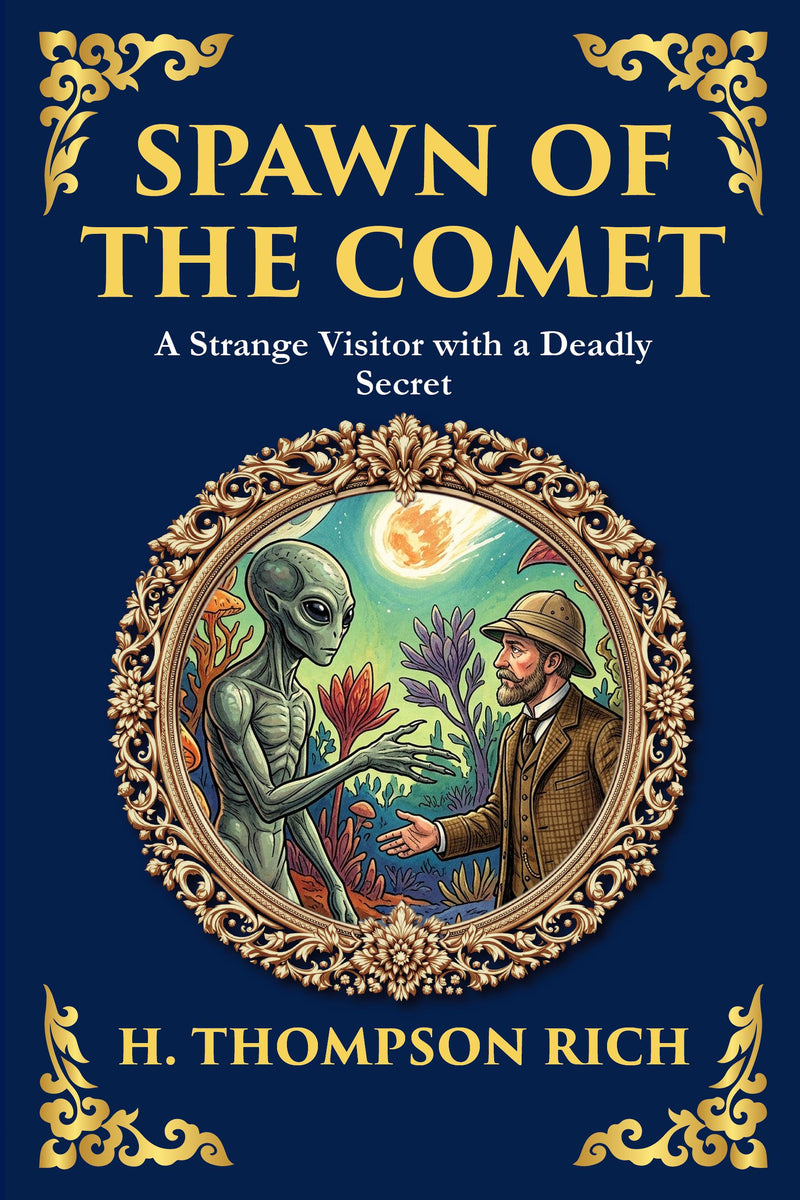
Spawn of the Comet
When a blazing comet streaks across the sky, it brings with it more than awe and wonder. From the scorched remnants of its landing emerges a being unlike anything humanity has ever seen —a creature that looks human, speaks our language, but harbors an origin not of this world.
or free app
10,000+ hrs library
30-day guarantee
The complete Spawn of the Comet appears in modern English through Library of Alexandria Press, available online with audiobook narration included for members.
Have you ever wondered why some miracles come wrapped in silence—and end in catastrophe? Spawn of the Comet is a chilling and thought-provoking work of classic science fiction that blends mystery, suspense, and cosmic horror. When a comet blazes through Earth’s atmosphere and crashes into the planet, scientists, journalists, and governments converge on the site—only to discover something far more disturbing than a celestial rock.
Emerging from the crater is a being perfectly human in appearance, but whose silence, intelligence, and eerie calm unsettle even the most seasoned experts. As the world debates whether it is man, alien, or something in-between, a quiet dread begins to spread: something isn’t right. Soon, events spiral beyond control as unexplained phenomena ripple outward from the arrival.
The “visitor” may not be here to communicate—but to prepare.
What you’ll discover in this modern edition
- A Tense Tale of First Contact with a Twist The visitor doesn’t arrive in a spaceship—but in silence, wrapped in mystery.
| Formats | eBook (EPUB + PDF) · Audiobook · Paperback · Hardcover · Large Print |
| Language | English |
| Trim size (print) | 6 × 9 in |
| Binding | Paperback — perfect-bound · Hardcover — casewrap |
| Large Print edition | Same text in a larger, easy-read type — a larger font, not a larger trim |
| Print pricing | Every physical book at our true cost — at-cost, no profit (members) |
| Library | 873 restored titles, always growing |
| Length | 12,151 words · ~49 min reading |
| Reading level | Grade 3 · an easy, flowing read (this modern-English edition) |
| Edition | Modern English translation · 2026 |
Member reviews for this edition are collected as readers finish it — be the first. Across the library: 12,000+ books shipped, every plan covered by a 365-day print guarantee.
About this edition
A faithful, unabridged modern-English edition by The Library of Alexandria — carefully rendered for today's reader and verified paragraph-by-paragraph against the public-domain source. Available as eBook, audiobook, paperback, hardcover, and large print.
- Complete & unabridgedVerified paragraph by paragraph against the source — never a scan, never abridged.
- Modern English, faithfulReadable today, with the author’s meaning kept intact. Readable — not simplified.
- Every format, one membershipRead in your browser or the free app, or listen to the full audiobook.
Included free with your membership
Cancel anytime, one click · 30-day money-back guarantee
Edition last updated July 2026
What’s inside
Spawn of the Comet — complete and unabridged, included in full with membership, plus the full audiobook.
Begin reading Spawn of the Comet
In clear modern English — the complete text is included with membership.
Introduction
There is a particular kind of wonder that belongs to the early decades of the twentieth century—a wonder born in the pages of cheap pulp magazines, printed on paper that yellowed and crumbled almost as quickly as it was read, yet which carried within its lurid covers some of the boldest dreams the human imagination has ever produced. Spawn of the Comet, by H. Thompson Rich, is a perfect specimen of that vanished age, a story that captures the breathless optimism and creeping dread of a world gazing upward at the heavens and wondering what might be looking back. To open this book is to step into a moment when the cosmos felt newly accessible and newly menacing all at once, when astronomy and astrology still rubbed shoulders in the popular mind, and when the mere passage of a comet could ignite both scientific curiosity and primal terror in equal measure.
This edition presents the tale in a modern translation, carefully adapted for the contemporary reader. That phrase deserves a moment of explanation, because it speaks to the spirit in which this volume was prepared. The original story emerged from a literary tradition that had its own conventions, its own rhythms, and its own assumptions about what a reader already knew and expected. Some of those conventions have aged gracefully; others have become obstacles, small stumbling blocks that can trip up a reader who simply wants to lose themselves in the adventure. The work of adaptation here has been to smooth those stumbling blocks without sanding away the texture that makes the original so charming. The goal has always been preservation through gentle renovation—to keep the house standing and beautiful while making sure the doors still open and the windows still let in the light.
To understand and fully appreciate what you are about to read, it helps to understand the era that produced it. The 1920s and 1930s were a remarkable period in the history of popular fiction, particularly in the United States, where a flood of inexpensive magazines—the so-called “pulps,” named for the rough wood-pulp paper on which they were printed—brought stories of adventure, mystery, romance, and the fantastic to millions of readers. These magazines were the streaming services of their day, the mass entertainment that filled the hours between work and sleep for ordinary people across the country. They were devoured on trains and trolleys, traded among friends, hidden inside textbooks, and read by lamplight long after sensible folk had gone to bed.
Within this teeming marketplace of imagination, a particular strain of storytelling was beginning to take shape—a strain that we would now recognize as science fiction, though the term itself had barely been coined. Writers were grappling with the implications of a rapidly changing world. The early twentieth century had seen the airplane go from a fragile novelty to an instrument of war and commerce, had seen radio waves carry voices invisibly across vast distances, had seen the discoveries of physicists and astronomers reshape humanity’s understanding of its place in the universe. Einstein’s theories were filtering, in garbled and sensational form, into the public consciousness. Telescopes were peering ever deeper into space. And every so often, a comet would streak across the sky, reminding everyone that the Earth was not a closed and safe room but a small vessel adrift in an unimaginably vast and mostly unknown ocean.
The appearance of a comet has, throughout human history, been freighted with meaning. Ancient peoples saw comets as omens, harbingers of plague and the deaths of kings. Even in the supposedly enlightened modern age, the passage of a comet could trigger waves of public anxiety. The most famous example came in 1910, when the Earth passed through the tail of Halley’s Comet. Spectroscopic analysis had detected the presence of cyanogen gas in the comet’s tail, and unscrupulous opportunists fed the resulting panic, selling “comet pills” and gas masks to a frightened public convinced that the planet might be poisoned as it swept through the celestial vapor. Nothing happened, of course—the tail of a comet is so diffuse as to be essentially a vacuum—but the episode left a deep mark on the popular imagination. The comet became, in the storyteller’s toolkit, a perfect vehicle for dread: beautiful, distant, mysterious, and potentially the bearer of something terrible.
It is precisely this rich vein of cultural anxiety and fascination that H. Thompson Rich taps into with Spawn of the Comet. The very title announces its premise with a kind of carnival-barker boldness that is utterly characteristic of the pulp era. There is no coyness here, no slow build toward a hidden secret. The reader is told immediately that something has come from the comet, that it is a “spawn,” with all the unsettling biological and reproductive connotations that word carries. And the subtitle promises a strange visitor with a deadly secret—a phrase that would have made any reader of the period reach eagerly for their nickel or dime. This was entertainment that knew exactly what it was and made no apologies. It promised thrills, and it delivered them.
Rich himself belongs to that vast and somewhat shadowy company of pulp authors who produced enormous quantities of fiction for the magazines of his day, working at speed and for modest pay, their names familiar to devoted readers but largely forgotten by literary history. These writers were the unsung craftsmen of popular storytelling, and their work, for all its rough edges, possesses a vitality and an unpretentious directness that can be genuinely refreshing. They were not writing for posterity or for critical acclaim. They were writing to grip the reader by the collar and refuse to let go until the last page. There is an honesty in that purpose, a clarity of intention, that more self-conscious literature sometimes lacks. When you read a story like this one, you are reading something built to do a job, and built well.
What makes the science fiction of this era so fascinating in retrospect is the way it blends genuine scientific speculation with pure imaginative invention. The writers of the period were working at the very frontier of what was known, and they did not always feel constrained by it. They borrowed the vocabulary of science—rays and emanations, evolution and atomic energy, the vast scales of astronomical distance and geological time—and they used that vocabulary to build wonders that no scientist would have endorsed but that captured a deeper kind of truth about human hopes and fears. To read these stories today is to encounter a vision of science as magic, as a source of limitless possibility and limitless danger, untempered by the cautious qualifications that later generations would learn to apply. There is something exhilarating about that boldness, even when—especially when—the science itself is gloriously, cheerfully impossible.
The modern reader approaching this work should set aside, for a few hours, the expectations bred by a century of subsequent storytelling. We live in an age saturated with science fiction. We have seen alien invasions rendered with photorealistic special effects, we have absorbed countless variations on the theme of contact with the unknown, and we have grown sophisticated, perhaps even jaded, in our consumption of the fantastic. But the writers of the pulp era were, in many cases, working out these ideas for the very first time. They were laying down the foundations on which all of later science fiction would be built. When you read a story from this period, you are reading something close to the source, encountering ideas in their first vivid bloom, before they had hardened into the familiar conventions and clichés of the genre. There is a freshness to that, a sense of discovery, that is worth cultivating the right frame of mind to appreciate.
A word, now, about the nature of this particular edition, and what it means that the text has been adapted for the contemporary reader. This is a subject worth dwelling on, because it touches on questions of authenticity, accessibility, and the proper way to bring an old work to a new audience.
The literary prose of the early twentieth century, particularly in the popular magazines, was written for an audience with different habits of reading than our own. Sentences tended to be longer and more elaborately constructed. Vocabulary included words and turns of phrase that have since fallen out of common use. Cultural references that would have been instantly clear to a reader in 1930 may now require explanation, or may simply pass unnoticed, their resonance lost. Certain idioms, certain assumptions about technology and society and the way the world worked, can create a subtle but persistent friction for the modern reader—a sense of distance, of having to translate as one goes, that interrupts the flow of the story and keeps the reader at arm’s length from the experience.
The work of adaptation aims to dissolve that friction. It involves a careful, sentence-by-sentence consideration of how the original meaning can best be conveyed to a reader today. Archaic constructions are gently modernized. Confusing or obsolete terms are clarified or replaced with their contemporary equivalents. The pacing, which in the original may have been calibrated for a more leisurely age, can be tightened where it sags. The aim is always to produce a reading experience that flows smoothly and naturally for the modern eye and ear, while remaining faithful to the substance, the spirit, and the essential character of the original work.
This is a delicate balance, and it is worth being honest about the tensions involved. There is a school of thought that holds that any alteration of an original text is a kind of violation, that the words as the author set them down are sacrosanct and must be preserved exactly, warts and all. There is genuine merit in this view, and for scholars, for specialists, for those who wish to study the work as a historical artifact, the unaltered original text remains available and indispensable. But there is another consideration, equally valid, which is that a story is not merely a museum piece to be preserved under glass. A story is meant to be read, to be enjoyed, to live in the minds of its readers. And if the barriers to that enjoyment grow too high, the story dies a quiet death, unread, no matter how perfectly its original words are preserved.
The philosophy behind this edition is that the highest form of respect one can pay to a work of popular entertainment is to keep it entertaining—to ensure that it can still do for a reader today what it did for a reader nearly a century ago. The pulp writers wanted, above all, to be read and enjoyed. They were not crafting precious literary objects; they were telling stories meant to thrill and delight. To adapt their work so that it can continue to thrill and delight is to honor their original purpose, perhaps more faithfully than a rigid preservation of every antiquated phrase would do.
That said, the adaptation has been undertaken with a light hand and a deep affection for the source material. The goal has never been to “improve” the story in the sense of imposing modern sensibilities upon it, or to scrub away the period flavor that is so much a part of its charm. Quite the opposite. The texture of the era, the particular atmosphere of a world poised between the wars, the distinctive voice and rhythm of the storytelling—these have been carefully preserved. What has changed is largely invisible: the smoothing of obstacles, the clarification of confusions, the gentle modernization of language that had grown too distant for comfortable reading. The reader should still feel, unmistakably, that they are reading a story from another time. They simply should not feel that they are struggling against the prose to get at the story underneath.
It is also worth acknowledging, as one must with any work from this period, that the values and attitudes of the early twentieth century were in many respects different from our own. The popular fiction of the era reflected the assumptions of its time, and not all of those assumptions have aged well. Where the original text contains material that a modern reader might find jarring or troubling, this adaptation has sought to handle it with care and sensitivity, neither pretending it does not exist nor allowing it to dominate or distort the reading experience. The aim is to present the story in a way that allows the modern reader to appreciate its genuine virtues—its inventiveness, its energy, its sense of wonder—without unnecessary distraction. Reading old fiction is, among other things, an exercise in encountering the past on its own terms, and there is value in that encounter, even when it makes us aware of how far we have come.
Cancel anytime, one click · 30-day money-back guarantee
Founding annual rate available now — your price locks for life when you join.
Not ready? Get this free chapter by email — read it anytime.
✓ Sent — check your inbox for Spawn of the Comet.
Questions about Spawn of the Comet
What is Spawn of the Comet about?
When a blazing comet streaks across the sky, it brings with it more than awe and wonder. From the scorched remnants of its landing emerges a being unlike anything humanity has ever seen —a creature that looks human, speaks our language, but harbors an origin not of this world. In Spawn of the Comet, H. Thompson Rich weaves a gripping and eerie tale of first contact, scientific discovery, and the terrifying realization that not all visitors come in peace.
Who wrote Spawn of the Comet?
Spawn of the Comet was written by H. Thompson Rich. This edition presents the complete work in clear modern English, faithfully rendered from the public-domain original by Library of Alexandria Press.
Is Spawn of the Comet free to read?
The opening chapter is free to read on this page. Members read and listen to the complete work — and the entire library — free, and can order any physical book at our true print cost.
How long is Spawn of the Comet?
2 chapters (~12,151 words) — about 49 min of reading in this modern-English edition.
Is this an abridged version of Spawn of the Comet?
No. This is the complete, unabridged Spawn of the Comet, carefully rendered into clear modern English and verified paragraph-by-paragraph against the public-domain source — nothing is cut or summarised.
What formats does Spawn of the Comet come in?
Spawn of the Comet is available as eBook, paperback, hardcover and large print. eBook and audiobook are included with membership; printed editions ship at our true print cost.
Shipping & returns
Billing & membership
More from the library


Explore Free eBooks
- Kant's Prolegomena to Any Future Metaphysics · Immanuel Kant
- The Advancement of Learning · Francis Bacon
- The Dawn of Day · Friedrich Nietzsche
- Meditations · Marcus Aurelius
- The Confessions of St. Augustine · Saint Augustine of Hippo
- Resurrection · Leo Tolstoy
- Dialogues Concerning Natural Religion · David Hume
- As You Like It · William Shakespeare
- Jack and Jill · Louisa May Alcott
- Dream Psychology: Psychoanalysis for Beginners · Sigmund Freud
- The Raven · Edgar Allan Poe
- Considerations on Representative Government · John Stuart Mill
- The Will to Power: An Attempted Transvaluation of All Values. Book III and IV · Friedrich Nietzsche
- Tarzan of the Apes · Edgar Rice Burroughs
- Fundamental Principles of the Metaphysic of Morals · Immanuel Kant
- The Confessions of Jean Jacques Rousseau — Complete · Jean-Jacques Rousseau
- The Merchant of Venice · William Shakespeare
- Democracy in America — Volume 2 · Alexis de Tocqueville
- Ecce Homo · Friedrich Wilhelm Nietzsche
- Second Treatise of Government · John Locke
- The Wonderful Wizard of Oz · L. Frank Baum
- The Prince · Niccolò Machiavelli
- Anne of Green Gables · L. M. Montgomery
- De Profundis · Oscar Wilde
- Thus Spake Zarathustra: A Book for All and None · Friedrich Nietzsche
- Anna Karenina · Leo Tolstoy
- Great Expectations · Charles Dickens
- The Island of Doctor Moreau · H. G. Wells
- A Midsummer Night's Dream · William Shakespeare
- The Strange Case of Dr. Jekyll and Mr. Hyde · Robert Louis Stevenson
Spawn of the Comet
Spawn of the Comet
A Strange Visitor with a Deadly Secret
H. Thompson Rich
Contents
- Introduction
- Spawn of the Comet
Introduction
There is a particular kind of wonder that belongs to the early decades of the twentieth century—a wonder born in the pages of cheap pulp magazines, printed on paper that yellowed and crumbled almost as quickly as it was read, yet which carried within its lurid covers some of the boldest dreams the human imagination has ever produced. Spawn of the Comet, by H. Thompson Rich, is a perfect specimen of that vanished age, a story that captures the breathless optimism and creeping dread of a world gazing upward at the heavens and wondering what might be looking back. To open this book is to step into a moment when the cosmos felt newly accessible and newly menacing all at once, when astronomy and astrology still rubbed shoulders in the popular mind, and when the mere passage of a comet could ignite both scientific curiosity and primal terror in equal measure.
This edition presents the tale in a modern translation, carefully adapted for the contemporary reader. That phrase deserves a moment of explanation, because it speaks to the spirit in which this volume was prepared. The original story emerged from a literary tradition that had its own conventions, its own rhythms, and its own assumptions about what a reader already knew and expected. Some of those conventions have aged gracefully; others have become obstacles, small stumbling blocks that can trip up a reader who simply wants to lose themselves in the adventure. The work of adaptation here has been to smooth those stumbling blocks without sanding away the texture that makes the original so charming. The goal has always been preservation through gentle renovation—to keep the house standing and beautiful while making sure the doors still open and the windows still let in the light.
To understand and fully appreciate what you are about to read, it helps to understand the era that produced it. The 1920s and 1930s were a remarkable period in the history of popular fiction, particularly in the United States, where a flood of inexpensive magazines—the so-called “pulps,” named for the rough wood-pulp paper on which they were printed—brought stories of adventure, mystery, romance, and the fantastic to millions of readers. These magazines were the streaming services of their day, the mass entertainment that filled the hours between work and sleep for ordinary people across the country. They were devoured on trains and trolleys, traded among friends, hidden inside textbooks, and read by lamplight long after sensible folk had gone to bed.
Within this teeming marketplace of imagination, a particular strain of storytelling was beginning to take shape—a strain that we would now recognize as science fiction, though the term itself had barely been coined. Writers were grappling with the implications of a rapidly changing world. The early twentieth century had seen the airplane go from a fragile novelty to an instrument of war and commerce, had seen radio waves carry voices invisibly across vast distances, had seen the discoveries of physicists and astronomers reshape humanity’s understanding of its place in the universe. Einstein’s theories were filtering, in garbled and sensational form, into the public consciousness. Telescopes were peering ever deeper into space. And every so often, a comet would streak across the sky, reminding everyone that the Earth was not a closed and safe room but a small vessel adrift in an unimaginably vast and mostly unknown ocean.
The appearance of a comet has, throughout human history, been freighted with meaning. Ancient peoples saw comets as omens, harbingers of plague and the deaths of kings. Even in the supposedly enlightened modern age, the passage of a comet could trigger waves of public anxiety. The most famous example came in 1910, when the Earth passed through the tail of Halley’s Comet. Spectroscopic analysis had detected the presence of cyanogen gas in the comet’s tail, and unscrupulous opportunists fed the resulting panic, selling “comet pills” and gas masks to a frightened public convinced that the planet might be poisoned as it swept through the celestial vapor. Nothing happened, of course—the tail of a comet is so diffuse as to be essentially a vacuum—but the episode left a deep mark on the popular imagination. The comet became, in the storyteller’s toolkit, a perfect vehicle for dread: beautiful, distant, mysterious, and potentially the bearer of something terrible.
It is precisely this rich vein of cultural anxiety and fascination that H. Thompson Rich taps into with Spawn of the Comet. The very title announces its premise with a kind of carnival-barker boldness that is utterly characteristic of the pulp era. There is no coyness here, no slow build toward a hidden secret. The reader is told immediately that something has come from the comet, that it is a “spawn,” with all the unsettling biological and reproductive connotations that word carries. And the subtitle promises a strange visitor with a deadly secret—a phrase that would have made any reader of the period reach eagerly for their nickel or dime. This was entertainment that knew exactly what it was and made no apologies. It promised thrills, and it delivered them.
Rich himself belongs to that vast and somewhat shadowy company of pulp authors who produced enormous quantities of fiction for the magazines of his day, working at speed and for modest pay, their names familiar to devoted readers but largely forgotten by literary history. These writers were the unsung craftsmen of popular storytelling, and their work, for all its rough edges, possesses a vitality and an unpretentious directness that can be genuinely refreshing. They were not writing for posterity or for critical acclaim. They were writing to grip the reader by the collar and refuse to let go until the last page. There is an honesty in that purpose, a clarity of intention, that more self-conscious literature sometimes lacks. When you read a story like this one, you are reading something built to do a job, and built well.
What makes the science fiction of this era so fascinating in retrospect is the way it blends genuine scientific speculation with pure imaginative invention. The writers of the period were working at the very frontier of what was known, and they did not always feel constrained by it. They borrowed the vocabulary of science—rays and emanations, evolution and atomic energy, the vast scales of astronomical distance and geological time—and they used that vocabulary to build wonders that no scientist would have endorsed but that captured a deeper kind of truth about human hopes and fears. To read these stories today is to encounter a vision of science as magic, as a source of limitless possibility and limitless danger, untempered by the cautious qualifications that later generations would learn to apply. There is something exhilarating about that boldness, even when—especially when—the science itself is gloriously, cheerfully impossible.
The modern reader approaching this work should set aside, for a few hours, the expectations bred by a century of subsequent storytelling. We live in an age saturated with science fiction. We have seen alien invasions rendered with photorealistic special effects, we have absorbed countless variations on the theme of contact with the unknown, and we have grown sophisticated, perhaps even jaded, in our consumption of the fantastic. But the writers of the pulp era were, in many cases, working out these ideas for the very first time. They were laying down the foundations on which all of later science fiction would be built. When you read a story from this period, you are reading something close to the source, encountering ideas in their first vivid bloom, before they had hardened into the familiar conventions and clichés of the genre. There is a freshness to that, a sense of discovery, that is worth cultivating the right frame of mind to appreciate.
A word, now, about the nature of this particular edition, and what it means that the text has been adapted for the contemporary reader. This is a subject worth dwelling on, because it touches on questions of authenticity, accessibility, and the proper way to bring an old work to a new audience.
The literary prose of the early twentieth century, particularly in the popular magazines, was written for an audience with different habits of reading than our own. Sentences tended to be longer and more elaborately constructed. Vocabulary included words and turns of phrase that have since fallen out of common use. Cultural references that would have been instantly clear to a reader in 1930 may now require explanation, or may simply pass unnoticed, their resonance lost. Certain idioms, certain assumptions about technology and society and the way the world worked, can create a subtle but persistent friction for the modern reader—a sense of distance, of having to translate as one goes, that interrupts the flow of the story and keeps the reader at arm’s length from the experience.
The work of adaptation aims to dissolve that friction. It involves a careful, sentence-by-sentence consideration of how the original meaning can best be conveyed to a reader today. Archaic constructions are gently modernized. Confusing or obsolete terms are clarified or replaced with their contemporary equivalents. The pacing, which in the original may have been calibrated for a more leisurely age, can be tightened where it sags. The aim is always to produce a reading experience that flows smoothly and naturally for the modern eye and ear, while remaining faithful to the substance, the spirit, and the essential character of the original work.
This is a delicate balance, and it is worth being honest about the tensions involved. There is a school of thought that holds that any alteration of an original text is a kind of violation, that the words as the author set them down are sacrosanct and must be preserved exactly, warts and all. There is genuine merit in this view, and for scholars, for specialists, for those who wish to study the work as a historical artifact, the unaltered original text remains available and indispensable. But there is another consideration, equally valid, which is that a story is not merely a museum piece to be preserved under glass. A story is meant to be read, to be enjoyed, to live in the minds of its readers. And if the barriers to that enjoyment grow too high, the story dies a quiet death, unread, no matter how perfectly its original words are preserved.
The philosophy behind this edition is that the highest form of respect one can pay to a work of popular entertainment is to keep it entertaining—to ensure that it can still do for a reader today what it did for a reader nearly a century ago. The pulp writers wanted, above all, to be read and enjoyed. They were not crafting precious literary objects; they were telling stories meant to thrill and delight. To adapt their work so that it can continue to thrill and delight is to honor their original purpose, perhaps more faithfully than a rigid preservation of every antiquated phrase would do.
That said, the adaptation has been undertaken with a light hand and a deep affection for the source material. The goal has never been to “improve” the story in the sense of imposing modern sensibilities upon it, or to scrub away the period flavor that is so much a part of its charm. Quite the opposite. The texture of the era, the particular atmosphere of a world poised between the wars, the distinctive voice and rhythm of the storytelling—these have been carefully preserved. What has changed is largely invisible: the smoothing of obstacles, the clarification of confusions, the gentle modernization of language that had grown too distant for comfortable reading. The reader should still feel, unmistakably, that they are reading a story from another time. They simply should not feel that they are struggling against the prose to get at the story underneath.
It is also worth acknowledging, as one must with any work from this period, that the values and attitudes of the early twentieth century were in many respects different from our own. The popular fiction of the era reflected the assumptions of its time, and not all of those assumptions have aged well. Where the original text contains material that a modern reader might find jarring or troubling, this adaptation has sought to handle it with care and sensitivity, neither pretending it does not exist nor allowing it to dominate or distort the reading experience. The aim is to present the story in a way that allows the modern reader to appreciate its genuine virtues—its inventiveness, its energy, its sense of wonder—without unnecessary distraction. Reading old fiction is, among other things, an exercise in encountering the past on its own terms, and there is value in that encounter, even when it makes us aware of how far we have come.
Tokyo, June 10 (AP)—Several of the meteors that hit Japan last night, as the Earth passed through the tail of the Mystery Comet, have been recovered and are baffling astronomers worldwide.
They are about the size of baseballs, orange, and seem to be made of an unknown metal. Because they are so incredibly hard, every attempt to analyze them has failed so far.
Since they are all the same size and have identical markings, many people believe they are seeds. Although this idea seems wild, some scientists in the area actually support it.
Jim Carter read the news report carefully and handed it back to his boss without saying a word.
Miles Overton, the city editor of The New York Press, pushed his green visor back on his bald head and looked up from his messy desk with an annoyed expression.
“You’re not sure!” Overton scoffed, impatiently biting down on his dead cigar. “And I guess you aren’t aware that they’re finding these damn things right here in New York, as well as in Chicago, London, Rio, and a few other cities,” he added.
“No, I know about New York. It’s like a giant egg hunt.”
“An egg hunt is exactly right! But why tell me all this now? I didn’t see any mention of them in your report on last night’s events. Did you see any?”
“No, but I saw plenty of shooting stars!” Jim said, remembering the strange experience he and everyone else on Earth had just gone through.
“Yeah, I bet!” Overton lit his ruined cigar and took a calming puff. “Anyway, getting back to the point—what are these damn things? That’s what I want to know.”
“Me too,” Jim said. “Maybe they really are seeds?”
Overton frowned. He was a practical man who didn’t care for fantasies. Running a daily newspaper already pushed his imagination to the limit. He had no mental energy left for the kind of idle daydreaming Jim was suggesting. He wanted facts, and he wanted them immediately.
End of the free sample
Keep reading, free
Members read and listen to the complete book — and the entire library. Cancel anytime, one click · 30-day money-back guarantee.