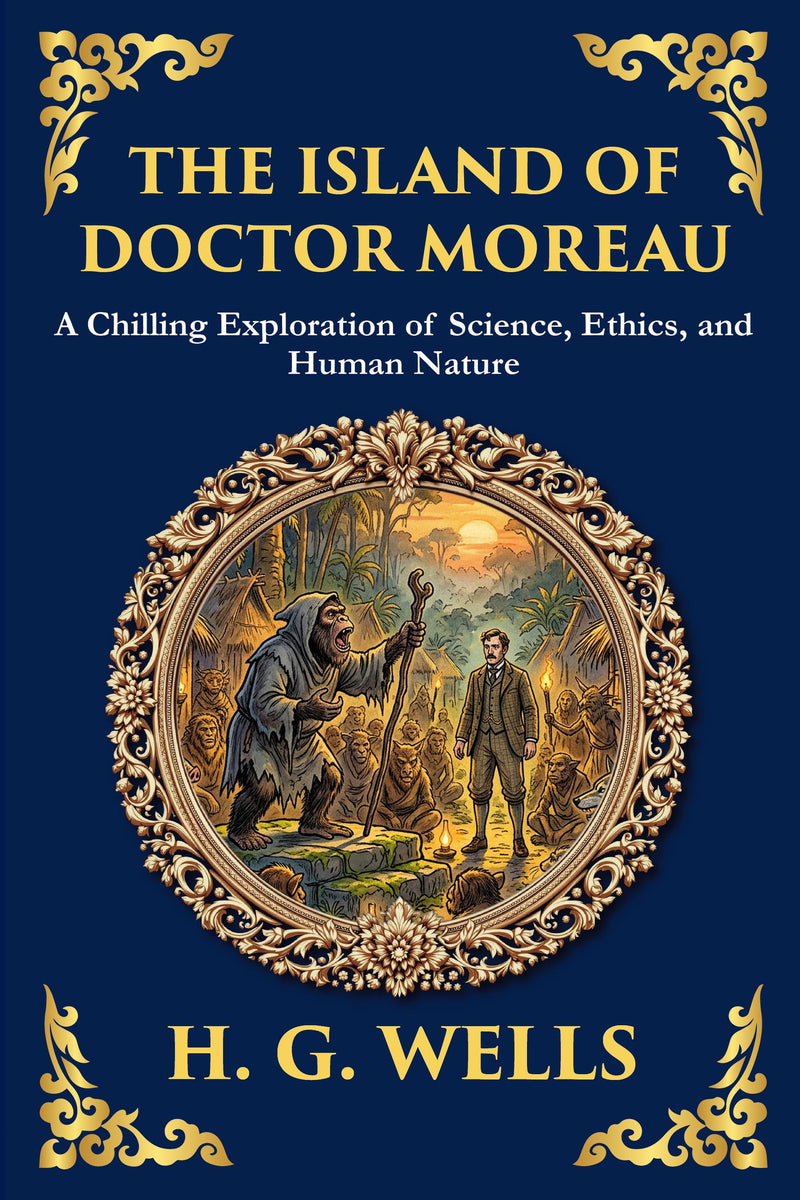
The Island of Doctor Moreau
A shipwrecked man finds himself on a remote island, where a brilliant but twisted scientist conducts grotesque experiments.
or free app
10,000+ hrs library
30-day guarantee
The complete The Island of Doctor Moreau appears in modern English through Library of Alexandria Press, available online with audiobook narration included for members.
Have you ever wondered why science, when unchecked, can become more monstrous than nature itself? In The Island of Doctor Moreau, H. G. Wells delivers one of the most haunting explorations of science, ethics, and human nature ever written. A castaway is stranded on a mysterious island, only to discover it is home to the nightmarish creations of Dr.
Moreau—a scientist who has pushed vivisection and experimentation to their horrifying limits. As the thin line between humanity and animal instinct blurs, Wells forces readers to confront disturbing questions about morality, evolution, and the dangers of scientific ambition without restraint.
What you’ll discover in this modern edition
- The Monstrous Experiments of Doctor Moreau – Explore the chilling world where animals are remade into distorted parodies of humanity.
- The Fragile Illusion of Civilization – Witness how fear, cruelty, and instinct threaten to undo the thin veneer of order.
- A Timeless Ethical Dilemma – Grapple with Wells’s enduring questions about science, morality, and the essence of being human.
- A Visionary Work of Science Fiction – Experience one of Wells’s most disturbing and thought-provoking novels, a precursor to debates about bioethics that still matter today.
| Formats | eBook (EPUB + PDF) · Audiobook · Paperback · Hardcover · Large Print |
| Language | English |
| Trim size (print) | 6 × 9 in |
| Binding | Paperback — perfect-bound · Hardcover — casewrap |
| Large Print edition | Same text in a larger, easy-read type — a larger font, not a larger trim |
| Print pricing | Every physical book at our true cost — at-cost, no profit (members) |
| Library | 873 restored titles, always growing |
| Length | 45,223 words · ~3 hr 1 min reading |
| Reading level | Grade 8 · an easy, flowing read (this modern-English edition) |
| Edition | Modern English translation · 2026 |
Member reviews for this edition are collected as readers finish it — be the first. Across the library: 12,000+ books shipped, every plan covered by a 365-day print guarantee.
About this edition
A faithful, unabridged modern-English edition by The Library of Alexandria — carefully rendered for today's reader and verified paragraph-by-paragraph against the public-domain source. Available as eBook, audiobook, paperback, hardcover, and large print.
- Complete & unabridgedVerified paragraph by paragraph against the source — never a scan, never abridged.
- Modern English, faithfulReadable today, with the author’s meaning kept intact. Readable — not simplified.
- Every format, one membershipRead in your browser or the free app, or listen to the full audiobook.
Included free with your membership
Cancel anytime, one click · 30-day money-back guarantee
Edition last updated July 2026
What’s inside
The Island of Doctor Moreau — complete and unabridged: all 23 sections included with membership, plus the full audiobook.
Begin reading The Island of Doctor Moreau
In clear modern English — the complete text is included with membership.
Introduction
There are books that entertain, books that instruct, and a rare few that unsettle us so profoundly that we are never quite the same after closing their covers. H. G. Wells produced one of these rare works when, in the final years of the nineteenth century, he committed to paper a story so disquieting that even he later referred to it as an exercise in youthful blasphemy. The tale you are about to enter is short—deceptively, almost dangerously so—but its compactness is part of its power. Like a surgeon’s blade, it cuts swiftly and with terrible precision, leaving a wound that lingers long after the reading is done.
This particular edition has been prepared as a modern translation, adapted for the contemporary reader. Before you proceed, it is worth understanding what that means and what it does not mean. The intention here has never been to dilute, sanitize, or sentimentalize the original vision. Wells was a writer of remarkable economy and ferocious imagination, and any edition worthy of his name must honor both qualities. What has been done instead is a careful smoothing of the linguistic and grammatical conventions of the late Victorian age—the elaborate sentence constructions, the archaic turns of phrase, the occasional vocabulary that has slipped from common usage—so that the modern reader can engage directly with the story’s emotional and intellectual force without stumbling over the scaffolding of a bygone era. The horror remains intact. The ideas remain undiminished. The questions remain as urgent as ever. What has changed is only the ease with which you may now confront them.
To read this book is to participate in a thought experiment that has only grown more relevant with the passage of time. When Wells first wrote it, the science it imagined was speculative to the point of fantasy. Today, much of what once seemed grotesque invention has crept uncomfortably close to the realm of the possible. This introduction will prepare you for the journey—not by spoiling what awaits, but by equipping you to feel its full weight. We will explore the man who wrote it, the turbulent age that shaped him, and the enduring questions the book forces every reader to face. Approach what follows with an open mind and a willingness to be disturbed, for that disturbance is precisely the point.
To understand this novel, one must first understand the extraordinary period of human history into which it was born and the singular mind that gave it shape. Herbert George Wells was born in 1866 in Bromley, a town on the outskirts of London, into circumstances that gave little indication of the literary heights he would eventually reach. His family was of modest means; his father kept a struggling shop and supplemented the household income through professional cricket, while his mother worked as a housekeeper. The young Wells experienced the precariousness of the lower middle class firsthand, an experience that would later sharpen his lifelong preoccupation with class, power, and the cruelties that the strong inflict upon the weak.
A fortunate accident of childhood altered the course of his life. Confined to bed with a broken leg, the young boy discovered the world of books, devouring volumes brought to him to ease his boredom. From that point forward, reading became both an escape and a means of ascent. Through scholarships and sheer determination, he eventually secured a place at the Normal School of Science in London, where he studied biology under Thomas Henry Huxley, one of the most influential scientific minds of the age. Huxley, often remembered as “Darwin’s Bulldog” for his vigorous public defense of the theory of evolution, left an indelible mark on his young pupil. The lessons Wells absorbed in those laboratories—about the kinship of all living things, about the brutal mechanisms of natural selection, about the thin and accidental nature of the boundary separating humanity from the rest of the animal kingdom—would resurface, transformed and intensified, in the pages of this very book.
The closing decades of the nineteenth century, often called the fin de siècle, were a time of profound cultural anxiety. The certainties of the early Victorian era were crumbling. Darwin’s theory of evolution, published in 1859, had detonated beneath the foundations of traditional religious and moral belief, suggesting that humankind was not a special creation set apart by divine design but rather one branch among countless others on the great tree of life—a creature descended from animals and, by implication, still part animal in its instincts and impulses. This idea was at once thrilling and terrifying. If we were merely sophisticated beasts, what exactly elevated us above them? Was our vaunted morality, our reason, our civilization, anything more than a thin veneer painted over the same savage drives that governed the wolf and the ape?
At the same time, science was advancing at a dizzying pace, and with it came a growing unease about the limits of human ambition. Vivisection—the practice of experimenting on living animals—was the subject of fierce public debate, pitting the promise of medical progress against profound questions about cruelty and the ethical treatment of sentient creatures. Anti-vivisection societies flourished, and the popular imagination was haunted by the image of the cold, dispassionate scientist who would sacrifice anything, and anyone, on the altar of knowledge. Wells, trained as a biologist and intimately familiar with the laboratory, understood both the genuine value of scientific inquiry and the chilling potential for its abuse. He wrote at a moment when society was beginning to grasp, with mounting dread, that knowledge and wisdom do not always travel together.
It was into this charged atmosphere that Wells launched his career as a writer of what he called “scientific romances”—the works we would now recognize as among the foundational texts of science fiction. In a remarkably brief and astonishingly fertile period during the 1890s, he produced a series of novels that would establish him as a master of the form and would continue to shape the genre for more than a century. The story of a time traveler venturing into the distant future, the tale of an invisible man undone by his own power, the chronicle of a Martian invasion that lays waste to the English countryside—these emerged in rapid succession from a mind teeming with ideas and possessed of an uncanny ability to dramatize abstract scientific concepts as gripping human drama. The book before you belongs to this golden period of his early genius, and many readers and critics consider it the darkest and most philosophically uncompromising of them all.
What distinguishes Wells from many writers who followed in his footsteps is that he was never content merely to thrill. The fantastical elements of his stories—the impossible machines, the strange creatures, the violations of natural law—were always vehicles for ideas. He used the unreal to illuminate the real, the imagined to interrogate the actual. Beneath the surface of adventure and horror lay serious meditations on the nature of progress, the responsibilities of power, the structure of society, and the fundamental character of the human animal. He was a moralist and a social critic as much as a storyteller, and in the years following his early triumphs he would devote much of his prodigious energy to political and social writing, becoming one of the most influential public intellectuals of his generation. He dreamed of a better, more rational world, even as his fiction repeatedly exposed the nightmares that human ambition could conjure.
This particular novel, written when Wells was still a young man at the height of his imaginative powers, channels all the anxieties of his age into a single, concentrated vision. It takes the great questions raised by Darwin and Huxley—the animal origins of mankind, the fragility of the line between human and beast—and pushes them to their logical and horrifying extreme. It takes the public debate over vivisection and the figure of the ruthless scientist and embodies them in a character whose name has become a byword for the dangers of unchecked scientific hubris. And it does all this within the framework of a tense, propulsive adventure story that grips the reader from its opening pages and refuses to let go. Wells understood that the most profound ideas are best delivered not through lecture but through experience—that to truly feel the force of a philosophical question, one must live it, even if only vicariously through the eyes of a character trapped in a waking nightmare.
It is worth remembering, too, the personal courage it took to write such a book. The vision Wells presents is not a comforting one. It offers no easy reassurances about human dignity or the benevolence of nature. It refuses the consolations that readers of his time had come to expect. When the book first appeared, it shocked and offended many. Critics decried it as gratuitous, repulsive, and even immoral. Wells was accused of wallowing in horror for its own sake, of trafficking in degradation. Yet beneath the visceral discomfort the story provokes lies a deadly serious moral seriousness. Wells was not reveling in cruelty; he was holding up a mirror, and what he showed his readers was an image they did not wish to see. That the book continues to disturb us today is a testament not to any cheap sensationalism but to the enduring truth of the questions it dares to ask.
The novel takes the form of a narrative recounted by a man who finds himself, through a series of misfortunes, stranded in a remote and isolated corner of the world—a place beyond the reach of ordinary civilization, where the normal rules of society no longer apply. This frame, the tale of a survivor reporting on extraordinary events, was a familiar device in the adventure literature of the period, and Wells employs it with masterful skill. By grounding the fantastical in the mundane mechanics of shipwreck and survival, he lends his impossible story an air of unsettling plausibility. We are invited to believe, against our better judgment, that what we are reading might actually have happened. The horror is all the more effective for arriving by such ordinary means.
What our narrator discovers in this remote place forms the heart of the book, and it would be a disservice to the reader to reveal it here. Part of the genius of the novel lies in the gradual, dawning realization of what is truly going on—the way understanding arrives in fragments, each more disturbing than the last, until the full and terrible picture finally assembles itself. To rob a first-time reader of that experience would be to diminish one of literature’s great exercises in mounting dread. Suffice it to say that the narrator enters a world governed by a strange and rigid order, presided over by a figure of immense intelligence and chilling detachment, and that he is forced to confront sights and truths that challenge his most fundamental assumptions about the nature of life, the meaning of suffering, and the boundary between the civilized and the savage.
What can be said is that the novel operates on multiple levels at once, and that its power derives from the way these levels reinforce and amplify one another. On the most immediate level, it is a tale of survival and suspense—a man trapped in a hostile environment, surrounded by dangers he does not fully comprehend, struggling to stay alive and to make sense of his predicament. On this level alone, the book succeeds brilliantly. The atmosphere of dread is sustained with remarkable skill, the pacing is taut and relentless, and the sense of physical and psychological peril mounts inexorably toward a climax of genuine terror. Readers who come to the book simply for a gripping story will not be disappointed.
But beneath this surface lies a far deeper and more troubling current. The novel is, at its core, a meditation on the nature of pain, on the limits of what one being may justifiably do to another in the pursuit of knowledge or power, and on the question of what, if anything, separates the human from the animal. It asks whether morality is something innate and essential to our nature or merely a fragile imposition, a set of rules drilled into us that might be stripped away under the right conditions. It interrogates the figure of the godlike creator who shapes life according to his own designs, indifferent to the suffering he causes, and it draws unsettling parallels between this figure and the natural processes that have shaped all life on earth—including ourselves. Indeed, one of the book’s most profound and disturbing suggestions is that the cruelty we recoil from in the story is not so different from the cruelty inherent in nature itself, the blind and pitiless mechanism of survival and selection that has produced every living thing.
Cancel anytime, one click · 30-day money-back guarantee
Founding annual rate available now — your price locks for life when you join.
Not ready? Get this free chapter by email — read it anytime.
✓ Sent — check your inbox for The Island of Doctor Moreau.
Questions about The Island of Doctor Moreau
What is The Island of Doctor Moreau about?
A shipwrecked man finds himself on a remote island, where a brilliant but twisted scientist conducts grotesque experiments. Here, beasts are reshaped into human-like creatures, bound by fear, cruelty, and the fragile illusion of civilization. But when nature rebels against artifice, the island plunges into chaos.
Who wrote The Island of Doctor Moreau?
The Island of Doctor Moreau was written by H. G. Wells. This edition presents the complete work in clear modern English, faithfully rendered from the public-domain original by Library of Alexandria Press.
Is The Island of Doctor Moreau free to read?
The opening chapter is free to read on this page. Members read and listen to the complete work — and the entire library — free, and can order any physical book at our true print cost.
How long is The Island of Doctor Moreau?
23 chapters (~45,223 words) — about 3 hr 1 min of reading in this modern-English edition.
Is this an abridged version of The Island of Doctor Moreau?
No. This is the complete, unabridged The Island of Doctor Moreau, carefully rendered into clear modern English and verified paragraph-by-paragraph against the public-domain source — nothing is cut or summarised.
What formats does The Island of Doctor Moreau come in?
The Island of Doctor Moreau is available as eBook, paperback, hardcover and large print. eBook and audiobook are included with membership; printed editions ship at our true print cost.
Shipping & returns
Billing & membership
More from the library


Explore Philosophy & Ideas
- Kant's Prolegomena to Any Future Metaphysics · Immanuel Kant
- The Advancement of Learning · Francis Bacon
- The Dawn of Day · Friedrich Wilhelm Nietzsche
- Meditations · Marcus Aurelius
- The Confessions of St. Augustine · Saint Augustine
- Dialogues Concerning Natural Religion · David Hume
- Considerations on Representative Government · John Stuart Mill
- The Will to Power: An Attempted Transvaluation of All Values. Book III and IV · Friedrich Nietzsche
- Groundwork of the Metaphysics of Morals · Immanuel Kant
- The Confessions of Jean-Jacques Rousseau — Complete · Jean-Jacques Rousseau
- Democracy in America — Volume 2 · Alexis de Tocqueville
- Ecce Homo · Friedrich Wilhelm Nietzsche
- Second Treatise of Government · John Locke
- The Prince · Niccolò Machiavelli
- Thus Spake Zarathustra: A Book for All and None · Friedrich Wilhelm Nietzsche
- Sophist · Plato
- The Seven Lamps of Architecture · John Ruskin
- Essays — First Series · Ralph Waldo Emerson
- The Book of the Damned · Charles Fort
- The Everlasting Man · G. K. Chesterton
- The Initiates of the Flame · Manly P. Hall
- The Book of Tea · Kakuzo Okakura
- The Japanese Spirit · Yoshisaburo Okakura
- The Analysis of Mind · Bertrand Russell
- Orthodoxy · G. K. Chesterton
- Apology, Crito, and Phaedo of Socrates · Plato
- Euthyphro · Plato
- Timaeus · Plato
- Ion · Plato
- Essays of Schopenhauer · Arthur Schopenhauer
The Island of Doctor Moreau
The Island of Doctor Moreau
A Chilling Exploration of Science, Ethics, and Human Nature
H. G. Wells
Contents
- Introduction
- Chapter 1
- Chapter 2
- Chapter 3
- Chapter 4
- Chapter 5
- Chapter 6
- Chapter 7
- Chapter 8
- Chapter 9
- Chapter 10
- Chapter 11
- Chapter 12
- Chapter 13
- Chapter 14
- Chapter 15
- Chapter 16
- Chapter 17
- Chapter 18
- Chapter 19
- Chapter 20
- Chapter 21
- Chapter 22
Introduction
There are books that entertain, books that instruct, and a rare few that unsettle us so profoundly that we are never quite the same after closing their covers. H. G. Wells produced one of these rare works when, in the final years of the nineteenth century, he committed to paper a story so disquieting that even he later referred to it as an exercise in youthful blasphemy. The tale you are about to enter is short—deceptively, almost dangerously so—but its compactness is part of its power. Like a surgeon’s blade, it cuts swiftly and with terrible precision, leaving a wound that lingers long after the reading is done.
This particular edition has been prepared as a modern translation, adapted for the contemporary reader. Before you proceed, it is worth understanding what that means and what it does not mean. The intention here has never been to dilute, sanitize, or sentimentalize the original vision. Wells was a writer of remarkable economy and ferocious imagination, and any edition worthy of his name must honor both qualities. What has been done instead is a careful smoothing of the linguistic and grammatical conventions of the late Victorian age—the elaborate sentence constructions, the archaic turns of phrase, the occasional vocabulary that has slipped from common usage—so that the modern reader can engage directly with the story’s emotional and intellectual force without stumbling over the scaffolding of a bygone era. The horror remains intact. The ideas remain undiminished. The questions remain as urgent as ever. What has changed is only the ease with which you may now confront them.
To read this book is to participate in a thought experiment that has only grown more relevant with the passage of time. When Wells first wrote it, the science it imagined was speculative to the point of fantasy. Today, much of what once seemed grotesque invention has crept uncomfortably close to the realm of the possible. This introduction will prepare you for the journey—not by spoiling what awaits, but by equipping you to feel its full weight. We will explore the man who wrote it, the turbulent age that shaped him, and the enduring questions the book forces every reader to face. Approach what follows with an open mind and a willingness to be disturbed, for that disturbance is precisely the point.
To understand this novel, one must first understand the extraordinary period of human history into which it was born and the singular mind that gave it shape. Herbert George Wells was born in 1866 in Bromley, a town on the outskirts of London, into circumstances that gave little indication of the literary heights he would eventually reach. His family was of modest means; his father kept a struggling shop and supplemented the household income through professional cricket, while his mother worked as a housekeeper. The young Wells experienced the precariousness of the lower middle class firsthand, an experience that would later sharpen his lifelong preoccupation with class, power, and the cruelties that the strong inflict upon the weak.
A fortunate accident of childhood altered the course of his life. Confined to bed with a broken leg, the young boy discovered the world of books, devouring volumes brought to him to ease his boredom. From that point forward, reading became both an escape and a means of ascent. Through scholarships and sheer determination, he eventually secured a place at the Normal School of Science in London, where he studied biology under Thomas Henry Huxley, one of the most influential scientific minds of the age. Huxley, often remembered as “Darwin’s Bulldog” for his vigorous public defense of the theory of evolution, left an indelible mark on his young pupil. The lessons Wells absorbed in those laboratories—about the kinship of all living things, about the brutal mechanisms of natural selection, about the thin and accidental nature of the boundary separating humanity from the rest of the animal kingdom—would resurface, transformed and intensified, in the pages of this very book.
The closing decades of the nineteenth century, often called the fin de siècle, were a time of profound cultural anxiety. The certainties of the early Victorian era were crumbling. Darwin’s theory of evolution, published in 1859, had detonated beneath the foundations of traditional religious and moral belief, suggesting that humankind was not a special creation set apart by divine design but rather one branch among countless others on the great tree of life—a creature descended from animals and, by implication, still part animal in its instincts and impulses. This idea was at once thrilling and terrifying. If we were merely sophisticated beasts, what exactly elevated us above them? Was our vaunted morality, our reason, our civilization, anything more than a thin veneer painted over the same savage drives that governed the wolf and the ape?
At the same time, science was advancing at a dizzying pace, and with it came a growing unease about the limits of human ambition. Vivisection—the practice of experimenting on living animals—was the subject of fierce public debate, pitting the promise of medical progress against profound questions about cruelty and the ethical treatment of sentient creatures. Anti-vivisection societies flourished, and the popular imagination was haunted by the image of the cold, dispassionate scientist who would sacrifice anything, and anyone, on the altar of knowledge. Wells, trained as a biologist and intimately familiar with the laboratory, understood both the genuine value of scientific inquiry and the chilling potential for its abuse. He wrote at a moment when society was beginning to grasp, with mounting dread, that knowledge and wisdom do not always travel together.
It was into this charged atmosphere that Wells launched his career as a writer of what he called “scientific romances”—the works we would now recognize as among the foundational texts of science fiction. In a remarkably brief and astonishingly fertile period during the 1890s, he produced a series of novels that would establish him as a master of the form and would continue to shape the genre for more than a century. The story of a time traveler venturing into the distant future, the tale of an invisible man undone by his own power, the chronicle of a Martian invasion that lays waste to the English countryside—these emerged in rapid succession from a mind teeming with ideas and possessed of an uncanny ability to dramatize abstract scientific concepts as gripping human drama. The book before you belongs to this golden period of his early genius, and many readers and critics consider it the darkest and most philosophically uncompromising of them all.
What distinguishes Wells from many writers who followed in his footsteps is that he was never content merely to thrill. The fantastical elements of his stories—the impossible machines, the strange creatures, the violations of natural law—were always vehicles for ideas. He used the unreal to illuminate the real, the imagined to interrogate the actual. Beneath the surface of adventure and horror lay serious meditations on the nature of progress, the responsibilities of power, the structure of society, and the fundamental character of the human animal. He was a moralist and a social critic as much as a storyteller, and in the years following his early triumphs he would devote much of his prodigious energy to political and social writing, becoming one of the most influential public intellectuals of his generation. He dreamed of a better, more rational world, even as his fiction repeatedly exposed the nightmares that human ambition could conjure.
This particular novel, written when Wells was still a young man at the height of his imaginative powers, channels all the anxieties of his age into a single, concentrated vision. It takes the great questions raised by Darwin and Huxley—the animal origins of mankind, the fragility of the line between human and beast—and pushes them to their logical and horrifying extreme. It takes the public debate over vivisection and the figure of the ruthless scientist and embodies them in a character whose name has become a byword for the dangers of unchecked scientific hubris. And it does all this within the framework of a tense, propulsive adventure story that grips the reader from its opening pages and refuses to let go. Wells understood that the most profound ideas are best delivered not through lecture but through experience—that to truly feel the force of a philosophical question, one must live it, even if only vicariously through the eyes of a character trapped in a waking nightmare.
It is worth remembering, too, the personal courage it took to write such a book. The vision Wells presents is not a comforting one. It offers no easy reassurances about human dignity or the benevolence of nature. It refuses the consolations that readers of his time had come to expect. When the book first appeared, it shocked and offended many. Critics decried it as gratuitous, repulsive, and even immoral. Wells was accused of wallowing in horror for its own sake, of trafficking in degradation. Yet beneath the visceral discomfort the story provokes lies a deadly serious moral seriousness. Wells was not reveling in cruelty; he was holding up a mirror, and what he showed his readers was an image they did not wish to see. That the book continues to disturb us today is a testament not to any cheap sensationalism but to the enduring truth of the questions it dares to ask.
The novel takes the form of a narrative recounted by a man who finds himself, through a series of misfortunes, stranded in a remote and isolated corner of the world—a place beyond the reach of ordinary civilization, where the normal rules of society no longer apply. This frame, the tale of a survivor reporting on extraordinary events, was a familiar device in the adventure literature of the period, and Wells employs it with masterful skill. By grounding the fantastical in the mundane mechanics of shipwreck and survival, he lends his impossible story an air of unsettling plausibility. We are invited to believe, against our better judgment, that what we are reading might actually have happened. The horror is all the more effective for arriving by such ordinary means.
What our narrator discovers in this remote place forms the heart of the book, and it would be a disservice to the reader to reveal it here. Part of the genius of the novel lies in the gradual, dawning realization of what is truly going on—the way understanding arrives in fragments, each more disturbing than the last, until the full and terrible picture finally assembles itself. To rob a first-time reader of that experience would be to diminish one of literature’s great exercises in mounting dread. Suffice it to say that the narrator enters a world governed by a strange and rigid order, presided over by a figure of immense intelligence and chilling detachment, and that he is forced to confront sights and truths that challenge his most fundamental assumptions about the nature of life, the meaning of suffering, and the boundary between the civilized and the savage.
What can be said is that the novel operates on multiple levels at once, and that its power derives from the way these levels reinforce and amplify one another. On the most immediate level, it is a tale of survival and suspense—a man trapped in a hostile environment, surrounded by dangers he does not fully comprehend, struggling to stay alive and to make sense of his predicament. On this level alone, the book succeeds brilliantly. The atmosphere of dread is sustained with remarkable skill, the pacing is taut and relentless, and the sense of physical and psychological peril mounts inexorably toward a climax of genuine terror. Readers who come to the book simply for a gripping story will not be disappointed.
But beneath this surface lies a far deeper and more troubling current. The novel is, at its core, a meditation on the nature of pain, on the limits of what one being may justifiably do to another in the pursuit of knowledge or power, and on the question of what, if anything, separates the human from the animal. It asks whether morality is something innate and essential to our nature or merely a fragile imposition, a set of rules drilled into us that might be stripped away under the right conditions. It interrogates the figure of the godlike creator who shapes life according to his own designs, indifferent to the suffering he causes, and it draws unsettling parallels between this figure and the natural processes that have shaped all life on earth—including ourselves. Indeed, one of the book’s most profound and disturbing suggestions is that the cruelty we recoil from in the story is not so different from the cruelty inherent in nature itself, the blind and pitiless mechanism of survival and selection that has produced every living thing.
I don’t intend to add anything to what has already been written about the loss of the Lady Vain. As everyone knows, she hit a drifting wreck ten days after leaving Callao. The longboat, carrying seven crew members, was rescued eighteen days later by the HMS Myrtle. The story of their terrible suffering is now as famous as the even more horrific Medusa case. However, I must add another story to the published account of the Lady Vain—one that is perhaps just as horrible and far stranger. Until now, it was assumed that the four men in the dinghy died, but that is wrong. I have the best possible evidence for this claim: I was one of those four men.
First, I must clarify that there were never four men in the dinghy; there were only three. Constans, whom the captain saw jump into the boat, luckily for us—and unluckily for him—never reached us. As he jumped from the tangle of ropes under the smashed bowsprit, a small piece of rope caught his heel. He hung upside down for a moment, then fell and hit a floating block or spar in the water. We rowed toward him, but he never resurfaced.
I say it was lucky for us that he didn’t make it, and I might even say it was lucky for him. We had only a small beaker of water and some soggy ship’s biscuits, because the alarm had been so sudden and the ship was completely unprepared for disaster. We hoped the people in the launch would have better supplies (though it seems they didn’t), and we tried to call out to them. They must not have heard us, and by the next morning, when the drizzle finally cleared after midday, they were gone. We couldn’t even stand up to look around because the boat was pitching so violently. The two other men who escaped with me were a passenger named Helmar and a sailor whose name I don’t know—a short, sturdy man with a stammer.
End of the free sample
Keep reading, free
Members read and listen to the complete book — and the entire library. Cancel anytime, one click · 30-day money-back guarantee.