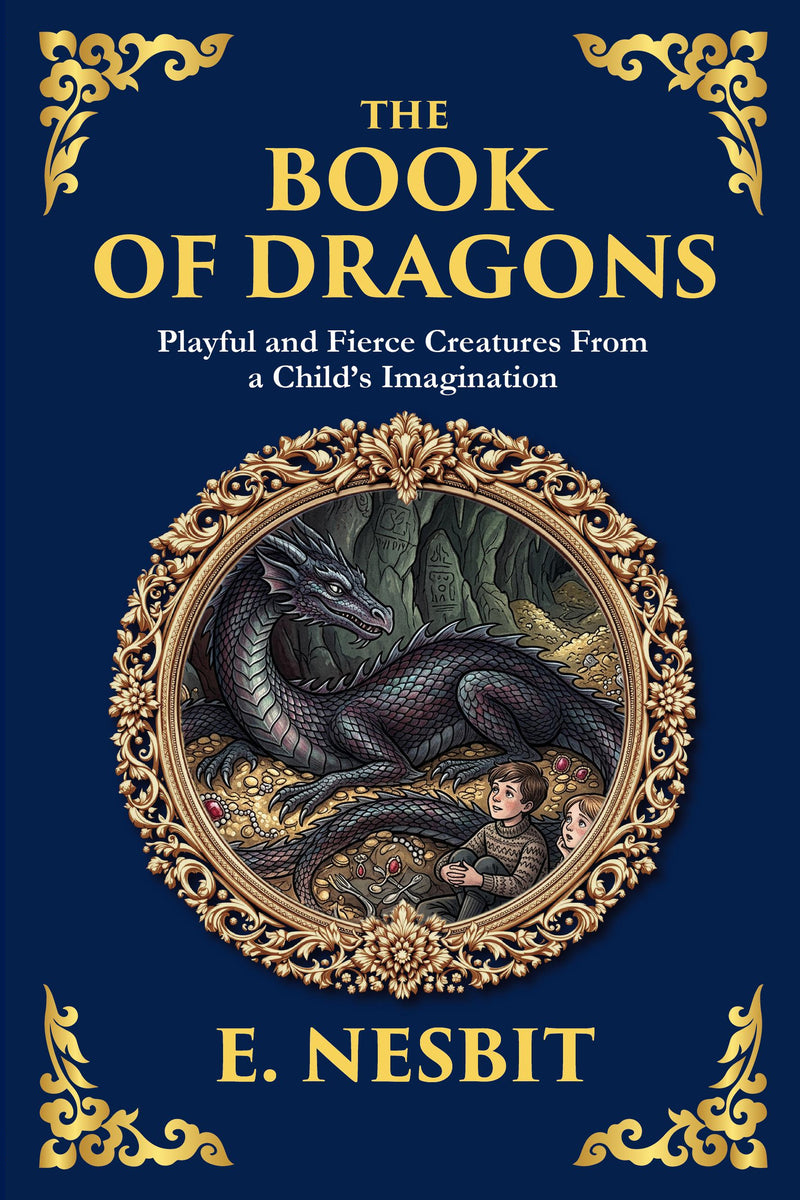
The Book of Dragons
Step into a magical world where dragons are as clever as they are mischievous, as fearsome as they are funny. In The Book of Dragons, E. Nesbit unleashes her boundless imagination to craft whimsical and thrilling tales of fantastical creatures, curious children, and lessons hidden in fire and scales.
or free app
10,000+ hrs library
30-day guarantee
The complete The Book of Dragons appears in modern English through Library of Alexandria Press, available online with audiobook narration included for members.
Have you ever wondered why dragons make the best—and worst—playmates? In The Book of Dragons, beloved children’s author E. Nesbit brings to life eight spellbinding stories of magical mishaps, brave youngsters, and dragons with personalities as big as their wings. Each tale is a delightful blend of mischief, adventure, and moral discovery, told with the same clever humor and warmth that made Nesbit a favorite of generations.
Written at the turn of the 20th century, these tales remain timeless in their appeal. Nesbit’s dragons aren’t just fierce beasts—they’re complicated, curious, sometimes cranky, often funny, and occasionally even wise. And the children who encounter them?
Equally brave, imaginative, and occasionally in over their heads.
What you’ll discover in this modern edition
- Eight Unique Dragon Tales – From royal dragons to underground ones, each story introduces a fantastical new world
- Whimsical Adventures with Heart – Explore what happens when children meet dragons, and the unexpected friendships that bloom
- Clever and Humorous Storytelling – Nesbit’s wit and wordplay shine, making each story a delight to read aloud
- A Touch of Morality with Every Roar – These fables gently weave in lessons of courage, kindness, honesty, and curiosity
- A Treasure for Young and Old – Perfect for children discovering fantasy for the first time—or adults revisiting a beloved childhood classic
| Formats | eBook (EPUB + PDF) · Audiobook · Paperback · Hardcover · Large Print |
| Language | English |
| Trim size (print) | 6 × 9 in |
| Binding | Paperback — perfect-bound · Hardcover — casewrap |
| Large Print edition | Same text in a larger, easy-read type — a larger font, not a larger trim |
| Print pricing | Every physical book at our true cost — at-cost, no profit (members) |
| Library | 873 restored titles, always growing |
| Length | 42,540 words · ~2 hr 50 min reading |
| Reading level | Grade 5 · an easy, flowing read (this modern-English edition) |
| Edition | Modern English translation · 2026 |
Member reviews for this edition are collected as readers finish it — be the first. Across the library: 12,000+ books shipped, every plan covered by a 365-day print guarantee.
About this edition
A faithful, unabridged modern-English edition by The Library of Alexandria — carefully rendered for today's reader and verified paragraph-by-paragraph against the public-domain source. Available as eBook, audiobook, paperback, hardcover, and large print.
- Complete & unabridgedVerified paragraph by paragraph against the source — never a scan, never abridged.
- Modern English, faithfulReadable today, with the author’s meaning kept intact. Readable — not simplified.
- Every format, one membershipRead in your browser or the free app, or listen to the full audiobook.
Included free with your membership
Cancel anytime, one click · 30-day money-back guarantee
Edition last updated July 2026
What’s inside
The Book of Dragons — complete and unabridged: all 9 sections included with membership, plus the full audiobook.
Begin reading The Book of Dragons
In clear modern English — the complete text is included with membership.
Introduction
There is a particular kind of magic that happens when a writer remembers, with absolute clarity, what it felt like to be a child. Not the sentimental, softened version of childhood that adults tend to invent in hindsight, but the real thing — the fierce loyalties, the sudden terrors, the conviction that the world is enormous and strange and full of things that grown-ups are too busy or too foolish to notice. Edith Nesbit possessed this gift in abundance, and nowhere is it more delightfully on display than in the collection of stories you are about to read. These are tales born from a writer who never quite stopped being a child herself, who understood that the best way to enchant young readers is to take them entirely seriously, and to take the absurd and the impossible just as seriously as the everyday.
What you hold in your hands is a celebration of dragons — but not the dragons of solemn medieval legend, all fire and doom and tragic knights. These are dragons with personalities. Some are vain, some are greedy, some are sleepy, some are simply enormous nuisances who happen to have wings and an appetite. They turn up in the most inconvenient places, behave in the most outrageous ways, and are dealt with — more often than not — by children who are cleverer, braver, and more sensible than any of the adults around them. This is the world Nesbit built: one where the fantastical bumps shoulders with the perfectly ordinary, where a dragon might emerge from the pages of a book or be discovered curled up where a dragon has absolutely no business being, and where the solution to such a crisis depends entirely on whether you have your wits about you and a friend you can trust.
This edition has been prepared as a modern translation and adaptation for the contemporary reader. That phrase deserves a moment of explanation, because it speaks to the spirit in which this book has been assembled. Nesbit wrote in the language of her time, and while her prose remains wonderfully readable, the rhythms, idioms, and occasional turns of phrase of a bygone era can sometimes form a small barrier between a young reader today and the sheer fun of the story. The aim here has been to smooth that barrier without sanding away the charm — to keep the wit, the warmth, and the unmistakable voice of the author intact while making the reading experience effortless and inviting for a new generation. You will find the stories as playful and as fierce as they ever were, but they should feel as though they were meant for you, here and now, rather than for a reader of more than a century ago.
A Writer Who Changed Children's Stories Forever
To understand why these tales feel so fresh and so alive, it helps to know a little about the remarkable woman who wrote them, and about the moment in which she was working. Edith Nesbit — known to her friends as Daisy and to her readers simply as E. Nesbit — was one of the most influential authors of children’s literature who has ever lived, though her name is not always as widely recognized as those of the writers she inspired. And inspire them she did. The chain of literary descent runs straight from her workshop to some of the most beloved storytellers of the twentieth century. The notion that ordinary children, in recognizable everyday settings, might stumble into adventures with magic and monsters — that idea, which now seems so natural that we can hardly imagine children’s books without it, was very largely her invention.
Before Nesbit, a great deal of children’s writing fell into one of two camps. There were the moralizing tales, where every story existed primarily to teach a lesson and where children were expected to be either impossibly good or instructively wicked. And there were the fairy tales of distant kingdoms, peopled by princes and princesses who bore no resemblance to anyone a real child might know. Nesbit did something genuinely new. She took children who squabbled and made mistakes and got dirty and argued over who got the biggest slice of cake — children who felt entirely real — and she dropped marvels into the middle of their lives. The result was electric. Suddenly the magic mattered more, because it was happening to people you recognized. The danger felt sharper, the wonder felt closer, and the comedy felt funnier, because it was all unfolding against the backdrop of a world the reader already knew.
She also refused to condescend. This may be the single most important thing to understand about her work, and it is the quality that makes her writing endure when so much else from her era has faded. Nesbit never wrote down to children. She trusted her readers to be intelligent, to appreciate a joke, to follow a clever plot, and to handle a genuine thrill of fear. She knew that children dislike being lectured and adore being treated as equals. Her narrator’s voice — chatty, conspiratorial, often hilariously dry — speaks to the reader as a fellow conspirator, someone who is in on the joke and who shares the reader’s mild contempt for the obtuseness of grown-ups. There is a constant, gleeful sense that the author is on the side of the children, and that she finds the adult world just as bewildering and ridiculous as her young characters do.
Her own life was anything but conventional, and something of its unorthodox energy crackles through every page she wrote. She was a co-founder of an influential social movement of her day, a poet, a passionate and somewhat chaotic personality who threw herself into causes and friendships with tremendous force. She wrote a great deal, partly out of love and partly out of financial necessity, and she produced an extraordinary body of work that ranged across many forms. But it is in her stories for children that her genius shines most steadily. She seems to have had a direct line to the imaginative life of childhood — to its logic, its games, its private rules, and its enormous capacity for wonder. When you read her, you can almost feel her remembering: the long summer afternoons, the half-believed superstitions, the way a perfectly ordinary garden or attic or stretch of countryside could become, with the right frame of mind, the threshold of an entirely other world.
The stories collected here belong to the lighter, funnier end of her imaginative range, though “light” should never be mistaken for slight. Comedy, done well, is among the hardest things a writer can attempt, and Nesbit was a master of it. Her dragons are funny because she has thought carefully about what a dragon would actually be like to deal with — the practical inconveniences, the absurd logic, the way that something monstrous can also be petty and pompous and easily fooled. She understood that the most effective fantasy grounds its impossibilities in believable detail. A dragon is far more entertaining, and far more memorable, when its terrifying qualities are balanced against some thoroughly mundane flaw. This is the secret sauce of the whole collection: the collision between the epic and the everyday, the grand and the ridiculous.
It is worth pausing, too, on the matter of the children in these stories. They are not flawless heroes. They quarrel, they sulk, they occasionally behave badly, and they sometimes get themselves into trouble through sheer mischief or carelessness. This is precisely what makes them so appealing and so true. Nesbit’s young protagonists succeed not because they are perfect, but because they are resourceful, loyal, and quick-thinking. When a dragon turns up, they do not wait for an adult to fix things — they roll up their sleeves and work out a plan, usually one that involves a clever exploitation of the dragon’s own weaknesses. There is a deep and reassuring message buried in all this fun: that children are capable, that intelligence and courage and friendship can overcome even the most overwhelming odds, and that the world rewards those who pay attention and keep their heads. It is empowering without ever being preachy, which is a very fine line to walk, and Nesbit walks it with effortless grace.
I will not spoil a single one of these stories for you, because half the pleasure of a Nesbit tale is the way it unfolds — the unexpected turns, the moments where you cannot quite see how the children will possibly escape their predicament, and the satisfying clicks of a clever plot falling into place. But I can tell you something about the texture and flavor of what awaits, so that you can settle into the right frame of mind.
Expect, first of all, dragons of astonishing variety. No two of these creatures are alike, and Nesbit’s invention seems inexhaustible. Some are vast and ancient and dreadful; others are smaller and more comically self-important. They come in different colors, with different habits and different appetites and different temperaments. Part of the joy of reading the collection straight through is watching the author ring endless changes on her central theme, finding fresh angles and fresh jokes each time. A lesser writer might have run out of ideas after the second or third dragon. Nesbit only seems to gather momentum, each story more inventive than the last, as though she is delighting herself as much as her reader.
Expect, too, a great deal of laughter. The humor in these pages is gentle but constant, woven into the very fabric of the prose. It lives in the narrator’s wry asides, in the absurd situations the children find themselves in, in the gap between how grand the dragons think they are and how foolishly they sometimes behave. There is a particular kind of comedy that comes from treating something impossible with deadpan practicality — and Nesbit is a virtuoso of exactly this. When her characters confront a dragon, they often discuss the problem with the same matter-of-fact common sense they might bring to a leaky roof or a difficult sum, and the contrast is irresistibly funny.
But do not imagine that the laughter cancels out the thrill. These are, after all, stories about dragons, and Nesbit understands that a dragon must be genuinely formidable for its defeat to feel like a triumph. There are moments of real tension, of genuine danger, of the prickling unease that comes when the children realize just how much trouble they are in. Nesbit knew that young readers crave a touch of fear — not the kind that gives nightmares, but the kind that makes the heart beat faster and the eyes race down the page to find out what happens next. She calibrates this beautifully. The peril is real enough to matter, but the reader is always held in safe hands, confident that cleverness and courage will find a way.
The settings will charm you as well. Nesbit had a wonderful eye for the kind of places where adventures might begin — the corner of a garden, a half-forgotten room, the pages of an old book, a quiet stretch of countryside. She understood that the threshold of the marvelous is rarely some grand and obvious gateway; more often it is something small and overlooked, a door you have walked past a hundred times without noticing. This sense of the magic hiding just beneath the surface of ordinary life is one of her great gifts as a writer, and it is part of what makes her stories linger in the memory long after they are read. After finishing one of her tales, you may find yourself looking at your own surroundings a little differently, wondering what might be hiding in the attic or the back of the cupboard or the depths of the garden shed.
And then there is the language itself — even in this modernized form, the unmistakable Nesbit voice carries through. It is a voice that includes you, that seems to lean in close and share a secret, that assumes you are clever enough to keep up and good-humored enough to enjoy the ride. Reading her is like being told a story by a brilliant, slightly mischievous older friend who knows exactly how to keep you hanging on every word. This collection is, above all, a pleasure to read aloud, and I would encourage anyone sharing it with a younger listener to do exactly that. The rhythm of the sentences, the timing of the jokes, the swelling and subsiding of the tension — these things come alive in the spoken voice, and there are few finer ways to spend an evening than reading one of these stories aloud and watching a child’s eyes grow wide.
Cancel anytime, one click · 30-day money-back guarantee
Founding annual rate available now — your price locks for life when you join.
Not ready? Get this free chapter by email — read it anytime.
✓ Sent — check your inbox for The Book of Dragons.
Questions about The Book of Dragons
What is The Book of Dragons about?
Step into a magical world where dragons are as clever as they are mischievous, as fearsome as they are funny. In The Book of Dragons, E. Nesbit unleashes her boundless imagination to craft whimsical and thrilling tales of fantastical creatures, curious children, and lessons hidden in fire and scales. Whether it’s a dragon who lives in a coal cellar or one that’s accidentally hatched by a naughty boy with a chemistry set, these enchanting stories brim with wit, charm, and a touch of mayhem.
Who wrote The Book of Dragons?
The Book of Dragons was written by E. Nesbit. This edition presents the complete work in clear modern English, faithfully rendered from the public-domain original by Library of Alexandria Press.
Is The Book of Dragons free to read?
The opening chapter is free to read on this page. Members read and listen to the complete work — and the entire library — free, and can order any physical book at our true print cost.
How long is The Book of Dragons?
9 chapters (~42,540 words) — about 2 hr 50 min of reading in this modern-English edition.
Is this an abridged version of The Book of Dragons?
No. This is the complete, unabridged The Book of Dragons, carefully rendered into clear modern English and verified paragraph-by-paragraph against the public-domain source — nothing is cut or summarised.
What formats does The Book of Dragons come in?
The Book of Dragons is available as eBook, paperback, hardcover and large print. eBook and audiobook are included with membership; printed editions ship at our true print cost.
Shipping & returns
Billing & membership
More from the library


Explore Children's Classics
- Peter and Wendy · J. M. Barrie
- Jack and Jill · Louisa May Alcott
- The Wonderful Wizard of Oz · L. Frank Baum
- Anne of Green Gables · L. M. Montgomery
- The Secret Garden · Frances Hodgson Burnett
- The Tale of Peter Rabbit · Beatrix Potter
- Peter Pan · J. M. Barrie
- The Prince and the Pauper · Mark Twain
- The Red Fairy Book · Andrew Lang
- Old Christmas: from the Sketch Book of Washington Irving · Washington Irving
- A Houseful of Girls · Sarah Tytler
- In the hollow of His hand · Hesba Stretton
- Miss Primrose · Agnes Giberne
- Five Little Peppers and How They Grew · Margaret Sidney
- The Loss of the Swansea: A Story of the Florida Coast · W. L. Alden
- Sky Island · L. Frank Baum
- Wild Animals I Have Known · Ernest Thompson Seton
- Skinny McCord · Percy Keese Fitzhugh
- The Hunniwell Boys and the Platinum Mystery · L. P. Wyman
- Rainbow Valley · L. M. Montgomery
- "Us and Our Donkey" · Amy Le Feuvre
- Dorothy and the Wizard in Oz · L. Frank Baum
- The Home Book of Verse — Volume 4 · Burton Egbert Stevenson
- The Story of Doctor Dolittle · Hugh Lofting
- The Tale of Benjamin Bunny · Beatrix Potter
- Fifty Famous Stories Retold · James Baldwin
- Rilla of Ingleside · L. M. Montgomery
- The House at Pooh Corner · A. A. Milne
- Rich and Humble: A Story for Young People · Oliver Optic
- The Three Bears · A. E. Kennedy
The Book of Dragons
The Book of Dragons
Playful and Fierce Creatures from a Child’s Imagination
E. Nesbit
Contents
- Introduction
- Chapter 1
- Chapter 2
- Chapter 3
- Chapter 4
- Chapter 5
- Chapter 6
- Chapter 7
- Chapter 8
Introduction
There is a particular kind of magic that happens when a writer remembers, with absolute clarity, what it felt like to be a child. Not the sentimental, softened version of childhood that adults tend to invent in hindsight, but the real thing — the fierce loyalties, the sudden terrors, the conviction that the world is enormous and strange and full of things that grown-ups are too busy or too foolish to notice. Edith Nesbit possessed this gift in abundance, and nowhere is it more delightfully on display than in the collection of stories you are about to read. These are tales born from a writer who never quite stopped being a child herself, who understood that the best way to enchant young readers is to take them entirely seriously, and to take the absurd and the impossible just as seriously as the everyday.
What you hold in your hands is a celebration of dragons — but not the dragons of solemn medieval legend, all fire and doom and tragic knights. These are dragons with personalities. Some are vain, some are greedy, some are sleepy, some are simply enormous nuisances who happen to have wings and an appetite. They turn up in the most inconvenient places, behave in the most outrageous ways, and are dealt with — more often than not — by children who are cleverer, braver, and more sensible than any of the adults around them. This is the world Nesbit built: one where the fantastical bumps shoulders with the perfectly ordinary, where a dragon might emerge from the pages of a book or be discovered curled up where a dragon has absolutely no business being, and where the solution to such a crisis depends entirely on whether you have your wits about you and a friend you can trust.
This edition has been prepared as a modern translation and adaptation for the contemporary reader. That phrase deserves a moment of explanation, because it speaks to the spirit in which this book has been assembled. Nesbit wrote in the language of her time, and while her prose remains wonderfully readable, the rhythms, idioms, and occasional turns of phrase of a bygone era can sometimes form a small barrier between a young reader today and the sheer fun of the story. The aim here has been to smooth that barrier without sanding away the charm — to keep the wit, the warmth, and the unmistakable voice of the author intact while making the reading experience effortless and inviting for a new generation. You will find the stories as playful and as fierce as they ever were, but they should feel as though they were meant for you, here and now, rather than for a reader of more than a century ago.
A Writer Who Changed Children's Stories Forever
To understand why these tales feel so fresh and so alive, it helps to know a little about the remarkable woman who wrote them, and about the moment in which she was working. Edith Nesbit — known to her friends as Daisy and to her readers simply as E. Nesbit — was one of the most influential authors of children’s literature who has ever lived, though her name is not always as widely recognized as those of the writers she inspired. And inspire them she did. The chain of literary descent runs straight from her workshop to some of the most beloved storytellers of the twentieth century. The notion that ordinary children, in recognizable everyday settings, might stumble into adventures with magic and monsters — that idea, which now seems so natural that we can hardly imagine children’s books without it, was very largely her invention.
Before Nesbit, a great deal of children’s writing fell into one of two camps. There were the moralizing tales, where every story existed primarily to teach a lesson and where children were expected to be either impossibly good or instructively wicked. And there were the fairy tales of distant kingdoms, peopled by princes and princesses who bore no resemblance to anyone a real child might know. Nesbit did something genuinely new. She took children who squabbled and made mistakes and got dirty and argued over who got the biggest slice of cake — children who felt entirely real — and she dropped marvels into the middle of their lives. The result was electric. Suddenly the magic mattered more, because it was happening to people you recognized. The danger felt sharper, the wonder felt closer, and the comedy felt funnier, because it was all unfolding against the backdrop of a world the reader already knew.
She also refused to condescend. This may be the single most important thing to understand about her work, and it is the quality that makes her writing endure when so much else from her era has faded. Nesbit never wrote down to children. She trusted her readers to be intelligent, to appreciate a joke, to follow a clever plot, and to handle a genuine thrill of fear. She knew that children dislike being lectured and adore being treated as equals. Her narrator’s voice — chatty, conspiratorial, often hilariously dry — speaks to the reader as a fellow conspirator, someone who is in on the joke and who shares the reader’s mild contempt for the obtuseness of grown-ups. There is a constant, gleeful sense that the author is on the side of the children, and that she finds the adult world just as bewildering and ridiculous as her young characters do.
Her own life was anything but conventional, and something of its unorthodox energy crackles through every page she wrote. She was a co-founder of an influential social movement of her day, a poet, a passionate and somewhat chaotic personality who threw herself into causes and friendships with tremendous force. She wrote a great deal, partly out of love and partly out of financial necessity, and she produced an extraordinary body of work that ranged across many forms. But it is in her stories for children that her genius shines most steadily. She seems to have had a direct line to the imaginative life of childhood — to its logic, its games, its private rules, and its enormous capacity for wonder. When you read her, you can almost feel her remembering: the long summer afternoons, the half-believed superstitions, the way a perfectly ordinary garden or attic or stretch of countryside could become, with the right frame of mind, the threshold of an entirely other world.
The stories collected here belong to the lighter, funnier end of her imaginative range, though “light” should never be mistaken for slight. Comedy, done well, is among the hardest things a writer can attempt, and Nesbit was a master of it. Her dragons are funny because she has thought carefully about what a dragon would actually be like to deal with — the practical inconveniences, the absurd logic, the way that something monstrous can also be petty and pompous and easily fooled. She understood that the most effective fantasy grounds its impossibilities in believable detail. A dragon is far more entertaining, and far more memorable, when its terrifying qualities are balanced against some thoroughly mundane flaw. This is the secret sauce of the whole collection: the collision between the epic and the everyday, the grand and the ridiculous.
It is worth pausing, too, on the matter of the children in these stories. They are not flawless heroes. They quarrel, they sulk, they occasionally behave badly, and they sometimes get themselves into trouble through sheer mischief or carelessness. This is precisely what makes them so appealing and so true. Nesbit’s young protagonists succeed not because they are perfect, but because they are resourceful, loyal, and quick-thinking. When a dragon turns up, they do not wait for an adult to fix things — they roll up their sleeves and work out a plan, usually one that involves a clever exploitation of the dragon’s own weaknesses. There is a deep and reassuring message buried in all this fun: that children are capable, that intelligence and courage and friendship can overcome even the most overwhelming odds, and that the world rewards those who pay attention and keep their heads. It is empowering without ever being preachy, which is a very fine line to walk, and Nesbit walks it with effortless grace.
I will not spoil a single one of these stories for you, because half the pleasure of a Nesbit tale is the way it unfolds — the unexpected turns, the moments where you cannot quite see how the children will possibly escape their predicament, and the satisfying clicks of a clever plot falling into place. But I can tell you something about the texture and flavor of what awaits, so that you can settle into the right frame of mind.
Expect, first of all, dragons of astonishing variety. No two of these creatures are alike, and Nesbit’s invention seems inexhaustible. Some are vast and ancient and dreadful; others are smaller and more comically self-important. They come in different colors, with different habits and different appetites and different temperaments. Part of the joy of reading the collection straight through is watching the author ring endless changes on her central theme, finding fresh angles and fresh jokes each time. A lesser writer might have run out of ideas after the second or third dragon. Nesbit only seems to gather momentum, each story more inventive than the last, as though she is delighting herself as much as her reader.
Expect, too, a great deal of laughter. The humor in these pages is gentle but constant, woven into the very fabric of the prose. It lives in the narrator’s wry asides, in the absurd situations the children find themselves in, in the gap between how grand the dragons think they are and how foolishly they sometimes behave. There is a particular kind of comedy that comes from treating something impossible with deadpan practicality — and Nesbit is a virtuoso of exactly this. When her characters confront a dragon, they often discuss the problem with the same matter-of-fact common sense they might bring to a leaky roof or a difficult sum, and the contrast is irresistibly funny.
But do not imagine that the laughter cancels out the thrill. These are, after all, stories about dragons, and Nesbit understands that a dragon must be genuinely formidable for its defeat to feel like a triumph. There are moments of real tension, of genuine danger, of the prickling unease that comes when the children realize just how much trouble they are in. Nesbit knew that young readers crave a touch of fear — not the kind that gives nightmares, but the kind that makes the heart beat faster and the eyes race down the page to find out what happens next. She calibrates this beautifully. The peril is real enough to matter, but the reader is always held in safe hands, confident that cleverness and courage will find a way.
The settings will charm you as well. Nesbit had a wonderful eye for the kind of places where adventures might begin — the corner of a garden, a half-forgotten room, the pages of an old book, a quiet stretch of countryside. She understood that the threshold of the marvelous is rarely some grand and obvious gateway; more often it is something small and overlooked, a door you have walked past a hundred times without noticing. This sense of the magic hiding just beneath the surface of ordinary life is one of her great gifts as a writer, and it is part of what makes her stories linger in the memory long after they are read. After finishing one of her tales, you may find yourself looking at your own surroundings a little differently, wondering what might be hiding in the attic or the back of the cupboard or the depths of the garden shed.
And then there is the language itself — even in this modernized form, the unmistakable Nesbit voice carries through. It is a voice that includes you, that seems to lean in close and share a secret, that assumes you are clever enough to keep up and good-humored enough to enjoy the ride. Reading her is like being told a story by a brilliant, slightly mischievous older friend who knows exactly how to keep you hanging on every word. This collection is, above all, a pleasure to read aloud, and I would encourage anyone sharing it with a younger listener to do exactly that. The rhythm of the sentences, the timing of the jokes, the swelling and subsiding of the tension — these things come alive in the spoken voice, and there are few finer ways to spend an evening than reading one of these stories aloud and watching a child’s eyes grow wide.
He was in the middle of building a palace when the news arrived, and he left bricks scattered all over the floor for the nurse to tidy up—but the news was truly extraordinary. There had been a knock at the front door and the sound of people talking downstairs. Lionel assumed it was just the repairman coming to check the gas, which had been turned off since the day Lionel tried to make a swing by tying his jump rope to the gas fixture.
Then, all of a sudden, the nurse came in and said, “Master Lionel, dear, they’ve arrived to take you away to be King.”
She quickly changed his smock, washed his face and hands, and brushed his hair. The whole time, Lionel kept squirming and fidgeting, saying things like, “Oh, don’t, Nurse,” and, “I’m sure my ears are clean enough,” or, “Forget about my hair, it’s fine,” and, “That’s enough.”
“You’re acting as if you’re going to be an eel instead of a King,” the nurse said.
The moment the nurse let go, Lionel bolted away without even waiting for his clean handkerchief. In the drawing room, there were two very serious-looking gentlemen wearing red fur robes and gold crowns with velvet centers that looked like the cream in expensive jam tarts.
They bowed deeply to Lionel, and the most serious man said, “Sire, your great-great-great-great-great-grandfather, the King of this country, has passed away, and now it is your turn to be King.”
“Yes, please, sir,” Lionel replied, “when does it start?”
“You’ll be crowned this afternoon,” said the serious gentleman, who didn’t look quite as solemn as the other one.
“Should I bring my nurse? What time do you want me to be ready? And wouldn’t it be better if I wore my velvet suit with the lace collar?” asked Lionel, who had been to many formal tea parties.
End of the free sample
Keep reading, free
Members read and listen to the complete book — and the entire library. Cancel anytime, one click · 30-day money-back guarantee.