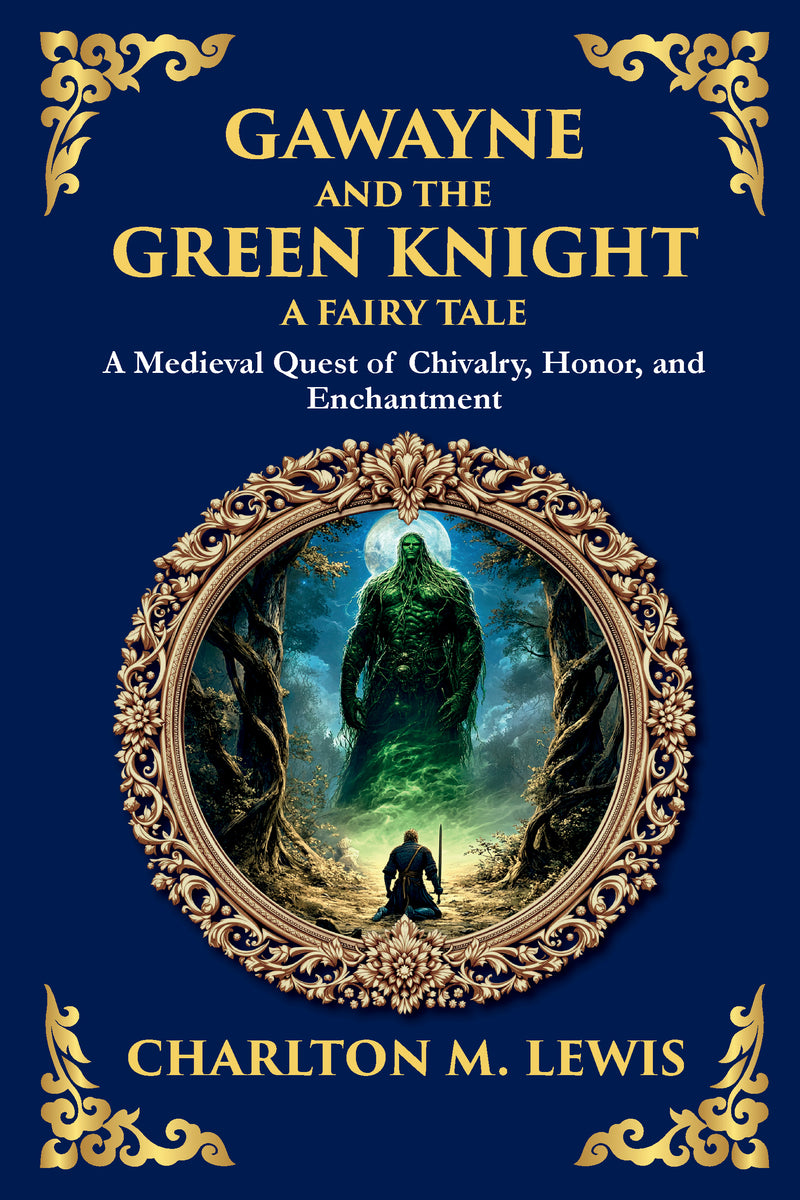
Gawayne and the Green Knight: A Fairy Tale
When a mysterious green knight challenges the court of King Arthur, only the noble Gawayne dares accept. So begins a spellbinding journey across enchanted forests, forgotten towers, and trials of moral and mortal strength.
or free app
10,000+ hrs library
30-day guarantee
The complete Gawayne and the Green Knight: A Fairy Tale appears in modern English through Library of Alexandria Press, available online with audiobook narration included for members.
Have you ever wondered why the greatest battles are not fought with swords, but with the soul? In Gawayne and the Green Knight: A Fairy Tale, Charlton M. Lewis breathes lyrical life into one of the most enduring legends of the Arthurian tradition. This beautifully crafted poetic narrative follows the valiant Sir Gawayne, whose oath to face the fearsome Green Knight launches him into a quest as mystical as it is moral.
This is no ordinary adventure tale. Gawayne’s journey is a mirror reflecting the deeper truths of integrity, humility, and the burdens of honor. With spellbinding verse and chivalric grandeur, Lewis reinterprets the medieval legend with a modern elegance that resonates across generations.
What you’ll discover in this modern edition
- A Legendary Challenge at King Arthur’s Court – Witness the unforgettable moment when the Green Knight arrives with an impossible game and only Gawayne answers the call.
- A Hero’s Quest Through Enchanted Lands – Follow Gawayne across mythical forests and magical castles as he searches for his fate and himself.
- Moral Trials Beneath the Armor – Explore the inner conflict between duty and desire, pride and humility, in a knight tested beyond the battlefield.
- Poetic Elegance That Elevates the Tale – Charlton M. Lewis's refined verse captures both the beauty and the tension of medieval romance.
- A Timeless Retelling for Modern Readers – This accessible edition opens the door to Arthurian myth for those new to the legend and long-time admirers alike.
| Formats | eBook (EPUB + PDF) · Audiobook · Paperback · Hardcover · Large Print |
| Language | English |
| Trim size (print) | 6 × 9 in |
| Binding | Paperback — perfect-bound · Hardcover — casewrap |
| Large Print edition | Same text in a larger, easy-read type — a larger font, not a larger trim |
| Print pricing | Every physical book at our true cost — at-cost, no profit (members) |
| Library | 873 restored titles, always growing |
| Length | 15,133 words · ~1 hr 1 min reading |
| Reading level | Grade 12 · a confident, adult read (this modern-English edition) |
| Edition | Modern English translation · 2026 |
Member reviews for this edition are collected as readers finish it — be the first. Across the library: 12,000+ books shipped, every plan covered by a 365-day print guarantee.
About this edition
A faithful, unabridged modern-English edition by The Library of Alexandria — carefully rendered for today's reader and verified paragraph-by-paragraph against the public-domain source. Available as eBook, audiobook, paperback, hardcover, and large print.
- Complete & unabridgedVerified paragraph by paragraph against the source — never a scan, never abridged.
- Modern English, faithfulReadable today, with the author’s meaning kept intact. Readable — not simplified.
- Every format, one membershipRead in your browser or the free app, or listen to the full audiobook.
Included free with your membership
Cancel anytime, one click · 30-day money-back guarantee
Edition last updated July 2026
What’s inside
Gawayne and the Green Knight: A Fairy Tale — complete and unabridged: all 5 sections included with membership, plus the full audiobook.
Begin reading Gawayne and the Green Knight: A Fairy Tale
In clear modern English — the complete text is included with membership.
Introduction
There are tales that survive the centuries because they speak to something permanent in us—a hunger for adventure, a fascination with courage, a deep and abiding curiosity about what a person is truly made of when no one is watching and everything is on the line. The story you are about to read is one of those rare survivors. It has crossed more than six hundred years to reach your hands, passing through the candlelit halls of medieval England, the studies of scholars, and the imaginations of generation upon generation of readers who found in it something both strange and intimately familiar. It is a story of a young knight, a mysterious challenge, and a journey into the unknown. It is also, at its heart, a story about what it means to keep your word.
Before you turn the page and step into that world, it is worth pausing to understand a little about where this tale came from, why it has endured, and what you might look for as you read. This is not because the story needs explanation—it is a marvel of plain narrative power that requires no scholarly footnotes to thrill and move a reader—but because a small amount of context can deepen your enjoyment immeasurably. Like a traveler who appreciates a foreign city more for knowing something of its history, you will find the magic of this tale glowing more brightly once you understand the firelit room in which it was first told.
The original poem behind this book is one of the greatest treasures of English literature. It was written sometime in the late fourteenth century, around the same period that Geoffrey Chaucer was composing his Canterbury Tales, though the two poets could hardly have been more different in style and setting. While Chaucer worked in the bustling, cosmopolitan world of London, with its merchants and pilgrims and shifting dialects, the author of the original Sir Gawain and the Green Knight—a writer whose name has been lost entirely to history, and whom scholars refer to simply as the “Gawain poet” or the “Pearl poet”—wrote in the dialect of the English northwest, a rugged and remote region of moors, forests, and looming hills. The language he used was already, even in his own time, somewhat old-fashioned and regional, dense with words borrowed from Old Norse and Old English that would have sounded archaic to a Londoner. For this reason, the original poem can be enormously difficult for a modern reader to approach. Even readers comfortable with Chaucer’s Middle English often find themselves baffled by the Gawain poet’s vocabulary and his intricate, alliterative verse.
This is where Charlton M. Lewis enters the story. The version you hold is his rendering of the ancient tale—a modern adaptation that strips away the barriers of obsolete language while preserving the spirit, the wonder, and the moral seriousness of the original. Lewis, an American scholar and poet who taught at Yale in the early twentieth century, was deeply versed in both the medieval source material and the demands of contemporary storytelling. His aim was not to produce a word-for-word academic translation, the kind that sits in a footnoted edition and serves the purposes of the classroom. His aim was something more generous and more difficult: to give the modern reader the experience of the poem, the sense of delight and suspense and meaning that its first audiences would have felt. He calls his version a “fairy tale,” and the choice of words is deliberate. He wants you to feel the enchantment.
You will notice this immediately in the readability of the verse. Where the original employs a complex form of alliterative meter—a poetic structure in which lines are bound together not by rhyme but by repeated consonant sounds, a technique inherited from the most ancient traditions of Germanic poetry—Lewis offers something more familiar to the modern ear. His lines move with a music that does not require a glossary to appreciate. He keeps the color and the strangeness of the medieval world, but he opens its doors wide enough that any reader can walk through. This is a significant achievement, and one worth appreciating as you read. Translation of poetry is a notoriously thankless task; the translator is forever balancing fidelity to the original against the need to create something that lives and breathes in the new language. Lewis manages to honor both demands, and the result is a version of the tale that feels at once antique and alive.
It is worth saying a word about the very form in which this story comes to you. We live in an age of prose. The novel dominates our reading lives, and most of us encounter poetry, if at all, in small lyric doses. The idea of reading a story—a full narrative with characters, suspense, and a satisfying arc—told entirely in verse may seem unusual at first. But for the audiences of the medieval world, and indeed for most of human history, this was the natural and expected mode of storytelling. Epics and romances were composed in verse because verse was memorable, musical, and suited to recitation aloud. When you read this tale, you would do well to remember that it was meant, originally, to be heard. The lines were spoken or sung before a gathered audience, perhaps during the long dark evenings of winter, in a hall warmed by a great fire while the wind howled outside. There is a particular pleasure to be found in reading these lines aloud, or at least hearing them in your mind’s ear. The rhythm carries you forward; the descriptions paint themselves vividly before you; and the whole experience takes on a quality of performance that flat prose can rarely achieve. Do not be afraid of the verse. Let it carry you. After only a few pages you will cease to notice it as a barrier and begin to feel it as a current, sweeping you along into the heart of the adventure.
The world this tale invites you to enter is the world of King Arthur and his Round Table—surely the most enduring and beloved setting in all of Western legend. By the time the Gawain poet sat down to write, the Arthurian tradition was already centuries old and immensely popular across Europe. Stories of Arthur and his knights circulated in French, German, Welsh, and English, each culture adding its own embellishments and emphases. The figure at the center of our story, Sir Gawain, was one of the most celebrated of all Arthur’s knights, renowned in particular for his courtesy, his loyalty, and his unimpeachable honor. In the French romances he sometimes appears as a flawed or even disreputable figure, but in the English tradition he is the very model of knightly virtue—the perfect courtier, the flower of chivalry. The Gawain poet draws on this reputation deliberately, for the entire drama of the tale depends upon it. We are watching the best of the best put to the test. And there is a special kind of suspense in seeing whether even the finest of men can live up to the impossible standard that his reputation demands.
What is chivalry, exactly, and why does it matter so much in this story? The word conjures up vague images of armored knights and damsels in distress, but the medieval ideal was both more specific and more demanding. Chivalry was a code—a set of standards governing how a knight should behave, encompassing physical courage on the battlefield, courtesy and refinement in the company of ladies and at court, generosity toward the weak, loyalty to one’s lord, devotion to God, and above all, the absolute and unbreakable keeping of one’s word. To make a promise, in this world, was to bind oneself utterly; to break a promise was to forfeit not just one’s reputation but one’s very identity as a knight and a man of honor. This is the framework within which everything in our story unfolds. When the central challenge of the tale is issued and a bargain is struck, the whole weight of this ideal comes crashing down upon the shoulders of our hero. Will he keep his word, even when keeping it seems to mean walking willingly toward his own destruction? That question is the engine of the narrative, and it gives the story a tension that has nothing to do with sword fights and everything to do with the human soul.
I will not tell you what the challenge is, nor what the bargain entails, nor how it all unfolds. To do so would be to rob you of the very pleasures the tale was designed to deliver. The Gawain poet was a master of suspense and surprise, and he constructed his story with extraordinary care, planting clues and echoes that only reveal their full significance as the narrative draws to its close. Part of the genius of this tale is the way it lulls you, draws you in, leads you down what seems to be one path only to reveal, at the crucial moment, that something far subtler has been happening all along. Read it as its first audiences would have—without knowing what is coming, alert to every detail, allowing the wonder and the dread to build. The reward at the end is all the greater for it.
One of the great delights of this tale is the vividness with which it brings the medieval world to life. The Gawain poet was an observer of extraordinary precision, and even through the veil of translation his eye for detail shines clearly. He describes feasts and festivals, the fashions of the court, the elaborate rituals of the hunt, the changing of the seasons across an entire year, and the harsh beauty of the wild landscape with a richness that makes the past feel immediate and tangible. When the story describes a great hall decked out for a midwinter celebration, you can almost smell the roasting meat and hear the music and the laughter. When it describes a knight riding alone through frozen, desolate country, you feel the bite of the cold and the loneliness of the journey. This is not the vague, generic medievalism of lesser tales; it is a world rendered with the loving specificity of someone who knew it intimately.
The descriptions of the natural world deserve particular attention. The Gawain poet was, among other things, one of the finest nature poets in the English language, and his rendering of the turning year—the bursting green of spring, the warmth and abundance of summer, the harvest and decay of autumn, the iron grip of winter—is among the most beautiful passages in all medieval literature. There is a deep awareness in this tale of time’s passage, of the way the seasons wheel relentlessly forward and carry us with them toward our appointments and our reckonings. The natural cycle mirrors the human drama, and the sense of time slipping away gives the story an emotional weight that lingers long after the final page. Watch for these passages as you read. They are not mere decoration; they are part of the meaning.
Then there is the matter of magic. This is, as the subtitle reminds us, a fairy tale, and like all good fairy tales it is woven through with enchantment. The medieval imagination did not draw the sharp line we draw between the natural and the supernatural; for the people of that age, the world was a place of wonders, where the marvelous might intrude at any moment into ordinary life. Magic in this story is not the cheerful, domesticated magic of modern children’s fantasy. It is older, stranger, and more unsettling—the kind of magic that comes from the deep, untamed places of the world and the human heart. There are forces at work in this tale that no human courage or skill can simply overcome, and the hero must find a way to face them not with the sword alone but with something deeper: integrity, faith, and the willingness to confront his own mortality. The supernatural elements are never merely spectacle. They are tests—tests of character, tests of nerve, tests of the soul. And the strangeness of the magic only heightens the sense that something profound is at stake.
It is worth dwelling for a moment on the figure who gives this tale half its title and all its eerie power: the Green Knight himself. I will say nothing of what he does or what he represents, for those are discoveries you should make for yourself. But I can tell you that he is one of the most unforgettable creations in all of literature—a being who seems to step out of the oldest layers of human myth, at once terrifying and strangely magnificent. His color alone, that vivid and unnatural green, carries a whole world of association: the green of growing things and of the wild forest, the green of life and of decay, the green of mystery and of the otherworld. The medieval audience would have felt the strangeness of him in their bones. He embodies the part of the world that lies beyond the bright, ordered, civilized space of the court—the dark forest at the edge of the firelight, the wilderness that is always waiting just past the walls. When he appears, the comfortable world of the Round Table is suddenly opened onto something vast and unknown, and the whole story takes on the quality of a journey into that unknown. Pay attention to him. He is far more than he first appears.
Cancel anytime, one click · 30-day money-back guarantee
Founding annual rate available now — your price locks for life when you join.
Not ready? Get this free chapter by email — read it anytime.
✓ Sent — check your inbox for Gawayne and the Green Knight: A Fairy Tale.
Questions about Gawayne and the Green Knight: A Fairy Tale
What is Gawayne and the Green Knight: A Fairy Tale about?
When a mysterious green knight challenges the court of King Arthur, only the noble Gawayne dares accept. So begins a spellbinding journey across enchanted forests, forgotten towers, and trials of moral and mortal strength. Gawayne and the Green Knight is a poetic retelling of an ancient legend—full of daring feats, noble virtues, and the quiet dangers of self-deception.
Who wrote Gawayne and the Green Knight: A Fairy Tale?
Gawayne and the Green Knight: A Fairy Tale was written by Charlton M. Lewis. This edition presents the complete work in clear modern English, faithfully rendered from the public-domain original by Library of Alexandria Press.
Is Gawayne and the Green Knight: A Fairy Tale free to read?
The opening chapter is free to read on this page. Members read and listen to the complete work — and the entire library — free, and can order any physical book at our true print cost.
How long is Gawayne and the Green Knight: A Fairy Tale?
5 chapters (~15,133 words) — about 1 hr 1 min of reading in this modern-English edition.
Is this an abridged version of Gawayne and the Green Knight: A Fairy Tale?
No. This is the complete, unabridged Gawayne and the Green Knight: A Fairy Tale, carefully rendered into clear modern English and verified paragraph-by-paragraph against the public-domain source — nothing is cut or summarised.
What formats does Gawayne and the Green Knight: A Fairy Tale come in?
Gawayne and the Green Knight: A Fairy Tale is available as eBook, paperback, hardcover and large print. eBook and audiobook are included with membership; printed editions ship at our true print cost.
Shipping & returns
Billing & membership
More from the library


Explore Myths & Legends
- The Red Fairy Book · Andrew Lang
- Vikram and the Vampire: Classic Hindu Tales of Adventure, Magic, and Romance · Unknown
- The Initiates of the Flame · Manly P. Hall
- The Nibelungenlied · G. H. Needler
- The Aeneid of Virgil · Virgil
- Fifty Famous Stories Retold · James Baldwin
- West African Folk-Tales
- Lamia · John Keats
- The Three Bears · A. E. Kennedy
- The Ballad of the White Horse · G. K. Chesterton
- The Danish History, Books I–IX · Saxo Grammaticus
- Andersen’s Fairy Tales · H. C. Andersen
- Folk-Tales of Bengal · Lal Behari Day
- The Birth of the War-God: A Poem by Kalidasa · Kálidása
- Omens and Superstitions of Southern India · Edgar Thurston
- The Legend of Sleepy Hollow · Washington Irving
- The Hyborian Age · Robert E. Howard
- The Odyssey · Homer
- Grimms’ Fairy Tales · Jacob Grimm and Wilhelm Grimm
- Just So Stories · Rudyard Kipling
- Aeschylus’ Prometheus Bound and the Seven Against Thebes · Aeschylus
- The Iliad · Homer
Gawayne and the Green Knight: A Fairy Tale
Gawayne and the Green Knight: A Fairy Tale
A Medieval Quest of Chivalry, Honor, and Magic
Charlton M. Lewis
Contents
- Introduction
- Canto 1: The Green Knight
- Canto 2: ELFINHART
- Canto 3: GAWAINE
- Canto 4 CONCLUSION
Introduction
There are tales that survive the centuries because they speak to something permanent in us—a hunger for adventure, a fascination with courage, a deep and abiding curiosity about what a person is truly made of when no one is watching and everything is on the line. The story you are about to read is one of those rare survivors. It has crossed more than six hundred years to reach your hands, passing through the candlelit halls of medieval England, the studies of scholars, and the imaginations of generation upon generation of readers who found in it something both strange and intimately familiar. It is a story of a young knight, a mysterious challenge, and a journey into the unknown. It is also, at its heart, a story about what it means to keep your word.
Before you turn the page and step into that world, it is worth pausing to understand a little about where this tale came from, why it has endured, and what you might look for as you read. This is not because the story needs explanation—it is a marvel of plain narrative power that requires no scholarly footnotes to thrill and move a reader—but because a small amount of context can deepen your enjoyment immeasurably. Like a traveler who appreciates a foreign city more for knowing something of its history, you will find the magic of this tale glowing more brightly once you understand the firelit room in which it was first told.
The original poem behind this book is one of the greatest treasures of English literature. It was written sometime in the late fourteenth century, around the same period that Geoffrey Chaucer was composing his Canterbury Tales, though the two poets could hardly have been more different in style and setting. While Chaucer worked in the bustling, cosmopolitan world of London, with its merchants and pilgrims and shifting dialects, the author of the original Sir Gawain and the Green Knight—a writer whose name has been lost entirely to history, and whom scholars refer to simply as the “Gawain poet” or the “Pearl poet”—wrote in the dialect of the English northwest, a rugged and remote region of moors, forests, and looming hills. The language he used was already, even in his own time, somewhat old-fashioned and regional, dense with words borrowed from Old Norse and Old English that would have sounded archaic to a Londoner. For this reason, the original poem can be enormously difficult for a modern reader to approach. Even readers comfortable with Chaucer’s Middle English often find themselves baffled by the Gawain poet’s vocabulary and his intricate, alliterative verse.
This is where Charlton M. Lewis enters the story. The version you hold is his rendering of the ancient tale—a modern adaptation that strips away the barriers of obsolete language while preserving the spirit, the wonder, and the moral seriousness of the original. Lewis, an American scholar and poet who taught at Yale in the early twentieth century, was deeply versed in both the medieval source material and the demands of contemporary storytelling. His aim was not to produce a word-for-word academic translation, the kind that sits in a footnoted edition and serves the purposes of the classroom. His aim was something more generous and more difficult: to give the modern reader the experience of the poem, the sense of delight and suspense and meaning that its first audiences would have felt. He calls his version a “fairy tale,” and the choice of words is deliberate. He wants you to feel the enchantment.
You will notice this immediately in the readability of the verse. Where the original employs a complex form of alliterative meter—a poetic structure in which lines are bound together not by rhyme but by repeated consonant sounds, a technique inherited from the most ancient traditions of Germanic poetry—Lewis offers something more familiar to the modern ear. His lines move with a music that does not require a glossary to appreciate. He keeps the color and the strangeness of the medieval world, but he opens its doors wide enough that any reader can walk through. This is a significant achievement, and one worth appreciating as you read. Translation of poetry is a notoriously thankless task; the translator is forever balancing fidelity to the original against the need to create something that lives and breathes in the new language. Lewis manages to honor both demands, and the result is a version of the tale that feels at once antique and alive.
It is worth saying a word about the very form in which this story comes to you. We live in an age of prose. The novel dominates our reading lives, and most of us encounter poetry, if at all, in small lyric doses. The idea of reading a story—a full narrative with characters, suspense, and a satisfying arc—told entirely in verse may seem unusual at first. But for the audiences of the medieval world, and indeed for most of human history, this was the natural and expected mode of storytelling. Epics and romances were composed in verse because verse was memorable, musical, and suited to recitation aloud. When you read this tale, you would do well to remember that it was meant, originally, to be heard. The lines were spoken or sung before a gathered audience, perhaps during the long dark evenings of winter, in a hall warmed by a great fire while the wind howled outside. There is a particular pleasure to be found in reading these lines aloud, or at least hearing them in your mind’s ear. The rhythm carries you forward; the descriptions paint themselves vividly before you; and the whole experience takes on a quality of performance that flat prose can rarely achieve. Do not be afraid of the verse. Let it carry you. After only a few pages you will cease to notice it as a barrier and begin to feel it as a current, sweeping you along into the heart of the adventure.
The world this tale invites you to enter is the world of King Arthur and his Round Table—surely the most enduring and beloved setting in all of Western legend. By the time the Gawain poet sat down to write, the Arthurian tradition was already centuries old and immensely popular across Europe. Stories of Arthur and his knights circulated in French, German, Welsh, and English, each culture adding its own embellishments and emphases. The figure at the center of our story, Sir Gawain, was one of the most celebrated of all Arthur’s knights, renowned in particular for his courtesy, his loyalty, and his unimpeachable honor. In the French romances he sometimes appears as a flawed or even disreputable figure, but in the English tradition he is the very model of knightly virtue—the perfect courtier, the flower of chivalry. The Gawain poet draws on this reputation deliberately, for the entire drama of the tale depends upon it. We are watching the best of the best put to the test. And there is a special kind of suspense in seeing whether even the finest of men can live up to the impossible standard that his reputation demands.
What is chivalry, exactly, and why does it matter so much in this story? The word conjures up vague images of armored knights and damsels in distress, but the medieval ideal was both more specific and more demanding. Chivalry was a code—a set of standards governing how a knight should behave, encompassing physical courage on the battlefield, courtesy and refinement in the company of ladies and at court, generosity toward the weak, loyalty to one’s lord, devotion to God, and above all, the absolute and unbreakable keeping of one’s word. To make a promise, in this world, was to bind oneself utterly; to break a promise was to forfeit not just one’s reputation but one’s very identity as a knight and a man of honor. This is the framework within which everything in our story unfolds. When the central challenge of the tale is issued and a bargain is struck, the whole weight of this ideal comes crashing down upon the shoulders of our hero. Will he keep his word, even when keeping it seems to mean walking willingly toward his own destruction? That question is the engine of the narrative, and it gives the story a tension that has nothing to do with sword fights and everything to do with the human soul.
I will not tell you what the challenge is, nor what the bargain entails, nor how it all unfolds. To do so would be to rob you of the very pleasures the tale was designed to deliver. The Gawain poet was a master of suspense and surprise, and he constructed his story with extraordinary care, planting clues and echoes that only reveal their full significance as the narrative draws to its close. Part of the genius of this tale is the way it lulls you, draws you in, leads you down what seems to be one path only to reveal, at the crucial moment, that something far subtler has been happening all along. Read it as its first audiences would have—without knowing what is coming, alert to every detail, allowing the wonder and the dread to build. The reward at the end is all the greater for it.
One of the great delights of this tale is the vividness with which it brings the medieval world to life. The Gawain poet was an observer of extraordinary precision, and even through the veil of translation his eye for detail shines clearly. He describes feasts and festivals, the fashions of the court, the elaborate rituals of the hunt, the changing of the seasons across an entire year, and the harsh beauty of the wild landscape with a richness that makes the past feel immediate and tangible. When the story describes a great hall decked out for a midwinter celebration, you can almost smell the roasting meat and hear the music and the laughter. When it describes a knight riding alone through frozen, desolate country, you feel the bite of the cold and the loneliness of the journey. This is not the vague, generic medievalism of lesser tales; it is a world rendered with the loving specificity of someone who knew it intimately.
The descriptions of the natural world deserve particular attention. The Gawain poet was, among other things, one of the finest nature poets in the English language, and his rendering of the turning year—the bursting green of spring, the warmth and abundance of summer, the harvest and decay of autumn, the iron grip of winter—is among the most beautiful passages in all medieval literature. There is a deep awareness in this tale of time’s passage, of the way the seasons wheel relentlessly forward and carry us with them toward our appointments and our reckonings. The natural cycle mirrors the human drama, and the sense of time slipping away gives the story an emotional weight that lingers long after the final page. Watch for these passages as you read. They are not mere decoration; they are part of the meaning.
Then there is the matter of magic. This is, as the subtitle reminds us, a fairy tale, and like all good fairy tales it is woven through with enchantment. The medieval imagination did not draw the sharp line we draw between the natural and the supernatural; for the people of that age, the world was a place of wonders, where the marvelous might intrude at any moment into ordinary life. Magic in this story is not the cheerful, domesticated magic of modern children’s fantasy. It is older, stranger, and more unsettling—the kind of magic that comes from the deep, untamed places of the world and the human heart. There are forces at work in this tale that no human courage or skill can simply overcome, and the hero must find a way to face them not with the sword alone but with something deeper: integrity, faith, and the willingness to confront his own mortality. The supernatural elements are never merely spectacle. They are tests—tests of character, tests of nerve, tests of the soul. And the strangeness of the magic only heightens the sense that something profound is at stake.
It is worth dwelling for a moment on the figure who gives this tale half its title and all its eerie power: the Green Knight himself. I will say nothing of what he does or what he represents, for those are discoveries you should make for yourself. But I can tell you that he is one of the most unforgettable creations in all of literature—a being who seems to step out of the oldest layers of human myth, at once terrifying and strangely magnificent. His color alone, that vivid and unnatural green, carries a whole world of association: the green of growing things and of the wild forest, the green of life and of decay, the green of mystery and of the otherworld. The medieval audience would have felt the strangeness of him in their bones. He embodies the part of the world that lies beyond the bright, ordered, civilized space of the court—the dark forest at the edge of the firelight, the wilderness that is always waiting just past the walls. When he appears, the comfortable world of the Round Table is suddenly opened onto something vast and unknown, and the whole story takes on the quality of a journey into that unknown. Pay attention to him. He is far more than he first appears.
King Arthur and his court were happy and full of cheer
In the towering castle of Camelot, on Christmas Day,
all the knights of the Round Table had returned,
Their shields hung unused against the decorated walls;
Blood-stained banners decorated the festive hall.
Light footsteps rustled across the floors covered in rushes,
and laughter echoed through the long hallways,
showing that everyone was relaxed and in a playful mood.
Rough Mars put aside his armor for the holiday of love.
The Christmas feast in the great hall had come to an end.
Reached through the window frames to the wall,
And cast strange, imaginative shadows across everything.
The loud partying fell silent. In a state of peaceful relaxation,
The knights gathered in small groups of two or three
Around the ladies and young women of the court,
They chatted aimlessly about unimportant things;
And in Arthur’s court, there was no finer knight than he.
He wore a coat of chainmail, or perhaps the armor of Cupid;
seemed to be the most beautiful treasure in all of heaven.
As the daylight disappeared, the dimness of twilight arrived
The silence grew heavier in the arched room,
except for the flickering light on the hearth,
where the dying embers glowed as the fire faded.
There is a specific, delicate feeling to the twilight,
When two people find each other in a quiet, lonely place,
it creates a thrill that vibrates through the entire body,
and causes the heart’s deepest secrets to be spoken aloud.
In Gawayne’s corner, as the shadows deepened,
Four eyes grew brighter, and two hearts beat faster;
Ten more minutes of quiet, uninterrupted conversation,
And only heaven knows what might have been said!
End of the free sample
Keep reading, free
Members read and listen to the complete book — and the entire library. Cancel anytime, one click · 30-day money-back guarantee.