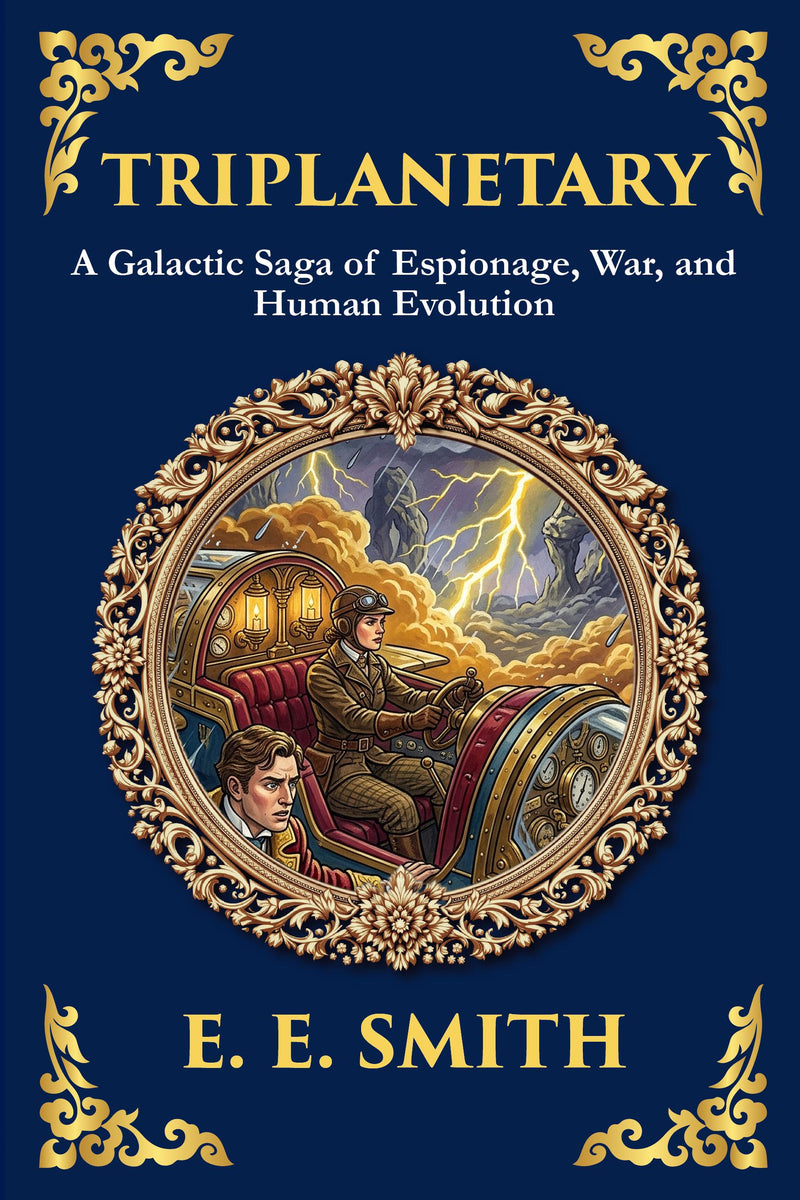
Triplanetary
The fate of three worlds hangs in the balance. In a universe teetering on the brink of galactic war, secret agents, alien powers, and ancient forces collide.
or free app
10,000+ hrs library
30-day guarantee
The complete Triplanetary appears in modern English through Library of Alexandria Press, available online with audiobook narration included for members.
Have you ever wondered why humanity’s destiny might be written among the stars? E. E. Smith’s Triplanetary is a sweeping epic of science fiction, blending espionage, interplanetary politics, and cosmic warfare into a saga that spans millennia. From the earliest days of humanity’s rise on Earth to a future where three planets—Earth, Mars, and Venus—form a fragile alliance, Smith weaves a tale of conflict, discovery, and destiny.
Hidden among these events are two ancient alien races, locked in a secret war that shapes the fate of countless worlds. Humanity is their newest pawn… and their last hope. As agents of the Triplanetary Service battle spies and traitors, a new hero emerges—Virgil Samms—whose courage and vision will one day lead to the creation of the Galactic Patrol and the mighty Lensmen.
Packed with breathtaking space battles, shadowy conspiracies, and the evolution of human courage, Triplanetary is more than a novel—it’s the origin story of an entire universe.
What you’ll discover in this modern edition
- A Universe-Spanning Conflict – Explore the secret war between ancient alien civilizations that has shaped life for millennia.
- Espionage Across the Stars – Follow the elite agents of the Triplanetary Service as they navigate treachery and interplanetary politics.
- Epic Space Battles and Heroic Sacrifice – Experience thrilling clashes between fleets that decide the fate of entire worlds.
- The Birth of the Galactic Patrol – Witness the origins of the legendary Lensman Corps, a cornerstone of classic science fiction.
- The Evolution of Humanity – Trace mankind’s journey from primitive beginnings to its role as a galactic power. Whether you are a long-time fan of E. E.
| Formats | eBook (EPUB + PDF) · Audiobook · Paperback · Hardcover · Large Print |
| Language | English |
| Trim size (print) | 6 × 9 in |
| Binding | Paperback — perfect-bound · Hardcover — casewrap |
| Large Print edition | Same text in a larger, easy-read type — a larger font, not a larger trim |
| Print pricing | Every physical book at our true cost — at-cost, no profit (members) |
| Library | 873 restored titles, always growing |
| Length | 89,464 words · ~5 hr 58 min reading |
| Reading level | Grade 5 · an easy, flowing read (this modern-English edition) |
| Edition | Modern English translation · 2026 |
Member reviews for this edition are collected as readers finish it — be the first. Across the library: 12,000+ books shipped, every plan covered by a 365-day print guarantee.
About this edition
A faithful, unabridged modern-English edition by The Library of Alexandria — carefully rendered for today's reader and verified paragraph-by-paragraph against the public-domain source. Available as eBook, audiobook, paperback, hardcover, and large print.
- Complete & unabridgedVerified paragraph by paragraph against the source — never a scan, never abridged.
- Modern English, faithfulReadable today, with the author’s meaning kept intact. Readable — not simplified.
- Every format, one membershipRead in your browser or the free app, or listen to the full audiobook.
Included free with your membership
Cancel anytime, one click · 30-day money-back guarantee
Edition last updated July 2026
What’s inside
Triplanetary — complete and unabridged: all 23 sections included with membership, plus the full audiobook.
Begin reading Triplanetary
In clear modern English — the complete text is included with membership.
Introduction
When readers speak of the great architects of science fiction, the conversation tends to gravitate toward a familiar handful of names. Yet long before the genre had matured into the respectable literary tradition it is today, before space opera became a marketable category, before galactic civilizations and interstellar wars became the common currency of popular imagination, there was Edward Elmer Smith—a man more often remembered simply as “Doc” Smith because of his doctorate in chemical engineering. What he produced was not merely entertainment, though it entertained generations of readers. He laid down the very blueprint that thousands of writers, filmmakers, and dreamers would follow for the rest of the twentieth century and beyond. The book you now hold in your hands is the opening movement of one of the most influential epics ever conceived in the genre, and it occupies a position in the history of imaginative literature that is difficult to overstate.
This modern translation and adaptation has been prepared with a specific purpose in mind: to deliver the pulse-pounding wonder of Smith’s original vision to readers who live in a very different world from the one in which it was first written. The prose has been carefully refreshed, the pacing tuned to contemporary sensibilities, and the language smoothed where the conventions of an earlier era might otherwise create friction for a modern audience. What has not changed is the soaring ambition, the breathtaking scope, and the sheer audacity of the storytelling. This is a saga that begins on the smallest of human scales and expands, almost vertiginously, to encompass the fate of entire worlds, the rise and fall of civilizations across uncountable millennia, and the secret machinery of cosmic forces operating just beyond the edge of human awareness. To read it is to stand at the headwaters of a mighty river and watch it begin its rush toward the sea.
To understand what makes this work so remarkable, it helps to understand a little about the circumstances of its creation and the man behind it. E. E. Smith was not a literary insider, nor was he a professional man of letters in the conventional sense. He was a working scientist, a food chemist by trade who specialized, of all things, in the development of doughnut mixes and other commercial baking products. This is not a trivial biographical curiosity—it speaks directly to the kind of mind that produced these stories. Smith approached the construction of his fictional universe with the methodical rigor of an engineer designing a structure meant to bear enormous loads. He thought in systems, in scales, in cause and effect. When he imagined a weapon, he wanted to understand the physics that made it work. When he imagined a spaceship, he wanted to account for the forces of acceleration, the limits of materials, the logic of propulsion. And when he imagined a war, he conceived it not as a single skirmish but as a vast and intricately interconnected campaign spanning solar systems.
The earliest versions of Smith’s space opera began to take shape in the 1910s and 1920s, an extraordinary fact when one considers how genuinely unprecedented his ideas were. There were no models for him to follow because, in a very real sense, the form he was inventing did not yet exist. Jules Verne had sent explorers beneath the sea and toward the moon. H. G. Wells had imagined Martian invasions and time machines. But the idea of a sprawling, multi-species galactic civilization, of interstellar travel as a routine matter, of cosmic-scale conflict between forces of order and chaos—these were largely Smith’s own invention, hammered out on the anvil of his imagination during the long gestation of his major works. By the time these stories reached print in the pulp magazines that flourished in the early to mid twentieth century, they struck readers with the force of revelation. Here was something entirely new: a vision of human destiny written across the stars themselves.
It is no exaggeration to say that the entire tradition of space opera—the term itself, the conventions, the grandeur—traces its lineage back to Smith. The serialized adventures that thrilled readers in those crackling, cheaply printed magazines became foundational texts for the writers who would dominate the so-called Golden Age of science fiction. Later generations of storytellers, working in film and television and across every medium imaginable, would draw upon a well that Smith helped to dig. The galactic patrols, the interstellar federations, the desperate battles between disciplined defenders of civilization and the ruthless agents of darkness, the heroes whose courage is matched only by their competence—these archetypes flowed outward from his pages into the broader culture, often without those who used them ever realizing where they originated. When you encounter the familiar shape of a great cosmic struggle in any modern story, you are encountering, at a distance, the influence of the man who wrote the book you are about to read.
What makes this particular volume so fascinating is its dual nature. It functions as a complete and self-contained story, but it also serves as a kind of grand overture, an introduction to a much larger symphony. Smith conceived of this opening installment as a way of laying the foundation for everything that would follow—of establishing the deep history, the hidden context, the cosmic stakes that give his larger saga its weight and meaning. The result is a narrative architecture of remarkable boldness. Rather than beginning his story in the thick of the action, Smith chose to begin at the very beginning, to trace the slow unfolding of events across spans of time so vast that human history seems but a flicker within them. This is storytelling on a scale that few writers before or since have dared to attempt, and it is one of the qualities that makes the experience of reading this book so distinctive. You are not simply following a plot; you are watching a universe take shape.
The author’s scientific background informs every page in ways both obvious and subtle. There is a palpable delight in the workings of things—in the mechanics of vessels hurtling through the void, in the energies that power them, in the strategies that govern their use. Smith was writing in an age when the wonders of science seemed to promise an almost limitless future, when each new discovery suggested that humanity stood on the threshold of transcending its earthbound limitations. That optimism, that boundless confidence in the capacity of intelligence and courage and ingenuity to overcome any obstacle, suffuses the entire work. It is, in a sense, a deeply hopeful book, even in its darkest passages. It believes in the possibility of greatness, in the idea that beings can rise above their circumstances and shape their own destinies through sheer force of will and intellect. This is a quality that has perhaps grown rarer in our more skeptical age, and it is part of what gives the reading experience its particular flavor—a flavor of wonder unashamed of itself.
One of the most striking features of this work is the sheer breadth of its temporal canvas. Where most adventure stories confine themselves to the span of a single human lifetime, or even a single dramatic episode, Smith was unafraid to think in terms of geological time, of civilizational cycles, of the long arc of evolution itself. The narrative does not hesitate to leap across vast gulfs, showing us how the threads of cause and effect can stretch across ages, how events in one era can echo down through countless generations to shape a distant future. This structure asks something of the reader—a willingness to surrender to a grander perspective, to relinquish the comfortable assumption that the story will remain anchored to a single time and place. Those who embrace this invitation will find themselves rewarded with a sense of scope and depth that few works of fiction can match.
The title itself signals the cosmic dimensions of what follows. We are dealing here not with a single world but with the relationships and tensions and conflicts that emerge when multiple worlds come into contact, when the destinies of separate civilizations become entangled. The early portions of the story establish the deep background against which the later drama will play out, introducing the reader to the secret history that lies beneath the surface of recorded events. There is a thrilling sense, as one reads, of seeing behind the curtain—of being shown the hidden truths and concealed forces that the characters within the story can scarcely begin to perceive. This dramatic irony, this privileged vantage point granted to the reader, is one of the great pleasures of the book, and it creates a mounting tension as the implications of what we are witnessing gradually become clear.
The subtitle of this edition speaks of espionage, war, and human evolution, and these three threads weave through the narrative in ways that reward close attention. The element of espionage brings a tension and intimacy to a story that might otherwise risk becoming too abstract in its grandeur. Here we find individual men and women operating in the shadows, gathering information, taking enormous personal risks, matching wits against cunning adversaries. These passages crackle with the energy of the thriller, with sudden reversals and narrow escapes and the constant uncertainty of a game in which the stakes could not be higher. Smith understood that even the largest conflicts ultimately come down to the choices and the courage of individuals, and he never loses sight of the human dimension even as his vision sweeps outward to encompass the fate of entire worlds.
The element of war, meanwhile, gives the book its propulsive momentum and its moments of genuine spectacle. Smith was a master of the large-scale set piece, of the battle that engages fleets and unleashes forces of almost unimaginable destructiveness. Yet his depictions of conflict are never merely gratuitous. They serve a purpose within the larger architecture of the story, illustrating the magnitude of what is at stake and the desperate resolve of those who fight to defend what they hold dear. There is a moral seriousness underlying these passages, a recognition that the struggle between order and chaos, between civilization and barbarism, is a struggle worth any sacrifice. The reader comes to understand that the wars depicted here are not simply contests of force but expressions of fundamentally opposed visions of what existence ought to be.
And then there is the theme of human evolution, perhaps the most profound and far-reaching of the three. Smith was deeply interested in the question of what humanity might become—of how the species might develop and refine itself over the long course of time, of the heights to which intelligence and will and discipline might ultimately aspire. This is not a story content to take human nature as a fixed and finished thing. It imagines transformation, advancement, the possibility that beings might transcend their present limitations and grow into something greater than they are. There is a visionary quality to these ideas, a willingness to dream large about the destiny of conscious life, that lifts the work above the level of mere adventure and gives it a philosophical resonance that lingers long after the final page.
What strikes many readers most forcefully is how these grand themes are conveyed not through dry exposition but through the sheer momentum of story. Smith was, above all else, a storyteller who understood the importance of keeping the reader turning pages. His narrative drives forward with relentless energy, building tension, raising stakes, delivering one breathtaking revelation after another. There is a generosity to his storytelling, an eagerness to thrill and amaze, that is genuinely infectious. He is not writing down to his audience; he is writing for an audience that he assumes shares his own boundless sense of wonder, his own delight in the possibilities of the imagination. This is a book that wants you to be excited, that wants you to feel the rush of discovery and the thrill of adventure, and it pursues that goal with an unflagging enthusiasm that has not dimmed with the passage of the decades.
Cancel anytime, one click · 30-day money-back guarantee
Founding annual rate available now — your price locks for life when you join.
Not ready? Get this free chapter by email — read it anytime.
✓ Sent — check your inbox for Triplanetary.
Questions about Triplanetary
What is Triplanetary about?
The fate of three worlds hangs in the balance. In a universe teetering on the brink of galactic war, secret agents, alien powers, and ancient forces collide. From the dawn of humanity to a future filled with interstellar empires, Triplanetary takes you on a breathtaking journey through time and space.
Who wrote Triplanetary?
Triplanetary was written by E. E. Smith. This edition presents the complete work in clear modern English, faithfully rendered from the public-domain original by Library of Alexandria Press.
Is Triplanetary free to read?
The opening chapter is free to read on this page. Members read and listen to the complete work — and the entire library — free, and can order any physical book at our true print cost.
How long is Triplanetary?
23 chapters (~89,464 words) — about 5 hr 58 min of reading in this modern-English edition.
Is this an abridged version of Triplanetary?
No. This is the complete, unabridged Triplanetary, carefully rendered into clear modern English and verified paragraph-by-paragraph against the public-domain source — nothing is cut or summarised.
What formats does Triplanetary come in?
Triplanetary is available as eBook, paperback, hardcover and large print. eBook and audiobook are included with membership; printed editions ship at our true print cost.
Shipping & returns
Billing & membership
More from the library


Explore Science Fiction
- The Island of Doctor Moreau · H. G. Wells
- A Midsummer Night’s Dream · William Shakespeare
- The Invisible Man: A Grotesque Romance · H. G. Wells
- The War of the Worlds · H. G. Wells
- The Strange Case of Dr. Jekyll and Mr. Hyde · Robert Louis Stevenson
- Limanora: the island of progress · Godfrey Sweven
- The Book of Dragons · E. Nesbit
- She · H. Rider Haggard
- Dorothy and the Wizard in Oz · L. Frank Baum
- The Princess and the Goblin · George MacDonald
- Gawayne and the Green Knight: A Fairy Tale · Charlton M. Lewis
- Lucian’s True History · Lucian of Samosata
- The Willows · Algernon Blackwood
- The Call of Cthulhu · H. P. Lovecraft
- The Life-Eater · Harold Ward
- The Marvelous Land of Oz · L. Frank Baum
- Mars is My Destination · Frank Belknap Long
- The Black Kiss
- The Beasts in the Void · Paul W. Fairman
- John Jones’s Dollar · Harry Stephen Keeler
- Subversive · Mack Reynolds
- The Mississippi Saucer · Frank Belknap Long
- Man of Distinction · Michael Shaara
- Spawn of the Comet · H. Thompson Rich
- The Golden Judge · Nathaniel Gordon
- Final Weapon · Everett B. Cole
- The Big Fix · George O. Smith
- Last Enemy · H. Beam Piper
- Time and Time Again · H. Beam Piper
- Sabotage in Space · Carey Rockwell
Triplanetary
Triplanetary
A Galactic Saga of Espionage, War, and Human Evolution
E. E. Smith
Contents
- Introduction
- Book 1
- Chapter 1
- Chapter 2
- Chapter 3
- Book 2
- Chapter 4
- Chapter 5
- Chapter 6
- Book 3
- Chapter 7
- Chapter 8
- Chapter 9
- Chapter 10
- Chapter 11
- Chapter 12
- Chapter 13
- Chapter 14
- Chapter 15
- Chapter 16
- Chapter 17
- Chapter 18
- Chapter 19
Introduction
When readers speak of the great architects of science fiction, the conversation tends to gravitate toward a familiar handful of names. Yet long before the genre had matured into the respectable literary tradition it is today, before space opera became a marketable category, before galactic civilizations and interstellar wars became the common currency of popular imagination, there was Edward Elmer Smith—a man more often remembered simply as “Doc” Smith because of his doctorate in chemical engineering. What he produced was not merely entertainment, though it entertained generations of readers. He laid down the very blueprint that thousands of writers, filmmakers, and dreamers would follow for the rest of the twentieth century and beyond. The book you now hold in your hands is the opening movement of one of the most influential epics ever conceived in the genre, and it occupies a position in the history of imaginative literature that is difficult to overstate.
This modern translation and adaptation has been prepared with a specific purpose in mind: to deliver the pulse-pounding wonder of Smith’s original vision to readers who live in a very different world from the one in which it was first written. The prose has been carefully refreshed, the pacing tuned to contemporary sensibilities, and the language smoothed where the conventions of an earlier era might otherwise create friction for a modern audience. What has not changed is the soaring ambition, the breathtaking scope, and the sheer audacity of the storytelling. This is a saga that begins on the smallest of human scales and expands, almost vertiginously, to encompass the fate of entire worlds, the rise and fall of civilizations across uncountable millennia, and the secret machinery of cosmic forces operating just beyond the edge of human awareness. To read it is to stand at the headwaters of a mighty river and watch it begin its rush toward the sea.
To understand what makes this work so remarkable, it helps to understand a little about the circumstances of its creation and the man behind it. E. E. Smith was not a literary insider, nor was he a professional man of letters in the conventional sense. He was a working scientist, a food chemist by trade who specialized, of all things, in the development of doughnut mixes and other commercial baking products. This is not a trivial biographical curiosity—it speaks directly to the kind of mind that produced these stories. Smith approached the construction of his fictional universe with the methodical rigor of an engineer designing a structure meant to bear enormous loads. He thought in systems, in scales, in cause and effect. When he imagined a weapon, he wanted to understand the physics that made it work. When he imagined a spaceship, he wanted to account for the forces of acceleration, the limits of materials, the logic of propulsion. And when he imagined a war, he conceived it not as a single skirmish but as a vast and intricately interconnected campaign spanning solar systems.
The earliest versions of Smith’s space opera began to take shape in the 1910s and 1920s, an extraordinary fact when one considers how genuinely unprecedented his ideas were. There were no models for him to follow because, in a very real sense, the form he was inventing did not yet exist. Jules Verne had sent explorers beneath the sea and toward the moon. H. G. Wells had imagined Martian invasions and time machines. But the idea of a sprawling, multi-species galactic civilization, of interstellar travel as a routine matter, of cosmic-scale conflict between forces of order and chaos—these were largely Smith’s own invention, hammered out on the anvil of his imagination during the long gestation of his major works. By the time these stories reached print in the pulp magazines that flourished in the early to mid twentieth century, they struck readers with the force of revelation. Here was something entirely new: a vision of human destiny written across the stars themselves.
It is no exaggeration to say that the entire tradition of space opera—the term itself, the conventions, the grandeur—traces its lineage back to Smith. The serialized adventures that thrilled readers in those crackling, cheaply printed magazines became foundational texts for the writers who would dominate the so-called Golden Age of science fiction. Later generations of storytellers, working in film and television and across every medium imaginable, would draw upon a well that Smith helped to dig. The galactic patrols, the interstellar federations, the desperate battles between disciplined defenders of civilization and the ruthless agents of darkness, the heroes whose courage is matched only by their competence—these archetypes flowed outward from his pages into the broader culture, often without those who used them ever realizing where they originated. When you encounter the familiar shape of a great cosmic struggle in any modern story, you are encountering, at a distance, the influence of the man who wrote the book you are about to read.
What makes this particular volume so fascinating is its dual nature. It functions as a complete and self-contained story, but it also serves as a kind of grand overture, an introduction to a much larger symphony. Smith conceived of this opening installment as a way of laying the foundation for everything that would follow—of establishing the deep history, the hidden context, the cosmic stakes that give his larger saga its weight and meaning. The result is a narrative architecture of remarkable boldness. Rather than beginning his story in the thick of the action, Smith chose to begin at the very beginning, to trace the slow unfolding of events across spans of time so vast that human history seems but a flicker within them. This is storytelling on a scale that few writers before or since have dared to attempt, and it is one of the qualities that makes the experience of reading this book so distinctive. You are not simply following a plot; you are watching a universe take shape.
The author’s scientific background informs every page in ways both obvious and subtle. There is a palpable delight in the workings of things—in the mechanics of vessels hurtling through the void, in the energies that power them, in the strategies that govern their use. Smith was writing in an age when the wonders of science seemed to promise an almost limitless future, when each new discovery suggested that humanity stood on the threshold of transcending its earthbound limitations. That optimism, that boundless confidence in the capacity of intelligence and courage and ingenuity to overcome any obstacle, suffuses the entire work. It is, in a sense, a deeply hopeful book, even in its darkest passages. It believes in the possibility of greatness, in the idea that beings can rise above their circumstances and shape their own destinies through sheer force of will and intellect. This is a quality that has perhaps grown rarer in our more skeptical age, and it is part of what gives the reading experience its particular flavor—a flavor of wonder unashamed of itself.
One of the most striking features of this work is the sheer breadth of its temporal canvas. Where most adventure stories confine themselves to the span of a single human lifetime, or even a single dramatic episode, Smith was unafraid to think in terms of geological time, of civilizational cycles, of the long arc of evolution itself. The narrative does not hesitate to leap across vast gulfs, showing us how the threads of cause and effect can stretch across ages, how events in one era can echo down through countless generations to shape a distant future. This structure asks something of the reader—a willingness to surrender to a grander perspective, to relinquish the comfortable assumption that the story will remain anchored to a single time and place. Those who embrace this invitation will find themselves rewarded with a sense of scope and depth that few works of fiction can match.
The title itself signals the cosmic dimensions of what follows. We are dealing here not with a single world but with the relationships and tensions and conflicts that emerge when multiple worlds come into contact, when the destinies of separate civilizations become entangled. The early portions of the story establish the deep background against which the later drama will play out, introducing the reader to the secret history that lies beneath the surface of recorded events. There is a thrilling sense, as one reads, of seeing behind the curtain—of being shown the hidden truths and concealed forces that the characters within the story can scarcely begin to perceive. This dramatic irony, this privileged vantage point granted to the reader, is one of the great pleasures of the book, and it creates a mounting tension as the implications of what we are witnessing gradually become clear.
The subtitle of this edition speaks of espionage, war, and human evolution, and these three threads weave through the narrative in ways that reward close attention. The element of espionage brings a tension and intimacy to a story that might otherwise risk becoming too abstract in its grandeur. Here we find individual men and women operating in the shadows, gathering information, taking enormous personal risks, matching wits against cunning adversaries. These passages crackle with the energy of the thriller, with sudden reversals and narrow escapes and the constant uncertainty of a game in which the stakes could not be higher. Smith understood that even the largest conflicts ultimately come down to the choices and the courage of individuals, and he never loses sight of the human dimension even as his vision sweeps outward to encompass the fate of entire worlds.
The element of war, meanwhile, gives the book its propulsive momentum and its moments of genuine spectacle. Smith was a master of the large-scale set piece, of the battle that engages fleets and unleashes forces of almost unimaginable destructiveness. Yet his depictions of conflict are never merely gratuitous. They serve a purpose within the larger architecture of the story, illustrating the magnitude of what is at stake and the desperate resolve of those who fight to defend what they hold dear. There is a moral seriousness underlying these passages, a recognition that the struggle between order and chaos, between civilization and barbarism, is a struggle worth any sacrifice. The reader comes to understand that the wars depicted here are not simply contests of force but expressions of fundamentally opposed visions of what existence ought to be.
And then there is the theme of human evolution, perhaps the most profound and far-reaching of the three. Smith was deeply interested in the question of what humanity might become—of how the species might develop and refine itself over the long course of time, of the heights to which intelligence and will and discipline might ultimately aspire. This is not a story content to take human nature as a fixed and finished thing. It imagines transformation, advancement, the possibility that beings might transcend their present limitations and grow into something greater than they are. There is a visionary quality to these ideas, a willingness to dream large about the destiny of conscious life, that lifts the work above the level of mere adventure and gives it a philosophical resonance that lingers long after the final page.
What strikes many readers most forcefully is how these grand themes are conveyed not through dry exposition but through the sheer momentum of story. Smith was, above all else, a storyteller who understood the importance of keeping the reader turning pages. His narrative drives forward with relentless energy, building tension, raising stakes, delivering one breathtaking revelation after another. There is a generosity to his storytelling, an eagerness to thrill and amaze, that is genuinely infectious. He is not writing down to his audience; he is writing for an audience that he assumes shares his own boundless sense of wonder, his own delight in the possibilities of the imagination. This is a book that wants you to be excited, that wants you to feel the rush of discovery and the thrill of adventure, and it pursues that goal with an unflagging enthusiasm that has not dimmed with the passage of the decades.
About two billion years ago, two galaxies collided—or rather, passed through one another. A few hundred million years of difference doesn’t really matter, as the process of passing through took at least that long. Around that same time—likely within a ten percent margin of error—almost every star in both galaxies developed planets.
There is plenty of evidence to suggest that it wasn’t a coincidence that so many planets formed right as the galaxies were merging. However, another school of thought argues it was pure chance, claiming that stars have planets as naturally and inevitably as cats have kittens.
Regardless, Arisian records are clear: before the two galaxies began to merge, neither had more than three solar systems, and usually they only had one. Because of this, when the sun of the planet where their race began grew old and cold, the Arisians struggled to save their culture. They had to race against time to solve the engineering challenges of moving an entire planet from an old sun to a younger one.
Since no physical matter was destroyed when the Eddorians were forced into the next plane of existence, their historical records are also available. These records—consisting of folios, tapes, and platinum alloy discs that can withstand even Eddore’s toxic atmosphere—agree with the Arisian accounts. Immediately before the merger began, there was only one planetary solar system in the Second Galaxy. Until the arrival of Eddore, the Second Galaxy had no intelligent life at all.
So, for countless millions of years, these two races—each the only intelligent life in their respective galaxy, and perhaps in the entire space-time continuum—remained completely unaware of each other. Both were already ancient by the time the galaxies merged. The only other thing they had in common was the possession of powerful minds.
End of the free sample
Keep reading, free
Members read and listen to the complete book — and the entire library. Cancel anytime, one click · 30-day money-back guarantee.