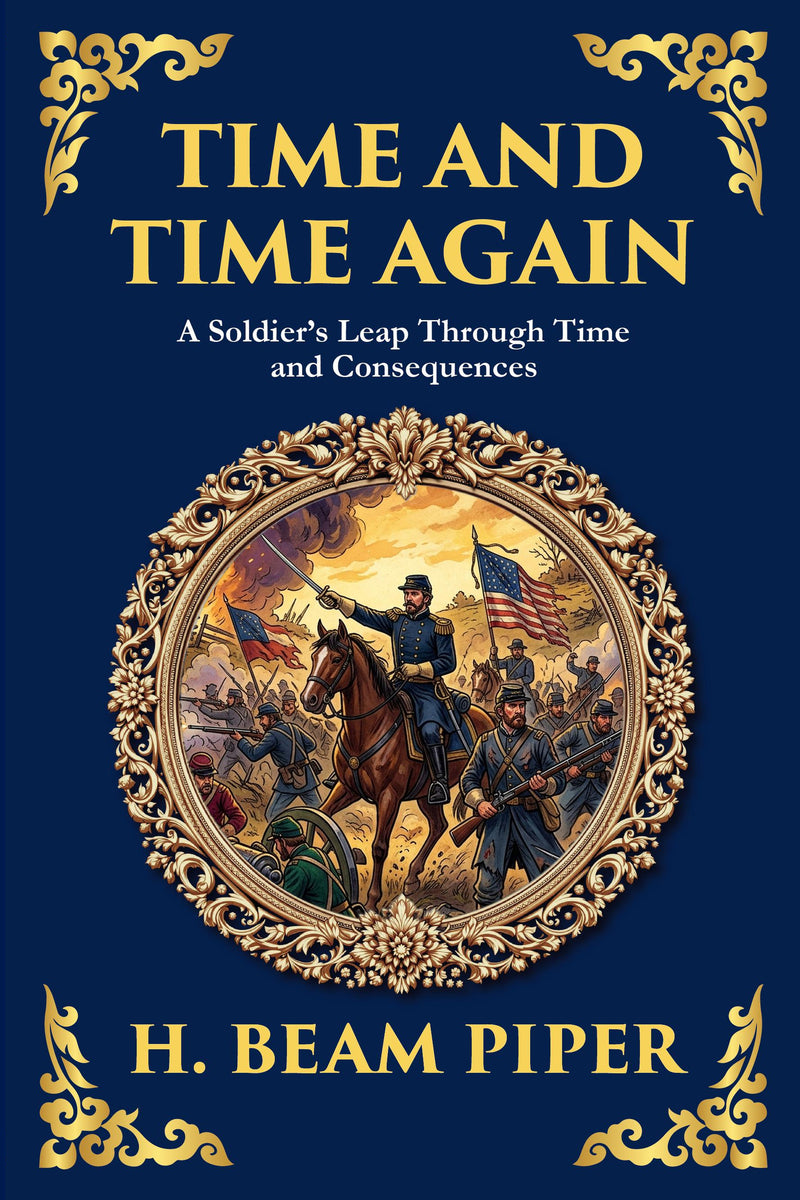
Time and Time Again — Large Print
Can a single thought in the moment of death rewrite the course of a life? In Time and Time Again, H. Beam Piper weaves a gripping tale of time travel, redemption, and second chances.
or free app
10,000+ hrs library
30-day guarantee
The complete Time and Time Again appears in modern English through Library of Alexandria Press, available online with audiobook narration included for members.
Have you ever wondered why a second chance could be the most terrifying gift of all? Time and Time Again by H. Beam Piper is a timeless and thought-provoking short story about one man’s return from death—not into the afterlife, but into his own past. When Sergeant Allan Hartley is struck down during the final days of a devastating war, he suddenly regains consciousness in the bedroom of his boyhood home.
The year is 1945. The war hasn’t happened yet. Armed with the memories and knowledge of a brutal future, Allan finds himself standing at a crossroads—one where every decision could prevent millions of deaths… or unravel reality itself.
But fate does not yield easily. And the young body he inhabits now carries both the weight of foresight and the innocence of youth. Is it his duty to warn the world?
Or is the burden of knowledge a curse in disguise? Through crisp prose and powerful themes, Piper explores: The haunting possibility of time travel as a vehicle for redemption and moral reckoning The psychological complexity of inhabiting a younger self with the mind of a war- hardened soldier The tension between fate and free will—can history truly be changed, or merely relived? The ethical questions behind intervention, knowledge, and the fragility of the future A soldier’s quest to use memory not for regret, but for purpose Perfect for fans of Ray Bradbury, Philip K. Dick, or Robert Heinlein, this unforgettable story asks the question: If you had the chance to live your life again—knowing what you now know—what would you do?
What you’ll discover in this modern edition
- A moving exploration of time travel as a path to redemption
- A soldier’s gripping internal struggle with what to change and what to leave untouched
- A razor-sharp look at fate, memory, and the ethics of altering history
| Formats | eBook (EPUB + PDF) · Audiobook · Paperback · Hardcover · Large Print |
| Language | English |
| Trim size (print) | 6 × 9 in |
| Binding | Paperback — perfect-bound · Hardcover — casewrap |
| Large Print edition | Same text in a larger, easy-read type — a larger font, not a larger trim |
| Print pricing | Every physical book at our true cost — at-cost, no profit (members) |
| Library | 873 restored titles, always growing |
| Length | 10,474 words · ~42 min reading |
| Reading level | Grade 4 · an easy, flowing read (this modern-English edition) |
| Edition | Modern English translation · 2026 |
Member reviews for this edition are collected as readers finish it — be the first. Across the library: 12,000+ books shipped, every plan covered by a 365-day print guarantee.
About this edition
A faithful, unabridged modern-English edition by The Library of Alexandria — carefully rendered for today's reader and verified paragraph-by-paragraph against the public-domain source. Available as eBook, audiobook, paperback, hardcover, and large print.
- Complete & unabridgedVerified paragraph by paragraph against the source — never a scan, never abridged.
- Modern English, faithfulReadable today, with the author’s meaning kept intact. Readable — not simplified.
- Every format, one membershipRead in your browser or the free app, or listen to the full audiobook.
Included free with your membership
Cancel anytime, one click · 30-day money-back guarantee
Edition last updated July 2026
What’s inside
Time and Time Again — Large Print — complete and unabridged, included in full with membership, plus the full audiobook.
Begin reading Time and Time Again — Large Print
In clear modern English — the complete text is included with membership.
Introduction
There are stories that arrive quietly, take up only a handful of pages, and yet manage to lodge themselves permanently in the imagination of everyone who encounters them. They do their work without spectacle, without the apparatus of grand world-building or the slow accumulation of the pages ahead. They simply pose a question so elegant, so personal, and so unsettling that the reader cannot put it down, and cannot quite leave it behind afterward. Time and Time Again is one of those stories. First published in 1947, it announced the arrival of a writer who would become one of the most quietly influential voices in mid-century American science fiction, and it remains, more than seventy-five years later, a small marvel of compression, intelligence, and feeling.
The premise at its heart is one of the most universally seductive ideas a human being can entertain. What if you could go back? Not metaphorically, not through memory or regret, but actually return to an earlier moment in your own life, carrying with you everything you have since learned, every mistake you have catalogued, every loss you have mourned and every chance you wish you had seized? It is the question we ask ourselves in the long hours of the night, the daydream we indulge in moments of disappointment, the bargain we would strike with any devil or angel who offered it. Piper takes that universal yearning and treats it not as a fantasy but as a problem to be reasoned through with the cool rigor of an engineer and the warm understanding of a man who has thought deeply about the weight of years. The result is a work that satisfies on the level of pure ideas while reaching the reader somewhere far more intimate.
This edition presents the story in a modern translation, carefully adapted for the contemporary reader. That phrase deserves a word of explanation, because it speaks to the spirit in which this volume has been prepared. The science fiction of the 1940s was written for an audience steeped in the conventions and cadences of its day, and while Piper’s prose was always remarkably clean and direct by the standards of his era, the passage of decades inevitably places small obstacles between a modern reader and a vintage text. Idioms shift. Technical references that once seemed cutting-edge acquire a quaint patina. Sentence rhythms that flowed naturally to readers in the immediate postwar years can feel, to us, slightly mannered or oblique. The aim of this adaptation is not to rewrite Piper, nor to strip away the texture of his time, but to smooth the path just enough that the modern reader can experience the story with the same immediacy its first audience did. The goal is fidelity to the experience rather than slavish reproduction of every period detail. What you hold is meant to feel alive in your hands, not preserved behind glass.
To understand why this particular tale carries the emotional charge it does, it helps to know a little about the man who wrote it. Henry Beam Piper, who published under the name H. Beam Piper, was in many ways an unlikely candidate for literary immortality. Born in Pennsylvania in 1904, he was largely self-educated, a voracious autodidact who never attended college and who worked for years as a laborer and night watchman for the Pennsylvania Railroad. This was not a man cushioned by privilege or shaped by formal academic training. He read constantly and widely, accumulating a formidable command of history, military affairs, firearms, and the broad sweep of human civilization, and he poured that hard-won knowledge into fiction that was, beneath its adventurous surfaces, deeply concerned with how societies rise, fall, learn, and forget.
Piper came to writing relatively late and achieved his greatest recognition gradually, over the course of the 1950s and early 1960s, with stories and novels that would influence generations of writers who came after him. He is best remembered today for two great bodies of work. The first is his Terro-Human Future History, an elaborate and meticulously constructed timeline tracing the expansion of humanity across the galaxy over thousands of years, a project that anticipated and arguably helped shape the entire subgenre of future-history science fiction. The second is Little Fuzzy and its sequels, gentle yet morally serious novels about the discovery of an alien species and the legal and ethical question of what, precisely, constitutes a person. That single question, returned to again and again across his career, reveals the moral seriousness that animated even his most entertaining work.
But before any of that, there was Time and Time Again. It was, in fact, the very first story Piper sold, the work that opened the door to his professional career when it appeared in Astounding Science Fiction under the editorship of the legendary John W. Campbell. There is something fitting, almost poetic, about the fact that a writer who would devote so much of his life to imagining vast spans of time should begin with a story about time itself, about its irreversibility and the dream of reversing it. The themes that would preoccupy him for the rest of his career are all present here in miniature: the burden of history, the value of knowledge, the question of what a person can do with the awareness they accumulate as they move through the world.
Piper’s own life ended in tragedy. In 1964, facing financial difficulties and apparently convinced that his career was failing, he took his own life. The cruel irony, the kind of irony that feels almost too pointed for fiction, is that his reputation has only grown in the decades since. His books have been reprinted again and again, his influence acknowledged by writers far more famous than he ever was in his lifetime, and the very qualities that made his work distinctive, its clarity, its intelligence, its quiet humanity, have aged into something like timelessness. He did not live to see how much his stories would come to mean to readers across multiple generations. There is a melancholy in that, but there is also a kind of vindication, and reading Time and Time Again with that knowledge adds a poignant resonance to a story that is already, at its core, about the things we wish we could have known sooner.
It is worth pausing on the moment in which the story was written. The year 1947 sat in the immediate shadow of the Second World War. The world had just emerged from a conflict of unprecedented scale and horror, one that had reshaped the global order, introduced the atomic bomb into human affairs, and left an entire generation grappling with grief, dislocation, and an anxious uncertainty about the future. The questions that hung over that period, about whether humanity could learn from its catastrophes, about whether knowledge of where we had gone wrong might allow us to choose differently, about what an individual could possibly do in the face of forces so much larger than himself, are precisely the questions this story engages. Piper, a man fascinated by military history and by the long patterns of human conflict, was writing into that anxious, hopeful, uncertain moment, and his story carries the weight of it. To read Time and Time Again is, in part, to glimpse how a thoughtful man at the dawn of the atomic age tried to imagine a better path, and what he believed a single person of conscience and foresight might accomplish.
A Story of Time, Memory, and Second Chances
I will not describe the events of the story in any detail, because to do so would be to rob you of the precise pleasures it is designed to deliver. Part of the deep satisfaction of Time and Time Again lies in the way it unfolds, the way its central situation is revealed and then explored with patient logic, and any summary that gave away its turns would be a disservice. But I can speak in general terms about what makes it so remarkable, and about the qualities you should watch for as you read, because understanding the artistry at work will only deepen your appreciation.
The story belongs to a venerable tradition of time-travel fiction, but it approaches that tradition from an unusual and deeply human angle. Where many time-travel tales are preoccupied with paradox, with the mechanical puzzles of cause and effect, with the dangers of altering the past or the impossibility of doing so, Piper is interested in something more personal and more profound. He is interested in the relationship between knowledge and time, in what it would actually mean to possess the wisdom of years while having the opportunity to act on it. He understands that the true tragedy of human life is not that we make mistakes, but that we make them while we are too young or too ignorant to know better, and that by the time we acquire the understanding that might have saved us, the moment to use it has passed. We learn, in other words, exactly backward, accumulating wisdom precisely as the opportunities to apply it dwindle.
This is the emotional engine of the story, and it is what lifts it above mere cleverness. We have all felt the ache of that backward learning, the sense that if only we knew then what we know now, everything might have been different. Piper takes that ache and gives it a literal form, and in doing so he forces us to confront what we would really do with such a gift. Would we use it for personal gain? For the benefit of others? Would we try to change the great course of history, or content ourselves with smaller, more intimate corrections? And underneath all of these questions lies a deeper and more troubling one: even with all the knowledge in the world, are we wise enough, disciplined enough, courageous enough to act well? The story does not answer these questions cheaply, and it trusts the reader to feel their weight.
What is so striking about Piper’s handling of this material is his restraint and his realism. There is a temptation, in stories of this kind, to indulge in wish-fulfillment, to give the protagonist effortless mastery over events, to let the fantasy run wild. Piper resists this. His treatment is grounded, thoughtful, and psychologically credible. He is interested in the practical difficulties as much as the dramatic possibilities, in the question of what is actually possible for a single human being who finds himself in an extraordinary situation. This grounding is what gives the story its peculiar power. It feels true. It feels like something that could happen to you, and that you would have to navigate with the same imperfect judgment you bring to everything else in your life.
The protagonist himself is worth watching closely. Piper had a gift for creating characters who were competent without being superhuman, intelligent without being cold, decent without being saccharine. The central figure of this story embodies that gift. He is a man you can believe in, a man whose reactions feel authentic, whose reasoning you can follow, whose growing comprehension of his circumstances mirrors your own. The subtitle of this edition describes him as a soldier, and that detail matters. There is a particular cast of mind that military experience can produce, a combination of practical realism and strategic thinking, an awareness of how individual action fits into larger patterns of conflict and consequence, and Piper, with his lifelong fascination with military history, draws on that cast of mind to great effect. The journey through time that the protagonist undertakes is not merely physical or temporal; it is a journey of understanding, of moral reckoning, of coming to terms with the strange and weighty gift he has been given.
I want to say a particular word about the craft of the writing, because it is easy to overlook in a story so propulsive. Piper was a master of economy. He does not waste words. He establishes situation, character, and stakes with remarkable efficiency, trusting the reader to keep up and rewarding that trust with a story that moves. There is not an ounce of fat on these pages. Every scene advances the whole; every detail earns its place. In an age when so much fiction is bloated and self-indulgent, when stories that could be told in fifty pages are stretched across five hundred, there is something genuinely refreshing about Piper’s discipline. He shows us how much can be accomplished in a small space when a writer knows exactly what he is doing and respects the intelligence of his audience. The brevity is not a limitation but a virtue, a demonstration of how concentration can intensify rather than diminish emotional and intellectual impact.
Cancel anytime, one click · 30-day money-back guarantee
Founding annual rate available now — your price locks for life when you join.
Not ready? Get this free chapter by email — read it anytime.
✓ Sent — check your inbox for Time and Time Again — Large Print.
Questions about Time and Time Again — Large Print
What is Time and Time Again about?
Can a single thought in the moment of death rewrite the course of a life? In Time and Time Again, H. Beam Piper weaves a gripping tale of time travel, redemption, and second chances. A soldier dies on the battlefield—only to awaken decades earlier in the body of his younger self.
Who wrote Time and Time Again?
Time and Time Again was written by H. Beam Piper. This edition presents the complete work in clear modern English, faithfully rendered from the public-domain original by Library of Alexandria Press.
Is Time and Time Again free to read?
The opening chapter is free to read on this page. Members read and listen to the complete work — and the entire library — free, and can order any physical book at our true print cost.
How long is Time and Time Again?
2 chapters (~10,474 words) — about 42 min of reading in this modern-English edition.
Is this an abridged version of Time and Time Again?
No. This is the complete, unabridged Time and Time Again, carefully rendered into clear modern English and verified paragraph-by-paragraph against the public-domain source — nothing is cut or summarised.
What formats does Time and Time Again come in?
Time and Time Again is available as eBook, paperback, hardcover and large print. eBook and audiobook are included with membership; printed editions ship at our true print cost.
Shipping & returns
Billing & membership
More from the library


Explore Science Fiction
- The Island of Doctor Moreau · H. G. Wells
- A Midsummer Night’s Dream · William Shakespeare
- The Invisible Man: A Grotesque Romance · H. G. Wells
- The War of the Worlds · H. G. Wells
- The Strange Case of Dr. Jekyll and Mr. Hyde · Robert Louis Stevenson
- Limanora: the island of progress · Godfrey Sweven
- The Book of Dragons · E. Nesbit
- She · H. Rider Haggard
- Dorothy and the Wizard in Oz · L. Frank Baum
- The Princess and the Goblin · George MacDonald
- Gawayne and the Green Knight: A Fairy Tale · Charlton M. Lewis
- Lucian’s True History · Lucian of Samosata
- The Willows · Algernon Blackwood
- The Call of Cthulhu · H. P. Lovecraft
- The Life-Eater · Harold Ward
- The Marvelous Land of Oz · L. Frank Baum
- Mars is My Destination · Frank Belknap Long
- The Black Kiss
- The Beasts in the Void · Paul W. Fairman
- John Jones’s Dollar · Harry Stephen Keeler
- Subversive · Mack Reynolds
- The Mississippi Saucer · Frank Belknap Long
- Man of Distinction · Michael Shaara
- Spawn of the Comet · H. Thompson Rich
- The Golden Judge · Nathaniel Gordon
- Final Weapon · Everett B. Cole
- The Big Fix · George O. Smith
- Last Enemy · H. Beam Piper
- Time and Time Again · H. Beam Piper
- Sabotage in Space · Carey Rockwell
Time and Time Again — Large Print
Time and Time Again — Large Print
A Soldier’s Journey Through Time and Its Aftermath
H. Beam Piper
Contents
- Introduction
- Time and Time Again
Introduction
There are stories that arrive quietly, take up only a handful of pages, and yet manage to lodge themselves permanently in the imagination of everyone who encounters them. They do their work without spectacle, without the apparatus of grand world-building or the slow accumulation of the pages ahead. They simply pose a question so elegant, so personal, and so unsettling that the reader cannot put it down, and cannot quite leave it behind afterward. Time and Time Again is one of those stories. First published in 1947, it announced the arrival of a writer who would become one of the most quietly influential voices in mid-century American science fiction, and it remains, more than seventy-five years later, a small marvel of compression, intelligence, and feeling.
The premise at its heart is one of the most universally seductive ideas a human being can entertain. What if you could go back? Not metaphorically, not through memory or regret, but actually return to an earlier moment in your own life, carrying with you everything you have since learned, every mistake you have catalogued, every loss you have mourned and every chance you wish you had seized? It is the question we ask ourselves in the long hours of the night, the daydream we indulge in moments of disappointment, the bargain we would strike with any devil or angel who offered it. Piper takes that universal yearning and treats it not as a fantasy but as a problem to be reasoned through with the cool rigor of an engineer and the warm understanding of a man who has thought deeply about the weight of years. The result is a work that satisfies on the level of pure ideas while reaching the reader somewhere far more intimate.
This edition presents the story in a modern translation, carefully adapted for the contemporary reader. That phrase deserves a word of explanation, because it speaks to the spirit in which this volume has been prepared. The science fiction of the 1940s was written for an audience steeped in the conventions and cadences of its day, and while Piper’s prose was always remarkably clean and direct by the standards of his era, the passage of decades inevitably places small obstacles between a modern reader and a vintage text. Idioms shift. Technical references that once seemed cutting-edge acquire a quaint patina. Sentence rhythms that flowed naturally to readers in the immediate postwar years can feel, to us, slightly mannered or oblique. The aim of this adaptation is not to rewrite Piper, nor to strip away the texture of his time, but to smooth the path just enough that the modern reader can experience the story with the same immediacy its first audience did. The goal is fidelity to the experience rather than slavish reproduction of every period detail. What you hold is meant to feel alive in your hands, not preserved behind glass.
To understand why this particular tale carries the emotional charge it does, it helps to know a little about the man who wrote it. Henry Beam Piper, who published under the name H. Beam Piper, was in many ways an unlikely candidate for literary immortality. Born in Pennsylvania in 1904, he was largely self-educated, a voracious autodidact who never attended college and who worked for years as a laborer and night watchman for the Pennsylvania Railroad. This was not a man cushioned by privilege or shaped by formal academic training. He read constantly and widely, accumulating a formidable command of history, military affairs, firearms, and the broad sweep of human civilization, and he poured that hard-won knowledge into fiction that was, beneath its adventurous surfaces, deeply concerned with how societies rise, fall, learn, and forget.
Piper came to writing relatively late and achieved his greatest recognition gradually, over the course of the 1950s and early 1960s, with stories and novels that would influence generations of writers who came after him. He is best remembered today for two great bodies of work. The first is his Terro-Human Future History, an elaborate and meticulously constructed timeline tracing the expansion of humanity across the galaxy over thousands of years, a project that anticipated and arguably helped shape the entire subgenre of future-history science fiction. The second is Little Fuzzy and its sequels, gentle yet morally serious novels about the discovery of an alien species and the legal and ethical question of what, precisely, constitutes a person. That single question, returned to again and again across his career, reveals the moral seriousness that animated even his most entertaining work.
But before any of that, there was Time and Time Again. It was, in fact, the very first story Piper sold, the work that opened the door to his professional career when it appeared in Astounding Science Fiction under the editorship of the legendary John W. Campbell. There is something fitting, almost poetic, about the fact that a writer who would devote so much of his life to imagining vast spans of time should begin with a story about time itself, about its irreversibility and the dream of reversing it. The themes that would preoccupy him for the rest of his career are all present here in miniature: the burden of history, the value of knowledge, the question of what a person can do with the awareness they accumulate as they move through the world.
Piper’s own life ended in tragedy. In 1964, facing financial difficulties and apparently convinced that his career was failing, he took his own life. The cruel irony, the kind of irony that feels almost too pointed for fiction, is that his reputation has only grown in the decades since. His books have been reprinted again and again, his influence acknowledged by writers far more famous than he ever was in his lifetime, and the very qualities that made his work distinctive, its clarity, its intelligence, its quiet humanity, have aged into something like timelessness. He did not live to see how much his stories would come to mean to readers across multiple generations. There is a melancholy in that, but there is also a kind of vindication, and reading Time and Time Again with that knowledge adds a poignant resonance to a story that is already, at its core, about the things we wish we could have known sooner.
It is worth pausing on the moment in which the story was written. The year 1947 sat in the immediate shadow of the Second World War. The world had just emerged from a conflict of unprecedented scale and horror, one that had reshaped the global order, introduced the atomic bomb into human affairs, and left an entire generation grappling with grief, dislocation, and an anxious uncertainty about the future. The questions that hung over that period, about whether humanity could learn from its catastrophes, about whether knowledge of where we had gone wrong might allow us to choose differently, about what an individual could possibly do in the face of forces so much larger than himself, are precisely the questions this story engages. Piper, a man fascinated by military history and by the long patterns of human conflict, was writing into that anxious, hopeful, uncertain moment, and his story carries the weight of it. To read Time and Time Again is, in part, to glimpse how a thoughtful man at the dawn of the atomic age tried to imagine a better path, and what he believed a single person of conscience and foresight might accomplish.
A Story of Time, Memory, and Second Chances
I will not describe the events of the story in any detail, because to do so would be to rob you of the precise pleasures it is designed to deliver. Part of the deep satisfaction of Time and Time Again lies in the way it unfolds, the way its central situation is revealed and then explored with patient logic, and any summary that gave away its turns would be a disservice. But I can speak in general terms about what makes it so remarkable, and about the qualities you should watch for as you read, because understanding the artistry at work will only deepen your appreciation.
The story belongs to a venerable tradition of time-travel fiction, but it approaches that tradition from an unusual and deeply human angle. Where many time-travel tales are preoccupied with paradox, with the mechanical puzzles of cause and effect, with the dangers of altering the past or the impossibility of doing so, Piper is interested in something more personal and more profound. He is interested in the relationship between knowledge and time, in what it would actually mean to possess the wisdom of years while having the opportunity to act on it. He understands that the true tragedy of human life is not that we make mistakes, but that we make them while we are too young or too ignorant to know better, and that by the time we acquire the understanding that might have saved us, the moment to use it has passed. We learn, in other words, exactly backward, accumulating wisdom precisely as the opportunities to apply it dwindle.
This is the emotional engine of the story, and it is what lifts it above mere cleverness. We have all felt the ache of that backward learning, the sense that if only we knew then what we know now, everything might have been different. Piper takes that ache and gives it a literal form, and in doing so he forces us to confront what we would really do with such a gift. Would we use it for personal gain? For the benefit of others? Would we try to change the great course of history, or content ourselves with smaller, more intimate corrections? And underneath all of these questions lies a deeper and more troubling one: even with all the knowledge in the world, are we wise enough, disciplined enough, courageous enough to act well? The story does not answer these questions cheaply, and it trusts the reader to feel their weight.
What is so striking about Piper’s handling of this material is his restraint and his realism. There is a temptation, in stories of this kind, to indulge in wish-fulfillment, to give the protagonist effortless mastery over events, to let the fantasy run wild. Piper resists this. His treatment is grounded, thoughtful, and psychologically credible. He is interested in the practical difficulties as much as the dramatic possibilities, in the question of what is actually possible for a single human being who finds himself in an extraordinary situation. This grounding is what gives the story its peculiar power. It feels true. It feels like something that could happen to you, and that you would have to navigate with the same imperfect judgment you bring to everything else in your life.
The protagonist himself is worth watching closely. Piper had a gift for creating characters who were competent without being superhuman, intelligent without being cold, decent without being saccharine. The central figure of this story embodies that gift. He is a man you can believe in, a man whose reactions feel authentic, whose reasoning you can follow, whose growing comprehension of his circumstances mirrors your own. The subtitle of this edition describes him as a soldier, and that detail matters. There is a particular cast of mind that military experience can produce, a combination of practical realism and strategic thinking, an awareness of how individual action fits into larger patterns of conflict and consequence, and Piper, with his lifelong fascination with military history, draws on that cast of mind to great effect. The journey through time that the protagonist undertakes is not merely physical or temporal; it is a journey of understanding, of moral reckoning, of coming to terms with the strange and weighty gift he has been given.
I want to say a particular word about the craft of the writing, because it is easy to overlook in a story so propulsive. Piper was a master of economy. He does not waste words. He establishes situation, character, and stakes with remarkable efficiency, trusting the reader to keep up and rewarding that trust with a story that moves. There is not an ounce of fat on these pages. Every scene advances the whole; every detail earns its place. In an age when so much fiction is bloated and self-indulgent, when stories that could be told in fifty pages are stretched across five hundred, there is something genuinely refreshing about Piper’s discipline. He shows us how much can be accomplished in a small space when a writer knows exactly what he is doing and respects the intelligence of his audience. The brevity is not a limitation but a virtue, a demonstration of how concentration can intensify rather than diminish emotional and intellectual impact.
Changing the steady, powerful flow of time would likely require a massive amount of energy. Normally, no one would expect to get a second chance at life. However, an atomic event might make both possible—
Blinded by the flash of the bomb and numbed by a sedative injection, he couldn’t tell how badly he was hurt, but he knew he was dying. In the darkness around him, voices sounded as if they were coming through a thick wall.
“They could’ve just left most of these guys where they found ‘em. Half of them won’t even survive until the truck gets here.”
“It doesn’t matter; as long as they are alive, they must be treated,” another voice replied, sounding sharp and educated. “We should start taking names while we wait.”
“Yes, sir.” Fingers fumbled with his ID tag. “Hartley, Allan; Captain, G5, Chem. Research AN/73/D. Serial, SO-23869403J.”
“Allan Hartley!” The medical officer spoke with shocked surprise. “Wait, he’s the man who wrote ‘Children of the Mist’, ‘Rose of Death’, and ‘Conqueror’s Road’!”
He tried to speak and must have moved; the medic’s voice became more alert.
“Major, I think he’s partially awake. Maybe I should give him another shot.”
Something poked Allan Hartley in the back of the neck. Soft waves of unconsciousness washed over him, and all that remained was a tiny spark of awareness, glowing alone and lost in a vast darkness.
The spark grew brighter. He was more than just a feeling of existence. He was a man with a name, a military rank, and memories. He remembered the searing blue-green flash and what he had been doing outside the shelter just before it happened. He remembered the month-long siege and the retreat from the north. He even remembered the days before the war, back when he was just little Allan Hartley, a schoolboy and the son of a successful lawyer in Williamsport, Pennsylvania.
End of the free sample
Keep reading, free
Members read and listen to the complete book — and the entire library. Cancel anytime, one click · 30-day money-back guarantee.