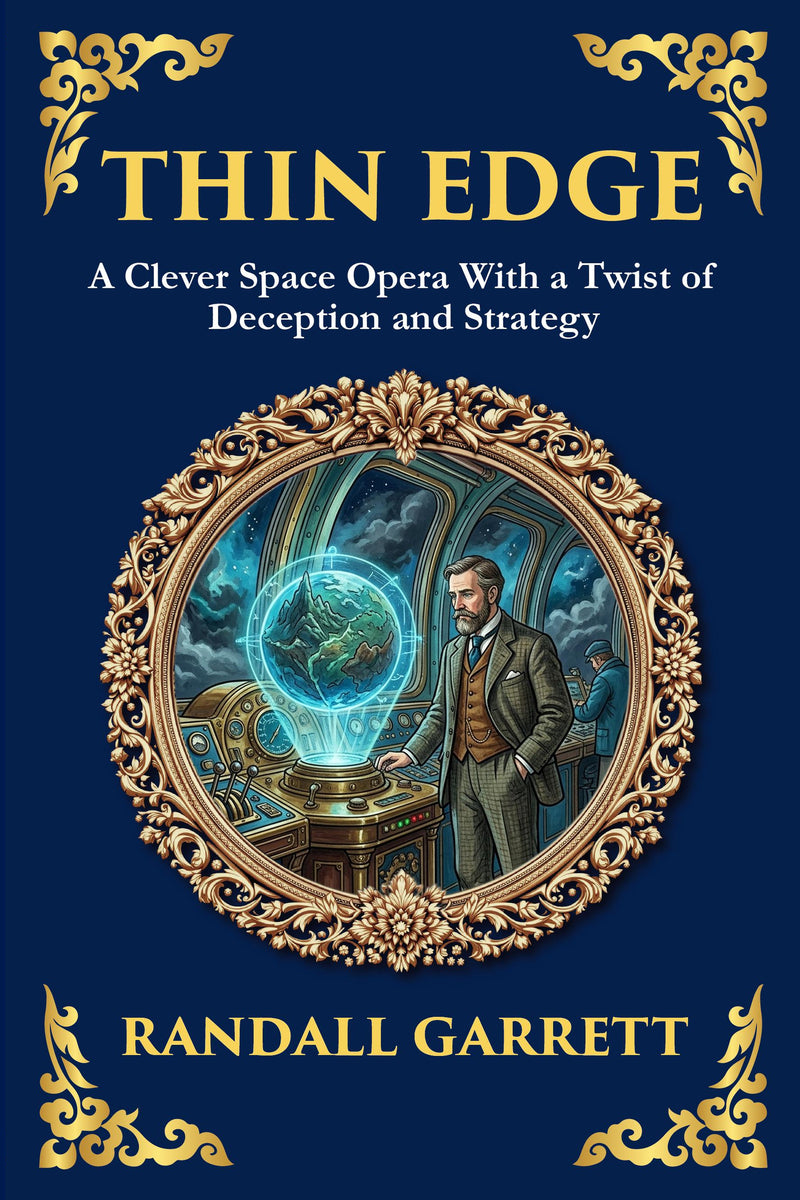
Thin Edge
In a universe where wars are won not just with weapons but with cunning, deception becomes the sharpest blade of all. Thin Edge is a gripping space opera by Randall Garrett, weaving together interstellar politics, espionage, and the razor-thin margin between victory and defeat.
or free app
10,000+ hrs library
30-day guarantee
The complete Thin Edge appears in modern English through Library of Alexandria Press, available online with audiobook narration included for members.
Have you ever wondered why the smartest players often win battles before they begin? Thin Edge: A Clever Space Opera With a Twist of Deception and Strategy is a brilliant tale of interstellar intrigue from Randall Garrett, a master of science fiction storytelling. Combining fast- paced adventure with intellectual gamesmanship, Garrett presents a space opera where diplomacy, betrayal, and psychological manipulation are every bit as dangerous as laser fire.
The story thrusts readers into a galactic conflict where empires rise and fall not just on the battlefield, but in the shadows of strategy and the subtle art of deception. Against this backdrop, a single strategist must navigate layers of lies, shifting alliances, and hidden motives to protect what little remains of honor and truth in a galaxy filled with deceit.
What you’ll discover in this modern edition
- A Galactic Game of Strategy – Follow a cunning strategist whose survival depends on intellect, foresight, and deception rather than brute force.
- Espionage and Intrigue Among the Stars – Experience a universe where wars are fought with information as much as weapons.
- Psychological Tension and Betrayal – Watch loyalties tested and friendships broken in a web of manipulation and shifting power.
- Randall Garrett’s Signature Craft – Enjoy a masterfully told space opera that blends sharp wit, thrilling adventure, and intellectual depth.
| Formats | eBook (EPUB + PDF) · Audiobook · Paperback · Hardcover · Large Print |
| Language | English |
| Trim size (print) | 6 × 9 in |
| Binding | Paperback — perfect-bound · Hardcover — casewrap |
| Large Print edition | Same text in a larger, easy-read type — a larger font, not a larger trim |
| Print pricing | Every physical book at our true cost — at-cost, no profit (members) |
| Library | 873 restored titles, always growing |
| Length | 12,401 words · ~50 min reading |
| Reading level | Grade 8 · an easy, flowing read (this modern-English edition) |
| Edition | Modern English translation · 2026 |
Member reviews for this edition are collected as readers finish it — be the first. Across the library: 12,000+ books shipped, every plan covered by a 365-day print guarantee.
About this edition
A faithful, unabridged modern-English edition by The Library of Alexandria — carefully rendered for today's reader and verified paragraph-by-paragraph against the public-domain source. Available as eBook, audiobook, paperback, hardcover, and large print.
- Complete & unabridgedVerified paragraph by paragraph against the source — never a scan, never abridged.
- Modern English, faithfulReadable today, with the author’s meaning kept intact. Readable — not simplified.
- Every format, one membershipRead in your browser or the free app, or listen to the full audiobook.
Included free with your membership
Cancel anytime, one click · 30-day money-back guarantee
Edition last updated July 2026
What’s inside
Thin Edge — complete and unabridged: all 8 sections included with membership, plus the full audiobook.
Begin reading Thin Edge
In clear modern English — the complete text is included with membership.
Introduction
There is a particular pleasure in encountering a story that refuses to take the easy route. We have all read the science fiction tale that wins its battles with bigger guns, brighter explosions, and a hero who simply happens to be stronger, faster, or luckier than everyone around him. Such stories have their charms, and there is nothing wrong with the occasional cosmic slugfest. But every so often a writer comes along who understands that the most exciting conflict in the universe is not the clash of fleets or the roar of engines, but the quiet, ferocious contest of minds. The work you are about to read belongs firmly in that rarer, more rewarding tradition. It is a story in which the sharpest weapon is intelligence, the deadliest maneuver is a well-timed deception, and the thin edge that separates victory from catastrophe is measured not in firepower but in foresight.
Randall Garrett, the author whose imagination gave rise to this tale, was one of the genuine craftsmen of the golden and silver ages of American science fiction. He belonged to that remarkable generation of writers who learned their trade in the crucible of the magazine markets, where a story had to grab a reader by the collar in its opening lines and refuse to let go until the final twist landed with a satisfying click. Garrett wrote prolifically, sometimes under his own name and sometimes behind a small forest of pseudonyms, and he wrote across nearly every register the genre had to offer. He could be uproariously funny, slyly satirical, rigorously logical, and genuinely suspenseful, often within the span of a single tale. What unified his enormous and varied output was a mind that delighted in puzzles. Garrett was the kind of author who never simply asked “what happens next?” but rather “what is the cleverest possible thing that could happen next?” — and then went one step further to ask how he might surprise even the reader who thought he had it all figured out.
That sensibility is on full display here. This is a space opera in the grand sense of the term, a story that takes the vast canvas of interstellar civilization and uses it to stage a drama of high stakes and higher cunning. But it is space opera with a particular flavor, one that rewards the attentive reader and treats intelligence — both the protagonists’ and your own — as the true currency of the narrative. The subtitle promises “a twist of deception and strategy,” and that promise is not idle marketing. Deception and strategy are not merely decorations layered onto an otherwise conventional adventure; they are the engine that drives the whole machine. To read this book well is to read it the way one plays a game of chess against a worthy opponent: alert, engaged, always wondering what the other side knows that you do not, and savoring the moment when the hidden design finally reveals itself.
One of the most appealing qualities of Randall Garrett’s fiction, and one that distinguishes it from a great deal of pulpier fare, is the profound respect he extends to the person turning the pages. Garrett never assumed his readers were passive consumers waiting to be spoon-fed sensation. He assumed, instead, that they were participants — co-conspirators, almost — capable of following an intricate argument, holding several threads in mind at once, and appreciating the elegance of a solution that depended on a detail planted forty pages earlier. This is the hallmark of the best mystery writing, and it is no accident that Garrett’s most enduring creations often blurred the line between science fiction and detective fiction. He understood that the deep structure of a satisfying tale of deception is identical whether the setting is a fog-bound English manor or the bridge of a starship: information is the prize, misdirection is the threat, and the reader’s growing comprehension is the real source of pleasure.
In this story you will find that same fundamental confidence in your intelligence. Garrett does not stop to explain every nuance, nor does he insult you by repeating what you have already grasped. He lays out a situation, populates it with characters whose motives may not be entirely what they appear, and then invites you to watch as the pieces move. The “thin edge” of the title is itself a wonderful image to keep in mind as you read, because it captures something essential about the kind of conflict Garrett loved to dramatize. A thin edge is precarious. It is the narrow margin by which a clever plan succeeds where a clumsy one would fail. It is the slender advantage that a sharp mind can wring out of circumstances that look, to the untrained eye, perfectly hopeless. And it is, of course, the cutting edge of a blade — the place where pressure becomes decisive, where the smallest application of force, properly aimed, accomplishes what brute strength never could.
That metaphor extends to the very texture of the prose. Garrett wrote with economy and precision, qualities that the magazine markets demanded and that he elevated into a genuine style. There is little wasted motion in his storytelling. Scenes do real work; dialogue carries information as well as character; description is deployed where it matters and withheld where it would only slow the momentum. For the contemporary reader, this lean efficiency is a tonic. We live in an age of sprawling, multi-volume sagas, and there is much to admire in that ambition, but there is also a special satisfaction in a story that knows exactly how long it needs to be and refuses to overstay its welcome. Garrett’s tale moves. It propels you forward not by manufacturing artificial cliffhangers but by continually deepening your understanding of the predicament and raising the stakes of its resolution. You will likely find that the pages turn faster than you expected, and that the ending arrives with a satisfying inevitability that, paradoxically, you never saw coming.
It is worth pausing to appreciate the particular intelligence of strategy as a literary subject, because it is harder to write well than it might appear. Anyone can declare that a character is brilliant; the difficulty lies in actually demonstrating that brilliance on the page in a way that the reader can follow and admire. A writer who claims his protagonist is a master tactician but then has him win through sheer authorial fiat has cheated. Garrett does not cheat. The cleverness in this book is genuine cleverness, the kind that you can trace and verify, the kind that makes you want to lean back and grin when you finally see how it all fits together. The strategies that unfold are grounded in logic, in human (and perhaps not entirely human) psychology, and in the careful management of who knows what and when. This is the rare adventure story in which the climax depends not on a desperate last-second gamble but on a plan whose pieces were quietly assembled in plain sight, waiting for the moment of revelation. When that moment comes, the pleasure is not the cheap thrill of surprise but the deeper delight of recognition — the sense that, yes, of course, it could only have happened this way, and how marvelous that someone thought of it.
The World of the Story and the Art of the Twist
Space opera as a form gives a writer enormous freedom. The galaxy is large; the possibilities are effectively infinite; the rules of physics and society can be bent or invented to suit the demands of the narrative. With that freedom, however, comes a corresponding danger: a story that can do anything sometimes ends up meaning nothing, because the stakes evaporate when consequences can be wished away. The great practitioners of the form understood that the trick is to establish constraints — clear, comprehensible rules — and then to wring drama out of the characters’ efforts to work within them, around them, or against them. Garrett was a master of this discipline. The interstellar setting of this tale is not merely a backdrop of pretty nebulae and convenient technologies; it is a system with logic and consequence, a stage built specifically to make the contest of wits that occupies its center both possible and meaningful.
Without venturing anywhere near the territory of spoilers — for to reveal the mechanics of a story built on deception would be to rob you of its central pleasure — it is fair to say that the architecture of the conflict is its own quiet marvel. There are sides, and there are interests, and there are individuals whose loyalties and aims are not always what they declare them to be. Part of the joy of reading lies in calibrating your own trust: deciding which characters to believe, which to suspect, and which to watch most closely precisely because they seem the most transparent. Garrett plays this game with you fairly but without mercy. He plants his clues honestly. He gives you everything you need to anticipate the turns of the plot. And yet, if you are like most readers, you will still be caught at least once by a development that, in retrospect, you ought to have seen coming. That experience — of being outmaneuvered by an author who was always playing scrupulously by the rules — is one of the singular delights of well-constructed fiction, and this book delivers it in abundance.
A word here about the nature of the “twist,” since it figures so prominently in how this volume presents itself. In lesser hands, a twist is a gimmick: a sudden reversal pasted onto the end of a story to manufacture a jolt, often at the cost of everything that came before. The twist that does not hold up under scrutiny, that contradicts what the characters knew or did earlier, that feels arbitrary rather than earned — that is the twist that gives the device a bad name. Garrett’s twists are of an entirely different order. They are not bolted on; they are baked in. They arise organically from the logic of the situation and the characters who inhabit it. When the deception at the heart of this tale is finally laid bare, you will not feel cheated or manipulated. You will feel, instead, that a curtain has been drawn back to reveal a structure that was always there, beautifully designed, waiting for you to perceive it whole. This is the difference between a magician who relies on cheap distractions and one who shows you both his empty hands and still leaves you astonished. Garrett belongs to the latter school, and reading him is an education in how the trick ought to be done.
This brings us to the matter of how to read the book for maximum enjoyment, and here I offer a few gentle suggestions rather than instructions, for every reader finds his or her own path through a story. First: pay attention. This is not a tale to skim. The details matter, and an offhand remark in an early chapter may prove to be the linchpin of everything that follows. Garrett does not waste your time, which means he expects you not to waste his careful construction by reading carelessly. Second: question everything. When a character states something as fact, ask yourself how that character knows it, whether it serves the speaker’s interests to have you believe it, and what would change if it turned out to be false. This is not paranoia; it is the proper engagement with a story whose subject is deception. The reader who reads suspiciously is rewarded; the reader who takes everything at face value will be pleasantly bewildered when the truth emerges. Third, and perhaps most important: enjoy the game. This is, above all, an entertainment of the highest order, and Garrett’s wit and pacing are meant to be relished. Do not approach the book as a homework assignment to be solved but as a contest of intellects in which you are a welcome and valued opponent. Whether you crack the puzzle before the author reveals it or are happily fooled to the last, you cannot lose, because the journey itself is the reward.
It is also worth dwelling, briefly, on what makes Garrett’s particular brand of cleverness feel so distinctly his own. Many writers can construct a clever plot; fewer can do it while also keeping the human element vivid and warm. Garrett never lost sight of the fact that strategies are executed by people, and that the most ingenious plan in the universe is only as compelling as the characters who devise and oppose it. His protagonists tend to be competent, confident, and quick — the kind of people you would want on your side in a crisis — but they are not cold calculating machines. They have humor, they have pride, they have moments of doubt and improvisation. The villains, meanwhile, are rarely cartoonish; they are formidable precisely because they are intelligent in their own right, capable of plans and counterplans, so that the contest never feels lopsided or foregone. The pleasure of watching two sharp minds circle each other, each anticipating the other’s moves, each laying traps and detecting them, is the pleasure of watching genuine mastery at work. Garrett serves that pleasure up with the generosity of a writer who clearly relished it himself.
Cancel anytime, one click · 30-day money-back guarantee
Founding annual rate available now — your price locks for life when you join.
Not ready? Get this free chapter by email — read it anytime.
✓ Sent — check your inbox for Thin Edge.
Questions about Thin Edge
What is Thin Edge about?
In a universe where wars are won not just with weapons but with cunning, deception becomes the sharpest blade of all. Thin Edge is a gripping space opera by Randall Garrett, weaving together interstellar politics, espionage, and the razor-thin margin between victory and defeat. In a galaxy ruled by power and ambition, one man learns that survival depends not on brute force, but on mastering the art of strategy and misdirection.
Who wrote Thin Edge?
Thin Edge was written by Randall Garrett. This edition presents the complete work in clear modern English, faithfully rendered from the public-domain original by Library of Alexandria Press.
Is Thin Edge free to read?
The opening chapter is free to read on this page. Members read and listen to the complete work — and the entire library — free, and can order any physical book at our true print cost.
How long is Thin Edge?
8 chapters (~12,401 words) — about 50 min of reading in this modern-English edition.
Is this an abridged version of Thin Edge?
No. This is the complete, unabridged Thin Edge, carefully rendered into clear modern English and verified paragraph-by-paragraph against the public-domain source — nothing is cut or summarised.
What formats does Thin Edge come in?
Thin Edge is available as eBook, paperback, hardcover and large print. eBook and audiobook are included with membership; printed editions ship at our true print cost.
Shipping & returns
Billing & membership
More from the library


Explore Science Fiction
- The Island of Doctor Moreau · H. G. Wells
- A Midsummer Night’s Dream · William Shakespeare
- The Invisible Man: A Grotesque Romance · H. G. Wells
- The War of the Worlds · H. G. Wells
- The Strange Case of Dr. Jekyll and Mr. Hyde · Robert Louis Stevenson
- Limanora: the island of progress · Godfrey Sweven
- The Book of Dragons · E. Nesbit
- She · H. Rider Haggard
- Dorothy and the Wizard in Oz · L. Frank Baum
- The Princess and the Goblin · George MacDonald
- Gawayne and the Green Knight: A Fairy Tale · Charlton M. Lewis
- Lucian’s True History · Lucian of Samosata
- The Willows · Algernon Blackwood
- The Call of Cthulhu · H. P. Lovecraft
- The Life-Eater · Harold Ward
- The Marvelous Land of Oz · L. Frank Baum
- Mars is My Destination · Frank Belknap Long
- The Black Kiss
- The Beasts in the Void · Paul W. Fairman
- John Jones’s Dollar · Harry Stephen Keeler
- Subversive · Mack Reynolds
- The Mississippi Saucer · Frank Belknap Long
- Man of Distinction · Michael Shaara
- Spawn of the Comet · H. Thompson Rich
- The Golden Judge · Nathaniel Gordon
- Final Weapon · Everett B. Cole
- The Big Fix · George O. Smith
- Last Enemy · H. Beam Piper
- Time and Time Again · H. Beam Piper
- Sabotage in Space · Carey Rockwell
Thin Edge
Thin Edge
A Clever Space Opera With a Twist of Deception and Strategy
Randall Garrett
Contents
- Introduction
- Chapter 1
- Chapter 2
- Chapter 3
- Chapter 4
- Chapter 5
- Chapter 6
- Chapter 7
Introduction
There is a particular pleasure in encountering a story that refuses to take the easy route. We have all read the science fiction tale that wins its battles with bigger guns, brighter explosions, and a hero who simply happens to be stronger, faster, or luckier than everyone around him. Such stories have their charms, and there is nothing wrong with the occasional cosmic slugfest. But every so often a writer comes along who understands that the most exciting conflict in the universe is not the clash of fleets or the roar of engines, but the quiet, ferocious contest of minds. The work you are about to read belongs firmly in that rarer, more rewarding tradition. It is a story in which the sharpest weapon is intelligence, the deadliest maneuver is a well-timed deception, and the thin edge that separates victory from catastrophe is measured not in firepower but in foresight.
Randall Garrett, the author whose imagination gave rise to this tale, was one of the genuine craftsmen of the golden and silver ages of American science fiction. He belonged to that remarkable generation of writers who learned their trade in the crucible of the magazine markets, where a story had to grab a reader by the collar in its opening lines and refuse to let go until the final twist landed with a satisfying click. Garrett wrote prolifically, sometimes under his own name and sometimes behind a small forest of pseudonyms, and he wrote across nearly every register the genre had to offer. He could be uproariously funny, slyly satirical, rigorously logical, and genuinely suspenseful, often within the span of a single tale. What unified his enormous and varied output was a mind that delighted in puzzles. Garrett was the kind of author who never simply asked “what happens next?” but rather “what is the cleverest possible thing that could happen next?” — and then went one step further to ask how he might surprise even the reader who thought he had it all figured out.
That sensibility is on full display here. This is a space opera in the grand sense of the term, a story that takes the vast canvas of interstellar civilization and uses it to stage a drama of high stakes and higher cunning. But it is space opera with a particular flavor, one that rewards the attentive reader and treats intelligence — both the protagonists’ and your own — as the true currency of the narrative. The subtitle promises “a twist of deception and strategy,” and that promise is not idle marketing. Deception and strategy are not merely decorations layered onto an otherwise conventional adventure; they are the engine that drives the whole machine. To read this book well is to read it the way one plays a game of chess against a worthy opponent: alert, engaged, always wondering what the other side knows that you do not, and savoring the moment when the hidden design finally reveals itself.
One of the most appealing qualities of Randall Garrett’s fiction, and one that distinguishes it from a great deal of pulpier fare, is the profound respect he extends to the person turning the pages. Garrett never assumed his readers were passive consumers waiting to be spoon-fed sensation. He assumed, instead, that they were participants — co-conspirators, almost — capable of following an intricate argument, holding several threads in mind at once, and appreciating the elegance of a solution that depended on a detail planted forty pages earlier. This is the hallmark of the best mystery writing, and it is no accident that Garrett’s most enduring creations often blurred the line between science fiction and detective fiction. He understood that the deep structure of a satisfying tale of deception is identical whether the setting is a fog-bound English manor or the bridge of a starship: information is the prize, misdirection is the threat, and the reader’s growing comprehension is the real source of pleasure.
In this story you will find that same fundamental confidence in your intelligence. Garrett does not stop to explain every nuance, nor does he insult you by repeating what you have already grasped. He lays out a situation, populates it with characters whose motives may not be entirely what they appear, and then invites you to watch as the pieces move. The “thin edge” of the title is itself a wonderful image to keep in mind as you read, because it captures something essential about the kind of conflict Garrett loved to dramatize. A thin edge is precarious. It is the narrow margin by which a clever plan succeeds where a clumsy one would fail. It is the slender advantage that a sharp mind can wring out of circumstances that look, to the untrained eye, perfectly hopeless. And it is, of course, the cutting edge of a blade — the place where pressure becomes decisive, where the smallest application of force, properly aimed, accomplishes what brute strength never could.
That metaphor extends to the very texture of the prose. Garrett wrote with economy and precision, qualities that the magazine markets demanded and that he elevated into a genuine style. There is little wasted motion in his storytelling. Scenes do real work; dialogue carries information as well as character; description is deployed where it matters and withheld where it would only slow the momentum. For the contemporary reader, this lean efficiency is a tonic. We live in an age of sprawling, multi-volume sagas, and there is much to admire in that ambition, but there is also a special satisfaction in a story that knows exactly how long it needs to be and refuses to overstay its welcome. Garrett’s tale moves. It propels you forward not by manufacturing artificial cliffhangers but by continually deepening your understanding of the predicament and raising the stakes of its resolution. You will likely find that the pages turn faster than you expected, and that the ending arrives with a satisfying inevitability that, paradoxically, you never saw coming.
It is worth pausing to appreciate the particular intelligence of strategy as a literary subject, because it is harder to write well than it might appear. Anyone can declare that a character is brilliant; the difficulty lies in actually demonstrating that brilliance on the page in a way that the reader can follow and admire. A writer who claims his protagonist is a master tactician but then has him win through sheer authorial fiat has cheated. Garrett does not cheat. The cleverness in this book is genuine cleverness, the kind that you can trace and verify, the kind that makes you want to lean back and grin when you finally see how it all fits together. The strategies that unfold are grounded in logic, in human (and perhaps not entirely human) psychology, and in the careful management of who knows what and when. This is the rare adventure story in which the climax depends not on a desperate last-second gamble but on a plan whose pieces were quietly assembled in plain sight, waiting for the moment of revelation. When that moment comes, the pleasure is not the cheap thrill of surprise but the deeper delight of recognition — the sense that, yes, of course, it could only have happened this way, and how marvelous that someone thought of it.
The World of the Story and the Art of the Twist
Space opera as a form gives a writer enormous freedom. The galaxy is large; the possibilities are effectively infinite; the rules of physics and society can be bent or invented to suit the demands of the narrative. With that freedom, however, comes a corresponding danger: a story that can do anything sometimes ends up meaning nothing, because the stakes evaporate when consequences can be wished away. The great practitioners of the form understood that the trick is to establish constraints — clear, comprehensible rules — and then to wring drama out of the characters’ efforts to work within them, around them, or against them. Garrett was a master of this discipline. The interstellar setting of this tale is not merely a backdrop of pretty nebulae and convenient technologies; it is a system with logic and consequence, a stage built specifically to make the contest of wits that occupies its center both possible and meaningful.
Without venturing anywhere near the territory of spoilers — for to reveal the mechanics of a story built on deception would be to rob you of its central pleasure — it is fair to say that the architecture of the conflict is its own quiet marvel. There are sides, and there are interests, and there are individuals whose loyalties and aims are not always what they declare them to be. Part of the joy of reading lies in calibrating your own trust: deciding which characters to believe, which to suspect, and which to watch most closely precisely because they seem the most transparent. Garrett plays this game with you fairly but without mercy. He plants his clues honestly. He gives you everything you need to anticipate the turns of the plot. And yet, if you are like most readers, you will still be caught at least once by a development that, in retrospect, you ought to have seen coming. That experience — of being outmaneuvered by an author who was always playing scrupulously by the rules — is one of the singular delights of well-constructed fiction, and this book delivers it in abundance.
A word here about the nature of the “twist,” since it figures so prominently in how this volume presents itself. In lesser hands, a twist is a gimmick: a sudden reversal pasted onto the end of a story to manufacture a jolt, often at the cost of everything that came before. The twist that does not hold up under scrutiny, that contradicts what the characters knew or did earlier, that feels arbitrary rather than earned — that is the twist that gives the device a bad name. Garrett’s twists are of an entirely different order. They are not bolted on; they are baked in. They arise organically from the logic of the situation and the characters who inhabit it. When the deception at the heart of this tale is finally laid bare, you will not feel cheated or manipulated. You will feel, instead, that a curtain has been drawn back to reveal a structure that was always there, beautifully designed, waiting for you to perceive it whole. This is the difference between a magician who relies on cheap distractions and one who shows you both his empty hands and still leaves you astonished. Garrett belongs to the latter school, and reading him is an education in how the trick ought to be done.
This brings us to the matter of how to read the book for maximum enjoyment, and here I offer a few gentle suggestions rather than instructions, for every reader finds his or her own path through a story. First: pay attention. This is not a tale to skim. The details matter, and an offhand remark in an early chapter may prove to be the linchpin of everything that follows. Garrett does not waste your time, which means he expects you not to waste his careful construction by reading carelessly. Second: question everything. When a character states something as fact, ask yourself how that character knows it, whether it serves the speaker’s interests to have you believe it, and what would change if it turned out to be false. This is not paranoia; it is the proper engagement with a story whose subject is deception. The reader who reads suspiciously is rewarded; the reader who takes everything at face value will be pleasantly bewildered when the truth emerges. Third, and perhaps most important: enjoy the game. This is, above all, an entertainment of the highest order, and Garrett’s wit and pacing are meant to be relished. Do not approach the book as a homework assignment to be solved but as a contest of intellects in which you are a welcome and valued opponent. Whether you crack the puzzle before the author reveals it or are happily fooled to the last, you cannot lose, because the journey itself is the reward.
It is also worth dwelling, briefly, on what makes Garrett’s particular brand of cleverness feel so distinctly his own. Many writers can construct a clever plot; fewer can do it while also keeping the human element vivid and warm. Garrett never lost sight of the fact that strategies are executed by people, and that the most ingenious plan in the universe is only as compelling as the characters who devise and oppose it. His protagonists tend to be competent, confident, and quick — the kind of people you would want on your side in a crisis — but they are not cold calculating machines. They have humor, they have pride, they have moments of doubt and improvisation. The villains, meanwhile, are rarely cartoonish; they are formidable precisely because they are intelligent in their own right, capable of plans and counterplans, so that the contest never feels lopsided or foregone. The pleasure of watching two sharp minds circle each other, each anticipating the other’s moves, each laying traps and detecting them, is the pleasure of watching genuine mastery at work. Garrett serves that pleasure up with the generosity of a writer who clearly relished it himself.
“Beep!” the radio said smugly. “Beep! Beep! Beep!”
“There’s one,” said the man operating the pickup controls of tugship 431. He checked the readings on his various instrument dials. Then, he carefully logged that the radio finder was broadcasting a beep on a specific frequency, and that the frequency and beep rate indicated the asteroid had been located and anchored by Captain Jules St. Simon. He duly noted the direction and distance.
The direction and distance data had already been sent to the pilot’s instruments. “Awesome!” the pilot said. “Got him.”
He pivoted the ship until the nose aligned with the signal, then slammed on the forward accelerator for a few seconds. He let off the pedal and waited as the ship drifted toward the asteroid.
In the darkness of space, only points of light were visible. To the left, the sun was a small, blinding white spot that was impossible to look at directly. Even out here in the Belt, between Mars and Jupiter, that massive stellar engine put out enough energy to make it uncomfortable to view with the naked eye. However, it could only light up physical matter; the vacuum of space remained pitch black. The pilot could have located the planets easily without even looking. He knew exactly where every single one of them was. He had to.
A person can navigate space using instruments and take the time to calculate where every planet should be. But if they rely on that, they won’t actually be able to navigate the Asteroid Belt.
In the nineteenth century, Mark Twain noted that a steamboat pilot navigating the Mississippi had to identify every landmark and shifting sandbar along the river before being allowed to take the wheel. He didn’t just have to memorize the entire river; he had to predict how the course would change and how the eddies would shift. He had to know exactly where he was at every moment, even on the darkest, moonless nights, just by glancing around.
End of the free sample
Keep reading, free
Members read and listen to the complete book — and the entire library. Cancel anytime, one click · 30-day money-back guarantee.