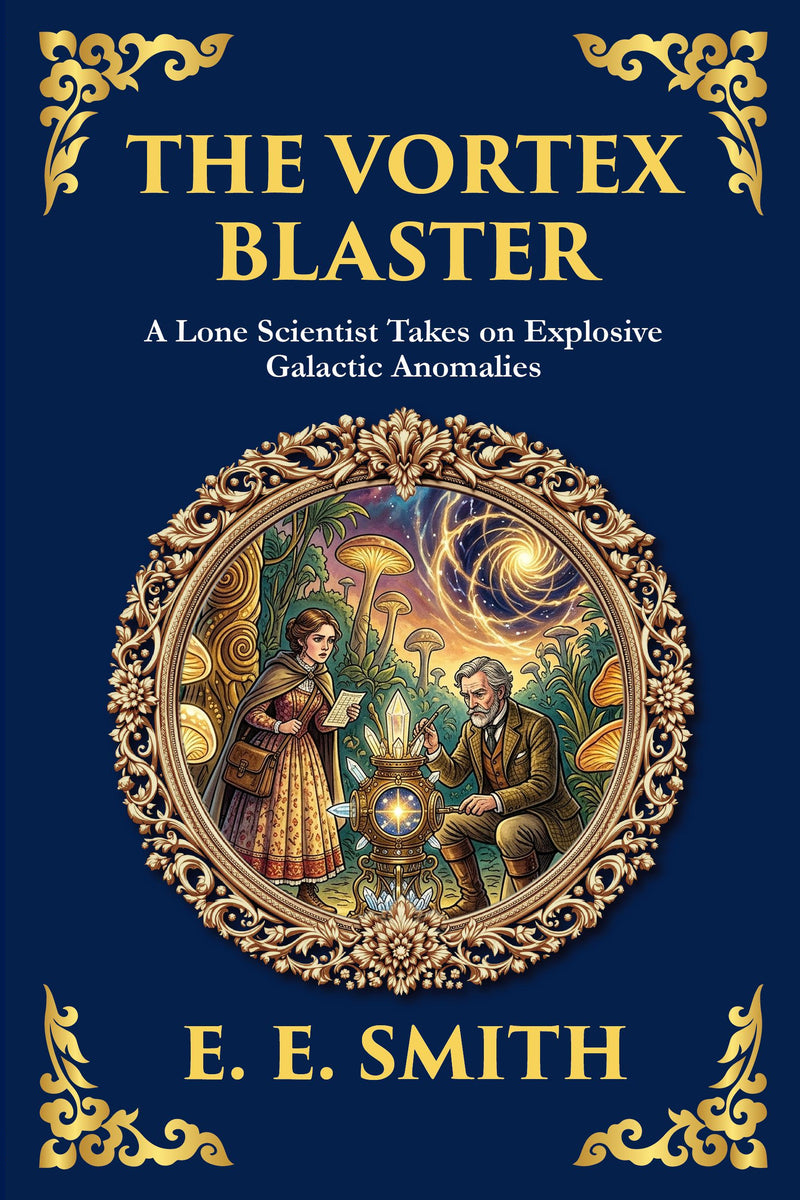
The Vortex Blaster
In a galaxy terrorized by runaway atomic vortices—raging, planet-destroying anomalies with no known origin—only one man dares to stand against them.
or free app
10,000+ hrs library
30-day guarantee
The complete The Vortex Blaster appears in modern English through Library of Alexandria Press, available online with audiobook narration included for members.
Have you ever wondered why the universe needs a hero who understands both numbers and destruction? When an unimaginable tragedy strikes—his wife and children lost in a vortex detonation— physicist Neal "Storm" Cloud dedicates his life to destroying the very phenomena that shattered his world. But these vortices aren’t just deadly—they’re unpredictable, intelligent, and growing.
Armed with nothing but his intellect, equations, and unshakable resolve, Cloud embarks on a solo mission to track and annihilate the most dangerous cosmic anomalies ever encountered. The Vortex Blaster (originally published as Storm Cloud on Deka) is E. E. Smith’s daring standalone contribution to the Lensman universe. A story of redemption and unrelenting courage, it explores what happens when one mind is pitted against the fury of interstellar chaos.
What you’ll discover in this modern edition
- A Reluctant Hero with a Tragic Past – Neal Cloud turns grief into a mission to save countless worlds.
| Formats | eBook (EPUB + PDF) · Audiobook · Paperback · Hardcover · Large Print |
| Language | English |
| Trim size (print) | 6 × 9 in |
| Binding | Paperback — perfect-bound · Hardcover — casewrap |
| Large Print edition | Same text in a larger, easy-read type — a larger font, not a larger trim |
| Print pricing | Every physical book at our true cost — at-cost, no profit (members) |
| Library | 873 restored titles, always growing |
| Length | 11,245 words · ~45 min reading |
| Reading level | Grade 4 · an easy, flowing read (this modern-English edition) |
| Edition | Modern English translation · 2026 |
Member reviews for this edition are collected as readers finish it — be the first. Across the library: 12,000+ books shipped, every plan covered by a 365-day print guarantee.
About this edition
A faithful, unabridged modern-English edition by The Library of Alexandria — carefully rendered for today's reader and verified paragraph-by-paragraph against the public-domain source. Available as eBook, audiobook, paperback, hardcover, and large print.
- Complete & unabridgedVerified paragraph by paragraph against the source — never a scan, never abridged.
- Modern English, faithfulReadable today, with the author’s meaning kept intact. Readable — not simplified.
- Every format, one membershipRead in your browser or the free app, or listen to the full audiobook.
Included free with your membership
Cancel anytime, one click · 30-day money-back guarantee
Edition last updated July 2026
What’s inside
The Vortex Blaster — complete and unabridged, included in full with membership, plus the full audiobook.
Begin reading The Vortex Blaster
In clear modern English — the complete text is included with membership.
Introduction
There is a particular kind of pleasure that comes from opening a book written by someone who genuinely loved the universe they were imagining. You can feel it in the prose, in the way physical laws are treated like beloved toys, in the sheer exuberance with which planets, energies, and impossible engineering problems are flung across the page. E. E. “Doc” Smith was one of the great architects of that joy. He helped invent the very vocabulary of large-scale science fiction—the kind that thinks not in terms of a single rocket or a lone laboratory, but in terms of whole galaxies humming with civilization, danger, and discovery. The book you are about to read is one of his more intimate and curious creations, a story that takes the towering machinery of his cosmic imagination and focuses it down to a sharp, human point: one man, one terrible loss, and one impossible problem that no one else can solve.
This modern translation has been prepared with a single goal in mind—to let the contemporary reader experience the headlong excitement of the original without stumbling over the linguistic quirks and dated conventions of an earlier era. The thrill that Smith offered his first readers was never meant to be a museum piece. It was meant to be felt directly, in the gut and the imagination, the way a roller coaster is felt rather than studied. What follows is an attempt to preserve that immediacy while smoothing the path for readers who did not grow up with the pulp magazines of the 1930s and 1940s. The bones of the story are entirely Smith’s; the adaptation simply clears away some of the dust so the structure beneath can shine.
Before you begin, it is worth taking a moment to understand who this author was, why his work mattered so enormously to the genre, and what makes this particular novel an unusual and rewarding entry in his body of work. None of what follows will spoil the plot. Instead, it is meant to act as a kind of orientation—a way of tuning your expectations so that the experience lands as powerfully as possible.
Edward Elmer Smith was, by training and profession, a food chemist. He held a doctorate and spent his working life perfecting the textures and stabilities of things like doughnut mixes and powdered foods. This is one of those biographical details that initially seems like a charming irony—the doughnut scientist who dreamed up galaxy-spanning wars—but it is actually a key to understanding everything that makes his fiction tick. Smith was a man who thought in terms of process, of cause and effect, of how a given set of inputs produces a measurable output. He approached the construction of an imaginary universe the same way he approached the construction of a stable emulsion: with rigor, with a sense of underlying rules, and with the satisfaction of watching a system behave the way it ought to.
Born in 1890, Smith came of age in an era when the wonders of the modern world were arriving at a dizzying pace. Electric light, the automobile, powered flight, radio, the early stirrings of atomic theory—all of these were either brand new or freshly imaginable in his lifetime. For a young man with a scientific bent and a romantic imagination, this was an intoxicating combination. The future was not an abstraction; it was something you could practically reach out and touch, accelerating toward you with every passing year. Smith took that sense of acceleration and pushed it to its logical extreme. If humanity could go from horse carts to airplanes in a single generation, what might it do given a thousand years? Ten thousand? A million?
His most famous achievement is the body of work that grew into what readers now call the Lensman series and its companion the Skylark series. These were the books that more or less established the subgenre known as space opera—grand, sweeping adventures set against a cosmic backdrop, featuring vast fleets, planet-shattering weapons, and conflicts that played out across the entire breadth of the galaxy and beyond. Smith did not invent every individual ingredient, but he was the chef who first combined them into a recognizable feast, and his influence on everything that followed is almost impossible to overstate. When you watch a modern film in which starships clash above a dying world, when you read a novel in which an ancient galactic order faces an existential threat, when you encounter the very idea that heroism might be measured against a backdrop of literally astronomical scale—you are, whether you know it or not, drinking from a well that Smith helped to dig.
What is sometimes lost in the celebration of his big set pieces is how genuinely he cared about the human element inside all that machinery. Yes, his heroes tended to be square-jawed paragons, and his villains were often unambiguously monstrous. The moral universe of his fiction is generally clear and uncomplicated by the standards of later, more cynical eras. But Smith understood something that a great many imitators missed: that the spectacle only matters if there is a person at the center of it whose feelings we share. A planet exploding is just an image. A planet exploding while someone we have come to care about watches helplessly is a tragedy. The story you are holding leans into exactly this principle, and it does so with surprising tenderness.
It is also worth appreciating Smith as a craftsman of pacing. He wrote in an age when fiction was largely consumed in installments, published chapter by chapter in pulp magazines where readers had to be hooked, held, and left hungry for the next issue. This produced a particular kind of narrative rhythm—propulsive, vivid, generous with incident, never lingering too long before launching the next development. Some modern readers, accustomed to slower and more interiorized literary fiction, are initially startled by the velocity of a Smith narrative. But once you surrender to that velocity, it becomes one of the great pleasures of the reading experience. These books move. They were engineered to move, by a man who understood engineering, and the momentum is part of the fun.
This translation has taken care to honor that momentum. Where the original language occasionally creaked under the weight of period slang, overly elaborate scientific jargon, or sentence constructions that have simply fallen out of common use, the text has been gently modernized—not rewritten, not reinvented, but clarified. The aim throughout has been to ensure that nothing stands between you and the forward rush of the tale. You should feel pulled along, the way Smith’s first readers were pulled along, eager to learn what happens next.
A Different Kind of Hero in a Familiar Universe
What makes this particular novel stand apart within Smith’s larger body of work is its scale—not the scale of its setting, which remains as cosmic and grand as ever, but the scale of its emotional focus. Where many of his stories give us whole organizations of heroes, fleets of allies, and a sense of vast collective effort against an equally vast collective enemy, this book begins with something far smaller and far more personal. It begins with one man and a wound.
The premise, which I will describe only in the broadest terms so as not to rob you of the pleasure of discovery, concerns a phenomenon that threatens lives and worlds in a way that is sudden, capricious, and seemingly impossible to predict or prevent. These are anomalies—violent, energetic, deadly eruptions of force that appear without warning and devastate whatever happens to be near them. Conventional science and conventional courage have proven insufficient against them. They are, in a very real sense, a problem that civilization has learned to dread and to endure rather than to solve.
Into this situation steps our protagonist: not a soldier, not a fleet admiral, not a member of any elite corps, but a scientist. A man whose qualifications for the task ahead are partly intellectual and partly born of something far more raw and human. He is driven not by ambition or duty in the abstract, but by a personal stake that gives his quest an intensity bordering on obsession. This is what elevates the book above mere problem-solving adventure. The puzzle of the anomalies is genuinely fascinating, and Smith works through it with all the methodical relish you would expect from a trained chemist. But underneath the puzzle runs a current of grief and determination that gives every page an emotional charge.
There is something deeply satisfying about a hero whose primary weapon is his mind. In an era of fiction that often equates heroism with physical violence, it is refreshing to encounter a protagonist whose greatest battles are fought against ignorance, against the limits of current knowledge, against the maddening unpredictability of a natural force that does not care about human suffering. The drama here is the drama of figuring something out—of staring at an intractable problem until, through a combination of intuition, experimentation, and sheer stubbornness, a path forward begins to emerge. Smith makes this thrilling. He understood, perhaps better than almost any of his contemporaries, that the act of discovery is one of the most exciting things a human being can do, and that it can be every bit as suspenseful as a sword fight or a chase.
This focus on a single, brilliant, wounded individual also allows the novel to explore themes that resonate well beyond their pulp-era origins. There is the question of how one carries on in the aftermath of catastrophic loss—whether by turning grief into purpose or by being consumed by it. There is the question of risk and responsibility: when one person possesses a unique ability to confront a danger that endangers many, what obligations does that ability create? There is the question of how knowledge advances, often through the dogged persistence of individuals willing to attempt what everyone else has dismissed as impossible. These are timeless concerns, and they give the story a weight and a relevance that have survived the decades remarkably intact.
The world surrounding the protagonist is, of course, recognizably Smithian. The reader will encounter advanced technologies described with that characteristic blend of confidence and ingenuity, social structures that span multiple worlds, and a sense of a civilization that has grown vast and capable while still remaining vulnerable to forces beyond its full control. Part of the charm of reading Smith today lies in observing how a brilliant mind of the early-to-mid twentieth century imagined the far future. Some of his guesses are uncannily prescient; others are delightfully of their time. Both kinds are rewarding. The prescient ones remind us that good speculative thinking can reach across generations, and the dated ones offer a window into the hopes, anxieties, and assumptions of the era that produced them.
It is important to read a book like this with a certain generosity of spirit—the same generosity we extend to any work created in a different cultural moment. The attitudes, the gender roles, the social conventions reflected in the original are products of their time. This adaptation has been careful not to erase the historical character of the work, because to do so would be a kind of falsification; you are reading something written by a particular person in a particular era, and that context is part of what gives the book its texture and its value. What the translation has done is ensure that the language itself does not create unnecessary friction, so that the genuine merits of the storytelling—the imagination, the pacing, the emotional core—can come through clearly. Approach it as you would approach any classic: with an awareness of its origins and an openness to its enduring pleasures.
One of those pleasures is Smith’s sheer inventiveness with the technical and the scientific. He delighted in describing how things worked, in walking the reader through the logic of a problem and the elegance of a solution. For some readers this is the candy at the heart of the book; for others it is simply atmosphere, the convincing hum of a working future. Either way, you do not need an advanced degree to enjoy it. Smith was a teacher at heart, and he had a gift for making complex ideas feel accessible and exciting. The translation has preserved this quality, taking care to keep the science legible and the explanations clear without flattening the wonder that animates them.
Cancel anytime, one click · 30-day money-back guarantee
Founding annual rate available now — your price locks for life when you join.
Not ready? Get this free chapter by email — read it anytime.
✓ Sent — check your inbox for The Vortex Blaster.
Questions about The Vortex Blaster
What is The Vortex Blaster about?
In a galaxy terrorized by runaway atomic vortices—raging, planet-destroying anomalies with no known origin—only one man dares to stand against them. The Vortex Blaster tells the thrilling tale of a brilliant scientist who becomes humanity’s last line of defense, hurling himself into danger to snuff out these cosmic time bombs before they annihilate everything in their path. Crafted by the legendary E. E. “Doc” Smith, master of high-concept space opera, this story fuses scientific ingenuity with explosive interstell
Who wrote The Vortex Blaster?
The Vortex Blaster was written by E. E. Smith. This edition presents the complete work in clear modern English, faithfully rendered from the public-domain original by Library of Alexandria Press.
Is The Vortex Blaster free to read?
The opening chapter is free to read on this page. Members read and listen to the complete work — and the entire library — free, and can order any physical book at our true print cost.
How long is The Vortex Blaster?
2 chapters (~11,245 words) — about 45 min of reading in this modern-English edition.
Is this an abridged version of The Vortex Blaster?
No. This is the complete, unabridged The Vortex Blaster, carefully rendered into clear modern English and verified paragraph-by-paragraph against the public-domain source — nothing is cut or summarised.
What formats does The Vortex Blaster come in?
The Vortex Blaster is available as eBook, paperback, hardcover and large print. eBook and audiobook are included with membership; printed editions ship at our true print cost.
Shipping & returns
Billing & membership
More from the library


Explore Science Fiction
- The Island of Doctor Moreau · H. G. Wells
- A Midsummer Night’s Dream · William Shakespeare
- The Invisible Man: A Grotesque Romance · H. G. Wells
- The War of the Worlds · H. G. Wells
- The Strange Case of Dr. Jekyll and Mr. Hyde · Robert Louis Stevenson
- Limanora: the island of progress · Godfrey Sweven
- The Book of Dragons · E. Nesbit
- She · H. Rider Haggard
- Dorothy and the Wizard in Oz · L. Frank Baum
- The Princess and the Goblin · George MacDonald
- Gawayne and the Green Knight: A Fairy Tale · Charlton M. Lewis
- Lucian’s True History · Lucian of Samosata
- The Willows · Algernon Blackwood
- The Call of Cthulhu · H. P. Lovecraft
- The Life-Eater · Harold Ward
- The Marvelous Land of Oz · L. Frank Baum
- Mars is My Destination · Frank Belknap Long
- The Black Kiss
- The Beasts in the Void · Paul W. Fairman
- John Jones’s Dollar · Harry Stephen Keeler
- Subversive · Mack Reynolds
- The Mississippi Saucer · Frank Belknap Long
- Man of Distinction · Michael Shaara
- Spawn of the Comet · H. Thompson Rich
- The Golden Judge · Nathaniel Gordon
- Final Weapon · Everett B. Cole
- The Big Fix · George O. Smith
- Last Enemy · H. Beam Piper
- Time and Time Again · H. Beam Piper
- Sabotage in Space · Carey Rockwell
The Vortex Blaster
The Vortex Blaster
A Lone Scientist Takes on Explosive Galactic Anomalies
E. E. Smith
Contents
- Introduction
- The Vortex Blaster
Introduction
There is a particular kind of pleasure that comes from opening a book written by someone who genuinely loved the universe they were imagining. You can feel it in the prose, in the way physical laws are treated like beloved toys, in the sheer exuberance with which planets, energies, and impossible engineering problems are flung across the page. E. E. “Doc” Smith was one of the great architects of that joy. He helped invent the very vocabulary of large-scale science fiction—the kind that thinks not in terms of a single rocket or a lone laboratory, but in terms of whole galaxies humming with civilization, danger, and discovery. The book you are about to read is one of his more intimate and curious creations, a story that takes the towering machinery of his cosmic imagination and focuses it down to a sharp, human point: one man, one terrible loss, and one impossible problem that no one else can solve.
This modern translation has been prepared with a single goal in mind—to let the contemporary reader experience the headlong excitement of the original without stumbling over the linguistic quirks and dated conventions of an earlier era. The thrill that Smith offered his first readers was never meant to be a museum piece. It was meant to be felt directly, in the gut and the imagination, the way a roller coaster is felt rather than studied. What follows is an attempt to preserve that immediacy while smoothing the path for readers who did not grow up with the pulp magazines of the 1930s and 1940s. The bones of the story are entirely Smith’s; the adaptation simply clears away some of the dust so the structure beneath can shine.
Before you begin, it is worth taking a moment to understand who this author was, why his work mattered so enormously to the genre, and what makes this particular novel an unusual and rewarding entry in his body of work. None of what follows will spoil the plot. Instead, it is meant to act as a kind of orientation—a way of tuning your expectations so that the experience lands as powerfully as possible.
Edward Elmer Smith was, by training and profession, a food chemist. He held a doctorate and spent his working life perfecting the textures and stabilities of things like doughnut mixes and powdered foods. This is one of those biographical details that initially seems like a charming irony—the doughnut scientist who dreamed up galaxy-spanning wars—but it is actually a key to understanding everything that makes his fiction tick. Smith was a man who thought in terms of process, of cause and effect, of how a given set of inputs produces a measurable output. He approached the construction of an imaginary universe the same way he approached the construction of a stable emulsion: with rigor, with a sense of underlying rules, and with the satisfaction of watching a system behave the way it ought to.
Born in 1890, Smith came of age in an era when the wonders of the modern world were arriving at a dizzying pace. Electric light, the automobile, powered flight, radio, the early stirrings of atomic theory—all of these were either brand new or freshly imaginable in his lifetime. For a young man with a scientific bent and a romantic imagination, this was an intoxicating combination. The future was not an abstraction; it was something you could practically reach out and touch, accelerating toward you with every passing year. Smith took that sense of acceleration and pushed it to its logical extreme. If humanity could go from horse carts to airplanes in a single generation, what might it do given a thousand years? Ten thousand? A million?
His most famous achievement is the body of work that grew into what readers now call the Lensman series and its companion the Skylark series. These were the books that more or less established the subgenre known as space opera—grand, sweeping adventures set against a cosmic backdrop, featuring vast fleets, planet-shattering weapons, and conflicts that played out across the entire breadth of the galaxy and beyond. Smith did not invent every individual ingredient, but he was the chef who first combined them into a recognizable feast, and his influence on everything that followed is almost impossible to overstate. When you watch a modern film in which starships clash above a dying world, when you read a novel in which an ancient galactic order faces an existential threat, when you encounter the very idea that heroism might be measured against a backdrop of literally astronomical scale—you are, whether you know it or not, drinking from a well that Smith helped to dig.
What is sometimes lost in the celebration of his big set pieces is how genuinely he cared about the human element inside all that machinery. Yes, his heroes tended to be square-jawed paragons, and his villains were often unambiguously monstrous. The moral universe of his fiction is generally clear and uncomplicated by the standards of later, more cynical eras. But Smith understood something that a great many imitators missed: that the spectacle only matters if there is a person at the center of it whose feelings we share. A planet exploding is just an image. A planet exploding while someone we have come to care about watches helplessly is a tragedy. The story you are holding leans into exactly this principle, and it does so with surprising tenderness.
It is also worth appreciating Smith as a craftsman of pacing. He wrote in an age when fiction was largely consumed in installments, published chapter by chapter in pulp magazines where readers had to be hooked, held, and left hungry for the next issue. This produced a particular kind of narrative rhythm—propulsive, vivid, generous with incident, never lingering too long before launching the next development. Some modern readers, accustomed to slower and more interiorized literary fiction, are initially startled by the velocity of a Smith narrative. But once you surrender to that velocity, it becomes one of the great pleasures of the reading experience. These books move. They were engineered to move, by a man who understood engineering, and the momentum is part of the fun.
This translation has taken care to honor that momentum. Where the original language occasionally creaked under the weight of period slang, overly elaborate scientific jargon, or sentence constructions that have simply fallen out of common use, the text has been gently modernized—not rewritten, not reinvented, but clarified. The aim throughout has been to ensure that nothing stands between you and the forward rush of the tale. You should feel pulled along, the way Smith’s first readers were pulled along, eager to learn what happens next.
A Different Kind of Hero in a Familiar Universe
What makes this particular novel stand apart within Smith’s larger body of work is its scale—not the scale of its setting, which remains as cosmic and grand as ever, but the scale of its emotional focus. Where many of his stories give us whole organizations of heroes, fleets of allies, and a sense of vast collective effort against an equally vast collective enemy, this book begins with something far smaller and far more personal. It begins with one man and a wound.
The premise, which I will describe only in the broadest terms so as not to rob you of the pleasure of discovery, concerns a phenomenon that threatens lives and worlds in a way that is sudden, capricious, and seemingly impossible to predict or prevent. These are anomalies—violent, energetic, deadly eruptions of force that appear without warning and devastate whatever happens to be near them. Conventional science and conventional courage have proven insufficient against them. They are, in a very real sense, a problem that civilization has learned to dread and to endure rather than to solve.
Into this situation steps our protagonist: not a soldier, not a fleet admiral, not a member of any elite corps, but a scientist. A man whose qualifications for the task ahead are partly intellectual and partly born of something far more raw and human. He is driven not by ambition or duty in the abstract, but by a personal stake that gives his quest an intensity bordering on obsession. This is what elevates the book above mere problem-solving adventure. The puzzle of the anomalies is genuinely fascinating, and Smith works through it with all the methodical relish you would expect from a trained chemist. But underneath the puzzle runs a current of grief and determination that gives every page an emotional charge.
There is something deeply satisfying about a hero whose primary weapon is his mind. In an era of fiction that often equates heroism with physical violence, it is refreshing to encounter a protagonist whose greatest battles are fought against ignorance, against the limits of current knowledge, against the maddening unpredictability of a natural force that does not care about human suffering. The drama here is the drama of figuring something out—of staring at an intractable problem until, through a combination of intuition, experimentation, and sheer stubbornness, a path forward begins to emerge. Smith makes this thrilling. He understood, perhaps better than almost any of his contemporaries, that the act of discovery is one of the most exciting things a human being can do, and that it can be every bit as suspenseful as a sword fight or a chase.
This focus on a single, brilliant, wounded individual also allows the novel to explore themes that resonate well beyond their pulp-era origins. There is the question of how one carries on in the aftermath of catastrophic loss—whether by turning grief into purpose or by being consumed by it. There is the question of risk and responsibility: when one person possesses a unique ability to confront a danger that endangers many, what obligations does that ability create? There is the question of how knowledge advances, often through the dogged persistence of individuals willing to attempt what everyone else has dismissed as impossible. These are timeless concerns, and they give the story a weight and a relevance that have survived the decades remarkably intact.
The world surrounding the protagonist is, of course, recognizably Smithian. The reader will encounter advanced technologies described with that characteristic blend of confidence and ingenuity, social structures that span multiple worlds, and a sense of a civilization that has grown vast and capable while still remaining vulnerable to forces beyond its full control. Part of the charm of reading Smith today lies in observing how a brilliant mind of the early-to-mid twentieth century imagined the far future. Some of his guesses are uncannily prescient; others are delightfully of their time. Both kinds are rewarding. The prescient ones remind us that good speculative thinking can reach across generations, and the dated ones offer a window into the hopes, anxieties, and assumptions of the era that produced them.
It is important to read a book like this with a certain generosity of spirit—the same generosity we extend to any work created in a different cultural moment. The attitudes, the gender roles, the social conventions reflected in the original are products of their time. This adaptation has been careful not to erase the historical character of the work, because to do so would be a kind of falsification; you are reading something written by a particular person in a particular era, and that context is part of what gives the book its texture and its value. What the translation has done is ensure that the language itself does not create unnecessary friction, so that the genuine merits of the storytelling—the imagination, the pacing, the emotional core—can come through clearly. Approach it as you would approach any classic: with an awareness of its origins and an openness to its enduring pleasures.
One of those pleasures is Smith’s sheer inventiveness with the technical and the scientific. He delighted in describing how things worked, in walking the reader through the logic of a problem and the elegance of a solution. For some readers this is the candy at the heart of the book; for others it is simply atmosphere, the convincing hum of a working future. Either way, you do not need an advanced degree to enjoy it. Smith was a teacher at heart, and he had a gift for making complex ideas feel accessible and exciting. The translation has preserved this quality, taking care to keep the science legible and the explanations clear without flattening the wonder that animates them.
Think of the “unsinkable” ships that sank into the ocean long before the era of Bergenholm and the discovery of atomic and cosmic energy.
More specifically, consider safety devices that protect against one danger while acting like a magnet for another, even worse, threat. A good example is the armored cable inside the walls of a wooden house. It protects the wires from accidental shorts, but because it cannot be perfectly grounded, it can attract—and sometimes does attract—the massive power of a lightning strike. Once the cable melts and turns into a flaming, white-hot line running through the entire house, the building’s remaining lifespan is measured in minutes.
In this case, there were four lightning rods. They were designed to protect the chromium, glass, and plastic home of Neal Cloud. These rods were properly grounded with copper-silver cables as thick as a grown man’s arm. Neal Cloud was an atomic physicist who understood lightning, and he took no risks when it came to the safety of his beautiful wife and their three wonderful children.
He didn’t know, and didn’t even suspect, that under specific atmospheric and magnetic conditions, his perfectly designed system would become a super-powerful magnet for flying vortices of atomic disintegration.
Now, Neal Cloud sat at his desk in a state of numb, strained apathy. His face was a sickly, yellowish-gray, and his thin, muscular hands gripped the arms of his chair tightly. His eyes were hard and lifeless, staring blankly past a small, 3D holographic portrait of everything that had made his life worth living.
His protection against lightning had acted as a vortex-magnet at the exact moment an unlucky soul tried to stop a “loose” atomic vortex. That person died, of course—they almost always do—and instead of being destroyed, the vortex shattered into an unknown number of scattered new vortices. One of these fragments of wild, uncontrolled energy—which looked more like a piece of a sun than anything a normal person would recognize—streaked toward and crashed through Neal Cloud’s new home.
End of the free sample
Keep reading, free
Members read and listen to the complete book — and the entire library. Cancel anytime, one click · 30-day money-back guarantee.