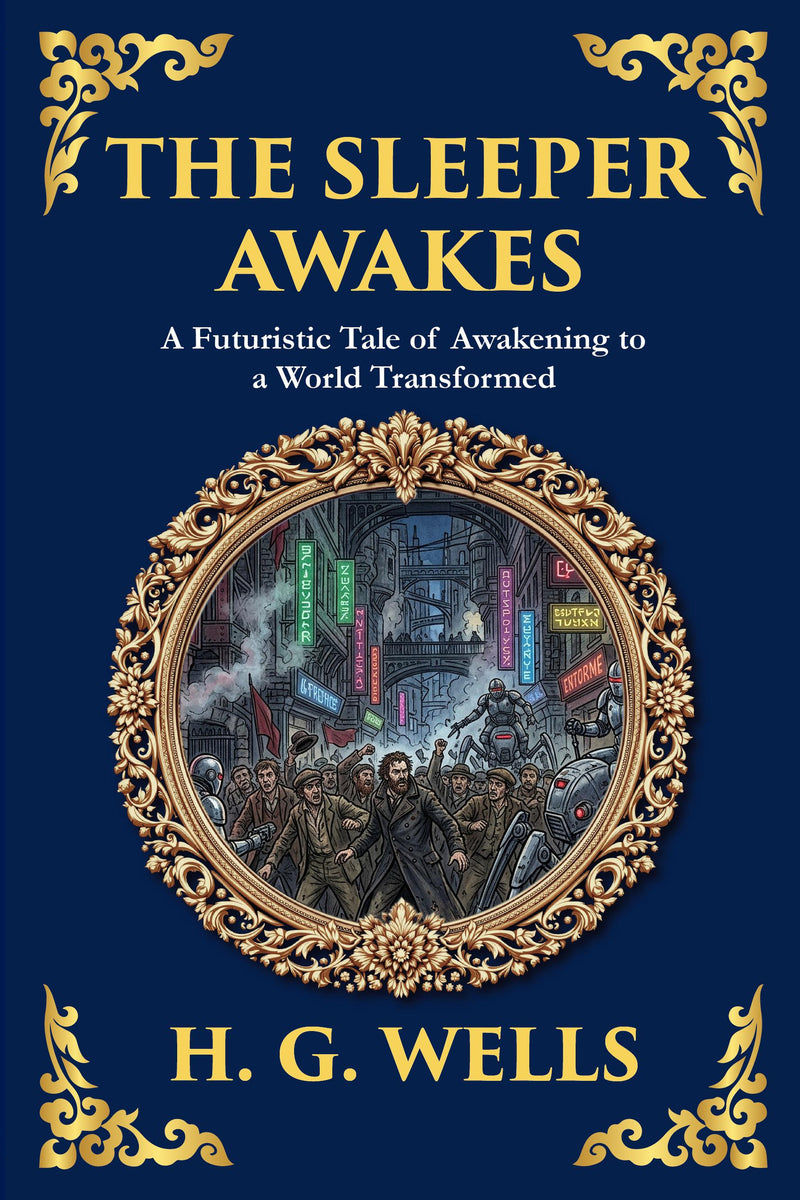
The Sleeper Awakes
What happens when a man falls asleep for centuries and wakes up to find the world irrevocably changed—and his name tied to an empire he never built?
or free app
10,000+ hrs library
30-day guarantee
The complete The Sleeper Awakes appears in modern English through Library of Alexandria Press, available online with audiobook narration included for members.
Have you ever wondered why the future so often reflects the flaws of our present? In The Sleeper Awakes, science fiction pioneer H. G. Wells presents a bold and unsettling vision of the future—a future shaped not by idealism, but by control, consumerism, and the consolidation of power. When Graham, an ordinary man from the 19th century, falls into a mysterious deep sleep, the world changes without him.
But his fortune and influence do not. Two centuries later, he awakens to discover a technocratic regime ruling in his name. His once-idle wealth has become the foundation of a global system of surveillance and subjugation.
Now a living legend and reluctant icon, Graham must navigate a metropolis of towering skyscrapers, flying machines, and restless citizens living under false freedoms. As rebellion brews and the truth behind his legacy is revealed, Graham is forced to choose: remain a symbol of power—or become the catalyst for revolution.
What you’ll discover in this modern edition
- A Dystopian World Reimagined Step into a future where the masses are subdued by spectacle, and power is concentrated in the hands of the few.
| Formats | eBook (EPUB + PDF) · Audiobook · Paperback · Hardcover · Large Print |
| Language | English |
| Trim size (print) | 6 × 9 in |
| Binding | Paperback — perfect-bound · Hardcover — casewrap |
| Large Print edition | Same text in a larger, easy-read type — a larger font, not a larger trim |
| Print pricing | Every physical book at our true cost — at-cost, no profit (members) |
| Library | 873 restored titles, always growing |
| Length | 76,140 words · ~5 hr 5 min reading |
| Reading level | Grade 7 · an easy, flowing read (this modern-English edition) |
| Edition | Modern English translation · 2026 |
Member reviews for this edition are collected as readers finish it — be the first. Across the library: 12,000+ books shipped, every plan covered by a 365-day print guarantee.
About this edition
A faithful, unabridged modern-English edition by The Library of Alexandria — carefully rendered for today's reader and verified paragraph-by-paragraph against the public-domain source. Available as eBook, audiobook, paperback, hardcover, and large print.
- Complete & unabridgedVerified paragraph by paragraph against the source — never a scan, never abridged.
- Modern English, faithfulReadable today, with the author’s meaning kept intact. Readable — not simplified.
- Every format, one membershipRead in your browser or the free app, or listen to the full audiobook.
Included free with your membership
Cancel anytime, one click · 30-day money-back guarantee
Edition last updated July 2026
What’s inside
The Sleeper Awakes — complete and unabridged: all 27 sections included with membership, plus the full audiobook.
Begin reading The Sleeper Awakes
In clear modern English — the complete text is included with membership.
Introduction
When Herbert George Wells published the story you are about to read, he was already a writer who had taught the world to dream forward. He had sent a traveler hurtling into the deep future aboard a machine, summoned creatures from the red planet to lay waste to Surrey, and imagined a man who could vanish from sight entirely. Yet among these celebrated scientific romances sits a work that, in its time, was perhaps the most prophetic of them all—a vision not of monsters or time machines, but of something far more unsettling: a future built by the slow, relentless logic of capital, technology, and human ambition. This is the story of a man who falls asleep in a world we might almost recognize and wakes in one we can scarcely comprehend, a sleeper who opens his eyes to find that the centuries have not stood still, and that the comfortable assumptions of his age have been swept away by forces no one fully intended to unleash.
Reading Wells today is a peculiar and thrilling experience, because so much of what he imagined has either come true or come uncomfortably close. He wrote at the very end of the nineteenth century, when electric light was still a novelty, when flight remained an unproven dream, and when the great cities of the world were only beginning to swell into the vast, teeming organisms we now take for granted. From that vantage point, he looked ahead and saw something extraordinary: a civilization of towering structures, moving walkways, aerial machines, and ceaseless mechanical motion, all governed by an economic order of staggering scale and complexity. To encounter this vision in the present day is to feel a strange double vision—to recognize, again and again, the shapes of our own world reflected back at us through the imagination of a man who never lived to see them realized. This modern translation has been prepared with precisely that recognition in mind, smoothing the antique phrasings and Victorian cadences of the original so that the urgency and intelligence of Wells’s vision can reach you directly, undimmed by the distance of more than a century.
A Visionary Who Looked Forward and Saw Ourselves
To understand the power of what awaits you, it helps to know something of the man who wrote it and the moment from which he wrote. H. G. Wells was born in 1866 into the lower reaches of England’s striving middle class, the son of a shopkeeper and a domestic servant. His early life was marked by financial precariousness and a fierce, almost desperate hunger for learning. He clawed his way up through scholarships and night study, eventually winning a place at the Normal School of Science in London, where he studied biology under Thomas Henry Huxley, the great defender of Darwin and one of the most formidable scientific minds of the age. That education left a permanent mark on Wells. He came away with a conviction that the human species was not a fixed and finished thing but a creature still in motion, shaped by its environment, capable of magnificent advance and equally capable of decline. Evolution, for Wells, was not merely a fact about the past; it was a lens through which to examine the future.
This biological imagination, fused with an acute sensitivity to the social upheavals of his time, gave Wells a gift that few writers before him had possessed. He did not simply invent fanciful technologies for their own sake. He thought systematically about how a single change—a new machine, a new economic arrangement, a new distribution of power—might ripple outward to transform every aspect of human life. He asked not only what the future might contain but what kind of people would live there, how they would think and speak and love and labor, and what would become of the human spirit under conditions radically different from his own. In this respect he was less a prophet than a kind of social scientist working in the medium of fiction, running thought experiments on the largest possible canvas.
The world in which Wells came of age was itself in the throes of bewildering change. The Industrial Revolution had reshaped England within living memory, herding millions into cities, hollowing out the old rural rhythms, and creating immense new concentrations of wealth alongside equally immense reservoirs of poverty. The factory system had introduced a logic of efficiency and accumulation that seemed to recognize no natural limit. Great financial enterprises were beginning to span continents. The telegraph had annihilated distance for the transmission of information. Photography, the phonograph, the electric tram, the department store—all of these were new, all of them were spreading, and all of them carried implications that few of Wells’s contemporaries paused to consider. Wells considered them obsessively. He understood, with a clarity that still astonishes, that these developments were not isolated curiosities but parts of a single, accelerating process, and that the process would not stop. He asked himself where it might lead if it continued, unchecked, for two hundred years.
The answer he produced is the world you are about to enter. It is a world of breathtaking technological sophistication, in which human ingenuity has reached heights his contemporaries could scarcely have imagined. But it is also a world of profound moral ambiguity, in which the very triumphs of progress have produced new and terrible forms of servitude, new chasms between the powerful and the powerless, and new questions about what it means to be free. Wells did not write a simple utopia, nor did he write a simple nightmare. He wrote something far more interesting and far more honest: a future that is genuinely advanced and genuinely troubling at the same time, in which the marvels and the horrors grow from the same root. This refusal to flatter either optimism or despair is one of the things that makes the book feel so startlingly contemporary. We too live in an age that promises us liberation through technology even as it binds us more tightly to systems we do not control. We too are sleepers, in our way, half-aware of the world being built around us while we attend to the small concerns of our daily lives.
It is worth pausing on the central conceit, because it is one of the oldest and most powerful in all of storytelling, and Wells handles it with particular brilliance. The figure of the sleeper who wakes after a great span of time appears in legends across many cultures—in the tale of the man who slumbers in the mountains and returns to find his village transformed, in stories of enchanted sleep and miraculous awakening that stretch back into antiquity. The appeal of such a device is obvious. It allows us to see our own world, or a possible version of it, through the eyes of a stranger, freed from the dulling familiarity that prevents us from truly perceiving the conditions of our lives. The sleeper notices everything because everything is new to him. His confusion becomes our clarity. His astonishment becomes our recognition. And because he carries within him the values and expectations of an earlier, more familiar age, he serves as a moral measuring stick against which the new world can be judged. Wells understood the full potential of this ancient device and turned it to thoroughly modern purposes. His sleeper does not wake into a fairy-tale kingdom but into a functioning, complex, internally consistent civilization, one whose logic the reader is invited to puzzle out alongside the protagonist.
This particular romance occupies a fascinating place in the development of science fiction as a literary form, and indeed in the development of Wells himself as a thinker. It belongs to the great early period of his career, the remarkable burst of creativity in the late 1890s during which he produced the scientific romances that would make his name immortal. But it differs from its famous siblings in instructive ways. Where some of his other works of this era hinge on a single fantastic premise—an invasion, an invention, a discovery—this one attempts something more sweeping. It tries to imagine an entire society, top to bottom, two centuries hence: its architecture and its economy, its entertainments and its labor, its politics and its propaganda, its fashions and its faiths. It is, in other words, an exercise in world-building on a grand scale, and in this it anticipates an enormous amount of the science fiction that would come after it.
Consider how many of the genre’s enduring preoccupations make early appearances here. The vast vertical city, in which the population is stacked into colossal structures and the old distinction between town and country has dissolved—this is a vision that countless later writers would borrow and elaborate. The notion that the future might be dominated less by kings or parliaments than by gigantic economic interests, that power might flow from the control of capital and machinery rather than from inherited title or martial conquest—this too proved astonishingly prescient. The mass manipulation of public opinion through new media, the reduction of human labor to a vast and faceless workforce, the way that comfort and convenience for some are purchased through the diminishment of others—all of these themes are here, sketched with a confidence and a coherence that mark the arrival of a major new mode of imaginative writing. When later authors built their towering dystopias and gleaming technocracies, they were, knowingly or not, working in territory that Wells had already mapped.
What makes this all the more remarkable is the precision of Wells’s social analysis. He was deeply engaged with the political and economic debates of his day, increasingly drawn to socialism and to questions about how society ought to be organized. He worried about the trajectory of unregulated capitalism, about the way that wealth tended to concentrate and to perpetuate itself, about the human cost of treating people as mere units of production. He worried, too, about the alternatives—about the dangers of bureaucracy, of centralized control, of systems so vast and impersonal that no individual could meaningfully resist or even comprehend them. The future he imagined in this book is, in part, an extrapolation of these anxieties: a projection of what might happen if the economic logic of his own time were allowed to run its course for two hundred years without fundamental reform. It is a future in which the machinery of production has reached miraculous heights of efficiency, and in which that very efficiency has produced consequences both wonderful and dreadful.
And yet it would be a mistake to read this work merely as a political tract dressed up in the costume of adventure. Wells was, first and foremost, a storyteller of immense skill, and he never forgot that ideas must be carried on the back of incident and character if they are to live. The narrative momentum here is considerable. There is mystery in the protagonist’s strange situation, suspense in his gradual discovery of his place in this new order, and genuine drama in the conflicts that develop around him. Wells understood that the reader’s curiosity is a fragile thing, easily lost, and he was careful to feed it constantly—to dole out revelations at exactly the right pace, to keep us asking questions and reaching for answers. The book moves. It has the propulsive quality of the best adventure fiction, even as it engages the mind with its larger questions. You will find yourself turning the pages not only to understand the world Wells has built but to discover what will become of the man at its center.
A word should be said here about the curious history of the text itself, for it bears on the experience of reading. Wells first published this story in serial form, and then as a book, near the turn of the century. But he was a restless and self-critical author who returned to several of his early works in later years, revising and reshaping them. He came to feel that the original version of this particular tale was hurried in places, written under the pressure of serial deadlines, and not fully equal to the magnitude of its own conception. And so, some years after its first appearance, he produced a revised edition, refining the prose, tightening the structure, and adjusting certain elements to his greater satisfaction. The very title underwent a subtle but significant change in the process. This history is worth knowing because it reveals how seriously Wells took the material—how he wrestled with it, returned to it, and tried to bring it closer to the vision he had glimpsed. The version that has come down to us as the standard text is the product of that mature reconsideration, the work of an author looking back on his younger self’s audacious imaginings and striving to do them justice.
Cancel anytime, one click · 30-day money-back guarantee
Founding annual rate available now — your price locks for life when you join.
Not ready? Get this free chapter by email — read it anytime.
✓ Sent — check your inbox for The Sleeper Awakes.
Questions about The Sleeper Awakes
What is The Sleeper Awakes about?
What happens when a man falls asleep for centuries and wakes up to find the world irrevocably changed—and his name tied to an empire he never built? The Sleeper Awakes is H. G. Wells’s visionary dystopian novel that explores the dangers of unchecked capitalism, mass control, and the illusion of freedom. Graham, a man once ordinary, awakens in a future where he unknowingly became the richest and most powerful figure on Earth while he slept.
Who wrote The Sleeper Awakes?
The Sleeper Awakes was written by H. G. Wells. This edition presents the complete work in clear modern English, faithfully rendered from the public-domain original by Library of Alexandria Press.
Is The Sleeper Awakes free to read?
The opening chapter is free to read on this page. Members read and listen to the complete work — and the entire library — free, and can order any physical book at our true print cost.
How long is The Sleeper Awakes?
27 chapters (~76,140 words) — about 5 hr 5 min of reading in this modern-English edition.
Is this an abridged version of The Sleeper Awakes?
No. This is the complete, unabridged The Sleeper Awakes, carefully rendered into clear modern English and verified paragraph-by-paragraph against the public-domain source — nothing is cut or summarised.
What formats does The Sleeper Awakes come in?
The Sleeper Awakes is available as eBook, paperback, hardcover and large print. eBook and audiobook are included with membership; printed editions ship at our true print cost.
Shipping & returns
Billing & membership
More from the library


Explore Science Fiction
- The Island of Doctor Moreau · H. G. Wells
- A Midsummer Night’s Dream · William Shakespeare
- The Invisible Man: A Grotesque Romance · H. G. Wells
- The War of the Worlds · H. G. Wells
- The Strange Case of Dr. Jekyll and Mr. Hyde · Robert Louis Stevenson
- Limanora: the island of progress · Godfrey Sweven
- The Book of Dragons · E. Nesbit
- She · H. Rider Haggard
- Dorothy and the Wizard in Oz · L. Frank Baum
- The Princess and the Goblin · George MacDonald
- Gawayne and the Green Knight: A Fairy Tale · Charlton M. Lewis
- Lucian’s True History · Lucian of Samosata
- The Willows · Algernon Blackwood
- The Call of Cthulhu · H. P. Lovecraft
- The Life-Eater · Harold Ward
- The Marvelous Land of Oz · L. Frank Baum
- Mars is My Destination · Frank Belknap Long
- The Black Kiss
- The Beasts in the Void · Paul W. Fairman
- John Jones’s Dollar · Harry Stephen Keeler
- Subversive · Mack Reynolds
- The Mississippi Saucer · Frank Belknap Long
- Man of Distinction · Michael Shaara
- Spawn of the Comet · H. Thompson Rich
- The Golden Judge · Nathaniel Gordon
- Final Weapon · Everett B. Cole
- The Big Fix · George O. Smith
- Last Enemy · H. Beam Piper
- Time and Time Again · H. Beam Piper
- Sabotage in Space · Carey Rockwell
The Sleeper Awakes
The Sleeper Awakes
A Futuristic Tale of Awakening to a World Transformed
H. G. Wells
Contents
- Introduction
- Preface to the New Edition
- Chapter 1
- Chapter 2
- Chapter 3
- Chapter 4
- Chapter 5
- Chapter 6
- Chapter 7
- Chapter 8
- Chapter 9
- Chapter 10
- Chapter 11
- Chapter 12
- Chapter 13
- Chapter 14
- Chapter 15
- Chapter 16
- Chapter 17
- Chapter 18
- Chapter 19
- Chapter 20
- Chapter 21
- Chapter 22
- Chapter 23
- Chapter 24
- Chapter 25
Introduction
When Herbert George Wells published the story you are about to read, he was already a writer who had taught the world to dream forward. He had sent a traveler hurtling into the deep future aboard a machine, summoned creatures from the red planet to lay waste to Surrey, and imagined a man who could vanish from sight entirely. Yet among these celebrated scientific romances sits a work that, in its time, was perhaps the most prophetic of them all—a vision not of monsters or time machines, but of something far more unsettling: a future built by the slow, relentless logic of capital, technology, and human ambition. This is the story of a man who falls asleep in a world we might almost recognize and wakes in one we can scarcely comprehend, a sleeper who opens his eyes to find that the centuries have not stood still, and that the comfortable assumptions of his age have been swept away by forces no one fully intended to unleash.
Reading Wells today is a peculiar and thrilling experience, because so much of what he imagined has either come true or come uncomfortably close. He wrote at the very end of the nineteenth century, when electric light was still a novelty, when flight remained an unproven dream, and when the great cities of the world were only beginning to swell into the vast, teeming organisms we now take for granted. From that vantage point, he looked ahead and saw something extraordinary: a civilization of towering structures, moving walkways, aerial machines, and ceaseless mechanical motion, all governed by an economic order of staggering scale and complexity. To encounter this vision in the present day is to feel a strange double vision—to recognize, again and again, the shapes of our own world reflected back at us through the imagination of a man who never lived to see them realized. This modern translation has been prepared with precisely that recognition in mind, smoothing the antique phrasings and Victorian cadences of the original so that the urgency and intelligence of Wells’s vision can reach you directly, undimmed by the distance of more than a century.
A Visionary Who Looked Forward and Saw Ourselves
To understand the power of what awaits you, it helps to know something of the man who wrote it and the moment from which he wrote. H. G. Wells was born in 1866 into the lower reaches of England’s striving middle class, the son of a shopkeeper and a domestic servant. His early life was marked by financial precariousness and a fierce, almost desperate hunger for learning. He clawed his way up through scholarships and night study, eventually winning a place at the Normal School of Science in London, where he studied biology under Thomas Henry Huxley, the great defender of Darwin and one of the most formidable scientific minds of the age. That education left a permanent mark on Wells. He came away with a conviction that the human species was not a fixed and finished thing but a creature still in motion, shaped by its environment, capable of magnificent advance and equally capable of decline. Evolution, for Wells, was not merely a fact about the past; it was a lens through which to examine the future.
This biological imagination, fused with an acute sensitivity to the social upheavals of his time, gave Wells a gift that few writers before him had possessed. He did not simply invent fanciful technologies for their own sake. He thought systematically about how a single change—a new machine, a new economic arrangement, a new distribution of power—might ripple outward to transform every aspect of human life. He asked not only what the future might contain but what kind of people would live there, how they would think and speak and love and labor, and what would become of the human spirit under conditions radically different from his own. In this respect he was less a prophet than a kind of social scientist working in the medium of fiction, running thought experiments on the largest possible canvas.
The world in which Wells came of age was itself in the throes of bewildering change. The Industrial Revolution had reshaped England within living memory, herding millions into cities, hollowing out the old rural rhythms, and creating immense new concentrations of wealth alongside equally immense reservoirs of poverty. The factory system had introduced a logic of efficiency and accumulation that seemed to recognize no natural limit. Great financial enterprises were beginning to span continents. The telegraph had annihilated distance for the transmission of information. Photography, the phonograph, the electric tram, the department store—all of these were new, all of them were spreading, and all of them carried implications that few of Wells’s contemporaries paused to consider. Wells considered them obsessively. He understood, with a clarity that still astonishes, that these developments were not isolated curiosities but parts of a single, accelerating process, and that the process would not stop. He asked himself where it might lead if it continued, unchecked, for two hundred years.
The answer he produced is the world you are about to enter. It is a world of breathtaking technological sophistication, in which human ingenuity has reached heights his contemporaries could scarcely have imagined. But it is also a world of profound moral ambiguity, in which the very triumphs of progress have produced new and terrible forms of servitude, new chasms between the powerful and the powerless, and new questions about what it means to be free. Wells did not write a simple utopia, nor did he write a simple nightmare. He wrote something far more interesting and far more honest: a future that is genuinely advanced and genuinely troubling at the same time, in which the marvels and the horrors grow from the same root. This refusal to flatter either optimism or despair is one of the things that makes the book feel so startlingly contemporary. We too live in an age that promises us liberation through technology even as it binds us more tightly to systems we do not control. We too are sleepers, in our way, half-aware of the world being built around us while we attend to the small concerns of our daily lives.
It is worth pausing on the central conceit, because it is one of the oldest and most powerful in all of storytelling, and Wells handles it with particular brilliance. The figure of the sleeper who wakes after a great span of time appears in legends across many cultures—in the tale of the man who slumbers in the mountains and returns to find his village transformed, in stories of enchanted sleep and miraculous awakening that stretch back into antiquity. The appeal of such a device is obvious. It allows us to see our own world, or a possible version of it, through the eyes of a stranger, freed from the dulling familiarity that prevents us from truly perceiving the conditions of our lives. The sleeper notices everything because everything is new to him. His confusion becomes our clarity. His astonishment becomes our recognition. And because he carries within him the values and expectations of an earlier, more familiar age, he serves as a moral measuring stick against which the new world can be judged. Wells understood the full potential of this ancient device and turned it to thoroughly modern purposes. His sleeper does not wake into a fairy-tale kingdom but into a functioning, complex, internally consistent civilization, one whose logic the reader is invited to puzzle out alongside the protagonist.
This particular romance occupies a fascinating place in the development of science fiction as a literary form, and indeed in the development of Wells himself as a thinker. It belongs to the great early period of his career, the remarkable burst of creativity in the late 1890s during which he produced the scientific romances that would make his name immortal. But it differs from its famous siblings in instructive ways. Where some of his other works of this era hinge on a single fantastic premise—an invasion, an invention, a discovery—this one attempts something more sweeping. It tries to imagine an entire society, top to bottom, two centuries hence: its architecture and its economy, its entertainments and its labor, its politics and its propaganda, its fashions and its faiths. It is, in other words, an exercise in world-building on a grand scale, and in this it anticipates an enormous amount of the science fiction that would come after it.
Consider how many of the genre’s enduring preoccupations make early appearances here. The vast vertical city, in which the population is stacked into colossal structures and the old distinction between town and country has dissolved—this is a vision that countless later writers would borrow and elaborate. The notion that the future might be dominated less by kings or parliaments than by gigantic economic interests, that power might flow from the control of capital and machinery rather than from inherited title or martial conquest—this too proved astonishingly prescient. The mass manipulation of public opinion through new media, the reduction of human labor to a vast and faceless workforce, the way that comfort and convenience for some are purchased through the diminishment of others—all of these themes are here, sketched with a confidence and a coherence that mark the arrival of a major new mode of imaginative writing. When later authors built their towering dystopias and gleaming technocracies, they were, knowingly or not, working in territory that Wells had already mapped.
What makes this all the more remarkable is the precision of Wells’s social analysis. He was deeply engaged with the political and economic debates of his day, increasingly drawn to socialism and to questions about how society ought to be organized. He worried about the trajectory of unregulated capitalism, about the way that wealth tended to concentrate and to perpetuate itself, about the human cost of treating people as mere units of production. He worried, too, about the alternatives—about the dangers of bureaucracy, of centralized control, of systems so vast and impersonal that no individual could meaningfully resist or even comprehend them. The future he imagined in this book is, in part, an extrapolation of these anxieties: a projection of what might happen if the economic logic of his own time were allowed to run its course for two hundred years without fundamental reform. It is a future in which the machinery of production has reached miraculous heights of efficiency, and in which that very efficiency has produced consequences both wonderful and dreadful.
And yet it would be a mistake to read this work merely as a political tract dressed up in the costume of adventure. Wells was, first and foremost, a storyteller of immense skill, and he never forgot that ideas must be carried on the back of incident and character if they are to live. The narrative momentum here is considerable. There is mystery in the protagonist’s strange situation, suspense in his gradual discovery of his place in this new order, and genuine drama in the conflicts that develop around him. Wells understood that the reader’s curiosity is a fragile thing, easily lost, and he was careful to feed it constantly—to dole out revelations at exactly the right pace, to keep us asking questions and reaching for answers. The book moves. It has the propulsive quality of the best adventure fiction, even as it engages the mind with its larger questions. You will find yourself turning the pages not only to understand the world Wells has built but to discover what will become of the man at its center.
A word should be said here about the curious history of the text itself, for it bears on the experience of reading. Wells first published this story in serial form, and then as a book, near the turn of the century. But he was a restless and self-critical author who returned to several of his early works in later years, revising and reshaping them. He came to feel that the original version of this particular tale was hurried in places, written under the pressure of serial deadlines, and not fully equal to the magnitude of its own conception. And so, some years after its first appearance, he produced a revised edition, refining the prose, tightening the structure, and adjusting certain elements to his greater satisfaction. The very title underwent a subtle but significant change in the process. This history is worth knowing because it reveals how seriously Wells took the material—how he wrestled with it, returned to it, and tried to bring it closer to the vision he had glimpsed. The version that has come down to us as the standard text is the product of that mature reconsideration, the work of an author looking back on his younger self’s audacious imaginings and striving to do them justice.
One afternoon at low tide, Mr. Isbister, a young artist staying in Boscastle, walked to the scenic cove of Pentargen to explore the caves. Halfway down the steep path to the beach, he suddenly came across a man sitting under a ledge of rock, looking deeply distressed. The man’s hands hung limply over his knees, his eyes were red and staring, and his face was wet with tears.
He looked back as Isbister approached. Both men felt awkward, but Isbister more so. To break the tension of his sudden pause, he remarked with an air of confidence that the weather was unusually hot for the time of year.
“It is,” the stranger replied shortly. He hesitated for a second, then added in a flat tone, “I can’t sleep.”
Isbister stopped abruptly. “No?” was all he said, but his posture showed he wanted to help.
“It may sound unbelievable,” the stranger said, turning tired eyes toward Isbister and gesturing weakly with his hand, “but I haven’t slept—not at all—for six nights.”
“Yes. Mostly bad advice. Drugs. My nervous system... They work fine for most people. It’s hard to explain. I don’t dare take... drugs that are strong enough.”
“That makes it difficult,” Isbister said.
He stood helplessly on the narrow path, unsure of what to do. It was clear the man wanted to talk. Feeling it was the natural thing to do, he tried to keep the conversation going. “I’ve never suffered from insomnia myself,” he said in a casual, conversational tone, “but in the cases I’ve known, people usually found something that—”
He spoke wearily. He made a dismissive gesture, and for a moment, both men were silent.
“Exercise?” Isbister suggested hesitantly, glancing from the man’s miserable face to the touring clothes he was wearing.
End of the free sample
Keep reading, free
Members read and listen to the complete book — and the entire library. Cancel anytime, one click · 30-day money-back guarantee.