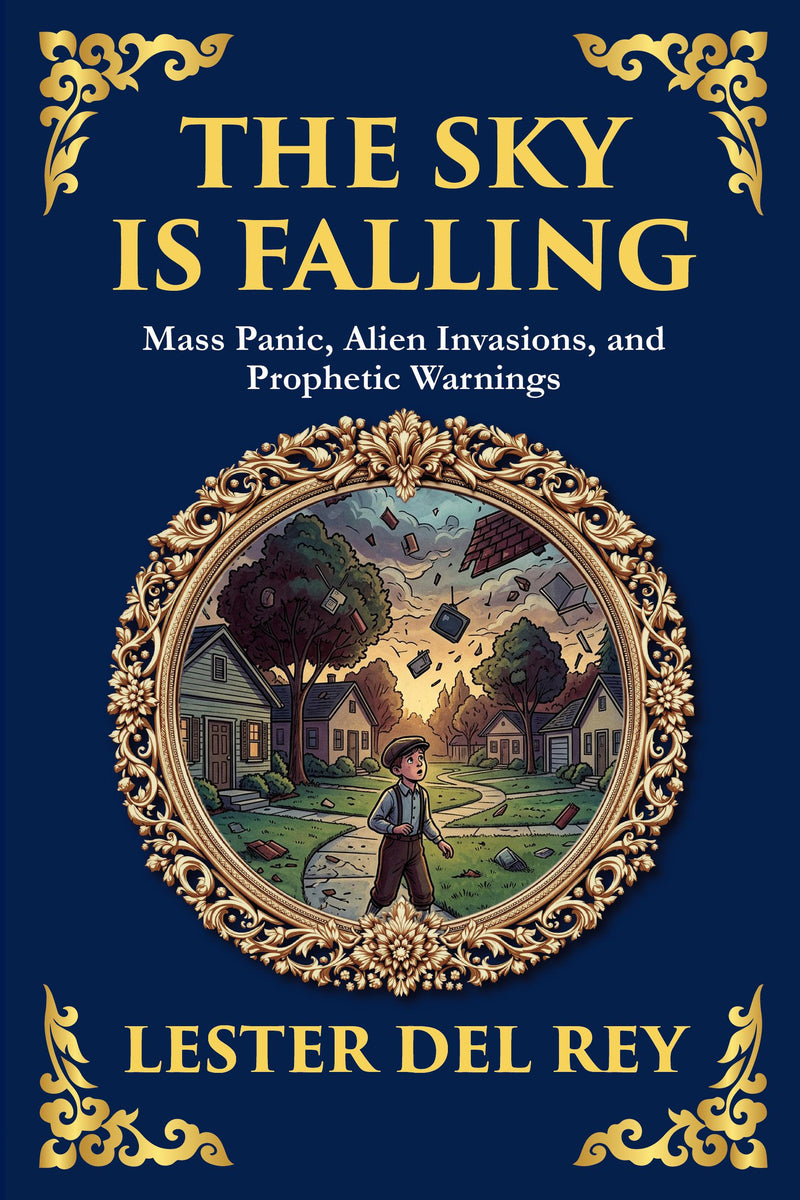
The Sky Is Falling — Large Print
The stars have shifted. The sky has changed. And no one is prepared for what’s about to fall. In The Sky Is Falling, legendary science fiction author Lester Del Rey crafts a gripping tale of paranoia, prophecy, and planetary peril.
or free app
10,000+ hrs library
30-day guarantee
The complete The Sky Is Falling appears in modern English through Library of Alexandria Press, available online with audiobook narration included for members.
Have you ever wondered why humanity ignores the truth—until it’s too late? The Sky Is Falling is a haunting tale of disbelief, dread, and disaster from one of science fiction’s most visionary minds, Lester Del Rey. Blending speculative fiction with prophetic terror, this novella asks chilling questions about trust, truth, and the consequences of cosmic ignorance.
David Brown is a man with a past—a former scientist turned outcast after claiming he received knowledge from another world. Shunned by society and ridiculed by peers, he retreats into isolation… until the messages start again. This time, the warnings are clearer.
The world is under silent observation. A change is coming. And it won’t be gentle.
With time slipping away, David must decide whether to run, hide—or sound the alarm once more. As strange phenomena ripple across the Earth and ancient symbols appear in the sky, he’s no longer sure if he’s insane… or the only sane one left.
What you’ll discover in this modern edition
- A gripping story of alien contact, prophetic warnings, and societal denial
- A psychological exploration of belief, sanity, and the burden of knowledge
| Formats | eBook (EPUB + PDF) · Audiobook · Paperback · Hardcover · Large Print |
| Language | English |
| Trim size (print) | 6 × 9 in |
| Binding | Paperback — perfect-bound · Hardcover — casewrap |
| Large Print edition | Same text in a larger, easy-read type — a larger font, not a larger trim |
| Print pricing | Every physical book at our true cost — at-cost, no profit (members) |
| Library | 873 restored titles, always growing |
| Length | 37,556 words · ~2 hr 30 min reading |
| Reading level | Grade 6 · an easy, flowing read (this modern-English edition) |
| Edition | Modern English translation · 2026 |
Member reviews for this edition are collected as readers finish it — be the first. Across the library: 12,000+ books shipped, every plan covered by a 365-day print guarantee.
About this edition
A faithful, unabridged modern-English edition by The Library of Alexandria — carefully rendered for today's reader and verified paragraph-by-paragraph against the public-domain source. Available as eBook, audiobook, paperback, hardcover, and large print.
- Complete & unabridgedVerified paragraph by paragraph against the source — never a scan, never abridged.
- Modern English, faithfulReadable today, with the author’s meaning kept intact. Readable — not simplified.
- Every format, one membershipRead in your browser or the free app, or listen to the full audiobook.
Included free with your membership
Cancel anytime, one click · 30-day money-back guarantee
Edition last updated July 2026
What’s inside
The Sky Is Falling — Large Print — complete and unabridged: all 11 sections included with membership, plus the full audiobook.
Begin reading The Sky Is Falling — Large Print
In clear modern English — the complete text is included with membership.
Introduction
There are certain writers who, having once been read, take up permanent residence in the imagination. Lester Del Rey is one of them. To open one of his stories is to step into a particular kind of intelligence—brisk, confident, deeply curious about how things work and how people behave when the ordinary rules of their lives are suddenly suspended. The Sky Is Falling belongs to that tradition of mid-century speculative fiction that took ideas seriously, treated readers as capable adults, and never forgot that beneath every grand cosmic scenario there is a human being trying to make sense of a world that has tilted on its axis.
This edition has been carefully prepared as a modern translation, adapted for the contemporary reader. That phrase deserves a moment of explanation, because it touches on the spirit in which this book is offered. The science fiction of Del Rey’s era was written in the idiom of its day. Its sentences carried the rhythms, the assumptions, and occasionally the obscurities of a vanished publishing culture—pulp magazines, double-novel paperbacks, the particular slang and shorthand of writers who were paid by the word and read by the millions. Much of that texture is delightful. Some of it, decades later, can interpose itself between the story and the person trying to enjoy it. The aim of this adaptation is to clear away the dust without sanding off the character: to let the narrative move with the urgency its title promises, while preserving the wit, the ingenuity, and the unmistakable voice that made Del Rey a beloved figure in the field. Nothing essential has been lost. What remains is the story as it was always meant to be experienced—quick, gripping, and alive.
To understand why that matters, it helps to understand the man and the moment that produced this book.
Lester Del Rey was born in 1915 in rural Minnesota, into circumstances that gave him no obvious path toward becoming one of the shaping intelligences of twentieth-century science fiction. He was largely self-educated, ferociously well-read, and possessed of the kind of restless practical mind that wants to take apart any machine—mechanical, social, or metaphysical—and see what makes it run. He came of age during the Great Depression, and he entered the world of professional writing in the late 1930s, during what enthusiasts would later call the Golden Age of science fiction.
That period, roughly spanning the late 1930s through the 1950s, was an extraordinary furnace of creativity. The pulp magazines—Astounding, Galaxy, Amazing Stories, and their many competitors—were hungry for material, and a generation of young writers fed that hunger with stories that ranged from the disposable to the immortal. Under the famously demanding editorship of figures like John W. Campbell, the genre was being pushed to grow up. No longer content with rocket ships and ray guns deployed as mere spectacle, the best writers of the era began to ask harder questions. What would actually happen to a society confronted with the impossible? How do ordinary institutions—governments, churches, families, scientists—respond when their understanding of reality is overturned? What is the difference between knowledge and wisdom, between fear and prudence, between panic and reasonable alarm?
Del Rey was right at the heart of this conversation. His early story “Helen O’Loy,” published in 1938, remains one of the most frequently anthologized pieces in the genre’s history, a tender and surprisingly emotional meditation on artificial life and love that prefigured themes writers would still be wrestling with in the next century. His “Nerves,” concerning an accident at a nuclear power plant, was praised for its sober technical realism long before the public had any direct experience of such dangers. These were not stories that traded in cheap thrills. They were stories that understood the thrill came from the consequences—from taking a premise seriously enough to follow it wherever it led.
What set Del Rey apart from many of his contemporaries was a peculiar double vision. He was a romantic about the possibilities of the future and a hard-nosed skeptic about human nature, and he held these two attitudes in productive tension throughout his career. He believed in reason, in the power of clear thinking to cut through confusion, and yet he never made the mistake of assuming that most people would think clearly when they were frightened. He understood crowds. He understood how quickly a rumor becomes a conviction, how a conviction becomes a movement, and how a movement can become a stampede that tramples the very people it claims to protect. This understanding gives his fiction a quality that feels startlingly modern: he was writing about the psychology of mass response, of contagion and credulity, at a time when those subjects were only beginning to be studied seriously.
It is worth pausing on the broader cultural backdrop, because The Sky Is Falling cannot be fully appreciated without it. The mid-twentieth century was an age obsessed with catastrophe and with the public’s reaction to it. In 1938, Orson Welles’s radio broadcast of The War of the Worlds had—at least according to the legend that grew around it—sent listeners fleeing into the streets, convinced that Martians had landed in New Jersey. Whether the panic was as widespread as the newspapers claimed is a matter historians still debate, but the idea of that panic lodged itself permanently in the cultural memory. It became a kind of parable about the fragility of the modern mind, about how thin the membrane is between the world we think we live in and the chaos we are always one announcement away from.
The decades that followed only deepened this preoccupation. The atomic bomb introduced, for the first time in human history, the genuine possibility of self-annihilation. The Cold War turned every international crisis into a potential apocalypse. Newspapers reported on bomb shelters, civil defense drills, and the strange new vocabulary of mutually assured destruction. And alongside these real terrors flourished a rich subculture of the irrational—reports of flying saucers, prophetic warnings, end-times predictions, and doomsday cults that gathered on hilltops to await the world’s end. The line between rational fear and irrational hysteria had never been blurrier, and writers of speculative fiction found in this confusion an inexhaustible subject.
This is the soil from which the present book grew. The title alone announces its thematic territory. “The sky is falling” is, of course, the cry of Chicken Little, the folktale character who mistakes an acorn for a catastrophe and, in spreading the alarm, leads an entire community to ruin. It is one of the oldest and most durable warnings in Western storytelling—a fable about the danger of believing too readily, of mistaking the trivial for the calamitous, of letting fear do our thinking for us. By invoking it, Del Rey signals immediately that this is a book concerned with the difference between a real threat and an imagined one, and with the far more interesting question of what happens when no one can tell which is which.
The subtitle of this edition—Mass Panic, Alien Invasions, and Prophetic Warnings—maps the terrain you are about to enter. But it would be a mistake to read those words as a simple table of contents. Del Rey was too sophisticated a writer to give you a tidy invasion story or a straightforward tale of collective hysteria. What he offers instead is something more layered: a scenario in which the categories themselves are destabilized, in which the reader is invited to share the disorientation of the characters, never entirely certain what is genuine and what is illusion, what deserves alarm and what is merely the product of a mind primed to expect the worst.
Without revealing the turns of the plot—because the experience of discovery is one of the chief pleasures this book has to offer—it is fair to say a few things about its method and its meaning.
Del Rey was a master of a particular narrative strategy that the Golden Age perfected and that has since become a staple of the genre: the slow, controlled revelation. He understood that the most powerful moments in speculative fiction come not from explaining everything at once but from doling out understanding in carefully measured doses, so that the reader is always slightly ahead of total comprehension but never lost. He places his characters—and through them, his readers—in a situation of profound uncertainty, and then he lets that uncertainty do its work. The result is a sustained tension that has nothing to do with action for its own sake and everything to do with the deep human discomfort of not knowing.
This is why the book has aged so well. Stories built primarily on technology tend to date badly; the future they imagine arrives, or fails to arrive, and the spell is broken. But stories built on human psychology, on the dynamics of belief and fear and authority, never go out of date, because human nature does not change at the pace technology does. The questions Del Rey poses here are if anything more urgent now than when he first posed them. We live in an age of instantaneous information and instantaneous misinformation, where a rumor can circle the planet before the truth has finished tying its shoes. We have watched whole populations swept up in waves of fear, watched experts contradicted and contradicting, watched the sober voice of reason struggle to make itself heard over the roar of alarm. The mechanisms Del Rey anatomized with such precision—the way a frightened crowd seeks a leader, the way a leader exploits a frightened crowd, the way truth becomes secondary to the need for certainty—are precisely the mechanisms we see operating around us every day.
And yet this is not a grim or hectoring book. One of the great pleasures of reading Del Rey is his fundamental humanity, his refusal to despair of people even as he depicts their worst tendencies. His protagonists tend to be competent, intelligent, and decent—not flawless, but recognizably good in the way that ordinary people can be good under pressure. They think. They observe. They refuse to take the easy path of belief or denial, insisting instead on understanding. There is something genuinely heartening about watching a Del Rey hero work through a problem, because the work is real; the author respects the difficulty of arriving at the truth and never pretends it comes cheaply. In a story so much concerned with mass irrationality, the steady presence of individual reason becomes something close to heroic.
The book also displays Del Rey’s wonderful narrative economy. He came up in a school that taught writers not to waste a word, and the discipline shows. Scenes move. Dialogue carries information and character simultaneously. Descriptions are vivid but never indulgent. There is a kinetic quality to his prose, a forward momentum that makes his books difficult to put down, and this momentum has been carefully preserved in the present adaptation. Where the original language has been gently modernized, it has been done in service of that momentum—removing the occasional archaism or dated turn of phrase that might cause a contemporary reader to stumble, smoothing the few passages where the conventions of an earlier era might now read as merely confusing, but always with the goal of keeping you turning pages.
It is also worth noting the way Del Rey handles the relationship between science and society, a theme that runs through all his best work. He was neither a naive technophile nor a reactionary technophobe. He saw clearly that knowledge is power and that power, in human hands, is always double-edged. The scientists in his fiction are not the mad geniuses or the noble saints of lesser stories; they are professionals, sometimes brilliant, sometimes mistaken, working within institutions that have their own logics and limitations. He was deeply interested in the gap between what experts know and what the public believes, between the careful provisional language of genuine inquiry and the loud certainties that the public craves. This gap, he understood, is where panic breeds. When people cannot understand the explanations available to them—or when no satisfactory explanation is available at all—they will manufacture their own, and the explanations they manufacture are rarely reassuring.
Cancel anytime, one click · 30-day money-back guarantee
Founding annual rate available now — your price locks for life when you join.
Not ready? Get this free chapter by email — read it anytime.
✓ Sent — check your inbox for The Sky Is Falling — Large Print.
Questions about The Sky Is Falling — Large Print
What is The Sky Is Falling about?
The stars have shifted. The sky has changed. And no one is prepared for what’s about to fall.
Who wrote The Sky Is Falling?
The Sky Is Falling was written by Lester Del Rey. This edition presents the complete work in clear modern English, faithfully rendered from the public-domain original by Library of Alexandria Press.
Is The Sky Is Falling free to read?
The opening chapter is free to read on this page. Members read and listen to the complete work — and the entire library — free, and can order any physical book at our true print cost.
How long is The Sky Is Falling?
11 chapters (~37,556 words) — about 2 hr 30 min of reading in this modern-English edition.
Is this an abridged version of The Sky Is Falling?
No. This is the complete, unabridged The Sky Is Falling, carefully rendered into clear modern English and verified paragraph-by-paragraph against the public-domain source — nothing is cut or summarised.
What formats does The Sky Is Falling come in?
The Sky Is Falling is available as eBook, paperback, hardcover and large print. eBook and audiobook are included with membership; printed editions ship at our true print cost.
Shipping & returns
Billing & membership
More from the library


Explore Science Fiction
- The Island of Doctor Moreau · H. G. Wells
- A Midsummer Night’s Dream · William Shakespeare
- The Invisible Man: A Grotesque Romance · H. G. Wells
- The War of the Worlds · H. G. Wells
- The Strange Case of Dr. Jekyll and Mr. Hyde · Robert Louis Stevenson
- Limanora: the island of progress · Godfrey Sweven
- The Book of Dragons · E. Nesbit
- She · H. Rider Haggard
- Dorothy and the Wizard in Oz · L. Frank Baum
- The Princess and the Goblin · George MacDonald
- Gawayne and the Green Knight: A Fairy Tale · Charlton M. Lewis
- Lucian’s True History · Lucian of Samosata
- The Willows · Algernon Blackwood
- The Call of Cthulhu · H. P. Lovecraft
- The Life-Eater · Harold Ward
- The Marvelous Land of Oz · L. Frank Baum
- Mars is My Destination · Frank Belknap Long
- The Black Kiss
- The Beasts in the Void · Paul W. Fairman
- John Jones’s Dollar · Harry Stephen Keeler
- Subversive · Mack Reynolds
- The Mississippi Saucer · Frank Belknap Long
- Man of Distinction · Michael Shaara
- Spawn of the Comet · H. Thompson Rich
- The Golden Judge · Nathaniel Gordon
- Final Weapon · Everett B. Cole
- The Big Fix · George O. Smith
- Last Enemy · H. Beam Piper
- Time and Time Again · H. Beam Piper
- Sabotage in Space · Carey Rockwell
The Sky Is Falling — Large Print
The Sky Is Falling — Large Print
Mass Panic, Alien Invasions, and Prophetic Warnings
Lester Del Rey
Contents
- Introduction
- Chapter 1
- Part 2
- Part 3
- Part 4
- Chapter 5
- Chapter 6
- Chapter 7
- Part 8
- Chapter 9
- Chapter 10
Introduction
There are certain writers who, having once been read, take up permanent residence in the imagination. Lester Del Rey is one of them. To open one of his stories is to step into a particular kind of intelligence—brisk, confident, deeply curious about how things work and how people behave when the ordinary rules of their lives are suddenly suspended. The Sky Is Falling belongs to that tradition of mid-century speculative fiction that took ideas seriously, treated readers as capable adults, and never forgot that beneath every grand cosmic scenario there is a human being trying to make sense of a world that has tilted on its axis.
This edition has been carefully prepared as a modern translation, adapted for the contemporary reader. That phrase deserves a moment of explanation, because it touches on the spirit in which this book is offered. The science fiction of Del Rey’s era was written in the idiom of its day. Its sentences carried the rhythms, the assumptions, and occasionally the obscurities of a vanished publishing culture—pulp magazines, double-novel paperbacks, the particular slang and shorthand of writers who were paid by the word and read by the millions. Much of that texture is delightful. Some of it, decades later, can interpose itself between the story and the person trying to enjoy it. The aim of this adaptation is to clear away the dust without sanding off the character: to let the narrative move with the urgency its title promises, while preserving the wit, the ingenuity, and the unmistakable voice that made Del Rey a beloved figure in the field. Nothing essential has been lost. What remains is the story as it was always meant to be experienced—quick, gripping, and alive.
To understand why that matters, it helps to understand the man and the moment that produced this book.
Lester Del Rey was born in 1915 in rural Minnesota, into circumstances that gave him no obvious path toward becoming one of the shaping intelligences of twentieth-century science fiction. He was largely self-educated, ferociously well-read, and possessed of the kind of restless practical mind that wants to take apart any machine—mechanical, social, or metaphysical—and see what makes it run. He came of age during the Great Depression, and he entered the world of professional writing in the late 1930s, during what enthusiasts would later call the Golden Age of science fiction.
That period, roughly spanning the late 1930s through the 1950s, was an extraordinary furnace of creativity. The pulp magazines—Astounding, Galaxy, Amazing Stories, and their many competitors—were hungry for material, and a generation of young writers fed that hunger with stories that ranged from the disposable to the immortal. Under the famously demanding editorship of figures like John W. Campbell, the genre was being pushed to grow up. No longer content with rocket ships and ray guns deployed as mere spectacle, the best writers of the era began to ask harder questions. What would actually happen to a society confronted with the impossible? How do ordinary institutions—governments, churches, families, scientists—respond when their understanding of reality is overturned? What is the difference between knowledge and wisdom, between fear and prudence, between panic and reasonable alarm?
Del Rey was right at the heart of this conversation. His early story “Helen O’Loy,” published in 1938, remains one of the most frequently anthologized pieces in the genre’s history, a tender and surprisingly emotional meditation on artificial life and love that prefigured themes writers would still be wrestling with in the next century. His “Nerves,” concerning an accident at a nuclear power plant, was praised for its sober technical realism long before the public had any direct experience of such dangers. These were not stories that traded in cheap thrills. They were stories that understood the thrill came from the consequences—from taking a premise seriously enough to follow it wherever it led.
What set Del Rey apart from many of his contemporaries was a peculiar double vision. He was a romantic about the possibilities of the future and a hard-nosed skeptic about human nature, and he held these two attitudes in productive tension throughout his career. He believed in reason, in the power of clear thinking to cut through confusion, and yet he never made the mistake of assuming that most people would think clearly when they were frightened. He understood crowds. He understood how quickly a rumor becomes a conviction, how a conviction becomes a movement, and how a movement can become a stampede that tramples the very people it claims to protect. This understanding gives his fiction a quality that feels startlingly modern: he was writing about the psychology of mass response, of contagion and credulity, at a time when those subjects were only beginning to be studied seriously.
It is worth pausing on the broader cultural backdrop, because The Sky Is Falling cannot be fully appreciated without it. The mid-twentieth century was an age obsessed with catastrophe and with the public’s reaction to it. In 1938, Orson Welles’s radio broadcast of The War of the Worlds had—at least according to the legend that grew around it—sent listeners fleeing into the streets, convinced that Martians had landed in New Jersey. Whether the panic was as widespread as the newspapers claimed is a matter historians still debate, but the idea of that panic lodged itself permanently in the cultural memory. It became a kind of parable about the fragility of the modern mind, about how thin the membrane is between the world we think we live in and the chaos we are always one announcement away from.
The decades that followed only deepened this preoccupation. The atomic bomb introduced, for the first time in human history, the genuine possibility of self-annihilation. The Cold War turned every international crisis into a potential apocalypse. Newspapers reported on bomb shelters, civil defense drills, and the strange new vocabulary of mutually assured destruction. And alongside these real terrors flourished a rich subculture of the irrational—reports of flying saucers, prophetic warnings, end-times predictions, and doomsday cults that gathered on hilltops to await the world’s end. The line between rational fear and irrational hysteria had never been blurrier, and writers of speculative fiction found in this confusion an inexhaustible subject.
This is the soil from which the present book grew. The title alone announces its thematic territory. “The sky is falling” is, of course, the cry of Chicken Little, the folktale character who mistakes an acorn for a catastrophe and, in spreading the alarm, leads an entire community to ruin. It is one of the oldest and most durable warnings in Western storytelling—a fable about the danger of believing too readily, of mistaking the trivial for the calamitous, of letting fear do our thinking for us. By invoking it, Del Rey signals immediately that this is a book concerned with the difference between a real threat and an imagined one, and with the far more interesting question of what happens when no one can tell which is which.
The subtitle of this edition—Mass Panic, Alien Invasions, and Prophetic Warnings—maps the terrain you are about to enter. But it would be a mistake to read those words as a simple table of contents. Del Rey was too sophisticated a writer to give you a tidy invasion story or a straightforward tale of collective hysteria. What he offers instead is something more layered: a scenario in which the categories themselves are destabilized, in which the reader is invited to share the disorientation of the characters, never entirely certain what is genuine and what is illusion, what deserves alarm and what is merely the product of a mind primed to expect the worst.
Without revealing the turns of the plot—because the experience of discovery is one of the chief pleasures this book has to offer—it is fair to say a few things about its method and its meaning.
Del Rey was a master of a particular narrative strategy that the Golden Age perfected and that has since become a staple of the genre: the slow, controlled revelation. He understood that the most powerful moments in speculative fiction come not from explaining everything at once but from doling out understanding in carefully measured doses, so that the reader is always slightly ahead of total comprehension but never lost. He places his characters—and through them, his readers—in a situation of profound uncertainty, and then he lets that uncertainty do its work. The result is a sustained tension that has nothing to do with action for its own sake and everything to do with the deep human discomfort of not knowing.
This is why the book has aged so well. Stories built primarily on technology tend to date badly; the future they imagine arrives, or fails to arrive, and the spell is broken. But stories built on human psychology, on the dynamics of belief and fear and authority, never go out of date, because human nature does not change at the pace technology does. The questions Del Rey poses here are if anything more urgent now than when he first posed them. We live in an age of instantaneous information and instantaneous misinformation, where a rumor can circle the planet before the truth has finished tying its shoes. We have watched whole populations swept up in waves of fear, watched experts contradicted and contradicting, watched the sober voice of reason struggle to make itself heard over the roar of alarm. The mechanisms Del Rey anatomized with such precision—the way a frightened crowd seeks a leader, the way a leader exploits a frightened crowd, the way truth becomes secondary to the need for certainty—are precisely the mechanisms we see operating around us every day.
And yet this is not a grim or hectoring book. One of the great pleasures of reading Del Rey is his fundamental humanity, his refusal to despair of people even as he depicts their worst tendencies. His protagonists tend to be competent, intelligent, and decent—not flawless, but recognizably good in the way that ordinary people can be good under pressure. They think. They observe. They refuse to take the easy path of belief or denial, insisting instead on understanding. There is something genuinely heartening about watching a Del Rey hero work through a problem, because the work is real; the author respects the difficulty of arriving at the truth and never pretends it comes cheaply. In a story so much concerned with mass irrationality, the steady presence of individual reason becomes something close to heroic.
The book also displays Del Rey’s wonderful narrative economy. He came up in a school that taught writers not to waste a word, and the discipline shows. Scenes move. Dialogue carries information and character simultaneously. Descriptions are vivid but never indulgent. There is a kinetic quality to his prose, a forward momentum that makes his books difficult to put down, and this momentum has been carefully preserved in the present adaptation. Where the original language has been gently modernized, it has been done in service of that momentum—removing the occasional archaism or dated turn of phrase that might cause a contemporary reader to stumble, smoothing the few passages where the conventions of an earlier era might now read as merely confusing, but always with the goal of keeping you turning pages.
It is also worth noting the way Del Rey handles the relationship between science and society, a theme that runs through all his best work. He was neither a naive technophile nor a reactionary technophobe. He saw clearly that knowledge is power and that power, in human hands, is always double-edged. The scientists in his fiction are not the mad geniuses or the noble saints of lesser stories; they are professionals, sometimes brilliant, sometimes mistaken, working within institutions that have their own logics and limitations. He was deeply interested in the gap between what experts know and what the public believes, between the careful provisional language of genuine inquiry and the loud certainties that the public craves. This gap, he understood, is where panic breeds. When people cannot understand the explanations available to them—or when no satisfactory explanation is available at all—they will manufacture their own, and the explanations they manufacture are rarely reassuring.
“Dave Hanson! By the power of the true name, I summon your cells and fluids, your spirit and ego, your self and—”
Dave Hanson! The name drifted through total darkness, pulling at him and assembling his being from nothingness. Suddenly, he realized he was alive, which shocked him. He gasped for air, and the breath stung his lungs. He was supposed to be dead—he shouldn’t have been breathing at all!
He regained his composure, fighting off the delusions in his mind, and took another breath. It didn’t burn as much this time, and he was able to notice the smells around him. However, he didn’t smell the sharp scent of the hospital he had expected. Instead, his nose was filled with the foul stench of sulfur, burnt hair, and heavy incense.
He gagged. His diaphragm tightened with the sharp pain of muscles that hadn’t been used in a long time, and he sneezed.
“That’s a good sign,” a man’s voice said. “The spirits have accepted the process and are departing. Only a living being can sneeze. But unless the salamander works, his chances are slim.”
Others muttered in agreement before an older voice interrupted. “It requires a deeper fire than most salamanders can produce, Ser Perth. We could assist with high-frequency radiation, but I’m worried about how that would affect the prepsyche. If we tried a tamed succubus—”
“Those things can’t be trusted,” the first voice replied. “And with the sky falling, we can’t risk trusting one.”
The words faded into a haze of semi-consciousness and fragmented thoughts. The sky was falling? Who killed Foxy Loxy? I, said the spider, who sat down inside, I went boom in the night and the cow jumped over the moon....
End of the free sample
Keep reading, free
Members read and listen to the complete book — and the entire library. Cancel anytime, one click · 30-day money-back guarantee.