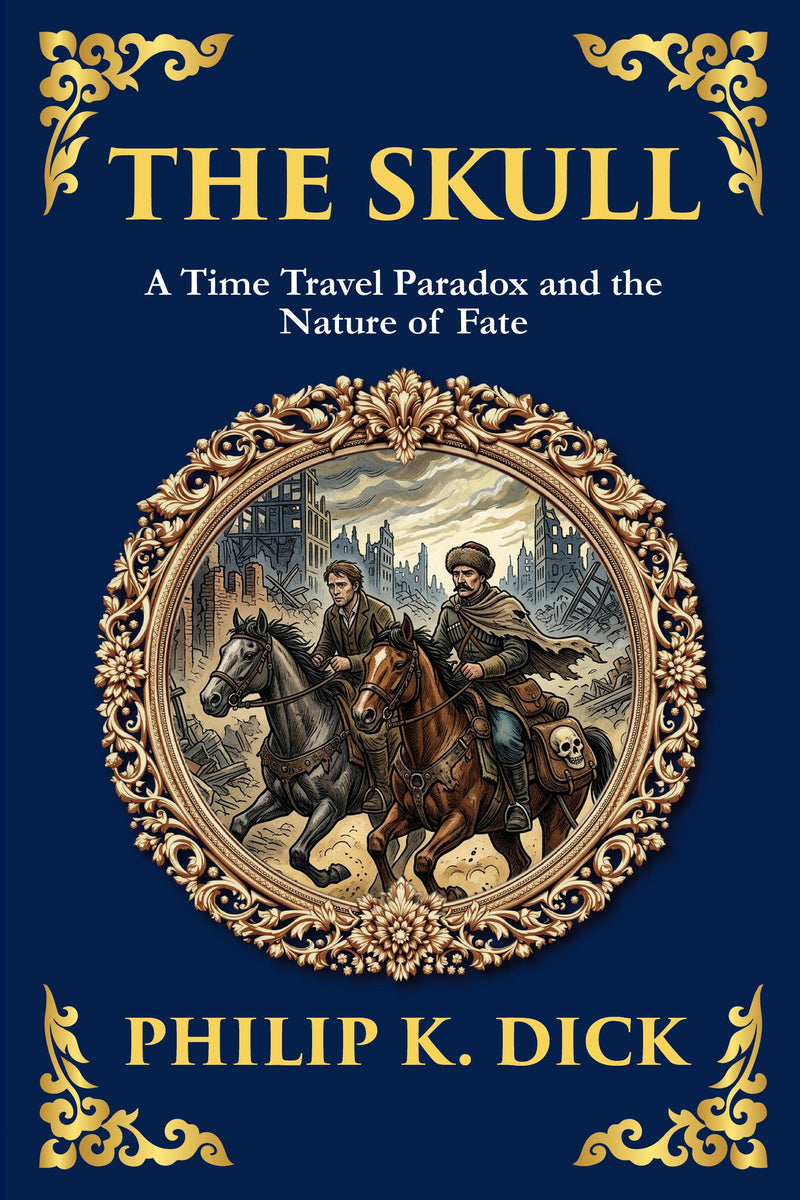
The Skull
In The Skull, Philip K. Dick plunges readers into a haunting time-travel thriller where cause and effect collapse, and fate proves inescapable.
or free app
10,000+ hrs library
30-day guarantee
The complete The Skull appears in modern English through Library of Alexandria Press, available online with audiobook narration included for members.
Have you ever wondered why time travel might not be the escape we imagine—but the trap we never saw coming? In The Skull, legendary science fiction writer Philip K. Dick crafts a razor-sharp short story that asks a timeless question: can we ever escape fate, or are we merely playing out a story already written? Set in a dystopian future where rebellion is crushed and thinkers are feared, the government sends a prisoner back into the past with a single mission—assassinate a man whose teachings are too dangerous to exist.
The twist? That man may be the very key to the prisoner’s own existence. Taut, mind-bending, and rich with philosophical undercurrents, The Skull is a perfect introduction to Dick’s singular vision—where time, identity, and reality are never what they seem.
What you’ll discover in this modern edition
- A Classic Time-Travel Paradox – Explore a mission that spirals into a loop of deadly irony and existential dread
| Formats | eBook (EPUB + PDF) · Audiobook · Paperback · Hardcover · Large Print |
| Language | English |
| Trim size (print) | 6 × 9 in |
| Binding | Paperback — perfect-bound · Hardcover — casewrap |
| Large Print edition | Same text in a larger, easy-read type — a larger font, not a larger trim |
| Print pricing | Every physical book at our true cost — at-cost, no profit (members) |
| Library | 873 restored titles, always growing |
| Length | 11,013 words · ~44 min reading |
| Reading level | Grade 3 · an easy, flowing read (this modern-English edition) |
| Edition | Modern English translation · 2026 |
Member reviews for this edition are collected as readers finish it — be the first. Across the library: 12,000+ books shipped, every plan covered by a 365-day print guarantee.
About this edition
A faithful, unabridged modern-English edition by The Library of Alexandria — carefully rendered for today's reader and verified paragraph-by-paragraph against the public-domain source. Available as eBook, audiobook, paperback, hardcover, and large print.
- Complete & unabridgedVerified paragraph by paragraph against the source — never a scan, never abridged.
- Modern English, faithfulReadable today, with the author’s meaning kept intact. Readable — not simplified.
- Every format, one membershipRead in your browser or the free app, or listen to the full audiobook.
Included free with your membership
Cancel anytime, one click · 30-day money-back guarantee
Edition last updated July 2026
What’s inside
The Skull — complete and unabridged, included in full with membership, plus the full audiobook.
Begin reading The Skull
In clear modern English — the complete text is included with membership.
Introduction
There is a particular kind of story that refuses to let go of the reader long after the final page has been turned. It lodges itself somewhere behind the eyes, surfacing in quiet moments, demanding to be reconsidered, re-examined, turned over and over like a coin found in an old coat pocket. The Skull is precisely this kind of story. Compact yet expansive, deceptively simple yet philosophically vertiginous, it represents an early flowering of one of the most distinctive imaginations American literature has ever produced. To approach it is to step into the workshop of a young writer already wrestling with the enormous questions that would define his entire body of work: What is the nature of time? Can a man escape his destiny, or does the very act of fleeing it deliver him into its arms? And perhaps most hauntingly of all—what happens when the future itself reaches backward to reshape the past?
Philip K. Dick wrote this tale during the most prolific and feverish period of his early career, in the early 1950s, when he was producing short fiction at a pace that now seems almost superhuman. The science fiction magazines of that decade were hungry for stories, and Dick, still in his twenties, was learning his craft in their pages, selling tale after tale to publications that paid modestly and demanded a great deal. Yet even in these early, commercially driven works, the seeds of genius are everywhere visible. The Skull is not the polished, paranoid masterpiece of his later novels—it does not yet carry the full weight of the metaphysical dread that would suffuse Ubik or Do Androids Dream of Electric Sheep?—but it is unmistakably the work of the same mind. The obsessions are already present. The questions are already being asked. And the answers, as always with Dick, are more troubling than reassuring.
This modern translation and adaptation has been prepared with the contemporary reader firmly in mind. The science fiction of the 1950s, for all its imaginative brilliance, was written in a particular idiom—one shaped by the conventions of the pulp magazines, by the assumptions of its era, and by a prose style that, to modern ears, can occasionally feel clipped, dated, or distractingly of its time. The aim here has been to preserve everything that makes the original story sing while gently smoothing the passages that might otherwise pull a reader out of the experience. The voice remains Dick’s. The ideas remain wholly his. What has changed is the accessibility, the flow, the ease with which a reader in our own century can slip into the world he created and stay there, undisturbed, until the story has done its work. This is not a dilution but a clarification—an effort to ensure that the brilliance of the original reaches you as freshly and forcefully as it reached its first readers seven decades ago.
A Young Master and the Birth of an Obsession
To understand why this particular story matters, it helps to understand the man who wrote it and the moment in which he wrote it. Philip Kindred Dick was born in 1928, in Chicago, into circumstances that would later seem almost mythologically significant to those who studied his life. He had a twin sister, Jane, who died in infancy—a loss that haunted him throughout his life and that many critics have identified as a wellspring of his lifelong preoccupation with doubles, with absent presences, with the uncanny sense that reality might be a thin membrane stretched over something far stranger and more frightening. The notion that the world we perceive might not be the world that truly is, that there could be other versions of ourselves and other versions of events lurking just beyond the edge of perception—this idea, which animates so much of his fiction, has roots that reach all the way back to his earliest years.
By the time he came to write the tales of his early period, Dick had already developed the restless, questioning intelligence that would make him one of the most philosophically ambitious writers ever to work in the genre. He was not content, as so many of his contemporaries were, simply to imagine new technologies or to stage adventures among the stars. He wanted to know what these things meant. He wanted to use the apparatus of science fiction—its time machines and its alien worlds and its impossible devices—as instruments for prying open the deepest questions about human existence. What does it mean to be a person? What does it mean to be real? Can we trust our own memories, our own perceptions, our own sense of who we are and where we stand in time?
The 1950s science fiction marketplace was, in many ways, an unlikely setting for such inquiries. The dominant mode was optimistic, technocratic, forward-looking—a literature of problem-solving engineers and confident explorers conquering the frontiers of space and time. Dick worked within this tradition, and he absorbed its conventions, but he was always pulling against it, always introducing a note of doubt, a shadow of unease. Where other writers saw the future as a triumph, he saw it as a riddle, and often as a threat. His protagonists are rarely the square-jawed heroes of the pulp tradition. They are ordinary, fallible, frightened people caught up in machinery they do not understand and cannot control—and this, more than any single idea, is what gives his work its enduring power and its profound humanity.
Time travel, in particular, exercised a powerful fascination over Dick throughout his career, and it is easy to see why. No other premise in science fiction so directly engages the questions that mattered most to him. To travel in time is to confront the nature of causality itself, to test the boundaries of free will, to ask whether the future is fixed or open, whether the past can be changed or whether it stands forever immutable. The time-travel paradox—the logical knot that ties itself when an effect becomes its own cause, when a journey into the past creates the very circumstances that necessitated the journey—is more than a clever puzzle. In Dick’s hands, it becomes a meditation on fate, on the terrifying possibility that we are not the authors of our own lives but merely the players of roles written long before we were born.
This is the territory that The Skull explores, and it does so with a directness and economy that the longer, more elaborate novels could never quite achieve. There is something to be said for the short form, for the way a tightly constructed tale can deliver a single devastating idea with the force of a hammer blow. Dick was a master of the short story, and many of his admirers maintain that his finest work was done at this length, where his prodigious imagination was disciplined by the constraints of the form. Stripped of the digressions and subplots that sometimes cluttered his novels, his short fiction achieves a kind of crystalline purity. Every element serves the central idea. Every scene drives toward the inevitable, the unexpected, the unforgettable conclusion.
What distinguishes Dick from so many of his peers, and what makes him worth reading and rereading even now, is the moral and emotional seriousness he brought to ideas that, in lesser hands, would have remained mere gimmicks. A time-travel paradox is, for many writers, simply a clever trick—a way to surprise the reader, to spring a twist, to demonstrate the author’s ingenuity. For Dick, it was always something more. It was a way of asking whether human beings have any genuine agency in the universe, whether our choices matter, whether we are free or merely fated. These are not idle questions. They are the questions that have occupied philosophers and theologians for millennia, and Dick had the audacity to address them in the pages of pulp magazines, between advertisements for body-building courses and correspondence schools. That he did so with such skill, such feeling, and such lasting resonance is a testament to a talent that the literary establishment of his time largely failed to recognize but that posterity has firmly vindicated.
Without revealing the particulars of the story—for to do so would rob you of the experience that awaits—it is worth dwelling for a moment on the central preoccupation that gives this tale its title and its power. The image of the skull is, of course, one of the oldest and most potent symbols in all of human culture. It is the memento mori, the reminder of death, the grinning emblem of mortality that artists and poets have placed before us for thousands of years to remind us that our time is short and that all flesh ends in the same place. To name a story after a skull is to invoke this entire tradition, to summon the weight of all the contemplations of death that have come before.
But Dick, characteristically, takes this familiar symbol and twists it into something stranger and more disquieting. The skull in this story is not merely a reminder of death in the abstract. It is a specific object, charged with specific meaning, bound up in a chain of events that loops back upon itself in ways that defy ordinary logic. It becomes a kind of fulcrum upon which the entire question of fate and freedom turns. Around it, Dick constructs a narrative machine of remarkable precision, in which past and future are not separate domains but intricately interwoven threads, each pulling upon the other, each shaping and being shaped by the other.
The genius of the construction lies in the way it dramatizes the philosophical problem at its heart. Time-travel stories often founder on the question of paradox—if you go back in time and prevent your own birth, how could you have been there to prevent it in the first place? Many writers simply ignore this difficulty or wave it away with some hand-waving about alternate timelines. Dick does not flinch from it. Instead, he stares directly into the paradox and asks what it would mean for a human being to be caught within it. What would it feel like to discover that your every effort to escape your fate is, in fact, the very mechanism by which that fate is brought about? What would it do to a person to realize that the future is not a blank page to be written but a story already told, in which they are merely an actor reciting lines they did not choose?
This is the existential horror at the center of the tale, and it is rendered all the more affecting by the ordinary humanity of those caught up in it. Dick never lets us forget that the abstract questions of free will and determinism are, for the people experiencing them, intensely personal and intensely painful. The philosophy is never disembodied. It is always lived, always felt, always suffered. This is the great achievement of his fiction—the way he grounds the most cosmic and mind-bending of ideas in the concrete experience of fallible, frightened, recognizable human beings. We do not merely contemplate the paradox of fate as an intellectual exercise. We feel it as a noose tightening around the neck of someone we have come to care about.
The question of fate that runs through this story connects it to a tradition far older than science fiction. The Greek tragedians understood, perhaps better than anyone who has come since, the terrible power of prophecy and the futility of resistance. Oedipus flees the oracle’s prediction only to fulfill it through the very act of fleeing. The harder he struggles against his destiny, the more surely he walks into its grasp. Dick, whether consciously or not, taps into this ancient vein of tragic understanding, transposing it from the world of gods and oracles into the world of time machines and scientific apparatus. The mechanism has changed—prophecy has become physics—but the essential terror remains the same. The future reaches back to claim us, and our struggles to escape it are themselves part of the design.
And yet—and this is crucial to understanding what makes Dick so much more than a purveyor of clever paradoxes—the story does not surrender entirely to fatalism. There is, woven through the despair, a flicker of something else: a stubborn insistence on the value of the human attempt to choose, to act, to matter. Even if the outcome is fixed, the struggle to be free is itself meaningful. Even if we are players in a script we did not write, the way we play our parts is our own. This tension—between the iron logic of determinism and the irreducible human longing for freedom—is never resolved, and that is precisely the point. Dick does not offer answers. He offers the questions, posed with such clarity and force that they become impossible to set aside.
Cancel anytime, one click · 30-day money-back guarantee
Founding annual rate available now — your price locks for life when you join.
Not ready? Get this free chapter by email — read it anytime.
✓ Sent — check your inbox for The Skull.
Questions about The Skull
What is The Skull about?
In The Skull, Philip K. Dick plunges readers into a haunting time-travel thriller where cause and effect collapse, and fate proves inescapable. A convicted criminal is sent back in time to assassinate a man whose ideas have sparked a global revolution—but when he arrives in the past, he finds himself entangled in a loop where killer and martyr may be one and the same. Exploring questions of identity, destiny, and free will, Dick’s story unfolds with chilling precision, blending philosophical insight with taut suspe
Who wrote The Skull?
The Skull was written by Philip K. Dick. This edition presents the complete work in clear modern English, faithfully rendered from the public-domain original by Library of Alexandria Press.
Is The Skull free to read?
The opening chapter is free to read on this page. Members read and listen to the complete work — and the entire library — free, and can order any physical book at our true print cost.
How long is The Skull?
2 chapters (~11,013 words) — about 44 min of reading in this modern-English edition.
Is this an abridged version of The Skull?
No. This is the complete, unabridged The Skull, carefully rendered into clear modern English and verified paragraph-by-paragraph against the public-domain source — nothing is cut or summarised.
What formats does The Skull come in?
The Skull is available as eBook, paperback, hardcover and large print. eBook and audiobook are included with membership; printed editions ship at our true print cost.
Shipping & returns
Billing & membership
More from the library


Explore Science Fiction
- The Island of Doctor Moreau · H. G. Wells
- A Midsummer Night’s Dream · William Shakespeare
- The Invisible Man: A Grotesque Romance · H. G. Wells
- The War of the Worlds · H. G. Wells
- The Strange Case of Dr. Jekyll and Mr. Hyde · Robert Louis Stevenson
- Limanora: the island of progress · Godfrey Sweven
- The Book of Dragons · E. Nesbit
- She · H. Rider Haggard
- Dorothy and the Wizard in Oz · L. Frank Baum
- The Princess and the Goblin · George MacDonald
- Gawayne and the Green Knight: A Fairy Tale · Charlton M. Lewis
- Lucian’s True History · Lucian of Samosata
- The Willows · Algernon Blackwood
- The Call of Cthulhu · H. P. Lovecraft
- The Life-Eater · Harold Ward
- The Marvelous Land of Oz · L. Frank Baum
- Mars is My Destination · Frank Belknap Long
- The Black Kiss
- The Beasts in the Void · Paul W. Fairman
- John Jones’s Dollar · Harry Stephen Keeler
- Subversive · Mack Reynolds
- The Mississippi Saucer · Frank Belknap Long
- Man of Distinction · Michael Shaara
- Spawn of the Comet · H. Thompson Rich
- The Golden Judge · Nathaniel Gordon
- Final Weapon · Everett B. Cole
- The Big Fix · George O. Smith
- Last Enemy · H. Beam Piper
- Time and Time Again · H. Beam Piper
- Sabotage in Space · Carey Rockwell
The Skull
The Skull
A Time Travel Paradox and the Nature of Fate
Philip K. Dick
Contents
- Introduction
- The Skull
Introduction
There is a particular kind of story that refuses to let go of the reader long after the final page has been turned. It lodges itself somewhere behind the eyes, surfacing in quiet moments, demanding to be reconsidered, re-examined, turned over and over like a coin found in an old coat pocket. The Skull is precisely this kind of story. Compact yet expansive, deceptively simple yet philosophically vertiginous, it represents an early flowering of one of the most distinctive imaginations American literature has ever produced. To approach it is to step into the workshop of a young writer already wrestling with the enormous questions that would define his entire body of work: What is the nature of time? Can a man escape his destiny, or does the very act of fleeing it deliver him into its arms? And perhaps most hauntingly of all—what happens when the future itself reaches backward to reshape the past?
Philip K. Dick wrote this tale during the most prolific and feverish period of his early career, in the early 1950s, when he was producing short fiction at a pace that now seems almost superhuman. The science fiction magazines of that decade were hungry for stories, and Dick, still in his twenties, was learning his craft in their pages, selling tale after tale to publications that paid modestly and demanded a great deal. Yet even in these early, commercially driven works, the seeds of genius are everywhere visible. The Skull is not the polished, paranoid masterpiece of his later novels—it does not yet carry the full weight of the metaphysical dread that would suffuse Ubik or Do Androids Dream of Electric Sheep?—but it is unmistakably the work of the same mind. The obsessions are already present. The questions are already being asked. And the answers, as always with Dick, are more troubling than reassuring.
This modern translation and adaptation has been prepared with the contemporary reader firmly in mind. The science fiction of the 1950s, for all its imaginative brilliance, was written in a particular idiom—one shaped by the conventions of the pulp magazines, by the assumptions of its era, and by a prose style that, to modern ears, can occasionally feel clipped, dated, or distractingly of its time. The aim here has been to preserve everything that makes the original story sing while gently smoothing the passages that might otherwise pull a reader out of the experience. The voice remains Dick’s. The ideas remain wholly his. What has changed is the accessibility, the flow, the ease with which a reader in our own century can slip into the world he created and stay there, undisturbed, until the story has done its work. This is not a dilution but a clarification—an effort to ensure that the brilliance of the original reaches you as freshly and forcefully as it reached its first readers seven decades ago.
A Young Master and the Birth of an Obsession
To understand why this particular story matters, it helps to understand the man who wrote it and the moment in which he wrote it. Philip Kindred Dick was born in 1928, in Chicago, into circumstances that would later seem almost mythologically significant to those who studied his life. He had a twin sister, Jane, who died in infancy—a loss that haunted him throughout his life and that many critics have identified as a wellspring of his lifelong preoccupation with doubles, with absent presences, with the uncanny sense that reality might be a thin membrane stretched over something far stranger and more frightening. The notion that the world we perceive might not be the world that truly is, that there could be other versions of ourselves and other versions of events lurking just beyond the edge of perception—this idea, which animates so much of his fiction, has roots that reach all the way back to his earliest years.
By the time he came to write the tales of his early period, Dick had already developed the restless, questioning intelligence that would make him one of the most philosophically ambitious writers ever to work in the genre. He was not content, as so many of his contemporaries were, simply to imagine new technologies or to stage adventures among the stars. He wanted to know what these things meant. He wanted to use the apparatus of science fiction—its time machines and its alien worlds and its impossible devices—as instruments for prying open the deepest questions about human existence. What does it mean to be a person? What does it mean to be real? Can we trust our own memories, our own perceptions, our own sense of who we are and where we stand in time?
The 1950s science fiction marketplace was, in many ways, an unlikely setting for such inquiries. The dominant mode was optimistic, technocratic, forward-looking—a literature of problem-solving engineers and confident explorers conquering the frontiers of space and time. Dick worked within this tradition, and he absorbed its conventions, but he was always pulling against it, always introducing a note of doubt, a shadow of unease. Where other writers saw the future as a triumph, he saw it as a riddle, and often as a threat. His protagonists are rarely the square-jawed heroes of the pulp tradition. They are ordinary, fallible, frightened people caught up in machinery they do not understand and cannot control—and this, more than any single idea, is what gives his work its enduring power and its profound humanity.
Time travel, in particular, exercised a powerful fascination over Dick throughout his career, and it is easy to see why. No other premise in science fiction so directly engages the questions that mattered most to him. To travel in time is to confront the nature of causality itself, to test the boundaries of free will, to ask whether the future is fixed or open, whether the past can be changed or whether it stands forever immutable. The time-travel paradox—the logical knot that ties itself when an effect becomes its own cause, when a journey into the past creates the very circumstances that necessitated the journey—is more than a clever puzzle. In Dick’s hands, it becomes a meditation on fate, on the terrifying possibility that we are not the authors of our own lives but merely the players of roles written long before we were born.
This is the territory that The Skull explores, and it does so with a directness and economy that the longer, more elaborate novels could never quite achieve. There is something to be said for the short form, for the way a tightly constructed tale can deliver a single devastating idea with the force of a hammer blow. Dick was a master of the short story, and many of his admirers maintain that his finest work was done at this length, where his prodigious imagination was disciplined by the constraints of the form. Stripped of the digressions and subplots that sometimes cluttered his novels, his short fiction achieves a kind of crystalline purity. Every element serves the central idea. Every scene drives toward the inevitable, the unexpected, the unforgettable conclusion.
What distinguishes Dick from so many of his peers, and what makes him worth reading and rereading even now, is the moral and emotional seriousness he brought to ideas that, in lesser hands, would have remained mere gimmicks. A time-travel paradox is, for many writers, simply a clever trick—a way to surprise the reader, to spring a twist, to demonstrate the author’s ingenuity. For Dick, it was always something more. It was a way of asking whether human beings have any genuine agency in the universe, whether our choices matter, whether we are free or merely fated. These are not idle questions. They are the questions that have occupied philosophers and theologians for millennia, and Dick had the audacity to address them in the pages of pulp magazines, between advertisements for body-building courses and correspondence schools. That he did so with such skill, such feeling, and such lasting resonance is a testament to a talent that the literary establishment of his time largely failed to recognize but that posterity has firmly vindicated.
Without revealing the particulars of the story—for to do so would rob you of the experience that awaits—it is worth dwelling for a moment on the central preoccupation that gives this tale its title and its power. The image of the skull is, of course, one of the oldest and most potent symbols in all of human culture. It is the memento mori, the reminder of death, the grinning emblem of mortality that artists and poets have placed before us for thousands of years to remind us that our time is short and that all flesh ends in the same place. To name a story after a skull is to invoke this entire tradition, to summon the weight of all the contemplations of death that have come before.
But Dick, characteristically, takes this familiar symbol and twists it into something stranger and more disquieting. The skull in this story is not merely a reminder of death in the abstract. It is a specific object, charged with specific meaning, bound up in a chain of events that loops back upon itself in ways that defy ordinary logic. It becomes a kind of fulcrum upon which the entire question of fate and freedom turns. Around it, Dick constructs a narrative machine of remarkable precision, in which past and future are not separate domains but intricately interwoven threads, each pulling upon the other, each shaping and being shaped by the other.
The genius of the construction lies in the way it dramatizes the philosophical problem at its heart. Time-travel stories often founder on the question of paradox—if you go back in time and prevent your own birth, how could you have been there to prevent it in the first place? Many writers simply ignore this difficulty or wave it away with some hand-waving about alternate timelines. Dick does not flinch from it. Instead, he stares directly into the paradox and asks what it would mean for a human being to be caught within it. What would it feel like to discover that your every effort to escape your fate is, in fact, the very mechanism by which that fate is brought about? What would it do to a person to realize that the future is not a blank page to be written but a story already told, in which they are merely an actor reciting lines they did not choose?
This is the existential horror at the center of the tale, and it is rendered all the more affecting by the ordinary humanity of those caught up in it. Dick never lets us forget that the abstract questions of free will and determinism are, for the people experiencing them, intensely personal and intensely painful. The philosophy is never disembodied. It is always lived, always felt, always suffered. This is the great achievement of his fiction—the way he grounds the most cosmic and mind-bending of ideas in the concrete experience of fallible, frightened, recognizable human beings. We do not merely contemplate the paradox of fate as an intellectual exercise. We feel it as a noose tightening around the neck of someone we have come to care about.
The question of fate that runs through this story connects it to a tradition far older than science fiction. The Greek tragedians understood, perhaps better than anyone who has come since, the terrible power of prophecy and the futility of resistance. Oedipus flees the oracle’s prediction only to fulfill it through the very act of fleeing. The harder he struggles against his destiny, the more surely he walks into its grasp. Dick, whether consciously or not, taps into this ancient vein of tragic understanding, transposing it from the world of gods and oracles into the world of time machines and scientific apparatus. The mechanism has changed—prophecy has become physics—but the essential terror remains the same. The future reaches back to claim us, and our struggles to escape it are themselves part of the design.
And yet—and this is crucial to understanding what makes Dick so much more than a purveyor of clever paradoxes—the story does not surrender entirely to fatalism. There is, woven through the despair, a flicker of something else: a stubborn insistence on the value of the human attempt to choose, to act, to matter. Even if the outcome is fixed, the struggle to be free is itself meaningful. Even if we are players in a script we did not write, the way we play our parts is our own. This tension—between the iron logic of determinism and the irreducible human longing for freedom—is never resolved, and that is precisely the point. Dick does not offer answers. He offers the questions, posed with such clarity and force that they become impossible to set aside.
“What is this opportunity?” Conger asked. “Go on. I’m interested.”
The room went silent. Everyone stared at Conger, who was still wearing his drab prison uniform. The Speaker slowly leaned forward.
“Before you went to prison, your trading business was doing well—it was all illegal, and very profitable. Now you have nothing, except the prospect of spending another six years in a cell.”
“There is a situation, very important to this Council, that requires your specific skills. Also, it’s a job you might find interesting. You were a hunter, weren’t you? You’ve spent a lot of time trapping, hiding in the bushes, and waiting at night for your prey. I imagine you find hunting satisfying—the chase, the stalking—“
Conger sighed, his lips curling. “All right,” he said. “Skip that part and get to the point. Who do you want me to kill?”
The Speaker smiled. “Everything in its own time,” he said softly.
The car slid to a stop. It was night, and the street was completely dark. Conger looked out. “Where are we? What is this place?”
The guard gripped his arm. “Come on. Through that door.”
Conger stepped out onto the damp sidewalk. The guard followed quickly, then the Speaker. Conger took a deep breath of the cold air and studied the dim outline of the building rising in front of them.
“I know this place. I’ve seen it before.” He squinted as his eyes adjusted to the dark. Suddenly, he froze. “This is—“
“Yes. The First Church.” The Speaker walked toward the steps. “They’re expecting us.”
“Yes.” The Speaker climbed the stairs. “You know we aren’t allowed in their churches, especially with guns!” He stopped. Two armed soldiers appeared ahead, one on each side.
End of the free sample
Keep reading, free
Members read and listen to the complete book — and the entire library. Cancel anytime, one click · 30-day money-back guarantee.