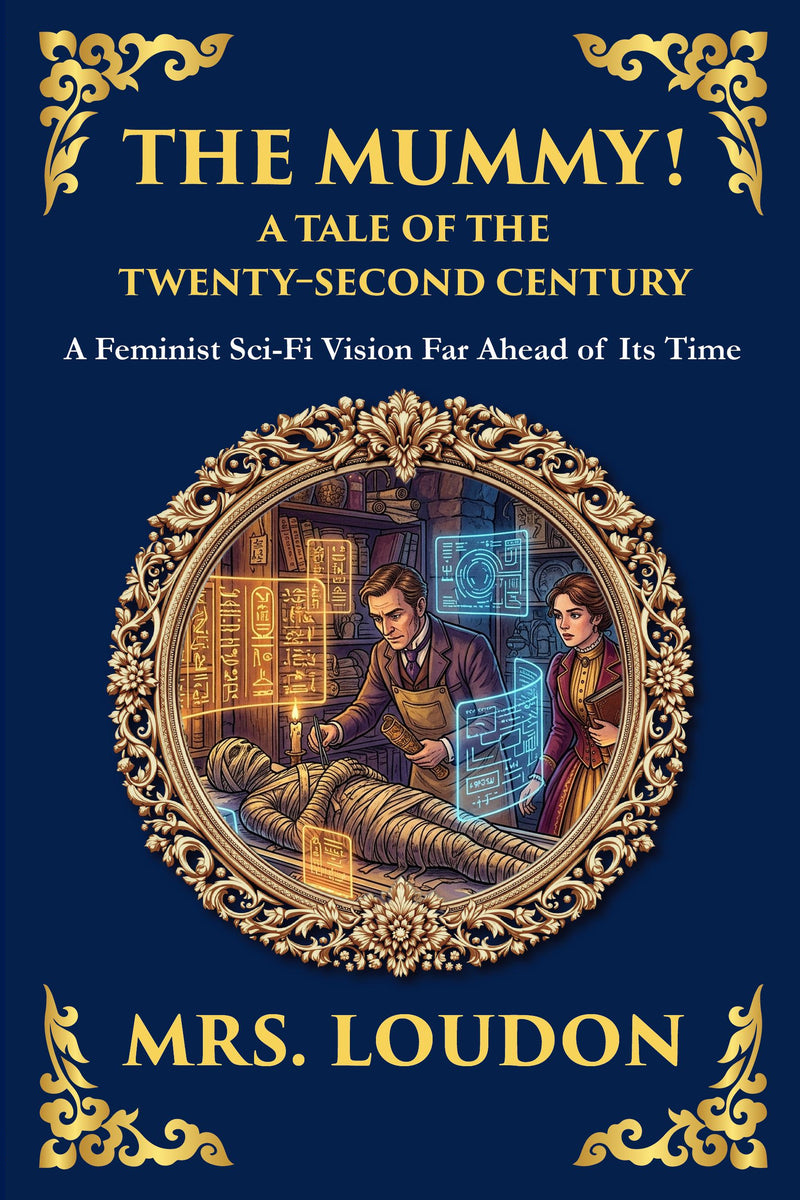
The Mummy! A Tale of the Twenty-Second Century
Jane C. Loudon Published in 1827, The Mummy! A Tale of the Twenty-Second Century is one of the earliest works of science fiction—and a startlingly visionary one.
or free app
10,000+ hrs library
30-day guarantee
The complete The Mummy! A Tale of the Twenty-Second Century appears in modern English through Library of Alexandria Press, available online with audiobook narration included for members.
Have you ever wondered why the future imagined by the past often reveals more about us than it does about tomorrow? Before Mary Shelley’s Frankenstein had yet defined the genre, Jane C. Loudon broke new ground with The Mummy! A Tale of the Twenty-Second Century—a speculative masterpiece written in 1827 that astonishingly predicts the future of science, politics, and gender.
Set in a richly imagined 22nd-century Europe, the story follows the political fallout and social upheaval after the sudden reawakening of Cheops, a wise and philosophical mummy. Unlike the monstrous depictions common in later pulp fiction, Cheops becomes a voice of ancient wisdom in a world run amok with power struggles, court corruption, and societal confusion. But what makes this novel truly exceptional is its portrayal of women: they vote, govern, invent, and challenge societal roles—making The Mummy! one of the earliest feminist works of science fiction.
Inside this visionary tale, you’ll discover: A Reanimated Mummy as Moral Philosopher – Far from a horror villain, Cheops offers ancient insight into a misguided future. Technologies of Tomorrow – From AI-like governance to video conferencing and weather control, Loudon’s predictions astound. Feminism Before Its Time – Female politicians, leaders, and thinkers command the story in a world radically reimagined. Dystopia Meets Satire – Court drama, royal intrigue, and biting commentary on political excess. A Forgotten Sci-Fi Pioneer – Rediscover a foundational voice in speculative fiction, long overshadowed but never outshone. This beautifully restored edition of The Mummy! brings Jane Loudon's trailblazing ideas to a new generation of readers ready to explore speculative fiction that’s not just imaginative—but prophetic.
What you’ll discover in this modern edition
- A reawakened Cheops the Mummy, who brings ancient wisdom to a fractured future
- A 22nd-century society filled with technology, intrigue, and rebellion
| Formats | eBook (EPUB + PDF) · Audiobook · Paperback · Hardcover · Large Print |
| Language | English |
| Trim size (print) | 6 × 9 in |
| Binding | Paperback — perfect-bound · Hardcover — casewrap |
| Large Print edition | Same text in a larger, easy-read type — a larger font, not a larger trim |
| Print pricing | Every physical book at our true cost — at-cost, no profit (members) |
| Library | 873 restored titles, always growing |
| Length | 153,875 words · ~10 hr 16 min reading |
| Reading level | Grade 5 · an easy, flowing read (this modern-English edition) |
| Edition | Modern English translation · 2026 |
Member reviews for this edition are collected as readers finish it — be the first. Across the library: 12,000+ books shipped, every plan covered by a 365-day print guarantee.
About this edition
A faithful, unabridged modern-English edition by The Library of Alexandria — carefully rendered for today's reader and verified paragraph-by-paragraph against the public-domain source. Available as eBook, audiobook, paperback, hardcover, and large print.
- Complete & unabridgedVerified paragraph by paragraph against the source — never a scan, never abridged.
- Modern English, faithfulReadable today, with the author’s meaning kept intact. Readable — not simplified.
- Every format, one membershipRead in your browser or the free app, or listen to the full audiobook.
Included free with your membership
Cancel anytime, one click · 30-day money-back guarantee
Edition last updated July 2026
What’s inside
The Mummy! A Tale of the Twenty-Second Century — complete and unabridged: all 34 sections included with membership, plus the full audiobook.
Begin reading The Mummy! A Tale of the Twenty-Second Century
In clear modern English — the complete text is included with membership.
Introduction
Imagine, for a moment, a young woman in her early twenties, recently orphaned, seated at a writing desk in late-1820s England, dipping her pen into the ink and beginning to describe a world more than three centuries distant from her own. She does not write of the familiar comforts of her age — of carriages, of candlelit drawing rooms, of the slow rhythms of agrarian life. Instead, she conjures into being a twenty-second-century civilization buzzing with mechanical wonders, propelled by forces her contemporaries could scarcely have dreamed of, and governed by structures and customs as alien to her readers as they would be to us. That young woman was Jane Webb, who would soon become Mrs. Loudon, and the extraordinary work she produced is the novel you now hold in your hands.
This is a book that defies easy categorization, and that defiance is precisely its charm. Published anonymously in 1827, it predates by half a decade the more famous flourishing of Victorian fiction and stands as one of the earliest and most audacious experiments in what we would today call science fiction. It is a work of speculative imagination, of social satire, of gothic horror, of romance, and of political philosophy, all braided together with a youthful exuberance and a restless intelligence that never quite settles into a single mode. To read it is to encounter a mind unbound by convention, delighting in the freedom that fiction affords to ask the largest of questions: What might the future look like? What will we become? And what, in the end, does it mean to be human in a world transformed beyond recognition?
The premise alone is enough to startle. In the twenty-second century, a resurrected Egyptian pharaoh — Cheops himself, builder of the Great Pyramid — is brought back to a kind of life and finds himself moving through a Europe utterly unlike anything he or his original era could have imagined. But to summarize the plot in such bare terms is to do the book a disservice, for the resurrection that gives the novel its arresting title is only the doorway through which the reader enters a vast and intricate world. What follows is a sweeping tapestry of court intrigue, dynastic struggle, romantic entanglement, and philosophical reflection, all rendered with an energy that carries the reader forward even when the path twists in unexpected directions. I will say nothing here that would spoil the surprises and reversals that await you, for half the pleasure of this novel lies in its sheer unpredictability, in never quite knowing what the author will dare to imagine next.
What I can tell you is that this is a book of astonishing prophetic vision. Long before the technologies she describes became even remotely possible, Mrs. Loudon imagined a future filled with inventions that read today as uncanny anticipations of our own world. She wrote of automated machinery performing the labor once done by human hands, of rapid mechanical transport across great distances, of a kind of instantaneous long-distance communication, and of medical and surgical advances that would have seemed pure sorcery to her readers. There are passages here that anticipate the espresso machine, the air-conditioned interior, mechanized agriculture, and forms of mass communication that would not exist for well over a century. None of this is presented with the dry precision of a technical manual; rather, these wonders are woven into the fabric of daily life in her imagined future, treated as ordinary furniture of a world that has simply moved on. That casual confidence — the refusal to marvel overmuch at her own inventions — is one of the marks of a true visionary, and it lends the novel a texture that feels remarkably modern.
To understand the singular achievement of this novel, it helps to understand something of the woman who wrote it, for her life was nearly as remarkable as the future she imagined. Jane Webb was born in 1807 near Birmingham, the daughter of a manufacturer who had made and then lost a considerable fortune. Her early years were comfortable, marked by travel and education, but the death of her father when she was seventeen left her in straitened circumstances and forced her to confront the hard reality faced by so many women of her age: she would need to support herself, and the avenues open to her were painfully narrow. She turned to her pen, and the result was this audacious three-volume novel, written and published when she was scarcely twenty years old.
The decision to write anonymously was both prudent and revealing. A young woman publishing a wild tale of resurrected pharaohs and futuristic machinery in the 1820s could hardly expect to be taken seriously, and indeed many of her first readers assumed the author to be a man. This assumption itself is worth pausing over, because it tells us something about the boldness of the imaginative leap she had made. The realm of speculative technological fantasy was presumed to be masculine territory, and the fact that a woman had ventured into it — and done so with such confidence and inventive flair — was itself a quiet act of defiance.
But the most extraordinary turn in this story came after publication. Among the novel’s admirers was a man named John Claudius Loudon, a prominent and influential landscape gardener and horticultural writer. He was so taken with the book’s vivid descriptions of futuristic gardening and agricultural machinery — for the author had imagined steam-powered ploughs and mechanized cultivation with startling specificity — that he sought out its author, fully expecting to meet a gentleman of scientific bent. When he discovered that the visionary mind behind these inventions belonged to a young woman, he was, by all accounts, charmed rather than scandalized. The two were introduced in 1830 and married the following year. Thus the novel quite literally shaped the course of its author’s life, drawing to her the very man who would become her husband and collaborator.
Their marriage was a genuine partnership of intellect and industry. Mrs. Loudon went on to become one of the most successful and influential garden writers of the nineteenth century in her own right, producing a stream of immensely popular books on horticulture and botany aimed at ordinary readers, particularly women. She demystified the science of gardening, made it accessible, and helped transform it into a respectable and beloved pursuit for the middle classes. In this sense, the practical, future-oriented imagination that animates this novel — its fascination with how technology might improve daily life, how knowledge might be democratized, how the future might be made better than the past — was no mere literary affectation. It was the consistent thread running through her entire life’s work.
Knowing this biography enriches the reading of the novel immeasurably. The futuristic agricultural machinery is not incidental detail; it springs from the same mind that would later revolutionize popular horticulture. The vision of a society reorganized along more rational and humane lines reflects a genuine reformist impulse. And the prominence of capable, intelligent, and ambitious female characters in the story — women who scheme, govern, love, and sometimes destroy, who occupy positions of real power and consequence — reflects the perspective of a woman who refused to accept the constricted role her society had marked out for her. This is why the subtitle rightly calls the work a feminist vision far ahead of its time. Mrs. Loudon did not write polemics about women’s rights; instead, she did something subtler and in some ways more powerful. She simply imagined a future in which women’s capacity for leadership, intellect, and decisive action was taken for granted, woven into the very structure of her speculative world. In her twenty-second century, queens rule, women maneuver through the corridors of power, and the question of female competence is not so much argued as assumed.
It is worth dwelling on just how unusual this was. When Mrs. Loudon was writing, the conventions governing female characters in fiction were rigid and confining. Women were to be virtuous, passive, decorative, and ultimately defined by their relationships to men. The novel you are about to read shatters these conventions with cheerful abandon. Its female characters are flawed and formidable, driven by their own desires and ambitions, capable of great virtue and great villainy alike. They are, in short, fully realized human beings rather than the cardboard ideals that populated so much fiction of the period. That a woman barely out of her teens had the imaginative courage to write such characters, and to set them loose in a meticulously imagined future world, remains genuinely astonishing nearly two centuries later.
One of the great pleasures of this novel lies in the sheer density and ingenuity of its world-building. Mrs. Loudon did not content herself with sketching a few futuristic gadgets and leaving the rest of her world recognizably contemporary. Instead, she imagined a comprehensive transformation of society — its politics, its fashions, its religions, its customs, its very rhythms of life. England in her twenty-second century is a place of marvels and absurdities, of grand technological achievement and peculiar social arrangement, and the author takes evident delight in showing us how the familiar has been made strange by the passage of time.
There is a wicked satirical edge to much of this. Like many writers who project their imaginations into the future, Mrs. Loudon used her speculative world as a mirror in which to reflect and gently mock the foibles of her own age. The fashions of her future are deliberately preposterous, the social conventions exaggerated to the point of comedy, the political arrangements both visionary and faintly ridiculous. She understood, as the best science fiction writers always have, that the future is a wonderful place from which to comment on the present. When she describes the elaborate and impractical clothing of her future aristocrats, or the byzantine customs governing courtship and marriage, or the curious religious and intellectual currents of her imagined era, she is holding a funhouse mirror up to the England of the 1820s and inviting her readers to laugh at themselves.
Yet the satire never overwhelms the genuine sense of wonder. There is real beauty in Mrs. Loudon’s vision of a transformed world, real excitement in her descriptions of human ingenuity triumphant. She imagined cities reshaped by technology, transport made swift and effortless, the rhythms of labor altered by mechanization, and the boundaries of human knowledge pushed ever outward. Her future is not a utopia — far from it, for she was too clear-eyed to believe that technology alone could perfect human nature — but it is a future in which the human capacity for invention and improvement has been given full rein. The result is a world that feels alive, detailed, and internally coherent in a way that few works of this early period managed to achieve.
The presence of the resurrected pharaoh at the center of this world adds a dimension of profound strangeness and depth. Here is a figure from the most ancient past thrust into the most distant future, a being who has seen empires rise and crumble, who carries within him the wisdom and the weariness of millennia. The juxtaposition of the ancient and the futuristic is one of the novel’s most striking and original conceits, and it allows Mrs. Loudon to explore questions of mortality, ambition, power, and the cyclical nature of human civilization. What does the past have to teach the future? Are the follies of one age destined to be repeated in the next? Can wisdom truly be passed down across the gulf of time, or is each generation doomed to learn its lessons anew? These weighty questions hover beneath the surface of the novel’s more immediate excitements, giving it a resonance that lingers long after the last page is turned.
Cancel anytime, one click · 30-day money-back guarantee
Founding annual rate available now — your price locks for life when you join.
Not ready? Get this free chapter by email — read it anytime.
✓ Sent — check your inbox for The Mummy! A Tale of the Twenty-Second Century.
Questions about The Mummy! A Tale of the Twenty-Second Century
What is The Mummy! A Tale of the Twenty-Second Century about?
Jane C. Loudon Published in 1827, The Mummy! A Tale of the Twenty-Second Century is one of the earliest works of science fiction—and a startlingly visionary one. Written by Jane C. Loudon (then known simply as “Mrs.
Who wrote The Mummy! A Tale of the Twenty-Second Century?
The Mummy! A Tale of the Twenty-Second Century was written by Mrs. Loudon. This edition presents the complete work in clear modern English, faithfully rendered from the public-domain original by Library of Alexandria Press.
Is The Mummy! A Tale of the Twenty-Second Century free to read?
The opening chapter is free to read on this page. Members read and listen to the complete work — and the entire library — free, and can order any physical book at our true print cost.
How long is The Mummy! A Tale of the Twenty-Second Century?
34 chapters (~153,875 words) — about 10 hr 16 min of reading in this modern-English edition.
Is this an abridged version of The Mummy! A Tale of the Twenty-Second Century?
No. This is the complete, unabridged The Mummy! A Tale of the Twenty-Second Century, carefully rendered into clear modern English and verified paragraph-by-paragraph against the public-domain source — nothing is cut or summarised.
What formats does The Mummy! A Tale of the Twenty-Second Century come in?
The Mummy! A Tale of the Twenty-Second Century is available as eBook, paperback, hardcover and large print. eBook and audiobook are included with membership; printed editions ship at our true print cost.
Shipping & returns
Billing & membership
More from the library


Explore Science Fiction
- The Island of Doctor Moreau · H. G. Wells
- A Midsummer Night’s Dream · William Shakespeare
- The Invisible Man: A Grotesque Romance · H. G. Wells
- The War of the Worlds · H. G. Wells
- The Strange Case of Dr. Jekyll and Mr. Hyde · Robert Louis Stevenson
- Limanora: the island of progress · Godfrey Sweven
- The Book of Dragons · E. Nesbit
- She · H. Rider Haggard
- Dorothy and the Wizard in Oz · L. Frank Baum
- The Princess and the Goblin · George MacDonald
- Gawayne and the Green Knight: A Fairy Tale · Charlton M. Lewis
- Lucian’s True History · Lucian of Samosata
- The Willows · Algernon Blackwood
- The Call of Cthulhu · H. P. Lovecraft
- The Life-Eater · Harold Ward
- The Marvelous Land of Oz · L. Frank Baum
- Mars is My Destination · Frank Belknap Long
- The Black Kiss
- The Beasts in the Void · Paul W. Fairman
- John Jones’s Dollar · Harry Stephen Keeler
- Subversive · Mack Reynolds
- The Mississippi Saucer · Frank Belknap Long
- Man of Distinction · Michael Shaara
- Spawn of the Comet · H. Thompson Rich
- The Golden Judge · Nathaniel Gordon
- Final Weapon · Everett B. Cole
- The Big Fix · George O. Smith
- Last Enemy · H. Beam Piper
- Time and Time Again · H. Beam Piper
- Sabotage in Space · Carey Rockwell
The Mummy! A Tale of the Twenty-Second Century
The Mummy! A Tale of the Twenty-Second Century
A Feminist Sci-Fi Vision Far Ahead of Its Time
Mrs. Loudon
Contents
- Introduction
- Preface by the Author
- Chapter 1
- Chapter 2
- Chapter 3
- Chapter 4
- Chapter 5
- Chapter 6
- Chapter 7
- Chapter 8
- Chapter 9
- Chapter 10
- Chapter 11
- Chapter 12
- Chapter 13
- Chapter 14
- Chapter 15
- Chapter 16
- Chapter 17
- Chapter 18
- Chapter 19
- Chapter 20
- Chapter 21
- Chapter 22
- Chapter 23
- Chapter 24
- Chapter 25
- Chapter 26
- Chapter 27
- Chapter 28
- Chapter 29
- Chapter 30
- Chapter 31
- Chapter 32
Introduction
Imagine, for a moment, a young woman in her early twenties, recently orphaned, seated at a writing desk in late-1820s England, dipping her pen into the ink and beginning to describe a world more than three centuries distant from her own. She does not write of the familiar comforts of her age — of carriages, of candlelit drawing rooms, of the slow rhythms of agrarian life. Instead, she conjures into being a twenty-second-century civilization buzzing with mechanical wonders, propelled by forces her contemporaries could scarcely have dreamed of, and governed by structures and customs as alien to her readers as they would be to us. That young woman was Jane Webb, who would soon become Mrs. Loudon, and the extraordinary work she produced is the novel you now hold in your hands.
This is a book that defies easy categorization, and that defiance is precisely its charm. Published anonymously in 1827, it predates by half a decade the more famous flourishing of Victorian fiction and stands as one of the earliest and most audacious experiments in what we would today call science fiction. It is a work of speculative imagination, of social satire, of gothic horror, of romance, and of political philosophy, all braided together with a youthful exuberance and a restless intelligence that never quite settles into a single mode. To read it is to encounter a mind unbound by convention, delighting in the freedom that fiction affords to ask the largest of questions: What might the future look like? What will we become? And what, in the end, does it mean to be human in a world transformed beyond recognition?
The premise alone is enough to startle. In the twenty-second century, a resurrected Egyptian pharaoh — Cheops himself, builder of the Great Pyramid — is brought back to a kind of life and finds himself moving through a Europe utterly unlike anything he or his original era could have imagined. But to summarize the plot in such bare terms is to do the book a disservice, for the resurrection that gives the novel its arresting title is only the doorway through which the reader enters a vast and intricate world. What follows is a sweeping tapestry of court intrigue, dynastic struggle, romantic entanglement, and philosophical reflection, all rendered with an energy that carries the reader forward even when the path twists in unexpected directions. I will say nothing here that would spoil the surprises and reversals that await you, for half the pleasure of this novel lies in its sheer unpredictability, in never quite knowing what the author will dare to imagine next.
What I can tell you is that this is a book of astonishing prophetic vision. Long before the technologies she describes became even remotely possible, Mrs. Loudon imagined a future filled with inventions that read today as uncanny anticipations of our own world. She wrote of automated machinery performing the labor once done by human hands, of rapid mechanical transport across great distances, of a kind of instantaneous long-distance communication, and of medical and surgical advances that would have seemed pure sorcery to her readers. There are passages here that anticipate the espresso machine, the air-conditioned interior, mechanized agriculture, and forms of mass communication that would not exist for well over a century. None of this is presented with the dry precision of a technical manual; rather, these wonders are woven into the fabric of daily life in her imagined future, treated as ordinary furniture of a world that has simply moved on. That casual confidence — the refusal to marvel overmuch at her own inventions — is one of the marks of a true visionary, and it lends the novel a texture that feels remarkably modern.
To understand the singular achievement of this novel, it helps to understand something of the woman who wrote it, for her life was nearly as remarkable as the future she imagined. Jane Webb was born in 1807 near Birmingham, the daughter of a manufacturer who had made and then lost a considerable fortune. Her early years were comfortable, marked by travel and education, but the death of her father when she was seventeen left her in straitened circumstances and forced her to confront the hard reality faced by so many women of her age: she would need to support herself, and the avenues open to her were painfully narrow. She turned to her pen, and the result was this audacious three-volume novel, written and published when she was scarcely twenty years old.
The decision to write anonymously was both prudent and revealing. A young woman publishing a wild tale of resurrected pharaohs and futuristic machinery in the 1820s could hardly expect to be taken seriously, and indeed many of her first readers assumed the author to be a man. This assumption itself is worth pausing over, because it tells us something about the boldness of the imaginative leap she had made. The realm of speculative technological fantasy was presumed to be masculine territory, and the fact that a woman had ventured into it — and done so with such confidence and inventive flair — was itself a quiet act of defiance.
But the most extraordinary turn in this story came after publication. Among the novel’s admirers was a man named John Claudius Loudon, a prominent and influential landscape gardener and horticultural writer. He was so taken with the book’s vivid descriptions of futuristic gardening and agricultural machinery — for the author had imagined steam-powered ploughs and mechanized cultivation with startling specificity — that he sought out its author, fully expecting to meet a gentleman of scientific bent. When he discovered that the visionary mind behind these inventions belonged to a young woman, he was, by all accounts, charmed rather than scandalized. The two were introduced in 1830 and married the following year. Thus the novel quite literally shaped the course of its author’s life, drawing to her the very man who would become her husband and collaborator.
Their marriage was a genuine partnership of intellect and industry. Mrs. Loudon went on to become one of the most successful and influential garden writers of the nineteenth century in her own right, producing a stream of immensely popular books on horticulture and botany aimed at ordinary readers, particularly women. She demystified the science of gardening, made it accessible, and helped transform it into a respectable and beloved pursuit for the middle classes. In this sense, the practical, future-oriented imagination that animates this novel — its fascination with how technology might improve daily life, how knowledge might be democratized, how the future might be made better than the past — was no mere literary affectation. It was the consistent thread running through her entire life’s work.
Knowing this biography enriches the reading of the novel immeasurably. The futuristic agricultural machinery is not incidental detail; it springs from the same mind that would later revolutionize popular horticulture. The vision of a society reorganized along more rational and humane lines reflects a genuine reformist impulse. And the prominence of capable, intelligent, and ambitious female characters in the story — women who scheme, govern, love, and sometimes destroy, who occupy positions of real power and consequence — reflects the perspective of a woman who refused to accept the constricted role her society had marked out for her. This is why the subtitle rightly calls the work a feminist vision far ahead of its time. Mrs. Loudon did not write polemics about women’s rights; instead, she did something subtler and in some ways more powerful. She simply imagined a future in which women’s capacity for leadership, intellect, and decisive action was taken for granted, woven into the very structure of her speculative world. In her twenty-second century, queens rule, women maneuver through the corridors of power, and the question of female competence is not so much argued as assumed.
It is worth dwelling on just how unusual this was. When Mrs. Loudon was writing, the conventions governing female characters in fiction were rigid and confining. Women were to be virtuous, passive, decorative, and ultimately defined by their relationships to men. The novel you are about to read shatters these conventions with cheerful abandon. Its female characters are flawed and formidable, driven by their own desires and ambitions, capable of great virtue and great villainy alike. They are, in short, fully realized human beings rather than the cardboard ideals that populated so much fiction of the period. That a woman barely out of her teens had the imaginative courage to write such characters, and to set them loose in a meticulously imagined future world, remains genuinely astonishing nearly two centuries later.
One of the great pleasures of this novel lies in the sheer density and ingenuity of its world-building. Mrs. Loudon did not content herself with sketching a few futuristic gadgets and leaving the rest of her world recognizably contemporary. Instead, she imagined a comprehensive transformation of society — its politics, its fashions, its religions, its customs, its very rhythms of life. England in her twenty-second century is a place of marvels and absurdities, of grand technological achievement and peculiar social arrangement, and the author takes evident delight in showing us how the familiar has been made strange by the passage of time.
There is a wicked satirical edge to much of this. Like many writers who project their imaginations into the future, Mrs. Loudon used her speculative world as a mirror in which to reflect and gently mock the foibles of her own age. The fashions of her future are deliberately preposterous, the social conventions exaggerated to the point of comedy, the political arrangements both visionary and faintly ridiculous. She understood, as the best science fiction writers always have, that the future is a wonderful place from which to comment on the present. When she describes the elaborate and impractical clothing of her future aristocrats, or the byzantine customs governing courtship and marriage, or the curious religious and intellectual currents of her imagined era, she is holding a funhouse mirror up to the England of the 1820s and inviting her readers to laugh at themselves.
Yet the satire never overwhelms the genuine sense of wonder. There is real beauty in Mrs. Loudon’s vision of a transformed world, real excitement in her descriptions of human ingenuity triumphant. She imagined cities reshaped by technology, transport made swift and effortless, the rhythms of labor altered by mechanization, and the boundaries of human knowledge pushed ever outward. Her future is not a utopia — far from it, for she was too clear-eyed to believe that technology alone could perfect human nature — but it is a future in which the human capacity for invention and improvement has been given full rein. The result is a world that feels alive, detailed, and internally coherent in a way that few works of this early period managed to achieve.
The presence of the resurrected pharaoh at the center of this world adds a dimension of profound strangeness and depth. Here is a figure from the most ancient past thrust into the most distant future, a being who has seen empires rise and crumble, who carries within him the wisdom and the weariness of millennia. The juxtaposition of the ancient and the futuristic is one of the novel’s most striking and original conceits, and it allows Mrs. Loudon to explore questions of mortality, ambition, power, and the cyclical nature of human civilization. What does the past have to teach the future? Are the follies of one age destined to be repeated in the next? Can wisdom truly be passed down across the gulf of time, or is each generation doomed to learn its lessons anew? These weighty questions hover beneath the surface of the novel’s more immediate excitements, giving it a resonance that lingers long after the last page is turned.
In the year 2126, England was peaceful and quiet under the absolute rule of a queen. Over several centuries, the country’s political state had undergone numerous changes. Various forms of government were adopted and then discarded until, as often happens after violent revolutions, everything settled into an absolute monarchy. During this time, the country’s religion had been as unstable as its government. Eventually, by adopting Catholicism, it seemed to reach a similar result. Despotism in government naturally leads to despotism in religion; the blind faith and passive obedience required by the state are the perfect preparation for the total submission of mind and body required by the church.
In the past, England had been blessed with a balanced government and a tolerant religion, allowing the people to enjoy as much freedom as is possibly compatible with prosperity and happiness. However, it is not human nature to be satisfied. We must always either hope for more or fear the worst. Things look much more beautiful from a distance than they do up close, so we always imagine that what we don’t have is infinitely better than what we do. We ignore the joys within our reach to chase others that, like will-o’-the-wisps, vanish the moment we think we’ve caught them.
This is what happened to the people of England. Not satisfied with being rich and prosperous, they craved something more. Great wealth led to wild schemes and massive speculations. Although many failed, some succeeded, and the enormous sums gained by those speculators encouraged others to follow the same path. New countries were discovered and developed; the entire earth was farmed to its limit; every corner of the globe was explored. Mountains were leveled, mines were dug deep, and the earth was stripped to its core. Even the air and sea did not escape; all of nature was forced to submit to the overwhelming dominance of Man.
End of the free sample
Keep reading, free
Members read and listen to the complete book — and the entire library. Cancel anytime, one click · 30-day money-back guarantee.