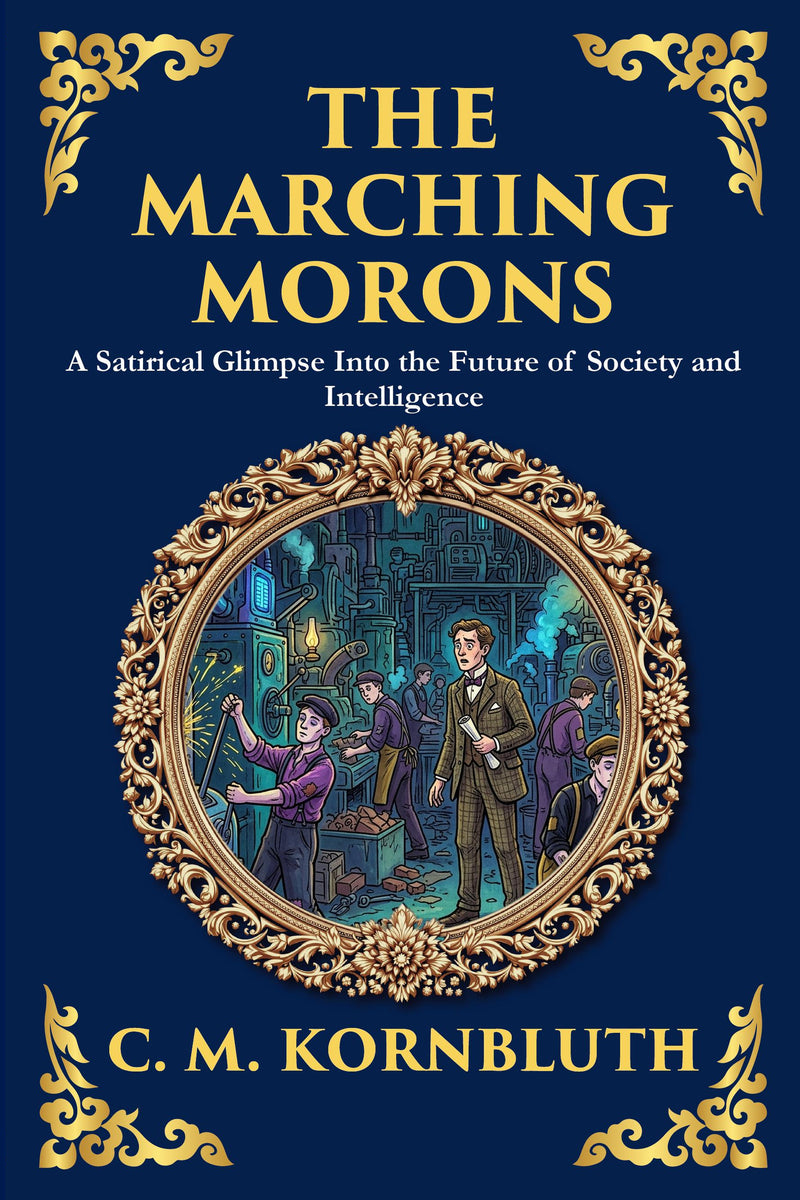
The Marching Morons
What if the future belonged to the foolish—and the intelligent became a forgotten minority? In The Marching Morons, C. M. Kornbluth delivers a chillingly prophetic satire where intelligence is rare, and idiocy reigns supreme.
or free app
10,000+ hrs library
30-day guarantee
The complete The Marching Morons appears in modern English through Library of Alexandria Press, available online with audiobook narration included for members.
Have you ever wondered why a society that values comfort over thought might be heading toward collapse? The Marching Morons by C. M. Kornbluth is one of the most influential—and unsettling—works of mid-century science fiction. Part of the Golden Age of speculative literature, this dystopian satire presents a future in which centuries of anti-intellectualism and social complacency have led to catastrophe: a world where the intelligent are few and powerless, and the masses— uniformed, unthinking, and overbred—are in full control.
John Barlow, a cunning con artist from the 20th century, is accidentally awakened from suspended animation in this grim future. The elite class of remaining geniuses hopes to use his ruthless skills to solve their growing crisis: how to manage a planet dominated by incompetence. But Barlow has plans of his own—ones that may shift the balance of power forever.
With biting irony and brutal foresight, Kornbluth holds a mirror up to consumerism, propaganda, and the decline of critical thought. Though written over seventy years ago, this story foreshadows our current debates about technology, media manipulation, intelligence, and leadership.
What you’ll discover in this modern edition
- A Terrifyingly Plausible Future – Explore a society where intelligence is bred out and mediocrity is mass-produced.
- A Flawed Antihero with a Vision – Follow John Barlow’s manipulative rise through a world that doesn’t even know it’s collapsing.
- A Classic of Sci-Fi Satire – One of the most enduring short stories from the Golden Age of science fiction.
- Themes That Echo Today – Examine issues of overpopulation, media addiction, education, and moral compromise.
- A Bold Challenge to Modern Complacency – Kornbluth’s timeless warning against letting comfort override critical thinking.
| Formats | eBook (EPUB + PDF) · Audiobook · Paperback · Hardcover · Large Print |
| Language | English |
| Trim size (print) | 6 × 9 in |
| Binding | Paperback — perfect-bound · Hardcover — casewrap |
| Large Print edition | Same text in a larger, easy-read type — a larger font, not a larger trim |
| Print pricing | Every physical book at our true cost — at-cost, no profit (members) |
| Library | 873 restored titles, always growing |
| Length | 14,918 words · ~1 hr 0 min reading |
| Reading level | Grade 6 · an easy, flowing read (this modern-English edition) |
| Edition | Modern English translation · 2026 |
Member reviews for this edition are collected as readers finish it — be the first. Across the library: 12,000+ books shipped, every plan covered by a 365-day print guarantee.
About this edition
A faithful, unabridged modern-English edition by The Library of Alexandria — carefully rendered for today's reader and verified paragraph-by-paragraph against the public-domain source. Available as eBook, audiobook, paperback, hardcover, and large print.
- Complete & unabridgedVerified paragraph by paragraph against the source — never a scan, never abridged.
- Modern English, faithfulReadable today, with the author’s meaning kept intact. Readable — not simplified.
- Every format, one membershipRead in your browser or the free app, or listen to the full audiobook.
Included free with your membership
Cancel anytime, one click · 30-day money-back guarantee
Edition last updated July 2026
What’s inside
The Marching Morons — complete and unabridged: all 6 sections included with membership, plus the full audiobook.
Begin reading The Marching Morons
In clear modern English — the complete text is included with membership.
Introduction
Some stories arrive ahead of their time and wait patiently for the world to catch up. C. M. Kornbluth’s “The Marching Morons,” first published in Galaxy Science Fiction in 1951, is one of those stories. More than seventy years after its appearance, it remains a sharp, uncomfortable, and irresistibly entertaining provocation—a tale that takes hold of an anxiety lurking at the edges of modern life and drags it into the harsh light of satire. To open this novella is to encounter a writer who refused to flatter his readers, who trusted them to be intelligent enough to sit with discomfort, and who wielded the tools of speculative fiction not merely to dazzle but to needle, to question, and to disturb. This is not a comfortable bedtime story. It is something far rarer: a piece of imaginative literature that lingers, that argues with you long after the final page, and that has earned its place among the most-discussed short works in the entire science fiction canon.
The premise, which has become so influential that it now circulates as a kind of cultural shorthand, is simple to state and devilishly complicated to think through. Kornbluth imagined a future in which the demographic patterns of intelligence had shifted in an alarming direction, producing a civilization caught in a peculiar and precarious balance. Around this central conceit he built a narrative that is by turns a thriller, a black comedy, a moral horror story, and a philosophical thought experiment. What makes the work endure is not the cleverness of its setup alone—though it is clever—but the way Kornbluth uses that setup to ask questions that we still have not answered, and perhaps never will: What do we owe one another? Who decides what makes a life worth living, or a society worth preserving? What happens when intelligence and conscience part ways? And what dark bargains might a desperate people accept if the alternative seems unbearable?
This modern translation has been prepared with a single guiding principle in mind: to make Kornbluth’s vision as immediate and as vivid for today’s reader as it was for the audience that first encountered it in the early 1950s. The science fiction of the mid-twentieth century was written in a particular idiom, dense with the slang, assumptions, and cultural reference points of its era. For contemporary readers, some of that texture can become a barrier rather than a bridge—a thicket of dated phrasing that slows the eye and distances the heart from a story that ought to grip both. The aim here has been to clear that thicket without disturbing the roots. The voice remains Kornbluth’s: caustic, intelligent, mordantly funny, and merciless in its precision. The ideas remain exactly as he conceived them, undiluted and unsoftened. What has changed is the surface—the rhythm of the prose, the accessibility of the language—so that nothing stands between you and the full force of the author’s imagination. Adapting a classic in this way is a delicate undertaking, and the goal throughout has been fidelity to the spirit of the original even where the letter has been gently modernized. Readers familiar with the 1951 text will recognize every beat; readers coming to it fresh will find a story that reads as though it could have been written for them.
It is worth pausing to consider the man behind the work, because Kornbluth’s biography illuminates the urgency that pulses beneath the satire. Cyril M. Kornbluth was born in New York City in 1923, the child of an era that would shape his sensibility in profound ways. He came of age during the Great Depression and entered adulthood as the world descended into the catastrophe of the Second World War. A precociously gifted young man, he was associated in his teens with the Futurians, a remarkable circle of young science fiction enthusiasts in New York that included figures who would go on to define the genre—Isaac Asimov, Frederik Pohl, Donald Wollheim, and others. These were not merely fans; they were ferociously ambitious aspiring writers, editors, and thinkers, many of them politically engaged, who debated ideas with the intensity of people who believed that the future was genuinely up for grabs. The Futurians produced an extraordinary concentration of talent, and Kornbluth was among the most naturally brilliant of them, capable of dashing off stories with a facility that astonished his peers.
His life was short and his career compressed. Kornbluth served in the U.S. Army during the Second World War, an experience that included combat in the Battle of the Bulge—a brutal, grinding ordeal that left physical and psychological marks. He carried heavy equipment through that campaign in conditions that damaged his health, and many who knew him believed the war contributed to the heart trouble that would cut his life tragically short. He died in 1958 at the age of thirty-four, collapsing on a train platform on his way to a job interview. He was, by any measure, a writer just entering his full powers, and the body of work he left behind—both under his own name and in celebrated collaborations, most famously with Frederik Pohl—represents only a fraction of what he might have achieved had he lived. That sense of unrealized potential gives his surviving work an added poignancy. Here was a man who had seen the worst that the twentieth century could produce, who had watched civilization nearly destroy itself, and who turned his considerable intelligence toward imagining where humanity might be heading. The darkness in his fiction is not nihilism for its own sake. It is the darkness of someone who had reasons to fear what people were capable of.
“The Marching Morons” emerged from this crucible. It belongs to a particular tradition of dystopian satire that flourished in the postwar years, when writers were grappling with the implications of mass society, consumer culture, advertising, and the new sciences of demography and psychology. The early 1950s in America were a period of remarkable prosperity and equally remarkable anxiety—a time when the comforts of the consumer economy coexisted with deep unease about conformity, manipulation, and the direction of modern life. Kornbluth shared with his sometime collaborator Frederik Pohl a particular obsession with the machinery of persuasion: advertising, marketing, the engineering of desire. Their joint novel The Space Merchants, published in 1952, just a year after this novella appeared, is one of the great satires of advertising-driven culture, and the same critical intelligence is on full display here. Kornbluth was fascinated and appalled by the ways in which mass society could be shaped, flattered, and exploited, and “The Marching Morons” extrapolates these anxieties into a future where the trends he observed have run their course.
It is important, in approaching this work, to understand the satirist’s method—because misreading it has been one of the persistent hazards in the story’s long reception. Satire functions by exaggeration, by pushing a tendency to its extreme so that we can see it clearly. The satirist does not necessarily endorse the world he depicts; more often, he holds it up as a warning, a distorted mirror in which we are meant to recognize our own follies. The danger with a satire as pointed as this one is that some readers may take the surface for the substance, mistaking the provocation for a manifesto. Kornbluth was a man of the political left, shaped by the Depression and the Futurian milieu, and his target here is not what a careless reading might suppose. The story’s bite is aimed in directions that reward careful attention. The most chilling element of the narrative is not the situation in which the future finds itself, but the solution that emerges—and the way that solution implicates the reader, forcing us to confront our own reactions, our own willingness to entertain ideas we might prefer to disavow. The genius of the piece lies in how it sets a trap: it invites a certain kind of contemptuous judgment, and then asks what such contempt might license. To read it well is to read it suspiciously, alert to the ways the author is testing you.
This is what elevates the work above mere clever extrapolation. A lesser writer would have been content with the central conceit, milking it for satirical laughs and grim irony. Kornbluth does more. He constructs a moral situation of genuine difficulty, populated by characters who must make terrible choices, and he refuses to let anyone—least of all the reader—off the hook. The story raises questions of ethics, of utilitarian calculation, of the value of human life and the limits of pragmatism, that have only grown more relevant as our own technologies have given us ever greater power to reshape ourselves and our societies. In an age of genetic engineering, of debates about reproduction and demographics, of algorithmic manipulation and mass persuasion at a scale Kornbluth could scarcely have imagined, the novella reads less like a period piece and more like a prophecy whose terms we are still arguing over. It anticipated, with uncanny precision, anxieties that would resurface again and again across the decades, and it did so with a literary economy and a moral seriousness that few of its imitators have matched.
Part of the enduring fascination of “The Marching Morons” lies in its structure, which is far more sophisticated than its lurid premise might suggest. Kornbluth was a master of the short form, and within the compass of a novella he manages to do an enormous amount of work. The story opens with a framing device that draws the reader in gradually, establishing a sense of mystery before the full dimensions of the future world become clear. We are introduced to this world through the eyes of a particular character whose journey of discovery mirrors our own. As he comes to understand the nature of the society he inhabits, so do we—and Kornbluth times these revelations with the skill of a practiced storyteller, parceling out information so that each new disclosure recontextualizes what came before.
This is one of the great pleasures of the reading experience, and it is one I am eager not to spoil. Much of the power of the narrative depends on the order in which its secrets are revealed, on the slow dawning of comprehension that gives way to dawning horror. To explain too much in advance would be to rob the story of its detonating effect. What can be said is that Kornbluth withholds and reveals with deliberate artistry, building toward a series of confrontations and decisions that constitute the moral heart of the piece. The plot moves with the propulsive energy of a thriller even as it engages with ideas of considerable philosophical weight. This combination—page-turning momentum yoked to genuine intellectual substance—is the hallmark of science fiction at its best, and Kornbluth achieves it with apparent effortlessness.
The world he builds is rendered with vivid, economical detail. There is a tactile quality to his imagined future, a sense of lived-in reality that grounds the fantastical premise. He understood that satire works best when it is anchored in specifics, when the absurdities of an imagined society are presented with the deadpan matter-of-factness of someone simply describing how things are. The texture of daily life in this future—its routines, its technologies, its casual assumptions—is conveyed through small, telling touches rather than long expository passages. We come to understand the world not through lectures but through observation, through the accumulation of detail, through the way characters behave and speak. This is the show-don’t-tell principle applied with rigor, and it is part of what gives the story its hallucinatory believability.
The characterization, too, is sharper than the satirical mode might lead one to expect. The central figures are not simply mouthpieces for ideas; they are recognizable human beings, driven by recognizable motives—ambition, fear, pride, the desire to be admired, the wish to solve an intractable problem. One of the most compelling aspects of the story is the way it presents its central dilemma not as an abstract puzzle but as a deeply human predicament, faced by people who are neither monsters nor saints but a complicated mixture of both. The reader is invited to understand their reasoning, to feel the pull of their logic, even as we recoil from where that logic leads. This is what makes the story genuinely unsettling rather than merely shocking. It does not present evil as something alien and external; it shows how reasonable people, confronting an apparently impossible situation, can talk themselves into the unthinkable. The banality with which the most disturbing ideas are discussed—the casual, problem-solving tone applied to matters of life and death—is one of Kornbluth’s most devastating effects.
Cancel anytime, one click · 30-day money-back guarantee
Founding annual rate available now — your price locks for life when you join.
Not ready? Get this free chapter by email — read it anytime.
✓ Sent — check your inbox for The Marching Morons.
Questions about The Marching Morons
What is The Marching Morons about?
What if the future belonged to the foolish—and the intelligent became a forgotten minority? In The Marching Morons, C. M. Kornbluth delivers a chillingly prophetic satire where intelligence is rare, and idiocy reigns supreme. Written in 1951 but more relevant than ever, this short story envisions a world where unchecked population growth, mindless media, and consumer culture have created a dystopia of willful ignorance.
Who wrote The Marching Morons?
The Marching Morons was written by C. M. Kornbluth. This edition presents the complete work in clear modern English, faithfully rendered from the public-domain original by Library of Alexandria Press.
Is The Marching Morons free to read?
The opening chapter is free to read on this page. Members read and listen to the complete work — and the entire library — free, and can order any physical book at our true print cost.
How long is The Marching Morons?
6 chapters (~14,918 words) — about 1 hr 0 min of reading in this modern-English edition.
Is this an abridged version of The Marching Morons?
No. This is the complete, unabridged The Marching Morons, carefully rendered into clear modern English and verified paragraph-by-paragraph against the public-domain source — nothing is cut or summarised.
What formats does The Marching Morons come in?
The Marching Morons is available as eBook, paperback, hardcover and large print. eBook and audiobook are included with membership; printed editions ship at our true print cost.
Shipping & returns
Billing & membership
More from the library


Explore Free eBooks
- Kant's Prolegomena to Any Future Metaphysics · Immanuel Kant
- The Advancement of Learning · Francis Bacon
- The Dawn of Day · Friedrich Nietzsche
- Peter and Wendy · J. M. Barrie
- Meditations · Marcus Aurelius
- The Confessions of St. Augustine · Saint Augustine of Hippo
- Resurrection · Leo Tolstoy
- Dialogues Concerning Natural Religion · David Hume
- As You Like It · William Shakespeare
- Jack and Jill · Louisa May Alcott
- Dream Psychology: Psychoanalysis for Beginners · Sigmund Freud
- The Raven · Edgar Allan Poe
- Considerations on Representative Government · John Stuart Mill
- The Will to Power: An Attempted Transvaluation of All Values. Book III and IV · Friedrich Nietzsche
- Tarzan of the Apes · Edgar Rice Burroughs
- Fundamental Principles of the Metaphysic of Morals · Immanuel Kant
- The Confessions of Jean Jacques Rousseau — Complete · Jean-Jacques Rousseau
- The Merchant of Venice · William Shakespeare
- Democracy in America — Volume 2 · Alexis de Tocqueville
- Ecce Homo · Friedrich Wilhelm Nietzsche
- Second Treatise of Government · John Locke
- The Wonderful Wizard of Oz · L. Frank Baum
- The Prince · Niccolò Machiavelli
- Anne of Green Gables · L. M. Montgomery
- De Profundis · Oscar Wilde
- Thus Spake Zarathustra: A Book for All and None · Friedrich Nietzsche
- Anna Karenina · Leo Tolstoy
- Great Expectations · Charles Dickens
- The Island of Doctor Moreau · H. G. Wells
- A Midsummer Night's Dream · William Shakespeare
The Marching Morons
The Marching Morons
A Satirical Look at the Future of Society and Intelligence
C. M. Kornbluth
Contents
- Introduction
- Chapter 1
- Chapter 2
- Chapter 3
- Chapter 4
- Chapter 5
Introduction
Some stories arrive ahead of their time and wait patiently for the world to catch up. C. M. Kornbluth’s “The Marching Morons,” first published in Galaxy Science Fiction in 1951, is one of those stories. More than seventy years after its appearance, it remains a sharp, uncomfortable, and irresistibly entertaining provocation—a tale that takes hold of an anxiety lurking at the edges of modern life and drags it into the harsh light of satire. To open this novella is to encounter a writer who refused to flatter his readers, who trusted them to be intelligent enough to sit with discomfort, and who wielded the tools of speculative fiction not merely to dazzle but to needle, to question, and to disturb. This is not a comfortable bedtime story. It is something far rarer: a piece of imaginative literature that lingers, that argues with you long after the final page, and that has earned its place among the most-discussed short works in the entire science fiction canon.
The premise, which has become so influential that it now circulates as a kind of cultural shorthand, is simple to state and devilishly complicated to think through. Kornbluth imagined a future in which the demographic patterns of intelligence had shifted in an alarming direction, producing a civilization caught in a peculiar and precarious balance. Around this central conceit he built a narrative that is by turns a thriller, a black comedy, a moral horror story, and a philosophical thought experiment. What makes the work endure is not the cleverness of its setup alone—though it is clever—but the way Kornbluth uses that setup to ask questions that we still have not answered, and perhaps never will: What do we owe one another? Who decides what makes a life worth living, or a society worth preserving? What happens when intelligence and conscience part ways? And what dark bargains might a desperate people accept if the alternative seems unbearable?
This modern translation has been prepared with a single guiding principle in mind: to make Kornbluth’s vision as immediate and as vivid for today’s reader as it was for the audience that first encountered it in the early 1950s. The science fiction of the mid-twentieth century was written in a particular idiom, dense with the slang, assumptions, and cultural reference points of its era. For contemporary readers, some of that texture can become a barrier rather than a bridge—a thicket of dated phrasing that slows the eye and distances the heart from a story that ought to grip both. The aim here has been to clear that thicket without disturbing the roots. The voice remains Kornbluth’s: caustic, intelligent, mordantly funny, and merciless in its precision. The ideas remain exactly as he conceived them, undiluted and unsoftened. What has changed is the surface—the rhythm of the prose, the accessibility of the language—so that nothing stands between you and the full force of the author’s imagination. Adapting a classic in this way is a delicate undertaking, and the goal throughout has been fidelity to the spirit of the original even where the letter has been gently modernized. Readers familiar with the 1951 text will recognize every beat; readers coming to it fresh will find a story that reads as though it could have been written for them.
It is worth pausing to consider the man behind the work, because Kornbluth’s biography illuminates the urgency that pulses beneath the satire. Cyril M. Kornbluth was born in New York City in 1923, the child of an era that would shape his sensibility in profound ways. He came of age during the Great Depression and entered adulthood as the world descended into the catastrophe of the Second World War. A precociously gifted young man, he was associated in his teens with the Futurians, a remarkable circle of young science fiction enthusiasts in New York that included figures who would go on to define the genre—Isaac Asimov, Frederik Pohl, Donald Wollheim, and others. These were not merely fans; they were ferociously ambitious aspiring writers, editors, and thinkers, many of them politically engaged, who debated ideas with the intensity of people who believed that the future was genuinely up for grabs. The Futurians produced an extraordinary concentration of talent, and Kornbluth was among the most naturally brilliant of them, capable of dashing off stories with a facility that astonished his peers.
His life was short and his career compressed. Kornbluth served in the U.S. Army during the Second World War, an experience that included combat in the Battle of the Bulge—a brutal, grinding ordeal that left physical and psychological marks. He carried heavy equipment through that campaign in conditions that damaged his health, and many who knew him believed the war contributed to the heart trouble that would cut his life tragically short. He died in 1958 at the age of thirty-four, collapsing on a train platform on his way to a job interview. He was, by any measure, a writer just entering his full powers, and the body of work he left behind—both under his own name and in celebrated collaborations, most famously with Frederik Pohl—represents only a fraction of what he might have achieved had he lived. That sense of unrealized potential gives his surviving work an added poignancy. Here was a man who had seen the worst that the twentieth century could produce, who had watched civilization nearly destroy itself, and who turned his considerable intelligence toward imagining where humanity might be heading. The darkness in his fiction is not nihilism for its own sake. It is the darkness of someone who had reasons to fear what people were capable of.
“The Marching Morons” emerged from this crucible. It belongs to a particular tradition of dystopian satire that flourished in the postwar years, when writers were grappling with the implications of mass society, consumer culture, advertising, and the new sciences of demography and psychology. The early 1950s in America were a period of remarkable prosperity and equally remarkable anxiety—a time when the comforts of the consumer economy coexisted with deep unease about conformity, manipulation, and the direction of modern life. Kornbluth shared with his sometime collaborator Frederik Pohl a particular obsession with the machinery of persuasion: advertising, marketing, the engineering of desire. Their joint novel The Space Merchants, published in 1952, just a year after this novella appeared, is one of the great satires of advertising-driven culture, and the same critical intelligence is on full display here. Kornbluth was fascinated and appalled by the ways in which mass society could be shaped, flattered, and exploited, and “The Marching Morons” extrapolates these anxieties into a future where the trends he observed have run their course.
It is important, in approaching this work, to understand the satirist’s method—because misreading it has been one of the persistent hazards in the story’s long reception. Satire functions by exaggeration, by pushing a tendency to its extreme so that we can see it clearly. The satirist does not necessarily endorse the world he depicts; more often, he holds it up as a warning, a distorted mirror in which we are meant to recognize our own follies. The danger with a satire as pointed as this one is that some readers may take the surface for the substance, mistaking the provocation for a manifesto. Kornbluth was a man of the political left, shaped by the Depression and the Futurian milieu, and his target here is not what a careless reading might suppose. The story’s bite is aimed in directions that reward careful attention. The most chilling element of the narrative is not the situation in which the future finds itself, but the solution that emerges—and the way that solution implicates the reader, forcing us to confront our own reactions, our own willingness to entertain ideas we might prefer to disavow. The genius of the piece lies in how it sets a trap: it invites a certain kind of contemptuous judgment, and then asks what such contempt might license. To read it well is to read it suspiciously, alert to the ways the author is testing you.
This is what elevates the work above mere clever extrapolation. A lesser writer would have been content with the central conceit, milking it for satirical laughs and grim irony. Kornbluth does more. He constructs a moral situation of genuine difficulty, populated by characters who must make terrible choices, and he refuses to let anyone—least of all the reader—off the hook. The story raises questions of ethics, of utilitarian calculation, of the value of human life and the limits of pragmatism, that have only grown more relevant as our own technologies have given us ever greater power to reshape ourselves and our societies. In an age of genetic engineering, of debates about reproduction and demographics, of algorithmic manipulation and mass persuasion at a scale Kornbluth could scarcely have imagined, the novella reads less like a period piece and more like a prophecy whose terms we are still arguing over. It anticipated, with uncanny precision, anxieties that would resurface again and again across the decades, and it did so with a literary economy and a moral seriousness that few of its imitators have matched.
Part of the enduring fascination of “The Marching Morons” lies in its structure, which is far more sophisticated than its lurid premise might suggest. Kornbluth was a master of the short form, and within the compass of a novella he manages to do an enormous amount of work. The story opens with a framing device that draws the reader in gradually, establishing a sense of mystery before the full dimensions of the future world become clear. We are introduced to this world through the eyes of a particular character whose journey of discovery mirrors our own. As he comes to understand the nature of the society he inhabits, so do we—and Kornbluth times these revelations with the skill of a practiced storyteller, parceling out information so that each new disclosure recontextualizes what came before.
This is one of the great pleasures of the reading experience, and it is one I am eager not to spoil. Much of the power of the narrative depends on the order in which its secrets are revealed, on the slow dawning of comprehension that gives way to dawning horror. To explain too much in advance would be to rob the story of its detonating effect. What can be said is that Kornbluth withholds and reveals with deliberate artistry, building toward a series of confrontations and decisions that constitute the moral heart of the piece. The plot moves with the propulsive energy of a thriller even as it engages with ideas of considerable philosophical weight. This combination—page-turning momentum yoked to genuine intellectual substance—is the hallmark of science fiction at its best, and Kornbluth achieves it with apparent effortlessness.
The world he builds is rendered with vivid, economical detail. There is a tactile quality to his imagined future, a sense of lived-in reality that grounds the fantastical premise. He understood that satire works best when it is anchored in specifics, when the absurdities of an imagined society are presented with the deadpan matter-of-factness of someone simply describing how things are. The texture of daily life in this future—its routines, its technologies, its casual assumptions—is conveyed through small, telling touches rather than long expository passages. We come to understand the world not through lectures but through observation, through the accumulation of detail, through the way characters behave and speak. This is the show-don’t-tell principle applied with rigor, and it is part of what gives the story its hallucinatory believability.
The characterization, too, is sharper than the satirical mode might lead one to expect. The central figures are not simply mouthpieces for ideas; they are recognizable human beings, driven by recognizable motives—ambition, fear, pride, the desire to be admired, the wish to solve an intractable problem. One of the most compelling aspects of the story is the way it presents its central dilemma not as an abstract puzzle but as a deeply human predicament, faced by people who are neither monsters nor saints but a complicated mixture of both. The reader is invited to understand their reasoning, to feel the pull of their logic, even as we recoil from where that logic leads. This is what makes the story genuinely unsettling rather than merely shocking. It does not present evil as something alien and external; it shows how reasonable people, confronting an apparently impossible situation, can talk themselves into the unthinkable. The banality with which the most disturbing ideas are discussed—the casual, problem-solving tone applied to matters of life and death—is one of Kornbluth’s most devastating effects.
In the land of the blind, the one-eyed man is king, of course. But what happens when a sharp, driven businessman lives in a society of total idiots?
Some things never changed. A potter’s wheel was still a potter’s wheel, and clay was still clay. Efim Hawkins had set up his shop near Goose Lake, where there was a thin vein of high-quality clay and a small beach of white sand. He used willow charcoal from his wood lot to fire three bottle-shaped kilns. The wood lot was also a great place for long walks while the kilns cooled; if he stayed too close, he’d get impatient and open them too early to see how a new shape or glaze had turned out. Then—ping!—the piece would crack, and the work would be nothing more than a scrap for the shard pile behind his slip tanks.
A business meeting was happening in his shop—a simple brick cube with a tiled roof—just as the Chicago-to-Los Angeles “rocket” roared overhead. It was a loud, sleek craft with swept-back wings and fiery jets, looking as fast and streamlined as a flying barracuda.
The buyer from Marshall Fields was examining a black-glazed one-liter carafe, nodding in approval with his large, handsome head. “This is real pretty,” he told Hawkins and his secretary, Gomez-Laplace. “This has got lots of what you call real est’etic principles. Yeah, it’s real pretty.”
“How much?” the secretary asked the potter.
“Seven-fifty each for orders of a dozen,” Hawkins said. “I made fifteen dozen last month.”
“They’re real est’etic,” the buyer from Fields repeated. “I’ll take them all.”
“I don’t think we can do that, doctor,” the secretary replied. “They would cost us $1,350. That would leave only $532 in our quarterly budget. Plus, we still have to go to East Liverpool to pick up some cheap dinner sets.”
End of the free sample
Keep reading, free
Members read and listen to the complete book — and the entire library. Cancel anytime, one click · 30-day money-back guarantee.