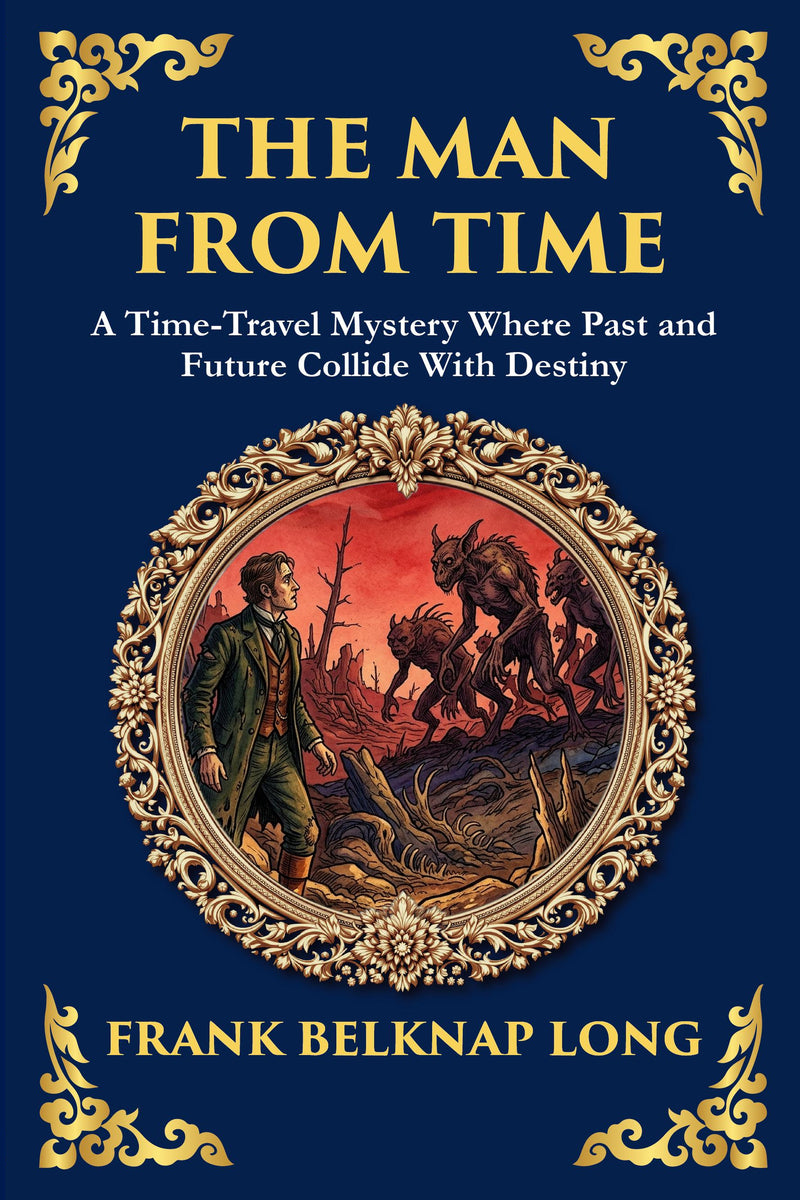
The Man from Time
What happens when time no longer moves in a straight line, but folds upon itself? In The Man from Time, Frank Belknap Long weaves a gripping tale of mystery, paradox, and humanity’s fragile grip on reality.
or free app
10,000+ hrs library
30-day guarantee
The complete The Man from Time appears in modern English through Library of Alexandria Press, available online with audiobook narration included for members.
Have you ever wondered why time might not be what it seems? The Man from Time is Frank Belknap Long’s mind-bending exploration of memory, identity, and the dark consequences of manipulating time itself. In this forgotten gem of early science fiction, Long presents a thrilling narrative that balances scientific wonder with human emotion— examining what it means to belong in a world you're not meant to exist in.
When a mysterious figure is found wandering aimlessly with no recollection of where—or when —he came from, scientists and military officials scramble to piece together the enigma. The man speaks in riddles, recalls fragments of impossible technology, and fears an unnamed catastrophe that has not yet happened. But the truth is even more dangerous: he has been sent from a shattered future, where mankind tampered too freely with time.
Now, with paradoxes threatening to consume reality, the man from time becomes the final hope to prevent a history that leads to oblivion.
What you’ll discover in this modern edition
- A Gripping Time Travel Mystery – Follow a stranger through a fractured world of secret labs, shadowy government plots, and bending timelines.
- A Thought-Provoking Sci-Fi Thriller – Question your understanding of time, free will, and the consequences of rewriting history.
- A Forgotten Masterpiece of Classic Sci-Fi – Rediscover a story by one of H.P. Lovecraft’s closest literary allies and contributors to the golden age of speculative fiction.
- A Character Torn Between Past and Future – Witness a deeply human story of identity and sacrifice hidden within the folds of time.
- A Cautionary Tale of Technological Hubris – Explore the dangers of playing god with forces we do not fully understand.
| Formats | eBook (EPUB + PDF) · Audiobook · Paperback · Hardcover · Large Print |
| Language | English |
| Trim size (print) | 6 × 9 in |
| Binding | Paperback — perfect-bound · Hardcover — casewrap |
| Large Print edition | Same text in a larger, easy-read type — a larger font, not a larger trim |
| Print pricing | Every physical book at our true cost — at-cost, no profit (members) |
| Library | 873 restored titles, always growing |
| Length | 8,489 words · ~34 min reading |
| Reading level | Grade 8 · an easy, flowing read (this modern-English edition) |
| Edition | Modern English translation · 2026 |
Member reviews for this edition are collected as readers finish it — be the first. Across the library: 12,000+ books shipped, every plan covered by a 365-day print guarantee.
About this edition
A faithful, unabridged modern-English edition by The Library of Alexandria — carefully rendered for today's reader and verified paragraph-by-paragraph against the public-domain source. Available as eBook, audiobook, paperback, hardcover, and large print.
- Complete & unabridgedVerified paragraph by paragraph against the source — never a scan, never abridged.
- Modern English, faithfulReadable today, with the author’s meaning kept intact. Readable — not simplified.
- Every format, one membershipRead in your browser or the free app, or listen to the full audiobook.
Included free with your membership
Cancel anytime, one click · 30-day money-back guarantee
Edition last updated July 2026
What’s inside
The Man from Time — complete and unabridged, included in full with membership, plus the full audiobook.
Begin reading The Man from Time
In clear modern English — the complete text is included with membership.
Introduction
There are certain writers whose names hum quietly beneath the great roaring engine of twentieth-century imaginative fiction—names that the casual reader may not recognize but that the devoted student of speculative literature speaks with reverence. Frank Belknap Long is one of these. He was a man who lived at the very heart of the most fertile and feverish period of American fantastic writing, who counted among his closest friends some of the most influential figures the genre has ever produced, and who, across a career spanning more than six decades, left behind a body of work as restless and varied as the imagination that produced it. To open the book you now hold is to step into the company of a storyteller who had absorbed the entire history of the pulp tradition and yet never stopped reaching forward, never stopped asking the questions that have always animated the best science fiction: What is time? What is destiny? And what becomes of a human being caught between the two?
The work before you is a meditation on these questions disguised, as the finest such meditations always are, as an adventure. It is a story of displacement and discovery, of a consciousness wrenched out of its proper moment and set adrift in a current it cannot control. It belongs to that grand and enduring lineage of time-travel narratives that stretches back to H. G. Wells and forward to our own restless century, but it bears the unmistakable fingerprints of its author—a writer who never quite lost his fascination with the strange, the uncanny, and the cosmic terror that lurks at the edges of rational understanding. What you are about to read is at once a puzzle, a chase, and a contemplation of the human place in a universe far larger and stranger than our daily lives allow us to imagine.
Before you begin, it is worth taking a moment—several moments, in fact—to understand the man who wrote it, the literary world he inhabited, and the particular flavor of wonder he brought to the page. For Frank Belknap Long was no ordinary craftsman. He was a bridge between eras, a survivor of literary movements, and a voice that, though it has sometimes been overshadowed by the giants who stood beside him, deserves to be heard again on its own terms. This modern translation, carefully adapted for the contemporary reader, is an attempt to do exactly that: to clear away the dust of decades, to smooth the archaisms and the dated cadences that can sometimes stand between a modern audience and an older text, and to let the essential pleasures of the story shine through with the clarity they had when they first appeared.
Frank Belknap Long was born in New York City in 1901, and the city would remain the gravitational center of his long life. He came into the world at the very dawn of the century whose anxieties, technologies, and dreams his fiction would so faithfully reflect. The America of his childhood was a place electrified by invention and unsettled by rapid change, a society watching the airplane take to the sky, the automobile crowd the streets, and the vast certainties of the Victorian age dissolve into something newer and more bewildering. It was, in short, exactly the kind of environment to produce a writer obsessed with the future and haunted by the past.
Long began publishing while still a very young man, and his earliest work appeared in the pages of Weird Tales, the legendary pulp magazine that served as the crucible for an entire generation of fantastic writers. It was here, in those lurid and beloved pages, that the great themes of horror, fantasy, and science fiction were forged into the distinctly American forms we recognize today. And it was here that Long made the acquaintance—first through correspondence and later in person—of the writer who would become his most famous friend and his most profound literary influence: Howard Phillips Lovecraft.
The friendship between Long and Lovecraft is one of the genuinely touching stories in the history of imaginative literature. The two men, despite a noticeable difference in age and temperament, formed a bond that lasted until Lovecraft’s death in 1937. They exchanged voluminous letters; they wandered the streets of New York together during Lovecraft’s unhappy sojourn in the city; they argued about philosophy, politics, and the nature of cosmic horror. Long was among the small circle of writers who gathered around Lovecraft, the so-called “Lovecraft Circle,” whose members would go on to shape the future of the genre. He contributed to and drew from the shared mythos of cosmic dread that Lovecraft pioneered, and his early stories carry the unmistakable chill of that influence—the sense of vast, indifferent forces moving behind the thin veil of ordinary reality, the suggestion that human knowledge is a tiny island in a black sea of the unknowable.
Yet to remember Long only as a satellite of Lovecraft is to do him a serious injustice. He was a prolific and independent talent who wrote across an extraordinary range of forms and genres. Over the course of his career he produced not only weird fiction and science fiction but also poetry, comic-book scripts, historical novels, gothic romances, and a tender, invaluable memoir of his famous friend. He was one of those workhorse professionals of the pulp era who learned to write quickly, to write to length, and to write in whatever idiom the market demanded—and who, in the process, developed a versatility that few of his contemporaries could match. When the great age of the pulps gave way to the paperback boom of the mid-century, Long adapted; when science fiction matured from juvenile adventure into a literature of ideas, he matured with it.
His longevity alone is remarkable. Long was writing and publishing into the 1980s, which means that his career touched nearly every significant phase in the development of modern fantastic literature. He began among the gaslit horrors of the early pulps and lived to see science fiction transformed into a sophisticated genre with literary ambitions and a vast popular readership. Few writers can claim to have witnessed—and participated in—so much. He was, in a very real sense, a living archive of the field, a man who had stood at the source and followed the river all the way to the sea.
The science fiction that Long produced in his middle and later years reflects this deep immersion in the genre’s evolving concerns. He was always interested in the large questions—the nature of time, the meaning of evolution, the possibility of other minds and other worlds, the fragility of human civilization against the backdrop of cosmic deep time. These were not merely plot devices for him but genuine philosophical preoccupations, inherited in part from his long association with Lovecraft’s cosmic pessimism but transformed, in his own work, into something more humane and more hopeful. Where Lovecraft saw the vastness of the universe as a source of unrelenting terror, Long was capable of finding in it a strange and melancholy beauty, even a kind of consolation.
It is this sensibility that the present book most fully expresses. Here is a story that takes one of the genre’s most enduring premises—the dislocation of a human being across the abyss of time—and uses it to explore questions of identity, belonging, and fate. The mystery at its center is not merely a puzzle to be solved but an invitation to consider what it means to be a person at all when the comfortable framework of one’s own moment in history has been stripped away. The “man from time” of the title is, in a sense, every one of us: a creature shaped by a particular epoch, suddenly forced to confront the alien strangeness of all the epochs that came before and all that are yet to come.
The time-travel story is one of the oldest and most fertile forms in all of speculative fiction, and it is worth pausing to consider why it has held such a powerful grip on the imagination for well over a century. From the moment H. G. Wells sent his unnamed Time Traveller hurtling into the far future in 1895, the device has offered writers an unparalleled tool for examining the human condition. To travel through time is to gain a kind of god’s-eye perspective on existence—to see the contingency of one’s own moment, to glimpse the rise and fall of civilizations, to confront mortality and change and the relentless forward motion of all things. It is a premise that lends itself equally to adventure, to satire, to romance, and to the deepest kind of philosophical inquiry.
What distinguishes the time-travel mystery as a particular subgenre is the marriage of this cosmic sweep to the intimate, tightly wound mechanics of detection. A mystery, by its nature, is a story about hidden truths and their gradual revelation—about the careful assembly of clues, the testing of hypotheses, the dawning of understanding. When you graft this structure onto the framework of time travel, something wonderful happens. The very fabric of cause and effect, which the conventional mystery treats as fixed and reliable, becomes itself a subject of investigation. Questions of who did what, and when, and why, take on a dizzying new complexity when “when” is no longer a stable coordinate. The detective in such a story must reason not only about the world but about time itself.
Long understood the rich potential of this fusion, and the story you are about to read makes full use of it. Without revealing anything of the plot—for the pleasures of a mystery are pleasures of discovery, and it would be a disservice to spoil them—it can be said that this is a narrative built on the slow, deliberate unveiling of a situation whose true dimensions are far larger than they first appear. The reader is placed in a position of productive uncertainty, sharing in the bewilderment of those caught up in events they do not yet understand, and is carried forward by the deeply human desire to know—to grasp the shape of the whole, to see how the scattered pieces fit together into a coherent and meaningful design.
This is, in fact, one of the great satisfactions of the form, and one that Long handles with the practiced skill of a writer who had spent decades learning how to hold a reader’s attention. The pulp tradition in which he was trained prized, above all things, momentum—the relentless forward drive of a story that never lets the reader’s interest flag. But the best pulp writers, and Long was among them, knew that momentum alone is not enough. A story must also offer texture, atmosphere, and the resonance of larger meaning. The headlong pace of adventure must be balanced against moments of wonder and reflection, against passages that invite the reader to pause and contemplate the strangeness of what is being described. It is this balance that gives the finest science fiction of the mid-century its enduring appeal, and it is this balance that you will find at work in the pages ahead.
There is, too, a particular emotional register to the time-travel story that few other forms can match: a profound and pervasive melancholy, a sense of loss inseparable from the wonder of discovery. To move through time is, inevitably, to be separated from everything one has known. The time traveler is the ultimate exile, cut off from home not by mere distance but by the irreversible flow of years. There is no going back—or if there is, it is fraught with paradox and peril. This theme of exile, of the displaced consciousness searching for a place to belong, runs like a deep current beneath the surface of the best time-travel fiction, and it speaks to something universal in the human experience. We are all, in a sense, travelers through time, carried inexorably forward from a past we can never recover toward a future we cannot foresee. The time-travel story merely literalizes this condition, making vivid and concrete the existential predicament we all share.
When Long turned his attention to this theme, he brought to it the full weight of his cosmic sensibility—that capacity, inherited and transformed from his apprenticeship in weird fiction, to feel the immensity of time and space as something almost physically overwhelming. The deep past and the far future were not, for him, mere backdrops for adventure but genuine objects of awe and terror and longing. And this is what elevates the story you are about to read above the level of mere puzzle-solving. Beneath the mechanics of mystery and the excitement of the chase, there pulses a deeper meditation on destiny and the human capacity to confront forces vastly greater than ourselves. The “collision” of past and future promised by the subtitle is not merely a matter of plot; it is the very theme of the book, the great churning of cosmic forces against which the small, brave, bewildered figure of the individual human being is set in stark and moving relief.
Cancel anytime, one click · 30-day money-back guarantee
Founding annual rate available now — your price locks for life when you join.
Not ready? Get this free chapter by email — read it anytime.
✓ Sent — check your inbox for The Man from Time.
Questions about The Man from Time
What is The Man from Time about?
What happens when time no longer moves in a straight line, but folds upon itself? In The Man from Time, Frank Belknap Long weaves a gripping tale of mystery, paradox, and humanity’s fragile grip on reality. A man appears without identity, knowledge of the present, or memory of the past—only a haunting sense that something in time has gone terribly wrong.
Who wrote The Man from Time?
The Man from Time was written by Frank Belknap Long. This edition presents the complete work in clear modern English, faithfully rendered from the public-domain original by Library of Alexandria Press.
Is The Man from Time free to read?
The opening chapter is free to read on this page. Members read and listen to the complete work — and the entire library — free, and can order any physical book at our true print cost.
How long is The Man from Time?
2 chapters (~8,489 words) — about 34 min of reading in this modern-English edition.
Is this an abridged version of The Man from Time?
No. This is the complete, unabridged The Man from Time, carefully rendered into clear modern English and verified paragraph-by-paragraph against the public-domain source — nothing is cut or summarised.
What formats does The Man from Time come in?
The Man from Time is available as eBook, paperback, hardcover and large print. eBook and audiobook are included with membership; printed editions ship at our true print cost.
Shipping & returns
Billing & membership
More from the library


Explore Science Fiction
- The Island of Doctor Moreau · H. G. Wells
- A Midsummer Night’s Dream · William Shakespeare
- The Invisible Man: A Grotesque Romance · H. G. Wells
- The War of the Worlds · H. G. Wells
- The Strange Case of Dr. Jekyll and Mr. Hyde · Robert Louis Stevenson
- Limanora: the island of progress · Godfrey Sweven
- The Book of Dragons · E. Nesbit
- She · H. Rider Haggard
- Dorothy and the Wizard in Oz · L. Frank Baum
- The Princess and the Goblin · George MacDonald
- Gawayne and the Green Knight: A Fairy Tale · Charlton M. Lewis
- Lucian’s True History · Lucian of Samosata
- The Willows · Algernon Blackwood
- The Call of Cthulhu · H. P. Lovecraft
- The Life-Eater · Harold Ward
- The Marvelous Land of Oz · L. Frank Baum
- Mars is My Destination · Frank Belknap Long
- The Black Kiss
- The Beasts in the Void · Paul W. Fairman
- John Jones’s Dollar · Harry Stephen Keeler
- Subversive · Mack Reynolds
- The Mississippi Saucer · Frank Belknap Long
- Man of Distinction · Michael Shaara
- Spawn of the Comet · H. Thompson Rich
- The Golden Judge · Nathaniel Gordon
- Final Weapon · Everett B. Cole
- The Big Fix · George O. Smith
- Last Enemy · H. Beam Piper
- Time and Time Again · H. Beam Piper
- Sabotage in Space · Carey Rockwell
The Man from Time
The Man from Time
A Time-Travel Mystery Where Past and Future Collide With Destiny
Frank Belknap Long
Contents
- Introduction
- The Man from Time
Introduction
There are certain writers whose names hum quietly beneath the great roaring engine of twentieth-century imaginative fiction—names that the casual reader may not recognize but that the devoted student of speculative literature speaks with reverence. Frank Belknap Long is one of these. He was a man who lived at the very heart of the most fertile and feverish period of American fantastic writing, who counted among his closest friends some of the most influential figures the genre has ever produced, and who, across a career spanning more than six decades, left behind a body of work as restless and varied as the imagination that produced it. To open the book you now hold is to step into the company of a storyteller who had absorbed the entire history of the pulp tradition and yet never stopped reaching forward, never stopped asking the questions that have always animated the best science fiction: What is time? What is destiny? And what becomes of a human being caught between the two?
The work before you is a meditation on these questions disguised, as the finest such meditations always are, as an adventure. It is a story of displacement and discovery, of a consciousness wrenched out of its proper moment and set adrift in a current it cannot control. It belongs to that grand and enduring lineage of time-travel narratives that stretches back to H. G. Wells and forward to our own restless century, but it bears the unmistakable fingerprints of its author—a writer who never quite lost his fascination with the strange, the uncanny, and the cosmic terror that lurks at the edges of rational understanding. What you are about to read is at once a puzzle, a chase, and a contemplation of the human place in a universe far larger and stranger than our daily lives allow us to imagine.
Before you begin, it is worth taking a moment—several moments, in fact—to understand the man who wrote it, the literary world he inhabited, and the particular flavor of wonder he brought to the page. For Frank Belknap Long was no ordinary craftsman. He was a bridge between eras, a survivor of literary movements, and a voice that, though it has sometimes been overshadowed by the giants who stood beside him, deserves to be heard again on its own terms. This modern translation, carefully adapted for the contemporary reader, is an attempt to do exactly that: to clear away the dust of decades, to smooth the archaisms and the dated cadences that can sometimes stand between a modern audience and an older text, and to let the essential pleasures of the story shine through with the clarity they had when they first appeared.
Frank Belknap Long was born in New York City in 1901, and the city would remain the gravitational center of his long life. He came into the world at the very dawn of the century whose anxieties, technologies, and dreams his fiction would so faithfully reflect. The America of his childhood was a place electrified by invention and unsettled by rapid change, a society watching the airplane take to the sky, the automobile crowd the streets, and the vast certainties of the Victorian age dissolve into something newer and more bewildering. It was, in short, exactly the kind of environment to produce a writer obsessed with the future and haunted by the past.
Long began publishing while still a very young man, and his earliest work appeared in the pages of Weird Tales, the legendary pulp magazine that served as the crucible for an entire generation of fantastic writers. It was here, in those lurid and beloved pages, that the great themes of horror, fantasy, and science fiction were forged into the distinctly American forms we recognize today. And it was here that Long made the acquaintance—first through correspondence and later in person—of the writer who would become his most famous friend and his most profound literary influence: Howard Phillips Lovecraft.
The friendship between Long and Lovecraft is one of the genuinely touching stories in the history of imaginative literature. The two men, despite a noticeable difference in age and temperament, formed a bond that lasted until Lovecraft’s death in 1937. They exchanged voluminous letters; they wandered the streets of New York together during Lovecraft’s unhappy sojourn in the city; they argued about philosophy, politics, and the nature of cosmic horror. Long was among the small circle of writers who gathered around Lovecraft, the so-called “Lovecraft Circle,” whose members would go on to shape the future of the genre. He contributed to and drew from the shared mythos of cosmic dread that Lovecraft pioneered, and his early stories carry the unmistakable chill of that influence—the sense of vast, indifferent forces moving behind the thin veil of ordinary reality, the suggestion that human knowledge is a tiny island in a black sea of the unknowable.
Yet to remember Long only as a satellite of Lovecraft is to do him a serious injustice. He was a prolific and independent talent who wrote across an extraordinary range of forms and genres. Over the course of his career he produced not only weird fiction and science fiction but also poetry, comic-book scripts, historical novels, gothic romances, and a tender, invaluable memoir of his famous friend. He was one of those workhorse professionals of the pulp era who learned to write quickly, to write to length, and to write in whatever idiom the market demanded—and who, in the process, developed a versatility that few of his contemporaries could match. When the great age of the pulps gave way to the paperback boom of the mid-century, Long adapted; when science fiction matured from juvenile adventure into a literature of ideas, he matured with it.
His longevity alone is remarkable. Long was writing and publishing into the 1980s, which means that his career touched nearly every significant phase in the development of modern fantastic literature. He began among the gaslit horrors of the early pulps and lived to see science fiction transformed into a sophisticated genre with literary ambitions and a vast popular readership. Few writers can claim to have witnessed—and participated in—so much. He was, in a very real sense, a living archive of the field, a man who had stood at the source and followed the river all the way to the sea.
The science fiction that Long produced in his middle and later years reflects this deep immersion in the genre’s evolving concerns. He was always interested in the large questions—the nature of time, the meaning of evolution, the possibility of other minds and other worlds, the fragility of human civilization against the backdrop of cosmic deep time. These were not merely plot devices for him but genuine philosophical preoccupations, inherited in part from his long association with Lovecraft’s cosmic pessimism but transformed, in his own work, into something more humane and more hopeful. Where Lovecraft saw the vastness of the universe as a source of unrelenting terror, Long was capable of finding in it a strange and melancholy beauty, even a kind of consolation.
It is this sensibility that the present book most fully expresses. Here is a story that takes one of the genre’s most enduring premises—the dislocation of a human being across the abyss of time—and uses it to explore questions of identity, belonging, and fate. The mystery at its center is not merely a puzzle to be solved but an invitation to consider what it means to be a person at all when the comfortable framework of one’s own moment in history has been stripped away. The “man from time” of the title is, in a sense, every one of us: a creature shaped by a particular epoch, suddenly forced to confront the alien strangeness of all the epochs that came before and all that are yet to come.
The time-travel story is one of the oldest and most fertile forms in all of speculative fiction, and it is worth pausing to consider why it has held such a powerful grip on the imagination for well over a century. From the moment H. G. Wells sent his unnamed Time Traveller hurtling into the far future in 1895, the device has offered writers an unparalleled tool for examining the human condition. To travel through time is to gain a kind of god’s-eye perspective on existence—to see the contingency of one’s own moment, to glimpse the rise and fall of civilizations, to confront mortality and change and the relentless forward motion of all things. It is a premise that lends itself equally to adventure, to satire, to romance, and to the deepest kind of philosophical inquiry.
What distinguishes the time-travel mystery as a particular subgenre is the marriage of this cosmic sweep to the intimate, tightly wound mechanics of detection. A mystery, by its nature, is a story about hidden truths and their gradual revelation—about the careful assembly of clues, the testing of hypotheses, the dawning of understanding. When you graft this structure onto the framework of time travel, something wonderful happens. The very fabric of cause and effect, which the conventional mystery treats as fixed and reliable, becomes itself a subject of investigation. Questions of who did what, and when, and why, take on a dizzying new complexity when “when” is no longer a stable coordinate. The detective in such a story must reason not only about the world but about time itself.
Long understood the rich potential of this fusion, and the story you are about to read makes full use of it. Without revealing anything of the plot—for the pleasures of a mystery are pleasures of discovery, and it would be a disservice to spoil them—it can be said that this is a narrative built on the slow, deliberate unveiling of a situation whose true dimensions are far larger than they first appear. The reader is placed in a position of productive uncertainty, sharing in the bewilderment of those caught up in events they do not yet understand, and is carried forward by the deeply human desire to know—to grasp the shape of the whole, to see how the scattered pieces fit together into a coherent and meaningful design.
This is, in fact, one of the great satisfactions of the form, and one that Long handles with the practiced skill of a writer who had spent decades learning how to hold a reader’s attention. The pulp tradition in which he was trained prized, above all things, momentum—the relentless forward drive of a story that never lets the reader’s interest flag. But the best pulp writers, and Long was among them, knew that momentum alone is not enough. A story must also offer texture, atmosphere, and the resonance of larger meaning. The headlong pace of adventure must be balanced against moments of wonder and reflection, against passages that invite the reader to pause and contemplate the strangeness of what is being described. It is this balance that gives the finest science fiction of the mid-century its enduring appeal, and it is this balance that you will find at work in the pages ahead.
There is, too, a particular emotional register to the time-travel story that few other forms can match: a profound and pervasive melancholy, a sense of loss inseparable from the wonder of discovery. To move through time is, inevitably, to be separated from everything one has known. The time traveler is the ultimate exile, cut off from home not by mere distance but by the irreversible flow of years. There is no going back—or if there is, it is fraught with paradox and peril. This theme of exile, of the displaced consciousness searching for a place to belong, runs like a deep current beneath the surface of the best time-travel fiction, and it speaks to something universal in the human experience. We are all, in a sense, travelers through time, carried inexorably forward from a past we can never recover toward a future we cannot foresee. The time-travel story merely literalizes this condition, making vivid and concrete the existential predicament we all share.
When Long turned his attention to this theme, he brought to it the full weight of his cosmic sensibility—that capacity, inherited and transformed from his apprenticeship in weird fiction, to feel the immensity of time and space as something almost physically overwhelming. The deep past and the far future were not, for him, mere backdrops for adventure but genuine objects of awe and terror and longing. And this is what elevates the story you are about to read above the level of mere puzzle-solving. Beneath the mechanics of mystery and the excitement of the chase, there pulses a deeper meditation on destiny and the human capacity to confront forces vastly greater than ourselves. The “collision” of past and future promised by the subtitle is not merely a matter of plot; it is the very theme of the book, the great churning of cosmic forces against which the small, brave, bewildered figure of the individual human being is set in stark and moving relief.
Deep in the Future he found the answer to Man’s age-old problem.
His name was Daring Moonson. It was a proud, brave name. But what was the point of a name that sounded like a call to battle if the man who owned it was too afraid to even say it out loud?
Moonson had tried to convince himself that a man could beat fear if he just had the courage to laugh at every sin in history and do whatever he wanted. “Whatever he wanted”—he liked that phrase. It felt like something from the Elizabethan era. Moonson often imagined himself as a man from that time, wearing a ruffled collar and gripping a sword, fighting loudly in a tavern.
In the Elizabethan Age, people ignored caution and lived with their whole hearts, not just their heads. Maybe that was why, even in the year 3689, bold names still appeared—names like Independence Forest or Man, Live Forever!
It wasn’t easy to live up to a name like Man, Live Forever! But Moonson wanted to believe it was possible. There is something in human nature that makes a person ignore caution and try to become the person their parents hoped they would be when they were born.
This is bad, Moonson thought. It’s really bad if I can’t stop my hands from shaking or the blood from pounding in my temples. I feel like a child locked in the dark, hearing rats scurry in a cobwebbed closet and the tap of a blind man’s cane on a deserted street at midnight.
Tap, tap, tap—getting closer and closer through the dark. How soon would the rats swarm out, vicious and bloodthirsty? How soon would the cane strike?
He looked up quickly, searching the shadows. For nearly a month, the complex, gleaming machinery had made him feel completely safe. As a scholar of time travel, his colleagues saw him as a man of great courage and determination.
End of the free sample
Keep reading, free
Members read and listen to the complete book — and the entire library. Cancel anytime, one click · 30-day money-back guarantee.