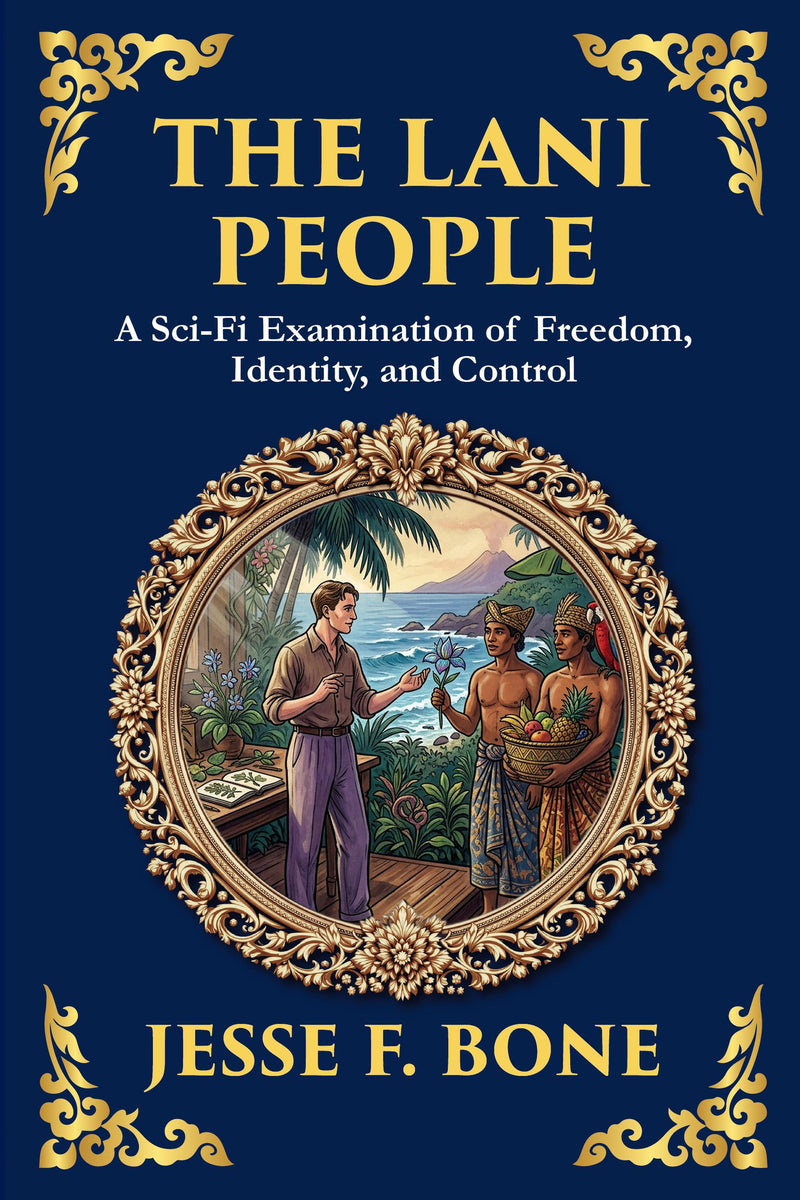
The Lani People
In a distant future where science has blurred the lines between humanity and ownership, the Lani—beautiful, engineered women bred for obedience—live under the control of their human masters.
or free app
10,000+ hrs library
30-day guarantee
The complete The Lani People appears in modern English through Library of Alexandria Press, available online with audiobook narration included for members.
Have you ever wondered why freedom is the one thing that can never be engineered? In The Lani People, Jesse F. Bone crafts a provocative and visionary work of science fiction that examines the fragile boundary between control and humanity. The novel unfolds in a society that has created the Lani, a genetically engineered race of women designed for servitude.
But when a man of conscience arrives, he begins to see them not as property, but as people—with thoughts, desires, and a longing for freedom. What follows is a story that challenges readers to confront deep ethical and philosophical questions about identity, ownership, and the essence of being human.
What you’ll discover in this modern edition
- A Bold Examination of Morality – A story that forces readers to consider the dangers of treating life as property.
- The Struggle for Freedom – The Lani women’s awakening to their individuality and humanity.
- Science Versus the Soul – A gripping conflict where technology collides with compassion.
- The Power of Love and Empathy – How one man’s courage sparks the fight for justice and dignity.
- A Classic of Philosophical Science Fiction – Written with intensity and vision, this novel remains as relevant today as when it was first published. This modern edition preserves the thought-provoking essence of Jesse F.
| Formats | eBook (EPUB + PDF) · Audiobook · Paperback · Hardcover · Large Print |
| Language | English |
| Trim size (print) | 6 × 9 in |
| Binding | Paperback — perfect-bound · Hardcover — casewrap |
| Large Print edition | Same text in a larger, easy-read type — a larger font, not a larger trim |
| Print pricing | Every physical book at our true cost — at-cost, no profit (members) |
| Library | 873 restored titles, always growing |
| Length | 60,324 words · ~4 hr 1 min reading |
| Reading level | Grade 6 · an easy, flowing read (this modern-English edition) |
| Edition | Modern English translation · 2026 |
Member reviews for this edition are collected as readers finish it — be the first. Across the library: 12,000+ books shipped, every plan covered by a 365-day print guarantee.
About this edition
A faithful, unabridged modern-English edition by The Library of Alexandria — carefully rendered for today's reader and verified paragraph-by-paragraph against the public-domain source. Available as eBook, audiobook, paperback, hardcover, and large print.
- Complete & unabridgedVerified paragraph by paragraph against the source — never a scan, never abridged.
- Modern English, faithfulReadable today, with the author’s meaning kept intact. Readable — not simplified.
- Every format, one membershipRead in your browser or the free app, or listen to the full audiobook.
Included free with your membership
Cancel anytime, one click · 30-day money-back guarantee
Edition last updated July 2026
What’s inside
The Lani People — complete and unabridged: all 21 sections included with membership, plus the full audiobook.
Begin reading The Lani People
In clear modern English — the complete text is included with membership.
Introduction
When Jesse F. Bone published The Lani People in 1962, he did so as a man uniquely positioned to write a novel about the boundary between human and animal, between person and property, between the living being who deserves dignity and the creature treated as a thing. Bone was not merely a science fiction author dabbling in moral questions from the comfort of an armchair. He was a Doctor of Veterinary Medicine, a professor of veterinary medicine and surgery, and a researcher who spent his professional life with his hands quite literally on the bodies of animals—understanding their physiology, their suffering, their care, and the strange and uneasy relationship that human beings maintain with the creatures placed under their dominion. It is impossible to read this novel without sensing that double vision behind every page: the clinician who knows exactly how a body works, and the moralist who cannot stop asking what we owe to the beings we control.
That tension is the beating heart of the book you are about to read. On its surface, this is a brisk, colorful piece of mid-century space adventure, complete with distant planets, interstellar commerce, mysterious alien-seeming beings, and a protagonist who arrives at a remote outpost expecting one kind of job and finds himself entangled in something far more consequential. But beneath the adventure runs a current of profound moral inquiry. The Lani People is, in the truest sense, a novel of ideas dressed in the popular costume of pulp science fiction—and that combination is precisely what gives it such enduring power. It asks the oldest and most uncomfortable question a civilization can ask of itself: Who counts as a person? And having asked it, the novel refuses to let either its characters or its readers look away from the answer.
This modern translation and adaptation has been prepared with the contemporary reader firmly in mind. The science fiction of the early 1960s was written for an audience steeped in the conventions of the magazine era, accustomed to a particular cadence of dialogue, a certain density of technical jargon, and assumptions about pacing and reference that can feel distant to a reader encountering the work for the first time today. Our aim in this edition has been to preserve everything that makes Bone’s vision distinctive—his wit, his moral seriousness, his clinician’s eye for detail, the strange beauty of his imagined world—while smoothing the path for a new generation of readers. Archaic turns of phrase have been gently modernized. Sentences that once required a footnote now carry their meaning clearly. The result, we hope, is a reading experience that feels immediate and alive, as though the story were being told to you now, rather than recovered from a yellowed paperback rescued from a secondhand bin. Nothing essential has been lost; what has been gained is accessibility, and with it, the chance for the novel’s questions to land with full force on a reader who may never have heard of Jesse F. Bone but who will not soon forget what he has to say.
A Doctor's Eye and a Moralist's Conscience
To understand why this particular novel matters—and why it has been chosen for inclusion in this series of modern translations—it helps to understand the man and the moment that produced it. Jesse Franklin Bone was born in 1916 and lived a long and remarkably productive life, dying in 2006 after decades spent both in laboratories and at typewriters. His scientific credentials were genuine and substantial: he held an advanced degree in veterinary medicine, taught at the university level, and contributed to professional and scientific literature. This was not a writer pretending to scientific authority for the sake of genre credibility. When Bone described the workings of a body, the logic of a biological system, or the procedures by which living creatures might be studied, bred, and controlled, he wrote from deep and intimate professional knowledge.
This matters enormously for The Lani People, because the novel turns on a question that a veterinarian, of all people, is uniquely qualified to dramatize. Every working day of his life, a veterinarian confronts the moral status of beings who cannot speak for themselves. He decides whose suffering matters and whose does not. He participates in systems—agricultural, commercial, scientific—that treat living creatures as commodities, as units of production, as property to be bought and sold, bred and culled, used and discarded. And he must do all of this while never quite losing sight of the fact that the animal on his table is a feeling thing, capable of fear and pain and, perhaps, something more.
Now imagine that professional sensibility applied to beings who look, speak, and behave almost exactly like human beings—but who, by the legal and social conventions of the world they inhabit, are classified not as people but as animals. That is the imaginative leap at the center of this novel, and it is one that only a writer with Bone’s particular background could have made with such unsettling conviction. The protagonist who arrives at the planet Kardon to take up a post is a medical man himself, and through his professional eyes we are invited to examine a population of beings whose status sits precisely on the knife’s edge between human and creature. The clinical detachment with which they are described—their physiology cataloged, their differences from baseline humanity noted, their value as property assessed—is exactly the detachment a working veterinarian or a working scientist might bring to any animal under study. And it is precisely that detachment, applied to beings so achingly close to human, that produces the novel’s deep and growing horror.
Bone wrote in an era when science fiction was beginning to mature from pure adventure into something more searching and self-aware. The genre had always had a speculative, philosophical streak, but the late 1950s and early 1960s saw a flowering of writers who used the conventions of space opera to interrogate the social arrangements of their own world. The questions of the day—questions about civil rights, about who deserved the full protection of law and the full recognition of humanity, about the moral catastrophes that could be rationalized when one group of beings was defined as fundamentally lesser than another—pressed on the American conscience with mounting urgency. Bone could not address those questions head-on in the genre and the market he was writing for, but he could do something arguably more powerful: he could displace them onto a far-off world, strip away the immediate political associations that might have caused a reader to put up defenses, and force that reader to confront the underlying moral logic in its naked form. This is one of the oldest and most valuable functions of science fiction—to make the familiar strange so that we can see it clearly again—and The Lani People performs that function with remarkable economy and force.
The subtitle of this edition names the novel’s three great themes directly: freedom, identity, and control. These are not abstractions imposed on the book by an editor straining for significance. They are the load-bearing pillars of the entire structure. The question of freedom arises the moment we learn how the Lani live and under what conditions—what they may and may not do, what is done to them, what futures are and are not available to them. The question of identity is even more profound, because the entire moral architecture of the world rests on a single classification: are the Lani people or are they not? Everything follows from the answer. And the question of control permeates every relationship in the book, from the institutional structures that govern the planet to the intimate dynamics between individuals, between owner and owned, between those who decide and those who are decided upon.
What makes The Lani People such a rewarding read is that Bone never lets these heavy themes weigh down the story. This is, first and foremost, a page-turner—a genuine adventure with a likable, capable protagonist, a vividly realized setting, a strong narrative engine, and a momentum that carries you forward chapter by chapter. Bone understood that ideas, however important, do not by themselves make fiction. Fiction is made of character, conflict, desire, and consequence. The moral inquiry at the center of this book works precisely because it is embedded in a story you actually want to read, populated by people you come to care about, leading toward outcomes you find yourself anxious to discover.
The protagonist’s journey is, in the classic mold, both external and internal. Externally, he arrives in a new place, takes up a difficult and demanding role, and finds himself enmeshed in a web of institutional and personal pressures that test his competence and his nerve. Internally—and this is where the novel does its deepest work—he undergoes a transformation of moral vision. He begins, as most of us would, by accepting the world as he finds it. The classifications, the hierarchies, the assumptions about who matters and who doesn’t—these are simply the water he swims in, the unexamined background of ordinary life. The drama of the novel lies in the slow, often painful process by which those unexamined assumptions are dragged into the light and forced to justify themselves. And here is the genius of Bone’s construction: because the reader sees the world through the protagonist’s eyes, the reader’s own assumptions are interrogated at the same time and by the same means. You do not watch a character change his mind from a safe distance. You change yours alongside him.
This is the mark of a novel that has earned its place in a series dedicated to works worth rediscovering. Bone is not lecturing you. He is not delivering a sermon dressed up as a story. He trusts you, as a reader, to feel your way toward the implications, to register the discomfort, to arrive at conclusions that the story itself never crudely states. The most powerful moments in the book are often the quietest—a small detail of treatment, a casual remark, a moment of recognition between two beings who, by the rules of their world, are not supposed to recognize each other as equals. Bone’s clinical prose, his refusal to overdramatize, makes these moments hit harder than any amount of overt moralizing could.
Part of the pleasure of reading older science fiction is encountering the particular flavor of the future as imagined from the past. The Lani People gives us a future of interstellar commerce, of frontier worlds and the corporations and institutions that administer them, of medicine and biology advanced well beyond our own but recognizable in its essential logic. There is a wonderful texture to this imagined universe—a sense of a fully realized society with its own economy, its own professional cultures, its own corruptions and decencies. Bone’s veterinary and scientific background lends this world a grounded plausibility. The institutions feel like real institutions, with real bureaucratic inertia and real human beings making real, fallible decisions inside them. This is not the gleaming, abstract future of much pulp science fiction. It is a lived-in world, with dust on its surfaces and compromise in its hallways.
Modern readers will, of course, notice that the novel is a product of its time. The gender dynamics, the assumptions about relationships and society, the conventions of how a story like this was structured and told in 1962—these reflect the era of the book’s composition. We have chosen, in preparing this edition, to respect that historical character rather than to scrub it away. To do otherwise would be to falsify the work and to deny the reader the genuine experience of encountering a voice from another moment in our cultural history. What we have done is clarify the language, modernize the most distractingly dated phrasings, and ensure that the prose reads smoothly to a contemporary ear. The aim has been to remove the barriers that obscure the book’s enduring power while preserving the authentic voice and vision of its author. We trust you, as a thoughtful reader, to engage with the novel both for what it is—a thrilling and morally serious adventure—and for what it reveals about the time and the mind that produced it.
Cancel anytime, one click · 30-day money-back guarantee
Founding annual rate available now — your price locks for life when you join.
Not ready? Get this free chapter by email — read it anytime.
✓ Sent — check your inbox for The Lani People.
Questions about The Lani People
What is The Lani People about?
In a distant future where science has blurred the lines between humanity and ownership, the Lani—beautiful, engineered women bred for obedience—live under the control of their human masters. But when questions of freedom, love, and dignity arise, the illusion of control begins to shatter. The Lani People is a daring exploration of morality, identity, and the eternal conflict between power and compassion.
Who wrote The Lani People?
The Lani People was written by Jesse F. Bone. This edition presents the complete work in clear modern English, faithfully rendered from the public-domain original by Library of Alexandria Press.
Is The Lani People free to read?
The opening chapter is free to read on this page. Members read and listen to the complete work — and the entire library — free, and can order any physical book at our true print cost.
How long is The Lani People?
21 chapters (~60,324 words) — about 4 hr 1 min of reading in this modern-English edition.
Is this an abridged version of The Lani People?
No. This is the complete, unabridged The Lani People, carefully rendered into clear modern English and verified paragraph-by-paragraph against the public-domain source — nothing is cut or summarised.
What formats does The Lani People come in?
The Lani People is available as eBook, paperback, hardcover and large print. eBook and audiobook are included with membership; printed editions ship at our true print cost.
Shipping & returns
Billing & membership
More from the library


Explore Science Fiction
- The Island of Doctor Moreau · H. G. Wells
- A Midsummer Night’s Dream · William Shakespeare
- The Invisible Man: A Grotesque Romance · H. G. Wells
- The War of the Worlds · H. G. Wells
- The Strange Case of Dr. Jekyll and Mr. Hyde · Robert Louis Stevenson
- Limanora: the island of progress · Godfrey Sweven
- The Book of Dragons · E. Nesbit
- She · H. Rider Haggard
- Dorothy and the Wizard in Oz · L. Frank Baum
- The Princess and the Goblin · George MacDonald
- Gawayne and the Green Knight: A Fairy Tale · Charlton M. Lewis
- Lucian’s True History · Lucian of Samosata
- The Willows · Algernon Blackwood
- The Call of Cthulhu · H. P. Lovecraft
- The Life-Eater · Harold Ward
- The Marvelous Land of Oz · L. Frank Baum
- Mars is My Destination · Frank Belknap Long
- The Black Kiss
- The Beasts in the Void · Paul W. Fairman
- John Jones’s Dollar · Harry Stephen Keeler
- Subversive · Mack Reynolds
- The Mississippi Saucer · Frank Belknap Long
- Man of Distinction · Michael Shaara
- Spawn of the Comet · H. Thompson Rich
- The Golden Judge · Nathaniel Gordon
- Final Weapon · Everett B. Cole
- The Big Fix · George O. Smith
- Last Enemy · H. Beam Piper
- Time and Time Again · H. Beam Piper
- Sabotage in Space · Carey Rockwell
The Lani People
The Lani People
A Sci-Fi Examination of Freedom, Identity, and Control
Jesse F. Bone
Contents
- Introduction
- Chapter 1
- Chapter 2
- Chapter 3
- Chapter 4
- Chapter 5
- Chapter 6
- Chapter 7
- Chapter 8
- Chapter 9
- Chapter 10
- Chapter 11
- Chapter 12
- Chapter 13
- Chapter 14
- Chapter 15
- Chapter 16
- Chapter 17
- Chapter 18
- Chapter 19
- Chapter 20
Introduction
When Jesse F. Bone published The Lani People in 1962, he did so as a man uniquely positioned to write a novel about the boundary between human and animal, between person and property, between the living being who deserves dignity and the creature treated as a thing. Bone was not merely a science fiction author dabbling in moral questions from the comfort of an armchair. He was a Doctor of Veterinary Medicine, a professor of veterinary medicine and surgery, and a researcher who spent his professional life with his hands quite literally on the bodies of animals—understanding their physiology, their suffering, their care, and the strange and uneasy relationship that human beings maintain with the creatures placed under their dominion. It is impossible to read this novel without sensing that double vision behind every page: the clinician who knows exactly how a body works, and the moralist who cannot stop asking what we owe to the beings we control.
That tension is the beating heart of the book you are about to read. On its surface, this is a brisk, colorful piece of mid-century space adventure, complete with distant planets, interstellar commerce, mysterious alien-seeming beings, and a protagonist who arrives at a remote outpost expecting one kind of job and finds himself entangled in something far more consequential. But beneath the adventure runs a current of profound moral inquiry. The Lani People is, in the truest sense, a novel of ideas dressed in the popular costume of pulp science fiction—and that combination is precisely what gives it such enduring power. It asks the oldest and most uncomfortable question a civilization can ask of itself: Who counts as a person? And having asked it, the novel refuses to let either its characters or its readers look away from the answer.
This modern translation and adaptation has been prepared with the contemporary reader firmly in mind. The science fiction of the early 1960s was written for an audience steeped in the conventions of the magazine era, accustomed to a particular cadence of dialogue, a certain density of technical jargon, and assumptions about pacing and reference that can feel distant to a reader encountering the work for the first time today. Our aim in this edition has been to preserve everything that makes Bone’s vision distinctive—his wit, his moral seriousness, his clinician’s eye for detail, the strange beauty of his imagined world—while smoothing the path for a new generation of readers. Archaic turns of phrase have been gently modernized. Sentences that once required a footnote now carry their meaning clearly. The result, we hope, is a reading experience that feels immediate and alive, as though the story were being told to you now, rather than recovered from a yellowed paperback rescued from a secondhand bin. Nothing essential has been lost; what has been gained is accessibility, and with it, the chance for the novel’s questions to land with full force on a reader who may never have heard of Jesse F. Bone but who will not soon forget what he has to say.
A Doctor's Eye and a Moralist's Conscience
To understand why this particular novel matters—and why it has been chosen for inclusion in this series of modern translations—it helps to understand the man and the moment that produced it. Jesse Franklin Bone was born in 1916 and lived a long and remarkably productive life, dying in 2006 after decades spent both in laboratories and at typewriters. His scientific credentials were genuine and substantial: he held an advanced degree in veterinary medicine, taught at the university level, and contributed to professional and scientific literature. This was not a writer pretending to scientific authority for the sake of genre credibility. When Bone described the workings of a body, the logic of a biological system, or the procedures by which living creatures might be studied, bred, and controlled, he wrote from deep and intimate professional knowledge.
This matters enormously for The Lani People, because the novel turns on a question that a veterinarian, of all people, is uniquely qualified to dramatize. Every working day of his life, a veterinarian confronts the moral status of beings who cannot speak for themselves. He decides whose suffering matters and whose does not. He participates in systems—agricultural, commercial, scientific—that treat living creatures as commodities, as units of production, as property to be bought and sold, bred and culled, used and discarded. And he must do all of this while never quite losing sight of the fact that the animal on his table is a feeling thing, capable of fear and pain and, perhaps, something more.
Now imagine that professional sensibility applied to beings who look, speak, and behave almost exactly like human beings—but who, by the legal and social conventions of the world they inhabit, are classified not as people but as animals. That is the imaginative leap at the center of this novel, and it is one that only a writer with Bone’s particular background could have made with such unsettling conviction. The protagonist who arrives at the planet Kardon to take up a post is a medical man himself, and through his professional eyes we are invited to examine a population of beings whose status sits precisely on the knife’s edge between human and creature. The clinical detachment with which they are described—their physiology cataloged, their differences from baseline humanity noted, their value as property assessed—is exactly the detachment a working veterinarian or a working scientist might bring to any animal under study. And it is precisely that detachment, applied to beings so achingly close to human, that produces the novel’s deep and growing horror.
Bone wrote in an era when science fiction was beginning to mature from pure adventure into something more searching and self-aware. The genre had always had a speculative, philosophical streak, but the late 1950s and early 1960s saw a flowering of writers who used the conventions of space opera to interrogate the social arrangements of their own world. The questions of the day—questions about civil rights, about who deserved the full protection of law and the full recognition of humanity, about the moral catastrophes that could be rationalized when one group of beings was defined as fundamentally lesser than another—pressed on the American conscience with mounting urgency. Bone could not address those questions head-on in the genre and the market he was writing for, but he could do something arguably more powerful: he could displace them onto a far-off world, strip away the immediate political associations that might have caused a reader to put up defenses, and force that reader to confront the underlying moral logic in its naked form. This is one of the oldest and most valuable functions of science fiction—to make the familiar strange so that we can see it clearly again—and The Lani People performs that function with remarkable economy and force.
The subtitle of this edition names the novel’s three great themes directly: freedom, identity, and control. These are not abstractions imposed on the book by an editor straining for significance. They are the load-bearing pillars of the entire structure. The question of freedom arises the moment we learn how the Lani live and under what conditions—what they may and may not do, what is done to them, what futures are and are not available to them. The question of identity is even more profound, because the entire moral architecture of the world rests on a single classification: are the Lani people or are they not? Everything follows from the answer. And the question of control permeates every relationship in the book, from the institutional structures that govern the planet to the intimate dynamics between individuals, between owner and owned, between those who decide and those who are decided upon.
What makes The Lani People such a rewarding read is that Bone never lets these heavy themes weigh down the story. This is, first and foremost, a page-turner—a genuine adventure with a likable, capable protagonist, a vividly realized setting, a strong narrative engine, and a momentum that carries you forward chapter by chapter. Bone understood that ideas, however important, do not by themselves make fiction. Fiction is made of character, conflict, desire, and consequence. The moral inquiry at the center of this book works precisely because it is embedded in a story you actually want to read, populated by people you come to care about, leading toward outcomes you find yourself anxious to discover.
The protagonist’s journey is, in the classic mold, both external and internal. Externally, he arrives in a new place, takes up a difficult and demanding role, and finds himself enmeshed in a web of institutional and personal pressures that test his competence and his nerve. Internally—and this is where the novel does its deepest work—he undergoes a transformation of moral vision. He begins, as most of us would, by accepting the world as he finds it. The classifications, the hierarchies, the assumptions about who matters and who doesn’t—these are simply the water he swims in, the unexamined background of ordinary life. The drama of the novel lies in the slow, often painful process by which those unexamined assumptions are dragged into the light and forced to justify themselves. And here is the genius of Bone’s construction: because the reader sees the world through the protagonist’s eyes, the reader’s own assumptions are interrogated at the same time and by the same means. You do not watch a character change his mind from a safe distance. You change yours alongside him.
This is the mark of a novel that has earned its place in a series dedicated to works worth rediscovering. Bone is not lecturing you. He is not delivering a sermon dressed up as a story. He trusts you, as a reader, to feel your way toward the implications, to register the discomfort, to arrive at conclusions that the story itself never crudely states. The most powerful moments in the book are often the quietest—a small detail of treatment, a casual remark, a moment of recognition between two beings who, by the rules of their world, are not supposed to recognize each other as equals. Bone’s clinical prose, his refusal to overdramatize, makes these moments hit harder than any amount of overt moralizing could.
Part of the pleasure of reading older science fiction is encountering the particular flavor of the future as imagined from the past. The Lani People gives us a future of interstellar commerce, of frontier worlds and the corporations and institutions that administer them, of medicine and biology advanced well beyond our own but recognizable in its essential logic. There is a wonderful texture to this imagined universe—a sense of a fully realized society with its own economy, its own professional cultures, its own corruptions and decencies. Bone’s veterinary and scientific background lends this world a grounded plausibility. The institutions feel like real institutions, with real bureaucratic inertia and real human beings making real, fallible decisions inside them. This is not the gleaming, abstract future of much pulp science fiction. It is a lived-in world, with dust on its surfaces and compromise in its hallways.
Modern readers will, of course, notice that the novel is a product of its time. The gender dynamics, the assumptions about relationships and society, the conventions of how a story like this was structured and told in 1962—these reflect the era of the book’s composition. We have chosen, in preparing this edition, to respect that historical character rather than to scrub it away. To do otherwise would be to falsify the work and to deny the reader the genuine experience of encountering a voice from another moment in our cultural history. What we have done is clarify the language, modernize the most distractingly dated phrasings, and ensure that the prose reads smoothly to a contemporary ear. The aim has been to remove the barriers that obscure the book’s enduring power while preserving the authentic voice and vision of its author. We trust you, as a thoughtful reader, to engage with the novel both for what it is—a thrilling and morally serious adventure—and for what it reveals about the time and the mind that produced it.
The boxed ad in the opportunities section of the Kardon Journal of Allied Medical Sciences stood out like a diamond in a pile of gravel. It read: “Wanted: Veterinarian for a residency at an active livestock operation. Single recent graduates preferred. Housing and services provided. Well-equipped hospital. Five-year contract with an option to renew. Starting salary is 15,000 credits per year with periodic raises. Please state your age, school, and marital status, and include a recent tri-di with your application. Address to Box V-9, this journal.”
Jac Kennon read the ad a second time. There had to be a catch. Nothing paying that much could be legitimate. Fifteen thousand a year was top-tier pay even on Beta, and an offer like this for a new graduate was unheard of—unless Kardon was experiencing massive inflation. But it wasn’t. The planet’s economy was rock solid. He knew because he had checked the financial status immediately after landing. Whatever was wrong with Kardon, it wasn’t the money. The exchange rate was 1.2 to 1 Betan.
A five-year contract—he mused—that would be seventy-five thousand. If he budgeted three thousand a year for living expenses, he’d have over sixty thousand in capital to start his own clinic. No bank would turn him down if he had that much cash as collateral.
Kennon gave a wry chuckle. He should probably get the job before he started spending money he didn’t actually have. He had 231 credits plus some change, a veterinary degree, a few textbooks, some instruments, and a first-class spaceman’s ticket. By budgeting carefully, he had enough to live here for a month. If his job search on this planet failed, he could always use his ticket to find another world.
End of the free sample
Keep reading, free
Members read and listen to the complete book — and the entire library. Cancel anytime, one click · 30-day money-back guarantee.