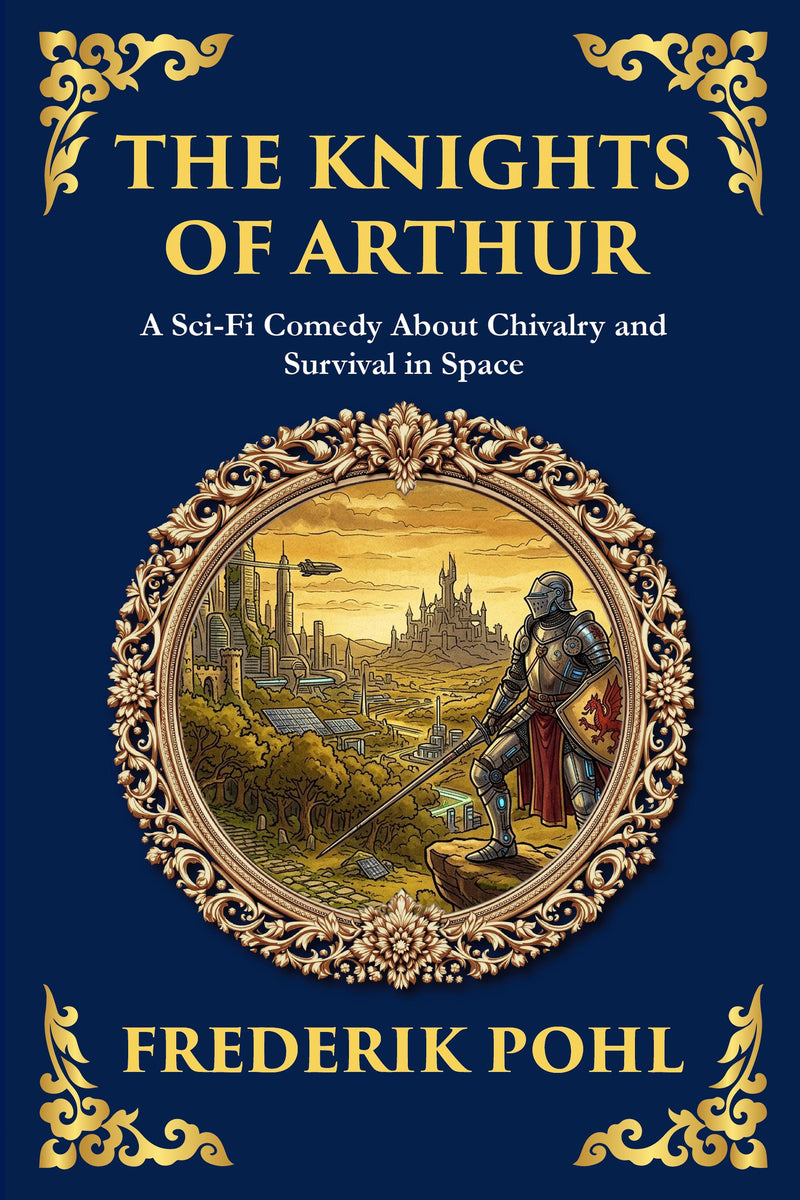
The Knights of Arthur
In The Knights of Arthur, Frederik Pohl delivers a brilliant satire set in a chaotic future where knighthood is less about shining armor and more about staying alive with style.
or free app
10,000+ hrs library
30-day guarantee
The complete The Knights of Arthur appears in modern English through Library of Alexandria Press, available online with audiobook narration included for members.
Have you ever wondered why chivalry survives even when humanity barely does? The Knights of Arthur is a brilliant fusion of space adventure and social satire by science fiction legend Frederik Pohl. Set in a post-collapse America where the future looks suspiciously like a retro-medieval mess, this short novel is equal parts comedy, critique, and cosmic quest.
Meet Don, a wandering ex-truck driver with a knack for trouble and a deep aversion to unnecessary heroics. Along with his sarcastic, semi-sentient computer companion, Arthur, he traverses the ruins of spacefaring civilization. But Don’s quiet scavenger life is upended when he stumbles upon a strange new social order: a group of would-be knights trying to bring back chivalry… in the middle of galactic nowhere.
As Don gets pulled into quests for honor, profit, and occasional survival, Pohl lampoons everything from feudal systems to corporate greed with his signature wit and insight. If Douglas Adams had co-written with Mark Twain, this might have been the result.
What you’ll discover in this modern edition
- A Hilarious Vision of the Future – Explore a world where space travel and feudal pageantry coexist in absurd harmony.
| Formats | eBook (EPUB + PDF) · Audiobook · Paperback · Hardcover · Large Print |
| Language | English |
| Trim size (print) | 6 × 9 in |
| Binding | Paperback — perfect-bound · Hardcover — casewrap |
| Large Print edition | Same text in a larger, easy-read type — a larger font, not a larger trim |
| Print pricing | Every physical book at our true cost — at-cost, no profit (members) |
| Library | 873 restored titles, always growing |
| Length | 17,737 words · ~1 hr 11 min reading |
| Reading level | Grade 7 · an easy, flowing read (this modern-English edition) |
| Edition | Modern English translation · 2026 |
Member reviews for this edition are collected as readers finish it — be the first. Across the library: 12,000+ books shipped, every plan covered by a 365-day print guarantee.
About this edition
A faithful, unabridged modern-English edition by The Library of Alexandria — carefully rendered for today's reader and verified paragraph-by-paragraph against the public-domain source. Available as eBook, audiobook, paperback, hardcover, and large print.
- Complete & unabridgedVerified paragraph by paragraph against the source — never a scan, never abridged.
- Modern English, faithfulReadable today, with the author’s meaning kept intact. Readable — not simplified.
- Every format, one membershipRead in your browser or the free app, or listen to the full audiobook.
Included free with your membership
Cancel anytime, one click · 30-day money-back guarantee
Edition last updated July 2026
What’s inside
The Knights of Arthur — complete and unabridged: all 7 sections included with membership, plus the full audiobook.
Begin reading The Knights of Arthur
In clear modern English — the complete text is included with membership.
Introduction
There are some writers who use science fiction as a telescope, pointing it outward to scan the far reaches of the cosmos for wonders and terrors. And then there are writers like Frederik Pohl, who turn the instrument around and use it as a mirror, holding it up to humanity so that we might laugh, wince, and recognize ourselves in the strange reflections that stare back. The work you are about to read belongs squarely to the second tradition. It is a story that takes the trappings of high adventure — gallant heroes, a noble quest, a damsel of sorts, the romance of a journey through the stars — and gently, mischievously, examines what happens to such grand ideals when they collide with the stubborn realities of human nature, scarce resources, and the small absurdities that govern how people actually behave when survival is on the line.
Frederik Pohl wrote this tale during one of the most fertile and inventive periods of his long career, an era when the science fiction magazines of mid-century America were brimming with talent and competition, and when a clever idea executed with style could earn a writer both admiration and a modest paycheck. Pohl understood, perhaps better than almost any of his contemporaries, that the future would not arrive as a clean, gleaming utopia of chrome and reason. Instead, he suspected — and his fiction repeatedly argues — that whatever marvels technology might bring, we would carry our oldest flaws right along with us into the new world. Greed, vanity, self-deception, the comforting lies we tell ourselves to feel important: these things do not get left behind when we board the rocket. They come along as stowaways, and they are very often the funniest and most revealing passengers aboard.
This particular story is, at its heart, a comedy. But it is a comedy in the richest and most durable sense of the word — not merely a string of jokes, but a clear-eyed and good-humored meditation on how people pursue meaning, status, and dignity in circumstances that conspire to deny them all three. The title invokes chivalry, that gleaming medieval ideal of knights and codes and noble service, and the modern setting transplants those notions into a world of spacecraft and survival. The tension between the grandeur of the ideal and the grubbiness of the reality is precisely where Pohl plants his flag, and it is the soil from which all the book’s humor and its surprising warmth grow.
To appreciate fully what Pohl accomplishes here, it helps to understand the kind of writer he was and the literary moment that shaped him. Frederik Pohl came up through the world of science fiction fandom in the 1930s, a remarkably young and energetic community of enthusiasts who corresponded, argued, published their own amateur magazines, and dreamed of building careers in a genre that the wider literary establishment still regarded with suspicion or outright contempt. Pohl was not merely a fan; he was a participant in the machinery of the field at every level. He worked as a literary agent, representing some of the most important authors of his generation. He served as an editor, shaping the magazines and anthologies that defined what science fiction could be. And throughout it all, he wrote — prolifically, inventively, and with a sensibility that set him apart from many of his peers.
While a great deal of mid-century science fiction was preoccupied with engineering, with the hard mechanics of spaceflight and the heroic competence of square-jawed problem-solvers, Pohl’s imagination tended to drift toward the social and economic dimensions of the future. He was fascinated less by how a machine worked than by what people would do with it, who would profit from it, who would be exploited by it, and how it might warp the relationships between human beings. His most celebrated collaborations and solo works share this quality: a deep skepticism about the promises of progress paired with a genuine, almost tender, curiosity about how ordinary people muddle through. He was the rare science fiction author who understood advertising, salesmanship, bureaucracy, and the soft machinery of persuasion — and he knew how to turn that understanding into stories that felt eerily prescient.
This satirical instinct is everywhere in the present work. Pohl does not lecture. He is far too skilled a craftsman for that. Instead, he builds a world and populates it with characters whose desires and delusions reveal the larger absurdities all on their own. He lets the situation do the talking. When a character clings to a grand title or insists on the trappings of nobility while scrabbling for the basic necessities of life, the contradiction speaks for itself, and it speaks with a comic precision that is unmistakably Pohl’s. There is a particular delight in watching pretension run headlong into circumstance, and Pohl orchestrates these collisions with the timing of a born comedian.
Yet it would be a mistake to read his comedy as mere cynicism. Pohl’s satire is never cruel for its own sake. Beneath the wit lies a real affection for his deluded, scheming, hopeful characters — a recognition that the impulse to dream beyond our means, to dress up our struggles in the borrowed finery of legend, is one of the most human things about us. The knights of his title may be ridiculous, but they are not contemptible. They are us, magnified and exaggerated just enough to be funny, and just enough to be true. This balance between mockery and sympathy is the hallmark of the very best satirists, and Pohl handles it with a sure and generous hand.
The era in which this story first appeared was one in which science fiction was beginning to grow up. The pulp magazines of the earlier decades, with their lurid covers and breathless adventure, were giving way to a more sophisticated and self-aware kind of storytelling. Writers were starting to use the genre’s tools to comment on contemporary anxieties — the Cold War, consumerism, conformity, the dehumanizing pressures of modern life. Pohl was at the forefront of this maturation. He saw that science fiction’s great gift was its ability to take an idea about human society and push it to its logical extreme, to build a world in which that idea governed everything, and then to walk the reader through the consequences. The result, in his hands, was fiction that entertained and provoked in equal measure, that made you laugh out loud and then, a moment later, made you think about why you were laughing.
What you hold in your hands is a product of that golden creative ferment. It carries the energy and economy of a story written for an audience that demanded to be entertained, the polish of a craftsman who had honed his prose through years of relentless practice, and the intellectual playfulness of a mind that simply could not resist poking at the soft underbelly of human ambition. It is, in short, vintage Pohl — and that is high praise indeed.
The Comedy of Survival and the Romance of the Ridiculous
One of the most enduring achievements of this story is the way it manages to be genuinely thrilling while remaining genuinely funny. These two qualities are surprisingly difficult to balance. Comedy tends to deflate tension; tension tends to crowd out laughter. But Pohl threads the needle masterfully, building a narrative in which the stakes feel real — survival, after all, is the most primal stake of them all — while never letting the proceedings tip into grim solemnity. The danger is present, the situation is precarious, and yet the reader is invited to grin at the gap between how the characters see themselves and how they actually are.
Consider the central conceit of the title: knights. The word conjures images of armor and honor, of quests undertaken for love and glory, of a rigid code that elevates the warrior into something noble and almost sacred. Now imagine all of that ceremony and self-regard transplanted into a setting where the fundamentals of life cannot be taken for granted, where the romantic idea of chivalry must somehow coexist with the unglamorous business of staying alive. The comedy practically writes itself, but Pohl does the hard work of making it sing. He understands that the funniest thing in the world is a person who takes themselves seriously in a situation that gives them no right to. And he understands, too, that there is something oddly admirable in that very seriousness — that the human capacity to maintain dignity, ritual, and aspiration even in degraded circumstances is both absurd and strangely heroic.
This is the deep engine of the book’s humor and its heart. The characters cling to their codes and their titles not because those things are practical, but because they are necessary — necessary to a sense of self, to the maintenance of order, to the fragile illusion that life has meaning beyond mere persistence. Pohl invites us to laugh at this, certainly, but he also invites us to recognize that we all do it. We all dress up our daily struggles in narratives that flatter us. We all reach for the borrowed grandeur of some ideal to make sense of our circumstances. The knights in this story are simply doing it more visibly, more literally, and therefore more comically than the rest of us manage to do.
There is a long and noble tradition behind this kind of storytelling. One thinks of Cervantes and his deluded knight tilting at windmills, convinced he was living a chivalric romance while the world around him saw only a foolish old man and a tired horse. Pohl belongs to that lineage — the tradition of writers who use the gap between aspiration and reality as a source of both comedy and pathos. Like Cervantes, Pohl knows that the dreamer who insists on living by an outdated or impractical code is at once the butt of the joke and its hero. The dreamer’s folly is what makes us laugh; the dreamer’s persistence is what makes us care.
But Pohl brings to this tradition something that the writers of earlier centuries could not: the lens of science fiction, with all its capacity to literalize metaphor and to build entire worlds out of a single satirical premise. By placing his story in a setting where survival itself is a daily question and where the conveniences of modern civilization can no longer be assumed, he strips his characters down to their essentials and lets us watch what they cling to when nearly everything else has been taken away. What they cling to, it turns out, is the very thing that makes them human: the need to matter, to belong to something larger than themselves, to be more than their bodies and their hungers.
The pacing of the story reflects Pohl’s background in the fast-moving world of magazine fiction. He does not waste words. The narrative moves briskly, propelled by incident and complication, by the constant friction between what the characters want and what the world will allow them to have. There is a craftsman’s economy to every scene, an awareness that the reader’s attention is a precious thing to be earned and held. And yet the prose is never merely functional. Pohl had a gift for the well-turned phrase, for the wry observation dropped at exactly the right moment, for the kind of comic understatement that rewards careful reading. This is a book that moves quickly enough to be devoured in a sitting or two, but that also rewards the reader who slows down to savor the wit embedded in its sentences.
It is worth noting, too, how skillfully Pohl handles the texture of his imagined world. Lesser writers, when constructing a future or an alien setting, tend either to over-explain — burying the reader in technical detail and exposition — or to under-explain, leaving the world a vague and unconvincing backdrop. Pohl does neither. He gives us exactly enough to make the world feel solid and lived-in, dropping details with a casual confidence that implies a much larger reality just beyond the edges of the page. We believe in his world not because he proves it to us, but because he behaves as though it requires no proof, and that assurance is contagious. The result is a setting that feels both fantastical and grounded, both strange and familiar — the perfect stage for a comedy of human nature.
Cancel anytime, one click · 30-day money-back guarantee
Founding annual rate available now — your price locks for life when you join.
Not ready? Get this free chapter by email — read it anytime.
✓ Sent — check your inbox for The Knights of Arthur.
Questions about The Knights of Arthur
What is The Knights of Arthur about?
In The Knights of Arthur, Frederik Pohl delivers a brilliant satire set in a chaotic future where knighthood is less about shining armor and more about staying alive with style. Join the reluctant hero, Don, and his talking computer buddy as they navigate a bizarre, crumbling society of outlaws, robots, and pseudo-medieval misfits—all while trying to survive long enough to make a buck. Hilarious, sharply observant, and surprisingly heartfelt, this sci-fi cult classic pokes fun at everything from bureaucracy to hero
Who wrote The Knights of Arthur?
The Knights of Arthur was written by Frederik Pohl. This edition presents the complete work in clear modern English, faithfully rendered from the public-domain original by Library of Alexandria Press.
Is The Knights of Arthur free to read?
The opening chapter is free to read on this page. Members read and listen to the complete work — and the entire library — free, and can order any physical book at our true print cost.
How long is The Knights of Arthur?
7 chapters (~17,737 words) — about 1 hr 11 min of reading in this modern-English edition.
Is this an abridged version of The Knights of Arthur?
No. This is the complete, unabridged The Knights of Arthur, carefully rendered into clear modern English and verified paragraph-by-paragraph against the public-domain source — nothing is cut or summarised.
What formats does The Knights of Arthur come in?
The Knights of Arthur is available as eBook, paperback, hardcover and large print. eBook and audiobook are included with membership; printed editions ship at our true print cost.
Shipping & returns
Billing & membership
More from the library


Explore Science Fiction
- The Island of Doctor Moreau · H. G. Wells
- A Midsummer Night’s Dream · William Shakespeare
- The Invisible Man: A Grotesque Romance · H. G. Wells
- The War of the Worlds · H. G. Wells
- The Strange Case of Dr. Jekyll and Mr. Hyde · Robert Louis Stevenson
- Limanora: the island of progress · Godfrey Sweven
- The Book of Dragons · E. Nesbit
- She · H. Rider Haggard
- Dorothy and the Wizard in Oz · L. Frank Baum
- The Princess and the Goblin · George MacDonald
- Gawayne and the Green Knight: A Fairy Tale · Charlton M. Lewis
- Lucian’s True History · Lucian of Samosata
- The Willows · Algernon Blackwood
- The Call of Cthulhu · H. P. Lovecraft
- The Life-Eater · Harold Ward
- The Marvelous Land of Oz · L. Frank Baum
- Mars is My Destination · Frank Belknap Long
- The Black Kiss
- The Beasts in the Void · Paul W. Fairman
- John Jones’s Dollar · Harry Stephen Keeler
- Subversive · Mack Reynolds
- The Mississippi Saucer · Frank Belknap Long
- Man of Distinction · Michael Shaara
- Spawn of the Comet · H. Thompson Rich
- The Golden Judge · Nathaniel Gordon
- Final Weapon · Everett B. Cole
- The Big Fix · George O. Smith
- Last Enemy · H. Beam Piper
- Time and Time Again · H. Beam Piper
- Sabotage in Space · Carey Rockwell
The Knights of Arthur
The Knights of Arthur
A Sci-Fi Comedy About Chivalry and Survival in Space
Frederik Pohl
Contents
- Introduction
- Chapter 1
- Chapter 2
- Chapter 3
- Chapter 4
- Chapter 5
- Chapter 6
Introduction
There are some writers who use science fiction as a telescope, pointing it outward to scan the far reaches of the cosmos for wonders and terrors. And then there are writers like Frederik Pohl, who turn the instrument around and use it as a mirror, holding it up to humanity so that we might laugh, wince, and recognize ourselves in the strange reflections that stare back. The work you are about to read belongs squarely to the second tradition. It is a story that takes the trappings of high adventure — gallant heroes, a noble quest, a damsel of sorts, the romance of a journey through the stars — and gently, mischievously, examines what happens to such grand ideals when they collide with the stubborn realities of human nature, scarce resources, and the small absurdities that govern how people actually behave when survival is on the line.
Frederik Pohl wrote this tale during one of the most fertile and inventive periods of his long career, an era when the science fiction magazines of mid-century America were brimming with talent and competition, and when a clever idea executed with style could earn a writer both admiration and a modest paycheck. Pohl understood, perhaps better than almost any of his contemporaries, that the future would not arrive as a clean, gleaming utopia of chrome and reason. Instead, he suspected — and his fiction repeatedly argues — that whatever marvels technology might bring, we would carry our oldest flaws right along with us into the new world. Greed, vanity, self-deception, the comforting lies we tell ourselves to feel important: these things do not get left behind when we board the rocket. They come along as stowaways, and they are very often the funniest and most revealing passengers aboard.
This particular story is, at its heart, a comedy. But it is a comedy in the richest and most durable sense of the word — not merely a string of jokes, but a clear-eyed and good-humored meditation on how people pursue meaning, status, and dignity in circumstances that conspire to deny them all three. The title invokes chivalry, that gleaming medieval ideal of knights and codes and noble service, and the modern setting transplants those notions into a world of spacecraft and survival. The tension between the grandeur of the ideal and the grubbiness of the reality is precisely where Pohl plants his flag, and it is the soil from which all the book’s humor and its surprising warmth grow.
To appreciate fully what Pohl accomplishes here, it helps to understand the kind of writer he was and the literary moment that shaped him. Frederik Pohl came up through the world of science fiction fandom in the 1930s, a remarkably young and energetic community of enthusiasts who corresponded, argued, published their own amateur magazines, and dreamed of building careers in a genre that the wider literary establishment still regarded with suspicion or outright contempt. Pohl was not merely a fan; he was a participant in the machinery of the field at every level. He worked as a literary agent, representing some of the most important authors of his generation. He served as an editor, shaping the magazines and anthologies that defined what science fiction could be. And throughout it all, he wrote — prolifically, inventively, and with a sensibility that set him apart from many of his peers.
While a great deal of mid-century science fiction was preoccupied with engineering, with the hard mechanics of spaceflight and the heroic competence of square-jawed problem-solvers, Pohl’s imagination tended to drift toward the social and economic dimensions of the future. He was fascinated less by how a machine worked than by what people would do with it, who would profit from it, who would be exploited by it, and how it might warp the relationships between human beings. His most celebrated collaborations and solo works share this quality: a deep skepticism about the promises of progress paired with a genuine, almost tender, curiosity about how ordinary people muddle through. He was the rare science fiction author who understood advertising, salesmanship, bureaucracy, and the soft machinery of persuasion — and he knew how to turn that understanding into stories that felt eerily prescient.
This satirical instinct is everywhere in the present work. Pohl does not lecture. He is far too skilled a craftsman for that. Instead, he builds a world and populates it with characters whose desires and delusions reveal the larger absurdities all on their own. He lets the situation do the talking. When a character clings to a grand title or insists on the trappings of nobility while scrabbling for the basic necessities of life, the contradiction speaks for itself, and it speaks with a comic precision that is unmistakably Pohl’s. There is a particular delight in watching pretension run headlong into circumstance, and Pohl orchestrates these collisions with the timing of a born comedian.
Yet it would be a mistake to read his comedy as mere cynicism. Pohl’s satire is never cruel for its own sake. Beneath the wit lies a real affection for his deluded, scheming, hopeful characters — a recognition that the impulse to dream beyond our means, to dress up our struggles in the borrowed finery of legend, is one of the most human things about us. The knights of his title may be ridiculous, but they are not contemptible. They are us, magnified and exaggerated just enough to be funny, and just enough to be true. This balance between mockery and sympathy is the hallmark of the very best satirists, and Pohl handles it with a sure and generous hand.
The era in which this story first appeared was one in which science fiction was beginning to grow up. The pulp magazines of the earlier decades, with their lurid covers and breathless adventure, were giving way to a more sophisticated and self-aware kind of storytelling. Writers were starting to use the genre’s tools to comment on contemporary anxieties — the Cold War, consumerism, conformity, the dehumanizing pressures of modern life. Pohl was at the forefront of this maturation. He saw that science fiction’s great gift was its ability to take an idea about human society and push it to its logical extreme, to build a world in which that idea governed everything, and then to walk the reader through the consequences. The result, in his hands, was fiction that entertained and provoked in equal measure, that made you laugh out loud and then, a moment later, made you think about why you were laughing.
What you hold in your hands is a product of that golden creative ferment. It carries the energy and economy of a story written for an audience that demanded to be entertained, the polish of a craftsman who had honed his prose through years of relentless practice, and the intellectual playfulness of a mind that simply could not resist poking at the soft underbelly of human ambition. It is, in short, vintage Pohl — and that is high praise indeed.
The Comedy of Survival and the Romance of the Ridiculous
One of the most enduring achievements of this story is the way it manages to be genuinely thrilling while remaining genuinely funny. These two qualities are surprisingly difficult to balance. Comedy tends to deflate tension; tension tends to crowd out laughter. But Pohl threads the needle masterfully, building a narrative in which the stakes feel real — survival, after all, is the most primal stake of them all — while never letting the proceedings tip into grim solemnity. The danger is present, the situation is precarious, and yet the reader is invited to grin at the gap between how the characters see themselves and how they actually are.
Consider the central conceit of the title: knights. The word conjures images of armor and honor, of quests undertaken for love and glory, of a rigid code that elevates the warrior into something noble and almost sacred. Now imagine all of that ceremony and self-regard transplanted into a setting where the fundamentals of life cannot be taken for granted, where the romantic idea of chivalry must somehow coexist with the unglamorous business of staying alive. The comedy practically writes itself, but Pohl does the hard work of making it sing. He understands that the funniest thing in the world is a person who takes themselves seriously in a situation that gives them no right to. And he understands, too, that there is something oddly admirable in that very seriousness — that the human capacity to maintain dignity, ritual, and aspiration even in degraded circumstances is both absurd and strangely heroic.
This is the deep engine of the book’s humor and its heart. The characters cling to their codes and their titles not because those things are practical, but because they are necessary — necessary to a sense of self, to the maintenance of order, to the fragile illusion that life has meaning beyond mere persistence. Pohl invites us to laugh at this, certainly, but he also invites us to recognize that we all do it. We all dress up our daily struggles in narratives that flatter us. We all reach for the borrowed grandeur of some ideal to make sense of our circumstances. The knights in this story are simply doing it more visibly, more literally, and therefore more comically than the rest of us manage to do.
There is a long and noble tradition behind this kind of storytelling. One thinks of Cervantes and his deluded knight tilting at windmills, convinced he was living a chivalric romance while the world around him saw only a foolish old man and a tired horse. Pohl belongs to that lineage — the tradition of writers who use the gap between aspiration and reality as a source of both comedy and pathos. Like Cervantes, Pohl knows that the dreamer who insists on living by an outdated or impractical code is at once the butt of the joke and its hero. The dreamer’s folly is what makes us laugh; the dreamer’s persistence is what makes us care.
But Pohl brings to this tradition something that the writers of earlier centuries could not: the lens of science fiction, with all its capacity to literalize metaphor and to build entire worlds out of a single satirical premise. By placing his story in a setting where survival itself is a daily question and where the conveniences of modern civilization can no longer be assumed, he strips his characters down to their essentials and lets us watch what they cling to when nearly everything else has been taken away. What they cling to, it turns out, is the very thing that makes them human: the need to matter, to belong to something larger than themselves, to be more than their bodies and their hungers.
The pacing of the story reflects Pohl’s background in the fast-moving world of magazine fiction. He does not waste words. The narrative moves briskly, propelled by incident and complication, by the constant friction between what the characters want and what the world will allow them to have. There is a craftsman’s economy to every scene, an awareness that the reader’s attention is a precious thing to be earned and held. And yet the prose is never merely functional. Pohl had a gift for the well-turned phrase, for the wry observation dropped at exactly the right moment, for the kind of comic understatement that rewards careful reading. This is a book that moves quickly enough to be devoured in a sitting or two, but that also rewards the reader who slows down to savor the wit embedded in its sentences.
It is worth noting, too, how skillfully Pohl handles the texture of his imagined world. Lesser writers, when constructing a future or an alien setting, tend either to over-explain — burying the reader in technical detail and exposition — or to under-explain, leaving the world a vague and unconvincing backdrop. Pohl does neither. He gives us exactly enough to make the world feel solid and lived-in, dropping details with a casual confidence that implies a much larger reality just beyond the edges of the page. We believe in his world not because he proves it to us, but because he behaves as though it requires no proof, and that assurance is contagious. The result is a setting that feels both fantastical and grounded, both strange and familiar — the perfect stage for a comedy of human nature.
There were three of us—if you count Arthur. We split up to avoid drawing attention. Engdahl just came across the big bridge, but since I had Arthur with me, I had to take the long way around.
When I checked in at the desk, I told them I was from Chicago. You know how it is. If you say you’re from Philadelphia, it’s like saying you’re from St. Louis or Detroit—basically, nobody lives in Philadelphia anymore. It just shows how things change. A few years ago, Philadelphia was the place to be. But not anymore, and I wanted to make a good impression.
I even gave the bellboy a hundred-and-fifty-dollar tip. I told him, “Do me a favor. My luggage is booby-trapped—“
“Sure,” he said, barely impressed by the money and even less impressed by me.
“I mean actually booby-trapped. Not just a burglar alarm. Along with the alarm, there’s a little surprise on a short fuse. So, if you hear the alarm go off, I want you to come running. Got it?”
“And get my head blown off?” He slammed my bags onto the floor. “Sir, you can take your damn money and—“
“Hold on a second, friend.” I handed him another hundred. “Please? It’s just a shaped charge. It won’t hurt anything except whoever messes with it, see? But I don’t want it to go off. So just come running when you hear the alarm to scare them away and—“
“No!” But he sounded less sure now. I gave him two hundred more, and he grudgingly agreed. “Fine. If I hear it. By the way, what’s in there that’s worth all this trouble?”
“I’m not kidding, it’s just personal stuff. It’s not worth a dime to anyone but me, understand? So don’t get any ideas—“
He sounded offended. “Sir, obviously the staff won’t touch your things. What kind of hotel do you think this is?”
End of the free sample
Keep reading, free
Members read and listen to the complete book — and the entire library. Cancel anytime, one click · 30-day money-back guarantee.