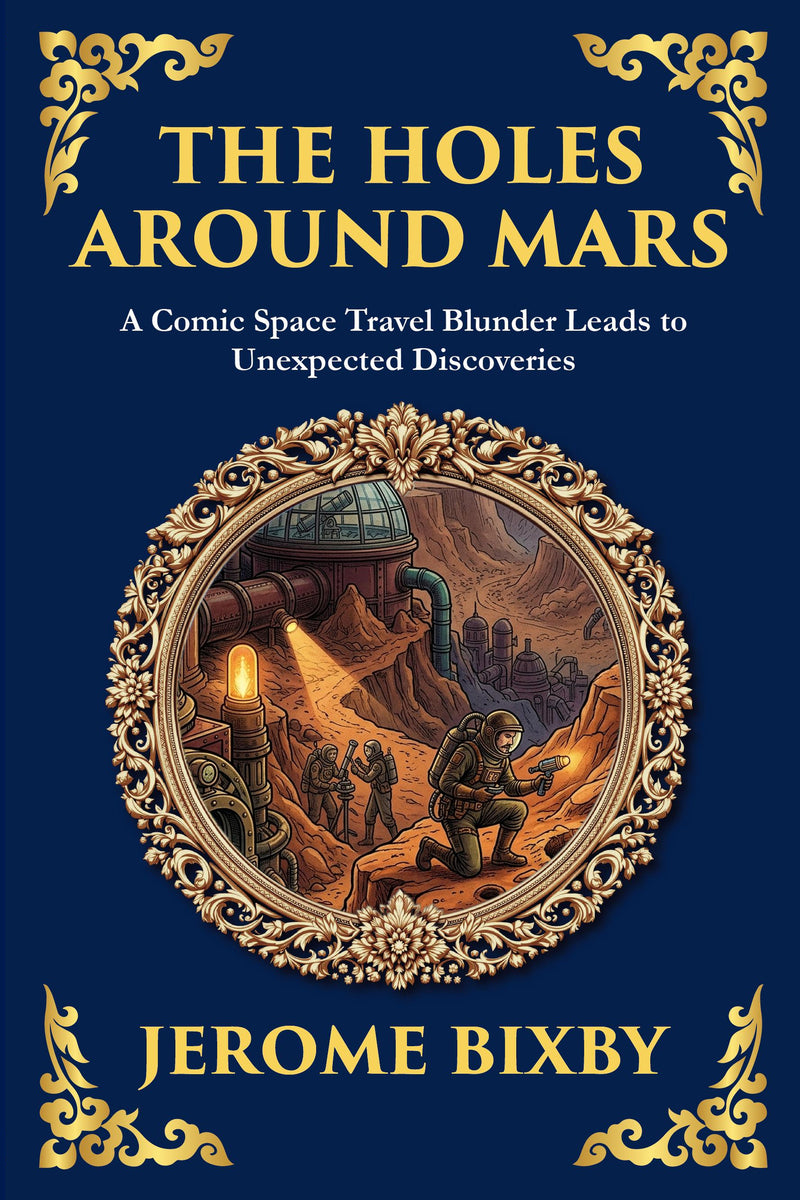
The Holes Around Mars
What happens when a mission to Mars becomes less about discovery and more about blunder? In The Holes Around Mars, Jerome Bixby delivers a sharp-witted, satirical tale of interplanetary travel gone awry.
or free app
10,000+ hrs library
30-day guarantee
The complete The Holes Around Mars appears in modern English through Library of Alexandria Press, available online with audiobook narration included for members.
Have you ever wondered why mistakes often lead to the most remarkable discoveries? In The Holes Around Mars, Jerome Bixby transforms space exploration into a delightful comedy of errors, where the mysteries of the cosmos are matched only by the absurdities of human logic. What begins as a straightforward Martian expedition quickly spirals into a hilarious and thought-provoking journey, filled with puzzling holes, strange landscapes, and questions that defy easy answers.
Bixby, known for his witty science fiction and playful approach to big ideas, crafts a short masterpiece that blends humor, irony, and speculation into an unforgettable interstellar romp. Perfect for fans of classic science fiction with a comic twist, The Holes Around Mars shows that not every great discovery comes from brilliance—sometimes, it comes from blunders.
What you’ll discover in this modern edition
- A Comic Martian Adventure – Follow astronauts who stumble into confusion and hilarity as they explore Mars.
- A Satire of Space Travel – A witty reminder that even in the future, human folly remains universal.
- A Classic Science Fiction Tale – Written by Jerome Bixby, the creative mind behind some of sci-fi’s most enduring works.
- A Story That Blends Humor with Wonder – Experience a mix of cosmic comedy and thought-provoking ideas about discovery.
| Formats | eBook (EPUB + PDF) · Audiobook · Paperback · Hardcover · Large Print |
| Language | English |
| Trim size (print) | 6 × 9 in |
| Binding | Paperback — perfect-bound · Hardcover — casewrap |
| Large Print edition | Same text in a larger, easy-read type — a larger font, not a larger trim |
| Print pricing | Every physical book at our true cost — at-cost, no profit (members) |
| Library | 873 restored titles, always growing |
| Length | 8,862 words · ~35 min reading |
| Reading level | Grade 5 · an easy, flowing read (this modern-English edition) |
| Edition | Modern English translation · 2026 |
Member reviews for this edition are collected as readers finish it — be the first. Across the library: 12,000+ books shipped, every plan covered by a 365-day print guarantee.
About this edition
A faithful, unabridged modern-English edition by The Library of Alexandria — carefully rendered for today's reader and verified paragraph-by-paragraph against the public-domain source. Available as eBook, audiobook, paperback, hardcover, and large print.
- Complete & unabridgedVerified paragraph by paragraph against the source — never a scan, never abridged.
- Modern English, faithfulReadable today, with the author’s meaning kept intact. Readable — not simplified.
- Every format, one membershipRead in your browser or the free app, or listen to the full audiobook.
Included free with your membership
Cancel anytime, one click · 30-day money-back guarantee
Edition last updated July 2026
What’s inside
The Holes Around Mars — complete and unabridged, included in full with membership, plus the full audiobook.
Begin reading The Holes Around Mars
In clear modern English — the complete text is included with membership.
Introduction
There is a particular kind of pleasure that comes from a story that knows exactly what it is. It does not pretend to be more than it sets out to be, and in that confidence it becomes something larger than its modest premise ever promised. Jerome Bixby’s The Holes Around Mars is precisely this sort of story: a brisk, witty, gleefully inventive piece of mid-century science fiction that wears its absurdity like a badge of honor while quietly tucking a genuine puzzle—and a genuine sense of wonder—into its back pocket. To open it is to step into an era when imagining the planets was a kind of national pastime, when the red dot of Mars hanging in the night sky was less a destination than a dare, and when a writer could take an outlandish idea, follow it to its logical conclusion, and produce something both ridiculous and strangely beautiful.
This edition presents the tale in a modern translation, adapted for the contemporary reader. That phrase deserves a moment of explanation, because it shapes everything about how you will experience the pages ahead. The original story belongs to a specific moment in the history of imaginative writing, a moment with its own rhythms of speech, its own assumptions about science and society, and its own conventions of how a story should be told aloud to an audience hungry for the future. Some of those conventions have aged gracefully; others have grown stiff with time, like old leather left in a drawer. The aim of this adaptation is not to sand away the personality of the work—heaven forbid—but to clear the small obstacles that can trip up a reader encountering it fresh, so that the humor lands as crisply as it did when it first appeared, and the ideas shine without the dust of dated phrasing obscuring them. What you hold is meant to feel immediate, alive, and conversational, the way the best science fiction always sounds when read by lamplight with the rest of the house asleep.
Before we go any further, a promise: nothing in this introduction will spoil the central surprises of the story. Bixby built this little machine with great care, and half its joy is the slow dawning realization of what is actually going on. To reveal the workings in advance would be like explaining a magic trick before the magician has finished his patter. So we will circle the story, admire it from the outside, set it in its proper context, and prepare you to enjoy it—but the trick itself remains yours to discover. Read on without fear.
A Writer Who Made Strangeness Feel Familiar
To understand the particular flavor of this story, it helps to know a little about the man who wrote it and the world that produced him. Jerome Bixby was one of those gloriously versatile talents who flourished in the great proliferation of American genre writing in the middle of the twentieth century. He was a working writer in the truest sense—a man who could turn his hand to a tense horror tale, a sweeping space adventure, or a quiet domestic eeriness, and who understood that the foundation of all of it was story. He is perhaps best remembered today for a handful of works that escaped the magazines and lodged themselves permanently in the cultural imagination, including a famous and deeply unsettling tale about a small boy with terrible powers that became one of the most celebrated episodes of a beloved television anthology series. But Bixby’s range was enormous, and his bibliography is studded with stories that demonstrate a restless, playful intelligence forever testing the boundaries of an idea to see how far it would stretch.
What unites Bixby’s best work is a certain mischievous precision. He liked premises that could be stated in a single sentence and then explored with rigorous, almost mathematical delight. Give him a strange rule about how the universe works, and he would follow that rule with the seriousness of a logician and the grin of a prankster. This is exactly the engine that powers the story before you. The setup is comic—even slapstick, in the best tradition of the bumbling expedition and the well-meaning crew getting in over their heads—but the comedy is never lazy. It is built on a real idea, a “what if” that Bixby pursues with such commitment that the absurdity curdles into something genuinely thought-provoking. By the time you reach the final pages, you may find that the laughs have given way to a quiet, almost philosophical astonishment. That is the Bixby signature: he makes you smile, and then he makes you wonder, and you are never entirely sure when one became the other.
The mid-century period in which this story appeared was a golden age for short science fiction. The magazines of the day were hungry for material, and writers competed to deliver clever, surprising, idea-driven tales that could grab a reader on a crowded train or in a quiet evening chair and refuse to let go. This was an environment that rewarded economy, wit, and a strong hook. A story had to earn its place among dozens of competitors, and the best of them developed a kind of muscular efficiency—not a word wasted, every paragraph pulling its weight, the whole thing built like a well-tuned engine designed to deliver maximum delight in minimum space. The Holes Around Mars is a beautiful specimen of this craft. It does not waste your time. It introduces its characters, establishes its situation, plants its seeds of wonder, and pays everything off with the satisfying click of a well-made lock. There is real artistry in this economy, and part of the joy of reading the story today is appreciating just how much Bixby accomplishes in such a compact space.
It is worth pausing, too, on the cultural fascination with Mars that hums beneath the surface of this tale. For generations, the red planet held a unique place in the human imagination. It was close enough to seem reachable, mysterious enough to invite endless speculation, and just visible enough to the naked eye to feel personal, almost intimate. Astronomers had spent decades peering at it through telescopes, debating the meaning of the markings on its surface, spinning theories about canals and civilizations and the possibility of life. By the time Bixby was writing, Mars had become a kind of communal dreaming-ground, a blank slate onto which writers projected every hope and anxiety about humanity’s future among the stars. The very title of this story announces its participation in that grand tradition while signaling, with that delightful and slightly baffling phrase about holes, that it intends to do something a little different with the familiar setting. That tension—between the well-worn romance of Mars and the unexpected, almost geometric strangeness Bixby introduces—is one of the great pleasures awaiting you.
The Comedy of Discovery and the Discovery of Comedy
Science fiction has always had a complicated relationship with humor. The genre is so often associated with grand themes—the fate of civilizations, the loneliness of the cosmos, the terror of the unknown—that we sometimes forget how naturally funny the situation of human beings in space actually is. Here we are, fragile and absurd creatures, hauling our coffee and our quarrels and our petty vanities across the void, encountering phenomena that make a mockery of everything we thought we understood. There is comedy in that gap between our pretensions and our limitations, and the writers who recognized this produced some of the most enduring work in the field. Bixby was one of them. He understood that wonder and laughter are not opposites but cousins, both born from the same sudden confrontation with the unexpected. The gasp and the giggle come from the same place.
In this story, the humor arrives early and stays late. There is a wonderful tradition in adventure writing of the expedition that goes sideways—the carefully planned mission that collides with reality and produces chaos, confusion, and the kind of human comedy that emerges when professionals are forced to improvise. Bixby leans into this with obvious affection. His crew are not gleaming heroes of the spaceways but recognizable people, with their irritations and their improvisations and their tendency to talk past one another at exactly the wrong moment. The voice of the storytelling carries a knowing, almost twinkling quality, as if the narrator is leaning in close to share a particularly good tale with the assurance that you, the listener, are smart enough to enjoy the joke. This conversational warmth is one of the qualities the present adaptation has worked hard to preserve and even amplify, smoothing the older cadences so that the comic timing—which is everything in a story like this—remains sharp and true.
But here is the crucial thing, the thing that elevates this story above mere comic diversion: the joke and the wonder are the same joke and the same wonder. The very feature of the situation that produces the laughs is also the feature that produces the awe. Bixby has constructed a premise where the absurdity is the marvel, where the thing that makes you smile is also the thing that makes you sit back and think, “Wait—how would that actually work?” And then, because Bixby is a careful and honest writer, he tells you exactly how it would work, and the explanation is so satisfying, so neatly logical, that the smile becomes something closer to delight. This is the rarest and finest kind of science fiction comedy—the kind that does not undercut the science but celebrates it, the kind that finds the genuine strangeness of the universe to be the best joke of all.
The “unexpected discoveries” promised in the subtitle are real, and they are worth waiting for. Without revealing anything, I can say that the pleasure of the story is the pleasure of watching a mystery assemble itself piece by piece, each new observation adding to a picture that the characters—and the reader—slowly come to understand. There is a detective-story quality to it, a sense of clues being laid down and then snapped together in a moment of revelation. Bixby plays fair with his readers, which is the highest compliment one can pay a writer of puzzle-stories. He gives you everything you need to anticipate the solution, and yet the solution still lands with the force of surprise, because he has been clever about where he points your attention. When the final pieces fall into place, you may well want to flip back through the earlier pages to admire how thoroughly the conclusion was prepared. That re-reading is one of the great gifts of a well-built tale, and this one rewards it richly.
There is also a tenderness to the story that sneaks up on you. Beneath the comedy and the cleverness, Bixby is interested in the human encounter with the genuinely new—the way our minds struggle to accommodate phenomena that do not fit our existing categories, and the way curiosity, that most human of impulses, drives us forward even when we are confused and out of our depth. The crew of his expedition are funny precisely because they are trying so hard to make sense of something that initially makes no sense at all. And in that effort—the squinting, the arguing, the measuring, the slowly dawning comprehension—Bixby captures something genuinely moving about the scientific spirit. We are creatures who cannot leave a mystery alone. We have to know. We have to understand. And the universe, it turns out, is full of things designed (or accidentally formed) to test that need to the limit. The story is, in its quiet way, a celebration of that restless human hunger to comprehend, dressed up in the cheerful clothing of a space comedy.
How to Read This Edition, and Why It Matters
A word now about the experience of reading older science fiction in a modern adaptation, because understanding the philosophy behind this edition will help you settle into the right frame of mind. When a story comes to us from an earlier generation of writing, it arrives bearing the marks of its origin. The slang is of its time. The technological assumptions reflect a world before certain discoveries and after others. The pacing follows the conventions of the magazine market that nurtured it. None of these things are flaws, exactly—they are part of the texture of the work, the fingerprints of the moment that made it. But for a contemporary reader encountering the story for the first time, some of these period qualities can act as small barriers, tiny moments of friction that pull you out of the experience and remind you that you are reading something old. A reference that no longer parses. A turn of phrase that has shifted meaning. A rhythm of dialogue that feels mannered to a modern ear.
Cancel anytime, one click · 30-day money-back guarantee
Founding annual rate available now — your price locks for life when you join.
Not ready? Get this free chapter by email — read it anytime.
✓ Sent — check your inbox for The Holes Around Mars.
Questions about The Holes Around Mars
What is The Holes Around Mars about?
What happens when a mission to Mars becomes less about discovery and more about blunder? In The Holes Around Mars, Jerome Bixby delivers a sharp-witted, satirical tale of interplanetary travel gone awry. When astronauts encounter bizarre phenomena on the Red Planet, confusion, comedy, and unexpected revelations ensue.
Who wrote The Holes Around Mars?
The Holes Around Mars was written by Jerome Bixby. This edition presents the complete work in clear modern English, faithfully rendered from the public-domain original by Library of Alexandria Press.
Is The Holes Around Mars free to read?
The opening chapter is free to read on this page. Members read and listen to the complete work — and the entire library — free, and can order any physical book at our true print cost.
How long is The Holes Around Mars?
2 chapters (~8,862 words) — about 35 min of reading in this modern-English edition.
Is this an abridged version of The Holes Around Mars?
No. This is the complete, unabridged The Holes Around Mars, carefully rendered into clear modern English and verified paragraph-by-paragraph against the public-domain source — nothing is cut or summarised.
What formats does The Holes Around Mars come in?
The Holes Around Mars is available as eBook, paperback, hardcover and large print. eBook and audiobook are included with membership; printed editions ship at our true print cost.
Shipping & returns
Billing & membership
More from the library


Explore Science Fiction
- The Island of Doctor Moreau · H. G. Wells
- A Midsummer Night’s Dream · William Shakespeare
- The Invisible Man: A Grotesque Romance · H. G. Wells
- The War of the Worlds · H. G. Wells
- The Strange Case of Dr. Jekyll and Mr. Hyde · Robert Louis Stevenson
- Limanora: the island of progress · Godfrey Sweven
- The Book of Dragons · E. Nesbit
- She · H. Rider Haggard
- Dorothy and the Wizard in Oz · L. Frank Baum
- The Princess and the Goblin · George MacDonald
- Gawayne and the Green Knight: A Fairy Tale · Charlton M. Lewis
- Lucian’s True History · Lucian of Samosata
- The Willows · Algernon Blackwood
- The Call of Cthulhu · H. P. Lovecraft
- The Life-Eater · Harold Ward
- The Marvelous Land of Oz · L. Frank Baum
- Mars is My Destination · Frank Belknap Long
- The Black Kiss
- The Beasts in the Void · Paul W. Fairman
- John Jones’s Dollar · Harry Stephen Keeler
- Subversive · Mack Reynolds
- The Mississippi Saucer · Frank Belknap Long
- Man of Distinction · Michael Shaara
- Spawn of the Comet · H. Thompson Rich
- The Golden Judge · Nathaniel Gordon
- Final Weapon · Everett B. Cole
- The Big Fix · George O. Smith
- Last Enemy · H. Beam Piper
- Time and Time Again · H. Beam Piper
- Sabotage in Space · Carey Rockwell
The Holes Around Mars
The Holes Around Mars
A Funny Space Travel Mistake Leads to Unexpected Discoveries
Jerome Bixby
Contents
- Introduction
- The Holes Around Mars
Introduction
There is a particular kind of pleasure that comes from a story that knows exactly what it is. It does not pretend to be more than it sets out to be, and in that confidence it becomes something larger than its modest premise ever promised. Jerome Bixby’s The Holes Around Mars is precisely this sort of story: a brisk, witty, gleefully inventive piece of mid-century science fiction that wears its absurdity like a badge of honor while quietly tucking a genuine puzzle—and a genuine sense of wonder—into its back pocket. To open it is to step into an era when imagining the planets was a kind of national pastime, when the red dot of Mars hanging in the night sky was less a destination than a dare, and when a writer could take an outlandish idea, follow it to its logical conclusion, and produce something both ridiculous and strangely beautiful.
This edition presents the tale in a modern translation, adapted for the contemporary reader. That phrase deserves a moment of explanation, because it shapes everything about how you will experience the pages ahead. The original story belongs to a specific moment in the history of imaginative writing, a moment with its own rhythms of speech, its own assumptions about science and society, and its own conventions of how a story should be told aloud to an audience hungry for the future. Some of those conventions have aged gracefully; others have grown stiff with time, like old leather left in a drawer. The aim of this adaptation is not to sand away the personality of the work—heaven forbid—but to clear the small obstacles that can trip up a reader encountering it fresh, so that the humor lands as crisply as it did when it first appeared, and the ideas shine without the dust of dated phrasing obscuring them. What you hold is meant to feel immediate, alive, and conversational, the way the best science fiction always sounds when read by lamplight with the rest of the house asleep.
Before we go any further, a promise: nothing in this introduction will spoil the central surprises of the story. Bixby built this little machine with great care, and half its joy is the slow dawning realization of what is actually going on. To reveal the workings in advance would be like explaining a magic trick before the magician has finished his patter. So we will circle the story, admire it from the outside, set it in its proper context, and prepare you to enjoy it—but the trick itself remains yours to discover. Read on without fear.
A Writer Who Made Strangeness Feel Familiar
To understand the particular flavor of this story, it helps to know a little about the man who wrote it and the world that produced him. Jerome Bixby was one of those gloriously versatile talents who flourished in the great proliferation of American genre writing in the middle of the twentieth century. He was a working writer in the truest sense—a man who could turn his hand to a tense horror tale, a sweeping space adventure, or a quiet domestic eeriness, and who understood that the foundation of all of it was story. He is perhaps best remembered today for a handful of works that escaped the magazines and lodged themselves permanently in the cultural imagination, including a famous and deeply unsettling tale about a small boy with terrible powers that became one of the most celebrated episodes of a beloved television anthology series. But Bixby’s range was enormous, and his bibliography is studded with stories that demonstrate a restless, playful intelligence forever testing the boundaries of an idea to see how far it would stretch.
What unites Bixby’s best work is a certain mischievous precision. He liked premises that could be stated in a single sentence and then explored with rigorous, almost mathematical delight. Give him a strange rule about how the universe works, and he would follow that rule with the seriousness of a logician and the grin of a prankster. This is exactly the engine that powers the story before you. The setup is comic—even slapstick, in the best tradition of the bumbling expedition and the well-meaning crew getting in over their heads—but the comedy is never lazy. It is built on a real idea, a “what if” that Bixby pursues with such commitment that the absurdity curdles into something genuinely thought-provoking. By the time you reach the final pages, you may find that the laughs have given way to a quiet, almost philosophical astonishment. That is the Bixby signature: he makes you smile, and then he makes you wonder, and you are never entirely sure when one became the other.
The mid-century period in which this story appeared was a golden age for short science fiction. The magazines of the day were hungry for material, and writers competed to deliver clever, surprising, idea-driven tales that could grab a reader on a crowded train or in a quiet evening chair and refuse to let go. This was an environment that rewarded economy, wit, and a strong hook. A story had to earn its place among dozens of competitors, and the best of them developed a kind of muscular efficiency—not a word wasted, every paragraph pulling its weight, the whole thing built like a well-tuned engine designed to deliver maximum delight in minimum space. The Holes Around Mars is a beautiful specimen of this craft. It does not waste your time. It introduces its characters, establishes its situation, plants its seeds of wonder, and pays everything off with the satisfying click of a well-made lock. There is real artistry in this economy, and part of the joy of reading the story today is appreciating just how much Bixby accomplishes in such a compact space.
It is worth pausing, too, on the cultural fascination with Mars that hums beneath the surface of this tale. For generations, the red planet held a unique place in the human imagination. It was close enough to seem reachable, mysterious enough to invite endless speculation, and just visible enough to the naked eye to feel personal, almost intimate. Astronomers had spent decades peering at it through telescopes, debating the meaning of the markings on its surface, spinning theories about canals and civilizations and the possibility of life. By the time Bixby was writing, Mars had become a kind of communal dreaming-ground, a blank slate onto which writers projected every hope and anxiety about humanity’s future among the stars. The very title of this story announces its participation in that grand tradition while signaling, with that delightful and slightly baffling phrase about holes, that it intends to do something a little different with the familiar setting. That tension—between the well-worn romance of Mars and the unexpected, almost geometric strangeness Bixby introduces—is one of the great pleasures awaiting you.
The Comedy of Discovery and the Discovery of Comedy
Science fiction has always had a complicated relationship with humor. The genre is so often associated with grand themes—the fate of civilizations, the loneliness of the cosmos, the terror of the unknown—that we sometimes forget how naturally funny the situation of human beings in space actually is. Here we are, fragile and absurd creatures, hauling our coffee and our quarrels and our petty vanities across the void, encountering phenomena that make a mockery of everything we thought we understood. There is comedy in that gap between our pretensions and our limitations, and the writers who recognized this produced some of the most enduring work in the field. Bixby was one of them. He understood that wonder and laughter are not opposites but cousins, both born from the same sudden confrontation with the unexpected. The gasp and the giggle come from the same place.
In this story, the humor arrives early and stays late. There is a wonderful tradition in adventure writing of the expedition that goes sideways—the carefully planned mission that collides with reality and produces chaos, confusion, and the kind of human comedy that emerges when professionals are forced to improvise. Bixby leans into this with obvious affection. His crew are not gleaming heroes of the spaceways but recognizable people, with their irritations and their improvisations and their tendency to talk past one another at exactly the wrong moment. The voice of the storytelling carries a knowing, almost twinkling quality, as if the narrator is leaning in close to share a particularly good tale with the assurance that you, the listener, are smart enough to enjoy the joke. This conversational warmth is one of the qualities the present adaptation has worked hard to preserve and even amplify, smoothing the older cadences so that the comic timing—which is everything in a story like this—remains sharp and true.
But here is the crucial thing, the thing that elevates this story above mere comic diversion: the joke and the wonder are the same joke and the same wonder. The very feature of the situation that produces the laughs is also the feature that produces the awe. Bixby has constructed a premise where the absurdity is the marvel, where the thing that makes you smile is also the thing that makes you sit back and think, “Wait—how would that actually work?” And then, because Bixby is a careful and honest writer, he tells you exactly how it would work, and the explanation is so satisfying, so neatly logical, that the smile becomes something closer to delight. This is the rarest and finest kind of science fiction comedy—the kind that does not undercut the science but celebrates it, the kind that finds the genuine strangeness of the universe to be the best joke of all.
The “unexpected discoveries” promised in the subtitle are real, and they are worth waiting for. Without revealing anything, I can say that the pleasure of the story is the pleasure of watching a mystery assemble itself piece by piece, each new observation adding to a picture that the characters—and the reader—slowly come to understand. There is a detective-story quality to it, a sense of clues being laid down and then snapped together in a moment of revelation. Bixby plays fair with his readers, which is the highest compliment one can pay a writer of puzzle-stories. He gives you everything you need to anticipate the solution, and yet the solution still lands with the force of surprise, because he has been clever about where he points your attention. When the final pieces fall into place, you may well want to flip back through the earlier pages to admire how thoroughly the conclusion was prepared. That re-reading is one of the great gifts of a well-built tale, and this one rewards it richly.
There is also a tenderness to the story that sneaks up on you. Beneath the comedy and the cleverness, Bixby is interested in the human encounter with the genuinely new—the way our minds struggle to accommodate phenomena that do not fit our existing categories, and the way curiosity, that most human of impulses, drives us forward even when we are confused and out of our depth. The crew of his expedition are funny precisely because they are trying so hard to make sense of something that initially makes no sense at all. And in that effort—the squinting, the arguing, the measuring, the slowly dawning comprehension—Bixby captures something genuinely moving about the scientific spirit. We are creatures who cannot leave a mystery alone. We have to know. We have to understand. And the universe, it turns out, is full of things designed (or accidentally formed) to test that need to the limit. The story is, in its quiet way, a celebration of that restless human hunger to comprehend, dressed up in the cheerful clothing of a space comedy.
How to Read This Edition, and Why It Matters
A word now about the experience of reading older science fiction in a modern adaptation, because understanding the philosophy behind this edition will help you settle into the right frame of mind. When a story comes to us from an earlier generation of writing, it arrives bearing the marks of its origin. The slang is of its time. The technological assumptions reflect a world before certain discoveries and after others. The pacing follows the conventions of the magazine market that nurtured it. None of these things are flaws, exactly—they are part of the texture of the work, the fingerprints of the moment that made it. But for a contemporary reader encountering the story for the first time, some of these period qualities can act as small barriers, tiny moments of friction that pull you out of the experience and remind you that you are reading something old. A reference that no longer parses. A turn of phrase that has shifted meaning. A rhythm of dialogue that feels mannered to a modern ear.
Spaceship crews should be chosen based on how easy they are to get along with. No chronic complainers, no hypochondriacs, and no cleaning obsessives—especially no one who thinks they’re the life of the party. I’m speaking from painful experience.
On the first trip to Mars, Hugh Allenby nearly drove us crazy with his puns. Eventually, we just learned to ignore them.
But no one can ignore that last classic one—it’s written into the history of astronomy, and it’s not going anywhere.
Allenby, the expedition leader, was the first person to step outside the ship. As he climbed down from the airlock of the Mars 1, he stepped on a nearby rock, caught the toe of his heavy boot in a hole, twisted his ankle, and slammed face-first into the ground.
Sitting there with his eyes squinting behind the clear shield of his oxygen mask, he stared at the rock.
The rock was about five feet tall. It was ordinary granite with no unusual shape, but a few inches below the top, a neat, round, four-inch hole ran straight through it in a northeasterly direction.
“I’m upset by the hole thing,” he grunted.
The rest of us hurried out of the ship and gathered around him. Only one or two of us winced at his terrible double pun.
“Did you break anything, Hugh?” asked Burton, our pilot, as he knelt beside him.
“Get out of my way, Burton,” Allenby said. “You’re blocking my view.”
Burton blinked. A man who was all long limbs and caution, he stepped aside, looking around to see what he was blocking.
He saw the rock and the round hole passing through it. He stood perfectly still, staring. We all did the same.
“Well, I’ll be damned,” said Janus, our photographer. “A hole.”
End of the free sample
Keep reading, free
Members read and listen to the complete book — and the entire library. Cancel anytime, one click · 30-day money-back guarantee.