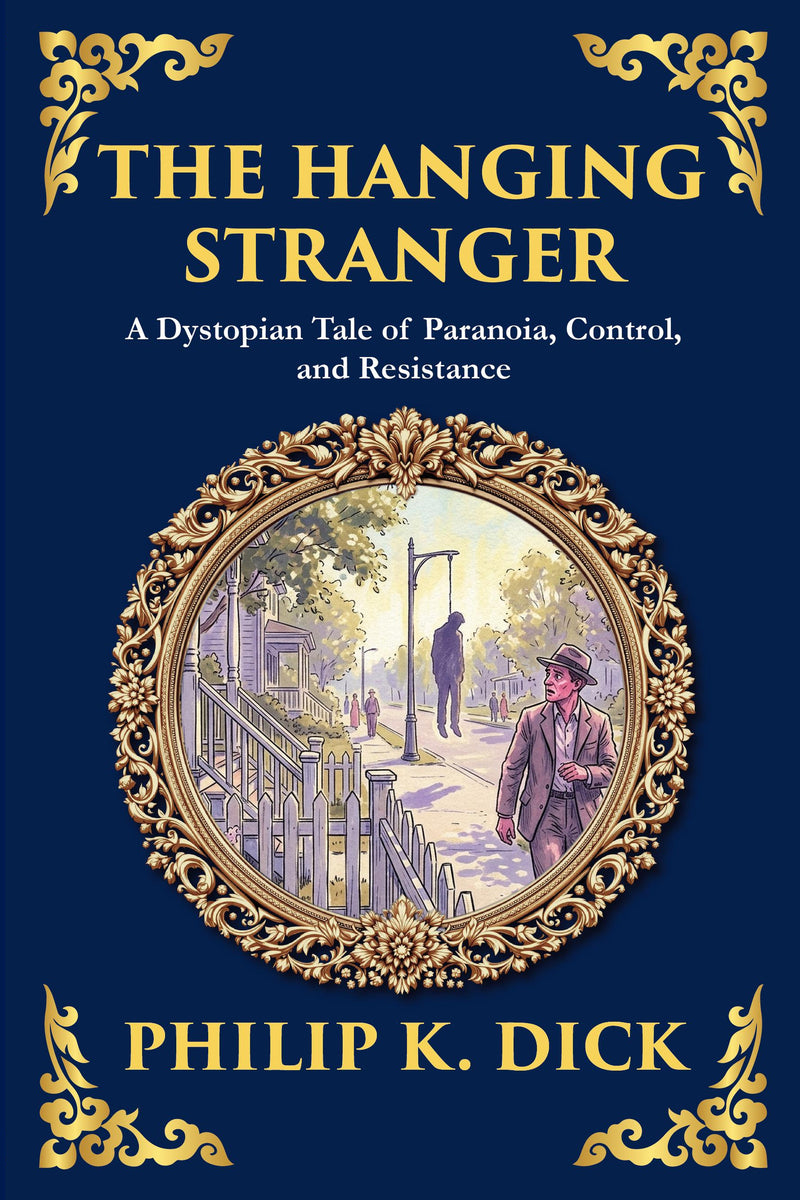
The Hanging Stranger
When Ed Loyce looks up and sees a man hanging from a lamppost in broad daylight, he expects panic. But the townspeople continue as if nothing is wrong.
or free app
10,000+ hrs library
30-day guarantee
The complete The Hanging Stranger appears in modern English through Library of Alexandria Press, available online with audiobook narration included for members.
Have you ever wondered why some horrors are ignored—not because they’re invisible, but because no one dares to see them? In The Hanging Stranger, legendary sci-fi author Philip K. Dick plunges readers into a paranoid dystopia where reality itself bends under the weight of unseen power. What begins as a seemingly normal day quickly turns nightmarish for Ed Loyce, an ordinary man who notices something horrifying—something no one else seems to care about.
A man is hanging from a lamppost in the center of town. No one reacts. Not his employees, not the police, not even his wife.
Ed soon finds himself in a race against the tightening grip of a society that has been hijacked by something sinister—something not quite human. In this tense and unsettling tale, Dick pulls apart the veil of collective illusion to reveal the terrifying consequences of a world built on obedience and denial.
What you’ll discover in this modern edition
- A Gripping Tale of Paranoia and Invasion Follow Ed Loyce’s descent into a horrifying reality that no one else will acknowledge.
| Formats | eBook (EPUB + PDF) · Audiobook · Paperback · Hardcover · Large Print |
| Language | English |
| Trim size (print) | 6 × 9 in |
| Binding | Paperback — perfect-bound · Hardcover — casewrap |
| Large Print edition | Same text in a larger, easy-read type — a larger font, not a larger trim |
| Print pricing | Every physical book at our true cost — at-cost, no profit (members) |
| Library | 873 restored titles, always growing |
| Length | 8,783 words · ~35 min reading |
| Reading level | Grade 5 · an easy, flowing read (this modern-English edition) |
| Edition | Modern English translation · 2026 |
Member reviews for this edition are collected as readers finish it — be the first. Across the library: 12,000+ books shipped, every plan covered by a 365-day print guarantee.
About this edition
A faithful, unabridged modern-English edition by The Library of Alexandria — carefully rendered for today's reader and verified paragraph-by-paragraph against the public-domain source. Available as eBook, audiobook, paperback, hardcover, and large print.
- Complete & unabridgedVerified paragraph by paragraph against the source — never a scan, never abridged.
- Modern English, faithfulReadable today, with the author’s meaning kept intact. Readable — not simplified.
- Every format, one membershipRead in your browser or the free app, or listen to the full audiobook.
Included free with your membership
Cancel anytime, one click · 30-day money-back guarantee
Edition last updated July 2026
What’s inside
The Hanging Stranger — complete and unabridged, included in full with membership, plus the full audiobook.
Begin reading The Hanging Stranger
In clear modern English — the complete text is included with membership.
Introduction
There is a particular kind of dread that does not announce itself with sirens or screams. It arrives quietly, in the ordinary places we trust most: the corner of a familiar street, the faces of neighbors we have known for years, the routines we perform without thinking. It is the dread of suddenly suspecting that something is wrong—deeply, fundamentally wrong—and that you may be the only one who can see it. This is the territory Philip K. Dick stakes out in the story you are about to read, and few writers in the history of literature have mapped that uneasy ground with greater precision or more enduring relevance.
First published in the December 1953 issue of Science Fiction Adventures, this short work belongs to one of the most extraordinary periods of creative output in American letters. Dick was in his mid-twenties, hammering out stories on a manual typewriter at a furious pace, producing dozens of tales for the pulp magazines that were then the lifeblood of imaginative fiction. Many writers of that era churned out forgettable space operas and ray-gun adventures to pay the rent. Dick did something stranger and far more lasting. He took the cheap, disposable format of the pulps and used it to ask the questions that would obsess philosophers and neuroscientists for decades to come: What is reality? How do we know what we know? Who decides what is normal, and what happens to those who refuse to accept the consensus? In the modest space of a few thousand words, he built a machine of pure anxiety that still runs as smoothly today as it did when Eisenhower was in the White House and the Cold War was settling into its long, frozen standoff.
What you hold in your hands is a modern translation and adaptation, prepared with the contemporary reader in mind. The intention behind this edition is not to alter the author’s vision but to clear away the small obstacles that time inevitably places between a writer and later generations. Idioms that have faded, references that have grown obscure, sentence structures that once felt natural but now read as dated—these have been gently smoothed so that the story’s relentless momentum and its psychological power come through with full force. The goal throughout has been fidelity to the essential experience: that creeping sense of unease, the tightening grip of paranoia, and the explosive moment when the comfortable surface of everyday life is peeled back to reveal something monstrous underneath. Dick’s genius was never in elaborate prose. It was in ideas that detonate quietly in your mind and keep going off for years afterward. This edition aims to make sure those detonations land.
To understand why this story carries the weight it does, it helps to understand the singular mind that produced it. Philip Kindred Dick was born in Chicago in 1928, the surviving twin of a brother who died in infancy—a loss that haunted him throughout his life and that many of his biographers point to as a wellspring of his lifelong preoccupation with absence, doubling, and the fragility of identity. He grew up largely in California, a state whose sun-drenched suburbs and sprawling postwar prosperity would become, in his fiction, theaters of quiet horror. There was always something Dick distrusted about the smooth and the pleasant, the manicured lawn and the friendly handshake. He suspected that beneath the surface of normal American life something else was operating, and that the people who seemed most ordinary might be the ones most worth watching.
This was not paranoia for its own sake. Dick lived through a period when the line between reasonable caution and outright delusion had genuinely blurred for an entire society. The early 1950s were the years of the Red Scare, of loyalty oaths and congressional hearings, of neighbors informing on neighbors and careers destroyed by whispered accusations. The fear of hidden enemies—of communist agents who might look exactly like your friends and coworkers—had seeped into the national bloodstream. At the same time, the rise of consumer culture, suburban conformity, and corporate organization was producing a different kind of anxiety: the fear of becoming a faceless cog, of losing one’s individuality to the gray machinery of mass society. Dick absorbed both of these fears and transmuted them into fiction. He understood, perhaps better than any writer of his time, that the most frightening thing is not the enemy at the gate but the possibility that the enemy is already inside, wearing a familiar face, and that no one will believe you when you try to sound the alarm.
He was, by all accounts, a difficult and brilliant man—chronically anxious, often broke, married five times, plagued by health problems and by experiences that he himself was never entirely sure how to interpret. He wrote at a pace that would have exhausted most authors, producing more than forty novels and well over a hundred short stories before his death in 1982. For much of his career he was poorly paid and critically overlooked, regarded as a writer of disposable genre fiction rather than serious literature. It was only later, particularly after his death, that the wider world caught up with him. Today his ideas have escaped the confines of science fiction entirely and entered the general culture. The films adapted from his work—including Blade Runner, Total Recall, Minority Report, and A Scanner Darkly—have made his themes part of the common vocabulary of our age. We now speak casually of questioning whether our reality is real, of artificial beings indistinguishable from humans, of surveillance states that monitor our every move and pre-emptively police our thoughts. These were Dick’s obsessions long before they were anyone else’s, and he was exploring them in stories like this one when the technology to realize his nightmares did not yet exist.
What makes Dick endure is not technological prophecy, though he made his share of uncanny predictions. It is something deeper and more philosophical. He was, at heart, a writer concerned with two questions above all others: “What is real?” and “What is human?” He returned to these questions again and again, from every conceivable angle, with the persistence of a man who genuinely could not stop asking them. He distrusted the official version of things—the consensus reality that everyone agrees to accept—and he was endlessly fascinated by the moment when that consensus cracks, when an individual suddenly perceives something that everyone around him refuses to see. In that gap between private perception and public reality, Dick located the central drama of human existence. Are you mad, or is everyone else? Is the world as it appears, or is the appearance a carefully maintained illusion concealing something else? And if you alone can see the truth, what do you owe to it, and what will it cost you?
The story before you is one of his purest distillations of these concerns. It is short, it is fast, and it is constructed with the economy of a master who understands exactly how to manipulate a reader’s expectations. But do not let its brevity fool you. Within its tight frame, Dick has packed an entire philosophy of suspicion, a meditation on the nature of authority and conformity, and a vision of resistance that is as bracing as it is unsettling. This is the work of a young writer already in full command of his powers, already obsessed with the themes that would occupy him for the rest of his life, and already capable of producing the particular vertigo that his name has come to signify.
What is it that makes a Philip K. Dick story feel so distinctively his? Part of the answer lies in his settings. Where many of his contemporaries reached for the exotic and the distant—alien worlds, far-future empires, gleaming spaceships—Dick most often kept his feet planted firmly in the recognizable present, or in a future barely distinguishable from it. His characters are not heroic adventurers or square-jawed captains. They are ordinary people: shopkeepers, repairmen, salesmen, husbands coming home from work. They have mundane jobs and mundane worries. They live in towns and cities that look exactly like the ones his readers inhabited. And it is precisely this ordinariness that makes the eruption of the uncanny so devastating when it comes.
This is a deliberate strategy, and it is essential to the effect of the story you are about to read. By grounding his fiction in the everyday, Dick ensures that when something goes wrong, it goes wrong in your world, not in some safely distant fantasy realm. The horror is not “out there” but right here, on the street where you live, among the people you trust. He understood that the deepest fear is not of the alien and the foreign but of the familiar turned suddenly strange—of the home that is no longer safe, the friend whose smile no longer reaches the eyes, the community that has somehow become a trap. There is a German word, unheimlich, often translated as “uncanny,” that literally means “unhomely”—the sensation of finding the familiar suddenly foreign and threatening. Dick was a master of the unheimlich long before most readers had a word for what he was doing to them.
The structure of his stories reinforces this disorientation. Dick rarely lets his readers stand on solid ground. He prefers to keep us, like his protagonists, perpetually off balance, uncertain whether what we are seeing is the truth or a delusion, whether the danger is real or imagined, whether the person sounding the alarm is a prophet or a madman. He plays with our natural desire to trust the narrator, to assume that the protagonist’s perception is reliable, and he uses that trust against us. The result is a reading experience that mimics the very paranoia it depicts. We become complicit in the protagonist’s spiraling suspicion. We start to see threats where there may be none—or where there may be everything. By the time the story reaches its conclusion, we are no longer sure of anything, and that uncertainty is not a flaw in the design. It is the design.
This brings us to one of the most important things to keep in mind as you read. The subtitle of this edition names three themes—paranoia, control, and resistance—and these are indeed the great pillars on which the story rests. But it would be a mistake to think of them as separate concerns. In Dick’s hands, they are intertwined, almost inseparable. Paranoia, after all, is the natural response to a world in which control is hidden and pervasive. And resistance is the only possible answer to paranoia that turns out to be justified. The terrible logic of the story is that the paranoid person may be right, that the suspicion that everyone is against you may not be a symptom of illness but an accurate perception of reality. This is what gives Dick’s work its peculiar moral force. He refuses to offer the comfortable reassurance that the anxious mind is simply mistaken. He leaves open the far more disturbing possibility that the anxious mind has seen something true.
Consider how radical this is. Most fiction that deals with paranoia—and most psychology, for that matter—treats it as a distortion, an error of perception to be corrected. The frightened protagonist learns, in the end, that his fears were unfounded, that the world is fundamentally trustworthy, that he was the problem all along. Dick inverts this entirely. In his universe, the comfortable consensus is the lie, and the lonely doubter is the one who sees clearly. This inversion is not merely a clever plot device. It reflects Dick’s genuine philosophical and political convictions. He had lived through an era in which authority lied as a matter of routine, in which the official version of reality was demonstrably constructed and manipulated, in which conformity was enforced with terrifying efficiency. He had reason to distrust the smooth surface of things. And he wrote fiction designed to instill that same productive distrust in his readers—to make us question the version of reality we have been handed, to look more closely at the faces around us, to wonder what might be hiding behind the friendly mask of normalcy.
Cancel anytime, one click · 30-day money-back guarantee
Founding annual rate available now — your price locks for life when you join.
Not ready? Get this free chapter by email — read it anytime.
✓ Sent — check your inbox for The Hanging Stranger.
Questions about The Hanging Stranger
What is The Hanging Stranger about?
When Ed Loyce looks up and sees a man hanging from a lamppost in broad daylight, he expects panic. But the townspeople continue as if nothing is wrong. In that chilling moment, his reality begins to unravel—and a dark, insidious force reveals itself.
Who wrote The Hanging Stranger?
The Hanging Stranger was written by Philip K. Dick. This edition presents the complete work in clear modern English, faithfully rendered from the public-domain original by Library of Alexandria Press.
Is The Hanging Stranger free to read?
The opening chapter is free to read on this page. Members read and listen to the complete work — and the entire library — free, and can order any physical book at our true print cost.
How long is The Hanging Stranger?
2 chapters (~8,783 words) — about 35 min of reading in this modern-English edition.
Is this an abridged version of The Hanging Stranger?
No. This is the complete, unabridged The Hanging Stranger, carefully rendered into clear modern English and verified paragraph-by-paragraph against the public-domain source — nothing is cut or summarised.
What formats does The Hanging Stranger come in?
The Hanging Stranger is available as eBook, paperback, hardcover and large print. eBook and audiobook are included with membership; printed editions ship at our true print cost.
Shipping & returns
Billing & membership
More from the library


Explore Science Fiction
- The Island of Doctor Moreau · H. G. Wells
- A Midsummer Night’s Dream · William Shakespeare
- The Invisible Man: A Grotesque Romance · H. G. Wells
- The War of the Worlds · H. G. Wells
- The Strange Case of Dr. Jekyll and Mr. Hyde · Robert Louis Stevenson
- Limanora: the island of progress · Godfrey Sweven
- The Book of Dragons · E. Nesbit
- She · H. Rider Haggard
- Dorothy and the Wizard in Oz · L. Frank Baum
- The Princess and the Goblin · George MacDonald
- Gawayne and the Green Knight: A Fairy Tale · Charlton M. Lewis
- Lucian’s True History · Lucian of Samosata
- The Willows · Algernon Blackwood
- The Call of Cthulhu · H. P. Lovecraft
- The Life-Eater · Harold Ward
- The Marvelous Land of Oz · L. Frank Baum
- Mars is My Destination · Frank Belknap Long
- The Black Kiss
- The Beasts in the Void · Paul W. Fairman
- John Jones’s Dollar · Harry Stephen Keeler
- Subversive · Mack Reynolds
- The Mississippi Saucer · Frank Belknap Long
- Man of Distinction · Michael Shaara
- Spawn of the Comet · H. Thompson Rich
- The Golden Judge · Nathaniel Gordon
- Final Weapon · Everett B. Cole
- The Big Fix · George O. Smith
- Last Enemy · H. Beam Piper
- Time and Time Again · H. Beam Piper
- Sabotage in Space · Carey Rockwell
The Hanging Stranger
The Hanging Stranger
A Dystopian Tale of Paranoia, Control, and Resistance
Philip K. Dick
Contents
- Introduction
- The Hanging Stranger
Introduction
There is a particular kind of dread that does not announce itself with sirens or screams. It arrives quietly, in the ordinary places we trust most: the corner of a familiar street, the faces of neighbors we have known for years, the routines we perform without thinking. It is the dread of suddenly suspecting that something is wrong—deeply, fundamentally wrong—and that you may be the only one who can see it. This is the territory Philip K. Dick stakes out in the story you are about to read, and few writers in the history of literature have mapped that uneasy ground with greater precision or more enduring relevance.
First published in the December 1953 issue of Science Fiction Adventures, this short work belongs to one of the most extraordinary periods of creative output in American letters. Dick was in his mid-twenties, hammering out stories on a manual typewriter at a furious pace, producing dozens of tales for the pulp magazines that were then the lifeblood of imaginative fiction. Many writers of that era churned out forgettable space operas and ray-gun adventures to pay the rent. Dick did something stranger and far more lasting. He took the cheap, disposable format of the pulps and used it to ask the questions that would obsess philosophers and neuroscientists for decades to come: What is reality? How do we know what we know? Who decides what is normal, and what happens to those who refuse to accept the consensus? In the modest space of a few thousand words, he built a machine of pure anxiety that still runs as smoothly today as it did when Eisenhower was in the White House and the Cold War was settling into its long, frozen standoff.
What you hold in your hands is a modern translation and adaptation, prepared with the contemporary reader in mind. The intention behind this edition is not to alter the author’s vision but to clear away the small obstacles that time inevitably places between a writer and later generations. Idioms that have faded, references that have grown obscure, sentence structures that once felt natural but now read as dated—these have been gently smoothed so that the story’s relentless momentum and its psychological power come through with full force. The goal throughout has been fidelity to the essential experience: that creeping sense of unease, the tightening grip of paranoia, and the explosive moment when the comfortable surface of everyday life is peeled back to reveal something monstrous underneath. Dick’s genius was never in elaborate prose. It was in ideas that detonate quietly in your mind and keep going off for years afterward. This edition aims to make sure those detonations land.
To understand why this story carries the weight it does, it helps to understand the singular mind that produced it. Philip Kindred Dick was born in Chicago in 1928, the surviving twin of a brother who died in infancy—a loss that haunted him throughout his life and that many of his biographers point to as a wellspring of his lifelong preoccupation with absence, doubling, and the fragility of identity. He grew up largely in California, a state whose sun-drenched suburbs and sprawling postwar prosperity would become, in his fiction, theaters of quiet horror. There was always something Dick distrusted about the smooth and the pleasant, the manicured lawn and the friendly handshake. He suspected that beneath the surface of normal American life something else was operating, and that the people who seemed most ordinary might be the ones most worth watching.
This was not paranoia for its own sake. Dick lived through a period when the line between reasonable caution and outright delusion had genuinely blurred for an entire society. The early 1950s were the years of the Red Scare, of loyalty oaths and congressional hearings, of neighbors informing on neighbors and careers destroyed by whispered accusations. The fear of hidden enemies—of communist agents who might look exactly like your friends and coworkers—had seeped into the national bloodstream. At the same time, the rise of consumer culture, suburban conformity, and corporate organization was producing a different kind of anxiety: the fear of becoming a faceless cog, of losing one’s individuality to the gray machinery of mass society. Dick absorbed both of these fears and transmuted them into fiction. He understood, perhaps better than any writer of his time, that the most frightening thing is not the enemy at the gate but the possibility that the enemy is already inside, wearing a familiar face, and that no one will believe you when you try to sound the alarm.
He was, by all accounts, a difficult and brilliant man—chronically anxious, often broke, married five times, plagued by health problems and by experiences that he himself was never entirely sure how to interpret. He wrote at a pace that would have exhausted most authors, producing more than forty novels and well over a hundred short stories before his death in 1982. For much of his career he was poorly paid and critically overlooked, regarded as a writer of disposable genre fiction rather than serious literature. It was only later, particularly after his death, that the wider world caught up with him. Today his ideas have escaped the confines of science fiction entirely and entered the general culture. The films adapted from his work—including Blade Runner, Total Recall, Minority Report, and A Scanner Darkly—have made his themes part of the common vocabulary of our age. We now speak casually of questioning whether our reality is real, of artificial beings indistinguishable from humans, of surveillance states that monitor our every move and pre-emptively police our thoughts. These were Dick’s obsessions long before they were anyone else’s, and he was exploring them in stories like this one when the technology to realize his nightmares did not yet exist.
What makes Dick endure is not technological prophecy, though he made his share of uncanny predictions. It is something deeper and more philosophical. He was, at heart, a writer concerned with two questions above all others: “What is real?” and “What is human?” He returned to these questions again and again, from every conceivable angle, with the persistence of a man who genuinely could not stop asking them. He distrusted the official version of things—the consensus reality that everyone agrees to accept—and he was endlessly fascinated by the moment when that consensus cracks, when an individual suddenly perceives something that everyone around him refuses to see. In that gap between private perception and public reality, Dick located the central drama of human existence. Are you mad, or is everyone else? Is the world as it appears, or is the appearance a carefully maintained illusion concealing something else? And if you alone can see the truth, what do you owe to it, and what will it cost you?
The story before you is one of his purest distillations of these concerns. It is short, it is fast, and it is constructed with the economy of a master who understands exactly how to manipulate a reader’s expectations. But do not let its brevity fool you. Within its tight frame, Dick has packed an entire philosophy of suspicion, a meditation on the nature of authority and conformity, and a vision of resistance that is as bracing as it is unsettling. This is the work of a young writer already in full command of his powers, already obsessed with the themes that would occupy him for the rest of his life, and already capable of producing the particular vertigo that his name has come to signify.
What is it that makes a Philip K. Dick story feel so distinctively his? Part of the answer lies in his settings. Where many of his contemporaries reached for the exotic and the distant—alien worlds, far-future empires, gleaming spaceships—Dick most often kept his feet planted firmly in the recognizable present, or in a future barely distinguishable from it. His characters are not heroic adventurers or square-jawed captains. They are ordinary people: shopkeepers, repairmen, salesmen, husbands coming home from work. They have mundane jobs and mundane worries. They live in towns and cities that look exactly like the ones his readers inhabited. And it is precisely this ordinariness that makes the eruption of the uncanny so devastating when it comes.
This is a deliberate strategy, and it is essential to the effect of the story you are about to read. By grounding his fiction in the everyday, Dick ensures that when something goes wrong, it goes wrong in your world, not in some safely distant fantasy realm. The horror is not “out there” but right here, on the street where you live, among the people you trust. He understood that the deepest fear is not of the alien and the foreign but of the familiar turned suddenly strange—of the home that is no longer safe, the friend whose smile no longer reaches the eyes, the community that has somehow become a trap. There is a German word, unheimlich, often translated as “uncanny,” that literally means “unhomely”—the sensation of finding the familiar suddenly foreign and threatening. Dick was a master of the unheimlich long before most readers had a word for what he was doing to them.
The structure of his stories reinforces this disorientation. Dick rarely lets his readers stand on solid ground. He prefers to keep us, like his protagonists, perpetually off balance, uncertain whether what we are seeing is the truth or a delusion, whether the danger is real or imagined, whether the person sounding the alarm is a prophet or a madman. He plays with our natural desire to trust the narrator, to assume that the protagonist’s perception is reliable, and he uses that trust against us. The result is a reading experience that mimics the very paranoia it depicts. We become complicit in the protagonist’s spiraling suspicion. We start to see threats where there may be none—or where there may be everything. By the time the story reaches its conclusion, we are no longer sure of anything, and that uncertainty is not a flaw in the design. It is the design.
This brings us to one of the most important things to keep in mind as you read. The subtitle of this edition names three themes—paranoia, control, and resistance—and these are indeed the great pillars on which the story rests. But it would be a mistake to think of them as separate concerns. In Dick’s hands, they are intertwined, almost inseparable. Paranoia, after all, is the natural response to a world in which control is hidden and pervasive. And resistance is the only possible answer to paranoia that turns out to be justified. The terrible logic of the story is that the paranoid person may be right, that the suspicion that everyone is against you may not be a symptom of illness but an accurate perception of reality. This is what gives Dick’s work its peculiar moral force. He refuses to offer the comfortable reassurance that the anxious mind is simply mistaken. He leaves open the far more disturbing possibility that the anxious mind has seen something true.
Consider how radical this is. Most fiction that deals with paranoia—and most psychology, for that matter—treats it as a distortion, an error of perception to be corrected. The frightened protagonist learns, in the end, that his fears were unfounded, that the world is fundamentally trustworthy, that he was the problem all along. Dick inverts this entirely. In his universe, the comfortable consensus is the lie, and the lonely doubter is the one who sees clearly. This inversion is not merely a clever plot device. It reflects Dick’s genuine philosophical and political convictions. He had lived through an era in which authority lied as a matter of routine, in which the official version of reality was demonstrably constructed and manipulated, in which conformity was enforced with terrifying efficiency. He had reason to distrust the smooth surface of things. And he wrote fiction designed to instill that same productive distrust in his readers—to make us question the version of reality we have been handed, to look more closely at the faces around us, to wonder what might be hiding behind the friendly mask of normalcy.
At five o’clock, Ed Loyce cleaned up, threw on his hat and coat, got in his car, and drove across town to his TV store. He was exhausted. His back and shoulders were sore from digging dirt out of the basement and wheeling it into the backyard. Still, for a forty-year-old man, he felt he’d done a good job. He had saved enough money for Janet to buy a new vase, and he actually enjoyed the idea of fixing the foundation himself.
It was getting dark. The setting sun cast long shadows over the rushing commuters, who looked tired and grim. Women carried heavy bundles and packages, and students swarmed home from the university, mixing with clerks, businessmen, and secretaries in drab outfits. He stopped his Packard at a red light and then accelerated again. The store had been open without him; he would arrive just in time to relieve his employee for dinner, review the day’s records, and perhaps even close a few sales himself. He drove slowly past the small patch of grass in the center of the street—the town park. There were no parking spots in front of LOYCE TV SALES AND SERVICE. He cursed under his breath and made a U-turn. He passed the little green square again, with its lonely drinking fountain, bench, and single lamppost.
Something was hanging from the lamppost. It was a shapeless, dark bundle, swaying slightly in the wind. It looked like some kind of dummy. Loyce rolled down his window and peered out. What the hell was it? Some kind of display? The Chamber of Commerce occasionally put displays in the square.
He made another U-turn and circled back. As he passed the park, he focused on the dark bundle. It wasn’t a dummy. And if it was a display, it was a strange one. The hair on the back of his neck stood up, and he swallowed hard. Sweat broke out on his face and hands.
End of the free sample
Keep reading, free
Members read and listen to the complete book — and the entire library. Cancel anytime, one click · 30-day money-back guarantee.