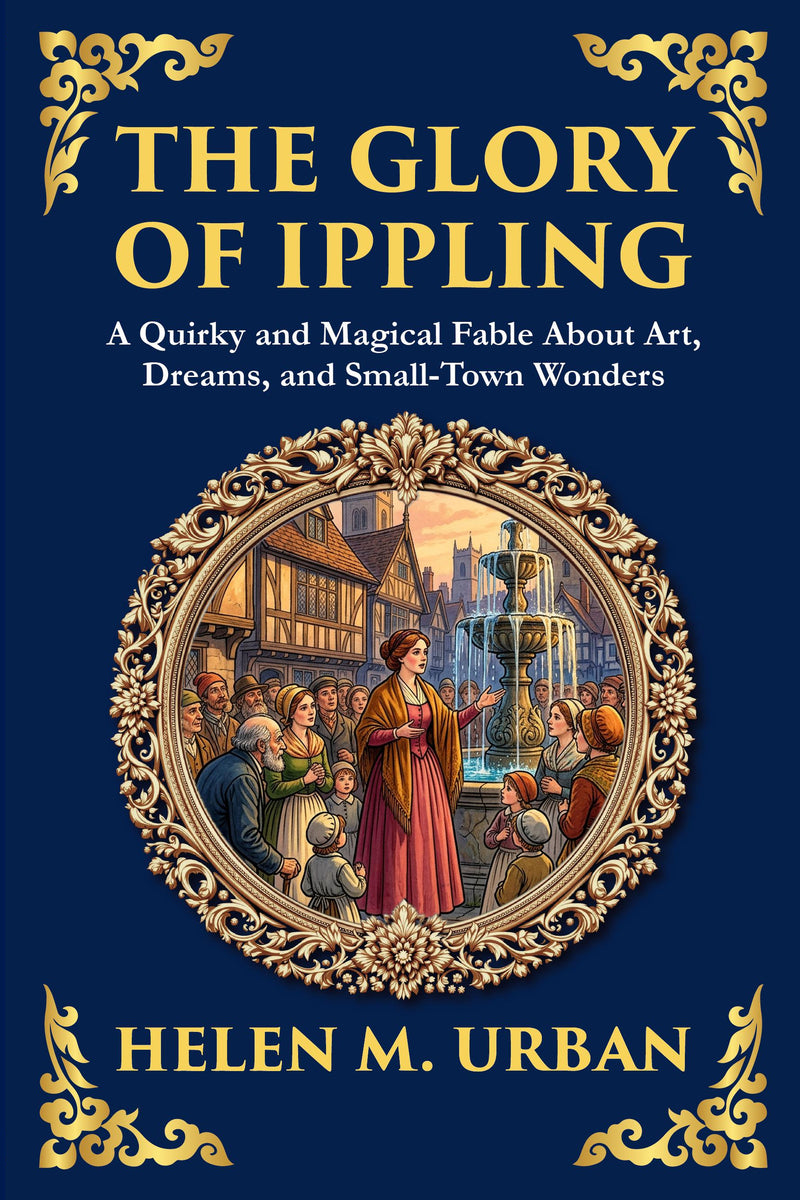
The Glory of Ippling
Welcome to Ippling, a forgotten dot on the map where nothing much ever happens—until one strange day, everything does. The Glory of Ippling is a whimsical and heartwarming tale about creativity, belief, and the peculiar magic that lives in the most ordinary places.
or free app
10,000+ hrs library
30-day guarantee
The complete The Glory of Ippling appears in modern English through Library of Alexandria Press, available online with audiobook narration included for members.
Have you ever wondered why some towns feel like they’re just waiting for something magical to happen? The Glory of Ippling by Helen M. Urban is a delightfully odd and inspiring fable that weaves the everyday with the extraordinary. It’s a story about finding color in the gray, beauty in the boring, and the spark of imagination in the most unexpected places.
The tale begins with a traveling artist whose cart of strange supplies and even stranger ideas rolls into the sleepy town of Ippling—a place so ordinary, its citizens pride themselves on how little ever changes. But change is coming. And it starts with a splash of paint, a curious mural, and the awakening of old stories.
What follows is a gentle upheaval of habits, as the townsfolk are drawn into a whimsical transformation of their streets, their homes, and their hearts. One by one, they rediscover creativity, purpose, and the joy of simply seeing things differently. Part The Little Prince, part Amélie, and entirely original, The Glory of Ippling is a celebration of art, joy, and the quiet revolution of imagination.
What you’ll discover in this modern edition
- A Town Transformed by Art – Follow the gentle chaos that begins when a single artist reawakens a town’s forgotten spirit.
- Quirky Characters and Gentle Humor – Meet a cast of delightfully odd and charming townspeople, each hiding a spark waiting to ignite.
- Themes of Creativity, Wonder, and Community – Explore how imagination can ripple through lives and change the world in subtle but powerful ways.
- An Uplifting Escape for Readers of All Ages – With lyrical prose and timeless charm, this story invites readers young and old to believe in the beautiful absurdity of dreams.
- A Story That Sticks With You – Like a favorite fairytale, this magical realist gem offers warmth, smiles, and thoughtful inspiration long after the final page.
| Formats | eBook (EPUB + PDF) · Audiobook · Paperback · Hardcover · Large Print |
| Language | English |
| Trim size (print) | 6 × 9 in |
| Binding | Paperback — perfect-bound · Hardcover — casewrap |
| Large Print edition | Same text in a larger, easy-read type — a larger font, not a larger trim |
| Print pricing | Every physical book at our true cost — at-cost, no profit (members) |
| Library | 873 restored titles, always growing |
| Length | 8,006 words · ~32 min reading |
| Reading level | Grade 9 · a comfortable read (this modern-English edition) |
| Edition | Modern English translation · 2026 |
Member reviews for this edition are collected as readers finish it — be the first. Across the library: 12,000+ books shipped, every plan covered by a 365-day print guarantee.
About this edition
A faithful, unabridged modern-English edition by The Library of Alexandria — carefully rendered for today's reader and verified paragraph-by-paragraph against the public-domain source. Available as eBook, audiobook, paperback, hardcover, and large print.
- Complete & unabridgedVerified paragraph by paragraph against the source — never a scan, never abridged.
- Modern English, faithfulReadable today, with the author’s meaning kept intact. Readable — not simplified.
- Every format, one membershipRead in your browser or the free app, or listen to the full audiobook.
Included free with your membership
Cancel anytime, one click · 30-day money-back guarantee
Edition last updated July 2026
What’s inside
The Glory of Ippling — complete and unabridged, included in full with membership, plus the full audiobook.
Begin reading The Glory of Ippling
In clear modern English — the complete text is included with membership.
Introduction
There are certain books that arrive in a reader’s life not with the thunderous fanfare of best-seller lists or the relentless churn of marketing campaigns, but quietly, almost shyly, like a stranger slipping into the back pew of a small chapel. They wait. They linger at the edges of attention, content to be overlooked, until one day a curious soul opens the cover and discovers something extraordinary humming beneath the modest exterior. The book you now hold in your hands is precisely such a treasure. It belongs to that rare and delightful category of stories that refuse to announce themselves too loudly, preferring instead to draw you in by degrees, until you find yourself wholly enchanted, wondering how on earth you ever lived without it.
To approach this fable is to step into a world where the ordinary and the marvelous are not opposites but companions, where the dusty corners of a forgotten town might suddenly bloom with color, and where the most unlikely of characters discover within themselves capacities for wonder, courage, and creation that they never suspected they possessed. It is a story about art and about dreaming, yes, but more than that, it is a story about the secret luminosity hidden inside the small and the overlooked—the village rather than the metropolis, the amateur rather than the master, the half-formed wish rather than the grand ambition. In an age that so often equates significance with size and worth with spectacle, this gentle and gleeful narrative offers a quiet rebellion: a reminder that glory, real glory, can flower in the most modest of soils.
This introduction is meant to serve as a kind of threshold—a doorway through which you may pass into the tale with your senses awakened and your expectations gently tuned. I shall not spoil for you a single one of the surprises that wait within these pages, for to do so would be a betrayal of the very spirit of discovery the author so lovingly cultivates. Instead, I hope to offer you something more useful: a sense of the texture of the experience to come, an appreciation of the craftsmanship behind it, and a few quiet suggestions for how you might read in order to receive the fullest measure of its gifts. Consider what follows not a map that flattens the landscape into known coordinates, but rather an invitation to wander—and a promise that the wandering will be worth your while.
The first thing many readers notice when they enter this story is its peculiar atmosphere, a quality that hovers somewhere between the cozy and the uncanny. This is the hallmark of the very best fables: they construct a world that feels at once entirely invented and somehow deeply recognizable, as though we had visited it long ago in a half-remembered dream and only now found our way back. The place at the heart of this tale—with its curious name that lingers pleasantly on the tongue—is one such world. It is small enough to hold in your imagination all at once, yet rich enough to reward repeated visits, full of nooks and characters and customs that seem to expand the longer you dwell among them.
Helen M. Urban possesses a rare gift for the kind of worldbuilding that proceeds not by exhaustive description but by suggestion, by the artful placement of telling details that allow the reader’s own imagination to do the rest. She understands that a town is not made real by the cataloguing of its streets and shops, but by the way its inhabitants speak of it, dream about it, complain about it, and quietly love it despite its faults. And so, as you read, you will find the setting accumulating in your mind almost without your noticing, until you realize that you can picture its weather and smell its air and anticipate the rhythms of its days. This is no small feat. It is the difference between a stage set and a living place, and it is one of the principal reasons this fable lingers so long in the memory after the final page is turned.
What makes the world of this book especially endearing is its embrace of the quirky. There is a playfulness here, a willingness to delight in the odd and the whimsical, that never tips over into the merely silly. The author has a wonderfully light touch with the absurd. She can introduce a notion so charmingly preposterous that you laugh aloud, and then, in the very next moment, reveal that beneath the whimsy lies a truth so tender and so true that your laughter softens into something close to reverence. This is the alchemy of the great fabulists, the ability to make us smile and ache at once, to wrap profound observations about the human heart in garments so colorful and so light that we scarcely notice we are being taught something until the lesson has already taken root.
It is worth pausing here to say a word about the genre itself, for the word “fable” carries with it certain expectations that this book both honors and gently subverts. We tend to think of fables as brief, pointed tales with talking animals and tidy morals stamped at the bottom like the maker’s seal on a coin. And there is, to be sure, a moral sensibility threaded through this narrative—a clear-eyed and generous wisdom about what matters and why. But you will find no heavy-handed sermonizing here, no finger wagged in your face. Urban trusts her readers. She lays out her world and her characters and her gentle marvels, and she allows the meaning to rise up organically, the way mist rises from a meadow at dawn—softly, beautifully, and entirely on its own terms. The reader is never lectured; the reader is invited to understand. And that act of invitation, that respect for the intelligence and feeling of the one who reads, is itself a kind of artistry that has become all too rare.
The magical elements of the story deserve particular mention, though I will be careful here to preserve the surprises. Suffice it to say that the magic in this book is not the bombastic, world-shaking sorcery of epic fantasy. It is something quieter and, I think, far more affecting: a magic of transformation and revelation, of the moment when the familiar suddenly shimmers with unsuspected possibility. It is the kind of enchantment that makes you look at your own ordinary surroundings with fresh eyes when you set the book down—at the chipped paint on a neighbor’s fence, the half-finished sketch tucked away in a drawer, the small dreams you have allowed to gather dust. This is magic as metaphor and metaphor as magic, the two so beautifully intertwined that you cease to ask which is which. And it is precisely this seamless union of the wondrous and the meaningful that elevates the tale above mere entertainment into the realm of genuine, lasting art.
The Heart of the Matter: Art, Dreams, and the Worth of Small Things
If the world of the book is its body, then its preoccupation with art and dreaming is its beating heart. At its deepest level, this is a story about the creative impulse—about what it means to make something, to imagine something into being, and to offer that creation up to a world that may or may not understand it. This is a theme of immense and abiding importance, and one that speaks with particular urgency to readers of our own time, when so many of us harbor secret artistic longings that we have set aside in the name of practicality, when so many of us have been told, in countless quiet ways, that our dreams are too small or too strange or too impractical to matter.
The author understands the peculiar vulnerability of the creative soul with a sympathy that can only come from intimate acquaintance. She knows the trembling hope with which we hold out our handmade things to others, and the cold fear of their rejection. She knows the way a dream can both sustain and torment us, the way it can feel simultaneously like the most important thing in the world and like a foolish indulgence we ought to have outgrown. And she knows, too, the extraordinary courage it takes to keep dreaming anyway—to keep making, keep imagining, keep reaching toward beauty even when the odds seem hopeless and the audience indifferent. These hard-won truths animate the whole of the book, and they are rendered with such warmth and such gentle humor that even the most painful insights arrive cushioned in compassion.
But this is not a melancholy book, far from it. For all its tender awareness of the dreamer’s struggles, the story is ultimately a celebration—a hymn of praise to the act of creation and to the unsuspected glory that can blossom when ordinary people dare to make something extraordinary. There is a profound generosity in the author’s vision. She does not reserve her admiration for the recognized genius or the polished master. On the contrary, she finds the most wondrous beauty in the amateur, the eccentric, the late bloomer, the one whom the world has dismissed or overlooked. In her telling, the most modest of creative acts can ripple outward in ways no one could have predicted, transforming not only the maker but the entire community around them. There is a deeply democratic, deeply humane spirit at work here—a conviction that the capacity for wonder and for making belongs to everyone, and that no town is too small and no person too humble to be the site of a genuine miracle.
This brings us to what I consider the true philosophical core of the book: its tender insistence on the worth of small things. We live in a culture obsessed with scale, with growth, with the relentless accumulation of more—more followers, more reach, more recognition, more noise. Against this clamoring tide, the story sets its quiet face, and it asks us to reconsider. What if glory is not a matter of magnitude at all? What if the most meaningful triumphs are the ones that happen in obscurity, witnessed by only a handful of people who happen to love the one who triumphs? What if a single town, a single life, a single act of creation, could contain within itself a fullness and a splendor every bit as real as anything celebrated on the world’s great stages?
These are not new questions, of course. The greatest literature has always returned to them. But Urban approaches them with such freshness, such originality of imagination, that they feel newly minted, as though we were considering them for the very first time. And the answers she offers—offered always obliquely, through story rather than statement—have the ring of hard-won truth. They are the kind of answers that do not so much resolve our questions as transfigure them, lifting us to a place from which the questions themselves appear in a new and consoling light. To read this book attentively is to come away with a subtly altered sense of what matters in life, a renewed appreciation for the overlooked riches of one’s own ordinary existence. And surely there is no higher praise one can offer a work of fiction than to say that it sends its readers back into their lives more awake, more grateful, and more willing to dream.
It is also worth dwelling for a moment on the sheer pleasure of the prose itself, for the themes I have described, weighty as they are, never weigh the book down. Urban writes with a lightness and a musicality that make the pages turn almost of their own accord. Her sentences have a way of curling unexpectedly, of arriving at a turn of phrase so apt and so delightful that you want to read it aloud to whoever happens to be nearby. There is wit here in abundance, but it is a kind wit, never cruel, never showing off, always in the service of the story and its inhabitants. The dialogue crackles with personality; each character speaks in a voice distinctly their own, so that you could close your eyes and know at once who was talking. And running through it all is a warmth, a fundamental affection for human beings in all their foolishness and frailty and unexpected nobility, that makes the act of reading feel like an act of being welcomed home.
A Note on This Edition, and How Best to Read It
A word, now, about the particular form in which this book reaches you. As the subtitle indicates, what you hold is a modern translation, an adaptation prepared with the contemporary reader expressly in mind. This is a labor undertaken with great care and even greater respect, and it deserves some explanation, for the relationship between a beloved older text and the modern reader is a delicate one, requiring both fidelity and finesse.
Cancel anytime, one click · 30-day money-back guarantee
Founding annual rate available now — your price locks for life when you join.
Not ready? Get this free chapter by email — read it anytime.
✓ Sent — check your inbox for The Glory of Ippling.
Questions about The Glory of Ippling
What is The Glory of Ippling about?
Welcome to Ippling, a forgotten dot on the map where nothing much ever happens—until one strange day, everything does. The Glory of Ippling is a whimsical and heartwarming tale about creativity, belief, and the peculiar magic that lives in the most ordinary places. When a wandering artist arrives in the sleepy town of Ippling, his unusual vision and playful ideas spark an unexpected transformation.
Who wrote The Glory of Ippling?
The Glory of Ippling was written by Helen M. Urban. This edition presents the complete work in clear modern English, faithfully rendered from the public-domain original by Library of Alexandria Press.
Is The Glory of Ippling free to read?
The opening chapter is free to read on this page. Members read and listen to the complete work — and the entire library — free, and can order any physical book at our true print cost.
How long is The Glory of Ippling?
2 chapters (~8,006 words) — about 32 min of reading in this modern-English edition.
Is this an abridged version of The Glory of Ippling?
No. This is the complete, unabridged The Glory of Ippling, carefully rendered into clear modern English and verified paragraph-by-paragraph against the public-domain source — nothing is cut or summarised.
What formats does The Glory of Ippling come in?
The Glory of Ippling is available as eBook, paperback, hardcover and large print. eBook and audiobook are included with membership; printed editions ship at our true print cost.
Shipping & returns
Billing & membership
More from the library


Explore Science Fiction
- The Island of Doctor Moreau · H. G. Wells
- A Midsummer Night’s Dream · William Shakespeare
- The Invisible Man: A Grotesque Romance · H. G. Wells
- The War of the Worlds · H. G. Wells
- The Strange Case of Dr. Jekyll and Mr. Hyde · Robert Louis Stevenson
- Limanora: the island of progress · Godfrey Sweven
- The Book of Dragons · E. Nesbit
- She · H. Rider Haggard
- Dorothy and the Wizard in Oz · L. Frank Baum
- The Princess and the Goblin · George MacDonald
- Gawayne and the Green Knight: A Fairy Tale · Charlton M. Lewis
- Lucian’s True History · Lucian of Samosata
- The Willows · Algernon Blackwood
- The Call of Cthulhu · H. P. Lovecraft
- The Life-Eater · Harold Ward
- The Marvelous Land of Oz · L. Frank Baum
- Mars is My Destination · Frank Belknap Long
- The Black Kiss
- The Beasts in the Void · Paul W. Fairman
- John Jones’s Dollar · Harry Stephen Keeler
- Subversive · Mack Reynolds
- The Mississippi Saucer · Frank Belknap Long
- Man of Distinction · Michael Shaara
- Spawn of the Comet · H. Thompson Rich
- The Golden Judge · Nathaniel Gordon
- Final Weapon · Everett B. Cole
- The Big Fix · George O. Smith
- Last Enemy · H. Beam Piper
- Time and Time Again · H. Beam Piper
- Sabotage in Space · Carey Rockwell
The Glory of Ippling
The Glory of Ippling
A Quirky and Magical Fable About Art, Dreams, and Small-Town Wonders
Helen M. Urban
Contents
- Introduction
- The Glory of Ippling
Introduction
There are certain books that arrive in a reader’s life not with the thunderous fanfare of best-seller lists or the relentless churn of marketing campaigns, but quietly, almost shyly, like a stranger slipping into the back pew of a small chapel. They wait. They linger at the edges of attention, content to be overlooked, until one day a curious soul opens the cover and discovers something extraordinary humming beneath the modest exterior. The book you now hold in your hands is precisely such a treasure. It belongs to that rare and delightful category of stories that refuse to announce themselves too loudly, preferring instead to draw you in by degrees, until you find yourself wholly enchanted, wondering how on earth you ever lived without it.
To approach this fable is to step into a world where the ordinary and the marvelous are not opposites but companions, where the dusty corners of a forgotten town might suddenly bloom with color, and where the most unlikely of characters discover within themselves capacities for wonder, courage, and creation that they never suspected they possessed. It is a story about art and about dreaming, yes, but more than that, it is a story about the secret luminosity hidden inside the small and the overlooked—the village rather than the metropolis, the amateur rather than the master, the half-formed wish rather than the grand ambition. In an age that so often equates significance with size and worth with spectacle, this gentle and gleeful narrative offers a quiet rebellion: a reminder that glory, real glory, can flower in the most modest of soils.
This introduction is meant to serve as a kind of threshold—a doorway through which you may pass into the tale with your senses awakened and your expectations gently tuned. I shall not spoil for you a single one of the surprises that wait within these pages, for to do so would be a betrayal of the very spirit of discovery the author so lovingly cultivates. Instead, I hope to offer you something more useful: a sense of the texture of the experience to come, an appreciation of the craftsmanship behind it, and a few quiet suggestions for how you might read in order to receive the fullest measure of its gifts. Consider what follows not a map that flattens the landscape into known coordinates, but rather an invitation to wander—and a promise that the wandering will be worth your while.
The first thing many readers notice when they enter this story is its peculiar atmosphere, a quality that hovers somewhere between the cozy and the uncanny. This is the hallmark of the very best fables: they construct a world that feels at once entirely invented and somehow deeply recognizable, as though we had visited it long ago in a half-remembered dream and only now found our way back. The place at the heart of this tale—with its curious name that lingers pleasantly on the tongue—is one such world. It is small enough to hold in your imagination all at once, yet rich enough to reward repeated visits, full of nooks and characters and customs that seem to expand the longer you dwell among them.
Helen M. Urban possesses a rare gift for the kind of worldbuilding that proceeds not by exhaustive description but by suggestion, by the artful placement of telling details that allow the reader’s own imagination to do the rest. She understands that a town is not made real by the cataloguing of its streets and shops, but by the way its inhabitants speak of it, dream about it, complain about it, and quietly love it despite its faults. And so, as you read, you will find the setting accumulating in your mind almost without your noticing, until you realize that you can picture its weather and smell its air and anticipate the rhythms of its days. This is no small feat. It is the difference between a stage set and a living place, and it is one of the principal reasons this fable lingers so long in the memory after the final page is turned.
What makes the world of this book especially endearing is its embrace of the quirky. There is a playfulness here, a willingness to delight in the odd and the whimsical, that never tips over into the merely silly. The author has a wonderfully light touch with the absurd. She can introduce a notion so charmingly preposterous that you laugh aloud, and then, in the very next moment, reveal that beneath the whimsy lies a truth so tender and so true that your laughter softens into something close to reverence. This is the alchemy of the great fabulists, the ability to make us smile and ache at once, to wrap profound observations about the human heart in garments so colorful and so light that we scarcely notice we are being taught something until the lesson has already taken root.
It is worth pausing here to say a word about the genre itself, for the word “fable” carries with it certain expectations that this book both honors and gently subverts. We tend to think of fables as brief, pointed tales with talking animals and tidy morals stamped at the bottom like the maker’s seal on a coin. And there is, to be sure, a moral sensibility threaded through this narrative—a clear-eyed and generous wisdom about what matters and why. But you will find no heavy-handed sermonizing here, no finger wagged in your face. Urban trusts her readers. She lays out her world and her characters and her gentle marvels, and she allows the meaning to rise up organically, the way mist rises from a meadow at dawn—softly, beautifully, and entirely on its own terms. The reader is never lectured; the reader is invited to understand. And that act of invitation, that respect for the intelligence and feeling of the one who reads, is itself a kind of artistry that has become all too rare.
The magical elements of the story deserve particular mention, though I will be careful here to preserve the surprises. Suffice it to say that the magic in this book is not the bombastic, world-shaking sorcery of epic fantasy. It is something quieter and, I think, far more affecting: a magic of transformation and revelation, of the moment when the familiar suddenly shimmers with unsuspected possibility. It is the kind of enchantment that makes you look at your own ordinary surroundings with fresh eyes when you set the book down—at the chipped paint on a neighbor’s fence, the half-finished sketch tucked away in a drawer, the small dreams you have allowed to gather dust. This is magic as metaphor and metaphor as magic, the two so beautifully intertwined that you cease to ask which is which. And it is precisely this seamless union of the wondrous and the meaningful that elevates the tale above mere entertainment into the realm of genuine, lasting art.
The Heart of the Matter: Art, Dreams, and the Worth of Small Things
If the world of the book is its body, then its preoccupation with art and dreaming is its beating heart. At its deepest level, this is a story about the creative impulse—about what it means to make something, to imagine something into being, and to offer that creation up to a world that may or may not understand it. This is a theme of immense and abiding importance, and one that speaks with particular urgency to readers of our own time, when so many of us harbor secret artistic longings that we have set aside in the name of practicality, when so many of us have been told, in countless quiet ways, that our dreams are too small or too strange or too impractical to matter.
The author understands the peculiar vulnerability of the creative soul with a sympathy that can only come from intimate acquaintance. She knows the trembling hope with which we hold out our handmade things to others, and the cold fear of their rejection. She knows the way a dream can both sustain and torment us, the way it can feel simultaneously like the most important thing in the world and like a foolish indulgence we ought to have outgrown. And she knows, too, the extraordinary courage it takes to keep dreaming anyway—to keep making, keep imagining, keep reaching toward beauty even when the odds seem hopeless and the audience indifferent. These hard-won truths animate the whole of the book, and they are rendered with such warmth and such gentle humor that even the most painful insights arrive cushioned in compassion.
But this is not a melancholy book, far from it. For all its tender awareness of the dreamer’s struggles, the story is ultimately a celebration—a hymn of praise to the act of creation and to the unsuspected glory that can blossom when ordinary people dare to make something extraordinary. There is a profound generosity in the author’s vision. She does not reserve her admiration for the recognized genius or the polished master. On the contrary, she finds the most wondrous beauty in the amateur, the eccentric, the late bloomer, the one whom the world has dismissed or overlooked. In her telling, the most modest of creative acts can ripple outward in ways no one could have predicted, transforming not only the maker but the entire community around them. There is a deeply democratic, deeply humane spirit at work here—a conviction that the capacity for wonder and for making belongs to everyone, and that no town is too small and no person too humble to be the site of a genuine miracle.
This brings us to what I consider the true philosophical core of the book: its tender insistence on the worth of small things. We live in a culture obsessed with scale, with growth, with the relentless accumulation of more—more followers, more reach, more recognition, more noise. Against this clamoring tide, the story sets its quiet face, and it asks us to reconsider. What if glory is not a matter of magnitude at all? What if the most meaningful triumphs are the ones that happen in obscurity, witnessed by only a handful of people who happen to love the one who triumphs? What if a single town, a single life, a single act of creation, could contain within itself a fullness and a splendor every bit as real as anything celebrated on the world’s great stages?
These are not new questions, of course. The greatest literature has always returned to them. But Urban approaches them with such freshness, such originality of imagination, that they feel newly minted, as though we were considering them for the very first time. And the answers she offers—offered always obliquely, through story rather than statement—have the ring of hard-won truth. They are the kind of answers that do not so much resolve our questions as transfigure them, lifting us to a place from which the questions themselves appear in a new and consoling light. To read this book attentively is to come away with a subtly altered sense of what matters in life, a renewed appreciation for the overlooked riches of one’s own ordinary existence. And surely there is no higher praise one can offer a work of fiction than to say that it sends its readers back into their lives more awake, more grateful, and more willing to dream.
It is also worth dwelling for a moment on the sheer pleasure of the prose itself, for the themes I have described, weighty as they are, never weigh the book down. Urban writes with a lightness and a musicality that make the pages turn almost of their own accord. Her sentences have a way of curling unexpectedly, of arriving at a turn of phrase so apt and so delightful that you want to read it aloud to whoever happens to be nearby. There is wit here in abundance, but it is a kind wit, never cruel, never showing off, always in the service of the story and its inhabitants. The dialogue crackles with personality; each character speaks in a voice distinctly their own, so that you could close your eyes and know at once who was talking. And running through it all is a warmth, a fundamental affection for human beings in all their foolishness and frailty and unexpected nobility, that makes the act of reading feel like an act of being welcomed home.
A Note on This Edition, and How Best to Read It
A word, now, about the particular form in which this book reaches you. As the subtitle indicates, what you hold is a modern translation, an adaptation prepared with the contemporary reader expressly in mind. This is a labor undertaken with great care and even greater respect, and it deserves some explanation, for the relationship between a beloved older text and the modern reader is a delicate one, requiring both fidelity and finesse.
There’s a rule of thumb for the galaxy: the more complicated a machine is, the bigger the mess it can make. Take the time the planetary computer for Buughabyta completely flipped its grain-futures data. The computer ordered only 15 acres of grain, and the people of Buughabyta had to survive for an entire year on the government’s stored reserves. This ended up using up the surplus, driving prices up, killing the subsidy, and balancing the Buughabytian budget for fifteen years—a piece of absolute nonsense that almost had permanent consequences. However, a professional economist with a knack for chaos and complexity managed to restore a state of balanced disorder, bringing Buughabyta right back to normal.
Or take the time a matter-duplicator receiver misread a chemical formula and produced a spectacularly broken blonde blood-pressure monitor instead of the intended item. This put a serious strain on the loyalty of a billion teenage girls who worshipped Doyle Oglevie. Doyle—she insisted she was now Doyle-he—took a while for her hormones to override the memory of his smooth, flirtatious, and seductive microphone performances. It put a strain on his wardrobe, too.
Of course, no machine can match the complexity of a group of humans operating with machine-like precision. For example, there was a time when an Ipplinger Cultural Contact Group was given a Boswellister with high-level connections and orders to put him to work—specifically to use his maturity.
Boswellister sat patiently. Internally, he was fidgeting and anxious, but he maintained a look of disdainful patience, knowing that his and his father’s status far outweighed the insignificance of the people watching him.
End of the free sample
Keep reading, free
Members read and listen to the complete book — and the entire library. Cancel anytime, one click · 30-day money-back guarantee.