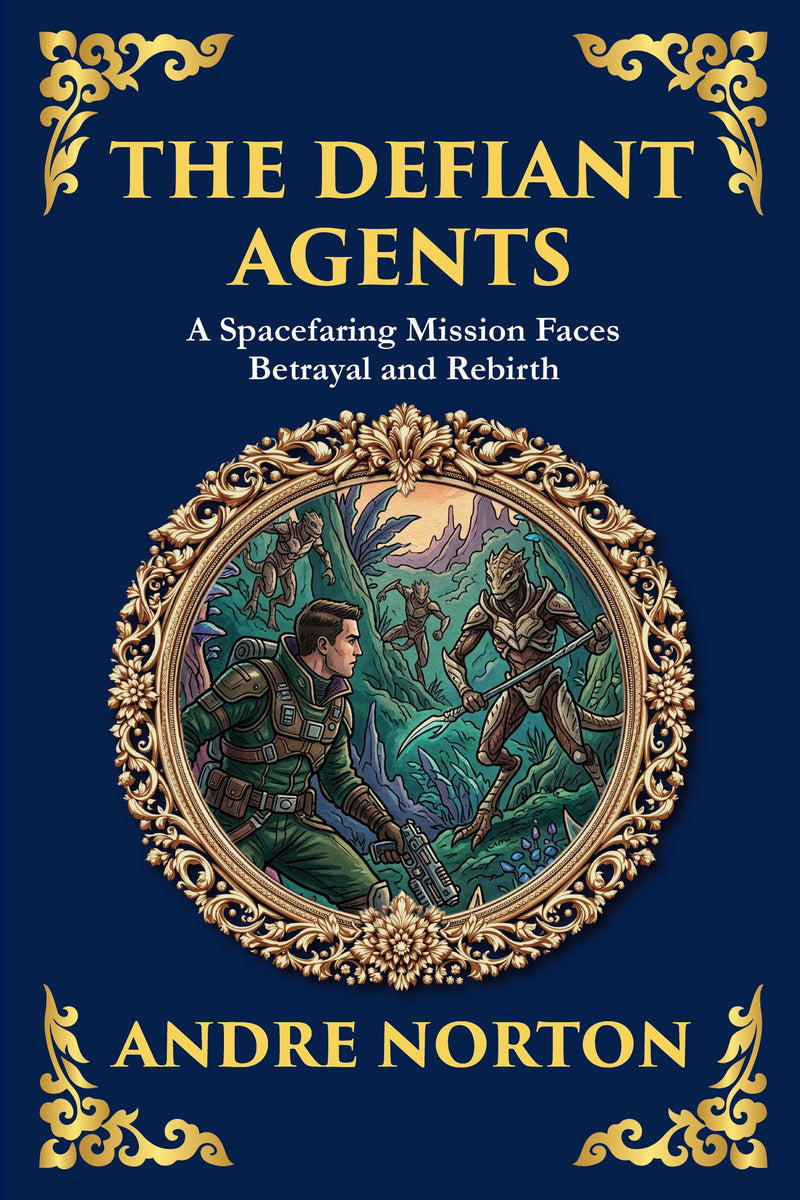
The Defiant Agents
In The Defiant Agents, master storyteller Andre Norton blends spacefaring adventure with the primal forces of loyalty, survival, and betrayal.
or free app
10,000+ hrs library
30-day guarantee
The complete The Defiant Agents appears in modern English through Library of Alexandria Press, available online with audiobook narration included for members.
Have you ever wondered why the future of humanity depends not only on technology, but on courage, loyalty, and the will to resist? Andre Norton’s The Defiant Agents is a gripping tale of space colonization gone awry. Selected settlers—men and women trained to build a new civilization on an alien world—are transported light-years from Earth.
Yet when they awaken, they discover their minds have been altered, their pasts erased, and their instincts reshaped. The dream of progress has become a struggle for survival. As rival groups clash for control of this strange new planet, the pioneers must confront questions of identity, allegiance, and what it means to remain truly human.
Norton’s novel combines the excitement of classic science fiction with deeper reflections on freedom, manipulation, and the resilience of the human spirit.
What you’ll discover in this modern edition
- An Unforgettable Colonization Story – A vision of space settlement where survival takes precedence over progress.
| Formats | eBook (EPUB + PDF) · Audiobook · Paperback · Hardcover · Large Print |
| Language | English |
| Trim size (print) | 6 × 9 in |
| Binding | Paperback — perfect-bound · Hardcover — casewrap |
| Large Print edition | Same text in a larger, easy-read type — a larger font, not a larger trim |
| Print pricing | Every physical book at our true cost — at-cost, no profit (members) |
| Library | 873 restored titles, always growing |
| Length | 59,238 words · ~3 hr 57 min reading |
| Reading level | Grade 8 · an easy, flowing read (this modern-English edition) |
| Edition | Modern English translation · 2026 |
Member reviews for this edition are collected as readers finish it — be the first. Across the library: 12,000+ books shipped, every plan covered by a 365-day print guarantee.
About this edition
A faithful, unabridged modern-English edition by The Library of Alexandria — carefully rendered for today's reader and verified paragraph-by-paragraph against the public-domain source. Available as eBook, audiobook, paperback, hardcover, and large print.
- Complete & unabridgedVerified paragraph by paragraph against the source — never a scan, never abridged.
- Modern English, faithfulReadable today, with the author’s meaning kept intact. Readable — not simplified.
- Every format, one membershipRead in your browser or the free app, or listen to the full audiobook.
Included free with your membership
Cancel anytime, one click · 30-day money-back guarantee
Edition last updated July 2026
What’s inside
The Defiant Agents — complete and unabridged: all 19 sections included with membership, plus the full audiobook.
Begin reading The Defiant Agents
In clear modern English — the complete text is included with membership.
Introduction
There are writers whose work defines a genre, and then there are writers who quietly expand the boundaries of what that genre is allowed to imagine. Andre Norton belongs firmly in the second, rarer category. For more than half a century she produced a body of science fiction and fantasy so vast and so influential that nearly every major author who followed her owes some portion of their imagination to her example. Yet despite her towering importance, she remains, for many contemporary readers, a half-remembered name rather than a living presence on the bookshelf. This edition exists to correct that imbalance, to bring one of her most thematically rich adventures back into the hands of readers who deserve to discover what made her extraordinary in the first place.
The novel you are about to read sits at a fascinating intersection in Norton’s long career. It belongs to a loose constellation of stories concerned with the fate of human beings cast adrift among the stars, with the politics of empire and resistance, and with the deep, often uncomfortable questions of what makes us who we are. It is a story of survival and identity, of loyalty tested under impossible pressure, and of the strange persistence of the human spirit when everything familiar has been stripped away. To read it now, decades after its first publication, is to be reminded both of how much science fiction has changed and of how many of its most enduring concerns were already present, fully formed, in Norton’s restless imagination.
Before we go any further, a brief word about what this introduction will and will not do. It will give you context: about the author, about the era that shaped her, about the themes that run like underground rivers through her fiction, and about the particular pleasures and challenges of reading her work today. What it will not do is spoil the experience that lies ahead. Norton was a master of pacing and revelation, and part of the joy of her storytelling is the way she lets a situation unfold, dropping the reader into an unfamiliar world and trusting them to find their footing. I have no intention of robbing you of that pleasure. Consider these pages a doorway rather than a map—enough to orient you, but never so much that the journey loses its sense of discovery.
To understand the achievement of this book, it helps to understand the remarkable woman who wrote it. Andre Norton was born Alice Mary Norton in Cleveland, Ohio, in 1912, into a world that would have found the idea of a female science fiction author not merely unusual but faintly absurd. The genre, in its early decades, was overwhelmingly a male domain—written by men, edited by men, and marketed to an assumed readership of boys and young men hungry for tales of rockets and ray guns. Norton entered this world by a side door, and she did so with a quiet shrewdness that tells us a great deal about the obstacles she faced. She legally adopted the name “Andre,” a deliberately androgynous choice intended to make her work more acceptable to publishers and readers who might have dismissed a story bearing a woman’s name on the cover.
That single decision speaks volumes about the literary landscape of the mid-twentieth century. It was not vanity or affectation; it was strategy, the calculated maneuver of a writer who understood that to be read at all she had to first slip past the gatekeepers’ assumptions. And slip past them she did. For decades, countless readers devoured her novels without ever suspecting that the author was a woman—and when the truth became more widely known, it only added to the sense that here was a writer who had quietly outmaneuvered an entire industry’s prejudices.
Before she became a full-time novelist, Norton spent years as a librarian, and this background left an indelible mark on everything she wrote. There is a librarian’s sensibility woven through her fiction: a deep respect for knowledge, a fascination with lost histories and forgotten lore, a sense that the past is never truly dead but lies waiting to be rediscovered and put to use. Her characters are frequently seekers, people who must recover something that has been hidden or suppressed—whether it is a forgotten skill, a buried memory, or an ancient power. This is not accidental. It is the worldview of someone who spent her early career surrounded by the accumulated memory of the human race, organizing it, protecting it, and handing it to those who came looking.
Norton’s productivity was staggering. Over a career that spanned roughly seven decades, she published well over a hundred novels and numerous short stories, writing across science fiction, fantasy, historical adventure, and combinations of all three. She was the first woman to receive several of the field’s highest honors, and she was named a Grand Master by the Science Fiction Writers of America—a recognition reserved for those whose lifetime achievement has fundamentally shaped the genre. Her influence radiates outward through generations of writers. Authors who would later become giants in their own right cited her as a formative inspiration, and the entire tradition of young-adult science fiction and fantasy owes her a debt that can scarcely be measured.
What made her so beloved was not merely the quantity of her output but its particular flavor. Norton wrote adventure stories, unashamedly so, but they were adventures imbued with a moral seriousness and an emotional depth that elevated them far above mere entertainment. Her protagonists tend to be outsiders—orphans, exiles, the dispossessed, those who do not fit comfortably into the societies they inhabit. There is a profound compassion in her treatment of these characters, a sense that the people the world overlooks may carry within them exactly the qualities the world most needs. She wrote, again and again, about belonging: about the search for a place, a people, a purpose. And she wrote about the natural world and humanity’s relationship to it with a tenderness that anticipated ecological concerns long before they became fashionable.
A Story of Survival, Identity, and the Echoes of the Past
The novel before you draws together several of the great themes that animated Norton’s imagination throughout her career, and it does so in a setting that gives them particular force. At its heart, this is a story about human beings transplanted into circumstances utterly beyond their control, forced to confront not only the dangers of an alien environment but the more insidious dangers of betrayal, manipulation, and the loss of self. It is, in the deepest sense, a story about what survives when everything else is taken away—and about whether the deepest layers of who we are can be reached, recovered, or reawakened when the surface has been damaged or erased.
Norton was endlessly fascinated by the question of identity, and by extension the question of heritage. What do we inherit from those who came before us? What sleeps within us, dormant until circumstances call it forth? In this novel, that fascination takes on a particular urgency, because the characters are people whose connection to their own past has been complicated, severed, or transformed. The drama that unfolds is in large part a drama of rediscovery—of individuals reaching back across distance and disruption to recover something essential about who they are and where they come from. It is a profoundly humane preoccupation, and it gives the adventure a resonance that lingers long after the final page.
Equally central is the theme of defiance, announced in the title itself. Norton was always drawn to the figure of the rebel, the resister, the one who refuses to submit to a power that would dominate or diminish them. But her treatment of defiance is never simplistic. She understood that resistance is costly, that it demands sacrifice, and that the line between the oppressor and the oppressed can blur in unexpected ways. The struggle at the center of this book is not a matter of clear-cut heroes opposing obvious villains, but a more textured exploration of competing loyalties, manipulated populations, and the difficulty of doing right when the very ground beneath your feet has shifted. The characters must decide not only whom to fight but whom to trust—and in Norton’s universe, that second question is often the harder one.
The setting amplifies all of these concerns. Norton was a writer who took genuine pleasure in the construction of worlds, and the environment in which this story unfolds is rendered with the kind of vivid, sensory specificity that marks her best work. There is a tactile quality to her landscapes—the feel of strange terrain underfoot, the unfamiliar quality of an alien sky, the constant low hum of danger that accompanies survival in a place not meant for human beings. She does not overwhelm the reader with technical exposition or pages of invented science; instead, she builds her worlds the way an experienced traveler describes a foreign country, attending to the details that matter for survival and trusting the reader to absorb the rest. This economy is one of her great strengths, and it is part of why her work has aged so gracefully.
There is also, running beneath the adventure, a meditation on the relationship between the so-called primitive and the technologically advanced—a theme that recurs throughout Norton’s fiction and that she handles with characteristic nuance. She was deeply skeptical of the assumption that technological sophistication equals moral or human superiority. Again and again in her work, she suggests that older ways of knowing, older skills and instincts and forms of wisdom, may prove more durable and more valuable than the gleaming apparatus of high civilization. In a story where characters are stripped of their advanced tools and thrown back upon more elemental resources, this theme acquires real dramatic weight. The question of which inheritance—the ancient or the modern—will sustain a person under pressure becomes one of the novel’s quiet but persistent undercurrents.
What lifts all of this above the level of straightforward adventure is Norton’s unfailing emotional intelligence. She understood that the most thrilling external action means little if the reader does not care about the people involved, and she invests her characters with a depth of feeling that makes their struggles genuinely affecting. We feel their fear, their loneliness, their flickering hope. We come to understand what they have lost and what they are fighting to reclaim. By the time the story reaches its climax, the stakes are not merely physical survival but something more profound—the preservation of dignity, of selfhood, of the bonds that make human existence meaningful. This is what separates Norton from many of her contemporaries who wrote competent but forgettable space adventures. She never forgot that beneath the exotic trappings, she was writing about people, and about the things that matter most to people.
Reading Norton Today: A Note on This Modern Edition
Every work of literature is a product of its moment, and the science fiction of the mid-twentieth century carries the fingerprints of the era that produced it. This presents both an opportunity and a challenge for the contemporary reader. The opportunity lies in the chance to encounter a vision of the future—or of distant worlds—as imagined by a mind shaped by very different concerns and assumptions than our own. There is genuine pleasure and value in this kind of time travel, in seeing how the writers of an earlier generation projected their hopes and anxieties onto the canvas of space. The challenge lies in the fact that some of the conventions, the rhythms, and the references of older science fiction can feel unfamiliar or even opaque to readers raised on more recent storytelling.
This edition has been prepared with that challenge squarely in mind. It is described as a modern translation, adapted for the contemporary reader, and it is worth explaining what that means and why it has been done. Norton wrote in a prose style that, while clear and propulsive by the standards of her day, sometimes employed turns of phrase, sentence structures, and idioms that can now read as dated or stilted. Certain references that would have been immediately legible to a reader in her own time have grown obscure with the passing decades. The aim of this adaptation has been to gently smooth these rough edges—to clarify what has become unclear, to update language that might otherwise distract or confuse, and to ensure that the reading experience flows as naturally for a reader today as the original did for its first audience.
Cancel anytime, one click · 30-day money-back guarantee
Founding annual rate available now — your price locks for life when you join.
Not ready? Get this free chapter by email — read it anytime.
✓ Sent — check your inbox for The Defiant Agents.
Questions about The Defiant Agents
What is The Defiant Agents about?
In The Defiant Agents, master storyteller Andre Norton blends spacefaring adventure with the primal forces of loyalty, survival, and betrayal. A team of pioneers is hurled across the stars to colonize a distant planet. But something has gone wrong.
Who wrote The Defiant Agents?
The Defiant Agents was written by Andre Norton. This edition presents the complete work in clear modern English, faithfully rendered from the public-domain original by Library of Alexandria Press.
Is The Defiant Agents free to read?
The opening chapter is free to read on this page. Members read and listen to the complete work — and the entire library — free, and can order any physical book at our true print cost.
How long is The Defiant Agents?
19 chapters (~59,238 words) — about 3 hr 57 min of reading in this modern-English edition.
Is this an abridged version of The Defiant Agents?
No. This is the complete, unabridged The Defiant Agents, carefully rendered into clear modern English and verified paragraph-by-paragraph against the public-domain source — nothing is cut or summarised.
What formats does The Defiant Agents come in?
The Defiant Agents is available as eBook, paperback, hardcover and large print. eBook and audiobook are included with membership; printed editions ship at our true print cost.
Shipping & returns
Billing & membership
More from the library


Explore Science Fiction
- The Island of Doctor Moreau · H. G. Wells
- A Midsummer Night’s Dream · William Shakespeare
- The Invisible Man: A Grotesque Romance · H. G. Wells
- The War of the Worlds · H. G. Wells
- The Strange Case of Dr. Jekyll and Mr. Hyde · Robert Louis Stevenson
- Limanora: the island of progress · Godfrey Sweven
- The Book of Dragons · E. Nesbit
- She · H. Rider Haggard
- Dorothy and the Wizard in Oz · L. Frank Baum
- The Princess and the Goblin · George MacDonald
- Gawayne and the Green Knight: A Fairy Tale · Charlton M. Lewis
- Lucian’s True History · Lucian of Samosata
- The Willows · Algernon Blackwood
- The Call of Cthulhu · H. P. Lovecraft
- The Life-Eater · Harold Ward
- The Marvelous Land of Oz · L. Frank Baum
- Mars is My Destination · Frank Belknap Long
- The Black Kiss
- The Beasts in the Void · Paul W. Fairman
- John Jones’s Dollar · Harry Stephen Keeler
- Subversive · Mack Reynolds
- The Mississippi Saucer · Frank Belknap Long
- Man of Distinction · Michael Shaara
- Spawn of the Comet · H. Thompson Rich
- The Golden Judge · Nathaniel Gordon
- Final Weapon · Everett B. Cole
- The Big Fix · George O. Smith
- Last Enemy · H. Beam Piper
- Time and Time Again · H. Beam Piper
- Sabotage in Space · Carey Rockwell
The Defiant Agents
The Defiant Agents
A Spacefaring Mission Faces Betrayal and Rebirth
Andre Norton
Contents
- Introduction
- Chapter 1
- Chapter 2
- Chapter 3
- Chapter 4
- Chapter 5
- Chapter 6
- Chapter 7
- Chapter 8
- Chapter 9
- Chapter 10
- Chapter 11
- Chapter 12
- Chapter 13
- Chapter 14
- Chapter 15
- Chapter 16
- Chapter 17
- Chapter 18
Introduction
There are writers whose work defines a genre, and then there are writers who quietly expand the boundaries of what that genre is allowed to imagine. Andre Norton belongs firmly in the second, rarer category. For more than half a century she produced a body of science fiction and fantasy so vast and so influential that nearly every major author who followed her owes some portion of their imagination to her example. Yet despite her towering importance, she remains, for many contemporary readers, a half-remembered name rather than a living presence on the bookshelf. This edition exists to correct that imbalance, to bring one of her most thematically rich adventures back into the hands of readers who deserve to discover what made her extraordinary in the first place.
The novel you are about to read sits at a fascinating intersection in Norton’s long career. It belongs to a loose constellation of stories concerned with the fate of human beings cast adrift among the stars, with the politics of empire and resistance, and with the deep, often uncomfortable questions of what makes us who we are. It is a story of survival and identity, of loyalty tested under impossible pressure, and of the strange persistence of the human spirit when everything familiar has been stripped away. To read it now, decades after its first publication, is to be reminded both of how much science fiction has changed and of how many of its most enduring concerns were already present, fully formed, in Norton’s restless imagination.
Before we go any further, a brief word about what this introduction will and will not do. It will give you context: about the author, about the era that shaped her, about the themes that run like underground rivers through her fiction, and about the particular pleasures and challenges of reading her work today. What it will not do is spoil the experience that lies ahead. Norton was a master of pacing and revelation, and part of the joy of her storytelling is the way she lets a situation unfold, dropping the reader into an unfamiliar world and trusting them to find their footing. I have no intention of robbing you of that pleasure. Consider these pages a doorway rather than a map—enough to orient you, but never so much that the journey loses its sense of discovery.
To understand the achievement of this book, it helps to understand the remarkable woman who wrote it. Andre Norton was born Alice Mary Norton in Cleveland, Ohio, in 1912, into a world that would have found the idea of a female science fiction author not merely unusual but faintly absurd. The genre, in its early decades, was overwhelmingly a male domain—written by men, edited by men, and marketed to an assumed readership of boys and young men hungry for tales of rockets and ray guns. Norton entered this world by a side door, and she did so with a quiet shrewdness that tells us a great deal about the obstacles she faced. She legally adopted the name “Andre,” a deliberately androgynous choice intended to make her work more acceptable to publishers and readers who might have dismissed a story bearing a woman’s name on the cover.
That single decision speaks volumes about the literary landscape of the mid-twentieth century. It was not vanity or affectation; it was strategy, the calculated maneuver of a writer who understood that to be read at all she had to first slip past the gatekeepers’ assumptions. And slip past them she did. For decades, countless readers devoured her novels without ever suspecting that the author was a woman—and when the truth became more widely known, it only added to the sense that here was a writer who had quietly outmaneuvered an entire industry’s prejudices.
Before she became a full-time novelist, Norton spent years as a librarian, and this background left an indelible mark on everything she wrote. There is a librarian’s sensibility woven through her fiction: a deep respect for knowledge, a fascination with lost histories and forgotten lore, a sense that the past is never truly dead but lies waiting to be rediscovered and put to use. Her characters are frequently seekers, people who must recover something that has been hidden or suppressed—whether it is a forgotten skill, a buried memory, or an ancient power. This is not accidental. It is the worldview of someone who spent her early career surrounded by the accumulated memory of the human race, organizing it, protecting it, and handing it to those who came looking.
Norton’s productivity was staggering. Over a career that spanned roughly seven decades, she published well over a hundred novels and numerous short stories, writing across science fiction, fantasy, historical adventure, and combinations of all three. She was the first woman to receive several of the field’s highest honors, and she was named a Grand Master by the Science Fiction Writers of America—a recognition reserved for those whose lifetime achievement has fundamentally shaped the genre. Her influence radiates outward through generations of writers. Authors who would later become giants in their own right cited her as a formative inspiration, and the entire tradition of young-adult science fiction and fantasy owes her a debt that can scarcely be measured.
What made her so beloved was not merely the quantity of her output but its particular flavor. Norton wrote adventure stories, unashamedly so, but they were adventures imbued with a moral seriousness and an emotional depth that elevated them far above mere entertainment. Her protagonists tend to be outsiders—orphans, exiles, the dispossessed, those who do not fit comfortably into the societies they inhabit. There is a profound compassion in her treatment of these characters, a sense that the people the world overlooks may carry within them exactly the qualities the world most needs. She wrote, again and again, about belonging: about the search for a place, a people, a purpose. And she wrote about the natural world and humanity’s relationship to it with a tenderness that anticipated ecological concerns long before they became fashionable.
A Story of Survival, Identity, and the Echoes of the Past
The novel before you draws together several of the great themes that animated Norton’s imagination throughout her career, and it does so in a setting that gives them particular force. At its heart, this is a story about human beings transplanted into circumstances utterly beyond their control, forced to confront not only the dangers of an alien environment but the more insidious dangers of betrayal, manipulation, and the loss of self. It is, in the deepest sense, a story about what survives when everything else is taken away—and about whether the deepest layers of who we are can be reached, recovered, or reawakened when the surface has been damaged or erased.
Norton was endlessly fascinated by the question of identity, and by extension the question of heritage. What do we inherit from those who came before us? What sleeps within us, dormant until circumstances call it forth? In this novel, that fascination takes on a particular urgency, because the characters are people whose connection to their own past has been complicated, severed, or transformed. The drama that unfolds is in large part a drama of rediscovery—of individuals reaching back across distance and disruption to recover something essential about who they are and where they come from. It is a profoundly humane preoccupation, and it gives the adventure a resonance that lingers long after the final page.
Equally central is the theme of defiance, announced in the title itself. Norton was always drawn to the figure of the rebel, the resister, the one who refuses to submit to a power that would dominate or diminish them. But her treatment of defiance is never simplistic. She understood that resistance is costly, that it demands sacrifice, and that the line between the oppressor and the oppressed can blur in unexpected ways. The struggle at the center of this book is not a matter of clear-cut heroes opposing obvious villains, but a more textured exploration of competing loyalties, manipulated populations, and the difficulty of doing right when the very ground beneath your feet has shifted. The characters must decide not only whom to fight but whom to trust—and in Norton’s universe, that second question is often the harder one.
The setting amplifies all of these concerns. Norton was a writer who took genuine pleasure in the construction of worlds, and the environment in which this story unfolds is rendered with the kind of vivid, sensory specificity that marks her best work. There is a tactile quality to her landscapes—the feel of strange terrain underfoot, the unfamiliar quality of an alien sky, the constant low hum of danger that accompanies survival in a place not meant for human beings. She does not overwhelm the reader with technical exposition or pages of invented science; instead, she builds her worlds the way an experienced traveler describes a foreign country, attending to the details that matter for survival and trusting the reader to absorb the rest. This economy is one of her great strengths, and it is part of why her work has aged so gracefully.
There is also, running beneath the adventure, a meditation on the relationship between the so-called primitive and the technologically advanced—a theme that recurs throughout Norton’s fiction and that she handles with characteristic nuance. She was deeply skeptical of the assumption that technological sophistication equals moral or human superiority. Again and again in her work, she suggests that older ways of knowing, older skills and instincts and forms of wisdom, may prove more durable and more valuable than the gleaming apparatus of high civilization. In a story where characters are stripped of their advanced tools and thrown back upon more elemental resources, this theme acquires real dramatic weight. The question of which inheritance—the ancient or the modern—will sustain a person under pressure becomes one of the novel’s quiet but persistent undercurrents.
What lifts all of this above the level of straightforward adventure is Norton’s unfailing emotional intelligence. She understood that the most thrilling external action means little if the reader does not care about the people involved, and she invests her characters with a depth of feeling that makes their struggles genuinely affecting. We feel their fear, their loneliness, their flickering hope. We come to understand what they have lost and what they are fighting to reclaim. By the time the story reaches its climax, the stakes are not merely physical survival but something more profound—the preservation of dignity, of selfhood, of the bonds that make human existence meaningful. This is what separates Norton from many of her contemporaries who wrote competent but forgettable space adventures. She never forgot that beneath the exotic trappings, she was writing about people, and about the things that matter most to people.
Reading Norton Today: A Note on This Modern Edition
Every work of literature is a product of its moment, and the science fiction of the mid-twentieth century carries the fingerprints of the era that produced it. This presents both an opportunity and a challenge for the contemporary reader. The opportunity lies in the chance to encounter a vision of the future—or of distant worlds—as imagined by a mind shaped by very different concerns and assumptions than our own. There is genuine pleasure and value in this kind of time travel, in seeing how the writers of an earlier generation projected their hopes and anxieties onto the canvas of space. The challenge lies in the fact that some of the conventions, the rhythms, and the references of older science fiction can feel unfamiliar or even opaque to readers raised on more recent storytelling.
This edition has been prepared with that challenge squarely in mind. It is described as a modern translation, adapted for the contemporary reader, and it is worth explaining what that means and why it has been done. Norton wrote in a prose style that, while clear and propulsive by the standards of her day, sometimes employed turns of phrase, sentence structures, and idioms that can now read as dated or stilted. Certain references that would have been immediately legible to a reader in her own time have grown obscure with the passing decades. The aim of this adaptation has been to gently smooth these rough edges—to clarify what has become unclear, to update language that might otherwise distract or confuse, and to ensure that the reading experience flows as naturally for a reader today as the original did for its first audience.
The office had four plain walls without a single window, so no sunlight from the outside hit the desk. Even so, the five disks lying on the surface seemed to glow—as if the heat of the chaos they could cause, or had already caused, was burning inside them.
However, imaginative theories couldn’t hide the cold, hard truth. Dr. Gordon Ashe, one of the four men staring gloomily at the display, gave a slight shake of his head to clear those thoughts from his mind.
The man to his right, Colonel Kelgarries, leaned in and asked sharply, “Is there any chance this is a mistake?”
“You saw the detector,” the thin, gray man behind the desk replied with cold precision. “No, there’s no mistake. These five have definitely been spied on.”
“And two of the choices among them,” Ashe whispered. That was the most critical detail now.
“I thought these were under the highest security,” Kelgarries challenged the gray man.
Florian Waldour’s distant expression didn’t budge. “Every possible precaution was taken. There was a sleeper—a hidden agent—planted—“
Ashe looked at his three companions: Kelgarries, the colonel in charge of one sector of Project Star; Florian Waldour, the station’s security chief; and Dr. James Ruthven.
“Camdon!” he exclaimed, barely able to believe the conclusion logic had led him to.
For the first time since he had known and worked with Kelgarries, Ashe saw the man look genuinely shocked.
“Camdon? But he was sent to us by—“ The colonel narrowed his eyes. “He must have been sent... there were too many background checks to fake that!”
“Oh, he was sent, alright.” For the first time, Waldour’s voice sounded emotional. “He was a sleeper, a very deep one. They must have planted him twenty-five or thirty years ago. He has played the part perfectly for that entire time.”
End of the free sample
Keep reading, free
Members read and listen to the complete book — and the entire library. Cancel anytime, one click · 30-day money-back guarantee.