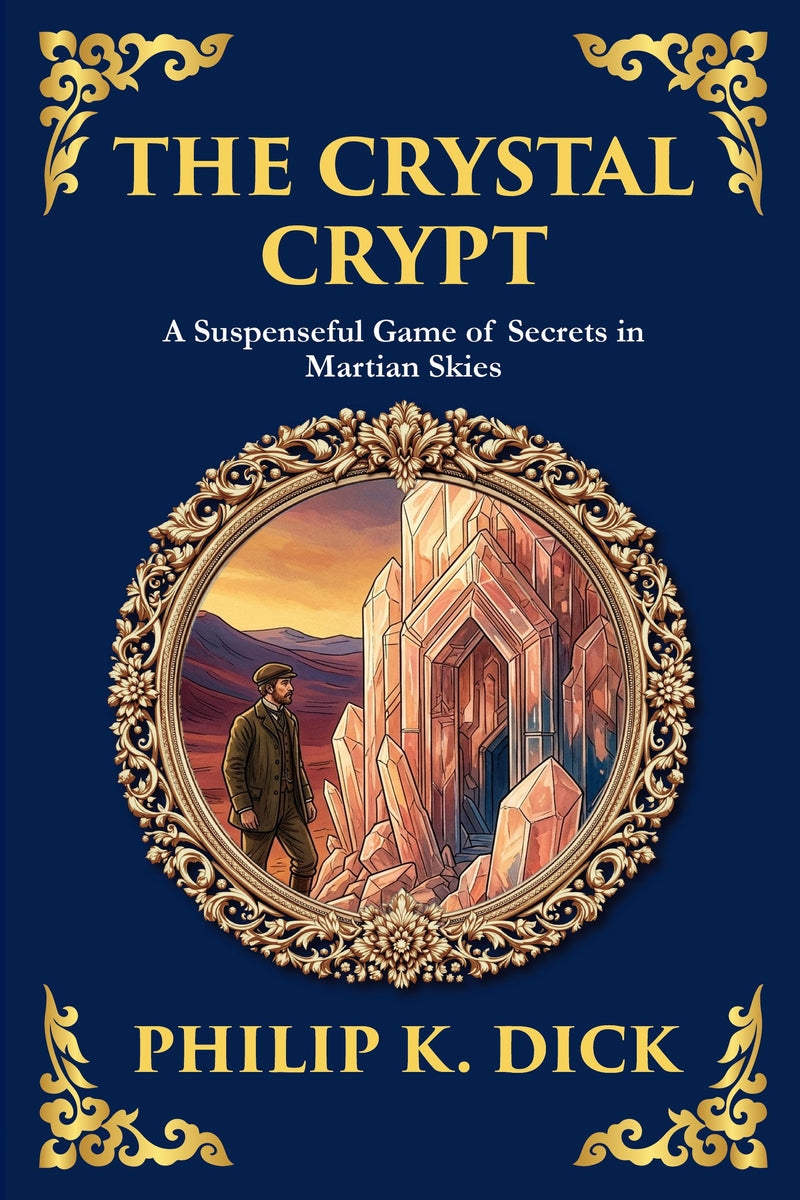
The Crystal Crypt — Large Print
In The Crystal Crypt, Philip K. Dick delivers a gripping tale of deception, surveillance, and moral ambiguity at the edge of interplanetary conflict.
or free app
10,000+ hrs library
30-day guarantee
The complete The Crystal Crypt appears in modern English through Library of Alexandria Press, available online with audiobook narration included for members.
Have you ever wondered why some truths are so dangerous, even the future must run from them? The Crystal Crypt is a masterclass in compact science fiction suspense from the visionary mind of Philip K. Dick. Set in a future where Earth and Mars stand on the brink of war, the story begins with the last spaceship leaving Mars—a seemingly uneventful flight, until a tense inspection reveals that three passengers may be hiding more than just luggage.
As interrogations unfold and cryptic clues emerge, readers are plunged into a razor-sharp narrative of hidden identities, mysterious technologies, and morally gray actions that question the very meaning of justice. What begins as a simple escape soon spirals into a tightly woven cat-and-mouse game, where motives blur and survival demands deception.
What you’ll discover in this modern edition
- An Unforgettable Interplanetary Mystery – A tense, high-stakes story set on the brink of Martian-Earth conflict.
| Formats | eBook (EPUB + PDF) · Audiobook · Paperback · Hardcover · Large Print |
| Language | English |
| Trim size (print) | 6 × 9 in |
| Binding | Paperback — perfect-bound · Hardcover — casewrap |
| Large Print edition | Same text in a larger, easy-read type — a larger font, not a larger trim |
| Print pricing | Every physical book at our true cost — at-cost, no profit (members) |
| Library | 873 restored titles, always growing |
| Length | 10,634 words · ~43 min reading |
| Reading level | Grade 3 · an easy, flowing read (this modern-English edition) |
| Edition | Modern English translation · 2026 |
Member reviews for this edition are collected as readers finish it — be the first. Across the library: 12,000+ books shipped, every plan covered by a 365-day print guarantee.
About this edition
A faithful, unabridged modern-English edition by The Library of Alexandria — carefully rendered for today's reader and verified paragraph-by-paragraph against the public-domain source. Available as eBook, audiobook, paperback, hardcover, and large print.
- Complete & unabridgedVerified paragraph by paragraph against the source — never a scan, never abridged.
- Modern English, faithfulReadable today, with the author’s meaning kept intact. Readable — not simplified.
- Every format, one membershipRead in your browser or the free app, or listen to the full audiobook.
Included free with your membership
Cancel anytime, one click · 30-day money-back guarantee
Edition last updated July 2026
What’s inside
The Crystal Crypt — Large Print — complete and unabridged, included in full with membership, plus the full audiobook.
Begin reading The Crystal Crypt — Large Print
In clear modern English — the complete text is included with membership.
Introduction
There is a particular thrill that comes from boarding a vehicle bound for somewhere you cannot return from easily—a train pulling away from a station, a ship slipping its moorings, a rocket lifting off a frozen Martian plain. In that moment, the passengers become a sealed community, bound together by circumstance, suspicion, and the slow tick of the clock. The walls close in. Every face becomes a question. Every silence becomes a clue. This is the atmosphere into which The Crystal Crypt invites you, and it is an atmosphere that few writers have ever conjured with the economy, intelligence, and quiet menace of Philip K. Dick.
What you hold in your hands is a compact masterwork of suspense, a story that compresses enormous tension into a small space and a short span of time. It belongs to a tradition as old as storytelling itself—the locked-room mystery, the chase across hostile terrain, the fugitives who must outwit pursuers using nothing but their wits—yet it bends that tradition through the unmistakable lens of one of the twentieth century’s most singular imaginations. To read it is to feel the pleasure of a tightly wound spring slowly releasing its energy, page by page, until the final turn snaps everything into place. This modern translation, adapted carefully for the contemporary reader, aims to deliver that pleasure undiminished by the passage of decades, while preserving every ounce of the original’s nerve-jangling intensity.
To understand why this story works the way it does, it helps to understand the man who wrote it. Philip Kindred Dick, born in Chicago in 1928 and raised largely in the San Francisco Bay Area, was a writer who spent his life obsessed with a handful of enormous questions and a refusal to answer them simply. What is real? Who can be trusted? What lies beneath the surface of the everyday? How do we know that the people around us are who they claim to be—and how do we know that we ourselves are who we believe ourselves to be? These questions thread through nearly everything he wrote, and they thread through this story too, even though it presents itself, at first glance, as a straightforward tale of escape and pursuit.
Dick was extraordinarily prolific, especially in the 1950s, when he was producing short fiction at a furious pace for the science fiction magazines that flourished in that era. These were the pulps and the digest-sized periodicals with lurid covers and ten-cent ambitions, publications that paid by the word and demanded brisk, hooky storytelling. Many writers treated this market as a factory floor, churning out interchangeable adventures of square-jawed spacemen and screaming damsels. Dick, by contrast, used the constraints of the form as a discipline. Forced to be brief, he learned to be precise. Forced to entertain, he learned to smuggle his deeper concerns inside the wrapping of thrilling plots. The short stories of this period are, in many ways, the laboratory in which he developed the themes and techniques that would later make his novels—Do Androids Dream of Electric Sheep?, The Man in the High Castle, Ubik, A Scanner Darkly—into enduring monuments of the genre and beyond.
It is worth pausing on the cultural moment that produced him. The 1950s were a decade of profound unease beneath a glossy surface of prosperity. The Cold War cast its shadow over every aspect of American life. The atomic bomb had demonstrated, in a single blinding instant, that humanity now possessed the power to destroy itself. Paranoia was not merely a psychological condition; it was a national mood, encouraged by political witch-hunts, by the constant rhetoric of hidden enemies, by the sense that the person sitting next to you might be a spy, a subversive, a saboteur in disguise. Dick absorbed all of this, and he gave it back to his readers transformed. His stories of impostors, double agents, and concealed identities were not escapism from the anxieties of his age; they were those anxieties refined into pure narrative fuel.
And yet to read Dick as merely a writer of his moment would be to sell him short. His genius lay in his capacity to take the disposable conventions of pulp science fiction and charge them with metaphysical weight. A simple chase becomes a meditation on identity. A space colony becomes a microcosm of human society and its discontents. A device meant to deliver a cheap thrill becomes a key that unlocks a question about the nature of trust itself. This is why his work has outlived the magazines it first appeared in, why it has been adapted again and again for film and television, why new generations of readers continue to discover him with a shock of recognition. He wrote about the future, but he was really writing about the permanent condition of being human in a world we can never fully understand.
The story you are about to read is a fine, concentrated example of these gifts. It is short—deliberately, bracingly short—but it does not feel slight. Every scene earns its place. Every character serves a purpose. The setting of Mars is not mere window dressing but a carefully chosen stage that heightens the drama: a world of cold, of distance, of dependence on fragile technology, of communities cut off from the safety of home. The Martian frontier in Dick’s hands becomes a place where the rules of ordinary life are suspended, where loyalties are uncertain, and where survival may depend on a single perfectly timed deception.
What makes the experience so gripping is the way Dick manages information. He understood, perhaps better than any of his contemporaries, that suspense is fundamentally about what the reader knows and does not know, and about the gap between what characters know and what they suspect. He doles out details with the precision of a card player deciding which cards to reveal and which to hold. You will find yourself, as you read, constantly recalibrating your sense of the situation—watching for the tell, listening for the false note, trying to determine which surface is solid and which conceals a trap. This is reading as active engagement, reading as participation in a game whose stakes feel real because the author has made you care about who wins and who loses.
The story’s central premise, which I will not spoil here, hinges on the kind of cleverness that rewards close attention. Dick was not content to construct a simple game of cat and mouse; he wanted to construct a game in which the mouse might be the cat, in which the hunter might be the hunted, in which the very ground beneath the characters’ feet might not be what it seems. Pay attention to the small things—the gestures, the objects, the offhand remarks. Dick was a writer who hid his most important clues in plain sight, trusting his readers to be attentive enough to notice and surprised enough to delight when the full pattern is finally disclosed. This is a story best read with your mind fully awake, your guard up, your skepticism engaged. It will reward you for it.
There is also, beneath the suspense, a current of genuine moral seriousness. Dick was never interested in violence or danger for their own sake. He was interested in what people do when they are cornered, in the choices they make under pressure, in the ways that ordinary individuals are caught up in forces larger than themselves. His protagonists are rarely heroes in the conventional mold. They are frightened, fallible, often desperate people doing their best to survive in a hostile universe. There is a deep humanity in this, a sympathy for the small and the overmatched, that distinguishes Dick from the more triumphalist science fiction of his era. He did not believe in invincible spacemen conquering the cosmos. He believed in fragile, anxious human beings stumbling through a world that constantly threatens to overwhelm them—and he found in that fragility something noble, something worth defending, something worth writing about.
The Art of Adaptation and the Pleasures of This Edition
A word about this edition and what it offers you. The phrase “a modern translation, adapted for the contemporary reader” deserves some explanation, because it is not quite the same as a translation between languages, and it is not a rewriting that takes liberties with the author’s intentions. Rather, it is an act of careful stewardship, the work of bringing a piece of mid-twentieth-century prose across the bridge of time so that it lands cleanly in the mind of a reader in the present day.
When Dick wrote this story, he was writing for an audience steeped in the conventions of its moment. Certain turns of phrase, certain rhythms of dialogue, certain assumptions about technology and society were second nature to readers then, but can feel slightly distant or quaint to us now. A sensitive adaptation smooths these small frictions without erasing the character of the original. It clarifies what time has obscured. It updates the texture of the language so that the modern reader can move through the story without stumbling over archaic constructions, while leaving intact the bones of the narrative, the architecture of the plot, the essential voice and vision of the author. The goal is to make the reading experience feel as immediate and electric as it must have felt to the story’s first audience, who encountered it fresh off the press, with no patina of age between them and the page.
This is a delicate balance, and it is worth appreciating the care it requires. One does not want to flatten the strangeness that is so much a part of Dick’s appeal—the slight off-kilter quality, the sense that something is not quite right beneath the ordinary surface. Nor does one want to preserve every dated reference so faithfully that the prose becomes a museum piece, admired but not lived in. The adaptation you are about to read threads this needle with respect for both the author and the reader. It treats the original as a thing of value to be honored, and it treats you, the reader, as someone who deserves to encounter that value without unnecessary obstacles.
There is a longstanding debate, among lovers of literature, about whether older works should be presented exactly as they were written or gently modernized for new audiences. Both positions have merit. The purist argues, rightly, that every word an author chose was a deliberate act, and that to alter those words is to interfere with the work’s integrity. The modernizer argues, equally rightly, that language is a living thing, that the purpose of a story is to be read and felt, and that excessive fidelity to outdated conventions can become a barrier that keeps a worthy work from finding the readers it deserves. For a work like this one—a piece of popular fiction originally written for a mass audience, intended above all to grip and entertain—the case for thoughtful modernization is especially strong. Dick did not write this story to be enshrined behind glass. He wrote it to be devoured. This edition aims to let you devour it.
What you will not find here is any tampering with the substance of the tale. The plot remains exactly as Dick conceived it. The characters retain their motivations, their secrets, their carefully constructed deceptions. The twists land where Dick intended them to land. The atmosphere of cold dread and tightening tension is preserved and, where possible, sharpened. This is the same story Dick wrote, presented in a form designed to let it speak most clearly to you.
It is also worth saying a few words about how best to approach the reading itself. Because this is a short, tightly constructed work, it rewards being read in a single sitting if you can manage it. Suspense is a fragile thing; it dissipates when interrupted, and it builds when sustained. If you can find an hour of uninterrupted time—an evening, a long train ride, a quiet afternoon—you will experience the story as it was meant to be experienced, as a single accelerating curve of tension that does not let you go until the final page. Resist the urge to skim ahead. Resist the urge to skip the small descriptive passages in search of the action. With Dick, the small passages often contain the action, in coded form. The details matter. The pacing matters. The slow accumulation of unease is part of the design.
Cancel anytime, one click · 30-day money-back guarantee
Founding annual rate available now — your price locks for life when you join.
Not ready? Get this free chapter by email — read it anytime.
✓ Sent — check your inbox for The Crystal Crypt — Large Print.
Questions about The Crystal Crypt — Large Print
What is The Crystal Crypt about?
In The Crystal Crypt, Philip K. Dick delivers a gripping tale of deception, surveillance, and moral ambiguity at the edge of interplanetary conflict. As the final ship departs Mars for Earth, three passengers carry a dangerous secret—one that could ignite war between worlds. But the Martian authorities are watching, and not everything is as it seems.
Who wrote The Crystal Crypt?
The Crystal Crypt was written by Philip K. Dick. This edition presents the complete work in clear modern English, faithfully rendered from the public-domain original by Library of Alexandria Press.
Is The Crystal Crypt free to read?
The opening chapter is free to read on this page. Members read and listen to the complete work — and the entire library — free, and can order any physical book at our true print cost.
How long is The Crystal Crypt?
2 chapters (~10,634 words) — about 43 min of reading in this modern-English edition.
Is this an abridged version of The Crystal Crypt?
No. This is the complete, unabridged The Crystal Crypt, carefully rendered into clear modern English and verified paragraph-by-paragraph against the public-domain source — nothing is cut or summarised.
What formats does The Crystal Crypt come in?
The Crystal Crypt is available as eBook, paperback, hardcover and large print. eBook and audiobook are included with membership; printed editions ship at our true print cost.
Shipping & returns
Billing & membership
More from the library


Explore Science Fiction
- The Island of Doctor Moreau · H. G. Wells
- A Midsummer Night’s Dream · William Shakespeare
- The Invisible Man: A Grotesque Romance · H. G. Wells
- The War of the Worlds · H. G. Wells
- The Strange Case of Dr. Jekyll and Mr. Hyde · Robert Louis Stevenson
- Limanora: the island of progress · Godfrey Sweven
- The Book of Dragons · E. Nesbit
- She · H. Rider Haggard
- Dorothy and the Wizard in Oz · L. Frank Baum
- The Princess and the Goblin · George MacDonald
- Gawayne and the Green Knight: A Fairy Tale · Charlton M. Lewis
- Lucian’s True History · Lucian of Samosata
- The Willows · Algernon Blackwood
- The Call of Cthulhu · H. P. Lovecraft
- The Life-Eater · Harold Ward
- The Marvelous Land of Oz · L. Frank Baum
- Mars is My Destination · Frank Belknap Long
- The Black Kiss
- The Beasts in the Void · Paul W. Fairman
- John Jones’s Dollar · Harry Stephen Keeler
- Subversive · Mack Reynolds
- The Mississippi Saucer · Frank Belknap Long
- Man of Distinction · Michael Shaara
- Spawn of the Comet · H. Thompson Rich
- The Golden Judge · Nathaniel Gordon
- Final Weapon · Everett B. Cole
- The Big Fix · George O. Smith
- Last Enemy · H. Beam Piper
- Time and Time Again · H. Beam Piper
- Sabotage in Space · Carey Rockwell
The Crystal Crypt — Large Print
The Crystal Crypt — Large Print
A Suspenseful Game of Secrets in Martian Skies
Philip K. Dick
Contents
- Introduction
- The Crystal Crypt
Introduction
There is a particular thrill that comes from boarding a vehicle bound for somewhere you cannot return from easily—a train pulling away from a station, a ship slipping its moorings, a rocket lifting off a frozen Martian plain. In that moment, the passengers become a sealed community, bound together by circumstance, suspicion, and the slow tick of the clock. The walls close in. Every face becomes a question. Every silence becomes a clue. This is the atmosphere into which The Crystal Crypt invites you, and it is an atmosphere that few writers have ever conjured with the economy, intelligence, and quiet menace of Philip K. Dick.
What you hold in your hands is a compact masterwork of suspense, a story that compresses enormous tension into a small space and a short span of time. It belongs to a tradition as old as storytelling itself—the locked-room mystery, the chase across hostile terrain, the fugitives who must outwit pursuers using nothing but their wits—yet it bends that tradition through the unmistakable lens of one of the twentieth century’s most singular imaginations. To read it is to feel the pleasure of a tightly wound spring slowly releasing its energy, page by page, until the final turn snaps everything into place. This modern translation, adapted carefully for the contemporary reader, aims to deliver that pleasure undiminished by the passage of decades, while preserving every ounce of the original’s nerve-jangling intensity.
To understand why this story works the way it does, it helps to understand the man who wrote it. Philip Kindred Dick, born in Chicago in 1928 and raised largely in the San Francisco Bay Area, was a writer who spent his life obsessed with a handful of enormous questions and a refusal to answer them simply. What is real? Who can be trusted? What lies beneath the surface of the everyday? How do we know that the people around us are who they claim to be—and how do we know that we ourselves are who we believe ourselves to be? These questions thread through nearly everything he wrote, and they thread through this story too, even though it presents itself, at first glance, as a straightforward tale of escape and pursuit.
Dick was extraordinarily prolific, especially in the 1950s, when he was producing short fiction at a furious pace for the science fiction magazines that flourished in that era. These were the pulps and the digest-sized periodicals with lurid covers and ten-cent ambitions, publications that paid by the word and demanded brisk, hooky storytelling. Many writers treated this market as a factory floor, churning out interchangeable adventures of square-jawed spacemen and screaming damsels. Dick, by contrast, used the constraints of the form as a discipline. Forced to be brief, he learned to be precise. Forced to entertain, he learned to smuggle his deeper concerns inside the wrapping of thrilling plots. The short stories of this period are, in many ways, the laboratory in which he developed the themes and techniques that would later make his novels—Do Androids Dream of Electric Sheep?, The Man in the High Castle, Ubik, A Scanner Darkly—into enduring monuments of the genre and beyond.
It is worth pausing on the cultural moment that produced him. The 1950s were a decade of profound unease beneath a glossy surface of prosperity. The Cold War cast its shadow over every aspect of American life. The atomic bomb had demonstrated, in a single blinding instant, that humanity now possessed the power to destroy itself. Paranoia was not merely a psychological condition; it was a national mood, encouraged by political witch-hunts, by the constant rhetoric of hidden enemies, by the sense that the person sitting next to you might be a spy, a subversive, a saboteur in disguise. Dick absorbed all of this, and he gave it back to his readers transformed. His stories of impostors, double agents, and concealed identities were not escapism from the anxieties of his age; they were those anxieties refined into pure narrative fuel.
And yet to read Dick as merely a writer of his moment would be to sell him short. His genius lay in his capacity to take the disposable conventions of pulp science fiction and charge them with metaphysical weight. A simple chase becomes a meditation on identity. A space colony becomes a microcosm of human society and its discontents. A device meant to deliver a cheap thrill becomes a key that unlocks a question about the nature of trust itself. This is why his work has outlived the magazines it first appeared in, why it has been adapted again and again for film and television, why new generations of readers continue to discover him with a shock of recognition. He wrote about the future, but he was really writing about the permanent condition of being human in a world we can never fully understand.
The story you are about to read is a fine, concentrated example of these gifts. It is short—deliberately, bracingly short—but it does not feel slight. Every scene earns its place. Every character serves a purpose. The setting of Mars is not mere window dressing but a carefully chosen stage that heightens the drama: a world of cold, of distance, of dependence on fragile technology, of communities cut off from the safety of home. The Martian frontier in Dick’s hands becomes a place where the rules of ordinary life are suspended, where loyalties are uncertain, and where survival may depend on a single perfectly timed deception.
What makes the experience so gripping is the way Dick manages information. He understood, perhaps better than any of his contemporaries, that suspense is fundamentally about what the reader knows and does not know, and about the gap between what characters know and what they suspect. He doles out details with the precision of a card player deciding which cards to reveal and which to hold. You will find yourself, as you read, constantly recalibrating your sense of the situation—watching for the tell, listening for the false note, trying to determine which surface is solid and which conceals a trap. This is reading as active engagement, reading as participation in a game whose stakes feel real because the author has made you care about who wins and who loses.
The story’s central premise, which I will not spoil here, hinges on the kind of cleverness that rewards close attention. Dick was not content to construct a simple game of cat and mouse; he wanted to construct a game in which the mouse might be the cat, in which the hunter might be the hunted, in which the very ground beneath the characters’ feet might not be what it seems. Pay attention to the small things—the gestures, the objects, the offhand remarks. Dick was a writer who hid his most important clues in plain sight, trusting his readers to be attentive enough to notice and surprised enough to delight when the full pattern is finally disclosed. This is a story best read with your mind fully awake, your guard up, your skepticism engaged. It will reward you for it.
There is also, beneath the suspense, a current of genuine moral seriousness. Dick was never interested in violence or danger for their own sake. He was interested in what people do when they are cornered, in the choices they make under pressure, in the ways that ordinary individuals are caught up in forces larger than themselves. His protagonists are rarely heroes in the conventional mold. They are frightened, fallible, often desperate people doing their best to survive in a hostile universe. There is a deep humanity in this, a sympathy for the small and the overmatched, that distinguishes Dick from the more triumphalist science fiction of his era. He did not believe in invincible spacemen conquering the cosmos. He believed in fragile, anxious human beings stumbling through a world that constantly threatens to overwhelm them—and he found in that fragility something noble, something worth defending, something worth writing about.
The Art of Adaptation and the Pleasures of This Edition
A word about this edition and what it offers you. The phrase “a modern translation, adapted for the contemporary reader” deserves some explanation, because it is not quite the same as a translation between languages, and it is not a rewriting that takes liberties with the author’s intentions. Rather, it is an act of careful stewardship, the work of bringing a piece of mid-twentieth-century prose across the bridge of time so that it lands cleanly in the mind of a reader in the present day.
When Dick wrote this story, he was writing for an audience steeped in the conventions of its moment. Certain turns of phrase, certain rhythms of dialogue, certain assumptions about technology and society were second nature to readers then, but can feel slightly distant or quaint to us now. A sensitive adaptation smooths these small frictions without erasing the character of the original. It clarifies what time has obscured. It updates the texture of the language so that the modern reader can move through the story without stumbling over archaic constructions, while leaving intact the bones of the narrative, the architecture of the plot, the essential voice and vision of the author. The goal is to make the reading experience feel as immediate and electric as it must have felt to the story’s first audience, who encountered it fresh off the press, with no patina of age between them and the page.
This is a delicate balance, and it is worth appreciating the care it requires. One does not want to flatten the strangeness that is so much a part of Dick’s appeal—the slight off-kilter quality, the sense that something is not quite right beneath the ordinary surface. Nor does one want to preserve every dated reference so faithfully that the prose becomes a museum piece, admired but not lived in. The adaptation you are about to read threads this needle with respect for both the author and the reader. It treats the original as a thing of value to be honored, and it treats you, the reader, as someone who deserves to encounter that value without unnecessary obstacles.
There is a longstanding debate, among lovers of literature, about whether older works should be presented exactly as they were written or gently modernized for new audiences. Both positions have merit. The purist argues, rightly, that every word an author chose was a deliberate act, and that to alter those words is to interfere with the work’s integrity. The modernizer argues, equally rightly, that language is a living thing, that the purpose of a story is to be read and felt, and that excessive fidelity to outdated conventions can become a barrier that keeps a worthy work from finding the readers it deserves. For a work like this one—a piece of popular fiction originally written for a mass audience, intended above all to grip and entertain—the case for thoughtful modernization is especially strong. Dick did not write this story to be enshrined behind glass. He wrote it to be devoured. This edition aims to let you devour it.
What you will not find here is any tampering with the substance of the tale. The plot remains exactly as Dick conceived it. The characters retain their motivations, their secrets, their carefully constructed deceptions. The twists land where Dick intended them to land. The atmosphere of cold dread and tightening tension is preserved and, where possible, sharpened. This is the same story Dick wrote, presented in a form designed to let it speak most clearly to you.
It is also worth saying a few words about how best to approach the reading itself. Because this is a short, tightly constructed work, it rewards being read in a single sitting if you can manage it. Suspense is a fragile thing; it dissipates when interrupted, and it builds when sustained. If you can find an hour of uninterrupted time—an evening, a long train ride, a quiet afternoon—you will experience the story as it was meant to be experienced, as a single accelerating curve of tension that does not let you go until the final page. Resist the urge to skim ahead. Resist the urge to skip the small descriptive passages in search of the action. With Dick, the small passages often contain the action, in coded form. The details matter. The pacing matters. The slow accumulation of unease is part of the design.
Pure terror gripped the Inner-Flight ship during that final trip from Mars to Earth. The black-clad Leiters were hunting them, and the bleak red planet was close behind.
“Attention, Inner-Flight ship! Attention! You are ordered to land at the Control Station on Deimos for inspection. Attention! Land immediately!”
The metallic scratch of the speaker echoed through the hallways of the massive ship. Passengers looked at one another with unease, whispering and staring out the windows at the tiny speck below—the small rock that served as the Martian checkpoint, Deimos.
“What’s happening?” an anxious passenger asked one of the pilots, who was rushing through the ship to check the airlock.
“We have to land. Please stay in your seats,” the pilot replied.
“Land? But why?” The passengers exchanged worried looks. Three slender Martian interceptors hovered above the bulky Inner-Flight ship, poised and ready for any emergency. As the transport prepared to touch down, the interceptors descended, carefully keeping a short distance away.
“Something is wrong,” a woman said nervously. “Good lord, I thought we were finally done with those Martians. Now what?”
“I don’t blame them for giving us one last check,” a heavyset businessman told his companion. “After all, we’re the last ship leaving Mars for Earth. We’re lucky they’re letting us go at all.”
“Do you think there will actually be a war?” a young man asked the girl sitting next to him. “The Martians won’t dare fight, not with our weapons and manufacturing power. We could conquer Mars in a month. It’s all just talk.”
The girl looked at him. “Don’t be so certain. Mars is desperate. They’ll fight with everything they have. I’ve lived on Mars for three years.” She shuddered. “Thank goodness I’m leaving. If—“
End of the free sample
Keep reading, free
Members read and listen to the complete book — and the entire library. Cancel anytime, one click · 30-day money-back guarantee.