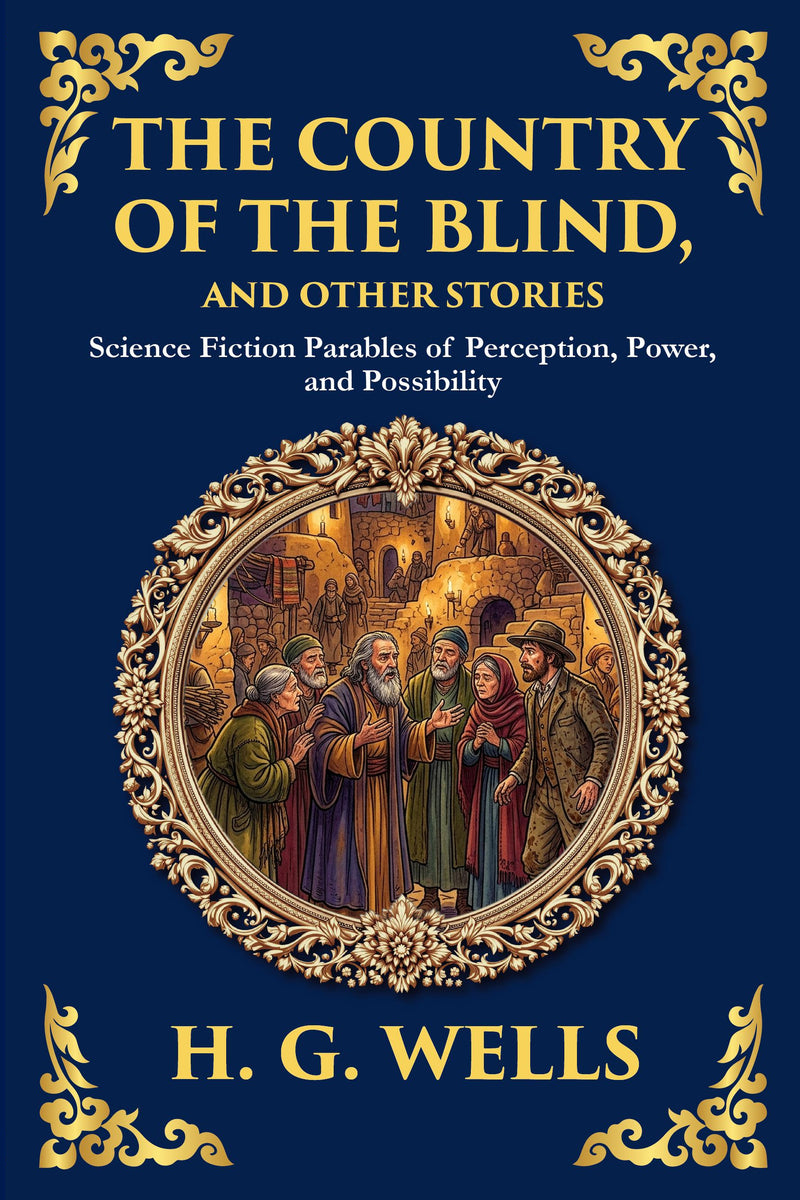
The Country of the Blind, and Other Stories
But what if the blind refuse to believe that sight exists at all? In this extraordinary collection of speculative tales, H. G. Wells explores the frailty of perception, the boundaries of science, and the illusions of human superiority.
or free app
10,000+ hrs library
30-day guarantee
The complete The Country of the Blind, and Other appears in modern English through Library of Alexandria Press, available online with audiobook narration included for members.
Have you ever wondered why those who see clearly are often the ones no one believes? The Country of the Blind, and Other Stories showcases H. G. Wells at his most philosophical and provocative. Often hailed as one of the founding fathers of science fiction, Wells doesn’t merely invent fantastical futures—he uses his tales as mirrors to reflect society’s deepest fears and blind spots.
This curated modern edition brings together some of Wells’ most powerful short stories, each a unique lens through which readers are invited to examine human nature, science, and the illusion of control. At the heart of the collection lies “The Country of the Blind,” a tale of a man who stumbles upon a secluded mountain society that has lived for generations without sight—and who is treated as delusional for claiming to see. But this is only the beginning.
What you’ll discover in this modern edition
- “The Country of the Blind” – A profound allegory about perception, cultural dominance, and the price of being different.
- “The Star” – A chilling depiction of cosmic catastrophe and humanity’s helplessness in the face of the universe.
- “The Door in the Wall” – A moving meditation on childhood wonder, regret, and the boundaries between reality and imagination.
- “The Empire of the Ants” – A terrifying glimpse of evolution run amok and the futility of imperial arrogance.
- A Modern Edition for Contemporary Readers – Carefully formatted for clarity and readability without sacrificing the original tone or intent.
- A Thought-Provoking Blend of Sci-Fi, Philosophy, and Satire – For fans of Ray Bradbury, Ursula K. Le Guin, and Black Mirror.
| Formats | eBook (EPUB + PDF) · Audiobook · Paperback · Hardcover · Large Print |
| Language | English |
| Trim size (print) | 6 × 9 in |
| Binding | Paperback — perfect-bound · Hardcover — casewrap |
| Large Print edition | Same text in a larger, easy-read type — a larger font, not a larger trim |
| Print pricing | Every physical book at our true cost — at-cost, no profit (members) |
| Library | 873 restored titles, always growing |
| Length | 155,145 words · ~10 hr 21 min reading |
| Reading level | Grade 4 · an easy, flowing read (this modern-English edition) |
| Edition | Modern English translation · 2026 |
Member reviews for this edition are collected as readers finish it — be the first. Across the library: 12,000+ books shipped, every plan covered by a 365-day print guarantee.
About this edition
A faithful, unabridged modern-English edition by The Library of Alexandria — carefully rendered for today's reader and verified paragraph-by-paragraph against the public-domain source. Available as eBook, audiobook, paperback, hardcover, and large print.
- Complete & unabridgedVerified paragraph by paragraph against the source — never a scan, never abridged.
- Modern English, faithfulReadable today, with the author’s meaning kept intact. Readable — not simplified.
- Every format, one membershipRead in your browser or the free app, or listen to the full audiobook.
Included free with your membership
Cancel anytime, one click · 30-day money-back guarantee
Edition last updated July 2026
What’s inside
The Country of the Blind, and Other Stories — complete and unabridged: all 35 sections included with membership, plus the full audiobook.
Begin reading The Country of the Blind, and Other Stories
In clear modern English — the complete text is included with membership.
Introduction
There is a particular kind of writer who arrives at the threshold of a new century and seems to absorb its anxieties, its hopes, and its half-formed nightmares all at once. Herbert George Wells was such a writer. When these stories first reached readers at the turn of the twentieth century, the world was tilting on its axis. Electricity was rewiring the night. Steam was giving way to combustion. Telegraph wires stitched continents together, and the first flickering experiments in heavier-than-air flight promised that the sky itself would soon belong to humankind. Into this churning moment stepped a man who had grown up poor in a Kentish town, who had clawed his way out of an apprenticeship behind a draper’s counter and into the laboratories of the Normal School of Science, where he studied biology under Thomas Henry Huxley, the great defender of Darwin. Wells emerged from that education with a mind trained to see human beings not as the fixed and finished crown of creation, but as one species among many, subject to the same laws of change, adaptation, and possible extinction as the trilobite and the dodo. That perspective—humbling, vertiginous, occasionally terrifying—runs like an electric current through every story collected here.
This volume gathers some of the finest short fiction Wells ever produced, presented in a modern translation adapted for the contemporary reader. A word about what that means, because it matters to the experience that lies ahead. Wells wrote in a prose that was, for its time, remarkably clear and direct—he prided himself on plain speaking and disliked ornament for its own sake. Yet more than a century has passed, and language drifts the way coastlines do, slowly but unmistakably. Certain turns of phrase that were transparent to an Edwardian reader now require a small mental translation; certain rhythms of sentence and idiom that once felt brisk now feel slightly formal; certain references to the technology, geography, and social assumptions of 1900 have grown opaque. The adaptation you hold smooths these obstacles without sanding away the texture that makes Wells Wells. The aim has been to let you fall into these worlds as cleanly and completely as his first readers did, to feel the chill of the abyss and the warmth of the lamplight without the friction of an unfamiliar dialect. What remains is the essential Wells: his curiosity, his moral seriousness, his sly humor, and above all his extraordinary gift for taking a single fantastic premise and following it, with ruthless logic, all the way to its human consequences.
It is difficult, from where we stand now, to grasp how much of the furniture of modern imagination Wells built himself. We swim in a sea of ideas that he, more than almost anyone, poured into the cultural reservoir. The time machine, the invisible man, the invading aliens, the engineered creatures, the world transformed by a single new substance or discovery—these are now the common stock of countless novels, films, and television series, repeated so often that they can seem like ancient archetypes. They are not. Many of them have a date and an author, and that author is frequently Wells. When you read these stories, you are drinking from the source rather than the tributary, and there is a particular pleasure in encountering ideas in their first, freshest form, before a thousand imitators wore the edges smooth.
But to call Wells merely an inventor of plots would be to misunderstand him entirely. He was never interested in gadgets for their own sake. What fascinated him was the collision between the new thing—whatever it might be—and the unchanging substance of human nature. Give a man invisibility, and what does he become? Not a superhero, in Wells’s hands, but a creature gradually unmade by his own power, isolated and brutalized by the very gift that should have liberated him. Drop a window of strange transparency into the heart of a quiet domestic scene, and watch how ordinary jealousy and curiosity warp into something far darker. Wells understood, with a clarity that still startles, that technology does not change human beings so much as reveal them. It strips away the social padding and shows us what we are underneath. This is why his stories endure while so much science fiction of subsequent generations has dated badly. The spaceship may be obsolete, but the human heart inside it is not.
His scientific training gave his fantasies a peculiar weight. When Wells describes an impossible event, he describes it the way a careful observer would—noting the temperature, the smell, the precise behavior of light, the small physical details that a less disciplined imagination would skip over. This grounding in observed reality is the secret of his persuasiveness. We believe in the marvels because the world around them feels so solid. A man who can render the texture of a damp English hedgerow or the precise quality of fear in a darkened room with such fidelity has earned our trust when he asks us to believe in something stranger. Wells learned this technique partly from journalism and partly from the laboratory bench, where you do not get to wave your hands; you measure, you record, you account for what you see. He brought that same accountability to the imagination, and the result was a new kind of storytelling that felt less like a fairy tale and more like a dispatch from a possible future.
The title piece of this collection stands among the supreme achievements of the short story form, in any genre or none. Without spoiling the particulars of its design, it can be said that it grows from one of the oldest of proverbs—the notion that in a certain kind of community, the man with a single advantage might be expected to reign supreme. Wells takes that comfortable assumption and turns it slowly, patiently, into something that questions everything we believe about perception, about authority, about what it means to be normal and what it means to be other. It is a story about a traveler who finds himself among people who do not share his most basic way of experiencing the world, and it asks, with disturbing seriousness, who exactly is qualified to say which way of seeing is the right one. The story has been read as a parable of colonialism, of disability, of scientific arrogance, of the loneliness of the outsider, and of the tyranny of consensus. It is all of these and none of them exclusively, which is precisely why it has refused to settle into a single meaning across the decades. Read it slowly. Let its quiet horror accumulate. It rewards patience as few stories do, and its final movement contains one of the most morally complex choices in all of literature—a choice you will find yourself turning over long after you have closed the book.
The remaining stories range across the full spectrum of Wells’s imaginative interests, and their variety is one of the chief delights of this collection. Some are tales of pure scientific marvel, in which a discovery or an experiment opens a door onto wonder or terror. Others are ghost stories, or near-ghost stories, in which Wells turns his rationalist eye on the supernatural and finds it both more and less frightening than superstition would have it. Several are studies in psychology, exploring obsession, fear, ambition, and the strange ways the mind defends itself against truths it cannot bear. A few are almost comic, displaying a lightness of touch that surprises readers who know Wells only by his grimmer reputation. And running beneath nearly all of them is that characteristic Wellsian undertow—the sense that the universe is vaster, stranger, and more indifferent to human concerns than we like to admit, and that our security is a thin and provisional thing, easily disturbed.
What unites these diverse pieces is a quality of vision that the subtitle of this volume names precisely: perception, power, and possibility. Again and again, Wells returns to the question of how we know what we know. His characters are forever encountering evidence that contradicts their settled assumptions, and the drama of the stories often lies in how they respond—whether they expand their understanding to accommodate the new reality, or retreat into denial, or are simply destroyed by what they cannot comprehend. This is the deep theme of the title story, but it surfaces everywhere. Wells was endlessly preoccupied with the limits of the human sensorium and the human mind, with the vast realms of experience that lie just beyond the reach of our senses and our concepts. He had a Darwinian’s awareness that our perceptions evolved not to reveal the truth of the cosmos but merely to keep us alive long enough to reproduce, and that there is no guarantee that the world as we experience it bears much resemblance to the world as it is. This is heady, almost philosophical territory, and yet Wells never lets the ideas float free of flesh and feeling. They are always embodied in a particular person, in a particular predicament, sweating and fearful and alive.
We tend to assume that the anxieties of our age are unprecedented, that no previous generation faced anything quite like the dizzying pace of technological change, the looming environmental catastrophes, the questions about what artificial minds might do to human society. Reading Wells is a useful corrective to that vanity. He confronted versions of all these fears more than a hundred years ago, and his responses still feel uncannily fresh. He understood that every new power humanity acquires is morally neutral in itself, taking its character from the hands that wield it. He understood that progress is not a straight line marching upward but a branching, contingent thing that can lead to paradise or catastrophe depending on choices we may not even recognize we are making. He understood that the human capacity for cruelty and self-deception scales up alongside our capacity for invention, so that each new tool is also a new temptation. These are not the comforting platitudes of an optimist or the despairing groans of a pessimist. They are the clear-eyed observations of a man who refused to look away from either the wonder or the danger of the world he saw coming.
It is worth saying something about Wells’s politics and his temperament, because they color these stories in ways a modern reader should understand. He was, throughout his life, a reformer and a believer in human improvement. He thought that humanity could, through reason, education, and the deliberate reorganization of society, build something far better than the brutal and wasteful world he was born into. He dreamed of a world state, of universal education, of the abolition of poverty and ignorance and war. This utopian streak ran deep, and it would dominate his later, more didactic writing. But—and this is crucial to appreciating his finest fiction—the utopian Wells was always shadowed by a darker, more skeptical Wells, the biologist who knew how easily nature undoes the works of mind, the historian who saw how often human beings betray their own best hopes. In the short stories gathered here, the two Wellses are held in productive tension. The optimism gives the work its forward-looking energy, its sense that the future is genuinely open and worth thinking hard about; the pessimism gives it its gravity, its refusal of easy answers, its willingness to imagine that things might go terribly wrong. The result is a body of work far richer and more troubling than either pure optimism or pure pessimism could produce.
For readers coming to these stories for the first time, a few words of guidance may enhance the experience. First, resist the urge to read them as quaint period pieces, charming relics of a vanished world of gas lamps and hansom cabs. The settings are indeed of their time, and there is pleasure in their atmosphere, but the questions the stories ask are entirely live. When you read about a man whose great discovery isolates him from his fellows, think about the scientists and engineers of our own day. When you read about a society whose certainties are challenged by an outsider’s different way of seeing, think about the clashes of worldview that fill our own news. Wells wrote about the future, and in many respects, we are living in it. The stories speak to us not despite their age but because of it; they have had time to prove their durability.
Cancel anytime, one click · 30-day money-back guarantee
Founding annual rate available now — your price locks for life when you join.
Not ready? Get this free chapter by email — read it anytime.
✓ Sent — check your inbox for The Country of the Blind, and Other Stories.
Questions about The Country of the Blind, and Other Stories
What is The Country of the Blind, and Other about?
But what if the blind refuse to believe that sight exists at all? In this extraordinary collection of speculative tales, H. G. Wells explores the frailty of perception, the boundaries of science, and the illusions of human superiority. From the haunting parable of a man trapped in a sightless society to the strange ethics of scientific discovery, The Country of the Blind, and Other Stories reveals the darker, wiser corners of Wells’ imagination.
Who wrote The Country of the Blind, and Other?
The Country of the Blind, and Other was written by H. G. Wells. This edition presents the complete work in clear modern English, faithfully rendered from the public-domain original by Library of Alexandria Press.
Is The Country of the Blind, and Other free to read?
The opening chapter is free to read on this page. Members read and listen to the complete work — and the entire library — free, and can order any physical book at our true print cost.
How long is The Country of the Blind, and Other?
35 chapters (~155,145 words) — about 10 hr 21 min of reading in this modern-English edition.
Is this an abridged version of The Country of the Blind, and Other?
No. This is the complete, unabridged The Country of the Blind, and Other, carefully rendered into clear modern English and verified paragraph-by-paragraph against the public-domain source — nothing is cut or summarised.
What formats does The Country of the Blind, and Other come in?
The Country of the Blind, and Other is available as eBook, paperback, hardcover and large print. eBook and audiobook are included with membership; printed editions ship at our true print cost.
Shipping & returns
Billing & membership
More from the library


Explore Science Fiction
- The Island of Doctor Moreau · H. G. Wells
- A Midsummer Night’s Dream · William Shakespeare
- The Invisible Man: A Grotesque Romance · H. G. Wells
- The War of the Worlds · H. G. Wells
- The Strange Case of Dr. Jekyll and Mr. Hyde · Robert Louis Stevenson
- Limanora: the island of progress · Godfrey Sweven
- The Book of Dragons · E. Nesbit
- She · H. Rider Haggard
- Dorothy and the Wizard in Oz · L. Frank Baum
- The Princess and the Goblin · George MacDonald
- Gawayne and the Green Knight: A Fairy Tale · Charlton M. Lewis
- Lucian’s True History · Lucian of Samosata
- The Willows · Algernon Blackwood
- The Call of Cthulhu · H. P. Lovecraft
- The Life-Eater · Harold Ward
- The Marvelous Land of Oz · L. Frank Baum
- Mars is My Destination · Frank Belknap Long
- The Black Kiss
- The Beasts in the Void · Paul W. Fairman
- John Jones’s Dollar · Harry Stephen Keeler
- Subversive · Mack Reynolds
- The Mississippi Saucer · Frank Belknap Long
- Man of Distinction · Michael Shaara
- Spawn of the Comet · H. Thompson Rich
- The Golden Judge · Nathaniel Gordon
- Final Weapon · Everett B. Cole
- The Big Fix · George O. Smith
- Last Enemy · H. Beam Piper
- Time and Time Again · H. Beam Piper
- Sabotage in Space · Carey Rockwell
The Country of the Blind, and Other Stories
The Country of the Blind, and Other Stories
Science Fiction Parables of Perception, Power, and Possibility
H. G. Wells
Contents
- Introduction
- Preface by the Author
- Chapter 1
- Chapter 2
- Chapter 3
- Chapter 4
- Chapter 5
- Chapter 6
- Chapter 7
- Chapter 8
- Chapter 9
- Chapter 10
- Chapter 11
- Chapter 12
- Chapter 13
- Chapter 14
- Chapter 15
- Chapter 16
- Chapter 17
- Chapter 18
- Chapter 19
- Chapter 20
- Chapter 21
- Chapter 22
- Chapter 23
- Chapter 24
- Chapter 25
- Chapter 26
- Chapter 27
- Chapter 28
- Chapter 29
- Chapter 30
- Chapter 31
- Chapter 32
- Chapter 33
Introduction
There is a particular kind of writer who arrives at the threshold of a new century and seems to absorb its anxieties, its hopes, and its half-formed nightmares all at once. Herbert George Wells was such a writer. When these stories first reached readers at the turn of the twentieth century, the world was tilting on its axis. Electricity was rewiring the night. Steam was giving way to combustion. Telegraph wires stitched continents together, and the first flickering experiments in heavier-than-air flight promised that the sky itself would soon belong to humankind. Into this churning moment stepped a man who had grown up poor in a Kentish town, who had clawed his way out of an apprenticeship behind a draper’s counter and into the laboratories of the Normal School of Science, where he studied biology under Thomas Henry Huxley, the great defender of Darwin. Wells emerged from that education with a mind trained to see human beings not as the fixed and finished crown of creation, but as one species among many, subject to the same laws of change, adaptation, and possible extinction as the trilobite and the dodo. That perspective—humbling, vertiginous, occasionally terrifying—runs like an electric current through every story collected here.
This volume gathers some of the finest short fiction Wells ever produced, presented in a modern translation adapted for the contemporary reader. A word about what that means, because it matters to the experience that lies ahead. Wells wrote in a prose that was, for its time, remarkably clear and direct—he prided himself on plain speaking and disliked ornament for its own sake. Yet more than a century has passed, and language drifts the way coastlines do, slowly but unmistakably. Certain turns of phrase that were transparent to an Edwardian reader now require a small mental translation; certain rhythms of sentence and idiom that once felt brisk now feel slightly formal; certain references to the technology, geography, and social assumptions of 1900 have grown opaque. The adaptation you hold smooths these obstacles without sanding away the texture that makes Wells Wells. The aim has been to let you fall into these worlds as cleanly and completely as his first readers did, to feel the chill of the abyss and the warmth of the lamplight without the friction of an unfamiliar dialect. What remains is the essential Wells: his curiosity, his moral seriousness, his sly humor, and above all his extraordinary gift for taking a single fantastic premise and following it, with ruthless logic, all the way to its human consequences.
It is difficult, from where we stand now, to grasp how much of the furniture of modern imagination Wells built himself. We swim in a sea of ideas that he, more than almost anyone, poured into the cultural reservoir. The time machine, the invisible man, the invading aliens, the engineered creatures, the world transformed by a single new substance or discovery—these are now the common stock of countless novels, films, and television series, repeated so often that they can seem like ancient archetypes. They are not. Many of them have a date and an author, and that author is frequently Wells. When you read these stories, you are drinking from the source rather than the tributary, and there is a particular pleasure in encountering ideas in their first, freshest form, before a thousand imitators wore the edges smooth.
But to call Wells merely an inventor of plots would be to misunderstand him entirely. He was never interested in gadgets for their own sake. What fascinated him was the collision between the new thing—whatever it might be—and the unchanging substance of human nature. Give a man invisibility, and what does he become? Not a superhero, in Wells’s hands, but a creature gradually unmade by his own power, isolated and brutalized by the very gift that should have liberated him. Drop a window of strange transparency into the heart of a quiet domestic scene, and watch how ordinary jealousy and curiosity warp into something far darker. Wells understood, with a clarity that still startles, that technology does not change human beings so much as reveal them. It strips away the social padding and shows us what we are underneath. This is why his stories endure while so much science fiction of subsequent generations has dated badly. The spaceship may be obsolete, but the human heart inside it is not.
His scientific training gave his fantasies a peculiar weight. When Wells describes an impossible event, he describes it the way a careful observer would—noting the temperature, the smell, the precise behavior of light, the small physical details that a less disciplined imagination would skip over. This grounding in observed reality is the secret of his persuasiveness. We believe in the marvels because the world around them feels so solid. A man who can render the texture of a damp English hedgerow or the precise quality of fear in a darkened room with such fidelity has earned our trust when he asks us to believe in something stranger. Wells learned this technique partly from journalism and partly from the laboratory bench, where you do not get to wave your hands; you measure, you record, you account for what you see. He brought that same accountability to the imagination, and the result was a new kind of storytelling that felt less like a fairy tale and more like a dispatch from a possible future.
The title piece of this collection stands among the supreme achievements of the short story form, in any genre or none. Without spoiling the particulars of its design, it can be said that it grows from one of the oldest of proverbs—the notion that in a certain kind of community, the man with a single advantage might be expected to reign supreme. Wells takes that comfortable assumption and turns it slowly, patiently, into something that questions everything we believe about perception, about authority, about what it means to be normal and what it means to be other. It is a story about a traveler who finds himself among people who do not share his most basic way of experiencing the world, and it asks, with disturbing seriousness, who exactly is qualified to say which way of seeing is the right one. The story has been read as a parable of colonialism, of disability, of scientific arrogance, of the loneliness of the outsider, and of the tyranny of consensus. It is all of these and none of them exclusively, which is precisely why it has refused to settle into a single meaning across the decades. Read it slowly. Let its quiet horror accumulate. It rewards patience as few stories do, and its final movement contains one of the most morally complex choices in all of literature—a choice you will find yourself turning over long after you have closed the book.
The remaining stories range across the full spectrum of Wells’s imaginative interests, and their variety is one of the chief delights of this collection. Some are tales of pure scientific marvel, in which a discovery or an experiment opens a door onto wonder or terror. Others are ghost stories, or near-ghost stories, in which Wells turns his rationalist eye on the supernatural and finds it both more and less frightening than superstition would have it. Several are studies in psychology, exploring obsession, fear, ambition, and the strange ways the mind defends itself against truths it cannot bear. A few are almost comic, displaying a lightness of touch that surprises readers who know Wells only by his grimmer reputation. And running beneath nearly all of them is that characteristic Wellsian undertow—the sense that the universe is vaster, stranger, and more indifferent to human concerns than we like to admit, and that our security is a thin and provisional thing, easily disturbed.
What unites these diverse pieces is a quality of vision that the subtitle of this volume names precisely: perception, power, and possibility. Again and again, Wells returns to the question of how we know what we know. His characters are forever encountering evidence that contradicts their settled assumptions, and the drama of the stories often lies in how they respond—whether they expand their understanding to accommodate the new reality, or retreat into denial, or are simply destroyed by what they cannot comprehend. This is the deep theme of the title story, but it surfaces everywhere. Wells was endlessly preoccupied with the limits of the human sensorium and the human mind, with the vast realms of experience that lie just beyond the reach of our senses and our concepts. He had a Darwinian’s awareness that our perceptions evolved not to reveal the truth of the cosmos but merely to keep us alive long enough to reproduce, and that there is no guarantee that the world as we experience it bears much resemblance to the world as it is. This is heady, almost philosophical territory, and yet Wells never lets the ideas float free of flesh and feeling. They are always embodied in a particular person, in a particular predicament, sweating and fearful and alive.
We tend to assume that the anxieties of our age are unprecedented, that no previous generation faced anything quite like the dizzying pace of technological change, the looming environmental catastrophes, the questions about what artificial minds might do to human society. Reading Wells is a useful corrective to that vanity. He confronted versions of all these fears more than a hundred years ago, and his responses still feel uncannily fresh. He understood that every new power humanity acquires is morally neutral in itself, taking its character from the hands that wield it. He understood that progress is not a straight line marching upward but a branching, contingent thing that can lead to paradise or catastrophe depending on choices we may not even recognize we are making. He understood that the human capacity for cruelty and self-deception scales up alongside our capacity for invention, so that each new tool is also a new temptation. These are not the comforting platitudes of an optimist or the despairing groans of a pessimist. They are the clear-eyed observations of a man who refused to look away from either the wonder or the danger of the world he saw coming.
It is worth saying something about Wells’s politics and his temperament, because they color these stories in ways a modern reader should understand. He was, throughout his life, a reformer and a believer in human improvement. He thought that humanity could, through reason, education, and the deliberate reorganization of society, build something far better than the brutal and wasteful world he was born into. He dreamed of a world state, of universal education, of the abolition of poverty and ignorance and war. This utopian streak ran deep, and it would dominate his later, more didactic writing. But—and this is crucial to appreciating his finest fiction—the utopian Wells was always shadowed by a darker, more skeptical Wells, the biologist who knew how easily nature undoes the works of mind, the historian who saw how often human beings betray their own best hopes. In the short stories gathered here, the two Wellses are held in productive tension. The optimism gives the work its forward-looking energy, its sense that the future is genuinely open and worth thinking hard about; the pessimism gives it its gravity, its refusal of easy answers, its willingness to imagine that things might go terribly wrong. The result is a body of work far richer and more troubling than either pure optimism or pure pessimism could produce.
For readers coming to these stories for the first time, a few words of guidance may enhance the experience. First, resist the urge to read them as quaint period pieces, charming relics of a vanished world of gas lamps and hansom cabs. The settings are indeed of their time, and there is pleasure in their atmosphere, but the questions the stories ask are entirely live. When you read about a man whose great discovery isolates him from his fellows, think about the scientists and engineers of our own day. When you read about a society whose certainties are challenged by an outsider’s different way of seeing, think about the clashes of worldview that fill our own news. Wells wrote about the future, and in many respects, we are living in it. The stories speak to us not despite their age but because of it; they have had time to prove their durability.
As I sit writing in my study, I can hear our Jane bumping her way downstairs with a brush and dustpan. In the old days, she used to sing hymns or whatever the current British national song was to the beat of her cleaning, but lately she has been silent and even careful with her work. There was a time when I prayed fervently for such silence, and my wife sighed with longing for such care, but now that it’s happened, we aren’t as happy as we thought we’d be. In fact, I would secretly rejoice—though it might be an unmanly weakness to admit it—to hear Jane sing “Daisy,” or to learn that her period of brooding had ended, even if it meant she broke every plate in the house except for one of Euphemia’s best green ones.
We were desperate to hear the end of the story about Jane’s boyfriend before we ever heard the end of him! Jane was always very open with my wife, and she would chat wonderfully in the kitchen about all sorts of things—so well, in fact, that I sometimes left my study door open—our house is quite small—just to listen in. But after William entered the picture, it was always William, and nothing but William; William this and William that; and just when we thought she had run out of things to say about him, she would start all over again. The engagement lasted three years in total, yet how she first met William and became so obsessed with him remained a secret. Personally, I believe it happened at the street corner where the Reverend Barnabas Baux used to hold open-air services after Sunday evening prayers. Young lovers used to flutter like moths around the paraffin lamp of that High Church hymn-singing spot. I imagine she stood there singing hymns, relying on memory and imagination instead of coming home to make supper, and William stepped up beside her and said, “Hello!” “Hello to you!” she replied; and once the formalities were out of the way, they started talking.
End of the free sample
Keep reading, free
Members read and listen to the complete book — and the entire library. Cancel anytime, one click · 30-day money-back guarantee.