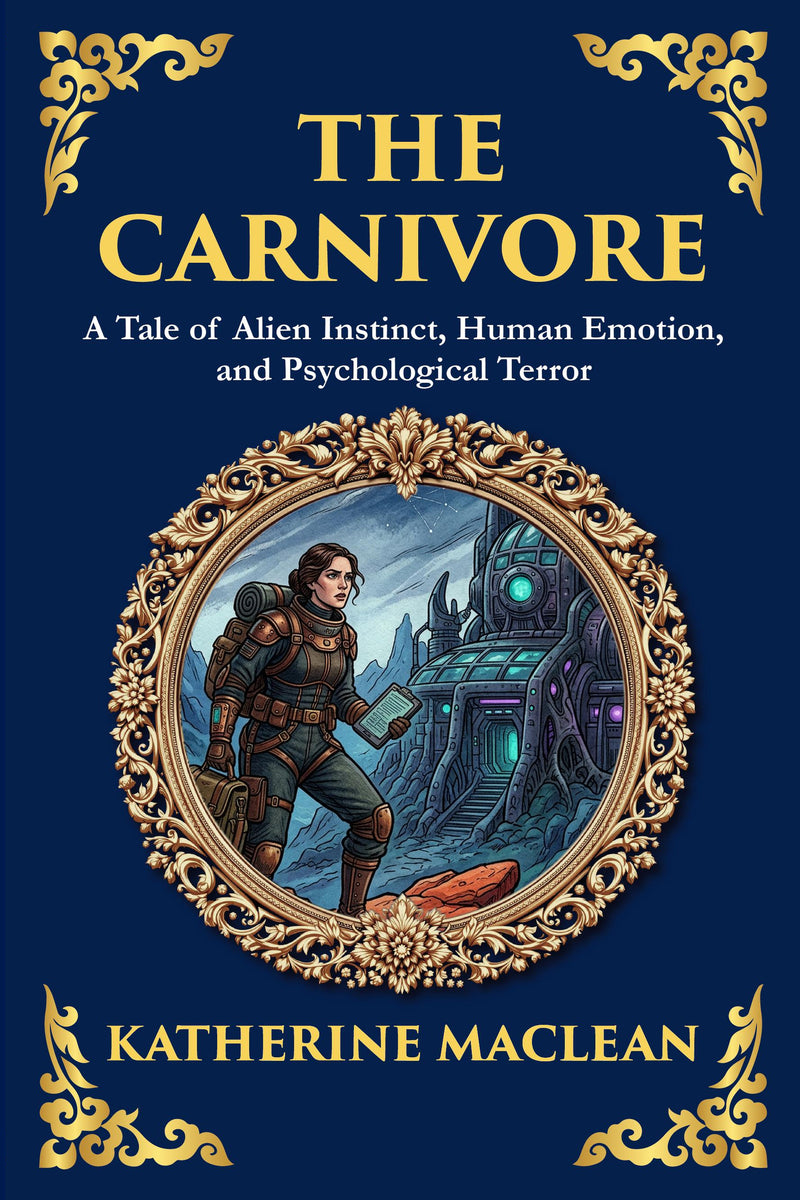
The Carnivore
In the chilling aftermath of an alien experiment gone wrong, a strange being awakens in a human world it doesn’t understand—yet instinctively hungers for.
or free app
10,000+ hrs library
30-day guarantee
The complete The Carnivore appears in modern English through Library of Alexandria Press, available online with audiobook narration included for members.
Have you ever wondered why something that thinks like us… might still want to destroy us? The Carnivore is a harrowing and deeply intelligent science fiction novella that explores the terrifying intersection of alien instinct and human emotion. When a government experiment with extraterrestrial consciousness breaks the bounds of control, the result is a being that absorbs more than just data—it absorbs us.
This is not just a story of alien contact. It is a psychological autopsy of identity, consciousness, and the thin veneer separating reason from hunger. In a world where trust fractures and reality twists, Katherine MacLean weaves a taut narrative that is as thought-provoking as it is unsettling.
What you’ll discover in this modern edition
- An Alien Unlike Any Other – Not a creature from space, but a mirror of human thoughts, fears, and desires—twisted by instincts we can’t control.
- A Tale of Terror and Introspection – Explore the breakdown of identity as the boundary between self and other dissolves.
- Psychological Depth Meets Science Fiction – A chillingly plausible scenario where science, morality, and alien sentience collide.
- A Forgotten Classic Reborn – Katherine MacLean’s profound meditation on consciousness, now reintroduced in a sleek, modern edition.
- A Warning Wrapped in Fiction – What happens when evolution meets intelligence— and outpaces compassion? For readers who love the cerebral horror of Philip K.
| Formats | eBook (EPUB + PDF) · Audiobook · Paperback · Hardcover · Large Print |
| Language | English |
| Trim size (print) | 6 × 9 in |
| Binding | Paperback — perfect-bound · Hardcover — casewrap |
| Large Print edition | Same text in a larger, easy-read type — a larger font, not a larger trim |
| Print pricing | Every physical book at our true cost — at-cost, no profit (members) |
| Library | 873 restored titles, always growing |
| Length | 5,299 words · ~21 min reading |
| Reading level | Grade 11 · a confident, adult read (this modern-English edition) |
| Edition | Modern English translation · 2026 |
Member reviews for this edition are collected as readers finish it — be the first. Across the library: 12,000+ books shipped, every plan covered by a 365-day print guarantee.
About this edition
A faithful, unabridged modern-English edition by The Library of Alexandria — carefully rendered for today's reader and verified paragraph-by-paragraph against the public-domain source. Available as eBook, audiobook, paperback, hardcover, and large print.
- Complete & unabridgedVerified paragraph by paragraph against the source — never a scan, never abridged.
- Modern English, faithfulReadable today, with the author’s meaning kept intact. Readable — not simplified.
- Every format, one membershipRead in your browser or the free app, or listen to the full audiobook.
Included free with your membership
Cancel anytime, one click · 30-day money-back guarantee
Edition last updated July 2026
What’s inside
The Carnivore — complete and unabridged, included in full with membership, plus the full audiobook.
Begin reading The Carnivore
In clear modern English — the complete text is included with membership.
Introduction
There are certain works of short fiction that, despite their brevity, lodge themselves permanently in the imagination. They do not announce themselves with sprawling page counts or grand declarations. Instead, they slip quietly into the reader’s mind and refuse to leave, leaving behind a residue of unease, of wonder, of philosophical disturbance that lingers long after the final sentence. The Carnivore belongs to this rare category. It is a story that asks far more questions than it answers, and it does so with a precision and emotional depth that few writers of any era have managed to achieve. To encounter it is to be confronted not only with the strangeness of the alien, but with the strangeness of ourselves.
Katherine MacLean wrote during a period when science fiction was undergoing a profound transformation. The genre, often dismissed in its early days as juvenile escapism filled with ray guns and bug-eyed monsters, was gradually maturing into something far more serious—a literature of ideas, capable of probing the deepest questions of identity, morality, biology, and the human condition. MacLean was among the writers who helped propel this transformation. She brought to the page not only a scientist’s rigor and curiosity but also a humanist’s compassion and a psychologist’s keen eye for the inner workings of the mind. The result was a body of work that consistently elevated the field, and The Carnivore stands as one of its finest and most haunting examples.
This modern translation and adaptation has been prepared with a singular purpose: to make MacLean’s remarkable vision accessible to a new generation of readers without sacrificing the integrity, the eerie beauty, or the intellectual force of the original. Language evolves, and the cadences and conventions of mid-twentieth-century prose can sometimes create a subtle barrier between the contemporary reader and the timeless ideas embedded within a text. The goal here has been to smooth that barrier, to allow the story to breathe in a register that feels immediate and natural to today’s ear, while preserving everything that made it extraordinary in the first place. What you hold is not a dilution but a clarification—a careful effort to ensure that nothing stands between you and the experience MacLean intended.
To understand the power of this story, it helps to understand something of the woman who created it and the world in which she worked. Katherine MacLean came of age as a writer in the late 1940s and 1950s, a time often described as the Golden Age of science fiction. It was an era dominated by towering male figures whose names have become synonymous with the genre, and yet MacLean carved out a place for herself through sheer talent and originality. She was not content to write adventure stories with a thin veneer of scientific decoration. She wanted to use the tools of science fiction to investigate genuine scientific and philosophical questions, and she possessed the intellectual equipment to do so convincingly.
Her background gave her an unusual advantage. She had a deep and abiding interest in the sciences—particularly in biology, chemistry, psychology, and the emerging fields that would later be grouped under terms like cybernetics and systems theory. This knowledge was not merely decorative in her fiction; it formed the very bones of her stories. When MacLean wrote about an alien physiology or an extraterrestrial psychology, she did so with the conviction of someone who had genuinely thought through the implications of difference—of what it might actually mean for a being to evolve under conditions utterly unlike our own, to develop drives and instincts and ways of perceiving the world that have no parallel in human experience.
What distinguished her further was her refusal to treat science and emotion as opposing forces. In her hands, the rigorously logical and the deeply felt were woven together into a single fabric. She understood that the most profound science fiction is not about gadgets or technology, but about consequences—about how knowledge changes us, how contact with the unknown reshapes our sense of who we are, and how the boundaries we draw between self and other, human and inhuman, predator and prey, are far more fragile and provisional than we would like to believe. This is the territory that The Carnivore explores with unflinching commitment.
MacLean was also, importantly, a writer who took the inner life seriously. The psychological dimension of her work is one of its most striking features. She was deeply interested in fear—not the cheap, momentary jolt of a sudden shock, but the slow, accumulating dread that arises from confronting something genuinely incomprehensible. She understood that true terror lives not in the monster’s claws but in the gap between what we expect and what we encounter, in the moment when our familiar categories collapse and we are forced to look at reality without the comforting filters we have spent our lives constructing. This understanding informs every line of the story you are about to read.
It is worth pausing to acknowledge the broader significance of her career. As a woman working in a field that was overwhelmingly male, MacLean faced obstacles that her male contemporaries simply did not. That she succeeded so completely—that her stories were celebrated, anthologized, and remembered—speaks to the undeniable quality of her work. She was eventually recognized by her peers with major awards and honors, and she was named a Grand Master of the field, an acknowledgment reserved for those whose contributions have fundamentally shaped the literature. Yet for all this recognition, her name is not as widely known today as it deserves to be. Part of the purpose of this edition is to help correct that imbalance, to bring her singular voice back into the conversation where it belongs, and to introduce her artistry to readers who may never have encountered it before.
The mid-century moment in which she wrote was one of profound anxiety and possibility. The shadow of the atomic bomb hung over everything. Humanity had, for the first time, acquired the power to destroy itself entirely, and the realization that scientific progress could lead as easily to annihilation as to utopia haunted the culture. At the same time, the dawning Space Age filled the public imagination with dreams of contact—with the possibility that we might not be alone, that out there in the vast dark, other minds and other forms of life might exist. Science fiction became the natural home for these competing hopes and fears, and writers like MacLean used the genre to ask the questions that more conventional literature could not. What would happen if we actually met something truly alien? Would we even recognize it? Would it recognize us? And what would that encounter reveal about the nature of intelligence, of morality, of life itself?
These are not idle speculations. They cut to the heart of what it means to be human, and they remain as urgent today as they were when MacLean first set them down. If anything, the passage of decades has only sharpened their relevance. We live now in an age increasingly preoccupied with questions of consciousness, of artificial minds, of the boundaries of the human, and of our place within a biosphere we are only beginning to understand. The themes that animate The Carnivore speak directly to these contemporary concerns, which is one reason the story feels so startlingly fresh despite its age.
The Story's Themes and the Reading Experience
Without revealing the particulars of the narrative—for to do so would be to rob you of the experience of discovery that lies at the heart of all great fiction—it is possible to speak about the larger ideas that the story sets in motion, and to prepare you for the kind of journey you are about to undertake.
At its core, this is a tale about encounter. It dramatizes what happens when consciousness meets something fundamentally other than itself, and it refuses to take the easy path of reassurance. Much science fiction, particularly of the popular variety, tends to domesticate the alien, to render it as either a monster to be defeated or a friend to be embraced—in either case, something comprehensible, something that fits into the familiar frameworks of human morality and emotion. MacLean does something far braver and far more unsettling. She invites us to consider the possibility of genuine alienness: a form of being whose drives and instincts and ways of understanding the world cannot be neatly mapped onto our own, and whose very existence calls into question the assumptions we make about what life is and what it values.
The title itself gestures toward one of the story’s central preoccupations. To be a carnivore is to be a predator, to survive by consuming other living things. It is a fact of biology so basic that we rarely pause to consider its moral weight. And yet the story asks us to consider it—to think about what instinct means, about the relationship between what a creature is and what it does, about whether the categories of cruelty and kindness, of guilt and innocence, even apply to a being whose nature is fundamentally different from our own. Is a predator evil for following its nature? Are we? These questions ripple outward from the narrative in unexpected and disturbing directions, and they implicate the reader far more deeply than one might initially expect.
This is where MacLean’s psychological mastery comes fully into play. The terror of the story is not the terror of gore or violence, though there is darkness here. It is the terror of perspective—of being forced to see the world through eyes that are not our own, and of recognizing, in that act of seeing, something both alien and uncomfortably familiar. The best horror, as MacLean understood, does not come from outside; it comes from within, from the dawning awareness that the boundaries we depend upon to feel safe are not as solid as we believed. The story works on the mind the way a slow-acting drug works on the body, its effects accumulating gradually until, by the end, the reader finds the entire ground of their assumptions shifted beneath their feet.
The subtitle of this edition speaks of “alien instinct,” “human emotion,” and “psychological terror,” and these three elements are indeed the legs upon which the story stands. But what makes the work so remarkable is the way these elements are not kept separate but are instead braided together into a single, indivisible experience. The alien instinct is rendered with such conviction that it becomes almost comprehensible; the human emotion is portrayed with such tenderness and vulnerability that it becomes almost unbearable; and the psychological terror arises precisely from the collision of the two—from the friction generated when these incompatible modes of being are forced into contact. MacLean does not let us rest comfortably in any single perspective. She moves us, sometimes within the space of a single passage, between worlds, and in doing so she destabilizes our sense of where we stand.
There is also, running beneath the surface of the story, a profound meditation on the nature of communication and understanding. Can two fundamentally different forms of being ever truly know one another? Is empathy possible across an unbridgeable gulf of biology and experience? Or are we all, in the end, locked within our own perspectives, projecting our hopes and fears onto creatures who may operate according to entirely different rules? These are questions that the story poses but does not presume to answer—and this restraint is one of its greatest strengths. MacLean trusts her readers. She does not condescend to them with tidy resolutions or comforting morals. Instead, she leaves them with something far more valuable: a set of questions that will continue to unfold in the mind long after the book is closed.
It is also worth noting the remarkable economy of MacLean’s craft. This is not a sprawling epic; it is a focused, concentrated work, and every element within it has been placed with deliberate care. There is no waste, no padding, no diversion from the central concerns. Each scene advances the story’s emotional and intellectual logic; each image resonates with meaning; each turn of the narrative deepens the reader’s engagement with its central questions. This is the discipline of a master craftsperson, someone who understood that power in fiction comes not from accumulation but from precision—from knowing exactly what to include and, just as importantly, what to leave out. The reader who comes to this story expecting the leisurely expansiveness of much contemporary fiction may be surprised by its intensity and focus, but this is precisely what makes it so memorable. It hits hard and it hits clean.
Cancel anytime, one click · 30-day money-back guarantee
Founding annual rate available now — your price locks for life when you join.
Not ready? Get this free chapter by email — read it anytime.
✓ Sent — check your inbox for The Carnivore.
Questions about The Carnivore
What is The Carnivore about?
In the chilling aftermath of an alien experiment gone wrong, a strange being awakens in a human world it doesn’t understand—yet instinctively hungers for. Born of science, shaped by emotion, and driven by something darker, The Carnivore is a gripping psychological sci-fi thriller that examines what happens when the human mind is mirrored by something truly inhuman. A brilliant fusion of cerebral terror and speculative wonder, this tale of transformation, paranoia, and identity forces us to ask: what defines humanit
Who wrote The Carnivore?
The Carnivore was written by Katherine MacLean. This edition presents the complete work in clear modern English, faithfully rendered from the public-domain original by Library of Alexandria Press.
Is The Carnivore free to read?
The opening chapter is free to read on this page. Members read and listen to the complete work — and the entire library — free, and can order any physical book at our true print cost.
How long is The Carnivore?
2 chapters (~5,299 words) — about 21 min of reading in this modern-English edition.
Is this an abridged version of The Carnivore?
No. This is the complete, unabridged The Carnivore, carefully rendered into clear modern English and verified paragraph-by-paragraph against the public-domain source — nothing is cut or summarised.
What formats does The Carnivore come in?
The Carnivore is available as eBook, paperback and large print. eBook and audiobook are included with membership; printed editions ship at our true print cost.
Shipping & returns
Billing & membership
More from the library


Explore Science Fiction
- The Island of Doctor Moreau · H. G. Wells
- A Midsummer Night’s Dream · William Shakespeare
- The Invisible Man: A Grotesque Romance · H. G. Wells
- The War of the Worlds · H. G. Wells
- The Strange Case of Dr. Jekyll and Mr. Hyde · Robert Louis Stevenson
- Limanora: the island of progress · Godfrey Sweven
- The Book of Dragons · E. Nesbit
- She · H. Rider Haggard
- Dorothy and the Wizard in Oz · L. Frank Baum
- The Princess and the Goblin · George MacDonald
- Gawayne and the Green Knight: A Fairy Tale · Charlton M. Lewis
- Lucian’s True History · Lucian of Samosata
- The Willows · Algernon Blackwood
- The Call of Cthulhu · H. P. Lovecraft
- The Life-Eater · Harold Ward
- The Marvelous Land of Oz · L. Frank Baum
- Mars is My Destination · Frank Belknap Long
- The Black Kiss
- The Beasts in the Void · Paul W. Fairman
- John Jones’s Dollar · Harry Stephen Keeler
- Subversive · Mack Reynolds
- The Mississippi Saucer · Frank Belknap Long
- Man of Distinction · Michael Shaara
- Spawn of the Comet · H. Thompson Rich
- The Golden Judge · Nathaniel Gordon
- Final Weapon · Everett B. Cole
- The Big Fix · George O. Smith
- Last Enemy · H. Beam Piper
- Time and Time Again · H. Beam Piper
- Sabotage in Space · Carey Rockwell
The Carnivore
The Carnivore
A Tale of Alien Instinct, Human Emotion, and Psychological Terror
Katherine MacLean
Contents
- Introduction
- The Carnivore
Introduction
There are certain works of short fiction that, despite their brevity, lodge themselves permanently in the imagination. They do not announce themselves with sprawling page counts or grand declarations. Instead, they slip quietly into the reader’s mind and refuse to leave, leaving behind a residue of unease, of wonder, of philosophical disturbance that lingers long after the final sentence. The Carnivore belongs to this rare category. It is a story that asks far more questions than it answers, and it does so with a precision and emotional depth that few writers of any era have managed to achieve. To encounter it is to be confronted not only with the strangeness of the alien, but with the strangeness of ourselves.
Katherine MacLean wrote during a period when science fiction was undergoing a profound transformation. The genre, often dismissed in its early days as juvenile escapism filled with ray guns and bug-eyed monsters, was gradually maturing into something far more serious—a literature of ideas, capable of probing the deepest questions of identity, morality, biology, and the human condition. MacLean was among the writers who helped propel this transformation. She brought to the page not only a scientist’s rigor and curiosity but also a humanist’s compassion and a psychologist’s keen eye for the inner workings of the mind. The result was a body of work that consistently elevated the field, and The Carnivore stands as one of its finest and most haunting examples.
This modern translation and adaptation has been prepared with a singular purpose: to make MacLean’s remarkable vision accessible to a new generation of readers without sacrificing the integrity, the eerie beauty, or the intellectual force of the original. Language evolves, and the cadences and conventions of mid-twentieth-century prose can sometimes create a subtle barrier between the contemporary reader and the timeless ideas embedded within a text. The goal here has been to smooth that barrier, to allow the story to breathe in a register that feels immediate and natural to today’s ear, while preserving everything that made it extraordinary in the first place. What you hold is not a dilution but a clarification—a careful effort to ensure that nothing stands between you and the experience MacLean intended.
To understand the power of this story, it helps to understand something of the woman who created it and the world in which she worked. Katherine MacLean came of age as a writer in the late 1940s and 1950s, a time often described as the Golden Age of science fiction. It was an era dominated by towering male figures whose names have become synonymous with the genre, and yet MacLean carved out a place for herself through sheer talent and originality. She was not content to write adventure stories with a thin veneer of scientific decoration. She wanted to use the tools of science fiction to investigate genuine scientific and philosophical questions, and she possessed the intellectual equipment to do so convincingly.
Her background gave her an unusual advantage. She had a deep and abiding interest in the sciences—particularly in biology, chemistry, psychology, and the emerging fields that would later be grouped under terms like cybernetics and systems theory. This knowledge was not merely decorative in her fiction; it formed the very bones of her stories. When MacLean wrote about an alien physiology or an extraterrestrial psychology, she did so with the conviction of someone who had genuinely thought through the implications of difference—of what it might actually mean for a being to evolve under conditions utterly unlike our own, to develop drives and instincts and ways of perceiving the world that have no parallel in human experience.
What distinguished her further was her refusal to treat science and emotion as opposing forces. In her hands, the rigorously logical and the deeply felt were woven together into a single fabric. She understood that the most profound science fiction is not about gadgets or technology, but about consequences—about how knowledge changes us, how contact with the unknown reshapes our sense of who we are, and how the boundaries we draw between self and other, human and inhuman, predator and prey, are far more fragile and provisional than we would like to believe. This is the territory that The Carnivore explores with unflinching commitment.
MacLean was also, importantly, a writer who took the inner life seriously. The psychological dimension of her work is one of its most striking features. She was deeply interested in fear—not the cheap, momentary jolt of a sudden shock, but the slow, accumulating dread that arises from confronting something genuinely incomprehensible. She understood that true terror lives not in the monster’s claws but in the gap between what we expect and what we encounter, in the moment when our familiar categories collapse and we are forced to look at reality without the comforting filters we have spent our lives constructing. This understanding informs every line of the story you are about to read.
It is worth pausing to acknowledge the broader significance of her career. As a woman working in a field that was overwhelmingly male, MacLean faced obstacles that her male contemporaries simply did not. That she succeeded so completely—that her stories were celebrated, anthologized, and remembered—speaks to the undeniable quality of her work. She was eventually recognized by her peers with major awards and honors, and she was named a Grand Master of the field, an acknowledgment reserved for those whose contributions have fundamentally shaped the literature. Yet for all this recognition, her name is not as widely known today as it deserves to be. Part of the purpose of this edition is to help correct that imbalance, to bring her singular voice back into the conversation where it belongs, and to introduce her artistry to readers who may never have encountered it before.
The mid-century moment in which she wrote was one of profound anxiety and possibility. The shadow of the atomic bomb hung over everything. Humanity had, for the first time, acquired the power to destroy itself entirely, and the realization that scientific progress could lead as easily to annihilation as to utopia haunted the culture. At the same time, the dawning Space Age filled the public imagination with dreams of contact—with the possibility that we might not be alone, that out there in the vast dark, other minds and other forms of life might exist. Science fiction became the natural home for these competing hopes and fears, and writers like MacLean used the genre to ask the questions that more conventional literature could not. What would happen if we actually met something truly alien? Would we even recognize it? Would it recognize us? And what would that encounter reveal about the nature of intelligence, of morality, of life itself?
These are not idle speculations. They cut to the heart of what it means to be human, and they remain as urgent today as they were when MacLean first set them down. If anything, the passage of decades has only sharpened their relevance. We live now in an age increasingly preoccupied with questions of consciousness, of artificial minds, of the boundaries of the human, and of our place within a biosphere we are only beginning to understand. The themes that animate The Carnivore speak directly to these contemporary concerns, which is one reason the story feels so startlingly fresh despite its age.
The Story's Themes and the Reading Experience
Without revealing the particulars of the narrative—for to do so would be to rob you of the experience of discovery that lies at the heart of all great fiction—it is possible to speak about the larger ideas that the story sets in motion, and to prepare you for the kind of journey you are about to undertake.
At its core, this is a tale about encounter. It dramatizes what happens when consciousness meets something fundamentally other than itself, and it refuses to take the easy path of reassurance. Much science fiction, particularly of the popular variety, tends to domesticate the alien, to render it as either a monster to be defeated or a friend to be embraced—in either case, something comprehensible, something that fits into the familiar frameworks of human morality and emotion. MacLean does something far braver and far more unsettling. She invites us to consider the possibility of genuine alienness: a form of being whose drives and instincts and ways of understanding the world cannot be neatly mapped onto our own, and whose very existence calls into question the assumptions we make about what life is and what it values.
The title itself gestures toward one of the story’s central preoccupations. To be a carnivore is to be a predator, to survive by consuming other living things. It is a fact of biology so basic that we rarely pause to consider its moral weight. And yet the story asks us to consider it—to think about what instinct means, about the relationship between what a creature is and what it does, about whether the categories of cruelty and kindness, of guilt and innocence, even apply to a being whose nature is fundamentally different from our own. Is a predator evil for following its nature? Are we? These questions ripple outward from the narrative in unexpected and disturbing directions, and they implicate the reader far more deeply than one might initially expect.
This is where MacLean’s psychological mastery comes fully into play. The terror of the story is not the terror of gore or violence, though there is darkness here. It is the terror of perspective—of being forced to see the world through eyes that are not our own, and of recognizing, in that act of seeing, something both alien and uncomfortably familiar. The best horror, as MacLean understood, does not come from outside; it comes from within, from the dawning awareness that the boundaries we depend upon to feel safe are not as solid as we believed. The story works on the mind the way a slow-acting drug works on the body, its effects accumulating gradually until, by the end, the reader finds the entire ground of their assumptions shifted beneath their feet.
The subtitle of this edition speaks of “alien instinct,” “human emotion,” and “psychological terror,” and these three elements are indeed the legs upon which the story stands. But what makes the work so remarkable is the way these elements are not kept separate but are instead braided together into a single, indivisible experience. The alien instinct is rendered with such conviction that it becomes almost comprehensible; the human emotion is portrayed with such tenderness and vulnerability that it becomes almost unbearable; and the psychological terror arises precisely from the collision of the two—from the friction generated when these incompatible modes of being are forced into contact. MacLean does not let us rest comfortably in any single perspective. She moves us, sometimes within the space of a single passage, between worlds, and in doing so she destabilizes our sense of where we stand.
There is also, running beneath the surface of the story, a profound meditation on the nature of communication and understanding. Can two fundamentally different forms of being ever truly know one another? Is empathy possible across an unbridgeable gulf of biology and experience? Or are we all, in the end, locked within our own perspectives, projecting our hopes and fears onto creatures who may operate according to entirely different rules? These are questions that the story poses but does not presume to answer—and this restraint is one of its greatest strengths. MacLean trusts her readers. She does not condescend to them with tidy resolutions or comforting morals. Instead, she leaves them with something far more valuable: a set of questions that will continue to unfold in the mind long after the book is closed.
It is also worth noting the remarkable economy of MacLean’s craft. This is not a sprawling epic; it is a focused, concentrated work, and every element within it has been placed with deliberate care. There is no waste, no padding, no diversion from the central concerns. Each scene advances the story’s emotional and intellectual logic; each image resonates with meaning; each turn of the narrative deepens the reader’s engagement with its central questions. This is the discipline of a master craftsperson, someone who understood that power in fiction comes not from accumulation but from precision—from knowing exactly what to include and, just as importantly, what to leave out. The reader who comes to this story expecting the leisurely expansiveness of much contemporary fiction may be surprised by its intensity and focus, but this is precisely what makes it so memorable. It hits hard and it hits clean.
The beings stood around my bed in air suits that looked like ski gear, with globes over their heads like upside-down fishbowls. It felt like a masquerade ball, full of strange costumes and funny masks.
I know those masks are actually their faces, but when I argue with them, I feel as if I’m talking to humans hiding behind masks. They are people. I can tell if I’ll like someone by the way they move or how they get excited when they speak; and I know I like these people in a motherly way. I guess you just have to feel motherly toward them.
They all remind me of Ronny, a medical student I once knew. He was small, round, and eager. You couldn’t help but like him, even if you couldn’t take him very seriously. He was a pacifist who wrote poetry and would pull it out to read aloud at the worst possible moments; he also stuttered whenever he talked too fast.
They are just like that—a mix of nervousness and gentleness.
I am not the only survivor—they’ve explained that—but I’m the first one they found and the least injured. Because of that, they’ve chosen me to represent the human race. They stand around my bed and answer my questions, and they’re patient with me when I argue.
As a group, they look like a cross between a diplomatic delegation and Noah’s Ark. There’s one of everything: big and small, thick and thin, some with four arms or wings, in every imaginable shape and color, covered in fur, skin, or feathers.
I can imagine them in their own “UN of the Universe,” giving speeches in different languages and listening patiently without really understanding each other’s problems, boring one another while being too polite to yawn.
End of the free sample
Keep reading, free
Members read and listen to the complete book — and the entire library. Cancel anytime, one click · 30-day money-back guarantee.