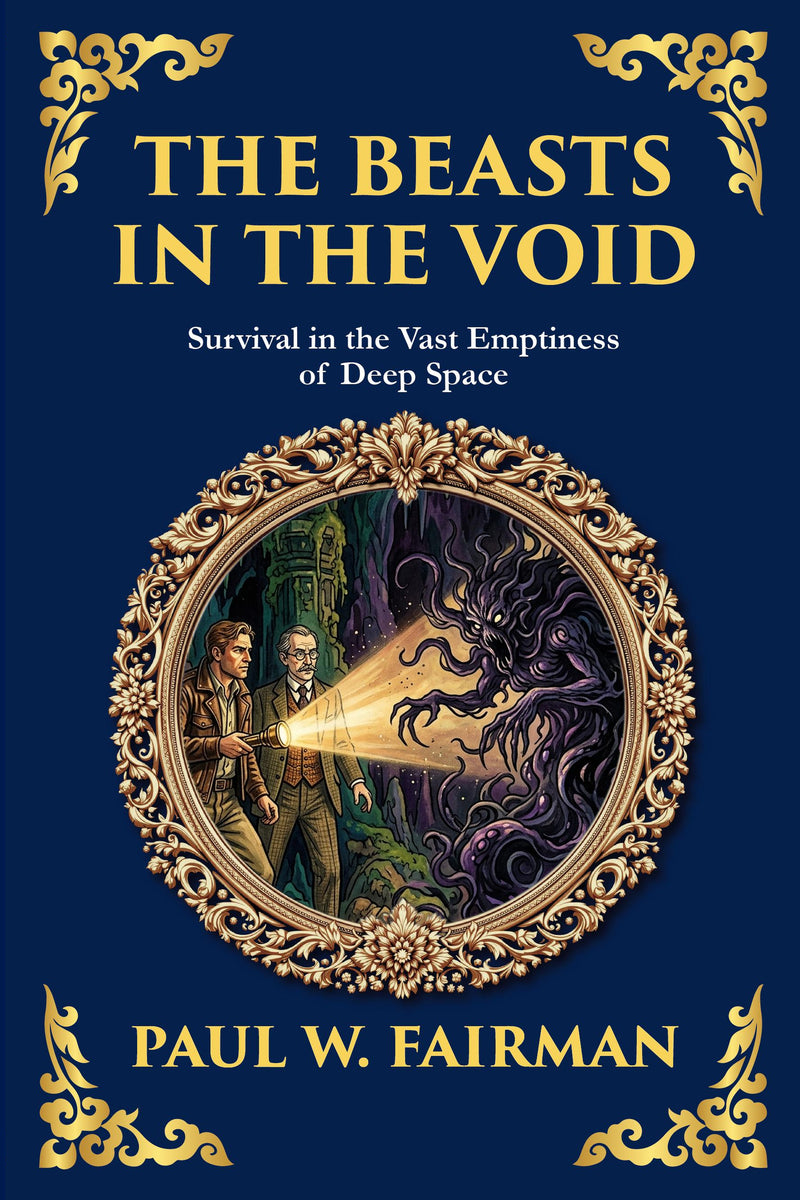
The Beasts in the Void — Large Print
The Beasts in the Void is a gripping tale of cosmic horror and raw human survival, set against the backdrop of an uncaring universe.
or free app
10,000+ hrs library
30-day guarantee
The complete The Beasts in the Void appears in modern English through Library of Alexandria Press, available online with audiobook narration included for members.
Have you ever wondered why isolation drives people to the edge of madness? The Beasts in the Void by Paul W. Fairman is a heart-pounding science fiction thriller that explores the terrifying consequences of isolation, the fragility of sanity, and the primal instincts awakened by the unknown. Originally published during the golden age of pulp sci-fi, this lost classic has been newly revived in a stunning modern edition that honors its psychological depth and eerie atmosphere.
The story begins with a crew of astronauts sent on a standard recon mission—only to be thrown wildly off course by an uncharted gravitational anomaly. Now stranded in deep space, their ship crippled and their communication severed, they must survive on dwindling rations and fading hope. But something is out there in the black.
Something with no name. Something that should not be.
What you’ll discover in this modern edition
- Claustrophobic Space Horror – Witness the unraveling of human minds in the silence and suffocating confinement of space.
| Formats | eBook (EPUB + PDF) · Audiobook · Paperback · Hardcover · Large Print |
| Language | English |
| Trim size (print) | 6 × 9 in |
| Binding | Paperback — perfect-bound · Hardcover — casewrap |
| Large Print edition | Same text in a larger, easy-read type — a larger font, not a larger trim |
| Print pricing | Every physical book at our true cost — at-cost, no profit (members) |
| Library | 873 restored titles, always growing |
| Length | 9,918 words · ~40 min reading |
| Reading level | Grade 3 · an easy, flowing read (this modern-English edition) |
| Edition | Modern English translation · 2026 |
Member reviews for this edition are collected as readers finish it — be the first. Across the library: 12,000+ books shipped, every plan covered by a 365-day print guarantee.
About this edition
A faithful, unabridged modern-English edition by The Library of Alexandria — carefully rendered for today's reader and verified paragraph-by-paragraph against the public-domain source. Available as eBook, audiobook, paperback, hardcover, and large print.
- Complete & unabridgedVerified paragraph by paragraph against the source — never a scan, never abridged.
- Modern English, faithfulReadable today, with the author’s meaning kept intact. Readable — not simplified.
- Every format, one membershipRead in your browser or the free app, or listen to the full audiobook.
Included free with your membership
Cancel anytime, one click · 30-day money-back guarantee
Edition last updated July 2026
What’s inside
The Beasts in the Void — Large Print — complete and unabridged, included in full with membership, plus the full audiobook.
Begin reading The Beasts in the Void — Large Print
In clear modern English — the complete text is included with membership.
Introduction
There are stories that arrive quietly from the pulp era, slipping past the marquee names and the celebrated anthologies, and yet they carry within them something startlingly durable—a kernel of imagination so vivid that it survives the decades intact, ready to be discovered anew. The Beasts in the Void is one of these stories. Written by Paul W. Fairman, a craftsman of mid-century science fiction whose name deserves far more recognition than it has received, this tale invites the reader into one of the oldest and most haunting questions the human mind has ever entertained: what waits for us out there, in the great dark between the stars, and what becomes of us when we go to meet it?
This edition presents the work in a modern adaptation, adapted thoughtfully for the contemporary reader. That phrase deserves a moment of explanation, because it shapes the experience you are about to have. The science fiction of Fairman’s era was written in a particular idiom—brisk, declarative, occasionally weighted with the slang and assumptions of its day. Some of that texture is delightful and worth preserving; some of it can place an unnecessary barrier between a reader of today and the genuine pleasures of the narrative. The goal of this adaptation has been to honor the author’s voice, pacing, and intent while gently smoothing the passages where the original idiom might trip a modern eye. The aim is not to rewrite the book into something it was never meant to be, but to clear the glass so that you can see the picture as freshly and clearly as its first audience did. What remains is the essential Fairman: the propulsive momentum, the sense of wonder shadowed by dread, and the conviction that the universe is far stranger and far more dangerous than our small and tidy imaginations would prefer.
Before you turn to the first chapter, it is worth spending a little time considering who Paul W. Fairman was, what kind of fiction he made, and why a story like this one continues to resonate in an age that has sent probes to the edge of the solar system and trained telescopes on worlds orbiting distant suns. Understanding the world this story came from—and the timeless anxieties it speaks to—will deepen your appreciation of everything that follows.
Paul W. Fairman belonged to a generation of American writers who learned their trade in the demanding, fast-moving marketplace of the pulp magazines. These were the cheaply printed periodicals, named for the rough wood-pulp paper they were printed on, that flourished from the 1920s through the 1950s and served as the proving ground for an enormous proportion of what we now recognize as classic science fiction, fantasy, and adventure storytelling. The pulps were not genteel. They paid by the word, often a penny or less, and they demanded that a writer produce constantly, reliably, and entertainingly. A man who wanted to make a living in that world could not afford to wait for inspiration. He had to be able to sit down, find the spine of a story, and bring it to life on the page with economy and force.
Fairman thrived in this environment. He wrote prolifically, both under his own name and behind a small army of pseudonyms, and he worked across the breadth of the popular genres. Just as importantly, he served as an editor, shaping the magazines from the inside and helping to determine which stories reached the eager readership that devoured them month after month. He understood, from both sides of the editorial desk, what made a story work: a hook that grabbed the reader instantly, a clean line of escalating tension, characters drawn with enough vividness to be rooted for, and an idea at the center that lingered after the last page was turned. This editorial sensibility shows in his fiction. There is rarely a wasted scene. The machinery of the story is always turning, always carrying the reader forward.
It is a mistake, one that has persisted for far too long, to dismiss the pulp writers as mere hacks churning out disposable entertainment. Certainly the volume of work they produced meant that not every page was a masterpiece. But within that vast output lived an enormous amount of genuine invention, narrative skill, and even philosophical daring. The pulp writers were, in a very real sense, the dreamers who first mapped the imaginative territory that later, more celebrated authors would settle and cultivate. They asked the foundational questions of science fiction—about alien life, about the future of humanity, about the moral weight of our expanding power—and they asked them in front of a mass audience, in language that anyone could understand. Fairman was one of the most reliable of these dreamers, and The Beasts in the Void shows him working at the height of his powers, channeling the deep human fear of the unknown into a tightly wound adventure.
What distinguishes Fairman’s best work from that of his contemporaries is a certain emotional clarity. He understood that science fiction, for all its gadgetry and cosmic scale, is finally a literature of feeling. The most advanced spaceship in the galaxy means nothing on the page unless we feel the racing pulse of the human being inside it. The most terrifying alien threat is only as frightening as the people it menaces are real to us. Fairman never lost sight of this. He grounded his marvels in recognizable human reactions—courage and cowardice, loyalty and betrayal, the will to survive when survival seems impossible. That is why a story written so many decades ago can still take hold of a reader today. The technology of his imagined future may have been overtaken by reality, or rendered quaint by it, but the human heart at the center of his fiction has not changed at all.
The title of this book promises us beasts, and it promises us the void, and in that pairing lies the whole engine of the story’s power. Consider for a moment what the void actually is—not as a setting in a novel, but as a fact of our existence. Space is the largest thing there is. It is, in every direction, an emptiness of such staggering proportions that the human mind cannot truly hold it. Between our world and the nearest star lie distances so vast that light itself, the fastest thing in creation, takes years to cross them. And within that emptiness, scattered like grains of sand across an ocean, are the worlds and the suns and whatever might live upon or among them.
The early science fiction writers understood instinctively that this emptiness was not neutral. It was not a blank backdrop against which adventures merely happened. The void itself was a character, a presence, a kind of antagonist. To venture into it was to leave behind every comfort and certainty of home—the air we breathe, the ground beneath our feet, the warmth of a sun at a survivable distance, the simple knowledge that other human beings are near. Out there, a person is reduced to whatever they carry with them: their ship, their supplies, their wits, their nerve, and the fragile bonds of trust with whatever crew shares their fate. Everything else falls away.
This is the existential condition that The Beasts in the Void explores, and Fairman uses the genre’s conventions to bring it to startling life. The “survival in the vast emptiness of deep space” promised by the subtitle is not a metaphor here. It is the literal, moment-to-moment substance of the story. There is a particular kind of dread that comes from being far from help, with no possibility of rescue, with the margin between life and death narrowed to the width of a metal hull and the reliability of equipment that was never truly designed for the things it now must face. Fairman knew how to wring tension from these conditions. He understood that the reader’s imagination, properly primed, will do much of the work of terror on its own. A strange sound in the silence of deep space. A reading on an instrument that should not be possible. A glimpse of something through a viewport that the mind refuses to accept. These are the tools of his trade, and he wields them with confidence.
And then there are the beasts. It would be unfair to the reader to say too much about what form the menace takes in this story—part of the pleasure of any tale of cosmic survival is the gradual unveiling of the threat, the slow tightening of the noose, the dawning comprehension of just what one is up against. But it is worth reflecting on why the idea of a monstrous presence in space has such an enduring grip on the human imagination. We are, by our nature, creatures who fear what we cannot see and cannot understand. For our distant ancestors, the darkness beyond the firelight was full of predators, real and imagined, and that primal terror is written deep into our bones. Science fiction takes that ancient fear and projects it onto the largest possible canvas. The darkness beyond the firelight becomes the darkness beyond the spaceship’s lights, and the predators become something far older, far stranger, and far more terrible than any beast that ever stalked the savannah.
What makes the best stories of this kind so effective is that they refuse to let the wonder and the terror be separated. They are two faces of the same coin. The same vastness that fills us with awe—the magnificence of a universe so much larger than ourselves—is also the vastness that fills us with dread, because in such an immensity we are so small, so fragile, so utterly alone. To gaze out at the stars is to feel both at once: the soaring exhilaration of possibility and the cold weight of our own insignificance. Fairman captures this doubleness. His void is beautiful and it is murderous, and the people who travel through it must reckon with both at the same time.
There is, too, a deeply human question buried at the heart of this kind of fiction, and it is one of the reasons such stories continue to matter. When we imagine going out into the void, we are imagining the future of our species—our restless drive to explore, to expand, to push beyond every boundary we encounter. The pulp writers were among the first to take that drive seriously as a subject for storytelling, and they were also among the first to wonder, in their own headlong way, what it might cost us. What do we become when we leave behind everything that made us? What do we owe to one another when we are the only humans for a million miles? And what right do we have to assume that the universe is empty, or friendly, or indifferent, when it might instead be inhabited by things that regard us not as explorers but as prey? These questions thrum beneath the surface of The Beasts in the Void, giving its adventure a resonance that outlasts the simple mechanics of its plot.
A reasonable question for any reader picking up a story from the pulp era is simply this: why read it now? We live in an age that has, in many ways, caught up with and surpassed the imaginations of these early writers. We have stood on the moon. We have sent machines to the surface of Mars and beyond the boundary of our solar system entirely. We have photographed the swirling clouds of distant giant planets and detected worlds circling stars we will never visit. The science fiction of the present is sleek and sophisticated, informed by a century of accumulated knowledge and refined by generations of authors building on what came before. What can a story like this one offer that the modern reader cannot find, in more polished form, on any bookshelf today?
The answer is that The Beasts in the Void offers something the sophistication of later work cannot replace: the raw, undiluted thrill of an idea encountered for the first time. There is a freshness to the pulp imagination, an absence of self-consciousness, that makes these stories feel like dispatches from a more innocent and more daring time. The writers of Fairman’s generation were inventing the vocabulary of the genre as they went. They were not weighed down by the conventions, the expectations, the careful realism that constrains so much of what follows. They wrote with the freedom of pioneers, and that freedom is exhilarating to encounter. When you read a story like this one, you are reading something close to the source—the place where the river of modern science fiction began, before it widened and slowed and split into a thousand familiar channels.
Cancel anytime, one click · 30-day money-back guarantee
Founding annual rate available now — your price locks for life when you join.
Not ready? Get this free chapter by email — read it anytime.
✓ Sent — check your inbox for The Beasts in the Void — Large Print.
Questions about The Beasts in the Void — Large Print
What is The Beasts in the Void about?
The Beasts in the Void is a gripping tale of cosmic horror and raw human survival, set against the backdrop of an uncaring universe. When a routine space mission is violently thrown off course, a small crew finds themselves adrift in the cold silence of the void. But they are not alone.
Who wrote The Beasts in the Void?
The Beasts in the Void was written by Paul W. Fairman. This edition presents the complete work in clear modern English, faithfully rendered from the public-domain original by Library of Alexandria Press.
Is The Beasts in the Void free to read?
The opening chapter is free to read on this page. Members read and listen to the complete work — and the entire library — free, and can order any physical book at our true print cost.
How long is The Beasts in the Void?
2 chapters (~9,918 words) — about 40 min of reading in this modern-English edition.
Is this an abridged version of The Beasts in the Void?
No. This is the complete, unabridged The Beasts in the Void, carefully rendered into clear modern English and verified paragraph-by-paragraph against the public-domain source — nothing is cut or summarised.
What formats does The Beasts in the Void come in?
The Beasts in the Void is available as eBook, paperback, hardcover and large print. eBook and audiobook are included with membership; printed editions ship at our true print cost.
Shipping & returns
Billing & membership
More from the library


Explore Science Fiction
- The Island of Doctor Moreau · H. G. Wells
- A Midsummer Night’s Dream · William Shakespeare
- The Invisible Man: A Grotesque Romance · H. G. Wells
- The War of the Worlds · H. G. Wells
- The Strange Case of Dr. Jekyll and Mr. Hyde · Robert Louis Stevenson
- Limanora: the island of progress · Godfrey Sweven
- The Book of Dragons · E. Nesbit
- She · H. Rider Haggard
- Dorothy and the Wizard in Oz · L. Frank Baum
- The Princess and the Goblin · George MacDonald
- Gawayne and the Green Knight: A Fairy Tale · Charlton M. Lewis
- Lucian’s True History · Lucian of Samosata
- The Willows · Algernon Blackwood
- The Call of Cthulhu · H. P. Lovecraft
- The Life-Eater · Harold Ward
- The Marvelous Land of Oz · L. Frank Baum
- Mars is My Destination · Frank Belknap Long
- The Black Kiss
- The Beasts in the Void · Paul W. Fairman
- John Jones’s Dollar · Harry Stephen Keeler
- Subversive · Mack Reynolds
- The Mississippi Saucer · Frank Belknap Long
- Man of Distinction · Michael Shaara
- Spawn of the Comet · H. Thompson Rich
- The Golden Judge · Nathaniel Gordon
- Final Weapon · Everett B. Cole
- The Big Fix · George O. Smith
- Last Enemy · H. Beam Piper
- Time and Time Again · H. Beam Piper
- Sabotage in Space · Carey Rockwell
The Beasts in the Void — Large Print
The Beasts in the Void — Large Print
Survival in the Vast Emptiness of Deep Space
Paul W. Fairman
Contents
- Introduction
- The Beasts in the Void
Introduction
There are stories that arrive quietly from the pulp era, slipping past the marquee names and the celebrated anthologies, and yet they carry within them something startlingly durable—a kernel of imagination so vivid that it survives the decades intact, ready to be discovered anew. The Beasts in the Void is one of these stories. Written by Paul W. Fairman, a craftsman of mid-century science fiction whose name deserves far more recognition than it has received, this tale invites the reader into one of the oldest and most haunting questions the human mind has ever entertained: what waits for us out there, in the great dark between the stars, and what becomes of us when we go to meet it?
This edition presents the work in a modern adaptation, adapted thoughtfully for the contemporary reader. That phrase deserves a moment of explanation, because it shapes the experience you are about to have. The science fiction of Fairman’s era was written in a particular idiom—brisk, declarative, occasionally weighted with the slang and assumptions of its day. Some of that texture is delightful and worth preserving; some of it can place an unnecessary barrier between a reader of today and the genuine pleasures of the narrative. The goal of this adaptation has been to honor the author’s voice, pacing, and intent while gently smoothing the passages where the original idiom might trip a modern eye. The aim is not to rewrite the book into something it was never meant to be, but to clear the glass so that you can see the picture as freshly and clearly as its first audience did. What remains is the essential Fairman: the propulsive momentum, the sense of wonder shadowed by dread, and the conviction that the universe is far stranger and far more dangerous than our small and tidy imaginations would prefer.
Before you turn to the first chapter, it is worth spending a little time considering who Paul W. Fairman was, what kind of fiction he made, and why a story like this one continues to resonate in an age that has sent probes to the edge of the solar system and trained telescopes on worlds orbiting distant suns. Understanding the world this story came from—and the timeless anxieties it speaks to—will deepen your appreciation of everything that follows.
Paul W. Fairman belonged to a generation of American writers who learned their trade in the demanding, fast-moving marketplace of the pulp magazines. These were the cheaply printed periodicals, named for the rough wood-pulp paper they were printed on, that flourished from the 1920s through the 1950s and served as the proving ground for an enormous proportion of what we now recognize as classic science fiction, fantasy, and adventure storytelling. The pulps were not genteel. They paid by the word, often a penny or less, and they demanded that a writer produce constantly, reliably, and entertainingly. A man who wanted to make a living in that world could not afford to wait for inspiration. He had to be able to sit down, find the spine of a story, and bring it to life on the page with economy and force.
Fairman thrived in this environment. He wrote prolifically, both under his own name and behind a small army of pseudonyms, and he worked across the breadth of the popular genres. Just as importantly, he served as an editor, shaping the magazines from the inside and helping to determine which stories reached the eager readership that devoured them month after month. He understood, from both sides of the editorial desk, what made a story work: a hook that grabbed the reader instantly, a clean line of escalating tension, characters drawn with enough vividness to be rooted for, and an idea at the center that lingered after the last page was turned. This editorial sensibility shows in his fiction. There is rarely a wasted scene. The machinery of the story is always turning, always carrying the reader forward.
It is a mistake, one that has persisted for far too long, to dismiss the pulp writers as mere hacks churning out disposable entertainment. Certainly the volume of work they produced meant that not every page was a masterpiece. But within that vast output lived an enormous amount of genuine invention, narrative skill, and even philosophical daring. The pulp writers were, in a very real sense, the dreamers who first mapped the imaginative territory that later, more celebrated authors would settle and cultivate. They asked the foundational questions of science fiction—about alien life, about the future of humanity, about the moral weight of our expanding power—and they asked them in front of a mass audience, in language that anyone could understand. Fairman was one of the most reliable of these dreamers, and The Beasts in the Void shows him working at the height of his powers, channeling the deep human fear of the unknown into a tightly wound adventure.
What distinguishes Fairman’s best work from that of his contemporaries is a certain emotional clarity. He understood that science fiction, for all its gadgetry and cosmic scale, is finally a literature of feeling. The most advanced spaceship in the galaxy means nothing on the page unless we feel the racing pulse of the human being inside it. The most terrifying alien threat is only as frightening as the people it menaces are real to us. Fairman never lost sight of this. He grounded his marvels in recognizable human reactions—courage and cowardice, loyalty and betrayal, the will to survive when survival seems impossible. That is why a story written so many decades ago can still take hold of a reader today. The technology of his imagined future may have been overtaken by reality, or rendered quaint by it, but the human heart at the center of his fiction has not changed at all.
The title of this book promises us beasts, and it promises us the void, and in that pairing lies the whole engine of the story’s power. Consider for a moment what the void actually is—not as a setting in a novel, but as a fact of our existence. Space is the largest thing there is. It is, in every direction, an emptiness of such staggering proportions that the human mind cannot truly hold it. Between our world and the nearest star lie distances so vast that light itself, the fastest thing in creation, takes years to cross them. And within that emptiness, scattered like grains of sand across an ocean, are the worlds and the suns and whatever might live upon or among them.
The early science fiction writers understood instinctively that this emptiness was not neutral. It was not a blank backdrop against which adventures merely happened. The void itself was a character, a presence, a kind of antagonist. To venture into it was to leave behind every comfort and certainty of home—the air we breathe, the ground beneath our feet, the warmth of a sun at a survivable distance, the simple knowledge that other human beings are near. Out there, a person is reduced to whatever they carry with them: their ship, their supplies, their wits, their nerve, and the fragile bonds of trust with whatever crew shares their fate. Everything else falls away.
This is the existential condition that The Beasts in the Void explores, and Fairman uses the genre’s conventions to bring it to startling life. The “survival in the vast emptiness of deep space” promised by the subtitle is not a metaphor here. It is the literal, moment-to-moment substance of the story. There is a particular kind of dread that comes from being far from help, with no possibility of rescue, with the margin between life and death narrowed to the width of a metal hull and the reliability of equipment that was never truly designed for the things it now must face. Fairman knew how to wring tension from these conditions. He understood that the reader’s imagination, properly primed, will do much of the work of terror on its own. A strange sound in the silence of deep space. A reading on an instrument that should not be possible. A glimpse of something through a viewport that the mind refuses to accept. These are the tools of his trade, and he wields them with confidence.
And then there are the beasts. It would be unfair to the reader to say too much about what form the menace takes in this story—part of the pleasure of any tale of cosmic survival is the gradual unveiling of the threat, the slow tightening of the noose, the dawning comprehension of just what one is up against. But it is worth reflecting on why the idea of a monstrous presence in space has such an enduring grip on the human imagination. We are, by our nature, creatures who fear what we cannot see and cannot understand. For our distant ancestors, the darkness beyond the firelight was full of predators, real and imagined, and that primal terror is written deep into our bones. Science fiction takes that ancient fear and projects it onto the largest possible canvas. The darkness beyond the firelight becomes the darkness beyond the spaceship’s lights, and the predators become something far older, far stranger, and far more terrible than any beast that ever stalked the savannah.
What makes the best stories of this kind so effective is that they refuse to let the wonder and the terror be separated. They are two faces of the same coin. The same vastness that fills us with awe—the magnificence of a universe so much larger than ourselves—is also the vastness that fills us with dread, because in such an immensity we are so small, so fragile, so utterly alone. To gaze out at the stars is to feel both at once: the soaring exhilaration of possibility and the cold weight of our own insignificance. Fairman captures this doubleness. His void is beautiful and it is murderous, and the people who travel through it must reckon with both at the same time.
There is, too, a deeply human question buried at the heart of this kind of fiction, and it is one of the reasons such stories continue to matter. When we imagine going out into the void, we are imagining the future of our species—our restless drive to explore, to expand, to push beyond every boundary we encounter. The pulp writers were among the first to take that drive seriously as a subject for storytelling, and they were also among the first to wonder, in their own headlong way, what it might cost us. What do we become when we leave behind everything that made us? What do we owe to one another when we are the only humans for a million miles? And what right do we have to assume that the universe is empty, or friendly, or indifferent, when it might instead be inhabited by things that regard us not as explorers but as prey? These questions thrum beneath the surface of The Beasts in the Void, giving its adventure a resonance that outlasts the simple mechanics of its plot.
A reasonable question for any reader picking up a story from the pulp era is simply this: why read it now? We live in an age that has, in many ways, caught up with and surpassed the imaginations of these early writers. We have stood on the moon. We have sent machines to the surface of Mars and beyond the boundary of our solar system entirely. We have photographed the swirling clouds of distant giant planets and detected worlds circling stars we will never visit. The science fiction of the present is sleek and sophisticated, informed by a century of accumulated knowledge and refined by generations of authors building on what came before. What can a story like this one offer that the modern reader cannot find, in more polished form, on any bookshelf today?
The answer is that The Beasts in the Void offers something the sophistication of later work cannot replace: the raw, undiluted thrill of an idea encountered for the first time. There is a freshness to the pulp imagination, an absence of self-consciousness, that makes these stories feel like dispatches from a more innocent and more daring time. The writers of Fairman’s generation were inventing the vocabulary of the genre as they went. They were not weighed down by the conventions, the expectations, the careful realism that constrains so much of what follows. They wrote with the freedom of pioneers, and that freedom is exhilarating to encounter. When you read a story like this one, you are reading something close to the source—the place where the river of modern science fiction began, before it widened and slowed and split into a thousand familiar channels.
Holloway was familiar with big-game hunters and their trips to other planets. But this mission was complete insanity—a spaceship hunting through—
The examiner looked skeptical and said, “But Mr. Holloway, the rules state that I must read your log before I take any verbal statements.”
Holloway’s face looked exhausted and worn down. His bloodshot eyes were sunken into dark hollows. He was staring at the examiner, but it seemed as if he were looking right through him.
Holloway replied, “But I have to talk! I need to tell you about it. I can’t stop talking.”
Holloway’s words poured out. “It began in the control cabin out in deep space. It happened when Mrs. Kelvey walked in. She was the blonde woman. I turned around, and she said, ‘Captain, there is a huge tiger in the hallway.’”
Desperate and terrified that he would be interrupted or lose his train of thought, Holloway described everything in great detail. “She said it like a petty complaint, almost casually. Then, before I could respond, she realized what she had just said and her expression shifted. It was like a horrified double-take. ‘A tiger? In the hallway of a spaceship?’ She asked that last part to herself in disbelief. Then she passed out. I looked outside. I thought I saw something blurry and vague, but it vanished quickly—if it was even there at all. The hallway was empty. No tiger. No animal of any kind—“
The examiner held up a hand to stop him, looking like a traffic cop. “Please, Mr. Holloway—please. We have to follow the regulations.”
Holloway closed his eyes for a second, but then he forced them open with determination, as if he were afraid of something.
End of the free sample
Keep reading, free
Members read and listen to the complete book — and the entire library. Cancel anytime, one click · 30-day money-back guarantee.