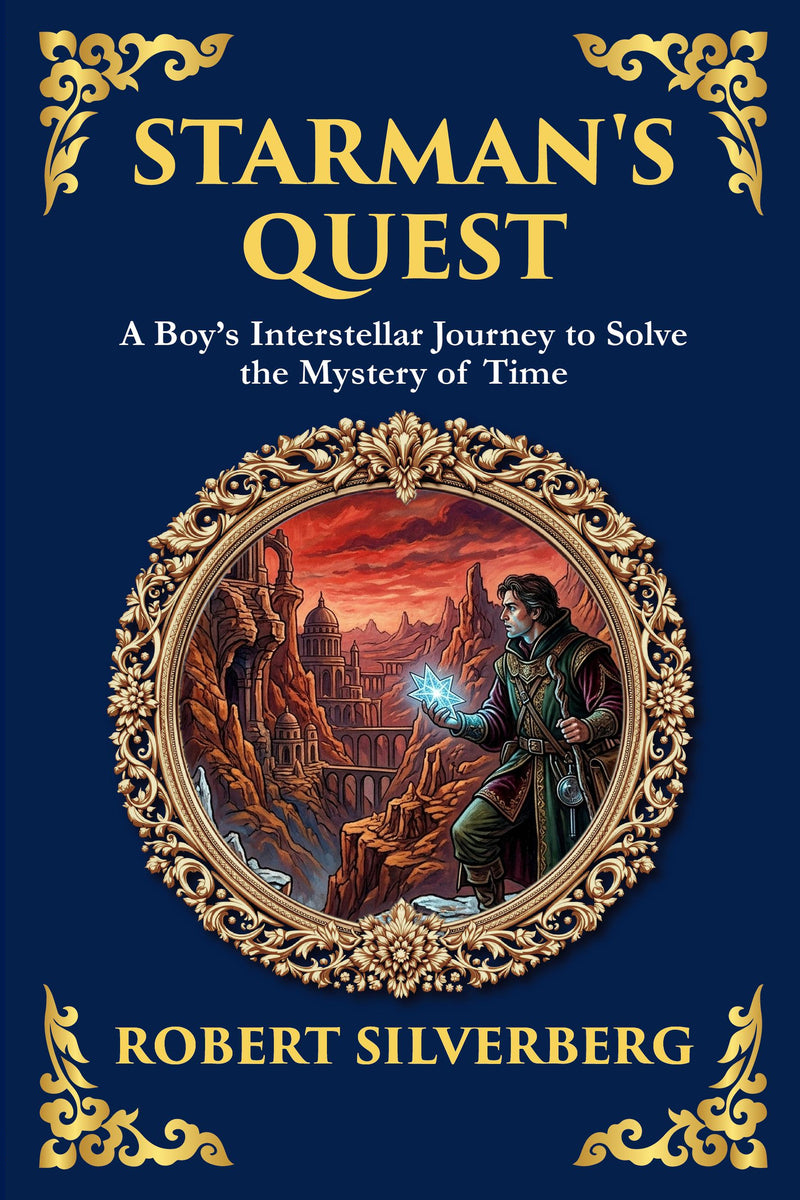
Starman’s Quest
How do you find your place in a galaxy where time moves differently for everyone? In Starman’s Quest, Hugo Award-winning author Robert Silverberg delivers a coming-of-age space odyssey unlike any other.
or free app
10,000+ hrs library
30-day guarantee
The complete Starman's Quest appears in modern English through Library of Alexandria Press, available online with audiobook narration included for members.
Have you ever wondered why a single day in space can mean a lifetime on Earth? In Starman’s Quest, Robert Silverberg crafts an imaginative and emotionally resonant sci-fi journey through space and time. This compelling novel follows Alan Donnell, a sixteen-year-old boy born aboard a starship that travels faster than light.
To the “Starmen” like Alan, a voyage between stars takes only days—but for those living on planets, centuries go by. Haunted by the gulf between himself and planetary society, Alan chooses to break free from the timeless shipboard life and explore the outside world. But Earth is not what he expected.
It’s riddled with decay, inequality, and mysterious bureaucracies that stretch across galaxies. When Alan hears whispers of a technology called the Cavour Hyperdrive—a potential cure to the time disparity—he sets out to find the truth and bring unity to a divided universe.
What you’ll discover in this modern edition
- A Unique Coming-of-Age Story in Deep Space Join Alan as he confronts not only the dangers of alien worlds but also the complexities of growing up in a world out of sync with time.
| Formats | eBook (EPUB + PDF) · Audiobook · Paperback · Hardcover · Large Print |
| Language | English |
| Trim size (print) | 6 × 9 in |
| Binding | Paperback — perfect-bound · Hardcover — casewrap |
| Large Print edition | Same text in a larger, easy-read type — a larger font, not a larger trim |
| Print pricing | Every physical book at our true cost — at-cost, no profit (members) |
| Library | 873 restored titles, always growing |
| Length | 45,852 words · ~3 hr 3 min reading |
| Reading level | Grade 7 · an easy, flowing read (this modern-English edition) |
| Edition | Modern English translation · 2026 |
Member reviews for this edition are collected as readers finish it — be the first. Across the library: 12,000+ books shipped, every plan covered by a 365-day print guarantee.
About this edition
A faithful, unabridged modern-English edition by The Library of Alexandria — carefully rendered for today's reader and verified paragraph-by-paragraph against the public-domain source. Available as eBook, audiobook, paperback, hardcover, and large print.
- Complete & unabridgedVerified paragraph by paragraph against the source — never a scan, never abridged.
- Modern English, faithfulReadable today, with the author’s meaning kept intact. Readable — not simplified.
- Every format, one membershipRead in your browser or the free app, or listen to the full audiobook.
Included free with your membership
Cancel anytime, one click · 30-day money-back guarantee
Edition last updated July 2026
What’s inside
Starman’s Quest — complete and unabridged: all 21 sections included with membership, plus the full audiobook.
Begin reading Starman’s Quest
In clear modern English — the complete text is included with membership.
Introduction
There are certain books that arrive at the very beginning of a great writer’s journey, books that crackle with the energy of a young imagination testing the limits of what it can do. To read such a book is to witness something rare: the moment when raw talent first reaches confidently toward the stars. The novel you are about to encounter is precisely this kind of work — an early flight from a writer who would go on to become one of the most celebrated and prolific figures in all of science fiction, a craftsman whose name would eventually stand beside the very greatest in the field. Yet what makes this story so compelling is not merely the reputation of its author, but the freshness and ambition packed into its pages, the sense that here is a young mind grappling with enormous ideas and refusing to be intimidated by their scale.
This particular edition has been carefully prepared as a modern translation, adapted for the contemporary reader. That phrase deserves a moment of explanation, because it speaks to the spirit in which this book has been brought back to life. Stories written in earlier decades sometimes carry the dust of their era in their language — turns of phrase that have grown stiff, references that have faded, rhythms of speech that no longer match the way we read today. The goal of this adaptation is to clear away that dust without disturbing the treasure beneath it. The plot remains intact, the characters remain true to themselves, the central wonder of the tale remains undiminished. What has changed is the accessibility, the ease with which a reader living in the twenty-first century can slip into the narrative and feel immediately at home. Think of it as the difference between viewing a beloved painting through a clouded pane of glass and seeing it freshly cleaned, its colors restored to their original vividness. The art is the same; the experience is renewed.
To understand why this book matters, it helps to understand the moment in which it was created. The author was extraordinarily young when this novel first appeared — barely out of his teenage years, a college student already producing fiction at a pace that astonished his peers and editors alike. This was an era when science fiction was bursting with energy, when magazines and paperbacks were hungry for stories of rockets and distant worlds, when a generation of writers was inventing, almost in real time, the language and conventions of a genre that would come to dominate the popular imagination. Into this exciting and chaotic landscape stepped a young man of prodigious gifts, a writer who would eventually produce hundreds of books and stories across a career spanning more than half a century.
It is tempting, when we know what an author later became, to look back at their early work with a certain condescension, to treat it as a mere curiosity, a stepping stone toward greater achievements. But that would be a mistake here. This novel, while written early, already displays many of the qualities that would define its author’s mature work: a fascination with vast spans of time, a deep curiosity about the human consequences of scientific possibility, and an unwavering belief that the universe is a place worth exploring with both the head and the heart. There is something genuinely moving about reading a story in which a great talent is just beginning to find its voice, in which the seeds of future masterpieces can be glimpsed in early bloom. You are not reading a footnote to a career; you are reading the opening chapter of one.
The writer in question would go on to win virtually every major award the genre had to offer, to be named a Grand Master, to influence countless writers who came after him. He worked in nearly every register that science fiction allows, from sweeping galactic epics to intimate, philosophical meditations on consciousness and mortality. But before all of that, before the accolades and the recognition, there was a young man with a typewriter and an enormous imagination, writing stories aimed in part at younger readers — adventure tales designed to thrill, to provoke wonder, and to plant in those readers the same love of the infinite that burned in the author himself. This book belongs to that tradition. It was written to be enjoyed, to be devoured in a sitting or two, to leave the reader breathless and hungry for more. That it also happens to be the work of a future giant only deepens its appeal.
What is remarkable is how the ambition of the novel outstrips its modest origins. This is not a simple shoot-‘em-up adventure dressed in spaceship clothing. At its heart lies one of the most profound and unsettling ideas in all of science: the strange behavior of time when you travel at speeds approaching that of light. The young author chose, for his early novel, to wrestle with a concept that the greatest physicists of the twentieth century had only recently begun to articulate — a concept so counterintuitive that it overturns our most basic assumptions about how the world works. That he chose to build an entire adventure around this idea, and to make it the engine of his story’s emotional power, tells us everything about the seriousness of his intentions, even in a book meant to entertain.
The central idea that animates this story is one that has haunted thinkers, dreamers, and storytellers ever since it was first understood. When we move through the universe at tremendous speeds — speeds that approach the velocity of light itself — something extraordinary happens to the passage of time. For the traveler hurtling through the cosmos, time slows. A journey that feels like months to those aboard a starship might encompass years, decades, even centuries for those left behind on a distant world. The traveler returns young while everyone they knew has aged and changed beyond recognition. This is not fantasy or magic; it is a genuine consequence of the way our universe is constructed, a fact of physics that has been confirmed by experiment and observation. And yet, despite its scientific reality, it carries within it a tragedy and a poetry that no equation can fully capture.
Imagine being torn loose from the ordinary current of time, set adrift in a separate stream that flows at a different pace than the world you came from. Imagine returning home only to find that home has moved on without you — that the people you loved have grown old and passed away, that the places you remember have transformed into something unrecognizable, that you have become a kind of ghost, belonging fully to no single moment. This is the predicament that lies at the heart of the novel, and the author handles it with a sensitivity that elevates the entire work. The adventure that propels the plot is real and exciting, full of motion and discovery, but beneath that surface runs a current of genuine melancholy and longing. The young hero of this tale is not merely chasing a goal across the stars; he is grappling with the most fundamental questions of belonging, of loss, of what it means to be cut off from the natural rhythm of human life.
This is the genius of using a scientific concept as the foundation of a story. The slowing of time is not just a clever plot device; it is a metaphor for experiences that all of us understand on some level. Who among us has not felt, at some point, out of step with the world around us — left behind by changes we did not choose, estranged from a past that has slipped beyond our reach? Who has not wished, in moments of grief or nostalgia, that we could somehow reverse the flow of time, recover what we have lost, return to a moment that has vanished forever? The science fiction premise gives these universal feelings a concrete and dramatic form, allowing the author to explore them with a directness that realistic fiction rarely permits. By taking the abstract emotional truth of time’s passage and rendering it literal — by creating a character who genuinely lives at a different speed than those around him — the writer transforms a physics lesson into a meditation on the human condition.
It is worth pausing to appreciate how skillfully this is accomplished within the framework of an adventure story. The temptation, when handling such heavy material, is to grow ponderous, to let the philosophy overwhelm the narrative. But this novel never loses sight of its primary obligation, which is to tell a thrilling story. The pacing is brisk, the stakes are clear, the action carries the reader forward with momentum. The deeper themes are woven into the fabric of the tale rather than stitched onto its surface, emerging naturally from the situations the characters find themselves in. This is harder to do than it might appear, and the fact that a writer so young could pull it off is a testament to the instinctive storytelling gifts that would serve him so well throughout his long career.
The imagined future in which the story unfolds is rendered with a vividness that draws the reader fully into its world. There are starships that ply the routes between distant suns, crews who live their entire lives in transit, societies structured around the strange demands of interstellar travel. There is a sense, throughout, of a vast and intricate cosmos teeming with possibility, a universe in which humanity has spread outward but carried with it all of its old hopes, fears, and contradictions. The young protagonist moves through this world as both a participant and an outsider, his unique relationship to time setting him apart even as he yearns to find his place. The reader experiences the universe through his eyes, sharing his wonder at its vastness and his ache at his own dislocation.
What gives the story its forward drive is the quest itself — the protagonist’s determined search for a solution to the very problem that time imposes upon him and all who travel as he does. This is a story about a young person who refuses to accept the limits the universe seems to have placed upon him, who sets out, against considerable odds, to change the fundamental terms of his existence. There is something deeply inspiring in this refusal, this insistence that even the laws of physics might be bent by sufficient courage and determination. Whether or not the quest succeeds is something you will discover for yourself, and it would spoil the pleasure of the reading to reveal it here. But the spirit of the search — the audacity of a single individual setting out to confront one of the great mysteries of the cosmos — is what gives the novel its enduring appeal. It is, in the truest sense, a tale of aspiration, of reaching for something that seems impossibly far away and refusing to give up the chase.
Why This Story Endures, and How to Read It
It might be tempting to wonder whether a story written in the middle of the twentieth century could possibly have much to say to a reader living in our own time. After all, our understanding of science has advanced enormously since this book was first written. Our culture has changed in countless ways. The future imagined by writers of an earlier generation can sometimes feel quaint, its predictions overtaken by reality, its assumptions belonging to a vanished age. And yet the best science fiction of any era was never really about prediction in the first place. It was about ideas, about possibilities, about the human heart confronting the unknown. The specific technologies imagined in these older stories matter far less than the questions they raise and the emotions they stir. A story built around the genuine, eternal physics of time and motion does not grow obsolete, because the underlying reality it explores has not changed and never will.
This is one of the reasons the novel deserves a fresh reading today. The dilemma at its center — the painful gap that opens up between the traveler and the world he leaves behind — is, if anything, more resonant now than it was when the book was written. We live in an age of acceleration, of constant change, of technologies that transform our lives faster than we can fully absorb. Many of us feel, in our own small ways, the disorientation of being carried forward through time at a pace that leaves the familiar behind. The young hero of this story, racing through the cosmos while the worlds he loves age and fade, becomes a figure we can recognize and identify with, even across the gulf of decades that separates us from the book’s creation. His longing is our longing. His search is, in some sense, our search too.
Cancel anytime, one click · 30-day money-back guarantee
Founding annual rate available now — your price locks for life when you join.
Not ready? Get this free chapter by email — read it anytime.
✓ Sent — check your inbox for Starman’s Quest.
Questions about Starman’s Quest
What is Starman's Quest about?
How do you find your place in a galaxy where time moves differently for everyone? In Starman’s Quest, Hugo Award-winning author Robert Silverberg delivers a coming-of-age space odyssey unlike any other. Young Alan Donnell was born aboard a faster-than-light spaceship, where decades pass outside while only days tick by for the crew.
Who wrote Starman's Quest?
Starman's Quest was written by Robert Silverberg. This edition presents the complete work in clear modern English, faithfully rendered from the public-domain original by Library of Alexandria Press.
Is Starman's Quest free to read?
The opening chapter is free to read on this page. Members read and listen to the complete work — and the entire library — free, and can order any physical book at our true print cost.
How long is Starman's Quest?
21 chapters (~45,852 words) — about 3 hr 3 min of reading in this modern-English edition.
Is this an abridged version of Starman's Quest?
No. This is the complete, unabridged Starman's Quest, carefully rendered into clear modern English and verified paragraph-by-paragraph against the public-domain source — nothing is cut or summarised.
What formats does Starman's Quest come in?
Starman's Quest is available as eBook, paperback, hardcover and large print. eBook and audiobook are included with membership; printed editions ship at our true print cost.
Shipping & returns
Billing & membership
More from the library


Explore Science Fiction
- The Island of Doctor Moreau · H. G. Wells
- A Midsummer Night’s Dream · William Shakespeare
- The Invisible Man: A Grotesque Romance · H. G. Wells
- The War of the Worlds · H. G. Wells
- The Strange Case of Dr. Jekyll and Mr. Hyde · Robert Louis Stevenson
- Limanora: the island of progress · Godfrey Sweven
- The Book of Dragons · E. Nesbit
- She · H. Rider Haggard
- Dorothy and the Wizard in Oz · L. Frank Baum
- The Princess and the Goblin · George MacDonald
- Gawayne and the Green Knight: A Fairy Tale · Charlton M. Lewis
- Lucian’s True History · Lucian of Samosata
- The Willows · Algernon Blackwood
- The Call of Cthulhu · H. P. Lovecraft
- The Life-Eater · Harold Ward
- The Marvelous Land of Oz · L. Frank Baum
- Mars is My Destination · Frank Belknap Long
- The Black Kiss
- The Beasts in the Void · Paul W. Fairman
- John Jones’s Dollar · Harry Stephen Keeler
- Subversive · Mack Reynolds
- The Mississippi Saucer · Frank Belknap Long
- Man of Distinction · Michael Shaara
- Spawn of the Comet · H. Thompson Rich
- The Golden Judge · Nathaniel Gordon
- Final Weapon · Everett B. Cole
- The Big Fix · George O. Smith
- Last Enemy · H. Beam Piper
- Time and Time Again · H. Beam Piper
- Sabotage in Space · Carey Rockwell
Starman’s Quest
Starman’s Quest
A Boy’s Interstellar Journey to Solve the Mystery of Time
Robert Silverberg
Contents
- Introduction
- Prologue
- Chapter 1
- Chapter 2
- Chapter 3
- Chapter 4
- Chapter 5
- Chapter 6
- Chapter 7
- Chapter 8
- Chapter 9
- Chapter 10
- Chapter 11
- Chapter 12
- Chapter 13
- Chapter 14
- Chapter 15
- Chapter 16
- Chapter 17
- Chapter 18
- Chapter 19
Introduction
There are certain books that arrive at the very beginning of a great writer’s journey, books that crackle with the energy of a young imagination testing the limits of what it can do. To read such a book is to witness something rare: the moment when raw talent first reaches confidently toward the stars. The novel you are about to encounter is precisely this kind of work — an early flight from a writer who would go on to become one of the most celebrated and prolific figures in all of science fiction, a craftsman whose name would eventually stand beside the very greatest in the field. Yet what makes this story so compelling is not merely the reputation of its author, but the freshness and ambition packed into its pages, the sense that here is a young mind grappling with enormous ideas and refusing to be intimidated by their scale.
This particular edition has been carefully prepared as a modern translation, adapted for the contemporary reader. That phrase deserves a moment of explanation, because it speaks to the spirit in which this book has been brought back to life. Stories written in earlier decades sometimes carry the dust of their era in their language — turns of phrase that have grown stiff, references that have faded, rhythms of speech that no longer match the way we read today. The goal of this adaptation is to clear away that dust without disturbing the treasure beneath it. The plot remains intact, the characters remain true to themselves, the central wonder of the tale remains undiminished. What has changed is the accessibility, the ease with which a reader living in the twenty-first century can slip into the narrative and feel immediately at home. Think of it as the difference between viewing a beloved painting through a clouded pane of glass and seeing it freshly cleaned, its colors restored to their original vividness. The art is the same; the experience is renewed.
To understand why this book matters, it helps to understand the moment in which it was created. The author was extraordinarily young when this novel first appeared — barely out of his teenage years, a college student already producing fiction at a pace that astonished his peers and editors alike. This was an era when science fiction was bursting with energy, when magazines and paperbacks were hungry for stories of rockets and distant worlds, when a generation of writers was inventing, almost in real time, the language and conventions of a genre that would come to dominate the popular imagination. Into this exciting and chaotic landscape stepped a young man of prodigious gifts, a writer who would eventually produce hundreds of books and stories across a career spanning more than half a century.
It is tempting, when we know what an author later became, to look back at their early work with a certain condescension, to treat it as a mere curiosity, a stepping stone toward greater achievements. But that would be a mistake here. This novel, while written early, already displays many of the qualities that would define its author’s mature work: a fascination with vast spans of time, a deep curiosity about the human consequences of scientific possibility, and an unwavering belief that the universe is a place worth exploring with both the head and the heart. There is something genuinely moving about reading a story in which a great talent is just beginning to find its voice, in which the seeds of future masterpieces can be glimpsed in early bloom. You are not reading a footnote to a career; you are reading the opening chapter of one.
The writer in question would go on to win virtually every major award the genre had to offer, to be named a Grand Master, to influence countless writers who came after him. He worked in nearly every register that science fiction allows, from sweeping galactic epics to intimate, philosophical meditations on consciousness and mortality. But before all of that, before the accolades and the recognition, there was a young man with a typewriter and an enormous imagination, writing stories aimed in part at younger readers — adventure tales designed to thrill, to provoke wonder, and to plant in those readers the same love of the infinite that burned in the author himself. This book belongs to that tradition. It was written to be enjoyed, to be devoured in a sitting or two, to leave the reader breathless and hungry for more. That it also happens to be the work of a future giant only deepens its appeal.
What is remarkable is how the ambition of the novel outstrips its modest origins. This is not a simple shoot-‘em-up adventure dressed in spaceship clothing. At its heart lies one of the most profound and unsettling ideas in all of science: the strange behavior of time when you travel at speeds approaching that of light. The young author chose, for his early novel, to wrestle with a concept that the greatest physicists of the twentieth century had only recently begun to articulate — a concept so counterintuitive that it overturns our most basic assumptions about how the world works. That he chose to build an entire adventure around this idea, and to make it the engine of his story’s emotional power, tells us everything about the seriousness of his intentions, even in a book meant to entertain.
The central idea that animates this story is one that has haunted thinkers, dreamers, and storytellers ever since it was first understood. When we move through the universe at tremendous speeds — speeds that approach the velocity of light itself — something extraordinary happens to the passage of time. For the traveler hurtling through the cosmos, time slows. A journey that feels like months to those aboard a starship might encompass years, decades, even centuries for those left behind on a distant world. The traveler returns young while everyone they knew has aged and changed beyond recognition. This is not fantasy or magic; it is a genuine consequence of the way our universe is constructed, a fact of physics that has been confirmed by experiment and observation. And yet, despite its scientific reality, it carries within it a tragedy and a poetry that no equation can fully capture.
Imagine being torn loose from the ordinary current of time, set adrift in a separate stream that flows at a different pace than the world you came from. Imagine returning home only to find that home has moved on without you — that the people you loved have grown old and passed away, that the places you remember have transformed into something unrecognizable, that you have become a kind of ghost, belonging fully to no single moment. This is the predicament that lies at the heart of the novel, and the author handles it with a sensitivity that elevates the entire work. The adventure that propels the plot is real and exciting, full of motion and discovery, but beneath that surface runs a current of genuine melancholy and longing. The young hero of this tale is not merely chasing a goal across the stars; he is grappling with the most fundamental questions of belonging, of loss, of what it means to be cut off from the natural rhythm of human life.
This is the genius of using a scientific concept as the foundation of a story. The slowing of time is not just a clever plot device; it is a metaphor for experiences that all of us understand on some level. Who among us has not felt, at some point, out of step with the world around us — left behind by changes we did not choose, estranged from a past that has slipped beyond our reach? Who has not wished, in moments of grief or nostalgia, that we could somehow reverse the flow of time, recover what we have lost, return to a moment that has vanished forever? The science fiction premise gives these universal feelings a concrete and dramatic form, allowing the author to explore them with a directness that realistic fiction rarely permits. By taking the abstract emotional truth of time’s passage and rendering it literal — by creating a character who genuinely lives at a different speed than those around him — the writer transforms a physics lesson into a meditation on the human condition.
It is worth pausing to appreciate how skillfully this is accomplished within the framework of an adventure story. The temptation, when handling such heavy material, is to grow ponderous, to let the philosophy overwhelm the narrative. But this novel never loses sight of its primary obligation, which is to tell a thrilling story. The pacing is brisk, the stakes are clear, the action carries the reader forward with momentum. The deeper themes are woven into the fabric of the tale rather than stitched onto its surface, emerging naturally from the situations the characters find themselves in. This is harder to do than it might appear, and the fact that a writer so young could pull it off is a testament to the instinctive storytelling gifts that would serve him so well throughout his long career.
The imagined future in which the story unfolds is rendered with a vividness that draws the reader fully into its world. There are starships that ply the routes between distant suns, crews who live their entire lives in transit, societies structured around the strange demands of interstellar travel. There is a sense, throughout, of a vast and intricate cosmos teeming with possibility, a universe in which humanity has spread outward but carried with it all of its old hopes, fears, and contradictions. The young protagonist moves through this world as both a participant and an outsider, his unique relationship to time setting him apart even as he yearns to find his place. The reader experiences the universe through his eyes, sharing his wonder at its vastness and his ache at his own dislocation.
What gives the story its forward drive is the quest itself — the protagonist’s determined search for a solution to the very problem that time imposes upon him and all who travel as he does. This is a story about a young person who refuses to accept the limits the universe seems to have placed upon him, who sets out, against considerable odds, to change the fundamental terms of his existence. There is something deeply inspiring in this refusal, this insistence that even the laws of physics might be bent by sufficient courage and determination. Whether or not the quest succeeds is something you will discover for yourself, and it would spoil the pleasure of the reading to reveal it here. But the spirit of the search — the audacity of a single individual setting out to confront one of the great mysteries of the cosmos — is what gives the novel its enduring appeal. It is, in the truest sense, a tale of aspiration, of reaching for something that seems impossibly far away and refusing to give up the chase.
Why This Story Endures, and How to Read It
It might be tempting to wonder whether a story written in the middle of the twentieth century could possibly have much to say to a reader living in our own time. After all, our understanding of science has advanced enormously since this book was first written. Our culture has changed in countless ways. The future imagined by writers of an earlier generation can sometimes feel quaint, its predictions overtaken by reality, its assumptions belonging to a vanished age. And yet the best science fiction of any era was never really about prediction in the first place. It was about ideas, about possibilities, about the human heart confronting the unknown. The specific technologies imagined in these older stories matter far less than the questions they raise and the emotions they stir. A story built around the genuine, eternal physics of time and motion does not grow obsolete, because the underlying reality it explores has not changed and never will.
This is one of the reasons the novel deserves a fresh reading today. The dilemma at its center — the painful gap that opens up between the traveler and the world he leaves behind — is, if anything, more resonant now than it was when the book was written. We live in an age of acceleration, of constant change, of technologies that transform our lives faster than we can fully absorb. Many of us feel, in our own small ways, the disorientation of being carried forward through time at a pace that leaves the familiar behind. The young hero of this story, racing through the cosmos while the worlds he loves age and fade, becomes a figure we can recognize and identify with, even across the gulf of decades that separates us from the book’s creation. His longing is our longing. His search is, in some sense, our search too.
The Lexman Spacedrive was only the second most important theoretical achievement of the exciting early years of the Space Age, but it changed human history and permanently altered how society developed on Earth.
Still, it was only the second most important discovery.
The Cavour Hyperdrive would have undoubtedly been ranked first in any historical analysis, if it had ever actually been put into practice. The Lexman Spacedrive allows humans to reach Alpha Centauri—the closest star with habitable planets—in about four and a half years. The Cavour Hyperdrive, if it ever truly existed, would have made Alpha Centauri accessible almost instantly.
But James Hudson Cavour was one of those tragic figures whose personality overshadowed the value of his work. He was a lonely, grumpy, and opinionated man—a crank, essentially—who isolated himself from society to develop the hyperspace drive, occasionally announcing that he was close to success.
A final, mysterious message in the year 2570 led some to believe that Cavour had reached his goal or was about to. Others, who were less sympathetic, saw his last message as the wild boast of a madman. It didn’t really matter which view people held; James Hudson Cavour was never heard from again.
A small group of passionate believers insisted that he had created a faster-than-light drive and had given humanity a way to reach the stars instantly. But like Cavour himself, they were laughed at, and the stars remained far away.
Far away—but not unreachable. The Lexman Spacedrive made that possible.
After decades of research, Lexman and his team developed their ionic drive in 2337. It allowed humans to approach, but not exceed, the universe’s theoretical speed limit: the speed of light.
End of the free sample
Keep reading, free
Members read and listen to the complete book — and the entire library. Cancel anytime, one click · 30-day money-back guarantee.