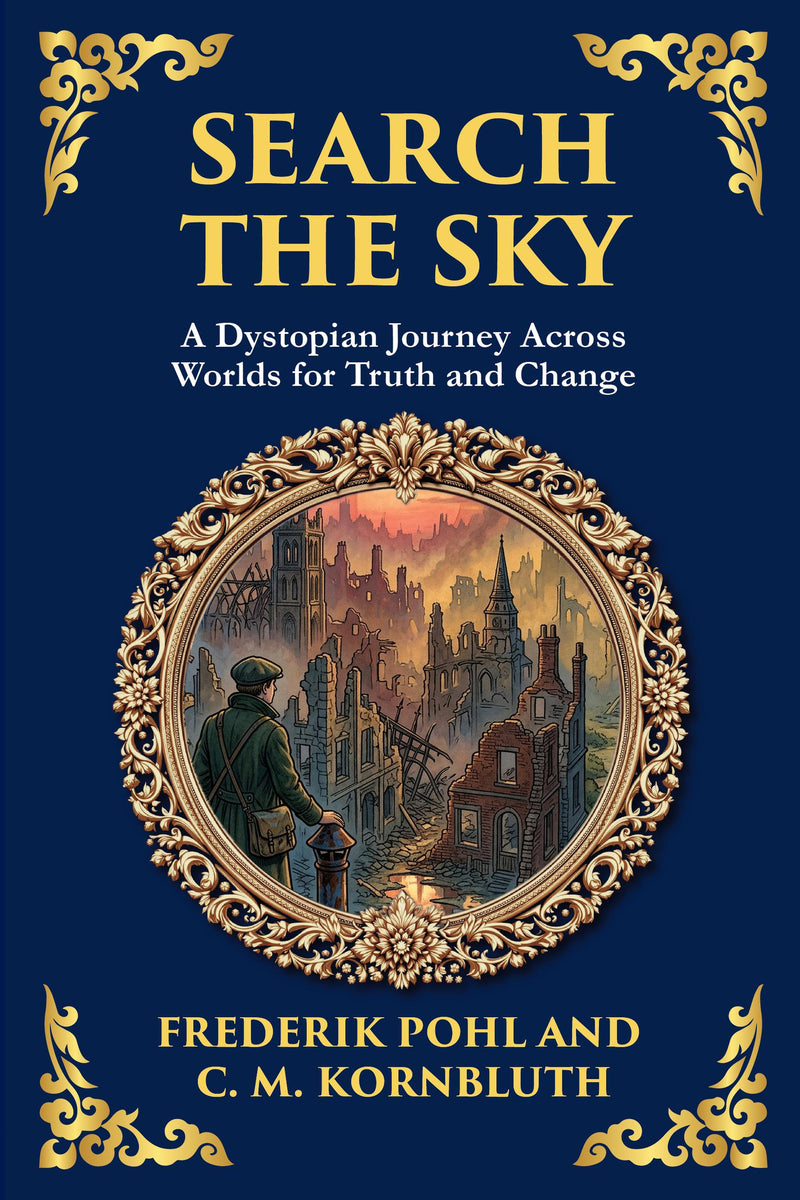
Search the Sky
Frederik Pohl & C. M. Kornbluth In Search the Sky, science fiction legends Frederik Pohl and C. M. Kornbluth craft a thrilling odyssey across the stars in search of truth, freedom, and the hope of renewal.
or free app
10,000+ hrs library
30-day guarantee
The complete Search the Sky appears in modern English through Library of Alexandria Press, available online with audiobook narration included for members.
Have you ever wondered why the greatest threat to humanity might be the systems we no longer question? Search the Sky is a daring, genre-defying science fiction journey that tears through complacency, dogma, and false utopias. Written by the iconic duo Frederik Pohl and C. M. Kornbluth, this novel invites readers into a future where Earth’s distant colonies have devolved into isolated, failed societies—each a distorted mirror of mankind’s fears and flaws.
Ross, a merchant of the stars from a world frozen in rigid tradition and controlled decline, is tasked with discovering why communication with several colonies has mysteriously ceased. But what begins as a routine mission quickly becomes a relentless confrontation with tyranny, paranoia, and self-destruction. From planets ruled by aging patriarchs to worlds locked in genetic madness, Ross must navigate surreal societies where the line between survival and surrender has long since vanished.
What you’ll discover in this modern edition
- in this unforgettable classic of dystopian science fiction:
- A Stark Critique of Cultural Decay – Explore worlds that have collapsed into parody due to obsession with conformity, age, purity, and power.
| Formats | eBook (EPUB + PDF) · Audiobook · Paperback · Hardcover · Large Print |
| Language | English |
| Trim size (print) | 6 × 9 in |
| Binding | Paperback — perfect-bound · Hardcover — casewrap |
| Large Print edition | Same text in a larger, easy-read type — a larger font, not a larger trim |
| Print pricing | Every physical book at our true cost — at-cost, no profit (members) |
| Library | 873 restored titles, always growing |
| Length | 56,730 words · ~3 hr 47 min reading |
| Reading level | Grade 3 · an easy, flowing read (this modern-English edition) |
| Edition | Modern English translation · 2026 |
Member reviews for this edition are collected as readers finish it — be the first. Across the library: 12,000+ books shipped, every plan covered by a 365-day print guarantee.
About this edition
A faithful, unabridged modern-English edition by The Library of Alexandria — carefully rendered for today's reader and verified paragraph-by-paragraph against the public-domain source. Available as eBook, audiobook, paperback, hardcover, and large print.
- Complete & unabridgedVerified paragraph by paragraph against the source — never a scan, never abridged.
- Modern English, faithfulReadable today, with the author’s meaning kept intact. Readable — not simplified.
- Every format, one membershipRead in your browser or the free app, or listen to the full audiobook.
Included free with your membership
Cancel anytime, one click · 30-day money-back guarantee
Edition last updated July 2026
What’s inside
Search the Sky — complete and unabridged: all 8 sections included with membership, plus the full audiobook.
Begin reading Search the Sky
In clear modern English — the complete text is included with membership.
Introduction
There is a particular kind of science fiction that does something sly and subversive beneath its surface entertainment. It dresses itself in the bright costume of adventure—spaceships, distant planets, strange societies glimpsed through a traveler’s startled eyes—and then, while you are busy enjoying the ride, it slips a mirror into your hands. You look up from the page expecting to see another world, and instead you catch a reflection of your own. This is the secret machinery of the best satirical science fiction, and it is the machinery that hums beneath every chapter of the novel you are about to read.
The collaboration between Frederik Pohl and Cyril M. Kornbluth produced some of the most enduring and intelligent science fiction of the mid-twentieth century, and the work in your hands belongs to that remarkable partnership. These were not writers content to thrill readers with rockets and ray guns, though they certainly knew how to deliver a propulsive story. They were observers of human folly, students of the strange ways societies organize themselves, and skeptics of the comfortable assumptions that most people carry through their lives without ever examining. When they sent a character traveling across the stars, they were never simply describing the heavens. They were sending up a flare over the landscape of human behavior, illuminating the things we would rather not see.
This particular novel takes the ancient and irresistible structure of the journey and gives it cosmic scale. The traveler’s tale is one of the oldest forms of storytelling we possess, stretching back to Odysseus wandering the wine-dark sea and forward through Gulliver’s improbable landfalls. The pattern is simple and powerful: a protagonist leaves the world they know, encounters a series of strange and unfamiliar places, and through those encounters comes to understand something they could not have learned at home. Each new destination becomes a kind of experiment, a controlled environment in which the authors can isolate a single tendency of human society and let it grow to monstrous or absurd proportions. The reader, accompanying the traveler, learns alongside them—and the learning is rarely comfortable.
What makes the journey structure so effective for satire is precisely its episodic nature. A single dystopia, however well constructed, can begin to feel like a thesis statement, a one-note argument hammered home for the length of a book. But a series of worlds, each twisted in its own particular direction, accumulates into something richer and more disturbing. The reader begins to see a pattern not in any single society but in the very impulse to organize human life around a single principle. By the time the journey nears its end, the cumulative effect is overwhelming: we have seen so many ways for a civilization to go wrong that we begin to wonder, uneasily, what hidden lunacies might be operating in our own.
The Authors and Their Strange and Fertile Partnership
To understand what you are about to read, it helps to understand a little about the two minds that produced it. Frederik Pohl and Cyril Kornbluth came up together in the fervent, argumentative, idealistic world of New York science fiction fandom in the 1930s and 1940s. This was a milieu unlike almost any other in literary history—a community of mostly young, mostly working-class enthusiasts who devoured the pulp magazines, wrote endless letters to the editors, formed clubs that splintered and reformed with the regularity of revolutionary cells, and dreamed of futures both glorious and terrible. They were the children of the Depression, and many of them carried with them a deep skepticism of the social and economic arrangements that had so visibly failed the generation before them.
This was the famous Futurians, a group whose membership reads like a roll call of the genre’s future giants. Out of these heated debates and shared ambitions came writers who would shape science fiction for decades. Pohl and Kornbluth were both products of this world, and both carried its restless, questioning spirit into their professional careers. They had absorbed, almost by osmosis, the conviction that science fiction was not merely escapism but a tool for thinking—a way of running experiments on history and society that could never be run in the real world.
Pohl, who lived a long and astonishingly productive life, became one of the most decorated figures in the field, a writer, editor, and agent whose influence touched nearly every corner of the genre. He had a gift for the cool, ironic observation, the ability to look at a trend in contemporary life and project it forward to its logical and horrifying conclusion. His best work has a clarity that borders on the chilling; he could describe a nightmare with the calm precision of a man reading a weather report.
Kornbluth, who died tragically young, brought a darker, more savage energy to their collaborations. Where Pohl could be wry, Kornbluth could be ferocious. He had a contempt for human stupidity and complacency that crackles on the page, and a willingness to follow his bleak insights all the way to their grim conclusions. There was nothing sentimental about him as a writer. He saw the comfortable lies that societies tell themselves and he wanted to tear them apart.
Together, the two produced a body of work that has outlasted nearly all of their contemporaries. Their most celebrated joint novel is a stinging satire of consumer culture and advertising that remains startlingly relevant generations after it was written, but it is far from their only achievement. What distinguished their partnership was the way their two sensibilities balanced and amplified one another. Pohl’s ironic detachment kept Kornbluth’s fury from curdling into mere misanthropy; Kornbluth’s ferocity kept Pohl’s irony from softening into the merely clever. The result was satire with both teeth and intelligence—funny enough to keep you turning pages, sharp enough to leave marks.
It is worth pausing to appreciate how unusual a successful literary collaboration actually is. Most attempts at co-writing produce work that feels stitched together, a patchwork of styles that never quite cohere. The best collaborations, by contrast, produce something that neither author could have written alone—a third voice that emerges from the friction of two distinct minds. The Pohl-Kornbluth partnership was one of these rare successes. Reading their joint work, you cannot easily say where one writer ends and the other begins. The seams are invisible. What you encounter instead is a unified vision, simultaneously playful and savage, that belongs entirely to itself.
The novel before you emerges from this fertile partnership at a particular moment in the history of science fiction and of American society. The 1950s were a period of enormous prosperity and equally enormous anxiety—a time of suburban expansion and consumer abundance shadowed by the threat of nuclear annihilation and the suffocating pressures of conformity. It was a decade obsessed with belonging, with fitting in, with not standing out. The pressure to conform was everywhere: in the workplace, in the neighborhood, in politics, in the very design of the new mass-produced suburbs spreading across the landscape. And it was precisely this anxiety, this sense that individual judgment and personal freedom were being slowly squeezed out of existence by the demands of a mass society, that gave the science fiction of the period its peculiar urgency.
Science fiction has always had a special relationship with social criticism, and the journey narrative is one of its sharpest instruments. When a writer creates a single imaginary society, they can comment on one aspect of human life. But when they send a traveler out among many societies, each developed along a different line, they can do something more ambitious: they can map the entire range of human possibility, exploring the various directions in which our worst tendencies might lead us if they were allowed to run unchecked.
This is satire in the classical sense—not the gentle, toothless humor that the word often suggests today, but the older and more dangerous tradition of Swift and Voltaire, of writers who used the fantastic and the absurd as weapons against complacency. Jonathan Swift sent Gulliver to lands of giants and tiny people, of immortals and intelligent horses, and in each place he held up some aspect of eighteenth-century England—its politics, its science, its vanities, its cruelties—for merciless examination. Voltaire sent his naive Candide stumbling through a world of disaster and folly to demolish the comfortable philosophy that this is the best of all possible worlds. The science fiction journey is a direct descendant of these works, and it inherits their essential method: the use of the strange to defamiliarize the familiar, to make us see with fresh eyes the things we have stopped noticing.
What does it mean to defamiliarize the familiar? Consider how difficult it is to see clearly the assumptions of your own time and place. The conventions we live by—the unspoken rules about how to behave, what to want, what to believe, how a society ought to be organized—are largely invisible to us precisely because they are everywhere. They are the water we swim in, and like fish, we do not notice the water. The genius of the satirical journey is that it lifts us out of our own water and drops us into a series of strange aquariums, each governed by different rules. By watching how the inhabitants of these other worlds take their own absurdities for granted, we begin to suspect that we too might be taking absurdities for granted. The fish, having seen other waters, begins at last to notice the water it has always lived in.
This is the deep purpose that runs beneath the adventure surface of the book you are about to read. The protagonist’s voyage from world to world is not merely a sequence of exciting episodes, though it is certainly that. It is a tour through the possible derangements of human society, a catalog of the ways in which a civilization can organize itself around a single principle and, in doing so, become a kind of madhouse. Each world the traveler encounters has taken some tendency—some attitude, some prejudice, some social arrangement—and pushed it to an extreme. And each, in its extremity, reveals something true about the more moderate versions of the same tendency operating in our own world.
There is a particular pleasure in this kind of reading, a pleasure that is partly intellectual and partly something darker. We laugh at the absurdities of the strange societies, but our laughter has an uneasy edge, because we recognize in them, distorted but unmistakable, the outlines of our own arrangements. The best satire produces this double response: delight at the cleverness of the invention, discomfort at the truth it exposes. Pohl and Kornbluth were masters of this double effect. They could make you laugh out loud at the ridiculous logic of some imaginary society and then, a moment later, make you stop laughing as you realized that the logic was not so different from the logic you yourself live by.
The science of this fiction deserves a word as well. Readers approaching mid-century science fiction sometimes expect either rigorous technical accuracy or pure fantasy, and they are surprised to find something in between—a literature that uses the apparatus of science not primarily for its own sake but as a means of enabling thought experiments about society and human nature. The interstellar travel, the strange worlds, the technologies that make the journey possible: these are tools, not ends. They are the means by which the authors construct their laboratory of human possibility. This is not to say that the science is careless—Pohl in particular had a sophisticated understanding of scientific ideas—but rather that the science serves the story’s deeper purpose, which is the examination of how human beings live together and how that living might go right or, more often in satire, terribly wrong.
Cancel anytime, one click · 30-day money-back guarantee
Founding annual rate available now — your price locks for life when you join.
Not ready? Get this free chapter by email — read it anytime.
✓ Sent — check your inbox for Search the Sky.
Questions about Search the Sky
What is Search the Sky about?
Frederik Pohl & C. M. Kornbluth In Search the Sky, science fiction legends Frederik Pohl and C. M. Kornbluth craft a thrilling odyssey across the stars in search of truth, freedom, and the hope of renewal. When trader Ross must leave the safety of his stagnant home planet to investigate the collapse of distant colonies, he embarks on a journey that will shake his beliefs and awaken a dormant defiance. Each new world offers strange customs, eerie uniformity, or brutal decay—but all point to a singular crisis infecti
Is Search the Sky free to read?
The opening chapter is free to read on this page. Members read and listen to the complete work — and the entire library — free, and can order any physical book at our true print cost.
How long is Search the Sky?
8 chapters (~56,730 words) — about 3 hr 47 min of reading in this modern-English edition.
Is this an abridged version of Search the Sky?
No. This is the complete, unabridged Search the Sky, carefully rendered into clear modern English and verified paragraph-by-paragraph against the public-domain source — nothing is cut or summarised.
What formats does Search the Sky come in?
Search the Sky is available as eBook, paperback, hardcover and large print. eBook and audiobook are included with membership; printed editions ship at our true print cost.
Shipping & returns
Billing & membership
More from the library


Explore Science Fiction
- The Island of Doctor Moreau · H. G. Wells
- A Midsummer Night’s Dream · William Shakespeare
- The Invisible Man: A Grotesque Romance · H. G. Wells
- The War of the Worlds · H. G. Wells
- The Strange Case of Dr. Jekyll and Mr. Hyde · Robert Louis Stevenson
- Limanora: the island of progress · Godfrey Sweven
- The Book of Dragons · E. Nesbit
- She · H. Rider Haggard
- Dorothy and the Wizard in Oz · L. Frank Baum
- The Princess and the Goblin · George MacDonald
- Gawayne and the Green Knight: A Fairy Tale · Charlton M. Lewis
- Lucian’s True History · Lucian of Samosata
- The Willows · Algernon Blackwood
- The Call of Cthulhu · H. P. Lovecraft
- The Life-Eater · Harold Ward
- The Marvelous Land of Oz · L. Frank Baum
- Mars is My Destination · Frank Belknap Long
- The Black Kiss
- The Beasts in the Void · Paul W. Fairman
- John Jones’s Dollar · Harry Stephen Keeler
- Subversive · Mack Reynolds
- The Mississippi Saucer · Frank Belknap Long
- Man of Distinction · Michael Shaara
- Spawn of the Comet · H. Thompson Rich
- The Golden Judge · Nathaniel Gordon
- Final Weapon · Everett B. Cole
- The Big Fix · George O. Smith
- Last Enemy · H. Beam Piper
- Time and Time Again · H. Beam Piper
- Sabotage in Space · Carey Rockwell
Search the Sky
Search the Sky
A Dystopian Journey Across Worlds for Truth and Change
Anonymous
Contents
- Introduction
- Chapter 1
- Chapter 2
- Chapter 3
- Chapter 4
- Chapter 5
- Chapter 6
- Chapter 7
Introduction
There is a particular kind of science fiction that does something sly and subversive beneath its surface entertainment. It dresses itself in the bright costume of adventure—spaceships, distant planets, strange societies glimpsed through a traveler’s startled eyes—and then, while you are busy enjoying the ride, it slips a mirror into your hands. You look up from the page expecting to see another world, and instead you catch a reflection of your own. This is the secret machinery of the best satirical science fiction, and it is the machinery that hums beneath every chapter of the novel you are about to read.
The collaboration between Frederik Pohl and Cyril M. Kornbluth produced some of the most enduring and intelligent science fiction of the mid-twentieth century, and the work in your hands belongs to that remarkable partnership. These were not writers content to thrill readers with rockets and ray guns, though they certainly knew how to deliver a propulsive story. They were observers of human folly, students of the strange ways societies organize themselves, and skeptics of the comfortable assumptions that most people carry through their lives without ever examining. When they sent a character traveling across the stars, they were never simply describing the heavens. They were sending up a flare over the landscape of human behavior, illuminating the things we would rather not see.
This particular novel takes the ancient and irresistible structure of the journey and gives it cosmic scale. The traveler’s tale is one of the oldest forms of storytelling we possess, stretching back to Odysseus wandering the wine-dark sea and forward through Gulliver’s improbable landfalls. The pattern is simple and powerful: a protagonist leaves the world they know, encounters a series of strange and unfamiliar places, and through those encounters comes to understand something they could not have learned at home. Each new destination becomes a kind of experiment, a controlled environment in which the authors can isolate a single tendency of human society and let it grow to monstrous or absurd proportions. The reader, accompanying the traveler, learns alongside them—and the learning is rarely comfortable.
What makes the journey structure so effective for satire is precisely its episodic nature. A single dystopia, however well constructed, can begin to feel like a thesis statement, a one-note argument hammered home for the length of a book. But a series of worlds, each twisted in its own particular direction, accumulates into something richer and more disturbing. The reader begins to see a pattern not in any single society but in the very impulse to organize human life around a single principle. By the time the journey nears its end, the cumulative effect is overwhelming: we have seen so many ways for a civilization to go wrong that we begin to wonder, uneasily, what hidden lunacies might be operating in our own.
The Authors and Their Strange and Fertile Partnership
To understand what you are about to read, it helps to understand a little about the two minds that produced it. Frederik Pohl and Cyril Kornbluth came up together in the fervent, argumentative, idealistic world of New York science fiction fandom in the 1930s and 1940s. This was a milieu unlike almost any other in literary history—a community of mostly young, mostly working-class enthusiasts who devoured the pulp magazines, wrote endless letters to the editors, formed clubs that splintered and reformed with the regularity of revolutionary cells, and dreamed of futures both glorious and terrible. They were the children of the Depression, and many of them carried with them a deep skepticism of the social and economic arrangements that had so visibly failed the generation before them.
This was the famous Futurians, a group whose membership reads like a roll call of the genre’s future giants. Out of these heated debates and shared ambitions came writers who would shape science fiction for decades. Pohl and Kornbluth were both products of this world, and both carried its restless, questioning spirit into their professional careers. They had absorbed, almost by osmosis, the conviction that science fiction was not merely escapism but a tool for thinking—a way of running experiments on history and society that could never be run in the real world.
Pohl, who lived a long and astonishingly productive life, became one of the most decorated figures in the field, a writer, editor, and agent whose influence touched nearly every corner of the genre. He had a gift for the cool, ironic observation, the ability to look at a trend in contemporary life and project it forward to its logical and horrifying conclusion. His best work has a clarity that borders on the chilling; he could describe a nightmare with the calm precision of a man reading a weather report.
Kornbluth, who died tragically young, brought a darker, more savage energy to their collaborations. Where Pohl could be wry, Kornbluth could be ferocious. He had a contempt for human stupidity and complacency that crackles on the page, and a willingness to follow his bleak insights all the way to their grim conclusions. There was nothing sentimental about him as a writer. He saw the comfortable lies that societies tell themselves and he wanted to tear them apart.
Together, the two produced a body of work that has outlasted nearly all of their contemporaries. Their most celebrated joint novel is a stinging satire of consumer culture and advertising that remains startlingly relevant generations after it was written, but it is far from their only achievement. What distinguished their partnership was the way their two sensibilities balanced and amplified one another. Pohl’s ironic detachment kept Kornbluth’s fury from curdling into mere misanthropy; Kornbluth’s ferocity kept Pohl’s irony from softening into the merely clever. The result was satire with both teeth and intelligence—funny enough to keep you turning pages, sharp enough to leave marks.
It is worth pausing to appreciate how unusual a successful literary collaboration actually is. Most attempts at co-writing produce work that feels stitched together, a patchwork of styles that never quite cohere. The best collaborations, by contrast, produce something that neither author could have written alone—a third voice that emerges from the friction of two distinct minds. The Pohl-Kornbluth partnership was one of these rare successes. Reading their joint work, you cannot easily say where one writer ends and the other begins. The seams are invisible. What you encounter instead is a unified vision, simultaneously playful and savage, that belongs entirely to itself.
The novel before you emerges from this fertile partnership at a particular moment in the history of science fiction and of American society. The 1950s were a period of enormous prosperity and equally enormous anxiety—a time of suburban expansion and consumer abundance shadowed by the threat of nuclear annihilation and the suffocating pressures of conformity. It was a decade obsessed with belonging, with fitting in, with not standing out. The pressure to conform was everywhere: in the workplace, in the neighborhood, in politics, in the very design of the new mass-produced suburbs spreading across the landscape. And it was precisely this anxiety, this sense that individual judgment and personal freedom were being slowly squeezed out of existence by the demands of a mass society, that gave the science fiction of the period its peculiar urgency.
Science fiction has always had a special relationship with social criticism, and the journey narrative is one of its sharpest instruments. When a writer creates a single imaginary society, they can comment on one aspect of human life. But when they send a traveler out among many societies, each developed along a different line, they can do something more ambitious: they can map the entire range of human possibility, exploring the various directions in which our worst tendencies might lead us if they were allowed to run unchecked.
This is satire in the classical sense—not the gentle, toothless humor that the word often suggests today, but the older and more dangerous tradition of Swift and Voltaire, of writers who used the fantastic and the absurd as weapons against complacency. Jonathan Swift sent Gulliver to lands of giants and tiny people, of immortals and intelligent horses, and in each place he held up some aspect of eighteenth-century England—its politics, its science, its vanities, its cruelties—for merciless examination. Voltaire sent his naive Candide stumbling through a world of disaster and folly to demolish the comfortable philosophy that this is the best of all possible worlds. The science fiction journey is a direct descendant of these works, and it inherits their essential method: the use of the strange to defamiliarize the familiar, to make us see with fresh eyes the things we have stopped noticing.
What does it mean to defamiliarize the familiar? Consider how difficult it is to see clearly the assumptions of your own time and place. The conventions we live by—the unspoken rules about how to behave, what to want, what to believe, how a society ought to be organized—are largely invisible to us precisely because they are everywhere. They are the water we swim in, and like fish, we do not notice the water. The genius of the satirical journey is that it lifts us out of our own water and drops us into a series of strange aquariums, each governed by different rules. By watching how the inhabitants of these other worlds take their own absurdities for granted, we begin to suspect that we too might be taking absurdities for granted. The fish, having seen other waters, begins at last to notice the water it has always lived in.
This is the deep purpose that runs beneath the adventure surface of the book you are about to read. The protagonist’s voyage from world to world is not merely a sequence of exciting episodes, though it is certainly that. It is a tour through the possible derangements of human society, a catalog of the ways in which a civilization can organize itself around a single principle and, in doing so, become a kind of madhouse. Each world the traveler encounters has taken some tendency—some attitude, some prejudice, some social arrangement—and pushed it to an extreme. And each, in its extremity, reveals something true about the more moderate versions of the same tendency operating in our own world.
There is a particular pleasure in this kind of reading, a pleasure that is partly intellectual and partly something darker. We laugh at the absurdities of the strange societies, but our laughter has an uneasy edge, because we recognize in them, distorted but unmistakable, the outlines of our own arrangements. The best satire produces this double response: delight at the cleverness of the invention, discomfort at the truth it exposes. Pohl and Kornbluth were masters of this double effect. They could make you laugh out loud at the ridiculous logic of some imaginary society and then, a moment later, make you stop laughing as you realized that the logic was not so different from the logic you yourself live by.
The science of this fiction deserves a word as well. Readers approaching mid-century science fiction sometimes expect either rigorous technical accuracy or pure fantasy, and they are surprised to find something in between—a literature that uses the apparatus of science not primarily for its own sake but as a means of enabling thought experiments about society and human nature. The interstellar travel, the strange worlds, the technologies that make the journey possible: these are tools, not ends. They are the means by which the authors construct their laboratory of human possibility. This is not to say that the science is careless—Pohl in particular had a sophisticated understanding of scientific ideas—but rather that the science serves the story’s deeper purpose, which is the examination of how human beings live together and how that living might go right or, more often in satire, terribly wrong.
Ross stood on the traders’ ramp looking out over the Yards, and that word kept popping into his head.
Almost everywhere on Halsey’s Planet, there was a faint smell of rot. The clean, massive, busy, and efficient spaceport only made the feeling more intense. From his high vantage point on the Ramp, he could see the Yards and the towers of Halsey City ten kilometers away—and the crumbling gray acres of Ghost Town lying between them.
Ross wrinkled his nose. He wasn’t usually one to dwell on things, but the scent of decay had filled his senses that morning. He had spent the whole night tossing and turning, struggling with a decision. He had woken up so early that the only thing that seemed right was to walk to work.
That meant walking through Ghost Town. He hadn’t done that in years, not since he was a child. Ghost Town had been a great place to play. Games like “Tag,” “Follow the Leader,” and “Senators and President”—all those old classics felt new when you could hide and turn among falling ruins, dash down nameless alleys, and run through leaning shacks where you might startle a screaming hermit.
But it was obvious that—in the fifteen years since those childhood games and his current walk to work as a stressed man—Ghost Town had expanded.
Everyone knew that! If you asked the right experts, they would tell you exactly how much and how fast it was growing. An acre a year, a street a month, a block a week; the experts would smile at you, convinced that the growth was under control simply because they could measure it.
If you asked those same experts, they would tell you why it was happening. Each one had a different answer, and they guaranteed there would be no overlap in their theories. “It is a purely psychological phenomenon, Mr. Ross. It’s a natural shift toward a more compact city, a huddling together, a mature realization that we depend on one another—basically, it’s a step forward....”
End of the free sample
Keep reading, free
Members read and listen to the complete book — and the entire library. Cancel anytime, one click · 30-day money-back guarantee.