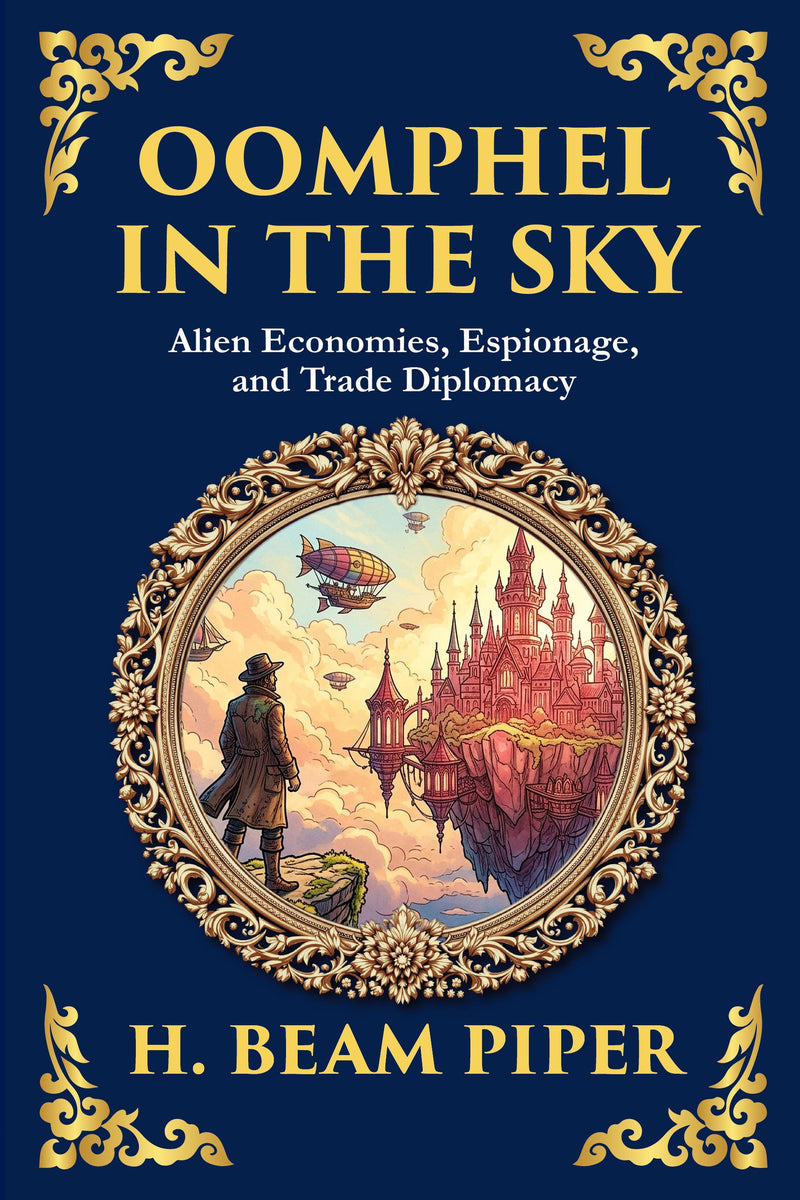
Oomphel in the Sky
On a distant alien world, where interstellar politics mix with tribal mysticism, human diplomats try to introduce trade, logic, and profit to a society bound by ritual and superstition.
or free app
10,000+ hrs library
30-day guarantee
The complete Oomphel in the Sky appears in modern English through Library of Alexandria Press, available online with audiobook narration included for members.
Have you ever wondered why interstellar diplomacy might depend more on psychology than firepower? In Oomphel in the Sky, H. Beam Piper takes readers to the planet of Kwannon—a world teeming with ritual, superstition, and a native species that rejects money, markets, and the very concept of trade. Enter the Terran Federation, eager to establish economic ties and extract rare resources—but faced with a cultural labyrinth no amount of negotiation can easily overcome.
The Federation dispatches a team of specialists—not soldiers or politicians, but traders, economists, and undercover agents. Their mission? To shift an entire civilization’s worldview without igniting a war.
But when covert agendas surface and rival factions collide, the line between commerce and conquest begins to blur.
What you’ll discover in this modern edition
- in this thought-provoking and genre-defining novel:
- A Unique Blend of Sci-Fi and Economics – Explore a rare science fiction narrative where trade policy, cultural understanding, and strategy take center stage.
| Formats | eBook (EPUB + PDF) · Audiobook · Paperback · Hardcover · Large Print |
| Language | English |
| Trim size (print) | 6 × 9 in |
| Binding | Paperback — perfect-bound · Hardcover — casewrap |
| Large Print edition | Same text in a larger, easy-read type — a larger font, not a larger trim |
| Print pricing | Every physical book at our true cost — at-cost, no profit (members) |
| Library | 873 restored titles, always growing |
| Length | 20,821 words · ~1 hr 23 min reading |
| Reading level | Grade 3 · an easy, flowing read (this modern-English edition) |
| Edition | Modern English translation · 2026 |
Member reviews for this edition are collected as readers finish it — be the first. Across the library: 12,000+ books shipped, every plan covered by a 365-day print guarantee.
About this edition
A faithful, unabridged modern-English edition by The Library of Alexandria — carefully rendered for today's reader and verified paragraph-by-paragraph against the public-domain source. Available as eBook, audiobook, paperback, hardcover, and large print.
- Complete & unabridgedVerified paragraph by paragraph against the source — never a scan, never abridged.
- Modern English, faithfulReadable today, with the author’s meaning kept intact. Readable — not simplified.
- Every format, one membershipRead in your browser or the free app, or listen to the full audiobook.
Included free with your membership
Cancel anytime, one click · 30-day money-back guarantee
Edition last updated July 2026
What’s inside
Oomphel in the Sky — complete and unabridged, included in full with membership, plus the full audiobook.
Begin reading Oomphel in the Sky
In clear modern English — the complete text is included with membership.
Introduction
There are certain writers whose work seems to grow more relevant with each passing decade, even as the technological furniture of their imagined worlds grows quaint. H. Beam Piper belongs firmly to this rare and valuable company. To open one of his stories is to encounter a mind that was less interested in the gadgets of the future than in the people who would have to live with them—the administrators, the merchants, the soldiers, the missionaries, and the bewildered natives caught in the gears of a galactic civilization too large for any single intelligence to comprehend. The novella you are about to read, presented here in a modern translation adapted for the contemporary reader, is one of the finest distillations of Piper’s particular genius: a tale that wears the costume of pulp adventure while concealing, beneath that costume, a remarkably sophisticated meditation on culture, faith, power, and the perils of misunderstanding.
The phrase “oomphel in the sky” comes from the invented vocabulary of an alien people, and it captures something essential about the story’s central concern. “Oomphel” is the word these beings use for the products of human technology—the manufactured marvels, the tools and trinkets and machines that humans bring with them from the stars. The word is at once reverent and uncomprehending, a label slapped onto a category of things whose inner workings are wholly mysterious to those who use them. And therein lies the engine of the entire narrative. What happens when one civilization possesses the means to produce wonders, and another civilization can only consume those wonders without understanding them? What happens when the gulf between maker and user becomes so vast that it begins to resemble the gulf between mortal and divine? These are the questions that animate the pages ahead, and they are questions that have, if anything, only grown sharper in the years since Piper first set them down.
Before we go further, a word about what this introduction will and will not do. It will not summarize the plot, reveal its turns, or spoil the satisfactions that the story has carefully arranged for you. Piper was a craftsman of suspense and revelation, and to give away his surprises would be to rob you of the very experience this book exists to provide. Instead, these pages aim to do something more useful: to set the stage, to sketch the man behind the work, to illuminate the ideas the story explores, and to suggest a few of the ways in which a thoughtful modern reader might approach a text written in and for a very different moment. Think of this not as a map that tells you where you are going, but as a guide to the country you are about to enter—its customs, its history, its peculiar light.
Henry Beam Piper was, by almost any measure, an unlikely candidate for literary immortality. Born in Pennsylvania in 1904, he spent much of his working life as a laborer and night watchman for the Pennsylvania Railroad, a job that left him long, quiet hours in which to read voraciously and, eventually, to write. He had little formal education beyond high school, yet he made himself into one of the most erudite figures in the science fiction of his era—a man deeply versed in history, in firearms, in linguistics, in anthropology, and in the long, recurring patterns of human conflict and human folly. He was an autodidact of the most impressive kind, the sort of self-taught scholar who reads not to pass examinations but to satisfy an unappeasable curiosity about how the world actually works.
This self-education shows on every page Piper wrote. Where many of his contemporaries in the science fiction magazines of the 1950s and early 1960s were content to imagine rockets and ray guns, Piper imagined societies. He understood—as relatively few of his peers did—that the most interesting question about the future was not “what machines will we have?” but “what kind of people will we be, and what kind of institutions will govern us?” His stories are populated by colonial bureaucracies, trading companies, religious orders, and the inevitable friction between them. He grasped, instinctively, that the meeting of two cultures is rarely a simple matter of conquest or commerce; it is a vast, messy, often tragic negotiation in which both sides bring their own assumptions, their own fears, and their own incommensurable ways of seeing the world.
Piper is best remembered today for two interconnected achievements. The first is his “Terro-Human Future History,” an elaborate and internally consistent chronicle of humanity’s expansion across the galaxy over the course of several millennia. This future history, into which the present story fits, is one of the great unsung accomplishments of mid-century science fiction—less famous than Asimov’s Foundation or Heinlein’s Future History, but in many ways more textured, more cynical, and more humane. Piper imagined a galaxy in which a great Terran Federation rises and eventually falls, in which planets are settled and exploited and sometimes forgotten, in which the same human dramas of greed, idealism, ambition, and compassion replay themselves against ever-changing backdrops. His second great achievement is the novel Little Fuzzy, a courtroom drama about the legal definition of personhood that remains startlingly fresh and morally urgent. Both works share the qualities that make the present novella so rewarding: a deep skepticism about easy answers, a profound interest in questions of culture and cognition, and an unfailing sympathy for the underdog—whether that underdog is a small furry alien or a confused human caught between competing loyalties.
The story before you unfolds on a colonized world, on a planet where humans have established a presence and where the native population has been drawn, willingly or not, into the orbit of a vastly more advanced civilization. This is one of Piper’s recurring settings, and it is one he handled with unusual sensitivity. He was writing, after all, during the high noon of decolonization, in the years when the European empires that had carved up Africa and Asia were collapsing or being dismantled, when the assumptions of colonial superiority that had governed the previous century were being challenged and overturned. Piper did not write political allegory in any crude sense, but he was acutely aware of the dynamics of empire, and his fiction is shot through with an understanding of how power flows between unequal partners, how good intentions can produce catastrophe, and how the seemingly benevolent gift of “civilization” can be experienced by its recipients as something closer to violence.
It is worth pausing on the circumstances of Piper’s death, not out of morbidity, but because they cast a poignant light on his work. In 1964, beset by financial difficulties and convinced that his writing career had failed, Piper took his own life. He did not know—could not have known—that his books would endure, that new generations of readers would discover his future history and find in it riches that his own era had insufficiently prized. He died believing himself a failure, and the tragedy of that belief is compounded by how utterly wrong it was. Today his works are studied, reprinted, and cherished; new authors have been authorized to expand upon his universe; and stories like the one in your hands continue to find appreciative audiences. There is a melancholy irony in the fact that a writer so attuned to the gap between perception and reality should have so badly misjudged his own significance. Reading him now, we read with the knowledge that he was right about so much and wrong about the one thing that mattered most to him.
Faith, Technology, and the Anatomy of Misunderstanding
At the heart of this novella lies one of the oldest and most resonant ideas in all of speculative fiction—an idea so durable that it has been formulated into something resembling a law. The science fiction writer Arthur C. Clarke famously declared that any sufficiently advanced technology is indistinguishable from magic. Piper’s story is, among other things, a profound and unsettling exploration of exactly this principle, but he pushes it further than the mere observation that ignorant people might mistake a flashlight for a miracle. He asks the harder questions: What does it do to a society to live surrounded by miracles it cannot understand? What happens to belief, to social order, to the very structure of a people’s worldview, when the divine appears to walk among them in the form of strangers from the sky?
The native people of Piper’s imagined world have a religion, a cosmology, a way of organizing their understanding of the universe. Into this carefully balanced system the humans have introduced their “oomphel”—their machines, their medicines, their inexplicable powers. For the natives, there is no clear line between the technological and the supernatural, because they lack the conceptual framework that would allow them to draw such a line. To them, a man who can summon light from a small box, who can speak across vast distances, who can heal the sick and predict the movements of the heavens, is not a more advanced version of themselves. He is something categorically different—something that must be fitted, somehow, into their existing understanding of gods and spirits and the order of creation. And when the humans, in their well-meaning way, attempt to manage this relationship, they find that they have stumbled into a situation of extraordinary delicacy, one in which a single misjudged word or gesture might trigger consequences they can neither predict nor control.
What makes Piper’s treatment of this theme so much richer than the standard pulp formula is his refusal to treat the natives as simpletons or the humans as gods. The native characters in his fiction are not stupid; they are working, often quite logically, from premises that differ radically from those of the humans. Their misunderstandings are not failures of intelligence but failures of translation—failures that run in both directions. The humans, for their part, are not omniscient overseers but harried, fallible administrators, struggling to maintain order, balance competing interests, and avoid the disasters that their own presence keeps threatening to provoke. The story’s protagonist—and I will say nothing of his particular adventures—is precisely the kind of figure Piper loved to write: a competent, intelligent, weary professional who understands the stakes far better than the bureaucrats above him, who tries to do the right thing in an impossible situation, and who must navigate a crisis whose roots lie in the collision of two utterly different ways of seeing the world.
This brings us to the theme of religion, which Piper handles with a subtlety that may surprise readers expecting either reverence or mockery. He was deeply interested in the social function of belief—in how religions arise, how they spread, how they respond to crisis, and how they can be manipulated or exploited. The story examines what happens when belief becomes unmoored from its traditional anchors, when prophecy and expectation begin to feed on themselves, when a population becomes susceptible to a kind of collective psychological contagion. These are phenomena that anthropologists and historians have documented many times over in our own world—the cargo cults of the Pacific, the millenarian movements that have swept through troubled societies throughout history, the strange and sometimes terrible things that happen when a people’s frame of reference is shattered by contact with a more powerful culture. Piper understood these phenomena, and he wove that understanding into a story that is, on its surface, a fast-moving adventure, but that operates, underneath, as a serious inquiry into the psychology of faith and the fragility of social order.
The economic dimension announced in this edition’s subtitle deserves attention as well. Piper was unusually interested in trade, commerce, and the material basis of civilization—subjects that most adventure writers ignored entirely. He understood that the meeting of cultures is always, in part, an economic event, that the things people want and the things they can produce shape the relationships between them as profoundly as any ideology or theology. The “oomphel” of the title is, after all, an economic category as much as a religious one. It represents goods, manufactured products, the output of an industrial civilization that the natives can use but not replicate. This dependency—the dependency of a consumer society upon producers it cannot match—is one of the central facts of the colonial relationship, in Piper’s imagined galaxy as in our own history. The diplomacy and espionage that thread through the narrative are, at bottom, struggles over the control and distribution of these material things, and over the immense power that flows to whoever controls them. Piper’s clear-eyed attention to these realities gives his story a hard, grounded quality that distinguishes it from more fanciful contemporaries. He never lets us forget that beneath the talk of gods and prophecy and the order of the heavens, there are warehouses, ledgers, and supply lines.
Cancel anytime, one click · 30-day money-back guarantee
Founding annual rate available now — your price locks for life when you join.
Not ready? Get this free chapter by email — read it anytime.
✓ Sent — check your inbox for Oomphel in the Sky.
Questions about Oomphel in the Sky
What is Oomphel in the Sky about?
On a distant alien world, where interstellar politics mix with tribal mysticism, human diplomats try to introduce trade, logic, and profit to a society bound by ritual and superstition. But in this strange culture, where goods are sacred and currency is taboo, success depends not just on strategy—but on deep understanding, daring espionage, and the manipulation of perception itself. H. Beam Piper’s Oomphel in the Sky is a brilliant fusion of science fiction and economic intrigue, where the balance between progress
Who wrote Oomphel in the Sky?
Oomphel in the Sky was written by H. Beam Piper. This edition presents the complete work in clear modern English, faithfully rendered from the public-domain original by Library of Alexandria Press.
Is Oomphel in the Sky free to read?
The opening chapter is free to read on this page. Members read and listen to the complete work — and the entire library — free, and can order any physical book at our true print cost.
How long is Oomphel in the Sky?
2 chapters (~20,821 words) — about 1 hr 23 min of reading in this modern-English edition.
Is this an abridged version of Oomphel in the Sky?
No. This is the complete, unabridged Oomphel in the Sky, carefully rendered into clear modern English and verified paragraph-by-paragraph against the public-domain source — nothing is cut or summarised.
What formats does Oomphel in the Sky come in?
Oomphel in the Sky is available as eBook, paperback, hardcover and large print. eBook and audiobook are included with membership; printed editions ship at our true print cost.
Shipping & returns
Billing & membership
More from the library


Explore Science Fiction
- The Island of Doctor Moreau · H. G. Wells
- A Midsummer Night’s Dream · William Shakespeare
- The Invisible Man: A Grotesque Romance · H. G. Wells
- The War of the Worlds · H. G. Wells
- The Strange Case of Dr. Jekyll and Mr. Hyde · Robert Louis Stevenson
- Limanora: the island of progress · Godfrey Sweven
- The Book of Dragons · E. Nesbit
- She · H. Rider Haggard
- Dorothy and the Wizard in Oz · L. Frank Baum
- The Princess and the Goblin · George MacDonald
- Gawayne and the Green Knight: A Fairy Tale · Charlton M. Lewis
- Lucian’s True History · Lucian of Samosata
- The Willows · Algernon Blackwood
- The Call of Cthulhu · H. P. Lovecraft
- The Life-Eater · Harold Ward
- The Marvelous Land of Oz · L. Frank Baum
- Mars is My Destination · Frank Belknap Long
- The Black Kiss
- The Beasts in the Void · Paul W. Fairman
- John Jones’s Dollar · Harry Stephen Keeler
- Subversive · Mack Reynolds
- The Mississippi Saucer · Frank Belknap Long
- Man of Distinction · Michael Shaara
- Spawn of the Comet · H. Thompson Rich
- The Golden Judge · Nathaniel Gordon
- Final Weapon · Everett B. Cole
- The Big Fix · George O. Smith
- Last Enemy · H. Beam Piper
- Time and Time Again · H. Beam Piper
- Sabotage in Space · Carey Rockwell
Oomphel in the Sky
Oomphel in the Sky
Alien Economies, Espionage, and Trade Diplomacy
H. Beam Piper
Contents
- Introduction
- Oomphel...
Introduction
There are certain writers whose work seems to grow more relevant with each passing decade, even as the technological furniture of their imagined worlds grows quaint. H. Beam Piper belongs firmly to this rare and valuable company. To open one of his stories is to encounter a mind that was less interested in the gadgets of the future than in the people who would have to live with them—the administrators, the merchants, the soldiers, the missionaries, and the bewildered natives caught in the gears of a galactic civilization too large for any single intelligence to comprehend. The novella you are about to read, presented here in a modern translation adapted for the contemporary reader, is one of the finest distillations of Piper’s particular genius: a tale that wears the costume of pulp adventure while concealing, beneath that costume, a remarkably sophisticated meditation on culture, faith, power, and the perils of misunderstanding.
The phrase “oomphel in the sky” comes from the invented vocabulary of an alien people, and it captures something essential about the story’s central concern. “Oomphel” is the word these beings use for the products of human technology—the manufactured marvels, the tools and trinkets and machines that humans bring with them from the stars. The word is at once reverent and uncomprehending, a label slapped onto a category of things whose inner workings are wholly mysterious to those who use them. And therein lies the engine of the entire narrative. What happens when one civilization possesses the means to produce wonders, and another civilization can only consume those wonders without understanding them? What happens when the gulf between maker and user becomes so vast that it begins to resemble the gulf between mortal and divine? These are the questions that animate the pages ahead, and they are questions that have, if anything, only grown sharper in the years since Piper first set them down.
Before we go further, a word about what this introduction will and will not do. It will not summarize the plot, reveal its turns, or spoil the satisfactions that the story has carefully arranged for you. Piper was a craftsman of suspense and revelation, and to give away his surprises would be to rob you of the very experience this book exists to provide. Instead, these pages aim to do something more useful: to set the stage, to sketch the man behind the work, to illuminate the ideas the story explores, and to suggest a few of the ways in which a thoughtful modern reader might approach a text written in and for a very different moment. Think of this not as a map that tells you where you are going, but as a guide to the country you are about to enter—its customs, its history, its peculiar light.
Henry Beam Piper was, by almost any measure, an unlikely candidate for literary immortality. Born in Pennsylvania in 1904, he spent much of his working life as a laborer and night watchman for the Pennsylvania Railroad, a job that left him long, quiet hours in which to read voraciously and, eventually, to write. He had little formal education beyond high school, yet he made himself into one of the most erudite figures in the science fiction of his era—a man deeply versed in history, in firearms, in linguistics, in anthropology, and in the long, recurring patterns of human conflict and human folly. He was an autodidact of the most impressive kind, the sort of self-taught scholar who reads not to pass examinations but to satisfy an unappeasable curiosity about how the world actually works.
This self-education shows on every page Piper wrote. Where many of his contemporaries in the science fiction magazines of the 1950s and early 1960s were content to imagine rockets and ray guns, Piper imagined societies. He understood—as relatively few of his peers did—that the most interesting question about the future was not “what machines will we have?” but “what kind of people will we be, and what kind of institutions will govern us?” His stories are populated by colonial bureaucracies, trading companies, religious orders, and the inevitable friction between them. He grasped, instinctively, that the meeting of two cultures is rarely a simple matter of conquest or commerce; it is a vast, messy, often tragic negotiation in which both sides bring their own assumptions, their own fears, and their own incommensurable ways of seeing the world.
Piper is best remembered today for two interconnected achievements. The first is his “Terro-Human Future History,” an elaborate and internally consistent chronicle of humanity’s expansion across the galaxy over the course of several millennia. This future history, into which the present story fits, is one of the great unsung accomplishments of mid-century science fiction—less famous than Asimov’s Foundation or Heinlein’s Future History, but in many ways more textured, more cynical, and more humane. Piper imagined a galaxy in which a great Terran Federation rises and eventually falls, in which planets are settled and exploited and sometimes forgotten, in which the same human dramas of greed, idealism, ambition, and compassion replay themselves against ever-changing backdrops. His second great achievement is the novel Little Fuzzy, a courtroom drama about the legal definition of personhood that remains startlingly fresh and morally urgent. Both works share the qualities that make the present novella so rewarding: a deep skepticism about easy answers, a profound interest in questions of culture and cognition, and an unfailing sympathy for the underdog—whether that underdog is a small furry alien or a confused human caught between competing loyalties.
The story before you unfolds on a colonized world, on a planet where humans have established a presence and where the native population has been drawn, willingly or not, into the orbit of a vastly more advanced civilization. This is one of Piper’s recurring settings, and it is one he handled with unusual sensitivity. He was writing, after all, during the high noon of decolonization, in the years when the European empires that had carved up Africa and Asia were collapsing or being dismantled, when the assumptions of colonial superiority that had governed the previous century were being challenged and overturned. Piper did not write political allegory in any crude sense, but he was acutely aware of the dynamics of empire, and his fiction is shot through with an understanding of how power flows between unequal partners, how good intentions can produce catastrophe, and how the seemingly benevolent gift of “civilization” can be experienced by its recipients as something closer to violence.
It is worth pausing on the circumstances of Piper’s death, not out of morbidity, but because they cast a poignant light on his work. In 1964, beset by financial difficulties and convinced that his writing career had failed, Piper took his own life. He did not know—could not have known—that his books would endure, that new generations of readers would discover his future history and find in it riches that his own era had insufficiently prized. He died believing himself a failure, and the tragedy of that belief is compounded by how utterly wrong it was. Today his works are studied, reprinted, and cherished; new authors have been authorized to expand upon his universe; and stories like the one in your hands continue to find appreciative audiences. There is a melancholy irony in the fact that a writer so attuned to the gap between perception and reality should have so badly misjudged his own significance. Reading him now, we read with the knowledge that he was right about so much and wrong about the one thing that mattered most to him.
Faith, Technology, and the Anatomy of Misunderstanding
At the heart of this novella lies one of the oldest and most resonant ideas in all of speculative fiction—an idea so durable that it has been formulated into something resembling a law. The science fiction writer Arthur C. Clarke famously declared that any sufficiently advanced technology is indistinguishable from magic. Piper’s story is, among other things, a profound and unsettling exploration of exactly this principle, but he pushes it further than the mere observation that ignorant people might mistake a flashlight for a miracle. He asks the harder questions: What does it do to a society to live surrounded by miracles it cannot understand? What happens to belief, to social order, to the very structure of a people’s worldview, when the divine appears to walk among them in the form of strangers from the sky?
The native people of Piper’s imagined world have a religion, a cosmology, a way of organizing their understanding of the universe. Into this carefully balanced system the humans have introduced their “oomphel”—their machines, their medicines, their inexplicable powers. For the natives, there is no clear line between the technological and the supernatural, because they lack the conceptual framework that would allow them to draw such a line. To them, a man who can summon light from a small box, who can speak across vast distances, who can heal the sick and predict the movements of the heavens, is not a more advanced version of themselves. He is something categorically different—something that must be fitted, somehow, into their existing understanding of gods and spirits and the order of creation. And when the humans, in their well-meaning way, attempt to manage this relationship, they find that they have stumbled into a situation of extraordinary delicacy, one in which a single misjudged word or gesture might trigger consequences they can neither predict nor control.
What makes Piper’s treatment of this theme so much richer than the standard pulp formula is his refusal to treat the natives as simpletons or the humans as gods. The native characters in his fiction are not stupid; they are working, often quite logically, from premises that differ radically from those of the humans. Their misunderstandings are not failures of intelligence but failures of translation—failures that run in both directions. The humans, for their part, are not omniscient overseers but harried, fallible administrators, struggling to maintain order, balance competing interests, and avoid the disasters that their own presence keeps threatening to provoke. The story’s protagonist—and I will say nothing of his particular adventures—is precisely the kind of figure Piper loved to write: a competent, intelligent, weary professional who understands the stakes far better than the bureaucrats above him, who tries to do the right thing in an impossible situation, and who must navigate a crisis whose roots lie in the collision of two utterly different ways of seeing the world.
This brings us to the theme of religion, which Piper handles with a subtlety that may surprise readers expecting either reverence or mockery. He was deeply interested in the social function of belief—in how religions arise, how they spread, how they respond to crisis, and how they can be manipulated or exploited. The story examines what happens when belief becomes unmoored from its traditional anchors, when prophecy and expectation begin to feed on themselves, when a population becomes susceptible to a kind of collective psychological contagion. These are phenomena that anthropologists and historians have documented many times over in our own world—the cargo cults of the Pacific, the millenarian movements that have swept through troubled societies throughout history, the strange and sometimes terrible things that happen when a people’s frame of reference is shattered by contact with a more powerful culture. Piper understood these phenomena, and he wove that understanding into a story that is, on its surface, a fast-moving adventure, but that operates, underneath, as a serious inquiry into the psychology of faith and the fragility of social order.
The economic dimension announced in this edition’s subtitle deserves attention as well. Piper was unusually interested in trade, commerce, and the material basis of civilization—subjects that most adventure writers ignored entirely. He understood that the meeting of cultures is always, in part, an economic event, that the things people want and the things they can produce shape the relationships between them as profoundly as any ideology or theology. The “oomphel” of the title is, after all, an economic category as much as a religious one. It represents goods, manufactured products, the output of an industrial civilization that the natives can use but not replicate. This dependency—the dependency of a consumer society upon producers it cannot match—is one of the central facts of the colonial relationship, in Piper’s imagined galaxy as in our own history. The diplomacy and espionage that thread through the narrative are, at bottom, struggles over the control and distribution of these material things, and over the immense power that flows to whoever controls them. Piper’s clear-eyed attention to these realities gives his story a hard, grounded quality that distinguishes it from more fanciful contemporaries. He never lets us forget that beneath the talk of gods and prophecy and the order of the heavens, there are warehouses, ledgers, and supply lines.
Because logic is based on starting assumptions, it can never change those assumptions. Since religious beliefs are just a set of assumptions, how can anyone use logic to fight a local superstition? Or use anything else for that matter?
Miles Gilbert watched the landscape glide beneath him. The rounded treetops looked like a patchwork quilt of red and orange under the double suns, while the shaded areas showed the natural yellow plants of Kwannon. The aircar began a slow turn to the left, bringing Gettler Alpha into view. It looked like a massive, glowing red smear, appearing about two feet wide if held at arm’s length, and slightly flattened where it touched the western horizon. In a couple of hours, it would set completely. By then, Beta—the planet’s main G-class star—would be at its hottest midafternoon peak. He checked his watch. It was 10:05, but that was Galactic Standard Time, which had nothing to do with the local sky. It did, however, mean he had just under two hours before the broadcast.
He switched on the communication screen in front of him. Harry Walsh, the news editor, appeared on the screen from his office in Bluelake, located halfway across the continent. He wanted a progress report.
“I’m almost done. I’m going to visit a few more native villages, and then I’ll head to Sanders’ plantation to see Gonzales. I hope to have a personal statement from him and the final progress map in time for the broadcast. I assume Maith is still okay with releasing the story at twelve hundred?”
“Definitely; he was always on board. The Army wants the publicity. The people at Government House wanted to suppress it, but they’ve given up on that now. The story is already everywhere here, including the native city.”
End of the free sample
Keep reading, free
Members read and listen to the complete book — and the entire library. Cancel anytime, one click · 30-day money-back guarantee.